Greener Journal of Agricultural Sciences
ISSN: 2276-7770; ICV: 6.15
Vol. 3 (9), pp. 663-668, September 2013
Copyright ©2017, the copyright of this article is retained by the author(s)
http://gjournals.org/GJAS

|
Greener Journal of Agricultural Sciences ISSN: 2276-7770; ICV: 6.15 Vol. 3 (9), pp. 663-668, September 2013 Copyright ©2017, the copyright of this article is retained by the author(s) http://gjournals.org/GJAS |
|
Research Article
Influence of Communal Area Grazing Management System on the Nutritive Value of Forages Selected by Cattle in a Semi-Arid Area of Zimbabwe
Hungwe Tinoziva1*, Mugabe Prisca2, Mutisi Charles2 and
Gandiwa Edson3
1Department of Livestock, Wildlife and Fisheries, Faculty of Agricultural Sciences, Great Zimbabwe University, P. O. Box 1235, Masvingo, Zimbabwe.
2Department of Animal Science, Faculty of Agriculture, University of Zimbabwe.
3Department of Wildlife and Safari Management, Chinhoyi University of Technology, Private Bag 7724, Chinhoyi, Zimbabwe.
|
ARTICLE INFO |
ABSTRACT |
|
|
Article No.: 061713678 DOI: 10.15580/GJAS.2013.9.061713678 |
A study was conducted to determine the effect of grazing management system on the nutritive value of forages selected by cattle. Animals were observed while grazing and the grazed samples were collected. The samples were analysed for chemical composition and digestibility. There were significant (P<0.05) interactions between grazing system and month of sampling on acid detergent fibre (ADF) and crude protein (CP) contents of the forages. Month of sampling had a significant (P<0.05) effect on all the parameters analysed. Samples collected under the traditional grazing system had significantly (p<0.05) higher levels of in vitro dry matter digestibility (IVDMD) and less ADF and NDF content compared to those forages from the grazing scheme. The CP content of the forages selected was not affected by grazing system (P>0.05). These findings suggest that grazing schemes tended to compromise the quality of forages selected under poor range conditions, possibly due to limited range resources. The ability of cattle under traditional grazing system to switch effectively among the different range resources might have enhanced the quality of forages selected.
|
|
|
Submitted: 17/06/2013 Accepted: 22/09/2013 Published: 29/09/2013 |
||
|
*Corresponding Author Hungwe Tinoziva E-mail: hungwetinoziva @gmail.com
|
||
|
Keywords: Forage nutritive value, communal grazing management, grazing scheme, traditional grazing system
|
||
|
|
|
INTRODUCTION
Communal area livestock production systems are inherently inefficient (Ainslie et al., 2002; Baptist, 1990) and productivity is low due to poor management of both stock and rangelands (Cousins, 1987; 1988). One way of improving cattle production in communal areas is to improve grazing management. Feed resource availability is a major determinant of cattle productivity in communal rangelands (Angassa and Oba, 2007; Fynn and O’Connor, 2000).
In most communal areas of Zimbabwe, traditional grazing management is practiced mainly through herding cattle during the rainy season. In some areas, grazing schemes have been promoted as an attempt to improve livestock production in communal areas. A combination of measures aimed at controlling livestock numbers, restricting access to communal rangelands and controlling movement of animals by means of fences is known as a ‘grazing scheme’ (Cousins, 1996). Grazing schemes involve fencing of the grazing area and internally dividing the area into paddocks so that rotational grazing can be implemented as veld management practice. The system of rotation recommended in grazing schemes is short duration grazing. Short duration grazing is a multi-paddock, one herd grazing system involving rapid rotation of the livestock (Gillen et al., 1991). If properly implemented, short duration grazing results in reduced percentages of un-grazed plants and improved livestock distribution in the grazing area (Savory, 1978). Generally, rotational grazing management systems curtail rangeland degradation and improve range condition (Vetter and Goqwana, 2000).
The implementation of grazing schemes was supported by various stakeholders such as the European Economic Community (EEC) and the Germany Agency for Technical Development (GTZ) (Cousins, 1996). Most of the work on grazing schemes in Zimbabwe has been on their socio-economic impact (Cousins, 1987; 1988; 1996; Scoones, 1990; 1995). The adoption of grazing schemes had been poor due to farmers’ view that the grazing schemes were a tool to impose de-stocking (Scoones, 1990). The impact of grazing schemes on the nutritive value of forages selected by cattle is largely unknown.
The objective of this study was to evaluate the influence of grazing management system on the nutritive value of forages selected by cattle.
MATERIALS AND METHODS
Study Site
The study was carried in Gutu district of Masvingo Province, Zimbabwe. Two areas, Vuzhe and Segande with contrasting rainfall patterns were selected for the study. This was done to prevent fluctuations in forage quality and quantity due to precipitation variations (Boone and Wang, 2007). Each area had a functional grazing scheme and an adjoining area where traditional grazing management was practiced.
Vuzhe falls under natural region III which receives moderate rainfall (650-800mm per annum), which comes in infrequent heavy falls accompanied by high temperatures. The area is suited about 40km south of Gutu centre and the soils are mostly shallow sandy loam. The grazing scheme consists of eleven paddocks covering about 500 hectares.
Segande is located in region IV and lies 15km east of Gutu centre. The region receives low rainfall (450-650mm per annum), with severe mid-season dry spells during the rainy season. The grazing scheme is divided into four paddocks, which together cover about 160 hectares. Two seasonal streams, Nyananga and Mazare, mark the eastern and western boundaries of the area.
In both areas, grazing scheme committees are entrusted to determine the rotation of animals through specific paddocks and the grazing duration in each paddock. The grazing period depended on the size of the paddock and the condition of vegetation.
Under the traditional grazing system, in both areas, the grazing areas consisted of any open spaces where cattle are herded during the day in the rainy season. These spaces included fallow fields and ridges bordering crop fields. Each individual farmer decided independently where the cattle would be grazing on a daily basis.
Data Collection
Four steers, from volunteer farmers willing to participate in the study, were selected to be observed for their forage selection. The four steers, in each grazing management system, were observed by trained observers while grazing and the grazed samples were collected. Direct observation of animals was used for its minimal time and equipment requirements (Holechek et al., 1982). Samples were collected manually each month from December to May. Within each month, sampling was done over two days, with collection dates selected at random. The observers rotated among the four animals after every 30 minutes. Samples were cut at least 10cm from the ground, depending on the height of the grass species being grazed. The composite samples were thoroughly mixed and sun-dried before being oven-dried at 50oC for 24 hours. The samples were then ground to pass through a 1mm screen.
Chemical analyses were done for crude protein (AOAC, 2003) and acid detergent fibre (Van Soest and Wine, 1967). Dry matter digestibility of the forages was determined by the two-stage in vitro technique (Tilley and Terry, 1963).
Data Analysis
The experimental design was a Completely Randomised Block Design with a 2*6 factorial arrangement. The factors were grazing management system and month of sampling. Data was blocked by area (Vuzhe and Segande). Analysis of variance for each chemical constituent was done using the General Linear Models procedure (SAS, 2003). Data was analysed for the effect of grazing management system, month of sampling and the interaction of grazing system and month of sampling. When F-tests were significant, Least Squares procedures were used for mean separation.
RESULTS
Table 1 summarises the effect of area, grazing management system, month of sampling and grazing system by month interaction on the nutritional parameters analysed. CP, ADF and IVDMD of the forages were significantly (P<0.05) affected by month of sampling. There were significant (P<0.05) month by grazing system interactions on CP, ADF and IVDMD.
The CP content of the forages collected under the two grazing management systems in Vuzhe and Segande are shown in Table 2. In both areas, CP levels were not significantly (P>0.05) different at the start of the grazing season (December). From January onwards , CP content was higher for forages from the traditional grazing system than those from traditional managed areas. In both areas, CP levels declined through the grazing season.
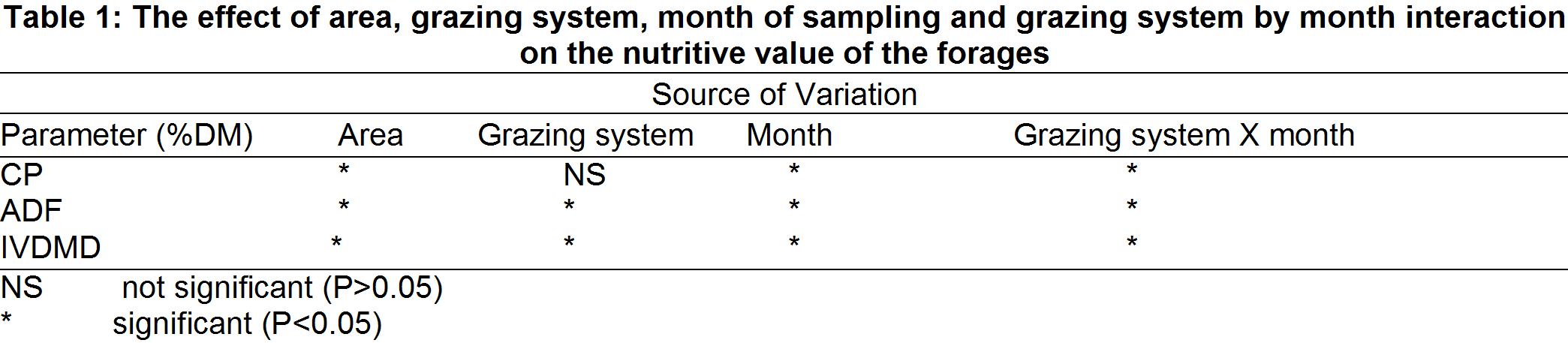
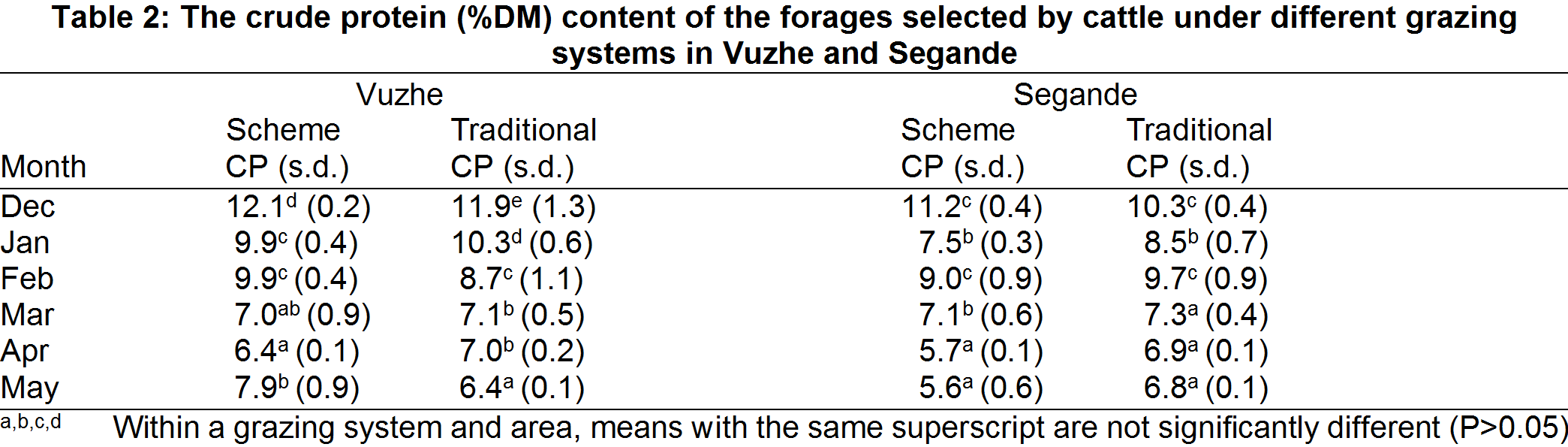
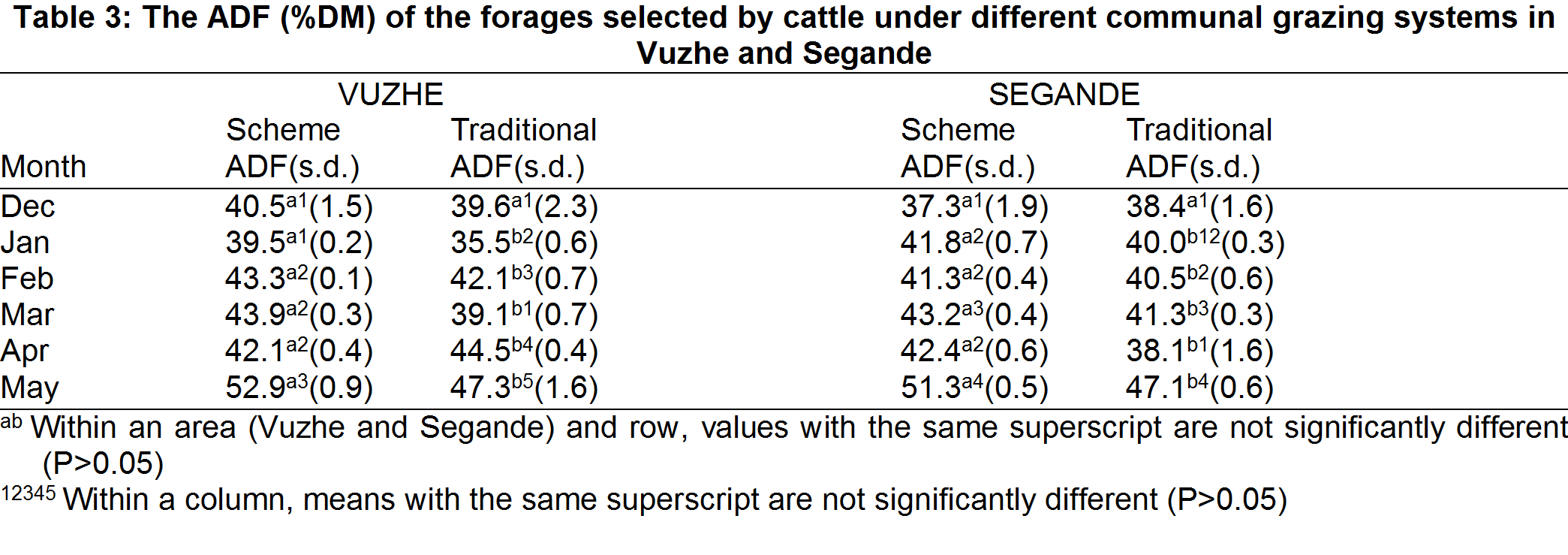
Table 3 shows the ADF content of the forages from the two grazing management systems. In Vuzhe, differences were not significant (P>0.05) in December for the two grazing systems. From February onwards, forages from the grazing scheme had higher (P<0.05) ADF levels than those collected under the traditional grazing management system. The same trend was also evident for the forages collected in Segande.
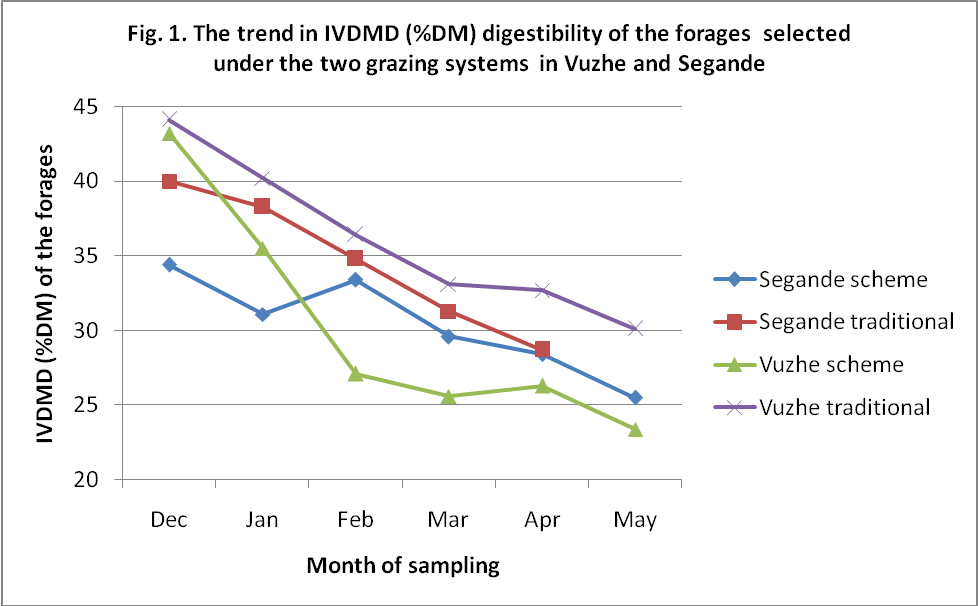
The digestibility of the forages selected by cattle under the two grazing management system in Vuzhe and Segande is shown in Figure 1. The grazing system practised and month of sample collection significantly (P<0.05) affected IVDMD. In Segande, the digestibility of forages was higher in traditionally grazed areas between December and February. Thereafter, the differences in digestibility between two management systems were not significant (P>0.05).
In Vuzhe, the digestibility values were not different (P<0.05) in December. From January until the end of the grazing season, forages selected under the traditional grazing system had higher (P<0.05) digestibility values than those from grazing scheme. Under both systems, forage digestibility declined with season.
DISCUSSION
The effect of area on all the nutritional parameters measured was expected since Vuzhe and Segande were located in different agro-ecological regions, which differ in rainfall, temperature and soil types. In semi-arid areas, forage quality and quantity change with rainfall patterns (Ash and Stafford Smith, 1996). Temperature increases the maturation process in forages (Wilson, 1982) and this lowers the digestibility of the forages (Dirven and Deinum, 1977).
Grazing management system did not affect the CP content of the forages. McIvor (1990) also reported similar findings between rotational and continuous grazing systems. However, earlier reports by Heitschmidt et al. (1987) indicated that continuously grazed forages had low CP levels. In Vuzhe, the animals were rotated among the paddocks according to vegetation condition based on visual appraisal by grazing scheme committee members. A pre-determined number of days in each paddock was used to determine the grazing duration.
Significant grazing system by month interactions could be explained by the heterogeneous grass species within the grazing areas. The decline in CP as the grazing period progressed towards cool-dry season confirms earlier reports by Yates et al. (1982), Devendra and Sevilla (2002) and Lesoli (2008). The decline in CP was attributed to the reduction in forage availability which limited selection by grazing animals. The maturation of the forages could also cause the decline in protein content.
The ADF levels tended to be higher in the grazing schemes than in areas where traditional grazing management was practiced. The ADF values obtained were higher than those (40% to 57.1%) reported by Hafley (1996), who also found higher figures for rotational grazing than continuous grazing. Low levels of forages under the traditional grazing system contradicted reports by Bertelsen et al. (1993), who reported higher levels for forages under continuous grazing. In the current study, though continuous grazing was practiced under the traditional system, individual farmers decided independently where to graze their animals. This might have enhanced the quality of forages available to the animals. The increase in ADF content with grazing season could be due to increases in cell wall thickening of the forages. As temperature and rainfall drop, feed availability declines (Tainton, 1999). The ability of animals to select high quality forage could have been lowered by feed scarcity.
The digestibility of the forages was not significantly different for both systems in December, in Vuzhe. This was expected since the animals were coming from the dry season when they would be foraging everywhere. As the season progressed, animals under traditional management had access to forage of high digestibility. Hafley (1996) also reported high digestibility for forages under continuous grazing paddocks. Rapid deterioration of the digestibility of forages from the grazing scheme might be an indicator of limited grazing resources. Scoones (1990) reported death of animals in pilot grazing schemes due to the omission of ‘key grazing resources’, such as vleis. Hendricks et al. (2005) and Bennett et al. (2007) also highlighted the importance of the ability to switch preference among different habitats.
In Segande, forages from the traditionally grazed area had higher digestibility values at the beginning of the grazing season (December) than those from the grazing scheme. Management of grazing areas is a complex process as other policies give rights to all citizens to use the common resource (Campbell and Shackleton, 2002). Individual farmer preferences on such issues as location of the paddock came into play when deciding the paddock to be grazed. This was more pronounced in Vuzhe where the grazing scheme was viewed as too large. The monitoring of eleven paddocks in Vuzhe might have compromised the quality of the forages available to the animals. In Segande, the grazing scheme consisted of four paddocks and the rotation of the animals was efficient.
CONCLUSIONS
Animals under the traditional grazing management system had access to forage of higher quality than those under grazing schemes. Restricting the movement of animals and controlling access to grazing areas alone did not bring about improvement in the nutritive value in the grazing schemes. Despite limited forage feed resources, cattle under the traditional grazing management system had an opportunity to get forages of high quality from several grazing resources available. There should be strict control of rotation of the paddocks and timely repair of broken fences in the grazing schemes if grazing and resting periods are to be effective.
ACKNOWLEDGEMENTS
We are grateful for the assistance obtained from the AGRITEX (Gutu district), especially Mr Trimboi and Mrs Matsikidze, both Extension Officers. Farmers from Gutu communal area, especially those from Vuzhe and Segande, are appreciated for their support and animals used in the study. This research was funded by the DANIDA/RVAU and the University of Zimbabwe Research Board Fund.
REFERENCES
AOAC. (2003). Association of Official Analytical Chemists. Official methods of analysis (14th Edition). 2200 Wilson Boulevard Arlington, Virginia 22201, USA.
Ainslie, A., Kepe, T., Ntsebeza, L., Ntshona, Z. and Turner, S. (2002). Cattle Ownership and Production in the Communal Areas of the Eastern Cape, University of the Western Cape, Research report number 10.
Angassa, A. and Oba, G. (2007). Relating long term rainfall variability to cattle dynamics in communal rangelands and a government ranch in Southern Ethiopia. Agricultural Systems 94: 715-725
Ash, A.J. and Stafford Smith, D.M. (1996). Evaluating stocking rate impacts Rangelands: Animals don’t practice what we preach. Rangeland Journal 18(2): 216-243.
Baptist, R. (1990). Simulated livestock dynamics: effects of pastoral off-take practices and drift on cattle wealth. Tropical Animal Health and Production 22: 67-76
Bennett, J., Lent, P.C. and Harris, P.J.C. (2007). Dry season foraging preferences of cattle and sheep in a communal area of South Africa. African Journal of Range and Forage Science 24(3): 109-121
Bertelson, B.S., Faulkner, D.B., Burskirk, D.D. and Castree, J.W. (1993). Beef cattle performance and forage characteristics of continuous, 6-paddock and 11-paddock grazing system. Journal of Animal Science 71: 1381-1389.
Boone, R.B. and Wang, C. (2007). Cattle dynamics in African grazing systems under variable climates. Journal of Arid Environments 70(3): 495-513
Campbell, B. and Shackleton, S. (2002). Organizing for community-based natural resources management. The Zimbabwe Science News 36: 5-12
Cousins, B. (1987). A survey of the current grazing schemes in communal lands of Zimbabwe. Centre for Applied Social Sciences, Harare, Zimbabwe.
Cousins, B. (1988). Evaluation of pilot grazing schemes. Harare, EEC and Agritex.
Cousins, B. (1989). Communities, class and grazing management in Zimbabwe’s communal lands. In: Cousins, B. (ed). People, Land and Livestock. Proceedings of a workshop on the socio-economic dimensions of livestock production in communal lands of Zimbabwe. Harare, GTZ and CASS, University of Zimbabwe. Pp 311- 371
Cousins, B. (1996). Collective decision making in communal area grazing schemes. PhD. Thesis, University of Zimbabwe. Pp591
Devendra, C. and Sevilla, C.C. (2002). Availability and use of feed resources in crop-animal systems in Asia. Agricultural Systems 71(1-2): 59-73
Dirven, J.C.P. and Deinum, B. (1977). The effect of temperature on the digestibility of grasses. An analysis. Forage research 3: 1-17.
Fynn, R.W.S. and O’Conner, T.G. (2000). Effect of stocking rate and rangeland dynamics and cattle performance in a semi-arid savanna, South Africa. Journal of Applied Ecology 37:491-507
Gillen, R.L., McCollum, T.F., Hodges, M.E., Brummer, J.E.and Tate, K.W. (1991). Plant responses to short duration grazing in tall-grass prairie. Journal of Range Management 44(2): 124-128.
Hafley, J.L. (1996). Comparison of Marshall and Surrey ryegrass for continuous and rotational grazing. Journal of Animal Science 74: 2269- 2275.
Heitschmidt, R.K., Dowhower, S.L. and Walker, J.W. (1987). Some effects of rotational grazing treatment on quantity and quality of available forage and amount of ground litter. Journal of Range Management 40): 318.
Hendricks, H.H., Clark, B., Bond, W.J., Midgley, J.J. and Novellie, P.A. (2005). Movement response patterns of livestock to rainfall variability in the Richterveld National Park. African Journal of Range and Forage Science 22:117-125
Holechek, J.L., Vavra, M. and Pieper, R.D. (1982). Botanical composition determination of range herbivore diets: A review. Journal of Range Management 35(3): 309-314.
Lesoli, M.S. (2008). Vegetation and Soil status and Human Perceptions on the condition of Communal Rangelands of the Eastern Cape, South Africa. M.Sc. thesis, University of Fort Hare, South Africa
Manley, W.A., Hart, R.H., Samuel, M.J., Smith, M.A., Waggoner, J.W. and Manley, J.T. (1997). Vegetation, cattle and economic responses to grazing strategies and pressures. Journal of Range Management 50: 638-646
McIvor, J.G. (1990). Seasonal changes in dry matter distribution and herbage quality of Urochloa species in north eastern Queensland. Australian Journal of Experimental Agriculture 30(4): 523. SAS. (2003). User Guide, Version 9. Statistical Analysis Systems Institute Inc, Cary, North Carolina, USA.
Savory, A. (1978). A holistic approach to range management using short duration grazing. In: D.N. Hyder (ed.). Proceedings of the 1st International Rangeland congress. Society for Range Management. Denver, Colorado. Pp555- 557.
Scoones, I.C. (1990). Livestock foraging: Exploiting a patchy environment. PhD Thesis. University of London.
Scoones, I.C. (1995). Exploiting heterogeneity: habitat use by cattle in dryland Zimbabwe. Journal of Arid Environments 29(2): 221-237.
Tainton, N.M. (1999). Veld management in South Africa. University of Natal Press, Pietermaritzburg
Tilley, J.M.A. and Terry, R.A. (1963). A two-stage technique for the in vitro digestion of forage crops. Journal of the British Grasslands Society 18: 104-111.
Van Soest, P.J. and Wine, R.H. (1967). Use of detergents in analysis of fibrous feeds. 4. Determination of plant cell wall constituents. Journal of the Association of Official Agricultural Chemists 50:50.
Vetter, S.and Goqwana, W.M. (2000). Grazing management and sustainability in a land reform pilot project: A case study of Gallawater A farm, Eastern Cape Province. In: Vetter, S and Goqwana, W.M., Bobo, J. and Marsh, A (eds). Land reform, sustainable rural livelihoods and gender relations, a case study of Gallawater A farm. Volume 2. Research report No. 5. Programme for land and Agrarian Studies, University of the Western Cape, Cape Town, South Africa. pp1-34
Wilson, J.R. (1982). Environmental and nutritional factors affecting herbage quality. In: J.B. Hacker (Ed.). Nutritional limits to animal production from pastures. Proceedings of an International Symposium held at St. Lucia, Queensland, Australia. August 24-28: pp 111-131.
Yates, D.A., Clanton, D.C.and Nichols, J.T. (1982). Effect of continuous grazing on the diet of steers. Journal of Range Management 35(3): 339-341.
|
Cite this Article: Tinoziva H, Prisca M, Charles M and Edson G (2013). Influence of Communal Area Grazing Management System on the Nutritive Value of Forages Selected by Cattle in a Semi-Arid Area of Zimbabwe. Greener Journal of Agricultural Sciences, 3(9): 663-668, http://doi.org/10.15580/GJAS.2013.9.061713678. |