|
Greener Journal of Agricultural Sciences ISSN: 2276-7770; ICV: 6.15 Vol. 6 (10), pp. 316-319, November 2016 Copyright ©2017, the copyright of this article is retained by the author(s) http://gjournals.org/GJAS |
|
Research Article (DOI: http://doi.org/10.15580/GJAS.2016.10.102616173)
The Performance of Japanese Quail (Coturnix coturnix) Birds on Graded Levels of Sweet Potato (Ipomoea batatas)
*Anthonia Ijeoma Ukanwoko and
Monica Ogochukwu Ironkwe
Department of Animal Science, University of Port Harcourt. P. M. B. 5323 Choba, Port Harcourt, Rivers State, Nigeria.
|
ARTICLE INFO |
ABSTRACT |
|
|
Article No.: 102616173 DOI: 10.15580/GJAS.2016.10.102616173 |
An experiment was conducted to determine the performance of Japanese quail on graded levels of sweet potato (0%, 11%, 22% and 33%) in treatment 1 (T1), treatment 2 (T2), treatment 3 (T3) and treatment 4 (T4), respectively. Ninety six quail birds were allotted to the four treatments (T1, T2, T3 and T4) in a Completely Randomized Design. The experiment lasted 8 weeks. Results showed that feed intake and egg weight were significantly (P<0.05) affected by the treatments. Feed intake was highest in T3 (39.42 +1.24g), followed by T2 (36.36+1.24g) and T1 (35.88+1.24g) and the least was in T4 (32.14+1.24g). Egg weight was highest and same in T4 (12.58+0.693g), T2 (12.54+ 0.693g) and T1 (11.83+ 0.693g) with the least in T3 (9.46+0.693g). There was depression in egg production in T3, therefore T2 is recommended for farmers.
|
|
|
Submitted: 26/10/2016 Accepted: 31/10/2016 Published: 18/11/2016 |
||
|
*Corresponding Author Anthonia Ijeoma Ukanwoko E-mail: ndutonia @yahoo .com
|
||
|
Keywords: Crude protein requirement, egg production, egg weight, feed intake, sweet potato meal
|
||
|
|
|
INTRODUCTION
Poultry production has been on the decline due to constraints like high cost of feed and drugs, low quality day old chicks, disease etc (Musa et al., 2008). This has resulted to low animal protein intake in developing countries like Nigeria. To bridge this gap, animal nutritionists are on the search for cheaper non – conventional feedstuff for the production of poultry, quail inclusive. Quails are cheap sources of animal protein (Babangida and Ubosi, 2006) and they are early maturers (Tuleun et al., 2013). The crude protein requirement of Japanese quail for egg production has been reported to be 20% (Edache et al., 2012 and Akpan et al., 2008) with a range of 16 – 30% (Attia et al., 2012 and Shayan et al., 2013).
Sweet potato (Ipomoea batatas) has been reported to support the growth of Japanese quail (Edache et al., 2009). Sweet potato meal can be included up to 25% in the diets of laying hens without adverse effect (Okereke et al., 2009).
This study was therefore aimed at evaluating the effects of graded levels of sweet potato meal on the performance of Japanese quail birds.
MATERIALS AND METHODS
Location of Study
This experiment was carried out in the University of Port Harcourt Research and Demonstration Farm, Choba, Obio/Akpor Local Government Area of Rivers State in the South-South zone of Nigeria. It falls within the humid rain forest zone of West Africa with long duration of rainfall (March - November) and a very short dry season precipitation occurs during September with an average of 367 mm of rain in 182 rain days with a temperature range of 25 - 280C and a very high relative humidity (above 80% rainfall (March-November) and a very short dry season precipitation occurs during September with an average of 367 mm of rain in 182 rain days with a temperature range of 25 - 280C and a very high relative humidity (above 80%).
Experimental diet
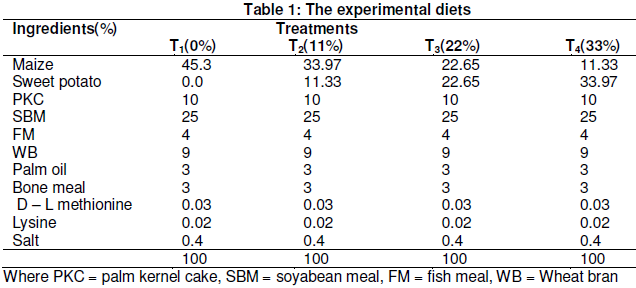
Sweet potato tubers were purchased from markets in Choba, sorted, peeled, chopped into slices and sundried for 7days. They were then milled and bagged for feed formulation. Other ingredients are bought from the market and in the feed formulation as shown in Table 1.
Experimental birds and their management
Ninety six female Japanese quail birds were randomly allotted to 4 dietary treatments. There were 8 birds per replicate, 3 replicates per treatment which is 24 birds per treatment in a Completely Randomized Design. The dried sweet potato meal was included at 0%, 11%, 22% and 33% in T1, T2, T3 and T4 respectively. The treatment diets were formulated to meet the 20% crude protein requirement of the laying quail birds.
Data collection
Daily feed allowance was weighed before giving to the birds and left over feed collected and weighed. The feed consumed by the birds for the day was obtained by difference between the weight of feed served and the weight of the left – over. Daily feed consumption per bird was obtained by dividing the total feed consumed by the total number of birds on each replicate. Birds were weighed in group per replicate at the beginning of the experiment and subsequently weighed at weekly interval. The average weight was obtained by dividing the total weights of the birds by the number of birds weighed per replicate.
Analytical procedure
The experiment was a Completely Randomized Design experiment. Data were analyzed using analysis of variance (ANOVA) (Steel and Torrie, 1980). Where ANOVA detected significant treatment effects, means were separated using Duncan’s multiple range test (Duncan, 1955).
RESULTS AND DISCUSSION
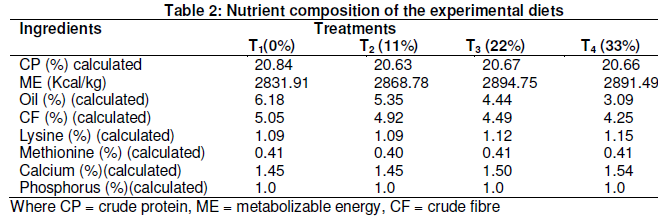
The nutrient composition of the experimental diets is summarized in Table 2.
The crude protein of the experimental diets fall within the range of 20.63 – 20.84%. This crude protein agrees with the 16 – 30% crude protein requirement of Japanese quail for egg production reported by Attia et al. (2012) and Shayan et al. (2013).
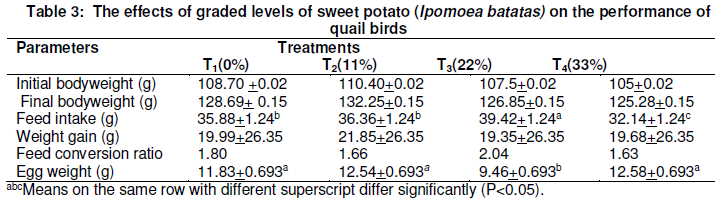
The performance of quail birds on graded level of sweet potato is shown in Table 3. Feed intake and egg weight were significantly (P<0.05) affected by the treatment diets. Feed intake tended to increase as the level of inclusion of sweet potato increases in the treatment diets and started declining after treatment 3. The highest feed intake was in T3 (39.42g), followed by T2 (36.36g) and T1 (35.88g) and the least in T4 (32.14g). The observed differences in feed intake are similar to those reported by Olubamiwa et al. (1999), Edache et al. (2005) and Edache et al. (2009). This positive attribute in feed intake recorded by the birds on 33% sweet potato inclusion could be ascribed to the high digestibility, palatability and solubility of sweet potato (Tewe et al., 2001). Egg weight was highest in T4 (12.583 + 0.693g) but same with T2 (12.542 + 0.693g) and T1 (11.833 + 0.693g) but declined in T3 (9.458 + 0.693g). This result agrees with the result of Akpan et al. (2008) for laying hens. They reported that more than 15% sweet potato depressed egg production. The result of this study showed that after 11% sweet potato inclusion, at 22% sweet potato inclusion, egg production of laying Japanese quail depressed.
CONCLUSION AND RECOMMENDATION
Sweet potato is available in several local and commercial markets. The escalating cost of poultry feed could be effectively alleviated by the use of cheaper and available ingredients like sweet potato. From the result of this study, it can be recommended that the best inclusion level of sweet potato is 11%. This will help farmers to produce at a lesser cost with increased profit margin.
REFERENCES
Akpan MO Alaku SO and Atseomajumi ED (2008). Effects of varying levels of crude protein on short term egg production of Japanese quail (Coturnix coturnix japonica) in a humid tropical environment. Proceeding of 13th Annual Conference Animal Science Association of Nigeria. September 15 – 19. Pp: 410 – 412.
Attia AI Mahrose KM Ismail IE and Abou – Kasem DE (2012). Response of growing Japanese quail raised under two stocking densities to dietary protein and energy levels. Egypt J. Anim. Prod., 47: 159 – 166.
Babangida S and Ubosi CO (2006). Effects of varying dietary protein levels on the performance of laying Japanese quail (Coturnix coturnix japonica) in a semi arid environment. Nig. J. Anim. Prod. 33: 45 – 52.
Duncan DB (1955). Multiple Ranges and Multiple F – Test. Biometry. 9: 1 – 42
F. A. O. (2005). Food and Agriculture Organization. Annual report 2005.
Edache JA Njike MC and Ehiobu NG (2003). Performance of laying Japanese quails (Coturnix coturnix japonica) fed different levels of protein under the Nigerian environment. J. Agric. Sci. Technol. 13: 93 – 99.
Edache JA Musa U Ehizokale MUM Esilonu JO Okpala EJ Kasin PD Yisa A and Zwandor NJ (2009). Replacement value of sweet potato (Ipomoea batatas) meal for maize in practical diets fed to quail (Coturnix coturnix japonica) chicks. Nig. J. Anim. Prod. 36 (11): 34 – 40.
Edache JA Yisa AG and Okpala EJ (2012). Effect of replacing maize with yam peel meal on short term laying performance of Japanese quail (Coturnix coturnix japonica). Pakistan Journal of Nutrition 11(7): 516 – 519.
Musa U Haruna ES and Lombin LH (2008). Quail production in the tropics. First Edition. National Veterinary Research Institute, Vom, NVRI Press Vom.
Olubamiwa OM Haruna ES Musa U Akinwale TO Lombin LH and Longe OG (1999). Effect of different levels of cocoa husk based diets on production performance of Japanese Quail. Nig. J. Anim. Prod., 26: 88 – 92.
Shayan BS Eila N and Norozian H (2013). The effect of decreased crude protein diets on performance, immune response and carcass traits of Japanese quail chickens. Ann. Biol. Res., 4: 313 – 317.
Steel RGD and Torrie JH (1980). Principles and Procedure of Statistics. 2nd Ed. McGraw Hill Book Co. Inc. New York.
Tewe OO Abu OA Ojeiyi EF and Nwokocha NH (2001). Status of sweet potato production, utilization, marketing of Nigeria. Proceedings of the 7th Triennial Symposium of the International Society for the tropical root crop Africa Branch (ISTRC – AB). Pp 65 – 74.
Tuleun CD Adenkola AY and Yenle FG (2013). Performance and erythrocyte osmotic membrane stability of laying Japanese quails (Coturnix coturnix japonica) fed varying dietary protein levels in a hot – humid tropics. Agriculture and Biology Journal of North America. 4(1): 6 – 13.
|
Cite this Article: Ukanwoko AI and Ironkwe MO (2016). The Performance of Japanese Quail (Coturnix coturnix) Birds on Graded Levels of Sweet Potato (Ipomoea batatas). Greener Journal of Agricultural Sciences, 6(10): 316-319, http://doi.org/10.15580/GJAS.2016.10.102616173. |