|
Greener Journal of Agricultural Sciences ISSN: 2276-7770; ICV: 6.15 Vol. 7 (10), pp. 271-274, December 2017 Copyright ©2017, the copyright of this article is retained by the author(s) http://gjournals.org/GJAS |
|
Research Article (DOI: http://doi.org/10.15580/GJAS.2017.10.120517175)
Soil Texture effect on Growth of Cowpea Plants under Root-knot Nematode, Meloidogyne incognita Infested Conditions
Ayodele A. Adegbite
Institute of Agricultural Research and Training, Obafemi Awolowo University, P.M.B. 5029, Moor Plantation, Ibadan, Nigeria.
|
ARTICLE INFO |
ABSTRACT |
|
|
Article No.: 120517175 DOI: 10.15580/GJAS.2017.10.120517175 |
Root-knot nematode (M. incognita) constitutes one of the important nematode pests on cowpea (Vigna unguiculata). The edaphic factors of soil such as soil texture play vital role in determining the severity of diseases caused by plant-parasitic nematodes. Screen house studies were conducted in 2013 and 2014 using 15cm size plastic pots (one kg capacity) having soils of five different textures (clay, clay loam, sandy loam, loamy sand and sand) on root-knot nematode (M. incognita) at one J2/g soil in cowpea (c.v. Ife brown) was undertaken. Under each soil type, nematode inoculated and non-inoculated checks were kept. The observations recorded 60 days after nematode inoculation revealed that maximum and significantly higher shoot length, fresh and dry root and shoot weight, number of leaves and buds/plant were in sandy loam soil while these growth parameters were minimum and significantly lower in clay loam soil irrespective of nematization. The reproduction factor of M. incognita based upon galling, fecundity and final soil populations was maximum (30.6) in sandy soil followed by loamy soil (25.8) while it was minimum (3.5) in clay soil making it least favourable for the nematode. With this result it shows that Sandy soil is highly favourable to M. incognita reproduction which is followed by loamy soil and the least favourable was clay soil to the nematode reproduction.
|
|
|
Submitted: 05/12/2017 Accepted: 06/12/2017 Published: 08/12/2017 |
||
|
*Corresponding Author Ayodele A. Adegbite E-mail: ayodeleadegbite@ ymail. Com |
||
|
Keywords: Soil texture; cowpea; root-knot nematode; Meloidogyne species; edaphic factors; reproduction factor
|
||
|
|
|
INTRODUCTION
Cowpea plants are attacked by a number of insects, pests and diseases including phyto-parasitic nematodes. The annual cowpea yield loss due to damage by plant parasitic nematodes on a world basis is estimated to be 10.7% (Sikora et al., 2005). Root-knot nematodes are serious pests of cowpea on a worldwide basis. M.incognita and M. javanica are the major species found on cowpea in most growing regions (Olowe, 2004). Adegbite, (2011) reported yield loss of 33 – 39% due to infestation by M. incognita. Among the plant parasitic nematodes, root-knot nematode (M. incognita) constitute one of the important nematode pests of cowpea in Nigeria (Adegbite et al., 2005). Abiotic components of the soil environment greatly influence the host parasitic relationship. The intensity of root-knot disease caused by M. incognita is greatly influenced by various edaphic factors of soil. Idowu, (1991) observed that edaphic factors of soil including soil texture play vital role in deciding the extent and severity of root-knot disease on cowpea and hence are important for evolving effective nematode management strategies/technologies.
O’Baron and Reynolds, (1961) observed that the plant response from soil fumigation to control root-knot nematode on cowpea was directly co-related with soil texture. Therefore, screen house studies were undertaken to see effect of five different textured soils on M. incognita in cowpea (c.v. Ife Brown).
MATERIALS AND METHOD
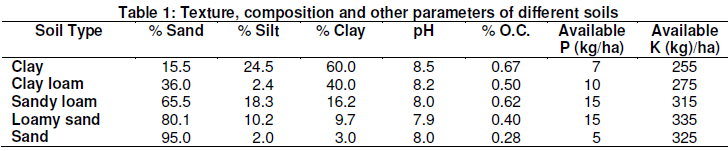
Soils from different locations were collected and analyzed in Soil Physic Laboratory of Institute of Agricultural Research and Training, Obafemi Awolowo University, Moor Plantation, Ibadan, Nigeria located at E3o54’ and N7o30’ for their texture and composition in 2013 and 2014 (Table 1).
Five different types of soils were filled in 1kg capacity 15cm size plastic pots after sterilization and recommended dose of fertilizers was mixed before sowing. Basal application of fertilizer using NPK (15:15:15) and a single super phosphate at a rate of 120kg N, 50kg P2O5 and 50kg K2O/ha (Adegbite et al., 2005). Hence five main treatments with 2 sub-treatments under each soil type, nematode inoculated and non-inoculated checks were maintained.
Cowpea seed (c.v. Ife Brown) soaked in water for 2 hours were sown in plastic pots. One week after germination, one seedling/pot was retained. Each plant was then inoculated with freshly hatched second stage juveniles of M. incognita at one J2/g soil (1000J2/pot). The second dose of N2 was applied one month after sowing. There were four replications in factorial CRD set up. Sixty days after nematode inoculation, observations on shoot length, fresh and dry root and shoot weight, number of leaves, buds/plants, number of galls, egg masses/plant, eggs/egg mess and final soil population were recorded. Results were analyzed statistically using SAS version 9.1. Means were separated using Duncan Multiple Range Test (DMRT) of 5% level of probability (SAS, 1998).
RESULTS AND DISCUSSION
Table 1 shows the soil type composition and other parameters like pH, % Organic carbon, available P (kg/ha) and K (kg/ha) in different Soil Texture.
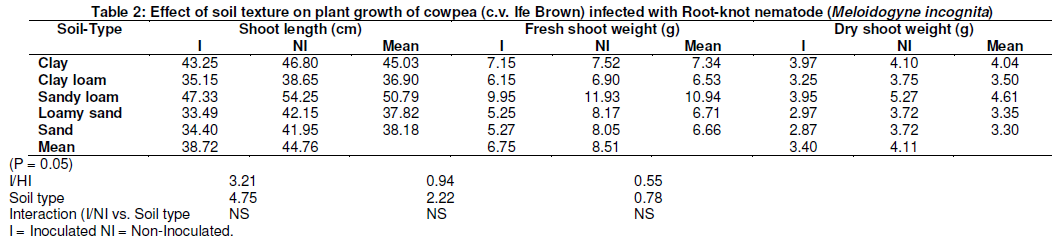
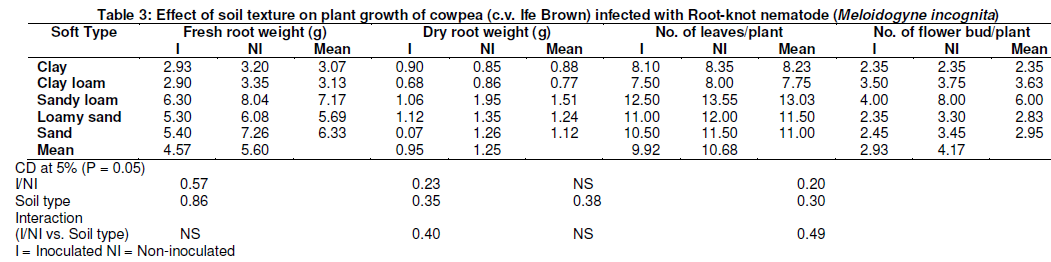
Tables 2 and 3 show that all the plant growth parameters of cowpea (cv Ife Brown) such as shoot length, fresh and dry root and shoot weight and number of buds/plants were maximum and significantly higher in non-inoculated as compared to nematode inoculated treatments irrespective of various soil texture indicating damaging potential of M. incognita under varied conditions.
However, maximum and significantly higher shoot length (45.9cm), fresh shoot weight (8.5g), dry shoot weight (3.9g), fresh root-weight (7.8g), dry root weight (2.5g), number of leaves (15.5) and number of buds (20.5) were obtained in sandy loam soil followed by loamy sand soil for most of the growth parameters except shoot length, fresh and dry shoot weight as compared to clay loam soil which showed minimum significantly lower plant growth parameters.
The interaction between presence or absence of nematodes and soil type was however, non-significant except for dry shoot weight and number of buds/flowers/plant.
The data on nematode galling and reproduction i.e. number of galls, egg masses, eggs/egg host and final soil population is shown in Table 4.
Maximum and significantly higher number of galls were in sand (420.0) followed by loamy sand (398.0) and sandy loam (345.0), however minimum gall formation (65.0) was in fine textured clay soil followed by clay loam (150.0) soil which differed significantly from the rest of the treatments. As the clay content increased, galling decreased and as sand content increased, galling increased favouring the multiplication of M. incognita. Similar trend was observed in respect of number of egg masses/plant and final soil populations, while number of eggs/egg mass showed non-significant differences among various soil texture treatments.
The reproduction factor was maximum (35.6) in sandy soil followed by loamy sand (30.5) while it was minimum (3.9) in clay soil followed by clay loam (10.5).
It was clear that growth of cowpea plants was better in sandy loam soil which contains sand and clay as (65.5), 16.2 percent and 18.3 silt respectively. As the clay content increased beyond 16.2%, the plant growth decreased. Also as clay content decreased below 16.2%, plant growth decreased irrespective of nematization.
Contrary to it, nematode galling and reproduction potential were positively co-related with sand content while negatively co-related with clay content, thus making the sandy soil most favourable, clay soil least while sandy loam soil moderately favourable for M. incognita. The findings are in conformity with those of O’Banon and Reynolds, (1961); Huan et. al., (1968); Mavlyanov and Abdullaeva, (1988); and Jain et. al., (1988) who also reported that population density of M. incognita was very high in coarse sandy soil as compared to clay soil in cotton.

CONCLUSION
Mechanical and physical factors determine porosity, aeration and water-holding capacity of soils. All of these conditions collectively influence the multiplication and distribution of nematodes in a soil type. Observations recorded 60 days after nematode inoculation revealed that maximum and significantly higher shoot length, fresh and dry root and shoot weight, number of leaves and buds per plant were in sandy loam soil while these growth parameters were minimum and significantly lower in clay loam soil. The reproduction factor was maximum (30.6) in sandy soil followed by loamy soil (25.8) while it was minimum (3.5) in clay soil making it least favourable for the nematode (M. incognita).
ACKNOWLEDGEMENT
The Director of Institute of Agricultural Research and Training, Moor Plantation, Ibadan Nigeria Professor James A. Adediran, Institute Research Committee and the Federal Ministry of Agriculture and Rural Development, Abuja are acknowledged for the approval and financial support given for the project.
REFERENCES
Adegbite AA, Amusa NA, Agbaje GO, Taiwo LB (2005). Screening of cowpea varieties for resistance to Meloidogyne incognita under field conditions. Nematropica 35: 155 – 159.
Adegbite AA, (2011). Assessment of yield loss of cowpea (Vigna unguiculata L.) due to Root-knot nematode, Meloidogyne incognita under field conditions. American Journal of Experimental Agriculture 1(3): 79 – 85.
Huan J, Rang WZ, Shentu GR (1986). Biological study of cotton root-knot nematode. ACTA-Agricultural Universitatis Zhejiangensis 12(4): 385 -391.
Idowu AA, (1991). The distribution of Root-knot Nematodes (Meloidogyne species) in Relation to elevation and Soil type in Vegetable Growing Areas of Upper Northern Nigeria. Nigerian Journal of Plant Protection 15: 15-19.
John RK, Paruthi IJ, Bhatti DS, (1988). Effect of M. incognita on Cotton in different soil types. Journal of Cotton Research and Development Plant 2, 90 – 93.
Mavlyanov OM, Abdullaeva OL, (1988). Biocoenetic Complexes of Cotton nematodes. Uzbekistan Biologipa Zurnalis, 42 – 45.
O’Banon JH, Reynolds HW, (1961). Root-knot nematode damage to cotton yields in relation to certain soil properties. Soil Science 92: 384 – 386.
Olowe T, (2004). Occurrence and distribution of root-knot nematodes, Meloidogyne spp., in Cowpea growing areas of Nigeria. Nematology 6: 811-817.
SAS Institute, (1998). SAS for linear models: A guide to the ANOVA and GLM procedures. SAS Institute, Cary, N.C.
Sikora RA, Greco N, Silva JFV, (2005). Nematode Parasites of Food Legumes In: Plant Parasitic Nematodes in Subtropical and Tropical Agriculture (Ed M. Luc, R.A.Sikora and J. Bridge) 2nd edition, Wallingford, UK, CABI Publishing, pp 259-318.
|
Cite this Article: Adegbite AA (2017). Soil Texture effect on Growth of Cowpea Plants under Root-knot Nematode, Meloidogyne incognita Infested Conditions. Greener Journal of Agricultural Sciences, 7(10): 271-274, http://doi.org/10.15580/GJAS.2017.10.120517175. |