|
Greener Journal of Agricultural Sciences Vol. 7 (9), pp. 263-270, November 2017 ISSN: 2276-7770; ICV: 6.15 Copyright ©2017, the copyright of this article is retained by the author(s) DOI http://doi.org/10.15580/GJAS.2017.09.112117171 http://gjournals.org/GJAS |
|
Characterization of Aroma Profile of Bogma, Traditional Homemade Turkish Spirit††
*Sercan Dede, Yahya Kemal Avşar
Mustafa Kemal University, Agricultural Faculty, Department of Food Engineering, Antakya-Hatay, Turkey.
|
ARTICLE INFO |
ABSTRACT |
|
|
Article No.: 112127171 Type: Research DOI: 10.15580/GJAS.2017.09.112117171 |
Volatile compounds and aroma profile of Bogma (traditional Turkish homemade distilled spirit) produced from dry fig were investigated. Volatile compounds by gas chromatography/mass spectrometry (GC/MS) and aroma active compounds by gas chromatography/olfactometry (GC/O) were determined using direct injection (DI) and head space-solid phase microextraction techniques (HS-SPME). Aroma extraction dilution analysis (AEDA) was employed to reveal the importance of each aroma active compounds in Bogma aroma. With DI, 12 volatiles and 7 aroma active compounds were detected while HS-SPME showed the existence of 44 volatiles and 16 aroma active compounds. Of the total aroma active compounds, 7 were determined only at the sniffing port. Results showed that aroma of this traditional spirit was affected from its raw material and production processes. Furthermore, both HS-SPME and DI technique should be used as complementary for a better understanding of aroma or similar type spirits.
|
|
|
Submitted: 21/11/2017 Accepted: 24/11/2017 Published: 30/11/2017 |
||
|
*Corresponding Author Sercan Dede E-mail: sercandede01@ gmail .com |
||
|
Keywords: Bogma, gas chromatography, mass spectrometry, olfactometry, aroma. |
||
|
|
|
1. INTRODUCTION
Bogma is a homemade traditional Turkish alcoholic beverage similar to raki. It is produced widely in the southern provinces of Turkey, such as Adana, Mersin, Hatay, Gaziantep and Kahramanmaraş, with no exact information on the amount produced (Öncü et al., 2002; Bulur, 2010). It is produced from dry fig or fresh grape or mixture of them. In traditional production technique, fermentation takes place in clay pots and distillation is implemented once or more using a simple copper apparatus equipped with an evaporator and condenser (Figure 1). During distillation, distillate was separated as head, heart and tail. Head and tail parts are discharged owing to toxic compounds (Yavaş and Rapp, 1991; Bulur, 2010).
Although it is produced and consumed widely, the available studies on chemical compositions and volatile components of Bogma are very limited. So far, using direct injection and gas chromatography techniques, 21 volatile compounds have been identified (Anli et al., 2007; Bulur, 2010; Zeren et al., 2012). Volatile compounds reported were acetaldehyde, acetic acid, methyl acetate, ethyl acetate, butyl acetate, isoamyl acetate and ethyl lactate, ethanol, methanol, 1-propanol, 1-butanol, 1-hexanol, 2-propanol, 2-butanol, 3-pentanol, 2-methyl-1-propanol, 2-methyl-1-butanol and 3-methyl-1-butanol, acetal, trans-anethole and estragole. Researchers reported that the amounts of methanol and higher alcohols were found to be higher than those of commercial brands (Anli et al., 2007; Bulur, 2010; Zeren et al, 2012) which have also been shown earlier by spectrophotometric studies (Fidan et al., 1996).
There is no study using headspace solid phase microextraction (HS-SPME) technique in Bogma. However, when used in Turkish raki, the most resembling spirit to Bogma, HS-SPME revealed the presence of 43 compounds, which were mainly composed of etheric oils from aniseed together with fermentation products (Anli et al., 2007; Yılmaztekin et al., 2011). It is concluded that the main source of volatile compounds are aniseed, fermentation, distillation and maturation (Erten and Canbaş, 2003; Cabaroglu and Yilmaztekin, 2011; Yılmaztekin et al., 2011).
HS-SPME technique has been successfully used to identify the volatiles of aniseed flavored spirits such as raki, anis, pastis and sambuca (Jurado et al., 2007; De León-Rodríguez et al., 2008; Plutowska et al., 2010). Amongst other extractions techniques of volatiles, SPME appears to be effective, cheap and rapid method used in spirits (Capobiango et al., 2015) as long as the right fiber is chosen (Plutowska and Wardencki, 2008).
To our best knowledge, there is not any study determine the volatile compounds of Bogma produced from dried figs by traditional methods using direct injection (DI) and HS-SPME techniques and to identify the aroma active compounds and show their contribution to overall Bogma aroma using olfactometric techniques, which was the aim of this study.
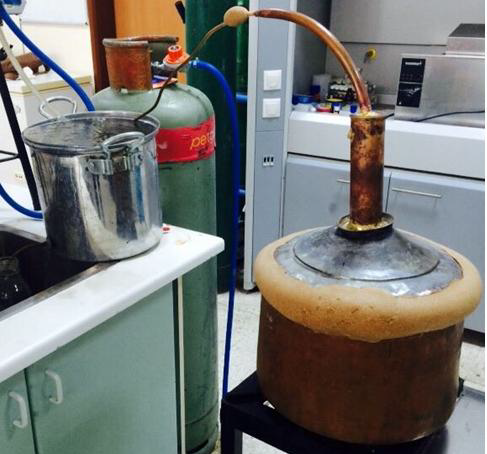
Figure 1: A traditional copper distillation apparatus equipped with an evaporator and condenser used for Bogma production
2. MATERIALS AND METHODS
2.1. Bogma production
Local dried fig variety (Ficus carica L.) was purchased from a Bogma producer. Bogma was produced in a traditional way using a clay pot (25 L) and a simple evaporator and condenser. Dry figs (5 kg) were chopped and mixed with water (10 L) before fermentation. The pots were filled with a ratio of approximately ¾ to prevent overflowing owing to froth formation during fermentation. Fermentation took place at ambient temperature for 15 days. Fermentation end-points were terminated by both traditional way which was the point when the froth
formation ceased and also measuring ethanol production using gas chromatography. For instrumental monitoring, daily samples were taken from the fermentation liquid and distilled which then were injected to a gas chromatography equipped with a flame ionization detector (GC/FID). The point when ethanol content reached a maximum and leveled off marked as the end of the fermentation. To determine the head, heart and tail parts, samples were drawn during distillation at 10 min intervals and analyzed by GC/FID.
2.2. Reagents
The standard references were purchased from different suppliers: ethanol, methanol, ethyl acetate, furfural, phenyl ethyl acetate, ethyl hexanoate, ethyl octanoate, acetic acid, sodium chloride from Merck (Germany); 2-pentylfuran from Alfa Aesar (England); n-alkane standards, dimethyl trisulfide, ethyl decanoate, ethyl dodecaoate, ethyl tetradecanoate, ß-caryophyllene, t-2-c-6-nonadienal, 2-phenylethyl alcohol, and 3-methyl-1-butanol from Sigma Aldrich (Germany); All chemicals were at analytical grade. Stock solutions were prepared in ethanol/water (40% v/v).
2.3. Chromatographic Analyses
2.3.1. Extraction of volatile compounds
Direct injection and HS-SPME techniques were used for extraction. For direct injection 1 mL of sample was used, HS-SPME was applied as described by Jurado et. al. (2007). A polydimethylsiloxane/carboxen/divinylbenzene (DVB/CAR/PDMS) fiber (50/30µm, 2 cm) from Supelco (Bellefonte, PA, USA) was used for HS-SPME extraction.
2.3.2. Analyses of volatile compositions of Bogma samples
Bogma samples were analyzed with a HP-6890 Series GC/HP 6890 Series mass selective detector (MSD, Hewlett Packard, Italy). For separation of volatiles, a fused silica capillary column (HP-INNOWax, 60 m length x 0.25 mm inner diameter x 0.25 µm film thickness (df), J & W Scientific, USA) and helium as carrier gas (1mL/min constant flow rate) were used. Gas chromatographic oven temperature was programmed from 40 to 150°C at a rate of 3°C/ min, with initial hold time of 3 min, then from 150°C to 240°C at a rate of 10°C/ min, with final hold time of 9 min. As MSD conditions: capillary direct interface temperature: 280oC; ionization energy: 70 eV. National Institute of Standards and Technology mass spectral database (NIST 02) was used to identify the compounds. Analyses were carried out in duplicate.
2.3.3. Olfactometric Analyses
A GC (Shimadzu GC2010 model, Japan) equipped with an olfactometry apparatus were used to implement the analyses. A polar capillary column (HP-INNOWax, 30-m length * 0.25-mm i.d* 0.25μm df J&W scientific) was used for olfactometric analyses. Samples were sniffed by three experienced sniffers twice. Oven temperature was programmed from 40 to 200°C at a rate of 10°C/min, with initial and final hold times of 5 and 15 min, respectively. Nitrogen was used as a carrier gas at a constant pressure of 100kPa. Contributions of each aroma active compounds to overall aroma were determined by aroma extraction dilution analyses (AEDA). For direct injection, a series of dilutions (1/1, 1/5, 1/25, 1/125, 1/625) was prepared and flavor dilution factors (FDF) were expressed as Log5FDF. For HS-SPME application, AEDA was carried out as described by Deibler et. al. (1999) and the results were expressed as Log2FDF.
2.3.4. Aroma Active Compounds
In determination of aroma active compounds, reference standards were directly injected to both GC/FID and GC/O, respectively. Retention index values (RI) that calculated from GC/FID and GC/O were compared with RI values of those aroma standards from literature. RI values were calculated according to equation of Van Den Dool and Kratz (1963). Aroma compounds which were detected at sniffing port of GC/O but not by GC/MS were identified tentatively by matching RI values and odor properties of unknowns against those of authentic standards.
3. RESULTS AND DISCUSSION
3.1. Volatile composition of Bogma samples
Percentages of volatile compounds of Bogma samples obtained by DI-GC/MS and HS-SPME-GC/MS technique are given in Table 1. Both the number and percentage of volatiles differed according to the techniques used. In total of 44 compounds, by DI twelve volatiles were and by HS-SPME 38 volatiles were identified.
The major volatiles were ethanol (23.99%), ethyl octanoate (6.21%), ethyl acetate (3.17%), ethyl dodecanoate (20.36%) ethyl decanoate (13.56%) and (-)-β-curcumene (3.71%). One of the differences between the techniques that nineteen esters (2, 9, 12, 14, 20-22, 24-26, 33, 35-40, 43 and 44) were detected by HS-SPME, while three esters (1, 2 and 13) detected by DI. Of the compounds, while methyl acetate (1) and ethyl lactate (13) were only detected by DI, ethyl acetate (2) was detected by both techniques. Some of those were also reported in Bogma (Bulur, 2010). Esters can be formed in alcoholic beverages by chemical or biochemical ways (Nykanen and Nykanen, 1991; Erten and Canbaş, 2003).
Four higher alcohols were detected in total. Three of the higher alcohols (5, 7 and 41) were same, one (4) were detected only by DI. Two of them (4 and 7) were reported earlier (Zeren et al., 2012). All higher alcohols detected thought to be most likely arisen from the higher pectin content of dry fig (Gözlekçi et al., 2011; Mujic et al., 2012). Higher alcohols are the major volatile components of alcoholic beverages that can be formed in two ways: Ehrlich pathway (from amino acids) by yeasts and biosynthesis (from sugar in the absence of amino acid) (Nykanen and Nykanen, 1991; Erten and Canbaş, 2003).
In addition, one aldehyde (18) and one ketone (10) were detected. Aldehydes form in some ways: Maillard reaction, Strecker degradation or autooxidation of fatty acids (Nykanen and Nykanen, 1991; Erten and Canbaş, 2003). Furfural (18) is shown to be a volatile compound of fig (Gözlekçi et al., 2011) and can also form by Maillard reaction during heating of sugar content in the presence of amino acid in the acidy state, which possibly occurs during distillation. Furfural content of Bogma was determined by chemical and chromatographic analyses in other studies (Şahin and Özçelik, 1982; Bulur, 2010).
Table 1: Percentages of volatile compounds of Bogma samples obtained by direct injection-gas chromatography/mass spectrometry (DI-GC/MS) and headspace-solid phase micro extraction-gas chromatography/mass spectrometry (HS-SPME-GC/MS)1,2,3
|
|
Compound |
|
DI (%) |
HS-SPME (%) |
||||||||||||||
|
|
|
|
Mean |
SD |
Mean |
SD |
||||||||||||
|
1 |
Methyl acetate |
|
0,01 |
0,004 |
nd |
- |
||||||||||||
|
2 |
Ethyl acetate |
|
1,46 |
0,143 |
4,17 |
1,703 |
||||||||||||
|
3 |
Ethanol |
|
97,09 |
0,359 |
25,99 |
9,379 |
||||||||||||
|
4 |
1-Propanol |
|
0,03 |
0,014 |
nd |
- |
||||||||||||
|
5 |
2-Methyl-1-propanol |
|
0,04 |
0,002 |
0,07 |
0,065 |
||||||||||||
|
6 |
3-Methyl--butylacetate |
|
nd |
- |
0,43 |
0,045 |
||||||||||||
|
7 |
3-Methyl-1-butanol |
|
0,48 |
0,096 |
0,78 |
0,568 |
||||||||||||
|
8 |
2-penthylfuran |
|
nd |
- |
0,04 |
0,00 |
||||||||||||
|
9 |
Ethyl hexanoate |
|
nd |
- |
0,25 |
0,025 |
||||||||||||
|
10 |
3-Hydroxy-2-butanone |
|
0,09 |
0,02 |
nd |
- |
||||||||||||
|
11 |
Geijerene |
|
0,01 |
0,004 |
nd |
- |
||||||||||||
|
12 |
Ethyl heptanoate |
|
nd |
- |
0,18 |
0,00 |
||||||||||||
|
13 |
Ethyl lactate |
|
0,09 |
0,053 |
nd |
- |
||||||||||||
|
14 |
Ethyl octanoate |
|
nd |
- |
7,21 |
4,337 |
||||||||||||
|
15 |
Acetic acid |
|
0,48 |
0,144 |
nd |
- |
||||||||||||
|
16 |
Calamenene |
|
nd |
- |
0,55 |
0,102
|
||||||||||||
|
17 |
Alfa-terpinolene |
|
nd |
- |
0,10 |
0,00 |
||||||||||||
|
18 |
Furfural |
|
0,02 |
0,003 |
0,10 |
0,031 |
||||||||||||
|
19 |
Ylangen |
|
nd |
- |
0,05 |
0,00 |
||||||||||||
|
20 |
Butyl octanoate |
|
nd |
- |
0,08 |
0,00 |
||||||||||||
|
21 |
Isoamyl heptanoate |
|
nd |
- |
0,11 |
0,00 |
||||||||||||
|
22 |
Nonyl acetate |
|
nd |
- |
0,11 |
0,064 |
||||||||||||
|
23 |
β-Elemene |
|
nd |
- |
0,06 |
0,00 |
||||||||||||
|
24 |
Methyl undecanoate |
|
nd |
- |
0,15 |
0,00 |
||||||||||||
|
25 |
Methyl decanoate |
|
nd |
- |
0,17 |
0,00 |
||||||||||||
|
26 |
Ethyl decanoate |
|
nd |
- |
18,478 |
12,56 |
||||||||||||
|
27 |
α-Bergamotene |
|
nd |
- |
0,09 |
0,62 |
||||||||||||
|
28 |
(-)-β-curcumene |
|
nd |
- |
3,71 |
0,00 |
||||||||||||
|
29 |
β-caryophyllene |
|
nd |
- |
0,39 |
0,236 |
||||||||||||
|
30 |
Farnesene |
|
nd |
- |
0,10 |
0,00 |
||||||||||||
|
31 |
β-Longipinene |
|
nd |
- |
0,07 |
0,00 |
||||||||||||
|
32 |
Isopentyl dodecanoate |
|
nd |
- |
0,72 |
0,580 |
||||||||||||
|
33 |
α-Zingiberene |
|
nd |
- |
0,43 |
0,00 |
||||||||||||
|
34 |
Ethyl dodecanoate |
|
nd |
- |
28,506 |
20,36 |
||||||||||||
|
35 |
Ethyl tetradecanoate |
|
nd |
- |
0,47 |
0,00 |
||||||||||||
|
36 |
Isobutyl decanoate |
|
nd |
- |
0,10 |
0,00 |
||||||||||||
|
37 |
Methyl tetradecanoate |
|
nd |
- |
0,06 |
- |
||||||||||||
|
38 |
Methyl dodecanoate |
|
nd |
- |
0,08 |
0,00 |
||||||||||||
|
39 |
Phenylethyl acetate |
|
nd |
- |
0,08 |
0,007 |
||||||||||||
|
40 |
α-Calacorene |
|
nd |
- |
0,04 |
0,018 |
||||||||||||
|
41 |
Phenyl ethyl alcohol |
|
0,03 |
0,006 |
0,04 |
0,013 |
||||||||||||
|
42 |
Ethyl hexadecanoate |
|
nd |
- |
0,22 |
0,00 |
||||||||||||
|
43 |
Ethyl octadecanoate |
|
nd |
- |
0,15 |
0,103 |
||||||||||||
|
44 |
Isoeugenol |
|
nd |
- |
0.13 |
0,00 |
||||||||||||
|
|
Others |
|
0,17 |
- |
5,54 |
- |
||||||||||||
|
|
Total |
|
100,00 |
- |
100,00 |
- |
||||||||||||
1) Percentages were obtained from peak areas by using an HP-INNOWax column.
2) Values are averages of duplicated injections.
3) SD: standard deviation; nd: not detected.
According to Turkish Food Codex Distilled Spirits Communiqué, furfural must not exist in agricultural ethyl alcohol (Anonymous, 2005). 3-hydroxy-2-butanone (10) is the only ketone found in samples which forms from amino acids and reported to be the most abundant aroma compound in fig fruits (Mujic et al., 2012). Like furfural, 2-pentyl furan (8) is a benzene derivate heterocyclic compound and its presence in fig fruits has already been shown (Gözlekçi et al., 2011). Of the compounds, furfural was detected with both techniques, ketone, only with DI and furan, only with HS-SPME. One propenyl phenols (44) was detected only HS-SPME and was also another compound thought to be arisen from raw material.
Twelve terpenes (nine sesquiterpenes: 17, 19, 23, 27-31 and 33; three cyclic monoterpenes: 11, 16 and 40) were detected. Among these compounds, ß-caryophllene (31) was the major component as a sesquiterpene.
Methanol contents of samples were found to be in trace amounts (<%0.05 v/v). As reported by Fidan et. al. (1996), this amount of methanol content is confirmed as an indicator of naturality and reality in spirit drinks made by natural fruits and also adding no sugar and no alcohol from a different source to the mash of fruits during production. As well known, methanol content in spirit drinks is formed from pectin by pectolytic enzymes via hydrolyzation of the methoxyl group (Apostolopoulou et al., 2005).
3.2. Determination of Aroma Profile of Bogma Samples
DI and HS-SPME techniques using gas chromatography-olfactometry (GC/O) presented different aroma profiles (Table 2). From the result of DI-GC/O, seven aroma active compounds (3, 7, 15, 18, 26, 39 and 41) were detected at the sniffing port (Table 2). From the FDF of the aroma active compounds, ethanol (alcohol), 3-methyl-1-butanol (chemical), acetic acid (vinegar), furfural (bread almond), and phenyl ethyl acetate (floral, sweet, herbal) contributed to the overall aroma of the samples.
Compared to DI-GC/O, more aroma active compounds were determined at the sniffing port when HS-SPME-GC/O technique was employed. Sixteen (2, 3, 5-9, 14, 26, 39, 45-50) aroma active compounds were detected (Table 2). Of the 16 aroma active compounds, 15 were appeared to be the major ones contributing to the overall aroma of Bogma samples. In addition to those detected with DI technique (3, 7, 26 and 39), ethyl acetate (fruity), 2-methyl-1-propanol (fruity), 3-methyl-1-butyl acetate (sweet fruity), 2-pentilfuran (chemical, buttery), ethyl hexanoate (sweet apple peel), ethyl octanoate (fruity, oily), methyl butanoate (ether, fruity), ethyl butyrate (sweet, apple peel), 1-octen-3-one (earthy, mushroom), dimethyl trisulfide (sulfur), methional (cooked potato), ethyl decanoate (grape, fruit) and t-2-c-6-nonadienal (cucumber) were the other important aroma active compounds. Incidentally, some of the compounds (6, 45, 46, 47, 48, 49 and 50) were only detected tentatively. Formation mechanisms of esters (methyl butanoate and ethyl butyrate) have already been mentioned previously. Another compound detected tentatively is 1-octen-3-one (47) that is formed by lipoxygenase and hydroperoxide lyase enzymes, and provides mushroom, grass, soil and/or raw chicken odor to the product (Eng-Leun Mau et al., 2006). Dimethyl trisulfide (48) is formed from methionine and provides high sulfuric odor to beverages (Yvon and Rijnen, 2001). This compound appeared to be specific to dry fig Bogma and may be used as an indicator of its authenticity. Methional (49), as a product of Strecker degradation of methionine- gives a corn-like aroma at high concentrations or sweet taste at low concentrations to alcoholic beverages (Ertekin et al., 2009). t-2-c-6-nonadienal (50) is an aldehyde forming from oxidative degradation of free fatty acids giving cucumber and watermelon-like notes to alcoholic beverages (Mujic et al., 2012).
Table 2: Aroma active compounds, odor descriptions, retention index (RI) and flavor dilution factors (FDF) of Bogma Samples obtained from direct injection-gas chromatography/olfactometry (DI-GC/O) (n=3) and head space-solid phase micro extraction-gas chromatography/olfactometry (HS-SPME-GC/O) (n=3), respectively
|
. |
|
|
|
|
|
Log5FDF |
|
||||||
|
|
|
|
|
|
|
DI |
|
HS-SPME |
|
||||
|
No |
Compounds |
Odor description |
1RIGCO |
2RIGCO-REF |
3RIref |
F1 |
F2 |
F3 |
I3 |
F1 |
F2 |
F3 |
4I |
|
2 |
Ethyl acetate |
Fruity |
902 |
854 |
902 |
- |
- |
- |
- |
3 |
3 |
3 |
MS,RI,RS,O |
|
3 |
Ethanol |
Alcohol |
954 |
943 |
936 |
4 |
4 |
4 |
MS, RI, RS, O |
3 |
3 |
3 |
RI, RS, O |
|
45 |
Methyl butanoate (T) |
Ether, fruity, sweet |
970 |
981 |
990 |
- |
- |
- |
- |
3 |
3 |
3 |
RI, RS, O |
|
46 |
Ethyl butyrate (T) |
Sweet, apple peel, Floral |
1058 |
981 |
1028 |
- |
- |
- |
- |
4 |
4 |
4 |
RI, RS, O |
|
5 |
2-methyl-1-propanol |
Fruity |
1077 |
1083 |
1085 |
- |
- |
- |
- |
2 |
3 |
3 |
RI, RS, O |
|
6 |
3-methyl-1-butyl acetate (T) |
Sweet, fruity, |
1121 |
- |
1118 |
- |
- |
- |
- |
3 |
3 |
3 |
MS,RI,O |
|
7 |
3-methyl-1-butanol |
Chemical |
1214 |
1205 |
1206 |
3 |
3 |
3 |
MS, RI, RS, O |
4 |
4 |
4 |
MS,RI,RS,O |
|
8 |
2-pentylfuran |
Chemical, buttery |
1215 |
1238 |
1240 |
- |
- |
- |
- |
1 |
1 |
0 |
MS,RI,RS,O |
|
9 |
Ethyl hexanoate |
Sweet, apple peel, Floral |
1237 |
1200 |
1229 |
- |
- |
- |
- |
4 |
4 |
4 |
MS,RI,RS,O |
|
47 |
1-octen-3-one (T) |
Earthy, mushroom |
1303 |
1304 |
1304 |
- |
- |
- |
- |
4 |
4 |
3 |
RI,RS,O |
|
48 |
Dimethyl trisulfide (T) |
Sulfur |
1385 |
1373 |
1377 |
- |
- |
- |
- |
4 |
4 |
4 |
RI,RS,O |
|
14 |
Ethyl octanoate |
Fruity, Oily |
1432 |
1436 |
1435 |
- |
- |
- |
- |
3 |
2 |
3 |
MS, RI, RS, O |
|
15 |
Acetic acid |
Acetic acid, vinegar |
1395 |
1419 |
1434 |
3 |
3 |
3 |
MS, RI, RS, O |
- |
- |
- |
MS, RI, RS, O |
|
49 |
Methional (T) |
Cooked potato |
1462 |
1485 |
1458 |
- |
- |
- |
- |
4 |
3 |
4 |
RI, RS, O |
|
18 |
Furfural |
Bread, almond |
1462 |
1474 |
1474 |
3 |
3 |
3 |
MS, RI, O |
- |
- |
- |
MS, RI, RS, O |
|
26 |
Ethyl decanoate |
Grape, Fruit, Sweet |
1549 |
1556 |
1630 |
- |
- |
- |
- |
4 |
4 |
3 |
MS, RI, RS |
|
50 |
t-2-c-6-nonadienal (T) |
Cucumber |
1598 |
1652 |
1597 |
- |
- |
- |
- |
3 |
3 |
4 |
RI, RS, O |
|
39 |
Phenyl ethyl acetate |
Herbal, sweet, Floral |
1837 |
1823 |
1821 |
3 |
2 |
3 |
MS, RI, RS, O |
4 |
4 |
4 |
MS, RI, RS, O |
|
41 |
Phenyl ethyl alcohol |
Floral, sweet, herbal |
1915 |
1915 |
1925 |
1 |
1 |
1 |
MS, RI, RS, O |
- |
- |
- |
MS, RI, RS, O |
1) Retention index calculated by using an HP-INNOWax column at GC-O sniffing port.
2) Retention index of reference standard calculated by using an HP-INNOWax column at GC-O sniffing port.
3) Retention index of reference standard taken from online databases (the pherobase and/or flavornet.org).
4) Determination method: O: Olfactometric; MS: Mass Spectrum; RI: Retention index; RIref,: Retention time of reference standard; RS: Reference Standard;
5) Other Abbreviations in Table: FDF: Flavor dilution factor; F: Dry Fig Bogma
4. CONCLUSIONS
In this study, volatile and aroma active compounds of Bogma produced by traditional methods with dry figs were investigated. Firstly, the results indicated that extraction techniques affected the both the number and percentage of volatile and aroma active composition of Bogma samples. Although HS-SPME recovered more volatiles, both HS-SPME and DI technique should be used as complementary for a better understanding of Bogma aroma or similar type spirits. Secondly, the raw material used for fermentation affected the composition of volatile and aroma active compounds of the spirits. Bogma samples were found to be highly aromatic due to its high ester content arising from raw material. Thirdly, some of the volatile compounds like 1-octen-3-one (47), dimethyl trisulfide (48), methional (49) and t-2-c-6-nonadienal (50) could be indicator molecules to identify dry fig Bogmas, which were detected tentatively at the sniffing port. Consequently, the present research is the first on the aroma profile of Bogma, which could be used for Geographical labeling of this product in the future.
ACKNOWLEDGEMENT
This study was supported by the Project number: 11800 by Mustafa Kemal University- Scientific Researches Projects Commission, Hatay, Turkey.
REFERENCES
Anli R E, Vural N. and Gucer Y (2007) Determination of the principal volatile compounds of Turkish Raki. Journal of the Institute of Brewing, 113(3): 302-309.
Anonymous 2005. Turkish Food Codex No: 2005/11. Distilled Alcoholic Beverages, Turkish Ministry of Agriculture, 2005.
Apostolopoulou AA, Flouros AI, Demertzis PG, Akrida-Demertzi K (2005). Differences in concentration of principal volatile constituent in Traditional Greek Distillates. Food Control, 16: 57-164.
Bulur A (2010). Research on the fundamental volatile components of Turkish Rakies. Çukurova University, MSc thesis. Adana, Turkey.
Cabaroglu T and Yilmaztekin M (2011). Methanol and major volatile compounds of Turkish Raki and effect of distillate source. Journal of the Institute of Brewing. 117(1): 98-105.
Capobiango BM, Mastello RB, Chin S-T, Oliveira Ede S, Cardeal Zde L, Marriott PJ (2015). Identification of aroma-active volatiles in banana Terra spirit using multidimensional gas chromatography with simultaneous mass spectrometry and olfactometry detection. Journal of Chromatography A, 1388: 227–235.
De León-Rodríguez A, Escalante-Minakata P, Jiménez-García MI, Ordoñez-Acevedo LG, Flores Flores JL and Barba de la Rosa AP (2008). Characterization of Volatile Compounds from Ethnic Agave Alcoholic Beverages by Gas Chromatography-Mass Spectrometry. Food Technology and Biotechnology. 46 (4): 448–455.
Deibler KD, Acree T and Lavin EH (1999). Solid phase microextraction application in gas chromatography olfactometry dilution analysis. Journal of Agriculture and Food Chemistry. 47: 1616−1618.
Eng-Leun Mau J, Beelman ROB and Ziegler GRR (2006). 1-octen-3-ol in the cultivated mushroom, Agaricus bisporus. Journal of Food Science, 57(3): 704-706.
Ertekin B, Okur ÖD and Güzel-Seydim Z (2009). Formation of Flavor Compounds by Amino Acid Catabolism in Cheese. Gida, 34 (1): 43-50. (Turkish)
Erten H and Canbaş A (2003). Aroma substances formed during the alcoholic fermentation. Gida, 28(6): 615-619. (Turkish)
Fidan I, Denli Y ve Anlı E (1996). A study on the amount of methanol in the production of raki in Turkey. Gida, 21(6): 415-418. (Turkish)
Gözlekçi S, Kafkas E and Ercişli S (2011). Volatile compounds determined by HS-GC/MS in peel and pulp of fig (Ficus carica L.) cultivars grown in Mediterranean Region. Notulae Botanicae Horti Agro-Botanici Cluj/Napoca, 39(2): 105-108
Jurado JM, Ballesteros O, Alcazar A, Pablos F, Martin MJ, Vilchez JL and Navalon A (2007). Characterization of aniseed-flavoured spirit drinks by headspace solid-phase microextraction gas chromatography–mass spectrometry and chemometrics - Talanta (72): 506–511.
Mujic I, Kralj MB, Jokic S, Jug T, Subaric D, Vidovic S, Zivkovic J and Jarni K (2012). Characterization of volatiles in dried white varieties figs. Journal of Food Science and Technology, 51(9): 1837-46.
Nykanen L and Nykanen I (1991). Distilled beverages (In: Maarse H, editor). Volatile Compounds in Foods & Beverages. New York, Marcel Dekker, p.547-580.
Öncü F, Ögel K and Çakmak D (2002). Alcohol Culture-2: Culture of Drink and Drink Literature, Journal of Dependence, 3(1): 31-36. (Turkish).
Plutowska B and Wardencki W (2008). Application of gas chromatography–olfactometry (GC–O) in analysis and quality assessment of alcoholic beverages – A review. Food Chemistry, 107: 449–463.
Plutowska B, Biernacka P and Wardencki W (2010). Identification of Volatile Compounds in Raw Spirits of Different Organoleptic Quality. Journal of the Institute of Brewing. 116(4): 433-439.
Şahin İ and Özçelik F (1982). The composition of our distilled spirits, especially research on the amount of methanol. Gida, 7(3): 121-129. (Turkish)
Van Den Dool H and Kratz PD (1963). A generalization of the retention index system including linear programmed gas liquid partition chromatography. Journal of Chromatography, 11: 463-471.
Yavaş I and Rapp A (1991). Gaschromatographisch-Massenspektrometrische Untersuchungen der Aromastoffe von Raki. Deutsche Lebensmittel-Rundschau, 87: 41-45. (German)
Yvon M and Rijnen L (2001). Cheese flavor formation by amino acid catabolism, International Dairy Journal, 11: 185-201.
Zeren C, Aydin Z, Yonden Z and Bucak S (2012). Composition of Bogma raki, Turkish traditional alcoholic beverage. Journal of Food Technology, 10: 87-91.
|
Cite this Article: Sercan D. and Yahya K.A. (2017). Characterization of Aroma Profile of Bogma, Traditional Homemade Turkish Spirit. Greener Journal of Agricultural Sciences, 7(9): 263-270, http://doi.org/10.15580/GJAS.2017.09.112117171. |