|
Greener Journal of Agricultural Sciences
Vol. 9(2), pp. 180-188, 2019
ISSN: 2276-7770
Copyright ©2019, the copyright of this article is retained by the
author(s)
DOI Link: http://doi.org/10.15580/GJAS.2019.2.030419043
http://gjournals.org/GJAS
|

|
Agriculture
Co-operative Associations, Livelihood Income and Rural Households Welfare in Osun State, Nigeria
Idowu James FASAKIN1; Oladeji Olayide POPOOLA 2
Department of Agriculture Economics, University of
Ibadan, Nigeria
Emails: Idowufasakin2010@ gmail.com and oladejipopoola1@
gmail.com
Tel: +23480665139231,
+23480304258012
|
ARTICLE INFO
|
ABSTRACT
|
|
Article No.: 030419043
Type: Research
DOI: 10.15580/GJAS.2019.2.030419043
|
The prevalence
of poverty among rural households in Nigeria has prompted various efforts on
poverty reduction, and one way out of poverty for rural farmers is
participation in cooperative associations. Therefore, this paper examined
the effect of participation in agriculture co-operative associations on
livelihood income and welfare of rural farmers in Osun
State, Nigeria. Data were collected through multi-stage random sampling;
descriptive statistics and Probit Regression Model
analysis were used. It was observed that there were more male farmers
(62.16%) than female (37.84%), mean age of the farmers was 37years and most
(67.57%) of the farmers were married. Households size was (54.59%) for (1-5)
family with 45.95% having farming experience of 11-15 years. Majority of the
farmers derived their income from agricultural activities (39.46%), though
the primary occupation was not farming (57.84%). Income level was (42.6%)
between 60,000-80,000 Naira monthly and a larger percentage (76.33%) are
active members of co-operative associations. Credit accessibility was poor
with 35.14%, a contributing factor to low welfare status and poverty. The
result of the Probit regression model showed that
the coefficients of age, sex, years of education, level of monthly income, access
to credit and size of the farm significantly affect participation in
cooperation association in the study area.
The coefficients of age, sex, size of the farm and access to credit
were positive and significant at 1%, 5% and 10% respectively, while the
coefficients of income level and level of education was negatively
significant at 10%. Farmers in the study area also keep different types of
livestock and domestic animals like Goat, Sheep, Fowls(poultry), Pig and
Catfish as either major, alternative or additional sources of income. It is
therefore recommended that cooperative societies should integrate adult
education as part of their empowerment programmes so as to boost the
literacy level of rural members. Also, short term loans, credit and inputs access
inform of empowerment should be made available to agriculture co-operative
members so as to strengthen the bond in the association and to help increase
the income level of co-operative members.
|
|
Submitted: 04/03/2019
Accepted: 10/03/2019
Published: 16/05/2019
|
|
*Corresponding Author
Idowu Fasakin
E-mail: idowufasakin2010@ gmail.com
Phone: +2348066513923
|
|
Keywords: Co-operative
Association, Livelihood incomes, Probit
Regression, rural Households.
|
|
|
|
INTRODUCTION
1.0. Background of the Study
There is an urgent
interest in producer organizations such as cooperatives as an institutional
tool to improve market participation of smallholder farmers, which has the
potential of increasing farm incomes and reduce rural poverty (Bernard and Spielman, 2009; Bernard and Taffesse,
2012). It has been ascertained that improving the productivity,
profitability and sustainability of smallholder agriculture is the main pathway
out of rural poverty in developing countries. Institutional innovations are
believed to play a crucial role in this as they can help farmers to overcome
market failures (Hazell et al., 2010; World Bank, 2008). To have an effect on income and
households’ welfare, these emerging institutions need to be both, inclusive –
i.e. poorer farmers need to participate – and effective – i.e. creating an
impact on farmers’ income and wellbeing. Cooperatives are often associated with
collective actions and social capital and are therefore often thought to be
more inclusive than other types of institutional innovations such as
contract-farming. The ability of households to exchange or move surplus from a
region of comparative advantage to a region with less potential within a country
or across national borders is an important ingredient towards the growth of
agriculture and the improvement of rural livelihood (Muchopa,
2011). Promotion of livelihood should be concentrated on human resources and
people of grass root levels and they should be mobilized to work together
voluntarily to make use of scarce resources at their disposal.
Agricultural cooperatives play a vital role in enhancing rural dwellers income
which will eventually promote their livelihood. People participate directly in
agriculture and they create and increase productivity which are the major
indicators for poverty reduction and promotion of livelihood in general (Chikaire, 2011). Enhancing the income of the rural poor
becomes more urgent and this calls for organizations such as cooperative
societies to use their potentials and resources optimally towards the
satisfaction of their members’ wellbeing.
The primary motive of promoting livelihoods is the belief
in the essential right of all human beings to equal opportunities and ensuring
that poor households have a stable livelihood which will substantially increase
their income over a period of time. Cooperative Societies all over
the world have been seen as one of the ways of reaching out to the households
where banking activities are evidently absent, and not a few have come to see
it as an alternative to the regular banking, since it, in most cases provides
members of the group with financial incentives
without the rigours usually experienced in banking
halls (Adewakun, 2012).
Traditional
cooperatives are common throughout Nigeria, but these groups tend to be small,
with a common bond based on membership of a similarity, societal and low
professional group (Adewakun, 2012). In some cases, savings and credit
co-operative societies are known to provide funding to their members at
reasonable interest rates and without the requirement of collateral. They are
therefore vital organs for improving the welfare and livelihoods of the rural
households (Mavimbela et al., 2010). Both
government and non-governmental with international agencies at various levels
have tried their best to improve livelihood of the people, but despite their
concerted efforts, participation in co-operative associations among rural
households is still very much in the doldrums (World Bank, 2005). Similarly,
many studies and researches have been conducted in a bid to fill the lacuna in
income disparity and inequalities of rural households Muchopa,
(2011) and Chikaire, (2011). However, little research
has been done on the extent to which participation in co-operative activities
have been helpful towards combating poverty and improving the rural households’
income in the study area, this study would attempt to fill this gap in
research.
2.0.
Problem Statement
Over the years, the concern and the threat posed by increasing
poverty among rural households has led the Nigerian government and international
agencies to devote considerable attention to alleviating its menace through
various aid programmes, sometimes in collaboration with the civil society and
donor agencies (Girei et al., 2013). Some of these programmes include:
Agricultural Development Programme (1975), Operation Feed the Nation (1986),
National Directorate for Employment (1987), National Fadama
Development Programme I (1992), Family Support Programme (1996), National Poverty
Eradication Programme (2001), Special Programme on Food Security (2001),
National Fadama II Programme (2004), National Special
Food Security Programme (2005), National Fadama III
Programme (2009) and Subsidy Reinvestment and Empowerment Program (2013) SURE-P
(NBS, 2015). Despite all these programmes and other policy measures, rural
poverty is on the increase and the percentage of the population living below
the poverty line in Nigeria is still a subject of concern to government and
donor agencies (NBS, 2017). The willingness of the low-income group to borrow
and repay at seemingly high interest ascertain their inability to access the
loans thus
confirming problems attached with accessing funds the
view that their financial problems has more to do with access to funds (Anyanwu, 2004). The poor lacked good credit history because
they never gained access to credit in the first place, thus the poverty level continues
to aggravate Akanji (2006) and Ojo
(2009).
In recent times, cooperative associations have been trying to
address members’ demands by mobilizing funds and granting credit to members at
no or low interest rates (Adeyemo and Bamire, 2005). However, they have not been able to grow
their wealth sufficiently due to non-accumulation of enough capital to finance
non-withdrawable capital funded assets, provide
cushion to absorb losses and impairment of members’ savings (Agrawal et al.,
2002). Also, the federal government of Nigeria in conjunction with the World
Bank, initiated the National Fadama Development
Program, aiming at increasing the incomes of farmers, the program uses the
community driven development approach which is being supported by an
international development association credit facility (NFDP, 2009). The
government also penetrated the local association and groups through the Growth
Enhancement Support Schemes (GESS), to distribute farm inputs especially
fertilizers to rural farmers through voucher system (FMARD, 2015). Despite all
these programmes and various continuous empowerment schemes across the country,
there has not been an adequate success for poverty reduction among the rural
households in the country. In view of
this and other aforementioned points, this paper will proffer answers to two
research questions; what effects does participation in agriculture
co-operative associations have on the livelihood income of the rural
households, what are the factors affecting/challenges faced by rural farmers in
participation in cooperative associations? These objectives will be examined in
this research paper; examining the factors affecting participation in
cooperative associations; identifying the challenges faced/factors affecting
rural farmers in participating in agriculture co-operative associations in the
study area.
3.0.
Literature Review
The term “Cooperative” is as old as human creation. From the
beginning, humans want to collaborate, work together or
work as a team to achieve many of the tasks. The story of ancient Babylon is a
good example, where people engaged in a form of cooperative activity in order
to build the tallest building that would touch the sky. Many cultures live
communal lives whereby individuals or groups help others to accomplish a goal
with the belief that they would reciprocate whenever their help is required or
needed. Thus, the term “cooperative entrepreneurship” dates back to ancient
times. However, in recent times, the term “cooperative” is resurfacing under
the current global economic challenges. Recently, authors in the area of
cooperatives are gradually linking cooperatives with entrepreneurship, thus the
term “cooperative entrepreneurship”. According to Skurnik
(2002), cooperative entrepreneurship is described as businesses owned by
members, or group of customers, called customer-owners. They do not just own
the business but are also in full control in the management of the business. It
is a business organization which is open to all and members voluntarily joined
with the aim of producing services in the interests of its members. The
definition by Van der Walt (2008) described
cooperative entrepreneurship as business organizations, voluntary and willingly
established by group of people called members with common needs in order to
apply this business into the community and also ensure that the actors called
entrepreneurs are fully involved in all the activities. Collective
entrepreneurship, which refers to producer-owned firms, is often located at the
level of the multiple producer-owners and at the level of the jointly-owned
firm. Also, in looking into the new phenomenon of agricultural cooperatives,
Van der Walt (2008) defined a cooperative as “a form of rent-seeking behaviour
exhibited by formal groups of individual agricultural producers that combine
the institutional frameworks of investor-driven shareholder firms and
patron-driven forms of collective action’, he argued that cooperative
entrepreneurship which is a new form of business can be used to offer rural
communities some techniques on how to deal with or cope in any economic
situation which had failed to respond to the community's priorities in their
quest to survive.
Nkechi et al., (2015) conducted a study on the
effects of membership of cooperative organisations
and determinants on farmer-members’ income in rural Anambra
state, Nigeria. Multiple regression technique i.e. the ordinary least squares
(OLS) was employed to test the impact of socio-economic characteristics of
members and some cooperative organisations related
variables on income. The study found out that members’ incomes are dependent
upon their socio-economic profile such as age, marital status, and membership
or otherwise of cooperative societies, education, cooperative marketing,
credit, gender and business expertise. Also,
respondents depend largely on farming related activities for generation of
income in the study area.
Taiwo et
al., (2015) conducted a study on the effect of
cooperative membership on the economic empowerment of women in Osun State of Nigeria. Data were obtained from 375 women
co-operators across two senatorial zones of Osun
State. Data obtained were analyzed with both
descriptive statistics and inferential model of regression, T-test, ANOVA
non-parametric correlation test as well post –hoc test. Evidence from the study
revealed that socioeconomic variables of the respondents are determinant
factors for their membership in cooperative societies. It was also revealed
that women cooperative societies in Osun State are
involved in different economic empowerment activities that are accessible and
capable of empowering women in Osun State.
Gomina, (2013) conducted a
study on the impact analysis of savings and credit
cooperative societies in combating poverty among crop farmers in three Local
Government Areas of Niger State, Nigeria. Foster-Greer-Thorbecke
indices, double difference estimators, paired t-test and multiple regressions
were used. Results of data analysis reveal that the mean ages of the farmer
beneficiaries and non-beneficiaries were 41 and 38 years respectively. The
results of poverty severity index revealed that about 2% of the beneficiaries
constitute the poorest among the respondents, while about 4% of the
non-beneficiaries constitute the poorest among the respondents after obtaining
credit. The results from double difference estimator revealed that SACCOS
Credit impacted positively on the beneficiaries‟ crop output and per
capita annual farm income with a positive mean value of 290.03kg and ₦ 2,054.77,
respectively. The results from multiple regression analysis revealed that
household size, farm income, non-farm income, educational level and interest
rate charged on credit were the significant factors that influence the level of
participation in SACCOS at 1% and 10% levels of significance respectively.
Kareem
et al., 2012 conducted a study on the impact of cooperative societies on capital formation
using a case study of Temidere-cooperative and
Thrift- societies, Ijebu-ode, Ogun
state. They found out that the total amount deposited enhances the capital
available to co-operators, majority of the loan collected by the co-operators
ranges from ₦20,000 - ₦100,000.
4.0.
METHODOLOGY
4.1.
Study area
The study
was carried out in Osun state, Nigeria. Osun State has 3 Agricultural Development Project (ADP)
zones, Osogbo, Iwo and Ife/Ijesha.
The ADP headquarters is at Iwo. The state is located in south-western Nigeria,
and lies within latitude 7.0° and 9.0° N, and longitude 2.8° and 6.8° E. The
state covers a total land area of approximately 8,602 km2 and lies between 300
and 600 m above the sea level with a largely gentle and undulating landscape.
The average rainfall ranges from 1,125 mm in derived savannah to 1,475 mm in
the rain forest belt. The mean annual temperature ranges from 27.2°C in the
month of June to 39.0°C in December. The soil types are varied but most contain
a high proportion of clay and are mainly dominated by laterite. The area is an
agrarian community that engaged in crop, fishery and poultry productions. (Olasunkanmi and Yusuf, 2014)
4.2.
Type and sources of Data
Primary
data was used for this study. A structure questionnaire was used to elicit
required information from the respondents. Information sought include
respondents’ characteristics such as age (year), sex, education level (years of
formal education), household size (number of persons), marital status etc.,
information on livelihood activities of respondents and their various income
sources were also collected; on-farm and off farm activities. Others are
information on membership of cooperative societies, benefits derived from
membership of cooperative society, reasons for not participating in agriculture
cooperative associations.
4.3.
Sampling Technique and Sample size
A
multi-stage random sampling technique was used in this survey. First, was the
purposive selection of Osun State, the second stage
was the selection of four local governments based on the previous information
gathered about agriculture co-operative association and agriculture production in
the state. The third stage was the selection of rural communities and
towns/villages, thereafter, the questionnaires were administered. In all, a
total of 185 questionnaires were administered. Selection was randomly done
based on probability proportionate to sizes. (PPs)
4.4.
Method of Analytical Data
The
analytical method that was used in this study includes descriptive analysis and
Probit Regression Model. The socio-economic profile
of the respondents was done with the use of descriptive statistics which
involves the use of frequency, percentage and cumulative Percentage. This
analysis captures the socio-economic roles of cooperative societies and the
challenges to participation in cooperative societies.
4.5.
Probit Model
The Probit model was used to determine the factors affecting
participation of the farmers in cooperative associations. In statistics, probit model is a type of regression where the dependent
variable can only take two values. It can also be said to be a unit of
measurement of statistical probability based on deviations from the mean of a
normal distribution. The standard normal distribution is commonly denoted as N
(0, 1) and its cumulative distribution function as ɸ(Ȥ).
It is used in a number of different ways. The explanatory variables used in
this model include socio-economic characteristics; age, sex, marital status,
household size, education status, level of income, size of farm land and
primary occupation. The dependent variable is participation in cooperative
society. It has two possible options; participate (member) or not-participate
(non-member) in cooperative. According Greene (1993),
 …, (1)
 =
=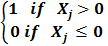 …, (2)
This process gives
the probit model;
Where
Y = Membership of the
Association (yes =1, no = 0)
 = Age (years)
 = Marital Status
 = Years of formal education (years)
 = Household size (number)
 = Monthly income (naira)
 = Access credit (yes =1, no = 0)
 = Size of the farm land (hectares)
 = Years of being a cooperative member (number)
 = Sex (1 = male. 0 = female)
 = Education level (year)
 = Error term
5.0. RESULTS
AND DISCUSSIONS
5.1.
Descriptive Statistics
The result
of the descriptive Statistics was shown in table 1.
From the
table (i), the percentage of male respondents was 62.16% while the female
respondents were 37.84%, this showed that male farmers
respondents were more than the female respondents. The age respondent showed
that 31.35% of the respondents were between the ranges of 21–40years, 37.84%
were between the ages of 41-60years, 23.24% were between the ages of 61-80years
and 7.57% were in the range of 81-100years. This implies that productive ages
of 41-60years are very active in cooperative societies and they are within the
economic active age. Also, 14.05% of the respondents were single, majority of
the respondents with 67.57% were married and 18.38% were divorced. It can be
inferred that the highest percentage of people engaging in cooperatives are
married and in economic productive age. Household size respondents were fairly
large with 54.59% having household size of 1-6 and 45.41% with 6-10 household
size. Farmers in the study area are
experienced in their farming activities, with 45.95% having 11-15years of
farming experience, 29.19% having 6-10years experience and 24.86 having
1-5years experience. The respondents are highly educated with 91.89% of the
respondents having primary, secondary or tertiary education, with only 8.11% of
the respondents having no education at all. Participation in farming as a
primary occupation in the study area has declined, with 57.84% of the
respondents claiming that non-farming activities is their primary occupation
while 42.16% of the respondents see farming as their primary occupation. Despite the decline in participation in
farming activities, about 39.46% of the respondents generated their income
directly from agricultural activities, 29.73% derived from non-agriculture
activities while 30.81% opined that they generate their income from both
sources. Credit access is very poor among the farmers, as 64.86% of the
respondents have no access to credit, while 35.14% have access to credit.
Extension access is fairly good with 51.35% having access to extension services
while 48.65% have no access. Participation in cooperative associations is high
among the respondents with 76.33% of the respondents as active members of
co-operative associations while 23.67% are non-members of any co-operative
association. Sample farmers in the study area has vast experiences in
co-operative association, as 36.76% of the respondents having 6-10 years of
experience, 25.41% having 11-15 years of experience, 23.78% having 1-5 years of experiences and
14.05% having more than 16 years of experience. The level of income of the
respondents varies across the study area, where 42.16% of the farmers earned
between 60,000- 80,000 naira monthly income, 23.24% earned between
40,000-60,000 naira, 16.22% earned between 20,000-40,000 naira monthly while
the least income earners are people with less than 20,000 naira monthly income
being 4.32%. The level of income of the farmers in the study was fairly large
with 42.16% being the highest earners.
5.2.
Effects of Co-operative Associations’ Membership on Farmers’ Livelihood Incomes
The Probit
regression model was used to determine the effects of co-operative associations
on farmers’ livelihood incomes. The
results show that age, gender, educational status, level of income, access to
credit and size of the farm were the explanatory variables that significantly
affect participation in cooperation associations either positively or
negatively. While household size, contact with extension agents, marital
status, and primary occupation on the other hand did not affect cooperation
significantly.
The coefficient of age had a positive
relationship with participation in cooperative and significant at 1%. This
implies that as the farmers get older, the probability of participating in
cooperative associations increases, because old age is a synonymous or proxy
with farmers’ experience and farmers are getting exposed to different types of
opportunities as they are ageing on the job. Also, sex had a positive
relationship with participation in cooperative associations at 1% level of
significance. The coefficient of sex increases probability of participation by
26%. This means that, male farmers were active in cooperative societies than females farmers and this justifies the dominance of male
farmers in the study area. The coefficient of years of education had a positive
relationship with farmers’ membership of association and was significant at 5%, this showed the positive contribution of education
attainment to co-operative association membership. Number of years spent in
school increase the probability of participating in cooperative activities by
11%. This means that, enlightened and educated farmers see more benefits in
joining cooperative association than people that are not educated. The
coefficient of income level has a negative relationship with participation in
cooperative associations and was significant at 10%. This is in conformity with
general beliefs that low capital farmers or individuals cherish becoming
co-operative association members, hoping that huge financial benefits will come
from their participation. Farmers with large financial base can stand on
his/her own without any alignment with any social organizations. Size of the
farm had a positive relationship with participation in cooperative at 5% level
of significant, which implies that a unit increase in the probability of farm
size by one acre will increase the probability of the land. Size of the farm
increases the probability of being in farming at 66% because almost half of the
members of the cooperative societies were involved in farming activities, but
majority of the members are benefitting from agricultural activities like crop
and livestock rearing, fish culturing etc.
5.3. Challenges
Facing Agriculture Co-operative Association in the Osun
State, Nigeria
Table
3 showed the problems and challenges faced by agriculture co-operative
association members in the study area. The challenges are ranked in order of
the frequency. Nearly all the sample farmers (96%) agreed that the purpose of
joining co-operative associations is to gain access to government credit or
finances but were unable to benefit from it despite the years they have been
there. This is closely followed by lack of government assistance (87%), where
they said besides credit, other government assistance didn’t reach their groups
or localities. Diversion of incentives/aids (83%) either from government or non-governmental
organization is another challenge identified by the farmers. Uncommitted
membership (65%) and poor leadership nearly have the same percentage as
indicated by the farmers. (55%) of the sampled farmers opined that members and
executives hoarded some relevant information from each other, as they complain
about preferential treatment and favouritisms among
themselves. This boils down to the lack of trust and sincerity (43%) as
indicated by their response.
5.4.
Conclusion and Policy Implications
This study analyzed the
generality and efficacy of participation in agricultural cooperative
associations and its effects on livelihood income in Osun
State, Nigeria. It was find out that cooperatives are to some extent limited
but that they are effective in improving rural incomes and reducing rural
poverty. Our findings indicate that there are some challenges facing members of
agriculture co-operative associations in the study area. Some of the challenges
include, leadership problem, reduction in the level of trust in association,
poor or inaccessible government assistance, hoarding of relevant information
among members, corrupt activities among others. For a region where more than
half of the rural population is poor, these are important effects and challenges.
This study is in support of the emphasis on agricultural cooperatives as an
institutional vehicle to boost the smallholder farm sector in Nigeria. The formation and management processes encourage democratic
decision-making, economic advancement, leadership development and education.
The public-private partnership between farmers, NGO and government will enhance
knowledge of the roles co-operatives play as a tool for improving the
socioeconomic well-being of the rural community and helping to boost the rural
quality of life. All agricultural co-operative associations have considerable
potential to fill the social-economic vacuum through the provision of goods,
services and employment, which are needed in rural communities to increase
farmers’ performance and income. This is similar to findings in Rwanda on
literature where on contract-farming is a widely studied institutional
innovation. While there is a growing amount of recent evidence that
contract-farming has a positive effect on farm performance and farmers’ welfare
(Bellemare, 2012; Dedehouanou
et al., 2013; Rao
and Qaim, 2011).
5.5. Recommendations
Based on the findings of this study, the following recommendations are
made:
There should be establishment and re-invigoration of existing
traditional and rural financial institutions for rural farmers, so as to make
the accessibility of credit for their respective venture easier and closer to
their localities. Agriculture
co-operative associations should integrate adult education as part of their
empowerment programmes, so as to boost the literacy level of the rural farmers
and increase their chances of getting social and economic inclusion. Existing
agricultural co-operative associations that are not registered should be
registered with the new ones. The registration will bring them recognition in
the state and disciplined executive members should be appointed in coordinating
their affairs. Agriculture co-operative associations should also seek for more
innovative programmes that will boost economic status of rural members,
programmes such as fish smoking, bee keeping, cattle ranching, and other modern
post-harvest technologies, this will enable rural people to attain
self-reliance as well as boosting their income. The importance of extension
services to effective economic empowerment cannot be over-emphasized, and as
such, the moribund extension services in the state should be re-invigorated.
This will help in disseminating relevant information to groups and associations
and mobilization of the groups in their respective locations will be easier.
Table 1:
Socio-economic characteristics of the Respondents
|
Variables
|
|
Frequency
|
Percentage
|
|
SEX
|
Male
Female
|
115
070
|
62.16
37.84
|
|
AGE
|
21-40
41-60
61-80
81-100
|
058
070
043
014
|
31.35
37.84
23.24
07.57
|
|
MARITAL STATUS
|
Single
Married
Divorced
|
026
125
034
|
14.05
67.57
18.38
|
|
HOUSEHOLD SIZE
|
1-5
6-10
|
101
084
|
54.59
45.41
|
|
FARMING EXPERIENCE
|
1-5
6-10
11-15
|
46
54
85
|
24.86
29.19
45.95
|
|
EDUCATION LEVEL
|
No Education
Primary
Secondary
Tertiary
|
015
028
044
098
|
8.11
15.14
23.78
52.97
|
|
PRIMARY OCCUPATION
|
Farming
Non-farming
|
078
107
|
42.16
57.84
|
|
SOURCE OF INCOME
|
Agricultural
Non-Agricultural
Both
|
73
55
57
|
39.46
29.73
30.81
|
|
ACCESS TO CREDIT
|
Yes
No
|
065
120
|
35.14
64.86
|
|
ACCESS TO EXTENSION
|
Yes
No
|
095
090
|
51.35
48.65
|
|
INCOME LEVEL
|
<₦20,000
₦20,001-₦40,000
₦40,001-₦60,000
₦60,001-₦80,000
>₦80,000
|
008
030
043
078
026
|
04.32
16.22
23.24
42.16
14.05
|
|
MEMBERSHIP OF COOPERATIVE
|
Yes
No
|
164
021
|
76.33
23.67
|
|
YEARS IN COOPERATIVE ASSOCIATION
|
1-5
6-10
11-15
16 and above
|
44
68
47
26
|
23.78
36.76
25.41
14.05
|
|
Total
|
|
185
|
100
|
|
|
|
|
|
Source: authors’
computation,
Table 2: Factors
affecting Farmers Participation in Cooperative Associations in Osun State
|
Variables
|
Marginal Value
|
Std. Errors
|
p>/Z/
|
|
Age
|
0.2663
|
.04771
|
0.000***
|
|
Sex
|
0.2575
|
.08184
|
0.002**
|
|
Marital status
|
-0.0169
|
.08922
|
0.850
|
|
Education (years)
|
0.1089
|
.05543
|
0.038*
|
|
Household size
|
-0.0113
|
.03727
|
0.761
|
|
Primary occupation
|
0.04761
|
.08841
|
0.590
|
|
Level of income (monthly)
|
-0.0559
|
.03264
|
0.087*
|
|
Size of the farm
|
0.0662
|
.03503
|
0.059*
|
|
Access to extension
|
0.04231
|
0.7954
|
0.4381
|
|
Access to credit
|
0.0614
|
0.3218
|
0.053*
|
|
Number of observation
|
185
|
|
Pseudo R Square
|
0.7543
|
|
Log likelihood
|
-149.962486
|
Source: authors’ computation, 2018 Sig.
***1%, 5%**, and 10%*
Table 3: Ranking of
the Challenges facing Participation in Co-operative Association in the Study
|
S/N
|
Challenges faced
|
Percentage
|
|
1.
|
Poor/inadequate credit access
|
96%
|
|
2.
|
Lack of government assistance
|
86%
|
|
3.
|
Diversion of incentives/aids
|
83%
|
|
4.
|
Uncommitted membership
|
65%
|
|
5.
|
Poor leadership
|
63%
|
|
6.
|
Information Hoarding among members
|
55%
|
|
7.
|
Lack of Trust and Sincerity
|
43%
|
|
8.
|
Social status and discrimination
|
24%
|
Source: Field Survey, 2018
REFERENCES
Adewakun, A.
(2012), Cooperative as tool for enhancing financial inclusion, African
Newspaper of Nigeria, Oct.13, P1.
Adeyemo, R. and Bamire, A.S. (2005). Savings and Investment Patterns of Cooperative Farmers in
South-Western Nigeria. Journal of Social Sciences, 11(3):
183-192.
Agrawal, R., Raju, K. V., Reddy, K.P., Srinivasan,
R. and Sriram, M. S. (2002). Member
Funds and Co-operative Performance. Research Paper,
Indian Institute of Management, State of Andhra Pradesh, India.
Akanji ,O. O. (2006). Microfinance as strategy for
poverty reduction. CBN Economic and Financial
Review, 4(39).
Anyanwu, C. M.
(2004): Microfinance Institutions in Nigeria: policy, practice and potentials.
Paper presented at the G24 Workshop on Constraints it growth in Sub-Saharan
Africa, Pretoria South Africa, 29th – 30th, November.
Bellemare, Marc F. (2012) “As
You Sow, So Shall You Reap: The Welfare Impacts of Contract Farming,” World
Development 40(7): 1418-1434.
Bernard, T., and D.J. Spielman. 2009. Reaching the poor through rural
producer organizations. A study of agricultural marketing
cooperatives in Ethiopia. Food Policy 34(1): 60-69
Bernard, T., and A.S. Taffesse. 2012. Returns to scope? Smallholders’
commercialization through multipurpose cooperatives in Ethiopia. Journal
of African Economies 21(3): 440- 464
Bernard, T., A.S. Taffesse,
and E. Gabre-Madhin. 2008. Impact of
cooperatives on smallholders' commercialization behavior:
evidence from Ethiopia. Agricultural Economics 39(2): 147–161
Chikaire et al (2010) Cooperatives A vehicle for rural development, Imo
State Nigeria Retrieved from http://www.sciencepub.net/nature
Dedehouanou, S.
F. A., Swinnen, J. and Maertens,
M. (2013), "Does Contracting Make Farmers Happy? Evidence
from Senegal". Review of Income and
Wealth, Volume 59, Issue Supplement S1, pages S138- S160.
European Commission (2010).
Employment in rural areas: Closing the job gap. Commission
staff working document. Brussels.
Fadama II Facility in Alleviating Poverty on Food Crop Farmers in
Adamawa State, Nigeria. Global Journal of
Agricultural Research, 1(3):8-15.
FAO (2014) Guide to extension training: The
framework of development. http://www.fao.org/docrep/t0060e/t0060e02.htm
Federal
Ministry of Agriculture and Water Resources (FMAWR). (2015). National Programme for
Food Security,
Federal
Ministry of Agriculture and Water Resources, Abuja, Management Association
of Nigeria Journal, 8 (2), p. 107.
Green, W. H. (1993) Econometric
Analysis, 6th edition. Prentice-Hall, New Jersey.
Gomina A,
(2013) Impact Analysis of Savings and Credit Cooperative Societies in combating
Poverty among Crop Farmers in three Local Government Areas of Niger State,
Nigeria. The School of Postgraduate
Studies, Ahmadu Bello University, Zaria,
Hazell,
P., C. Poulton, S. Wiggins, and A. Dorward (2010). The future of small
farms: trajectories and policy priorities. World Development 38(10): 1349-1361
Mavimbela,
P., Masuku, M.B. and Belete,
A. (2010) Contribution of savings and credit cooperatives to food crop
production in Swaziland: A case study of smallholder farmers. African
Journal of Agricultural Research, 5 (21):28682874.
Muchopa et al
(2011). Evaluating Performance by Cooperative Value and
Efficiency. Nigerian Journal of Cooperative
Studies. 2(1), 39 – 54.
National Bureau of Statistics (NBS, 2011)
Annual Socio-Economic Survey: Nigeria Poverty Profile Report. Document produced
by National Bureau of Statistic. Abuja, Nigeria. Retrieved from www.nigerianstst.gov.ng
National Bureau of Statistics (NBS, 2013)
Nigerians living below poverty line:
Retrieved on August 18, 2013, from Nigeria Politics online.
National Fadama
Development Project III (2009). National Cooperative Development Policy
Document, Abuja.
Nkechi, C.O.,
Charles O. and Uchenna (2015): Effects of membership
of cooperative organisations and determinants on
farmer-members’ income in rural Anambra State,
Nigeria. International Journal of
Scientific and Technology Research, 4(8):28-35
Olasunkanmi
and Yusuf, 2014). Resource use efficiency in small scale catfish farming in Osun State, Nigeria. Sky Journal of Agricultural Research 3(1) 037 - 045,
Ojo, O. (2009). Impact
of microfinance on entrepreneurial development: the case of Nigeria: The
International Conference on Administration and Business. ICEA – FAA, 14th –
15th November.The Faculty of Business and
Administration University of Bucharest
Rao,
V., Ibanez, A. M., 2003. The social impact of social funds in
Jamaica: A mixed-methods analysis of participation, targeting, and collective
action in community-driven development. World Bank Policy
Research Working Paper no. 2970.
Skurnik,
S. (2002). The role of cooperative
entrepreneurship and firms in organizing economic activities–Past, Present and
Future. LTA, Issue1,103-124.
Taiwo Abdulahi
Olabisi, Udunze Ugochukwu MacDonald, Agbasi Obianugu Emmanuela. Effect of Cooperative Membership on the Economic Empowerment of
Women in Osun State of Nigeria. International Journal of Business and Economics Research.Vol.
4, No. 2, 2015, pp. 21-29. doi:
10.11648/j.ijber.20150402.11
Van de Walle, D., Cratty,
D., 2002. Impact evaluation of rural road rehabilitation project, The World
Bank, Washington, DC
World Bank (2005) Report on poverty and
hunger across the world. A World Bank document available at www.worldbank.org
World
Bank (2008) Report on Sustainability and poverty in Africa and the world. A
World Bank document available at www.worldbank.org
|
Cite this Article: Fasakin IJ; Popoola OO
(2019). Agriculture Co-operative Associations, Livelihood Income and Rural
Households Welfare in Osun State, Nigeria. Greener
Journal of Agricultural Sciences 9(2): 180-188,
http://doi.org/10.15580/GJAS.2019.2.030419043.
|


