|
Greener Journal of Agricultural Sciences Vol. 9(3), pp. 337-343, 2019 ISSN: 2276-7770 Copyright ©2019, the copyright of this
article is retained by the author(s) |
|
Forest Production, Restoration and Management under
Climate Change
Hyunshik Moon1 and Tamirat
Solomon1, 2*
1Department
of Forest Environmental Resources, Institute of Agriculture and Life Sciences, Gyeongsang National University, Jinju
52825, South Korea
2Department of Natural Resources Management, Wolaita Sodo University, College
of Agriculture P.O.B 138, Wolaita Sodo,
Ethiopia.
|
ARTICLE INFO |
ABSTRACT |
|
Article No.: 080719153 Type: Review DOI: 10.15580/GJAS.2019.3.080719153 |
Many countries in the world are faced with two
diverse but interwoven challenges in the 21st century; feeding a growing
population and how to adapt to climate change. Changes in climate are
recognized as one of the major factors accelerating the degradation of land.
Thus, land degradation either caused by human being or natural factors is
still a continuous process and the coverage of forests is dwindling. To halt
the problem successful, restoration of forest ecosystems using native
species as healthy living systems, capable of adaptation climate change
requires attention. At the establishment phase, tree selection for
rehabilitation however, remains one of the least understood and most often
ignored components where rehabilitation has been done by using exotic tree
species. Therefore, to achieve the successful rehabilitation of degraded
lands, foresters and nursery managers need to reconsider the selection,
production, and out planting of native trees in a dynamic context instead of
the monoculture exotic plantation to create connectivity across landscapes
and building in adaptability for changing climates. |
|
Submitted: 07/08/2019 Accepted: 26/08/2019 Published: |
|
|
*Corresponding Author Tamirat Solomon E-mail: tasolmame@
gmail.com |
|
|
Keywords: |
|
|
|
|
INTRODUCTION
Forest resources across the world have been
increasingly degraded and the rest stressed over the past two decades mainly
due to the factors related with population growth and climate change. Global
total forest area decreased from 4.28
billion hectares to 3.99 billion hectares from 1990 to 2015, with percent
global forest cover dropping from 31.85% to 30.85% (Payn
et al., 2015). Thus, understanding of the complex relationships between a
changing climate, forests and its management is important for the sustainability
of life on the earth.
Climate
change could have significant negative impacts on existing forests (Sedjo & Sohngen, 1998); on
nursery production by heat stress damage, high day and soil temperature,
increasing the water take up and transpiration (Burton, 2016); and also
failures of survival of newly planted seedlings (Paterson et al., 2015). It
presents significant potential risks to forests and challenges for forest
managers (Keenan, 2015). On the other hand, increasing demands of forest
products and services caused by high population growth is also resulting a serious pressure on the area, quality of forest
resources. In the 1800th the world population was 1 billion (Mittal
and Mittal, 2013), and after 2 centuries later, the global population is 7.6
billion, which is expected to reach 8.6 billion in 2030 (UN, 2017).
Survival
of planted trees is an attribute of the quality of planting seedlings used (Nyoka et al., 2018). Production of healthy trees seedlings
(both genetically and physical condition) is one of the key solution to halt
deforestation and sustainability of forest resources. Because, tree growth is a
function of genetic potential of the species and environmental conditions (Koslowski et al., 1991). However, shortage of quality tree
seedlings has been a major constraint in forestry and forest production. For
instance, for the survival of seedlings, root growth potential (RGP) which is
the ability to regenerate new roots and is closely linked to the seedling’s
ability to avoid water stress after planting is important (Duryea &
McClain, 1984; McTague & Tiius,
1996). But, the environmental changes resulted from climate change is limiting
the potential of plants to grow, reproduce and indeed survive through its life
cycle (Martin, 2009). Present synthesis is an attempt to compile existing
information on the forest production and management under
the changing climate; impacts of climate on the rehabilitation process,
survival of seedlings, and approaches for the sustainable management of forests
including choices of species for the forest production and development.
Tree
Nursery Production for Restoration and Climate Change
The climate appears to be changing faster
than plants can adapt (Williams
and Dumroese, 2014). Thus, the concept and
understanding of climate change together with the problem it poses at present
and future, is taken seriously across the world. Climate change is affecting
forests though effects on nursery, weeds, soils, insects, invasive species and
disease. In terms of nursery production the main climatic variables that are
important includes temperature, solar radiation, water, and atmospheric CO2
concentration. As plant growth is driven by environmental factors, any change
to the environment will impact on production of plants specifically tree
nursery.
Tree
nurseries are vital to the existence and well-being of our environment to live
in. Beside to being a source of employment for the societies, tree nurseries
are the main sources of healthy seedlings. Thus, cultivation according to
physiological guidelines is essential to produce plants with maximum survival
and growth potential (Lavender, 1984). Actually, the production and growth of
seedlings depends on the environmental condition. For instance, successful
seedling establishment and growth depends on the soil condition and the stored
soil moisture to ensure survival into the next growing season (Warren et al.,
2005). Environmental factors such as light, moisture, nutrients, density, and
temperature and plant physiological factors such as carbohydrate reserves,
hormone levels, frost hardiness, and dormancy interact to shape growth and
survival of seedlings in nursery fields and after out planting (Lavender, 1984).
Therefore, in the nursery the production of trees which survive is considered
more important and more likely to succeed than trying to influence the
long-term growth of the stand (Donald, 1979).
In recent years the attention of ecologists, researchers and scientists given to the impact of climate change on the forests and the management strategies aimed at assisting forests to adapt to climate change. However, it’s seldom observed that implementation of these strategies to the sources of forest plants specifically tree nursery production. The increasing severity of climate impacts and vulnerability of forest ecosystem mean that the sources of planting materials to maintain the sustainability of forest and its management need more attention. Thus, we need to develop a range of flexible strategies to ensure sufficient volume of planting materials (Broadhurst
et al., 2016); to give a wider recognition throughout the industry and meet the planting objectives sustainably (Whittet et al., 2016).Artificial Regeneration of Degraded Lands, Seedlings
Survival and Climate Change
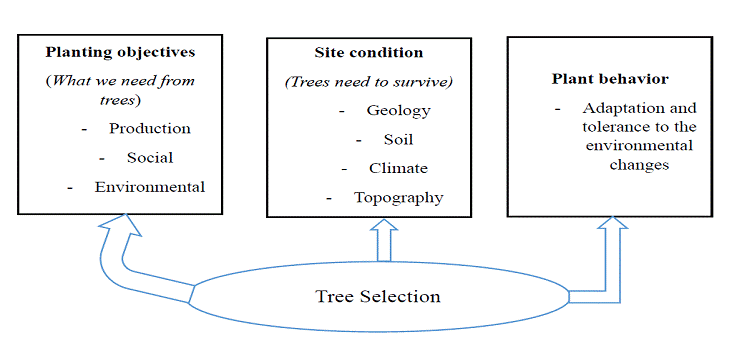
Choice of Species for successful Forest Rehabilitation in
the changing climate
FAO (2001). Global forest resources assessment 2000. FAO
Forestry Paper No.140. FAO, Rome, Italy.
Grossnickle SC (2005a). Importance of root growth in overcoming planting stress. New For 30:273–294.
Reubens B, Moeremans C, Poesen J, Nyssen J, Tewoldeberhan S, Franzel S, Deckers J, Orwa C, Muys B (2011). Tree
species selection for land rehabilitation in Ethiopia: from fragmented
knowledge to an integrated multi criteria decision approach. Agroforestry
Systems, 82:303–330. Roy HE, Bacon J, Beckmann B, Harrower CA, Hill MO, Isaac, NJB, Preston, CD, Rathod, B, Rorke, SL, Marchant, JH, Musgrove, AJ, Noble, DG, Sewell, J, Seeley, B, Sweet, N, Adams, L, Bishop, J, Jukes, AR, Walker, KJ, Pearman, DA (2012). Non-Native Species in Great Britain: establishment, detection
and reporting to inform effective decision making. FRP -
Final Report. Pp 110 Sanderson EW, Jaiteh M,
Levy MA, Redford KH, Wannebo AV, Woolner
G, (2002). The human footprint and the last of the wild. BioScience 52(10): 891-904. Sarah P and Zonana M (2015). Livestock redistribute runoff and
sediments in semi-arid rangeland areas. Solid Earth6: 433–443. https://doi.org/10.5194/se-6-433-2015. Schiappacasse I, Nahuelhual L, Vasquez F,
Echeverria C (2012). Assessing the benefits and costs of dryland forest restoration in central Chile. Journal
of Environmental Management 97: 38–45. https://dx.doi.org/10.1016/j.jenvman.2011.11.007. Sedjo R and Sohngen B (1998). Impacts of Climate Change on
Forests. Internet edition. Resources
for the Future. Pp 1-8. Shimamoto CY, Padial AA, da Rosa CM, Marques MCM (2018).
Restoration of ecosystem services in tropical forests: A global meta-analysis. PLoS ONE 13(12): e0208523. https://doi.org/
10.1371/journal.pone.0208523. Simula M, El-Lakany H and Tomaselli I (2011). Restoration,
rehabilitation, reforestation and plantations. International
Tropical Timber Council. Summary Report. La
Antigua Guatemala, Guatemala. Solomon T and Moon H (2018). Expansion of exotic tree
species and impacts on management of the indigenous trees; emphasis on
eucalyptus species in Wolaita, South Ethiopia - a
review. International Journal of Research and Review.
2018; 5(1):15-20. Thomas E, Jalonen R, Loo J, Boshier
D, Gallo L, Cavers S, Bordács S, Smith P, Bozzano M (2014). Genetic considerations
in ecosystem restoration using native tree species. Forest Ecology and
Management 333 (2014) 66–75. Uhl C, (1988). Restoration of Degraded Lands in the Amazon
Basin. In: Wilson E.O. and Frances M. Peter (Eds.). Biodiversity.
Washington (DC): National Academies Press (US); 1988. ISBN-10:
0-309-03783-2ISBN-10: 0-309-03739-5 United Nations (2017). The world
population prospects. Department of Economics and
Social Affairs. New York. Wang J and Meng J (2018). Identifying
indigenous tree species for land reforestation, forest restoration, and
plantation transformation on Hainan Island, China. J. Mt. Sci. 15: 2433.
https://doi.org/10.1007/s11629-018-4861-1. Warren JM, Meinzer FC,
Brooks JR and Domec JC (2005). Vertical
stratification of soil water storage and release dynamics in Pacific Northwest
coniferous forests. Agric. For. Meteorol. 130: 39-58. Watt MS, Kriticos DJ, Alcaraz S, Brown AV, and Leriche
A (2009). The hosts and potential geographic range of Dothistroma
needle blight. Forest Ecology and Management 257:1505–1519. Whittet R, Cottrell J, Cavers S, Pecurul M, Ennos R (2016). Supplying trees in an era
of environmental uncertainty: Identifying challenges faced by the forest
nursery sector in Great Britain. Land Use Policy 58: 415–426. doi: 10.1016/j.landusepol.2016.07.027. Williams MI and Dumroese RK
(2014). Role of climate
change in reforestation and nursery practices. Western Forester.
59(1): 11-13. Wyk GV, Pepler D, Gebrehiwot K, Aerts R, and Muys B (2006). The potential and risks of using
exotics for the rehabilitation of Ethiopian dry land forests. Journal of the
Dry lands 1(2): 148-157. Yirdaw E, Tigabu M, Lemenih M, Negash M, and Teketay D (2014). Rehabilitation of
degraded forest and woodland ecosystems in Ethiopia for sustenance of
livelihoods and ecosystem services. In: Katila
P., Galloway G., de Jong W., Pacheco P., Mery G.
(Eds.). Forests under Pressure – Local Responses to Global
Issue. IUFRO World Series Volume 32. ISBN 978-3- 902762-30-6. pp. 299–313.

|
Cite this Article: Hyunshik,
M; Tamirat, S (2019). Forest Production,
Restoration and Management under Climate Change. Greener Journal of Agricultural Sciences 9(3): 337-343, https://doi.org/10.15580/GJAS.2019.3.080719153
|