|
Greener Journal of
Agricultural Sciences
Vol. 9(4), pp. 466-472,
2019
ISSN: 2276-7770
Copyright ©2019, the
copyright of this article is retained by the author(s)
https://gjournals.org/GJAS
|

|
Rural
Farmers Participatory Soil Quality Assessment in Ibiono
Ibom Area, Akwa Ibom State, Nigeria.
Kamalu, Onyinyechi Jas.1; *Ndeh,
Aniebiet
Bassey2
Crop and Soil Science Department, University
of Port Harcourt, P.M.B. 5323 Port Harcourt, Rivers State, Nigeria.
Emails: onyikamalu@ gmail. com1; aniebietabasi4jesus@ gmail.
com2
|
ARTICLE INFO
|
ABSTRACT
|
|
Article
No.: 121319215
Type: Research
|
This study centered
on rural farmers’ participatory soil quality assessment in eight communities (Ibiaku Osuk, Ikot Usen,
Use Ndon, Ikpa Ikot Uneke, Ibiaku
Ikot Usan, Use Ikot Amama, Edem
Uraua and Oko-Ita) of Ibiono Ibom Local Government
Area of Akwa Ibom State.
The approaches employed were on-farm and household interviews. The study was
based on administration of questionnaires and focus group discussions. A
total of sixty (60) farmers were involved in the study. The rural farmers in Ibiono Ibom area consider soil
quality in relation to the following aspects: visual appearance (soil colour
and organic matter), Ease of tillage operation (soil texture), land forms
(slope, erosion threat, drainage) and History of the land (fallow period,
past yield record and prevalent weed in the area). The farmers in Ibiono Ibom have three soil
quality classes using colour as index. These classes are: Obubid Isong (black or dark soil) which is
ranked to be the best in terms of productivity, Idaidat Isong (red or dark brown soil)
and Isong
Mbat (gray bleached, heavy and poorly drained). Based on
texture, the soils were classified as; Isong Mberi (presence of high organic matter
and very easy to till), Isong ntan/ adan ntan (soils high in
sand content) which soil type is believed to be a bad soil because it does not
have a good water retention capacity, leaching of nutrients easily occur and
organic matter content is low, Isong Mbat/Aduang Isong
(soils high in clay content and poorly drained) and Ikon-eto (hard soils, often
characterized by the presence of stones and tree stumps). The ranking of soil
properties as soil quality determinant in the area was of the descending
order; Colour and Past Harvest record > Texture > Vegetation >
Fallow period > Topography > Location > Ease of Tillage > Drainage.
|
|
Accepted: 14/12/2019
Published: 25/12/2019
|
|
*Corresponding
Author
Ndeh,
Aniebiet Bassey
E-mail:
aniebietabasi4jesus@ gmail.com
|
|
Keywords: soil quality; soil quality determinants; rural farmers’
perspective; productivity ranking
|
|
|
|
INTRODUCTION
Rural
farmers’ perspective is a central paradigm in the management of soil quality
for sustainable productivity. Soil quality is the capacity of the soil to
function as a vital living system to sustain biological productivity, promote
environmental quality, and maintain plants and animal health (Doran, 2002).
Healthy soils comprise the integration of physical, chemical and
biological components that requires holistic management approaches aimed at
optimizing the multiple functions of soil (Doran and Parkin,
1994). Over the years, the indicators of soil quality
commonly used are largely based on scientific methodologies. Local farmers’
perception which is a rapid and less expensive tool in soil quality assessment
has not been considered. Information on rural farmers’ perception is lacking in
Ibiono Ibom area and
therefore, there is a pressing need for this study. Integration and harnessing
knowledge from within and between scientific and local knowledge bars will
enable communities to fully realize their capacity and become involved in
monitoring and responding to the challenges of soil degradation (Reed et al.,
2007). Regardless of the impacts of climate variables on soil degradation,
farmers’ view and knowledge of soil is a significant production factor (Winter, 1997). In-depth knowledge of soil processes by
farmers reflects sound soil management and vice versa (Omari
et al., 2018). Rural farmers’ perception
on soil quality can be assessed without any cost and based on
observation without any laboratory analysis rather than conventional soil
quality assessment which is very expensive and not generally acceptable and
socially accessible in the rural society. Also, rural farmers find it very
difficult to implement farming principles that they were not carried along
during the development of such principles. Rural farmer’s perception on soil
quality will enable rural farmers in Ibiono Ibom Area to have hands on knowledge about the quality of
soils in the area and will serve as a guide in choosing a particular land for
specific crop(s). This information will also serve as a guide to other land
users in the area. This study is aimed
at evaluating the rural farmers’ perception on soil quality in Ibiono Ibom Area which will help
to increase crop yield output at the community level as well as increasing the
bulk of knowledge on soil quality assessment.
MATERIALS AND METHOD
Site Description
The
study was conducted in eight communities (Ibiaku Osuk, Ikot Usen,
Use Ndon, Ikpa Ikot Uneke, Ibiaku
Ikot Usan, Use Ikot Amama, Edem
Uraua and Oko-Ita) of Ibiono
Ibom Local Government Area of Akwa
Ibom State, Nigeria, with its headquarters at Oko-Ita. Ibiono Ibom is bounded by Cross River State, Itu,
Arochukwu (Abia State), Abak and Ini
local government area. Ibiono Ibom
occupies a land mass of 2761.76sq.km, with a total population of 385,145. It
consists of 9 clans, 33 groups and 193 villages. It has coordinates; 5014’0’
N 7053’0’E / 5.233330N 7.883330E. The average
temperature of the area is 250C and the area witnesses two distinct
seasons which are the dry and rainy seasons and has a number of rivers and
tributaries flowing within its territory. The average humidity level of Ibiono Ibom is 85% while the wind
speed is at an average of 10km/h. The
main ethnic group of Ibiono Ibom
is the Ibibio people, who speak a dialect of the Ibibio language. The land use
pattern of the area is in this order; agricultural, residential, transport,
commercial and residential. Mineral resources include deposits of various
stones, clay, sand and crude oil. There are forest resources such as palm
trees, rubber, timber and others. The dwellers are predominantly farmers,
traders and craftsmen.
Data collection
The
approaches employed were on-farm interview and household interview. Data for
the study was based on interviews (through questionnaire administration) and
focus group discussions. Questionnaires were administered randomly to 50
households in selected communities. The sample unit was the farm household with
the head of the household or the person who takes farm management decisions as
the respondent. Questionnaires comprised both demographic data and soil
knowledge data collection. Information was gathered on age, gender, educational
status, ethnic origin and participation in farmer groups during the
administration of the questionnaires. Soil knowledge data was collected via
semi-structured questions pertaining to perception of local soils, for
instance, ‘How would you describe a good/fertile soil? What do you consider in choosing a land for
the cultivation of a particular crop? How do you improve and maintain the
fertility of the soil on your farm? How and why do you assess your farm soil
before planting? Do you practice bush burning? How do you manage/ control
pests, diseases, weeds and erosion in your farm?
RESULT
AND DISCUSSION
Rural
Farmers’ Soil Quality Perception in Ibiono Ibom Area
The
farmers in Ibiono Ibom area
consider soil quality in relation to the following aspects: visual appearance
(soil colour and organic matter), Ease of tillage
operation (soil texture), land forms (slope, erosion threat, drainage) and
History of the land (fallow period, past yield record and prevalent weed in the
area).
According
to the people of Ibiono Ibom
Area, a soil is considered to be a bad soil, if it does not have good water
retention capacity, high level of organic matter, ease of tillage operations,
low erosion risk, dark coloration (sometimes) as well as high yield and
productivity. The reverse is the case for a good and productive soil. The rural
farmers noted that bad soils could contain high amount of organic matter which
make them fertile but they are not productive due to its waterlogged nature and
ability to release the nutrients to plants. A good soil may not be as fertile
as the poorly drained soils but it has the ability to release nutrients for
plants uptake. The features of these soils are summarized in the Table 1.1
below;
Table
1.1: The Rural Farmers Rating of Soils as Bad, Moderate and Good
|
Features
|
Bad Soil
|
Moderate Soil
|
Good Soil
|
|
Colour
|
Gray and white sand
|
Brown and red
|
Black
|
|
Texture
|
98%
clay or sand
|
70 - 85 % sand
|
40 - 60% sand, 20 – 30% clay
|
|
Organic matter content
|
High
|
Moderately low
|
Very high
|
|
Drainage
|
Very poor
|
Moderately poor
|
Well drained
|
|
Ease of tillage
|
Very difficult
|
Slightly difficult
|
Easy to till
|
|
Crops
|
Cocoyam
|
Cassava and cocoyam.
|
Vegetables, cassava, cocoyam, yam, maize
melon.
|
|
Fertility
|
Fertile
|
Slightly Fertile
|
Very Fertile
|
|
Productivity
|
Very low
|
Moderately low
|
High and Heavy high
|
Ranking
of Rural Farmers’ Soil Quality Determinants in Ibiono
Ibom Area
Various properties employed by
the rural farmers in the assessment of soil quality are presented in Table 1.2.
The properties considered by the farmers in soil quality assessment were soil colour, soil texture, ease of tillage operations, past
yield record, topography and fallow period, location of the farm, drainage and
vegetation.
The
farmers in Ibiono Ibom have
three soil quality classes using colour as index.
These classes are: Obubid
isong (black or dark soil) which is ranked to
be the best in terms of productivity, Idaidat isong (red or dark brown
soil) and Isong
mbat (gray
bleached, heavy and poorly drained).
Based
on texture, soil in Ibiono Ibom
area are classified according to the rural farmers as; Isong mberi (soils that are characterized by the presence of high organic
matter and very easy to till ), Isong ntan/
adan ntan ( soils high in sand content) which
soil type is believed to be a bad soil because it does not have a good water
retention capacity, leaching of nutrients easily occur and organic matter
content is low, Isong
mbat/ aduang isong (soils high
in clay content or gley / poorly drained soil) and Ikon-eto (hard soils which are difficult or hard for tillage
operation and often characterized by the presence of stones and tree stumps).
Based on soil texture, Isong
mberi is
ranked the best in terms of productivity by the rural farmers.
In Ibiono Ibom area, the quality of
soils for agricultural purposes is tied to organic matter which is mostly
interpreted by the rural farmers in the prevailing colour
of the soil within the locality. The ranking of soil properties as soil quality
determinant in the area was of the descending order; Colour
and Past Harvest record > Texture > Vegetation > Fallow period >
Topography > Location > Ease of Tillage > Drainage.
This
study’s findings correspond to Desbiez et al, (2004) and Omari
et al. (2018). According to their
study, farmers’ indigenous indicators of soil health comprised (i) Biological
indicators: plants (other than cultivated crops) and soil fauna whose presence
or growth indicates a healthy or non-healthy soil; (ii) Soil characteristic
indicators: soil properties which signify the health status of soils; and (iii)
Above ground plant vigor: crop or weed-growth characteristics and yield.
Farmers’ soil quality indicators according to this study are generally limited
to visible and tactile properties of the soil such as color and tilt, similar
to Dawoe et al, (2012) and Barrios et al, (2006)
in southern Ghana and eastern Africa respectively.
Table
1.2 Ranking
of Rural Farmers Soil Quality Determinants in Ibiono Ibom Area
|
Soil Properties
|
No. of farmers
|
Percentage of farmers (%)
|
Ranking of soil Properties
|
|
Soil colour
|
50/50
|
100
|
1st
|
|
Location
|
18/50
|
36
|
6th
|
|
Ease of tillage
|
15/50
|
30
|
7th
|
|
Past Harvest record
|
50/50
|
100
|
1st
|
|
Topography
|
20/50
|
40
|
5th
|
|
Fallow period
|
28/50
|
56
|
4th
|
|
Drainage / flooding
|
5/50
|
10
|
8th
|
|
Soil texture/Soil type
Vegetation
|
40/50
35/50
|
80
70
|
2nd
3rd
|
Rural
farmers soil quality perspective and management of soils in Ibiono
Ibom Area
Farmers in Ibiono
Ibom area put the following management inputs in
place while farming so as to maintain the quality of the soil in the area;
fallowing, mixed cropping, application of organic manure/ mulching, crop
rotation and making bars across the slopes.
Fallowing: In Ibiono
Ibom area, most of the farmers do not apply inorganic
fertilizers as they cannot afford it or/ and some believed that crops planted
with inorganic fertilizers are not always sweet. Hence, the major way of
improving and maintaining soil quality and fertility of soils in the area by
the local farmers is by fallowing. The fallow period ranges from 2 to 7 years
depending on the community and land ownership. Table 1.4 below, indicates the
rural farmers’ productivity rating based on fallow period.
Mixed
cropping: Cultivation of cassava, maize and melon together on the same piece
of farmland is a very common practice in the area. They believed that the melon
will cover the soil surface to reduce evaporation and impact of sunlight on the
soil surface as well as adding nutrient to the soil since it will be harvested
before the cassava.
Application
of Organic manure and Mulching: Since most farmers don’t
use inorganic fertilizer, they use organic fertilizers such as poultry
dropping, manure from the goat pens, cattle dung as well as mulching
waterleaves with Awolowo leaves and other mulching
materials so as to improve and maintain the quality of the soils.
Bars
across the slopes: Erosion which is considered to be
one of the major threats of soil quality by the farmers especially on sloppy
farmlands is controlled by the farmers by making cross bars across the slopes
using weeds, sticks and soil material. The farmers believed that nutrients and
soil losses through erosion are mitigated through this.
Table 1.3: Rural
Farmers’ Soil Quality Classification of Representative Farms in Ibiono Ibom Area
|
Sample
Identity
|
Rural
Farmers’ Soil Quality Description
|
Soil Colour
|
Soil
Texture
|
Drainage
|
Land Use
|
Rural
Farmers’ (Indigenous) Soil Quality
Rating
|
|
Ikot Usen
|
Obubid-Isong
|
Very Dark gray
|
Loamy Sand
|
well drained
|
Cassava and Oil Palm Tree
|
1
|
|
Ikot Usen 2
|
Idaidad-Isong
|
Light brown/ red
|
Sandy loam
|
Moderately drained
|
Newly Harvested Farm
|
2
|
|
Ikot Usen 3
|
Isong Mbat
|
Dark gray
|
Sandy Clay Loam
|
Poorly drained
|
Fallowed Land
|
3
|
|
Ibiaku Osuk 1
|
Obubid-Isong
|
Very dark gray
|
Sandy loam
|
well drained
|
Newly Harvested Farm
|
2
|
|
Ibiaku Osuk 2
|
Obubid-Isong
|
Dark gray
|
Loamy Sand
|
Well drained
|
Cassava
and Oil Palm Tree
|
2
|
|
Ibiaku Osuk 3
|
Isong Mberi
|
Black/ dark soil
|
Sandy loam
|
Perfectly drained
|
Fallowed Land
|
1
|
|
Edem Urua
|
Isong Mberi
|
Black/ dark soil
|
Loam
|
Perfectly drained
|
Cassava, melon and maize
|
1
|
|
Use Ikot Amama
|
Idaided-Isong
|
Light brown/ red
|
Loamy sand
|
Well drained
|
Cassava
|
2
|
|
Use Ikot Amama
|
Isong Mbat
|
Light gray
|
Clayey
|
Poorly drained
|
Cocoyam and water yam
|
1
|
|
Oko-Ita 1
|
Obubid Isong
|
Black
|
Sandy loam
|
Perfectly drained
|
Cassava, Melon, Waterleaf and Maize
|
1
|
|
Oko-Ita 2
|
Obubid Isong
|
Black
|
Sandy loam
|
Perfectly drained
|
Cassava and cocoyam
|
1
|
|
Ikpa Ikot Uneke
|
Isong Mberi
|
Black
|
Loam
|
Well drained
|
Cassava, Maize and Melon
|
1
|
|
Ekput
|
Obubid Isong
|
Dark gray
|
Sandy loam
|
Perfectly drained
|
Cassava
|
1
|
Soil Quality Rating: 1 = Good soil; 2 = Moderate soil; 3 = Bad
soil (Collated Rural Farmer’s Rating)
Table 1.4: Rural Farmers Productivity Rating Based on Fallow
Periods
|
Fallow
Period
|
No. of
farmers
|
Percentage of farmers (%)
|
Productivity rating by
rural farmers
|
|
No fallow
|
7/50
|
14
|
Low
productive
|
|
1 year
|
19/50
|
38
|
Moderately productive
|
|
2- 4 years
|
22/50
|
44
|
Moderately/Very productive
|
|
5-7years
|
12/50
|
24
|
Very productive
|
|
More than 7 years
|
Nil
|
Nil
|
Nil
|
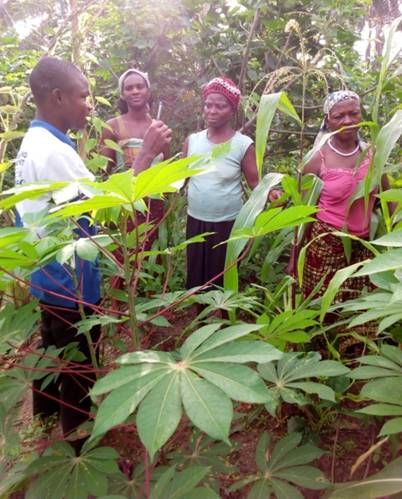
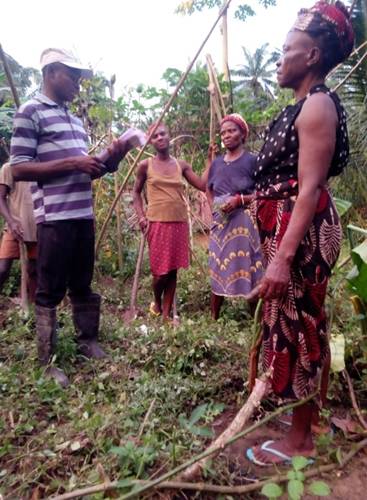
Figure 1:
On-farm interview and Discussions with
some farmers in Ibiono Ibom
Area
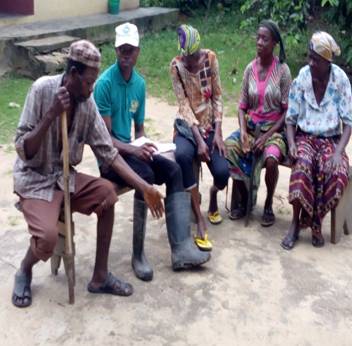
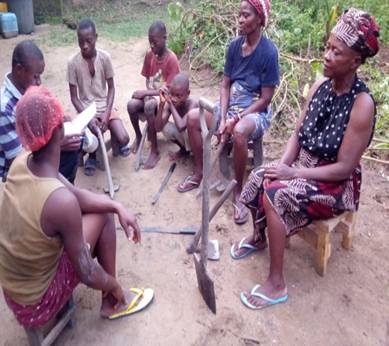
Figure 2:
Household and focused group
participatory soil quality assessment in Ibiono Ibom Area
CONCLUSION
This study
identified rural farmers’ soil quality determinants
and ranking in Ibiono Ibom
area of Akwa Ibom state.
It highlights the key points of farmers’ perceived knowledge of soils management practices, and soil health
indicators. The study findings reveal that farmers are equipped with some local
knowledge that agrees with classical methodologies of identifying healthy
soils. Furthermore, soil management
among knowledge rural farmers is low. Hence it is recommended from this study
that farmers should be sensitized through participatory approach training
programs on management of site-specific on-farm resources. This will offer the
opportunity to examine farmers ’indigenous knowledge for the subsequent
integration with the scientific knowledge for sustainable soil management.
ACKNOWLEDGEMENTS
We will forever remain grateful for the
encouragements and supports of Prof. (Mrs) E. C. Wokoma, Dr.(Mrs.) E. I. Hamadina, Dr (Mrs).
M. O. Adedokun and Dr. B. E. Udom.
We also appreciate
the encouragements and support of Deacon and Mrs. Bassey
Edet Ndeh, Mrs. Franca,
Mrs. Sister Angel, Esther Saunders and Sis. Blessing Esegine.
We also appreciate
our brothers and friends Bassey Samuel, Ndifreke Imeh, Happiness Imeh Ndeh, Godwin Samuel, Saviour Akpan, Mrs. Akon Sunday
Tom, Mrs. Aniekeme Godwin Ndeh
and other rural farmers in Ibiono Ibom
for their contributions and support during the field sampling and interaction
with the farmers. May God bless you all.
REFERENCES
Barrios, E.; Herrera, R. and Valles,
J.L. (1994) Tropical Floodplain
Agroforestry Systems in Mid-Orinoco River basin, Venezuela.
Agrofor. Syst., 28,
143–157.
Dawoe, E.K.; Quashie-Sam, J.; Isaac,
M.E. and Oppong, S.K. (2012) Exploring Farmers’ local Knowledge and Perceptions of Soil
Fertility and Management in the Ashanti Region of Ghana. Geoderma, 179–180, 96–103.
Desbiez, A.; Matthews, R.; Tripathi, B.;
Ellis-Jones, J. (2004)
Perceptions and Assessment of Soil Fertility by Farmers in the Mid-hills of
Nepal. Agric. Ecosyst.
Environ.,
103, 191–206.
Doran, J. W. (2002).
Soil Health and Global Sustainability: Translating Science into Practice. Agriculture, Ecosystem and Environment, 88(2):
119-127
Doran,
J. W. and Parkin, T. (1994). Defining and Assessing Soil Quality. In Defining Soil
Quality for a Sustainable Environment; Coleman, D.C., Bezdicek,
D.F., Stewart, B.A.E., Eds.; Soil Science
Society of America: Madison, WI, USA, Volume 35, pp. 3–21.
Reed, S. C.;
Cleveland. C. C. and Townsend, A. R. (2007). Control over leaf litter and Soil
Nitrogen Fixation in two lowland tropical rain forests. Biotropica 39 ,
585 - 592.
Omari, R. A, Bellingrath-Kimura, S. D., Addo, E. S., Oikawa, Y.,
and Fujii, Y. (Exploring Farmers’ Indigenous
Knowledge of Soil Quality and Fertility Management Practices in Selected
Farming Communities of the Guinea Savannah Agro-Ecological Zone of Ghana). Sustainability.10, 1034.
Winter, M.
(1997) New Policies and New
Skills: Agricultural Change and Technology Transfer. Sociol. Ruralis, 37,
363–381.
|
Cite this Article: Kamalu,
OJ; Ndeh, AB (2019). Rural Farmers Participatory
Soil Quality Assessment in Ibiono Ibom Area, Akwa Ibom State, Nigeria. Greener
Journal of Agricultural Sciences 9(4): 466-472.
.
|