|
Greener Journal of Agricultural Sciences
Vol. 10(3),
pp. 136-144, 2020
ISSN:
2276-7770
Copyright
©2020, the copyright of this article is retained by the author(s)
https://gjournals.org/GJAS
|

|
Cost
Efficiency Analysis of Maize Production Among Rural
Small Scale Farmers in Itesiwaju Local Government
Area (LGA), Oyo State, Nigeria
*Ogunwande Isaac Olusegun; Adesokan Goodness Eniola
Department of Agricultural
and Resource Economics, The Federal University of
Technology, Akure, Oyo State, Nigeria.
|
ARTICLE INFO
|
ABSTRACT
|
|
Article
No.: 081820103
Type: Research
|
Maize is a crop
commonly cultivated in Nigeria and its demand and supply is on the increase
every year, this nevertheless pave the way for involvement of majority of
rural households in every stage of production. The paper explored the cost
efficiency of maize production in Itesiwaju local
government area(LGA) of Oyo State. Primary data was
collected from 173 maize farmers and this was achieved through the use of
copies of well-structured questionnaire and application of multistage
sampling procedure. Data collected were analysed using Stochastic Frontier
Cost Function (SFCF) in determining factors affecting cost efficiency among
farms. Results on socioeconomic characteristics of maize farmers showed the
average quantitative variables age (46 years), household size (8 members),
years of experience (28 years) and number of extension contacts (11 visits)
while the mean seed and agrochemical cost were N1,643.00 and N3,150.00
respectively. Farming experience (p<0.1), extension contacts (p<0.05)
and household size (p<0.1) were found to increase cost efficiency of
farms. Cost variables such as labour (p<0.05), seed (p<0.1) and
agrochemicals also increased the cost efficiency of maize farms. Gamma (ϓ)
showed that about 0.98 percent of the variation in
cost of production was due to factors beyond farmers’ control and sigma
square (σ2) of 1.378(p<0.01) explained the suitability and
appropriateness of the analytical model. The Return to Scale was 1.154 and
the majority of maize farmers had clustered cost efficiency distribution
between the range of 0.51 and 0.99 suggesting being cost efficient in maize
production.
|
|
Accepted: 22/08/2020
Published: 11/09/2020
|
|
*Corresponding
Author
Ogunwande Isaac Olusegun
E-mail: ioogunwande@ futa.edu.ng
|
|
Keywords: Maize; Cost Efficiency; Farmers; Maize Production; Stochastic
Frontier
|
|
|
|
INTRODUCTION
Maize is one of the major cereal crops of the world and the
second most important cereal crop in the world after wheat, contributing
substantially to the total cereal grain production in the world economy as a
trade, food, feed and industrial grain crop (Pingali,
2001; Food and Agriculture Organization, 2009). Developing countries plant
two-third of the global maize production while industrialized countries plant
one-third. None of the top 25 maize-producing countries are from Africa,
producing 17.4 million hectares
amounting to 12.5% of the maize global area (FAO, 2014). Of the 140 million
hectares of maize grown globally, approximately 22 million (15.7%) are in sub-Sahara
Africa, out of this, 17 million hectares are grown in the mid-altitude area and
12.3 million hectares in the tropic lowlands (Pingali,
2001).
The major maize growing countries in Africa are Nigeria,
South Africa, Ethiopia, Kenya, Malawi, Tanzania, Congo, Mozambique and
Zimbabwe, all mainly Eastern and Southern African countries except for Nigeria.
According to FAO (2009), in 2006 alone, African continent cultivated 26
continent cultivated 26,118 million, which increased to 26,726 in 2007 but
reduced marginally in 2008 to 26, 106 million. Based on the FAO (2007)
estimates, 158 million hectares of maize are harvested worldwide; Africa
harvests 29 million hectares with Nigeria as the largest producer in the Sub-Sahara
Africa harvesting 3%, followed by Tanzania. In 2017, maize production for
Nigeria was 10.4 million tonnes though Nigeria maize production fluctuated substantially
in recent years but tended to increase through 1968 to 2017 period ending at 10.4
million tonnes in 2017.Maize Farmers Association of Nigeria (2019) affirmed that
the production of maize increased from eight million tonnes to 20 million
tonnes in Nigeria between 2015 and 2018.
Maize is Africa’s most important cereal, forming a basic
part of the cereal – legume intercropping system is common to most developing
countries’ agriculture (Ofori and Stern, 1987). Being
a very important staple food for millions of Nigerians and residents of West
Africa, maize is one of the two major crops covering about 40% of the area
under agricultural production, and its production accounts for 43% of maize
grown in West Africa (FAO, 2002; Iken and Amusa, 2004; McCann, 2005; Ogunsumi
et al., 2005). Maize production therefore is of strategic importance for
food security and the socio-economic stability of countries and sub-regions in
sub Saharan Africa, including Nigeria (Morris, 1998).
Maize is widely grown across Nigeria. All of the 36 states
and the FCT (Federal Capital Territory) grow maize (Figure 2). Those states
with the highest maize area are Niger, Kaduna, Ogun, Kogi, Taraba, Katsina,
Oyo, Plateau, Ondo, and Kano. Together, these account
for nearly 57% of the total area. In a similar fashion, Kaduna, Niger, Plateau,
Borno, Kano, Ondo, Ogun, Taraba, Kogi,
and Bauchi together account for close to 60% of maize
production in the country. The productivity of maize is extremely variable
among the states. Greater rates of growth were reported for 15 of the 36 states
and FCT between 1994 and 2012. Notable among these were Yobe
(ROG = 7.5%), Katsina (4.8%), Jigawa
(4.2%), Zamfara (2.9%), and Oyo (2.5%). By contrast,
22states had negative growths over the same period– with Kaduna (-6.0%), Taraba (-5.1%), Delta (- 5.1%), Imo (-3.9%), and Plateau
(-3.7%), showing the highest negative growth rates between 1994 and 2012.
Drought Tolerant Maize for Africa(DTMA) under the auspices
of the International Institute of Tropical Agriculture(IITA) reported that,
more than 5.56 million hectares of land planted to maize in 2013 (or about 16%
of all of Africa’s maize area combined) with Nigeria having the right to claim
the position of the giant of maize production in Africa. It stated further that
only Tanzania claims a distant second position with about 4.1million ha. Maize
production in the former country had a humble beginning; it stayed around one
million hectares through the early 1980s but its accelerated growth started in
the mid-1980s when hybrids were introduced, exceeding the 5 million hectares
mark in the mid-1990s following the introduction of early and extra-early
varieties; it declined or remained slow during the late 2000s, mainly due to
drought and erratic rainfall, but picked up thereafter (Figure 1). Currently it
occupies the largest area of cultivated land in the country, followed by
sorghum, cassava, millet, cowpea, yam, rice and groundnut, according to the
National Bureau of Statistics (NBOS). Maize, sorghum, and millet occupied about
5.5 million, 4.9 million, and 2.9 million ha, respectively, in 2012.
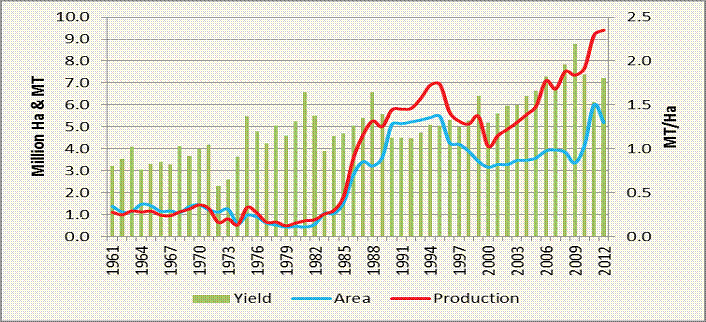
Figure 1: Trend in maize production in Nigeria
Source: Calculated by the authors from
FAOSTAT, Jan 2014)
Zalkuwi et al (2010) analysed maize production in Ganye
local government area of Adamawa State and concluded that farmers in the study
were cost efficient in the allocation of the available resources with an index
of 1.04. Taiwo et
al (2011) worked on economic advantage of hybrid maize over open pollinated
maize in Giwa local government area of Kaduna State
and based on their result concluded that farmers using hybrid seed were more
efficient than farmers using open pollinated seed. Olayemi
(2004) and Koutsyannis (1988) established that the
technical transformation of input to output is at a cost to farmers and the
return on investments by a farmer should exceed production cost for the farmer
to make profit and still operate as a player in the industry. They established
further that, cost of production is disaggregated into variable and fixed cost;
the former varies with the scale of production and remained varied over the
entire production horizon while the latter does not vary with the scale of
production but varied in the long run. They concluded that, in the long run,
all costs are variable. Northern Nigeria which is mostly savannah, favours
maize production and the cited researches above were
from the area. However, this study was being carried out in the Southern
Nigeria with more rainfall in order to find out whether farmers in the
rain-forest of the country are cost efficient in maize production or not. This
study hopes to contribute substantially to the existing literature in the area
of assessment of cost efficiency frontier attainment among small farmers and
the need to encourage farmers to join the industry.
This study among others hopes to answer the following
research questions: What are the socioeconomic characteristics of maize farmers
in the study area? Are maize farmers in the study area cost efficient? What are
the constraints associated with production of maize in the study area? The following
questions among others are hoped to be answered in this study through the
following specific objectives, which are to: describe the socioeconomic
characteristics of maize farmers; identify the determinants of cost efficiency
among rural small scale maize farmers and examine constrains militating against
maize production in the study area.
Hypothesis
of the Study
This study is built on the null hypothesis that:
There is no significant
relationship between the cost of production of maize and selected socioeconomic
characteristics.
MATERIALS AND METHODS
Study Area
The study area was Itesiwaju local government area (LGA) of Oyo State. The
headquarters is Otu. It has a total land area of 1,543km2
and a population of 128,652(NPC, 2006). Itesiwaju LGA
is bounded to the North by Atisbo LGA, to the West by
Kajola LGA, to the East by Atiba
and Oyo West LGAs and to the South by Iseyin LGA. It
is about 115km from Ibadan, the State capital but completely located in the
guinea savannah area of the State and based on political affiliation, belongs
to Oyo North Senatorial District (Oyo State Diary, 2018). The average annual
rainfall and temperature are about 1450mm and ±26.50C respectively;
this paves the way for good edaphic qualities of retaining surface feeder crop
needing nutrients at the top-most ground level for accessibility of nutrients
by plants. The rainfall regime in the area is bimodal and the distribution is
dense in the southern part and sparse in the northern part. The indigenes of
the LGA are predominantly farmers practising either on part time or full time
basis. Yoruba is the major occupants of the area but playing host to other
tribes from other regions such as Hausa, Fulani, Egede
and foreigners from the neighbouring countries among others. Itesiwaju LGA government area belongs to Oke-Ogun zone in the State where massive production takes
place and as such called the food basket of the State.
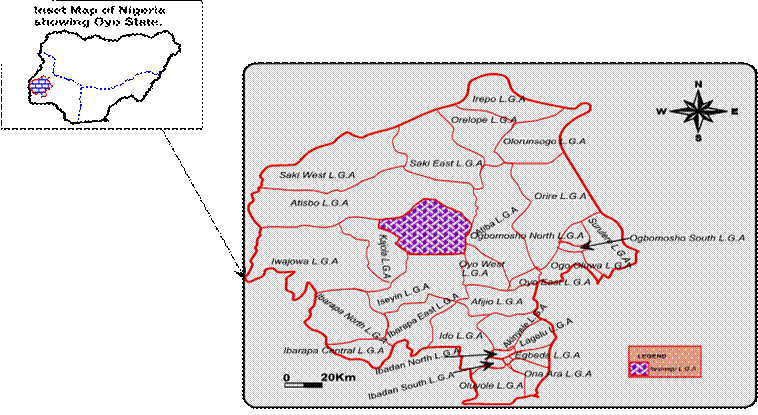
Figure 2: Map of Itesiwaju local government area (LGA) of Oyo State
Type of
Data and Instrument of Data Collection
Data used for this study was strictly from primary source
and the instrument of data collection was well-structured copies of
questionnaire and interview guide. Data relating to the socioeconomic
characteristics and cost profile of farmers were collected, among them are:
age, years of experience, level of education, cost of land, cost of
agrochemicals, cost of seed and cost of labour among others.
Data
Collection Technique
A multistage sampling procedure was used in collecting data
for the study. The first stage was the purposive selection of Itesiwaju LGA from the thirteen (13) LGAs of Oke-Ogun senatorial district which is the food basket of
Oyo State (Assessment and Poverty Rating Report, 2005) and characterised with
heavy concentration of small scale maize farmers. Purposive selection of six
spatially located noticeable towns in Itesiwaju local
government area was done and these are: Babaode, Gbonkan, Ipapo, Oke-Amu, Otu, and Okaka, this forms the second sampling stage. The third
sampling stage was the random sampling of 30 respondents from each of the
selected towns, Total sampling size was 180 respondents who were reached and
interviewed. Eight of the responses were rejected due to bias and
inconsistency. A total of 173 responses were eventually used for the study.
Analytical
Tools
Cost
Efficiency
The cost function representing the
dual approach in the technology is seen as a constant towards the optimizing behavior
of firms (Chambers, 1983). In the context of the cost function, any error of
optimization is taken to translate into higher cost for the producers. However
the stochastic nature of the production frontier would still imply that the
theoretical minimum cost frontier would be stochastic (Coelli,
1996). The stochastic frontier cost functions model for estimating
farm level overall economic efficiency is specified as:
Ci = g(Yi
, Pi ,; α) + εi 1
i = 1,2…n
This is explicitly stated as:
C = α0+α1P+α2P+α3P+α4P+α5P
+Y*+(Vi + Ui) 2
Where the variables are selected based on the work of Ogundari and Ojo (2006) and Ogundariet al (2006) thus:
C
= total cost (in Naira);
P1 =
Farm-land Acquisition cost(in Naira);
P2
= Labour Cost (in Naira);
P3
= Seed Cost (in Naira);
P4
= Fertilizer Cost (in Naira);
P5
= Agrochemicals Cost (in Naira);
Y*=
Total Farm output (in kg);
εi = Error term.
where
εi=
Vi + Ui 3
Here Vi and Ui are as defined earlier. However,
inefficiency is always believed to increase costs as error component has
positive signs.
The inefficiency model specified by Battese
and Coelli(1993)
is stated as follows:
υi=
δ0 + δ1Z1ij+ δ2Z2ij + δ3Z3ij 4
υij = In-efficiency model of the ith farmer
Z1
= Farmer’s Experience
(in years)
Z2 = Extension Contact (No.)
Z3 = Household Size (No.)
Test of Hypotheses
Student’s t-test was used
to test the significant relationship between the cost of production of maize
and selected socioeconomic variable. The formula is as follows:
 5
5
Where
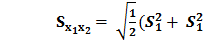 6
6
RESULTS
AND DISCUSSION
Socioeconomic
and Input Cost Characteristics of Respondents
Table 1 revealed the socioeconomic characteristics of maize
farmers in the study area. Result of age distribution of the respondents showed
the mean age of 46 years while the majority (67.6%) were active and capable of
working diligently in transforming available inputs to optimal output at
reasonable cost. Majority (70.5%) of the farmers were male while their female
counterparts were 29.5% suggesting that maize production demands more attention,
energy and resources which are mostly available among male farmers. Result on household size distribution of the
respondents revealed the range (6-12) members as the highest (58.4%) with the
mean household size of 8 members. This size is relatively large with an
advantage of family labour to work on the maize farm since farm labour seems to
be relatively scarce nowadays due to massive rural-urban drift most especially
among by youths. Farming experience of maize farmers revealed that they have a mean
farming experience of 28 years and the highest (27.2%) of experience within the
range of 21-30 years. It could be inferred from this result that a lot of the
farmers had been in maize production of maize for at least about three decades
and based on this will always find production easier and flexible. Education of
the respondents showed that a high number acquired secondary education (34.2%)
and this was closely trailed by primary education (30.6%). Both respondents
with no formal education and tertiary education were 22.5% and 12.7%
respectively. This result suggests that the majority of the maize farmers had
at least primary education inferring that education plays a significant role in
ensuring efficient management of maize farms for better realization of output
at a remarkable cost reduction level. Extension contacts of the respondents
revealed the mean seasonal visits of 7 times, while the highest (53.8%) fell
within the bracket of 6-12 visits. This result suggests that farmers had less
than 12 extension contacts on-season which is just about 50% of the total
recommended extension visits per season; it is an indication that farmers were
under-visited in the previous season and invariably received lesser extension
services. Highest (49.7%) number of farmers realized between N150, 000 and
N200, 000 per season with a mean income of N164, 450.00 which is equivalent to
$357.50.
Table
1: Socioeconomic Characteristics of Maize Farmers
|
Variable
|
Frequency
|
Percentage
|
Mean
|
|
Age(in years)
≤20
21-40
41-60
>60
|
01
55
61
56
|
0.6
31.8
35.3
32.4
|
46 years
|
|
Gender
Male
Female
|
122
51
|
70.5
27.5
|
-
|
|
Household Size(No.)
≤5
6-12
>12
|
66
101
06
|
38.2
58.4
3.4
|
8 members
|
|
Farming Exp.(in years)
≤10
11-20
21-30
>30
|
33
41
47
52
|
19.1
23.7
27.2
30.0
|
28 years
|
|
Educational Level
No Formal Educ.
Primary Education
Secondary Education
Tertiary Education
|
39
53
59
22
|
22.5
30.6
34.2
12.7
|
-
|
|
Extension Contacts
≤5
6-12
>12
Seasonal Income(in
N)
≤100,000
100,001-150,000
150,001-200,000
>200,000
|
50
93
30
10
18
86
59
|
28.9
53.8
17.3
5.8
10.4
49.7
34.1
|
7 times
N164,450.00
|
|
Total
|
173
|
100.00
|
|
Source: Field Survey, 2020
Determinants
of Cost Efficient in Maize Production
The maximum likelihood estimate (MLE) of cost of maize
production among farmers in the study area is presented in table 2. The
estimate for the variance parameter, ϓ, is close to one,
indicating that inefficiency effects are highly significant in the analysis of
the total cost of maize produced among sampled farms. Sigma square (σ)2 has the value of 1.379 and this indicates the
variance was due to measurement error. Log-likelihood function of 373.21
indicated that the value maximizes the joint densities in the estimated model.Of
all the efficiency variables modelled; cost of labour, cost of seed, and cost
of agrochemicals were found to be significant at 5 percent and 10 percent
levels and positively signed, whileinefficiency variables such as years of
farming experience, number extension contacts, and household size were negatively
signed according to a prioriexpectation
and found to be significant at 5 percent and 10 percent respectively. Cost of
labour (p<0.05), cost of seed (p<0.1) and cost of agrochemicals
(p<0.1) negatively influenced the total cost of production by 17.4%, 80.9%
and 13.2% respectively. This result is suggestive of the fact that the three
inputs are highly imperative in the production of maize. Based on this, they
are scarce and relatively costly being that labour continually drifts to urban
and this affects maize production because farming is labour intensive. Seed is
very imperative in the maize production process and, whether a farmer uses the
high yielding variety or open-pollinated variety, the acquisition is cost
determined. Since most farmers are desirous of attaining optimum production
frontier, improved varieties are widely patronized.
Moreover, cost of agrochemicals is high and threatens maize
production because it is used more often in weeding operation which has been
substituted for labour which also seems to be very hard to get in the rural
areas in recent times. Inefficiency variable showed that farming experience
(p<0.1) and number of extension contacts (p<0.05) decreased the cost of
production of maize by the respective of 20.1% and 60.9% while household size
(p<0.1) increased the total cost by 58.3%. It could be inferred from this
result that farmers with more years of experience are efficient in the
allocation of farm input at reasonable prices and farmers who get advisory
services from extension agent were able to save cost which in turn widened
their profit margin.
Table
2: Maximum Likelihood Cost Estimate of Maize Production among Farmers
|
Cost Function Estimates
|
|
|
|
Variable
|
Co-efficient
|
T-ratio
|
|
Cost
Variable
|
|
|
|
Constant β0
|
4.5729***
|
5.86***
|
|
Cost of Land(in Naira) β1
|
0.0378
|
0.23
|
|
Cost of Labour(in Naira) β2
|
-0.1735**
|
-4.04**
|
|
Cost of Seed(in Naira) β3
|
0.8088*
|
3.43*
|
|
Cost of Fertilizer(in Naira) β4
|
-0.0941
|
-1.14
|
|
Cost of Agrochem(in Naira) β5
|
-0.1319*
|
-3.04*
|
|
Total Output (in Kg) Y**
|
0.7067
|
-0.08
|
|
|
|
|
|
Inefficiency Variable
|
|
|
|
Constant δ0
|
0.1153
|
1.15
|
|
Farming Experience(in years) δ1
|
0.2010*
|
3.31*
|
|
Extension Contacts(No.) δ2
|
0.6091**
|
4.45**
|
|
Household Size(No.) δ3
|
-0.5829*
|
-2.00*
|
|
Diagnostic Statistics
Sigma Sq.
σ2
|
1.3786***
|
|
|
Gamma ϓ
|
0.0190(0.981)
|
|
|
Log-likelihood (LLf)
|
273.21***
|
|
|
Likelihood Ratio(LR)
|
19.577***
|
|
|
Number of Respondents
|
173
|
|
Source: Field Survey, 2020
Cost
Elasticity Estimate of Maize Production
The elasticity estimate showed the overall input cost
influence on the total cost of production. The cost elasticity value was 1.154.
This means that on every unit of input cost incurred by maize farmers, there is
an increase of 0.154 unit cost expended above the minimum cost. The result
suggests that minimum cost was spent by farmers in the production of maize
which invariably reduce total cost. Moreover, production at lower cost increases
the profit margin in the long-run.
Table 3: Cost Elasticity Estimate of Maize
Production and Returns to Scale (RTS)
|
Variable
|
Cost Elasticity(CE)
|
|
Cost of Land(in Naira) β1
|
0.038
|
|
Cost of Labour(in Naira) β2
|
-0.174
|
|
Cost of Seed(in Naira) β3
|
0.809
|
|
Cost of Fertilizer(in Naira) β4
|
-0.094
|
|
Cost of Agrochem.(in Naira) β5
|
-0.132
|
|
Total Output (in Kg) Y**
|
0.707
|
|
Total
|
1.154
|
Source: Field Survey, 2020.
Cost
Efficiency Profile of Respondents
Cost efficiency distribution of respondents is presented in
table 5. The majority (0.90-1.00) of maize farmers (92.49%) operated on the
highest efficiency cost frontier. The minority (0.51-0.70) who are 1.16%
operated at the average cost efficiency frontier. The overall farmers’
population performed between the middle and highest efficiency range. This
result indicates that maize farmer in the study area are efficient in their
farming practices suggesting strongly that, maize production among farmers in
the area in which the study was carried out can continue in the production of
maize as it is profitable.
Table
5: Cost Efficiency Distribution of Respondents
|
Efficiency Range
|
Frequency
|
Percentage
|
|
≤0.10
|
-
|
-
|
|
0.11-0.20
|
-
|
-
|
|
0.21-0.30
|
-
|
-
|
|
0.31-0.40
|
-
|
-
|
|
0.51-0.60
|
01
|
0.6
|
|
0.61-0.70
|
01
|
0.6
|
|
0.71-0.80
|
05
|
2.8
|
|
0.81-0.90
|
06
|
3.5
|
|
0.90-1.00
|
160
|
92.5
|
|
Total
|
173
|
100.0
|
Source: Field Survey, 2020.
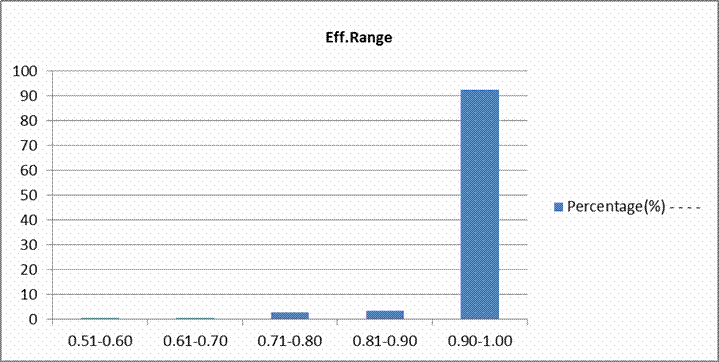
Figure 3: Efficiency range of Maize farmers’ performance
Challenges
Confronting Maize Production
Maize farmers’ responses to the challenges confronting them
in the study area are presented in Table 6. High cost of agrochemicals was the
most identified problem with 96.5%(1st)
while the least was shortage of cultivable land, 55.5 %(8th) for shortage of
cultivable land while all other challenges hanged in between. The mean response
of the respondents was 80%. Agrochemicals (96.5%) assumed the first identified
constraint and was suspected to be due to high cost of labour for farm plot
maintenance. It could be inferred from this that, farmers aimed at solving
persistent weeding problem through the use of agrochemicals as farm labour is
relatively scarce. The least of the identified constraints was the shortage of
cultivable land. This problem may be arising due to land tenure problem which
was statutorily handled by the land use decree of 1978 that land should be held
in trust by the federal and state government and allocate to all users for farm
and industrial purpose among others. High cost of labour(90.2%),
low market price(85%), high transportation cost (79.8), high cost of seed
(78%), shortage of extension (60.7%) andshortage of cultivable land (55.5%)
were other identified problems which directly or indirectly challenged maize
production in the study area.
Table 6: Constraints to Maize
Production
|
Constraints
|
Number of Vote
|
Percentage
|
Rank
|
|
High cost of labour
|
156
|
90.2
|
3rd
|
|
High cost of seed
|
135
|
78.0
|
6th
|
|
High cost of agrochemicals
|
167
|
96.5
|
1st
|
|
Shortage of cultivable land
|
96
|
55.5
|
8th
|
|
Pilfering
|
164
|
94.8
|
2nd
|
|
Low market price
|
147
|
85.0
|
4th
|
|
High transportation cost
|
138
|
79.8
|
5th
|
|
Shortage of extension visit
|
105
|
60.7
|
7th
|
|
Sample size(173)
Mean response(80%)
|
|
|
|
Source: Field Survey, 2020.
Hypothesis
Testing
Based on the result from student’s t-test, cost of production
of maize was significantly influenced by farmer’s experience, number of
extension contacts and household’s size farming experience and number of
seasonal extension contacts increased
the cost efficiency of maize farmers while household size was otherwise in the
study area.
CONCLUSION
AND RECOMMENDATION
Production of maize was found to be cost effective among
farmers in the study area given the efficiency index of 1.154. Despite the fact
that labour cost, fertilizer cost and agrochemical cost reduced cost efficiency,
but farming experience, extension contacts and household sizewere found to
increase cost efficiency. It was therefore recommended that:
(i)
Farmers should be exposed to advanced agricultural farm
machineries which reduces drudges in farm operation hence the reduction in
labour use and invariably reduced cost.
(ii)
Fertilizer
supply should be increased and made available to farmers at affordable price.
(iii)
Agrochemicals,
which substitutes for more labour use most especially in weeding operation
should also be made available and accessible to farmers for timely and
efficient weed control.
(iv)
More
extension services should be made more available to farmers through employment
of more trained and capable extension agents.
REFERENCES
Battese,
G.E. and Coelli, T.J. (1993). A Stochastic
Frontier Production Function
incorporating a model for Technical Inefficiency effect, working papers
in Econometrics and Applied Statistics, No. 69, Department of Econometrics,
University of New England, Armidale.
Chambers,
R.G. (1983). Applied Production Analysis: A Dual Approach Cambridge: Cambridge
University Press.
Coelli, T.J. (1996). ‘A Guide to FRONTIER
4.1: A computer programme for stochastic frontier Production and Cost Function
Estimation’. CEPA Working Paper.96/07, University of New
England, Armidale, Australia.
CSDP
(2005).Report of World Bank Consultants on Rating and Assessment of Poverty of
Local Government Areas in Oyo State.Ministry of Local Government and
Chieftaincy Matters, State Secretariat, Agodi, Oyo State, Nigeria.
FAO
(2007).
The state of food and agriculture: Paying farmers for environmental services.
FAO (2009). State of food security in
the World: Economic crises-impacts and lessons learned-Publication of the Food
and Agriculture Organization of the United Nations, Rome, Italy. www.fao.org/icatalog/inter-e.htm.
FAO (2014).The State of Food and Agriculture, ‘Innovation
in Family Farming’. Prepared by members of Food and
Agriculture Organization’s Agricultural Development Economics Division(ESA). Food and Agriculture Organization of the
United Nations, Rome, Italy www.fao.org/publication
FAO (2017). The Future of food
agriculture: Trends and Challenges. Publications of the Food
and Agriculture Organization of the United Nations, Rome, Italy.
FAO.(
2002). “Food Insecurity: When People Must Live with Hunger and Fear
Starvation.” The State of Food Insecurity in the World.
Rome: The Food and Agriculture Organization of the United Nations.)
FAO.( 2002). “Food Insecurity: When People Must Live with
Hunger and Fear Starvation.” The State of Food Insecurity in
the World. Rome: The Food and Agriculture Organization of the United
Nations.)
Iken, J.E. and Amusa, N.A. (2004). Review: Maize Research and Production
in Nigeria. African Journal of
Biotechnology, 3(6), 302-307.
Koutsyannis, A. (1988). Modern Microeconomics. Pp. 156-174, Palgrave Macmillan,
Second Edition, ISBN 978-1-349-15603-0
Maize Farmers Association of Nigeria (2019).
Central Bank of Nigeria Agricultural Programme: Association to facilitate
500,000 maize farmers. http://www.pmnewsnigeria.com
McCann
R. (2003). “Maize, Africa’s New World Crop” http:// www.theglobalist.com/DBWeb/printStoryId.aspx?StoryId=4887
Ministry of Lands (2015).Survey Division, State Secretariat,
Agodi, Ibadan, Oyo State.
Morris,
M.L. (ed.) (1998). Maize Seed Industries in Developing
Countries. Lynne Rienner Publishers, Boulder, Colorado
National Population Census (2006).Population Report of the
Federal Republic of Nigeria.Pp 2-4.
Ofori, F. and Stern, W.R.
(1987).Cereal-legume intercropping system. Advances in Agronomy, San Diego 41:
41-89.
Ogundari, K. and Ojo, S.O.
(2006).An Examination of Technical, Economic and Allocative of Small Farms.Journal of Central European Agriculture, 7(3),
423-432.
Ogundari, K., Ojo, S.O,
Ajibefun, I.A. (2006). Economic Efficiency and Cost Efficiency in Small Scale
Maize Production. Journal of Social
Science 13(2):131-136.
Ogunsumi I.O., Ewuola S.O.,
Daramola A.G. (2005). Socio-economic Impact Assessment of maize production
technology on farmers’ welfare in Southwest, Nigeria. J. Central Euro. Agric., 6(1): 15-26.
Olayemi,
J.K. (1980). ‘Food Crop Production by Small Farmers in Nigeria’ In Nigeria
Small Farmers – Problems and Prospects in Integrated Rural Development, Olayide
S.O; J.A. Eweka and V.E. Bello Osagie (Eds) Centre for Agricultural Rural and
Development, University of Ibadan. pp 18-33.
Olayemi, J.K. (2004). Principles of microeconomics for applied
economic analysis. Pp. 67-92, Mokola, Ibadan, Oyo State: SICO Publishers
Oyo State Diary (2018).Pace-Setter Diary, Ministry of
Information and Culture, Agodi, Ibadan, Oyo State.
Pingali, P.L.(2001).
CIMMYT 1999–2000 World Maize Facts and Trends.Meeting World Maize Needs:
Technological Opportunities and Priorities for the Public Sector. Mexico, D.F.:
CIMMYT. 25pp
Taiwo, B.A., Alamu, J.F., and Ibrahim, U. (2011).Economic advantage of
hybrid maize over open pollinated maize in Giwa Local Government Area of Kaduna
State.American Lournal of Experimental
Agriculture, 1(3), 101-109.
Zalkuwi,
J.W., Dia, Y.Z. and Dia, R.Z. (2010).Analysis of
economic efficiency of maize production in Ganye Local Government Area of
Adamawa State, Nigeria. Report and Opinion, 2 (7), 1-11.
|
Cite this Article: Ogunwande IO; Adesokan
GE (2020). Cost Efficiency Analysis of Maize Production Among Rural Small
Scale Farmers in Itesiwaju Local Government Area
(LGA), Oyo State, Nigeria. Greener Journal of Agricultural
Sciences 10(3): 136-144.
|