INTRODUCTION
Maize is among the
most important and widely consumed staple food in tropical Africa (FAO, 2020). In the savanna
ecology of Ghana, maize is produced predominantly by smallholder,
resource-poor farmers under rain-fed
conditions (Kankam-Boadu et al., 2018). Sun et al. (2019) reported that maize is
most popular cereal crop in northern Ghana due to its high yield, ease of
processing and low cost of production. However, the average yield of about 1.5
t/ha is below the achievable yields of up to 6 t/ha (Oppong-Abebrese
et al., 2019. Soil fertility is crucial in increasing cereal crop yields, and low soil fertility and low
application of external inputs are the major factors affecting productivity of maize,
and these account for the low yield of the crop. Improving yields through
increased productivity of the savanna soils can be achieved by external inputs
of nutrients which are available mainly in the form of inorganic fertilizers. Across
the north of Ghana, the most sourced of inorganic fertilizers are commercial
fertilizers, which farmers can easily access on the local market.
The main
limiting nutrients in the soils of the major maize growing areas in northern
Ghana have been organic carbon (<1.5 %), total nitrogen (< 0.2 %),
exchangeable potassium (<100 mg/kg) and available phosphorus (< 10 mg/kg)
(Abumere et al., 2019).
For many decades, a one-cap-fits-all fertilizer
recommendations have been made for maize and other crops in Ghana. Moreover,
soil conditions are dynamic over the years and the
old recommendations are not always efficient. Hence, the need
to constantly update or make site-specific fertilizer recommendations for maize
in the northern agroecological zone of Ghana.
Over the
years, use of NPK fertilizers have been the primary
means of nutrient replenishment. This is understandable as NPK remains the most
important nutrients required for crop production (Abumere et al., 2019). Sole
application of NPK has helped to increase maize yield significantly. However,
some room remains for further yield increment. It has been postulated that the
inclusion of secondary nutrients such as sulphur (S)
and micro nutrients such as boron (B) and Zinc (Zn) in fertilizer blends could
increase maize yields sharply, beyond levels achieved by use of sole NPK
(Njoroge et al., 2018). This postulate has not been confirmed nor denied in savanna
ecology of Ghana. In view of this, fertilizer blends/formulation in northern
Ghana remains primarily of N, P and K which may be limiting possible yield
increment through secondary and micro-nutrient inclusion. There is the need to
study the growth and yield increment of fertilization through inclusion of
secondary and micronutrient elements in fertilizer formulations.
YARA Ghana is an agro
input company involved in the importation and sale of mineral fertilizers to
improve agricultural production and income of farmers.
Yara Ghana has recently introduced standard fertilizer formulations for cereal
crop production, namely Actyva (23N+10P+5K+2MgO+3S+0.3Zn), Unik-15 (15N+15P+15K+2.2S), NPK (15N+20P+20K), Urea (46N), Sulfan
(24N+6S) and SOA (21N+24S). The comparative agronomic
efficacy of these formulations within the different agro ecological zones in
northern Ghana remains largely unknown. There is the need to compare the
relative productivity of the fertilizer regimes to enable subsequent
recommendation to the resource-poor farmer for maize production in the ecology.
This study sought to establish and compare the yields of maize obtained
from treatments with the various YARA fertilizer formulations
within the different agroecological zones of northern Ghana.
MATERIALS
AND METHODS
Study sites
The trial was conducted during the 20219
cropping season in farmers’ farms in four locations, namely, Nyankpala, Walewale, Yendi and Damongo, in the
northern Guinea savanna zone of Ghana. Generally, the savanna ecology is that
of a tropical continental with a single rainy season, usually from May to
October (and peaks around late August or early September), followed by an
extended dry season (FAO, 2020; Tetteh et al., 2016). The four locations
for this study share ecological traits similar to the Guinea savanna ecological
zone. However, there are some differences. Nyankpala
is at an altitude of about 183 m above sea level and mean annual rainfall of
about 1000 – 1300 mm. The area has a gentle undulating to flat terrain (Kumah, 2016). The area is largely
characterized by low-lying areas of grassland with few spread perennial woody
species. Some crops cultivated in this ecology include maize, rice, soybean and
cowpea. Soils in this region are largely developed from voltaian
shale and sandstone with texture being largely sandy loam to loamy sand (Yidana et al., 2011) and classified as a
Ferric Luvisol.
Yendi largely shares similar ecological traits with
guinea savanna. On the other hand, unique traits include average annual
rainfall which ranges between 1005 – 1150 mm. The area has a relatively flat
terrain with gentle slopes. Soils here are developed over shale, usually
shallow (15-30 cm) to very shallow (<15 cm) and are generally sandy loan at
the top and sandy loam or silty loam in the subsoil. Crops mostly cultivated
include maize, rice, sorghum and millet. Damango
records average annual rainfall as being between 1100-1200 mm and the terrain
is mostly flattened with gentle slopes (Tetteh et al., 2016). Soils are over sandstone with sandy loam
texture. Popular crops in this ecology include millet, maize, soybean, sorghum
and groundnuts. Walewale records average annual
rainfall between 900 – 1000 mm (Tetteh et al., 2016). Soils are developed from granite or upper Birimian phyllite and the top
soil texture is usually coarse sandy loam or loamy sand. The terrain of this
ecology is sloppy and crops cultivated include maize, millet, rice, groundnuts,
beans, sorghum and yam.
Land preparation, experimental design and
treatments
At each location, stumps were initially
removed from the fields to ease demarcation. Each field was disc-ploughed and
harrowed (with a hoe) during the first week of July.
The single factor
experiment, laid out in a Randomized Complete Block Design (RCBD), with five
treatments and four replicates for each treatment, was used. Field size of 35 m x 19 m with plot size of 5 m x 5 m were used. A
1 m and 2 m alleys were allowed between treatments in each block and between
blocks, respectively. The treatments included five different fertilization
regimes (Table 1). The treatments were based on a protocol provided by YARA
Ghana limited for the conduct of the trial.
Planting, application
of treatments and crop husbandry
The Obatanpa maize
variety obtained from the Ganoma agro inputs shop,
Tamale, Ghana, was used for planting. Sowing was done during the second week of
July at the rate of two plants per hill. The plants were spaced at 75 cm
between rows and 40 cm within rows. The pre-emergence herbicide Glyphader 480 (360g/l glyphosate a.e.;
SL) was applied at planting to control surviving weeds.
At
each trial site, application of the fertilizer treatments was done strictly according
to the protocol indicated in Table 1 above. The basal (2 after crop emergence) application
of Actyva and Unil-15 treatments was done by deep
placement while top dress (4 after crop emergence) application with Actyva, Sulfan, Sulphate of Ammonia and Urea was done by band placement.
Post-emerged
weeds were controlled with atrazine (WP 80 g/l/ha, a.e.
SL) at 3 and 6 weeks after planting. Bunds were constructed around each plot
prior to application of the treatments to avoid fertilizer drift into adjacent
plots. The crops were sprayed with Emastar (Emamectin Benzoate 12g/L +
Acetamiprid 64g/L) at 2 and 5 WAP to control fall armyworms.
Estimation
of maize yield and analysis of data
Sampling for yield data was done after
harvest of the maize. Maize cobs from each plot were manually removed from the
plants after maturity. De-husking, threshing and winnowing were also done
manually based on farmer practice. Threshed grains were air dried and oven
dried to 13% moisture content by weight. The weighed grains were converted into
weight per unit area (kg/ha).
The mass of 100 grain
of maize was also taken to investigate the effect of nutrient regime on grain
weight.
The maize yield data
were analyzed using analysis of variance (ANOVA) in GenStat Statistical package
12th edition. The treatment means were separated and compared using the Least
Significant Difference (LSD) at 5% level of probability.
RESULTS
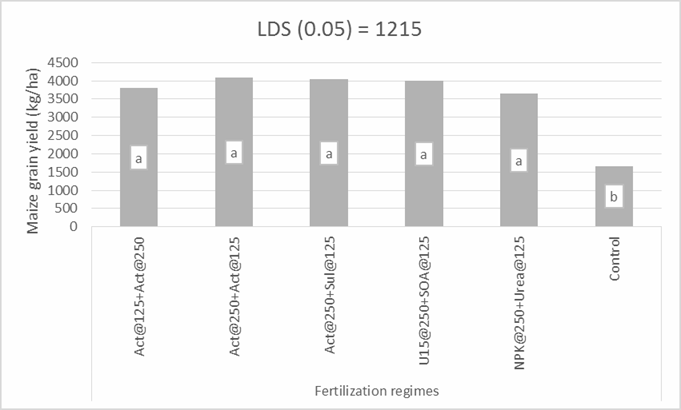
Maize yield was significantly affected by
fertilization regimes at Damango (p=0.008). Maize yield ranged from 4165
kg/ha in Act@250+Act@125 to 1688 kg/ha in the control (unfertilized plot)
(Figure 1). However, the highest yield in Act@250+Act@125 at Damango was not statistically different
from those of Act@125+Act@250
(3749 kg/ha), Act@250+Sul@125 (4144 kg/ha), U15@250+SOA@125 (4073 kg/ha), and NPK@250+Urea@125 (3648 kg/ha), which together differed from the lowest yield of 1688 observed
for the unfertilized field. Yield increases of 122%, 146%, 145%, 141% and 116%
due to fertilization was recorded for Act@125+Act@250,
Act@250+Act@125, Act@250+Sul@125, U15@250+SOA@125 and NPK@250+Urea@125, respectively over the unfertilized field.
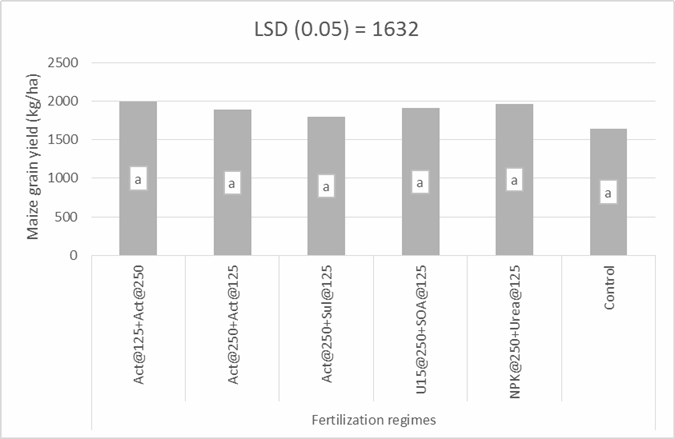
In contrast to the observation in Damango, the
fertilization regimes had no significant effect on maize yield at Nyankpala (p=0.263),
which ranged between 1528 kg/ha to 1890 kg/ha (Figure 2) and was generally in
the order Act@125+Act@250
> U15@250+SOA@125 > Act@250+Act@125 > NPK@250+Urea@125 > Act@250+Sul@125 > control plot.
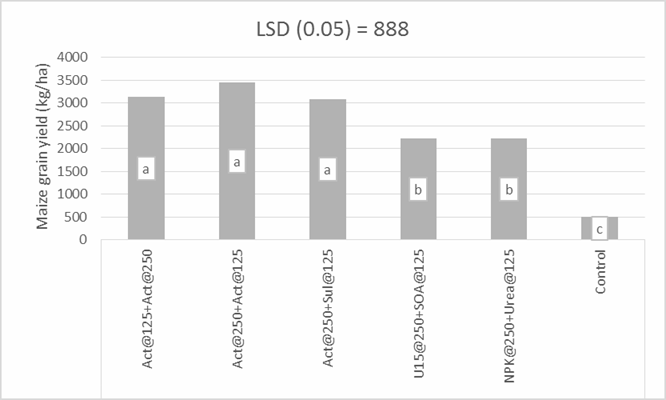
At Walewale, maize yield was significantly
affected by the fertilization regimes (p<0.001).
The yield ranged from 3447 kg/ha in Act@250+Act@125 to 493 kg/ha in the
control plot (Figure 3). However, the highest yield in Act@250+Act@125 was statistically comparable to
that of Act@125+Act@250 (3140 kg/ha) and Act@250+Sul@125 (3079 kg/ha), which differed
significantly from the other treatments. But similar yields were observed for NPK@250+Urea@125 and U15@250+SOA@125 which were significantly higher
than that of the control. Yield increases of 536%, 599%, 524%, 351% and 428%
due to fertilization were recorded for Act@125+Act@250, Act@250+Act@125,
Act@250+Sul@125, U15@250+SOA@125 and NPK@250+Urea@125, respectively over the control plot.
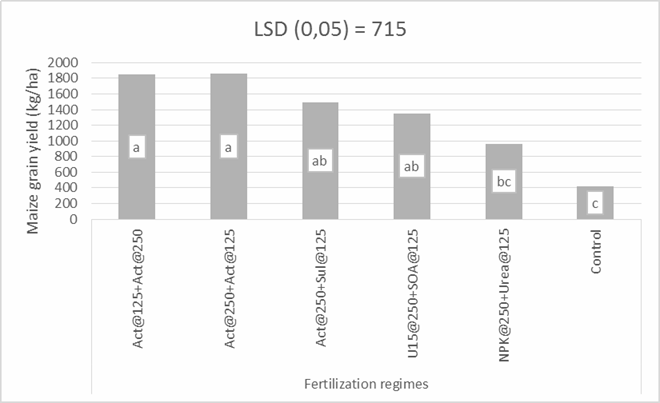
As in the case of Walewale, the fertilization
regimes significantly affected maize yield at Yendi (p=0.008). Maize yield at Yendi ranged from 1861 kg/ha in Act@250+Act@125 to 417 kg/ha in the control (Figure
4). Here again, the highest yield in Act@250+Act@125
was
statistically comparable to that of Act@125+Act@250 (1849 kg/ha), Act@250+Sul@125 (1496 kg/ha) and U15@250+SOA@125 (1353 kg/ha) which differed
significantly from that of NPK@250+Urea@125
(965 kg/ha)
and the control (417 kg/ha). However, yields from Act@250+Sul@125, U15@250+SOA@125 and NPK@250+Urea@125 were statistically similar. Apart from the yield of NPK@250+Urea@125 which was not significantly
different from the control plot, yields of all fertilized treatments were
significantly higher than that of the control. Yield increases of 343%, 346%,
258%, 224% and 131% due to fertilization were recorded for Act@125+Act@250, Act@250+Act@125,
Act@250+Sul@125, U15@250+SOA@125 and NPK@250+Urea@125, respectively over the control plot.
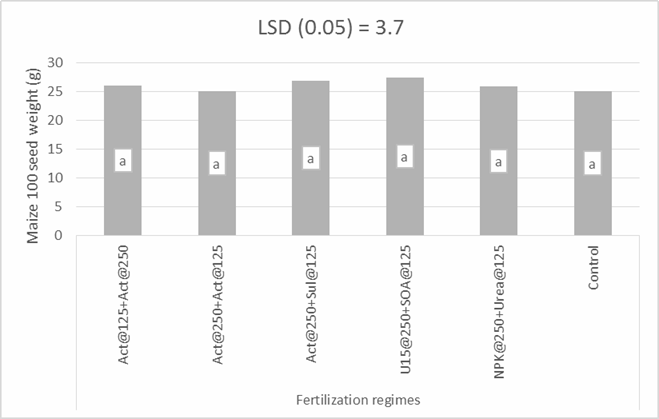
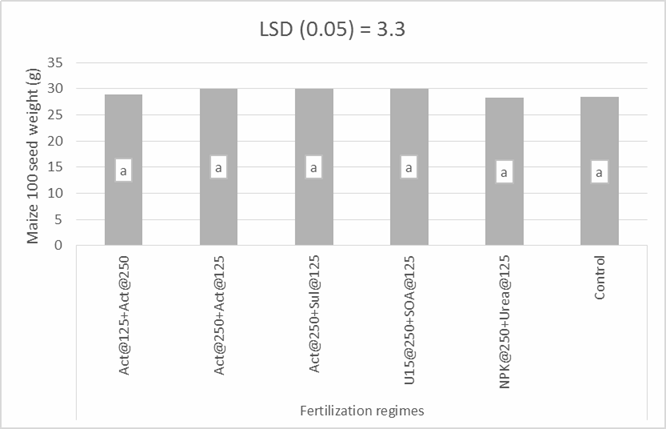
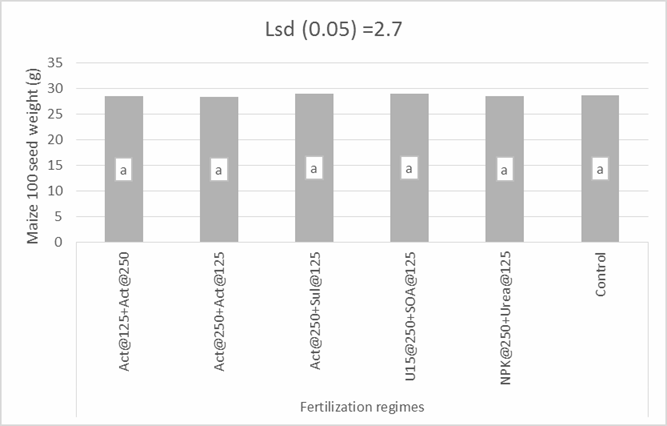
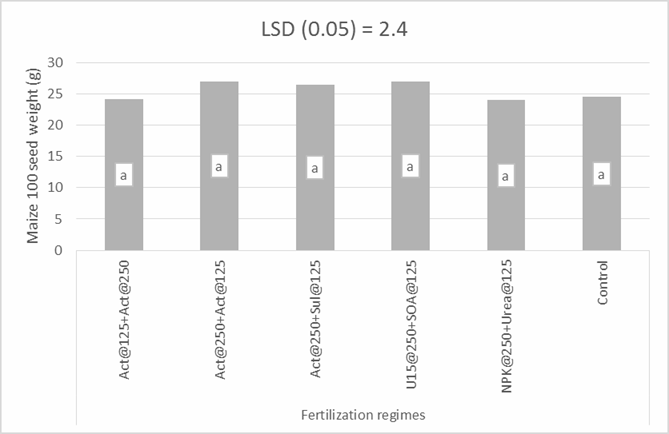
Unlike maize yield, the fertilization regimes did not have significant
impact on 100 seed weight of maize grown at Damango (p=0.783), Nyankpala
(p=0.611), Walewale
(p=0.094), and Yendi
(p=0.114). For Damango,
100 seed weight of maize ranged from 25.1 g to 27.4 g (Figure 5) and was
generally in the order U15@250+SOA@125
> Act@250+Sul@125 > Act@125+Act@250 > NPK@250+Urea@125 > Act@250+Act@125 = Control.
Similar trends were observed in Nyankpala. The 100 seed weight recorded for Nyankpala ranged from 30.0 g to 28.3 g (Figure 6) and
was in the order U15@250+SOA@125 = Act@250+Sul@125 = Act@250+Act@125 > Act@125+Act@250 > Control > NPK@250+Urea@125. The 100 seed weight recorded for Walewale
ranged from 29.0 g to 25.0 g (Figure 7) and was in the order U15@250+SOA@125
>
Act@250+Sul@125 >Contro
l> NPK@250+Urea@125 > Act@125+Act@250 > Act@250+Act@125. At Yendi, 100 seed weight ranged from 24.0 to
27.3 g (Figure 8) and was in the order U15@250+SOA@125
> Act@250+Act@125 > Act@250+Sul@125 >Control > Act@125+Act@250 > NPK@250+Urea@125.
DISCUSSION
Generally, the statistically similar 100 seed
weight of maize as observed for the fertilization regimes across all sites showed
the existence of relatively low impact of the nutrient regimes on grain filling
and grain mass. One would have expected that different fertilization regimes
would potentially affect the extent of grain filling as reported by Njoroge et
al. (2018) and Lisuma et al. (2016. Moreover, the
findings of this study contradict these previous findings, and show that the
nutrient regimes used for the study may not significantly impact grain filling
and grain mass of maize. In another study, however, Kugbe
et al. (2019), found that grain mass was significantly affected by chemical
fertilization regime. It is therefore likely that other nutrient regimes, aside
the protocol used in this study may impact on the extent of grain filling and
grain mass of maize.
The non-significant
effect of fertilization regimes on maize yield at Nyankpala
and Yendi,
and on maize yield at Nyankpala may be attributed to
non-responsive soils of the sites. With the differences in nutrient input, one
would have expected differences in impact of the nutrient regimes that is
attributable to fertilization. The non-responsive nature of the soils to
chemical fertilization suggests the need for physical remediation of these
soils to enhance their productivity. Apart from Nyankpala,
the relatively high response to fertilization of up to 5-fold increases in
yield showed that fertilization is important to achieve high yields in the
nutrient-poor soils of northern Ghana. The highest yield of 5450 kg/ha for maize
achieved from Act@250+Sul@125 at Walewale, and its
comparableness to yields of Act@125+Act@250 and Act@250+Act@125 showed
similarity in performance of the Actyva fertilizer formulations.
Soils at Damango tended to have similar yields with
the fertilization regimes, and the Actyva treatments
had similar high yields that were greater than that of the control and Unik 15 in both Walewale and Yendi, indicating superior performance of Actyva to the Unik 15 and NPK
formulations.
Though the
fertilization regime tended to have similar rate of NPK, inclusion of Sulphur
as secondary nutrient, and Boron and Zinc as micronutrients in the Actyva formulations may have contributed to their enhanced
productivity in treatments that contain these fertilizers. As shown by Daphade et al. (2019), B and Zn as micronutrients enhance
availability of primary and secondary nutrients to enable uptake by crops. The
results showed that inclusion of micro nutrients in NPK fertilizer grade could
increase photosynthetic activity and result in high grain yield. The findings
of the study showed that sole availability of N, P and K only, as found in
primary NPK fertilizers, even at higher application rates may not be adequate
for enhanced photosynthetic ability in maize production for the nutrient-poor
soils of northern Ghana. The increase in yield in Actyva-treated
plots might also be due to uptake synergy as the micro nutrients contained in
these fertilizers are reported to enhance availability of the other nutrients (Daphade et al., 2019). The superior performance of Actyva show the need for Sulphur and micro nutrient
inclusion in chemical fertilizer formulation as proposed by Yigermal
et al. (2019), and further agrees with Olowookere et
al. (2017) who reported that micronutrient application enhanced the yield of
maize biomass and grain yield.
To the resource-poor
farmer, grain yield is the most economic end result of morphological and
physiological processes that occur during growth and development of the maize
plant. The reduction in grain yield in the lots that received no fertilization
might have been due to deficiency of important nutrients including N, P and K.
This result is similar to the findings of Kihara et
al. (2017), Njoroge et al. (2018) and Lisuma et al.
(2016), who revealed that grain yield could be significantly increased through
secondary and micronutrient addition. The increase in grain yield due to
secondary and micro nutrient inclusion relative to the control plot could be
due to improvement in soil nutrient deficiency and imbalances. Sulfur is
required by plants for synthesis of major metabolic compounds such as
glutathione, proteins and amino acids and sulpho-lipids
required for healthy crop growth (Qahar and Ehmad, 2016). While inclusion of Mg as a secondary nutrient
in NPK formulation may have comparatively low effect on maize growth and yield,
inclusion of Sulphur in plant nutrition is known to better enhance and
synergize the uptake of other essential nutrients like N, thereby increasing
both N use and S use efficiency and promoting the growth of the plant (Fismes et al., 2000).
Like Sulphur, Boron
increases protein contents in the plant and also plays vital roles in cell wall
division, synthesis, elongation and nucleic acid metabolism that translates into rapid plant growth (Tahir et al., 2012).
Boron and zinc also work in synergy with hormones and enzymes that perform
various functions in the metabolism of carbohydrate and protein and efficient
water use in the crop (Ceyhan et al., 2008; Rudani et
al., 2018). Under the prevailing rainfed system, which was marked by draught in
the 2019 cropping season, enhanced water use efficiency is critical for the
crops’ development. These explain the observed high yield in plants that
received boron and zinc micro nutrients compared to those that did not. As
noted by Irfan et al. (2019), a synergy that is generated in Phosphorus uptake
by Boron, enhances crop production even under Phosphorus-deficient soils upon Boron
addition. Zinc plays roles in resistance to heavy metal concentration (Rizwan
et al., 2019), diseases and enhances photosynthesis and carbohydrate
accumulation (Rudani et al., 2018). The combined
effect of Sulphur, boron and zinc may have synergistically resulted in the
observed better growth and high yields in fertilizer formulations that included
all three nutrients. This finding is in consonance with that reported by Kugbe et al. (2019). The foregoing reasoning explains why
there were no significant difference between T1 and T2
for maize production, and also explains why T3 was higher than T4 in maize
production in Walewale.
CONCLUSION
Maize grain yield obtained from each of the
fertilizer treatments was significantly higher than the control. However, there
were no significant differences between Act@125+Act@250 and Act@250+Act@125for
maize production. Moreover, Act@250+Sul@125 had higher grain yield than U15@250+SOA@125
in maize production in Walewale while there was no
significant difference between the two treatments at other locations. Soils at
different sites responded differently to the fertilizer regimes. Damango tended to have similar maize yields on fields that
received fertilization, but the Actyva treatments
gave yields that were greater than yields of U15@250+SOA@125 and NPK@250+Urea@125
formulations. In all locations, the Actyva
formulations gave similar high yields, indicating superior performance of these
treatments to Unik 15 and NPK formulations. Yield
increases of up to 500% were recorded and attributed to S, B and Zn inclusion
that enhanced synergy in growth promoting factors- including protein and amino
acid synthesizing properties of S, enhanced physiological and environmental
tolerance to diseases, water stress, and improvements in P and N-uptake that
promoted maize growth. Farmers can achieve maximum maize yield in the ecology
through fertilization with Actyva formulations.
Competing interest
Authors have no conflict of interests
Acknowledgements
YARA Ghana Limited provided funding for the
research.
REFERENCES
Abumere, V.I.,
O. A. Dada, A.
G. Adebayo, F.
R. Kutu, and A. O. Togun (2019). Different Rates of Chicken Manure and NPK
15-15-15 Enhanced Performance of Sunflower (Helianthus annuus L.)
on Ferruginous Soil. International Journal of Agronomy 23(1).
342-355 doi.org/10.1155/2019/3580562.
Ceyhan, E., Onder, M., Ozturk, O., Marmankaya,
M., Hamurcu, M., Gezgin, S.
(2008). Effects of application of boron on yields, yield
component and oil content of sunflower in boron-deficient calcareous soils.
African Journal of Biotechnology 7: 2854-2861.
Daphade, S.T., G.R.Hanwate, Gourkhede,
P.H (2019).
Influence of Zn, Fe and B Applications
on Nutrient Availability in Soil at Critical Growth Stages of Maize(Zea mays) in Vertisol of Marathawada Region of
Maharashtra, India. International Journal of Current Microbiology and Applied
Sciences 8: 206-212.
FAO. (2020). State of forest genetic resources in Ghana. Retrieved March
24, 2020, from http://www.fao.org/3/ab388e/ab388e02.htm#TopOfPage
Fismes, J., P.C. Vong, A. Guckert,
Frossard, E. (2000). Influence of sulfur on
apparent N-use efficiency, yield and quality of oilseed rape (Brassica
napus L.) grown on a calcareous soil. European
Journal of Agronomy 12: 127–141.
Irfan, M., Abbas, M., Shah, J.A., Depar, N., Memon. M.Y., Sial, N. A. (2019). Interactive effect of phosphorus and boron on plant growth,
nutrient accumulation and grain yield of wheat grown on calcareous soil.
Eurosian Journal of Soil Science 8 (1): 17-26.
Kankam-Boadu
I., Joseph Sarkodie-Addo
and Francis Kweku Amagloh
(2018). Profitability of maize production in the northern region of
Ghana. International
Journal of Development. 77 (2): 11-20
Kihara, J., Sileshi, G.W., Nziguheba,
G.,
M. Kinyua, Zingore, S.,
Sommer R. (2017). Application of secondary nutrients and micronutrients increases crop
yields in sub-Saharan Africa. Agronomy for Sustainable Development 37 (25): 1-11.
Kugbe, J.X., Kombat, R., Atakora W (2019). Secondary
and Micronutrient Inclusion in Fertilizer Formulation Impact on Maize Growth
and Yield across Northern Ghana. Cogent Food and Agriculture (In press)
Kugbe,
X. J., & Zakaria, I. (2015). Effects of soil
conservation technologies in improving soil productivity in northern Ghana.
Journal of Soil Science and Environmental Management, 6(6): 158-167.
Lisuma, J., Semoka, J., Sem,
E. (2016). Maize Yield Response and Nutrient Uptake after
Micronutrient Application on a Volcanic Soil. Agronomy Journal 98 (2):
402-406.
Njoroge, R., Abigael
N. Otinga, John R. Okalebo,
Mary Pepela and Roel Merckx (2018). Maize (Zea mays L.) Response to Secondary and Micronutrients for Profitable N, P and K
Fertilizer Use in Poorly Responsive Soils. Agronomy 8(4): 49.
Olowookere, B.T., Oyerinde, A.A. and Malgwi, W.B., (2017). Influence of
Nitrogen and Micronutrient Fertilizer Blends on Growth and Yield of Maize
Varieties. Journal of Agriculture Food and Development 3: 1-6.
Oppong Abebrese, S., Alex Yeboah, Wilson Dogbe, Paul Kofi Ayirebi Dartey, Richard Akromah, Vernon EdwardGracen, Samuel Kwame Offei, and Eric
Yirenkyi Danquah (2019). Evaluation
of Yield, Reaction to Diseases, and Grain Physical Attributes of Some
Introduced Rice Hybrids in Ghana. International Journal of
Agronomy (2019). doi.org/10.1155/2019/3926765
Qahar, A., Ahmad, B. (2016). Effect of nitrogen and sulphur on maize hybrids yield and post
harvest soil nitrogen and sulphur. Sarhad Journal of Agriculture 32 (3): 239-251.
Rizwan, M., Ali, S., Rehman, M.Z.U., Maqbool, A.
(2019). A critical review on the effects of zinc at toxic
levels of cadmium in plants. Environmental Science and Pollution
Research 26 (7): 6279-6289.
Rudani, L., Vishal, P., Kalavati, P. (2018). The importance of zinc in plant growth- a review.
International Research Journal of Natural and Applied Sciences 5 (2): 38-48.
Sun, J., Gao, J., Wang, Z., Hu, S.
Zhang, F. Bao, H., Fan, Y. (2019). Maize Canopy
Photosynthetic Efficiency, Plant Growth, and Yield Responses to Tillage Depth. Agronomy 9 (3): 234-242.
Tahir, M., Ali,
A., Khalid, F., Naeem, M., Fiaz, N., Waseem, M.
(2012). Effect of foliar applied boron application on
growth, yield and quality of maize (Zea
mays L.). Pakistan journal of scientific and industrial
research 55(3), 117-121.
Tetteh, F., Larbi, A., Nketia, K. A., Senayah, J. K., Hoeschle-Zeledon,
I., & Abdul-Rahman, N. (2016). Suitability of soils for cereal cropping
in Northern Ghana. Evaluations and Recommendations. https://doi.org/10.13140/RG.2.2.34455.73122
Yidana, S. M., Abdul-Samed, A., Banoeng-Yakubo, B., & Nude, P. M.
(2011). Characterization of the Hydrogeological Conditions of Some Portions of
the Neoproterozoic Voltaian Supergroup in Northern Ghana. Journal of Water
Resource and Protection, 3(12), 863-871.
Yigermal, H., Nakachew, K., Assefa, F. (2019). Effect of integrated nutrient application on phonological, vegetative
growth and yield-related parameters of maize in Ethiopia: A review. Cogent Food and Agriculture 5 (1): 9-19.