INTRODUCTION
Solanum macrocarpon otherwise known as the African
eggplant is of the family Solanaceae, it is a tropical perennial plant
that is closely related to the garden egg (Ojo and Olufolaji,
1997). They are perennials that are grown
commercially as an annual crop. There are about 25 species of eggplants in
Nigeria. Prominent among these are the S. aethiopicum
L. (Ethiopian eggplant) and S. macrocarpon L.
(Gboma eggplant), which are widely cultivated in
Nigeria and across the African continent (Bonsu et al., 2002; Grubben
et al., 2004).
Solanum macrocarpon is one of the
indigenous underutilized vegetables consumed by the resource poor in Nigeria to
meet daily vegetable requirements for minerals, vitamins and protein nutritious
food items as a substitute to egg, meat and milk ( Idowu et al.,2014).
The moisture, crude protein, crude fat and crude fibre
contents of S. macrocarpon were 92.00 ± 0.43, 0.52 ±
0.02, 0.15 ± 0.02 and 2.50 ± 0.02% (Eltta et al., 2017).
In West Africa both leaves and fruits are
eaten. Fresh leaves and young stems of S.
macrocarpon are widely consumed in West Africa
and Central Africa. Leaves can be harvested over a number of seasons and
sometimes for more than a year when not interrupted by a dry season (Animashaun et al.,
2019).
High quality seeds produce normal seedlings with adequate
photosynthetic apparatus for production and assimilation through the leaves.
Leaves play an important role in determining photosynthetic potential and have
significant effect on yield responses (Lawlor, 2001).
In general, African egg plant with indeterminate
growth and flowering habit continues to have vegetative growth even at
reproductive phase. Plucking of some green leaves for vegetable purpose and
leaf damage due to insect attack also reduce the source production and alters
the source sink ratio on the plants (Lawlor, 2001).
Removal of early formed leaves to certain extent and retention of some of them
for photosynthesis purpose may result in production of more shriveled,
undersized and wrinkled seeds as the source percentage are reduced. However,
none harvesting of green leaves may only help to increase the seed size due to
higher availability of source (Lawlor 2001).
The manual removal of leaves can provide some economic
benefit to the farmers by selling green leaves as vegetable and by doing so the
farmer gets some additional income without much reduction in the seed yield and
quality and this practice can be advocated for seed production.
Despite its nutritional and medicinal importance, production
of the S. macrocarpon
falls short of demand throughout the year (Teslim et al., 2019). This is due to a number of constraints such as lack
of quality seed, competition from exotic vegetables, low market demand, pests
and diseases infestation and slow growth. Lack of quality seed has been a major
hindrance to sustainable production and utilization of S. macrocarpon. So there is the need to create
awareness among farmers for effective means of improved seed production and
distribution to replace the farmer-to farmer seed exchange and conservation of germplasm so as to improve production and income.
Though the crop is used, both as source of medicine and
nutrition, there is a scanty data on the effect of leaf harvesting on the fruit
and quality of S. macrocarpon seeds. There is
the need to investigate the effect of leaf harvest that will not pose a threat
to seed yield and quality on African eggplant in Benue state Nigeria. The
experiment was conducted to find out the critical leaf harvesting frequency and
its influence on seed yield and quality in African eggplant.
MATERIALS AND METHODS
Planting Material
Seeds of S. macrocarpon, African eggplant were obtained from the local farmers around University
of Agriculture; Makurdi.
Experimental site
The
field experiment was conducted during the 2019 cropping season at the Federal
University of Agriculture Makurdi, Teaching and
Research Farm (7.76°N and longitude 8.62°E, and at the elevation of about103 m
above sea level). The soil at the site is well drained sandy loam.
Experimental Design and Treatments
A single factor experiment was laid out in a Randomized
Complete Block Design (RCBD) on the field, while the laboratory experiment was
laid out in Completely Randomized Design (CRD. Both experiments were replicated
three times with the following leave harvesting frequencies as
treatments:
The treatments are. 1. No leaf harvest
= No leaf was not harvested; 2.One leaf harvest frequency = Leaves were
harvested only once at 4 weeks after transplanting; 3.Two leaf harvest
frequency = Leaves were harvested twice at 4 and 6 weeks after transplanting;
and 4.Three leaf harvest frequency = Leaves were harvested thrice at 4, 6 and 8
weeks after transplanting
Agronomic Practices
Seedlings were raised in a standard nursery before
transplanting to the field. The land was first sprayed with Glyphosate and
later ridged manually. Transplanting was done and NPK 15:15:15 fertilizer was
applied at the rate of 100kg/ha at seven days after transplanting. Hand weeding
was done at flower bud initiation to keep the field clean. Leaf harvesting was
done manually with knife by cutting the leaves at the point of attachment to
the main stem. Pod harvesting was done when the entire pod turn yellow. Seeds
were extracted from the harvested pods manually, washed and shed dried. Dried
seeds were stored for seed quality tests.
Germination test was conducted using sand method in wooden
boxes. The sand was washed and heat sterilized to kill soil microbes and
foreign seeds before use. One hundred (100) seeds were sown in each box to
represent a replicate and covered with fine sand. Sown seeds were kept moist
till the experiment. Germinated seeds were counted daily to allow analysis of
germination index as a parameter for seed vigour.
Germination percentage and Germination rate were determined
as described by Abdul-Baki and Anderson (1973) as
follows:
High values obtained using this
expression mean higher seedling vigour of one sample
in relation to another (Al-Mudaris, 1998).
Data collection
Data were collected on the following parameters; Germination
percentage and Germination rate, Fruit diameter (cm), Number of fruit per
plant, Number of seeds per fruit, and thousand (1000) seed weight.
Data Analysis
The data collected
were subjected to analysis of variance (ANOVA). Significant treatment means
were separated using Fisher Least Significant Difference (FLSD). All data
analysis was carried out using GenStat Statistical
Software, 17 Edition
RESULTS
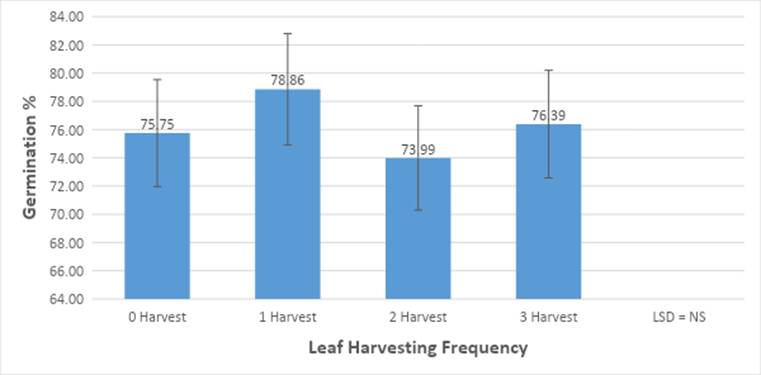
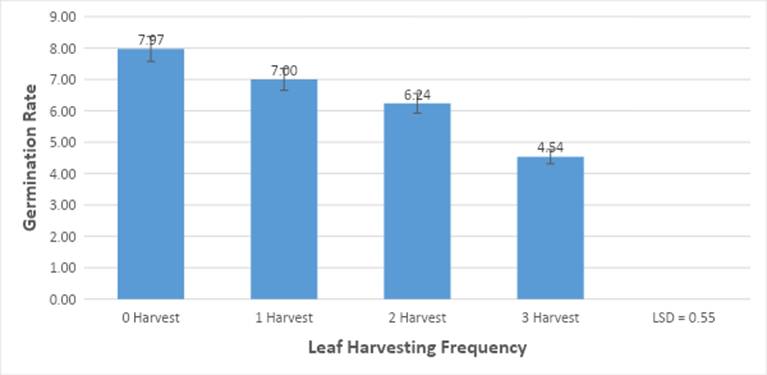
The result shows that leaf harvesting frequency did not
significantly affects fruit diameter, number of seeds per fruit and seed
germination percentage (fig1). However, there were highly significant
differences among the leaf harvesting frequencies with respect to number of
fruits per plant, 1000 seeds weight and germination rate. Nevertheless, the
mean values showed decreases in fruit size as the leaves were frequently
harvested with mean values 23.24cm, 22.70cm, 22.29cm and 21.73cm, respectively
across the treatments. However, where leaves were not harvested had the highest
number of fruits per plant and decreases as cross the harvest frequency
increased with the following mean values of 8.36, 3.60, 2.34 and
1.20.

Figure 1. Effects of Leaf Harvesting
Frequency on Fruit Diameter of African Eggplant leaf
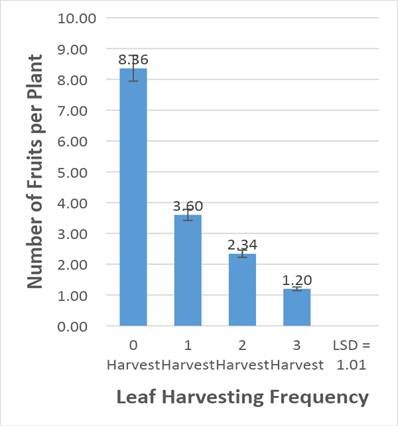
Figure
2 Effects of Leaf Harvesting Frequency on Number of Fruits Plant of African Eggplant leaf
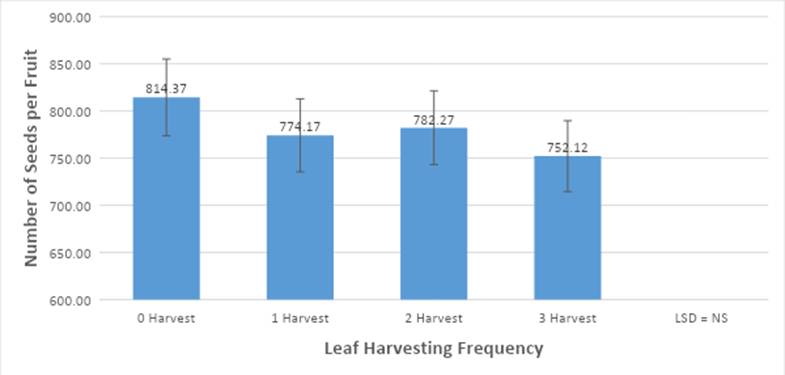
The mean numbers of seeds per fruit obtained from the
different leaf harvesting frequencies were not statistically different (Figure
3). Meanwhile, the treatment where leaves were not harvests had the highest
number of seeds per fruit and where leaves were harvested three times up to the
eight week after transplanting had the least number of seeds per fruit with
mean values of 814.37 and 752.12 seeds, respectively.
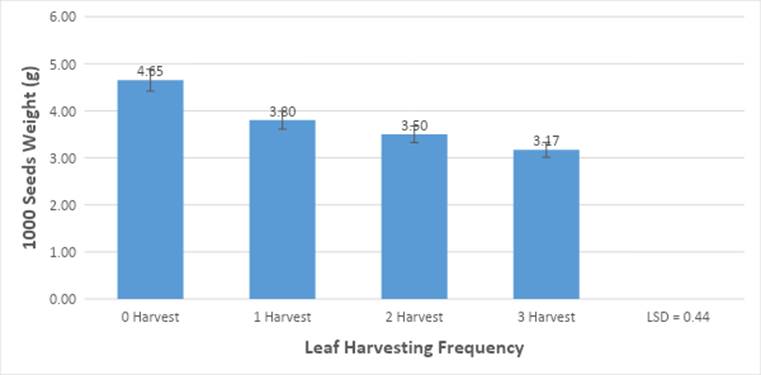
The smean effects of leaf
harvesting frequency on 1000 seeds weight are presented in figure 4 below. The
result showed that treatment without leaf harvests had higher 1000 seed weight
with mean value of 4.65g which was significantly different from other
treatments with mean values of 3.80g, 3.50g and 3.17g, respectively. Also,
where leaves were harvested at 4 and 6 weeks, the 1000-seed weight was not
different from where leaves were harvested once at 4 weeks or thrice at
4, 6, and 8 weeks.
DISCUSSION
Where leaves were not harvested plants had more
photosynthetic activities which lead to more accumulation of assimilates that was available for fruit formation. Ibrahim et al. (2010) reported that the higher
the intensity of defoliation, the fewer the number of flowers formed. Where
leaf harvesting frequency did not influence fruit diameter could be due to the reduction in fruit number per plant along the
leaf harvesting frequency that reduces competition in the treatments with less
number of leaves which in turn improve the fruit size. This result corroborates
study conducted in cowpea (Moura et al., 2014)
and they said that defoliation during vegetative phase did not influence the
production components evaluated.
The decrease in number of fruits per plant with respect to
increase in leaf defoliation could be due to the reduction in food supply due
to less photosynthetic activities in the treatments with higher frequency of defoliation. This
result disagreed with the findings by Quintela (2009)
who stated that there was no significant alteration to the number of pods,
seeds per pod, and 100 seed weight for removal of the leaf area at different
levels in the main leaves of the common bean.
The number of seeds per fruit was not influence by leaf
harvesting frequencies; this could be due to genetic effects, that number of
seeds per fruit is genetically controlled and not environmental. However, the
result does not conform to Moura (1999), in a study
conducted on common bean (P. vulgaris), where he reported that the loss
of leaf area affects the yield components. Also Bahry
et al. (2013) and Fontoura, et al.,
(2006), defoliation levels and the time of leaf harvest influence negatively
the number of seeds and seeds per plant. In maize, Heidari (2015) showed that complete defoliation severely
reduced seed yield, row number per ear, seed number per ear, cob length, cod
weight and ear weight and that Defoliation treatments had minor effect on
produced seed germination traits
1000 seed weight increase could be as a result of source
sink relationship in the treatments with less leaf harvesting frequencies.
Leaves play an important role in determining photosynthetic potential and have
significant effect on yield responses according to (Lawlor
2001). The result agreed with Moura et al.
(2014) who carried out a study on defoliation in cowpeas and concluded that
there was a significant difference in the 100 seed weight with respect to leaf
defoliation; and that at 25 DAS, plants with 25% defoliation had heavier seeds
and defoliations at 100% had lighter seeds. They also said that when
defoliations occurred at 40 DAS, plants with 25% of defoliation produced
smaller seeds and defoliations of 75 and 100% produced seeds of smaller weight.
Similarly, Ahmed
et al. (2015) said garlic defoliated
at seedling and reproductive stages produced similar and higher garlic in terms
of growth and yield performance than that defoliated at vegetative stage.
Irrespective of leaf harvesting frequency up to eight weeks
after transplanting Solanum Macrocapon) seeds were
able to attain germination ability that is, the seeds reached a physiological
state that enabled the germination of the seeds. Germination test was not able
to dictate the difference in the physiological quality of these seeds.
However, germination rate which is a vigour test was
able to dictate these differences. The result agreed with Koptur
et al., (1996) who reported similar
germination percentage in common vetch (Vicia
sativa), seeds produced under different leaf defoliation.
The influence of leaf defoliation on germination rate could
be as a result of higher 1000 seed weight which translates to more food
reserves in the seeds and this implicates seed vigour.
In common vetch (Vicia sativa),
defoliation treatments on maternal plant did not have significant effect on
days to germination (Koptur et al., 1996). In
addition to that Heidari, (2015) reported that
defoliation of leaves at different levels had no significant effect on seedling
weight and vigour; and that defoliation
treatments had minor effect on produced seed germination traits. Contrastingly, this study showed that leaf defoliation
influences vigour.
Correlation indicates that number of fruit per plant in
African egg plant could determine 1000 seed weight
and germination rate. Significant positive correlation of number of pods per
plant and a high but non-significant positive value of number of seeds per pod
was also reported by Ghobary (2010) in vegetable pea.
Pal and singh (2012) have reported positive and
significant association of pod yield per plant with number of pods per plant,
pod length and pod weight. Heidari, (2015) reported
in an experiment conducted on maize that Cob length and weight had a positive
and significant correlation with all traits except 100 seed weight. A similar result
was observed in 1000 seed weight which positively determines germination rate
but not germination percentage. Heidari, (2015),
reported that seed germination percentage had a positive and significant
correlation with seed vigor based on weight in common vetch (Vicia sativa), and leaf defoliation on
maternal plant did not have significant effect on days to germination (Koptur et al., 1996).
CONCLUSIONS
This study showed that leaf harvesting frequency influences
yield and seed quality parameters of African eggplant. It could concluded that
African eggplant (S. macrocarpon) seed
producers can actually harvest the vegetable leaves up to 8 weeks after
transplanting (three times) without reducing seed yield and quality.
Recommendations
African eggplant could be produced for both vegetables and seed
REFERENCES
1.
Ahmed, H. G., Saidu, Y. I., Aliyu, U.,
and Bello, M.T. ( 2015) Effects of Defoliation Stages and Defoliation Intensity
on Growth and Yield of Garlic (Allium sativum L.) in Sokoto, Nigeria. Journal
of Agriculture and Veterinary Science 8 (12) PP 96-99.
2.
Akande, S. R., Olakojo, S. A., Ajayi, S. A., Owolade, O. F., Adetumbi, J. A., , O. N., Ogunbodede,
B. A. (2012). Planting date effects on cowpea seed yield and quality at
Southern Guinea Savannah of Nigeria. Seed Technology 34:979-988. https://stjournal.org/volume-34-no-1-2012/.
3.
Al-Mudaris MA
(1998). Notes on various parameters recording the speed of seed germination.
Journal of Agriculture in the Tropics and Subtropics 99 (2):147-154
https://www.jarts.info/index.php/tropenlandwirt/article/view/1495
4.
Animashaun,
T. T., Oluwaghemi, O., Okewale
M. O.and Opabode, J. T.
(2019). Response of African eggplant (Solanum macrocarpon L.) to foliar application of
6-benzylaminopurine and gibberellic acid. Asian
Journal of Biological Science, 12: 911-916.
5.
Bahry, A. S., Yahya M. Al-wahaibi, Adbulkadir Elshafie and Ali Al-Bemani (2013) biosurfactant
production by bacillus subtills B20 using Date
molasses and its application in enhance oil recovery.
Doi:10.1016/j.ibiod.2012.01.006.
6.
Bahry, C. A., Venske, E., Nardino, M., Zimmer,
P. D., Souza, V. Q. S. and Caron, B.O. (2013). Agronomic performance of soybean
as a function of defoliation in vegetative stages. Tech. Science Agropec. 7(4):19-24.
7.
Bonsu, K. O., Fontem, D. A., Nkansah, G. O., Iroume, R. N., Owusu, E. O., Schippers, R. R. (2002). Diversity within the Gboma eggplant (Solanum macrocarpon), an indigenous vegetable from West Africa. Ghana Journal of Horticulture, 1:50–58.
8.
Eletta,
O. A. A; Orimolade, B. O; OluwaniyI, O. O; DOSUMU, O. O. (2017). Evaluation of
Proximate and Antioxidant Activities of Ethiopian Eggplant (Solanum aethiopicum L) and Gboma
Eggplant (Solanum macrocarpon
L). Journal of
Applied Science, Environment and Management.
Vol. 21 (5) 967-972
9.
Fontoura, T. B,
Costa, J. A. and Daros, E. (2006). Effect of levels
and epochs and defoliation on yield and yield components of soybean grains. Science. 7:49-54.
10.
Ghobary, H. M. M.
2010. Study of relationship between yield and some yield components in garden
pea (Pisum sativum L.)
by using correlation and path analysis. J. Agric. Res. 36, 351–360.
11.
Grubben, GJH;
Denton, OA (2004). Plant Resources of Tropical Africa II: Vegetables (Leiden, Wageningen: Backhuys Publishers)
35-198.
12.
Heidari (2013).
Effect of irrigation with contaminated water by cloth detergent on seed
germination trait and early growth of sunflower (Helianthus Annuus
L.) Notulae Scientia biologicae 5(1)
Doi:10.15835/nsb.5.1.9003
13.
Heidari, H.,
2012. Effect of defoliation intensity on maize yield, yield components and seed
germination. Life Science Journal, 9 (4): 1587-1590.
14.
Heidari, H.,
2013. Yield, yield components and seed germination of maize (Zea mays L.) at different defoliation and
tassel removal treatments. Philippine Agricultural Scientists, 96 (1): 42-47.
15.
Heidari, H.,
2015. Effect of defoliation based on leaf position on maize yield, yield
components and produced seed germination. Bulg. J. Agric. Sci., 21 801–80.
16.
Heidari, H., S. Bahraminejad, G. Maleki and A. H.
Papzan, 2009. Response of cumin (Cuminum cyminum L.) to sowing date and plant
density. Research Journal of Agriculture and Biological Sciences, 5 (4):
597-602.
17.
Ibrahim, U., Auwal,
B.M., Udom, G. N. (2010). Effect of Stage and
Intensity of Defoliation on the Performance of Vegetable Cowpea (Vigna unguiculata
(L.) Walp). African
J. Agric. Res. 5(18): 2446-2451.
18.
Idowu,
M. K., Oyedele, D. J., Adekunle,
O. K.; Akinremi, O. O. and Eilers,
B. (2014). Effects of Planting Methods and Seed Density on Vegetable Yield and
Nutrient Composition of Solanum macrocarpon
and Solanum scabrum in
Southwest Nigeria. Food and Nutrition
Sciences. 5, 1185-1195 http://www.scirp.org/journal/fns http://dx.doi.org/10.4236/fns.2014.513129.
19.
ISTA (2020). International Rules for Seed
Testing. The Germination tests. Volume 2020(1):1-14 https://doi.org/10.15258/istarules.2020.05.
20.
Koptur, S.,
Smith, C.L.,and. Lawton, J.
H. (1996) Effects of artificial defoliation on reproductive allocation in the
common vetch Vicia sativa (fabaceae;
papilionoideae). American
Journal of Botany, 83 (7): 886-889.
21.
Lawlor, D. W.
(2001) Annals of botany photosynthesis. 3rd ed. 386 PP. Oxford: Bio
22.99 (soft back). Issue 6, June 2001 pages 852-853. https://doi.org/10.1000/anbo.2001.1418.
22.
Moura, A., Nielsen, C.
A. S., Bilstrup, J., & Jose, V. M. M. (2014). Recent
diversification of a marine genus (tursiop Spp) tracks habitat preference and environmental change
systematic biology. 62(6) Doi:10.1093/sysbio/syt051.
23.
Ojo, O.D., Olufolaji, A.O. (1997). Optimum NPK fertilizer rates for
growth and yield of Solanum macrocarpon. Journal of Vegetable Crop Production,
3(1), 73-77.
24.
Pal, A. K. and Singh, S. (2012). Correlation
and path analysis in garden pea (Pisum sativum L. var. hortense). The Asian Journal of Horticulture. 7(2):
569-573.
25.
Quitela (2009)
Genetic analysis redraws the management boundaries for the European sprout. 3
March, 2020. https//doi.org/10.1111/eva12942.