Weed control
has been identified as one of the major constraints in cassava production
systems as it requires high capital, and found to be about 50-80% of the total
budget while its return on investment (ROI) ranging from 32% to 37% (Ekeleme et al., 2016; Rana and Rana,
2016; Ojiako et al., 2018; Ekeleme
et al., 2019). Ekeleme et al. (2019) reported that weed
infestation can lead to 50-90% cassava yield loss if not properly managed.
Therefore, in order to maximize profit through reducing the cost of weeding
operation, weeding should be done by the least expensive technology that will
effectively control weeds without affecting other phases of cassava production
(Rana and Rana, 2016).
There is a
need to determine the most cost-effective integrated weed control options by
considering all the required input operational costs under different tested
weed control options while observing the fundamental economic principles for
weed management (Wiles, 2004; De Rus, 2010). According to Wiles (2004) and Ekeleme et al. (2019) who reported the economic threshold
for weed management is calculated by comparing the value of prevented yield
loss from weed competition in the current season with the cost of an input’s
application. Thus, any weed control procedures should be used only when its
results are expected to be more economical than without using any control
measure (Rana and Rana, 2016). The cost of weed control can be defined as the
value of the resource used in producing the materials used for weed control in
their best alternative aiming at either maximizing output, maximizing profit,
maximizing utility, minimizing cost or a combination of all these (Ettah and Angba, 2016).
For the determination of good integrated weed control
option, the choice of weed control measures to use depends not only on its
efficacy but also its cost. Thus, in order to get the most economical
treatment, the economics of each treatment should be worked out on the basis of
current market prices of the inputs and output obtained (Rana and Rana, 2016; Itam et al., 2018). This can be done by conducting the
cost-benefit analysis (CBA) which is according to Rana and Rana (2016) a
systematic approach to estimate the short- and long-term significances by
measuring all costs incurred and all possible revenue and benefits from an
investment project proposal (Rana and Rana, 2016). Cost benefit analysis can be
done by calculating the benefit cost ratio (BCR), by which if the ratio
obtained is above one meaning that the farmer would get more additional returns
from investment.
In Eastern zone of Tanzania, adoption of the best
integrated weed control option(s) on cassava production which lead to the
maximum return while having the lowest cost as possible thus producing highest
profit has not been clearly done, thus farmers still face challenges in terms
of efficiency, timeliness and effectiveness in weed control as they mostly
relay on a single weed control option (Kayeke et al.,
2018). Due to that, cassava fresh root yield in Tanzania was estimated by
FAOSTAT (2017), to be 6.2 t ha-1 which is far most below the
production potential of about 50.8-80 t ha-1 (Senkoro
et al., 2018; URT, 2020). Other researchers reported the benefit cost analysis
of a single agricultural input like fertilizer only as its
used in cassava production (Senkoro et al., 2018). Therefore, this study aimed at establishing
the cost of inputs used at each stage of production and to determining the most
economical integrated weed control option(s) tested in cassava production in
the selected sites of Eastern zone of Tanzania.
MATERIAL AND METHOD
Description of the study site
The study
was conducted at Ilonga, Kilosa, Morogoro region located at 6°46’ 27” S, 37°2’14” E, and
479.95 m ASL (Zakayo, 2015) and Mkuranga, Coastal
region, Tanzania located at 7°12’19” S, 39°20’38” E, 93.87 m ASL (Mkuranga, 2009). At Mkuranga,
average monthly temperature ranges from 18.8 °C during the coolest months of
July and August to the highest monthly means of 31.9 °C to 32.6 °C during the
hot season from December to March (Mkuranga, 2009).
Relative humidity ranges from 67-70 % from August to October and increasing to
82 % during the wettest month of April, and the site is experiencing bi-modal
rainfall pattern; form March to May (the main wet season) with averaged 550 mm
of rain and November to December (short rains) with averaged 235 mm of rain (Mkuranga, 2009; RCO, 2011).
At Kilosa, the district
experiences the mean annual temperature of about 25°C with an average of eight
months of rainfall starting from October to May (Kajembe
et al., 2013; Zakayo, 2015). According to Zakayo (2015) stated that the rainfall distribution at Kilosa site is bimodal, with short rains begins from October
to January, followed by long rains starting from mid-February to May.
Experimental
design used was factorial experiment (2 × 2 × 2) arranged in randomized
complete block design, whereby eight plots were established to make one
replication. Plot size was 4 m by 5 m and plots were separated by 1 m and
replication was separated by 2 m. Treatments were replicated three times in
each site. Treatments were two tillage practices (Till only and till + Ridge),
two pre-emergence weed control options (herbicide) (Primagram
Gold a.i 290 g L-1 S-metolachlor and 370 g
L-1 atrazine and Oxfen a.i
Oxyfluorfen 24% EC) and two post emergence weed
control options (herbicide; Force up a.i 480 g/L of
Glyphosate-Isopropylamine salt and mechanized weeder
tool; back pack weeder with modified tines). Pre emergence weed control
treatment was applied during a day of planting. Post emergence weed control
treatments were applied when weed population reached 30% (three to four leaves
stage) within a plot as per IITA (ACAI project) protocol. Cassava (Kiroba variety) planted at a population of 10,000 plants/ha
was used.
Data on inputs and its costs per tested weed
management option/treatment were collected, which included the costs of
acquiring herbicides and planting materials, labor costs on land preparation,
tillage and ridging, herbicide application, physical weeding, and cassava
harvesting. Also, data on the market price of cassava per one kilogram were
recorded per each site. The market price (September 2020) was obtained from
farmers who sell cassava in local markets and district extension workers.
Data on costs of acquiring herbicides,
planting materials, labor costs on land preparation, tillage and ridging,
herbicide application, mechanical weeding, cassava harvesting were recorded and
used to compute benefit cost ratio.
Definition of terms
Production costs: This refers to the value of inputs used in
producing a product or output. Thus, due to that, there are two types of costs;
fixed cost which is the cost that does not change over a period of time as
output changes and variable costs which are the costs that keep on changing as
the output changes (Igben and Eyo,
2002; Itam et al., 2018).
Marginal return (MR): Is the difference between the total revenue
obtained from the production activity and total variable cost incurred (Daramola et al., 2019). It is expressed as;
MR =
Total Revenue from cassava production – Total Variable Cost incurred
Where; The
total revenue is obtained by multiplying the quantity of cassava yield
harvested per hectare by the price of one kilogram of the cassava product and the
total variable cost is the summation of all variable cost incurred (Itam et al., 2018; Daramola et al., 2019).
Cost benefit
analysis (CBA): Is an approach used to
estimate the short- and long-term significances of the tested treatments by
measuring all costs and all possible revenue and benefits from treatments
applied at a period of production (Rana and Rana. 2016). According to De Rus (2021) stated the cost benefit analysis can be done
using the benefit cost ratio. Thus, for
this study, the benefit cost ratio (B:C) for each
treatment applied was calculated by dividing gross profit obtained by the total
cost incurred from integrated weed control combinations.

From the
formular above, if the benefit cost ratio is < 1 then the costs exceed the
benefit, therefore the tested weed control package was rejected. However, if
the benefit cost ratio is ≥ 1 then the benefits exceed
the costs, therefore the tested weed control package was accepted.
RESULTS
The influence of tillage practice, pre-emergence weed control and post
emergence weed control treatments on cassava fresh root weight (t/ha) at Mkuranga and Kilosa sites
The results
on the influence of tillage practices on cassava fresh root weight (t ha-1)
are shown in Table 1. At Mkuranga site, tillage
practice did not significantly (P>0.05) influence the cassava fresh root
weight. Till treatment showed the highest cassava fresh root weight of 38.56 t
ha-1 as compared to the till and ridge treatment which was used as
standard. Pre emergence treatments and post emergence treatments did not
significantly (P>0.05)
affect the cassava fresh root weight. Oxfen herbicide which was as a pre-emergence weed control
treatment exhibited the highest cassava fresh root weight (38 t ha-1)
while mechanical weeding which was the post emergence weed control treatment
led to highest cassava fresh root weight (40.64 t ha-1) followed by
force up herbicide which exhibited the lowest cassava fresh root weight (34.53 t ha-1).
At Kilosa site, tillage practice significantly (P<0.05) affected the cassava fresh root weight. Till and ridge treatment
resulted into the highest cassava fresh root weight of 21.14 t ha-1. Pre emergence treatments and post emergence
treatments did not significantly (P>0.05) affect the cassava fresh root weight. Oxfen
treatment showed the highest cassava fresh root weight (14.8 t ha-1)
when used as a pre-emergence treatment while mechanical weeding which was used
as a post emergence treatment led to lowest cassava fresh root weight (14.5 t
ha-1) as compared to force up herbicide which exhibited the highest
cassava fresh root weight (14.85 t ha-1).
DISCUSSION
The influence of tillage
practice, pre-emergence and post emergence weed control treatments on cassava
yield
The study
findings revealed that, high cassava root yield observed in Till and ridged
plots could be attributed by the fact that, ridges provide large surface area
for cassava roots to expand and enlarge as compared to the plots with no
ridges. Also, the use of oxfen herbicide (a.i Oxyfluorfen 24% EC) as
pre-emergence herbicide reduces weed competition during the initial stages of
cassava growth. These results are in accordance to that of Schwartz-Lazaro and Copes (2019) who observed, weed
seedbank and weed population is highly reduced as tillage intensity increases
as a result of exposure of weed seeds to the conditions that does not favor
their growth. Also, Godwin et al. (2017),
reported pre-emergence herbicide help in controlling weeds for up to four weeks
after cassava planting.
In these
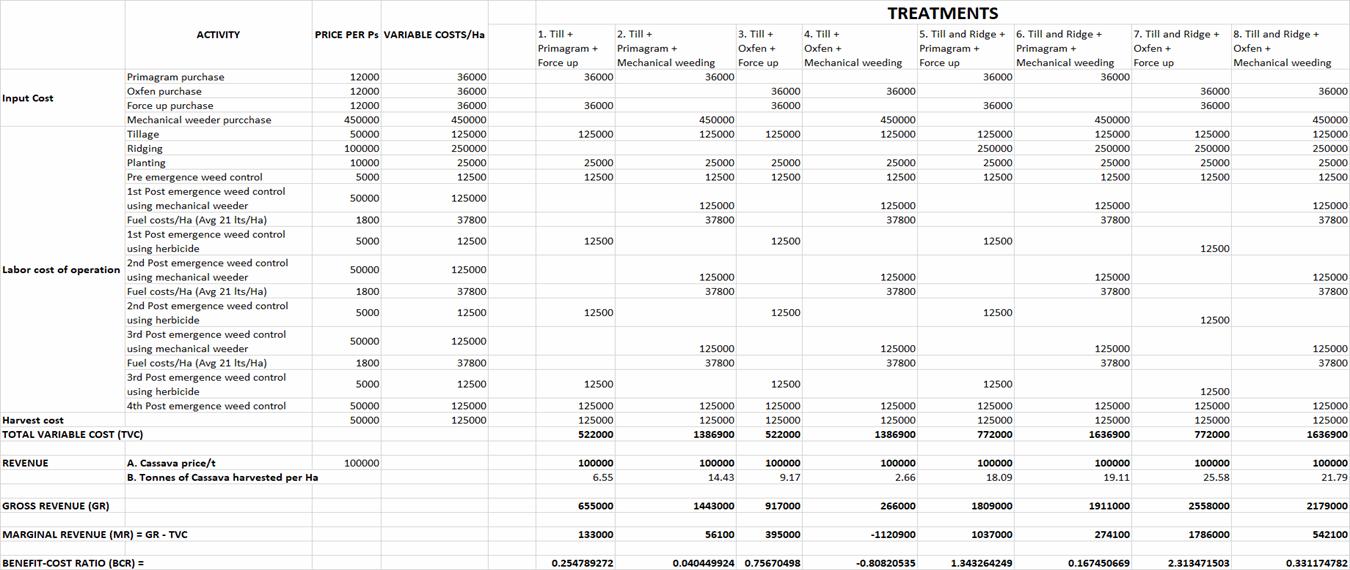
findings, the variation in total variable costs between treatments inputs
applied could be attributed by the difference in input applied and difference
in method used for equipment operation. These results are in accordance to that
of Kosemani and Bamgboye
(2018) who observed the differences in expenditure per hectare during cassava
production was a result of difference in
amount of biological and chemical energy input and difference in method of
equipment acquisitions in cassava production. Also, James et al. (2011)
observed in cassava production, the amount spent on manual resources was the
highest as compared to the amount spent on chemical resources as the amount
spent in physical resources was more than 42% of the total cost of the
inputs.
Also, the
gross revenue per hectare obtained differed from one treatment to the other at
both sites. This difference in revenue observed was largely attributed by the
difference in cassava yield obtained per each treatment. Similar results were
explained by Velmurugan et al. (2017), who
reported during cassava production, the difference in cassava growth and the
cassava yield may be attributed by the difference in weed management activities
applied.
Thus, at Mkuranga site the treatment
combinations of till × Oxfen ×
Force up and till × Primagram × Force
up treatment combinations had high benefit cost ratio of 2.39 and 2.04
respectively regardless of the lower cassava root yield obtained from those
treatment combinations while at Kilosa
site, the only treatment combination Till and Ridge × Oxfen
× Force up had high benefit cost ratio of 2.31. These results were due
to the fact that, the use of herbicides in controlling weeds in cassava is
cheaper than the use of mechanical weeding treatments. The results are in
agreement with that of Udensi et al. (2012); Islami et al. (2017); Kosemani
and Bamgboye (2018) and Ekeleme
et al. (2019) who reported that the use of herbicides in controlling weeds in
cassava production were very cheap as compared to the use of other means of
weed control like the use of mechanized tools.
CONCLUSION
Benefit cost ratio of 2.31 at Kilosa site and
2.39 at Mkuranga site, respectively indicates practicability
of cassava production from the economic point of view. Therefore, good farm
preparation, the use of herbicides, the use of high yield cassava varieties (Kiroba) and optimum use of fertilizer increased the
profitability of cassava production. Based on the findings of this study,
tillage should be done initially before cassava planting, proper use of
pre-emergence and post-emergence herbicides as the integrated weeding
operations could lead to optimum cassava root production. Consequently, the
treatment combinations of Till and Ridge × Oxfen
herbicide × Force up herbicide and till × Oxfen
herbicide × Force up herbicide are recommended for Kilosa and Mkuranga
sites respectively in order to increase cassava productivity and income of the
farmers in these areas.
CONFLICT OF INTEREST
I declare no
potential conflict of interest.
ACKNOWLEDGMENT
This is part of MSc. Research Dissertation by
Joseph Adonia Leonard funded by International
Institute of Tropical Agriculture (IITA) under the African Cassava Agronomy
Initiative (ACAI) project.
REFERENCES
1.
Daramola, O. S., Adeyemi, O. R., Adigun, J. A.
and Adejuyigbe, C. O. (2019). Economics of row
spacing and integrated weed management in soybean (Glycine max
L.). Journal of Agricultural Sciences (Belgrade) 64(3): 265-278.
2.
De Rus, G.
(2010). Introduction to Cost-benefit Analysis: Looking for Reasonable
Shortcuts. Edward Elgar. University Carlos III de Madrid and research
affiliate, FEDEA, Spain. 264pp.
3.
Ekeleme, F., Atser,
G., Dixon, A., Hauser, S., Chikoye, D., Olorunmaiye, P. M., Sokoya, G.,
Alfred, J., Moses C. O., Korieocha, D. S. and Olojede, A. O. (2019). Assessment of weeds of cassava and
farmers management practices in Nigeria. Tropical Agriculture 37(2): 1-22.
4.
Ekeleme, F., Hauser, S., Atser, G.,
Dixon, A., Weller, S., Olorunmaiye, P., Usman, H., Olojede, A. and Chikoye, D.
(2016). Weed management in cassava in Africa: Challenges and opportunities. Outlook
Pest Management 27(5): 208-212.
5.
Ettah, O. I. and Angba,
A. O. (2016). Analysis of cost and returns among cassava farmers in Cross River
State, Nigeria. International Journal of Science and Research (IJSR) 5(11): 111-114.
6.
FAOSTAT. (2017). Crop
statistics. FAO, Rome. [http://www.fao.org/faostat/en/#data/QC] site visited on
25/10/2021.
7.
Igben, S. M. and Eyo, E. O. (2002). Agricultural Economics: An Introduction to
Basic Concepts and Primary Principles: Best print Business Press, Uyo, Nigeria. pp.82-88.
8.
Islami, T., Wisnubroto,
E. I. and Utomo, W. H. (2017). Effect of chemical and
mechanical weed control on cassava yield, soil quality and erosion under cassava
cropping system. Journal of Advanced Agricultural Technologies Vol, 4(1): 57-61.
9.
Itam, K. O., Ajah,
E. A. and Udoeyop, M. J. (2018). Comparative cost and
return analysis of cassava production by adopters and non-adopters of improved
cassava varieties among farmers in Ibesikpo Asutan LGA, Akwa Ibom State,
Nigeria. Global Journal of Agricultural Sciences 17(1): 33-41.
10. James, A., Nandi, P. G., and Evans, N. Y. (2011).
Economic Analysis of Cassava Production in Obubra
Local Government Area of Cross River State, Nigeria. Asian Journal of
Agricultural Sciences 3(3):
205-209.
11. Kajembe, G. C., Silayo, D. S. A., Mwakalobo, A. B. and Mutabasi, K.
(2013). The Kilosa District REDD+ pilot project,
Tanzania. A socioeconomic baseline study IIED. Turkish Journal of Fisheries and Aquatic Sciences 12(4): 743–749.
12. Kayeke, M. J., Nhamo, N. and Chikoye, D. (2018). Reducing Risk of Weed Infestation and
Labor Burden of Weed Management in Cropping Systems. In: Smart Technologies
for Sustainable Smallholder Agriculture. pp. 123-143.
13. Kosemani, B. S. and Bamgboye,
A. I. (2018). Cost of Energy Input in the Production of Cassava (Manihot
Esculenta). Energy and Environment
Research 8(1): 10-17.
14. Mkuranga ICMAP. (2009). Mkuranga
District Integrated Coastal Management Action Plan. Prime Minister’s Office
Regional administration and local government, Mkuranga
District Council. 170pp.
15. Ojiako, I. A., Tarawali,
G., Okechukwu, R. U., Chianu,
J., Ezedinma, C. and Edet,
M. (2018). Profitability of cassava production: comparing the actual and
potential returns on investment among smallholders in southern Nigeria. Journal of Biology, Agriculture and Healthcare 8(16): 51-65.
16. Rana, S. S. and Rana, M. C. (2016).
Principles and practices of weed management. Department of Agronomy,
College of Agriculture, CSK Himachal Pradesh Krishi Vishvavidyalaya, Palampur. 138pp.
17. RCO. (2011). Pwani Regional
Website - Regional Commissioner’s Office. [http://www. pwani.go.tz/bagamoyo/d_acl.php] site visited on 27/10/2021.
18. Senkoro, C. J., Tetteh, F. M., Kibunja, C. N., Ndungu‐Magiroi,
K. W., Quansah, G. W., Marandu, A. E., Ley, G. J.,
Mwangi, T. J. and Wortmann, C. S. (2018). Cassava yield and economic response
to fertilizer in Tanzania, Kenya and Ghana. Agronomy Journal 110(4): 1600-1606.
19. The United Republic of
Tanzania (URT). (2020). National Cassava
Development Strategy (NCDS) 2020 – 2030. Ministry of agriculture, Tanzania.
96pp.
20. Udensi, E. U., Tarawali, G., Ilona,
P., Okoye, B. C. and Dixon, A. (2012). Adoption of chemical weed control
technology among cassava farmers in south eastern Nigeria. Journal of Food,
Agriculture and Environment 10: 667-674.
21. Velmurugan, M., Manickam, S. and Pugalendhi, L. (2017). Effect of Weed Management Practices
on The Growth and Yield of Cassava (Manihot esculenta Crantz). Journal
of Root Crops 43(1):
34-38.
22. Wiles, L. J. (2004). Economics of Weed
Management: Principles and Practices 1. Weed Technology 18(1): 1403-1407.
23. Zakayo, R. (2015). Pastoral
adaptive capacity in the changing climate in Kilosa
district. Doctoral Dissertation for Award Degree at Sokoine University of
Agriculture. [www.weadapt.org › system› files_force ›
annotated_bibliography_ecosyst] site visited on
27/10/2021.