The rice (Oryza sativa L.) industry in Guyana is
currently the largest agricultural industry in the country. It is the main
contributor to export earnings in the agriculture sector and accounted for 18%
of Agricultural GDP in 2022. Rice is cultivated primarily along the coastal
belt in Essequibo, Demerara and Berbice. During 2022 and 2023 symptoms of dirty
grains and blighted panicles symptoms were observed in isolated cases, on about
1-5% of plants within farmers’ fields in Essequibo (region# 2 and 3), Demerara
(reg.#4 and 5) and Berbice (reg.# 6), in isolated patches in the rice fields across
the rice industry in Guyana. Four samples at maturity stage with elongated,
light brown lesions on the leaf margins and paddy grains with straw and
brownish color, discolored grains with brown spots, distorted, unfilled,
partially filled which also appears to be rotted were harvested, labeled and
place in paper bags in March 2022 from regions# 2 ,3 ,4 and 5 for diagnosis and
molecular confirmation at GRDB, Plant Protection Department (PPD)- Plant
Pathology arm at the Rice Research Station (RRS), Burma, Mahaicony, East Coast
Demerara for detailed analysis. Likewise, a replicate of the said four samples
collected were packaged and sent to the Center for Agriculture and Bioscience
International (CABI or CAB International), United Kingdom (UK), Diagnostic and
Advisory Service department for assistance with the further identification and
molecular confirmation of the complex group of microorganisms observed. Initial
identification to genus-level was done using morphological features and MALDI-ToF. The isolation process begins with the discolored
grains being removed from the panicles, surface was sterilized for 1.5-3
minutes in sodium hypochlorite (NaOCl) prior to
plating on to Tap Water Agar (TWA) plates; Placed into a damp chamber to induce
sporulation; Subcultures of the resultant fungal growth were then plated onto
Plate Count Agar (PCA) and were identified to genus-level using morphological
features, and two dominant isolates were selected and submitted for the
molecular identification. Similarly, discolor grains were surface cleaned with
ethanol, then crushed in sterile distilled water and streaked onto Trypticase
Soy Agar (TSA) plates and placed into a damp chamber; Subcultures of bacteria
were plated onto Nutrient Agar (NA) and identified initially using
Matrix-Assisted Laser Desorption Ionization, Time-of Flight (MALDI-ToF) mass spectrometry. Likewise, three dominant bacterial isolates
were selected and submitted for molecular identification/ sequencing analysis.
Results
of each morphological identification found Curvularia
sp., Pantoea sp., and Pseudomonas
sp., to be the most predominant microorganisms present of the discolored
paddy grain samples analyzed. The molecular sequencing for the two fungal
isolates identified both as being Curvularia
sp., with top matches of >99% were made to several species including C.
lunata, C. dactyloctenicola,
and >98% for C. inaequalis for the sequencing
results. Curvularia species have a
worldwide distribution, occurring as pathogens or saprobes of a wide range of
plants. Curvularia. lunata is well documented in literature for its involvement in causing
dirty panicles of rice (Persaud et al., 2019 and 2022) and works with other microorganism
species from different genera to cause the symptoms described (Seephueak et al., 2019).
Similarly,
sequencing analysis of the three bacterial isolates identified Pantoea stewartia, Pantoea sp. with matches of >99% to
several closely related species [including P. allii,
P. ananatis, P. agglomerans
and P. pleuroti] and Pseudomonas oryzihabitans with top matches of >99% by comparing
the sequence obtained with those available from the European Molecular Biology
Laboratory (EMBL) database via the European Bioinformatics Institute
(EBI). Pantoea isolates have been known
to be isolated from habitats including plants, humans and environmental
sources. Many different Pantoea species
have been isolated from a variety of plants including maize, grasses and rice
and there are mixed reports of both pathogenicity and beneficial properties
(Doni et al., 2021). Both subspecies of P. stewartii
(indolgenes and stewartii)
are phytopathogenic and responsible for wilts, blight and leafspots. The Pantoea genus has also been described as the
causative agent of grain discoloration since 1983, when it was first reported
in Japan (Azegami 1983), China (Xie
2001; Hong et al. 2002; Yan et al. 2010), West Africa (Kini et al., 2020),
India (Logeshwari et al., 2023) and Brazil (Horn et al., 2023). The disease
contributed to severe losses in rice production, as much as 75%, due to grain
weight reduction, floret sterility, strands reduction, inhibition of seed
germination and year-to-year transmission on account of the seed borne pathogen
(Trung et al. 1993). Symptoms initially include light, rusty, water-soaked
lesions on the lemma or palea, which later turn brown, causing grain
discoloration and abortion (Yan et al. 2010). Likewise, Pseudomonas oryzihabitans species has been recently reported as
pathogen of rice, causing a panicle blight and grain discoloration with
different symptoms to B. glumae (Hou et al., 2020).
The
different bacterial and fungal isolates isolated from the discolored portions
of the rice grains found fungi, Curvuularia
sp. (C. lunata) and bacteria species Pantoea sp. (especially Pantoea
ananatis) and Pseudomonas oryzihabitans
working together and responsible for the discoloration of grains, as these pathogens
are known to be associated with ‘discolored rice panicles and leaves’
and are known to work in conjunction with other fungal and bacterial species to
cause grain discoloration and panicle blight symptoms (Azizi et al., 2020).
Pathogenicity
testing was carried out following Koch’s pustulates utilizing the protocol as
described by (Yan et al., 2010 and Hou et al., 2020) to determine if any of the
above pathogens were responsible for the symptoms observed. For pathogenicity
test, eighteen pots (30x30x27cm) filled with soils, planted with Rustic cv.
Grow outdoor between 30 to 37oC at >75% RH. At booting stage nine
pots were inoculated by injecting the panicle buds with spore of Curvularia sp. (106/ml) and
bacteria suspension of Pantoea sp. and Pseudomonas oryzihabitans
(108 CFU/ml, each). Water was used as control. At 5-7 days after
inoculation (DAI), water-soaked, light brown lesions
start appearing on leaves, and the heading rice showing light-brownish color on
grains 7-10 DAI. Later at 14-21 DAI, the entire grains become discolored
with brown spots, distorted, unfilled, partially filled like the symptoms
observed in farmers’ fields in region #2, 3, 4 and 5. In contrast, the control
plants remain healthy and symptomless. Hou et al., (2020) Kini et al., (2020),
and Persaud et al (2019) reported similar findings. Re-isolation yielded Curvularia sp., Pantoea
sp., and Pseudomonas oryzihabitans from
the inoculated plants. To our knowledge, this is the first report that identifies
and confirm these 3 pathogens causing the dirty discolored grains of paddy and
blighted panicle in Guyana.
ACKNOWLEDGEMENTS
Firstly,
the authors would like to give special thanks and recognition to the Director
and the entire team from the Diagnostic and Advisory Service department of
Center for Agriculture and Bioscience International (CABI or CAB
International), United Kingdom (UK), for their support and assistance with the
full detailed identification and molecular confirmation of the complex group of
microorganisms observed. Also, the authors are thankful to Guyana Rice
Development Board (GRDB) for providing them with the necessary funding and
laboratory facility to conduct this research work at the GRDB, Rice Research
Station, Burma, and within the rice industry in Guyana. Additionally, thanks to
the PPD (Plant Pathology) team for their support and assistance with carrying out
all the necessary research activities.
DECLARATIONS
STATEMENTS
Competing
interest and Fundings: The authors have no relevant financial or
non-financial interests to disclose.
Data availability: The original
contributions presented in the study are included in the article/supplementary
material, further inquiries can be directed to the corresponding author/s.
Author contributions: RP: designed and
executed the study, analyzed the data, and drafted the paper. All other authors
provided editing support, technical advice, read, and agreed with the content
of the paper.
COMPLIANCE
WITH ETHICAL STANDARDS
Conflict
of interest:
The authors declare that there is no potential conflict of interest to report.
Research involving Human
Participants and/or Animals: The authors declare that the current research did not involve
human participants or animals as test materials.
REFERENCES:
Azegami K. 1983. Bacterial palea browning, a new disease of
rice caused by Erwinia herbicola. Bull. Natl. Inst. Agric. Ser. C. 37:1–12.
Azizi, M. M. F., Ismail, S. I., Ina-Salwany,
M. Y., Hata, E. M., and Zulperi, D. 2020. The
emergence of Pantoea species as a future
threat to global rice production. Vol. 60, No. 4: 327–335. DOI:
10.24425/jppr.2020.133958.
Center for Agriculture and Bioscience International (CABI or CAB
International). 2023. Final report of analysis. Diagnostic and Advisory Service. United
Kingdom (UK).
Doni, F., Suhaimi, N.S.M., Irawan, B., Mohamed, Z., Mispan,
M.S. 2021. Associations of Pantoea with
Rice Plants: As Friends or Foes? Agriculture.
2021; 11(12):1278. https://doi.org/10.3390/agriculture11121278.
Horn, L. M. L., Gonçalves, R. T.
C. M. J., Martins, F. C., Scheidt, B. T., Pereira, F. S., Santos, A. N. M. R., Rossarola, V., and Gorayeb, E. S.
2023. Pantoea ananatis
in Oryza sativa in Brazil. Ciência Rural, Santa Maria, v.53:5, e20210832. http://doi.org/10.1590/0103-8478cr20210832.
Hou, Y., Zhang, Y., Yu, L., Ding,
X., Liu, L., Wang, L., and Huang, S. 2020. First Report of Pseudomonas oryzihabitans Causing Rice Panicle Blight and Grain
Discoloration in China. Plant Disease. 104:1252.
Kini, K.; Lefeuvre, P.; Silué, D.; Koebnik, R. 2020. Genome resources of three West
African strains of Pantoea ananatis causing
bacterial blight and grain discoloration of rice. Phytopathology 110, 1500–1502. https://doi.org/10.1094/PHYTO-03-20-0091-A.
Logeshwari,
R., Gopalakrishnan, C., Naveena, S. and Manonmani, S. 2023. First report of
rice bacterial leaf blight and grain discolouration
caused by Pantoea agglomerans
in India. New Disease Reports, 47, e12154. https://doi.org/10.1002/ndr2.12154.
Persaud, R., Payman, G., Singh, N., Persaud, D. A., Khan, A. and
Subramanian, G. 2022. Management of rice grain discoloration complex with the
use of medicinal plant extracts and new generation fungicides under Guyana
agricultural settings. Curr Inves Agri Curr
Res 10(1), pp 1341-1354. https://doi.10.32474/CIACR.2022.10.000329
Persaud, R., Persaud, M., Saravanakumar, D., Homenauth, O. 2019. Identification of causal agent and
management of grain discoloration in rice. Journal of Plant Diseases and
Protection (2): 183-196. https://doi.org/10.1007/s41348-019-00289-7.
Seephueak,
P., Preecha, C. and Seephueak, W. (2019). The
diversity of fungi associated with rice (Oryza sativa L.) from Nakhon Si
Thammarat, Thailand. International Journal of Agricultural Technology 15(3):
485-500. http://www.ijat-aatsea.com.
Molecular
Methods and Basis for ID (CABI or CAB International, 2023):
Methods
utilized for Molecular Identification of Bacteria, Fungi and Yeasts:
All
original samples are subjected to a purity check.
Molecular
assays are carried out on each sample using nucleic acid as a template. A
proprietary formulation [microLYSIS®-PLUS (MLP), Microzone, UK] is subjected to the rapid heating and
cooling of a thermal cycler, to lyse cells and release deoxyribonucleic acid
(DNA).
Following
DNA extraction, Polymerase Chain Reaction (PCR) is employed to amplify copies
of the rDNA in vitro.
The
quality of the PCR product is assessed by undertaking gel electrophoresis.
PCR
purification step is carried out to remove unutilised
dNTPs, primers, polymerase and other PCR mixture
compounds and obtain a highly purified DNA template for sequencing. This
procedure also allows concentration of low yield amplicons.
Sequencing
reactions are undertaken using BigDye® Terminator
v3.1 kit from Applied Biosystems (Life Technologies, UK) which utilises fluorescent labelling of
the chain terminator ddNTPs, to permit sequencing.
Removal of
excess unincorporated dye terminators is carried out to ensure a problem-free
electrophoresis of fluorescently labelled sequencing reaction products on the
capillary array AB 3130 Genetic Analyzer (DS1) DyeEx™
2.0 (Qiagen, UK).
Modules
containing prehydrated gel-filtration resin are
optimized for clean-up of sequencing reactions containing BigDye®
terminators. Dye removal is followed by suspension of the purified products in
highly deionised formamide
Hi-Di™ (Life Technologies, UK) to prevent rapid sample evaporation and
secondary structure formation.
Samples
are loaded onto the AB 3130 Genetic Analyzer and sequencing undertaken to
determine the order of the nucleotide bases, adenine, guanine, cytosine, and
thymine in the DNA oligonucleotide.
Following
sequencing, identifications are undertaken by comparing the sequence obtained
with those available from the European Molecular Biology Laboratory (EMBL)
database via the European Bioinformatics Institute (EBI).
Molecular
Identifications:
Basis
for level of identification
All
identifications are based, unless otherwise stated, on matches to sequences
published in peer-reviewed literature or matches to a validated type strain.
Species
level identification
Identification
is provided to species level, or where appropriate to species group for
bacteria, where matches of 99-100% identity are obtained and for fungi, where
matches of 97-100% identity are obtained, provided that matches include a
sequence derived from type or other validated culture and when there is a clear
sequence distinction between taxa.
Clade
level identification
Identification
is given to clade level for bacteria and fungi where matches of 97-100%
identity are obtained to more than one species within a genus belonging to a
single published clade and there is no clear sequence distinction between taxa.
Genus
level identification
Identification
is given to genus level for bacteria where matches are lower than 99-100% (i.e.
97-98% identity) to a single taxon and for fungi where matches are lower than
97-100% (i.e. 95-96% identity) to a single taxon.
Also, for
both bacteria and fungi, identification is given to genus level where matches
of 97-100% identity are obtained to more than one species within a genus and
there is no clear sequence distinction between taxa.
Family
level identification
Identification
is provided to family level for bacteria and fungi where matches of 95%
identity or above are obtained to more than one genus, but all belong to one
family.
Order
level identification
Identification
is provided to order level for bacteria and fungi where matches of 95% identity
or above are obtained to genera of more than one family,
Non
identified samples
Where no
identification can be provided, the sample report states why this is the case.
Methods
outside the scope of accreditation
Morphological
Identification
Identification
of fungi by morphological analysis involves preparation of subcultures on
diagnostic media. Colony morphology of the original sample and subcultures is examined.
Slides are prepared and microscopic analysis of sporulating structures is
undertaken at x400 magnification. Identification is based on comparison with
published taxonomic descriptions.
Additional
information for E1006
E1006001: Pantoea sp.
Top matches
of >99% were made to members of this genus and included several different
species. The validated type strain sequence of P. allii
[AY530795] gave a match of 100%, and P. pleuroti
[KJ654341] gave a match of 99.7%. Sequences derived from the validated type
strain of P. ananatis ATCC 33244 [U80196] gave a
match of 100%, and P. agglomerans [DSM 3493] also
gave a match of 99.7%.
E1006002: Pseudomonas
oryzihabitans
Top matches
of >99% were made to sequences derived from the validated type strain of
this species [NBRC 102199:], and [LMG 7040:] giving matches of 99.5% and 99.6%
respectively.
E1006003: Pantoea stewartii
Top matches
of >99% were made to sequences ascribed to Pantoea
stewartii and included the validated type strain
sequence of Pantoea stewartii
subsp. indologenes LMG 2632 [Y13251] with a match of
99.1%, and a sequence derived from a validated type strain of Pantoea stewartii subsp. stewartii LMG 2715 [Z96080] gave a match of 98.9%.
E1006004: Curvularia sp.
The ITS
sequence obtained from this sample showed top matches at >99% identity to
members of the genus Curvularia. The best matches
included sequences from type strains published in peer-reviewed literature,
e.g. 100% identity to sequence MF490815 from the type strain of Curvularia dactyloctenicola (CPC
28810) and 99.8% identity to sequence MF490814 from the type strain of C. chiangmaiensis, both of which have been published in
published in Tan Y.P. et al. (2018)
E1006005: Curvularia sp.
Using FASTA with the EBI database, top
matches to fully named and published sequences were to members of the genus Curvularia with matches at >98% identity. These included
sequences published in peer-reviewed literature, e.g. 98.5% identity to Curvularia inaequalis sequence
MH856096 from reference culture collection strain CBS 102.42 and 98.5% identity
to Curvularia protuberata
sequence MH864531 from reference culture collection strain CBS 127342, both of
which have been published
in Vu, D. et al. (2018).
Sequence data for the five selected
microorganism for molecular characterization and identification
Sequence data: E0001006
E0001006001 partial 16S sequence:
>E1006001BR_003_2022-05-12_G01.ab1
CTGCCTTCCTCCCCGCTGAAAGTACTTTACAACCCGAAGGCCTTCTTCATACACGCGGCATGGCTGCATCAGGCTTGCGCCCATTGTGCAATATTCCCCACTGCTGCCTCCCGTAGGAGTCTGGACCGTGTCTCAGTTCCAGTGTGGCTGGTCATCCTCTCAGACCAGCTAGGGATCGTCGCCTAGGTGGGCCGTTACCCCGCCTACTAGCTAATCCCATCTGGGTTCATCCGATAGTGAGAGGCCCGAAGGTCCCCCTCTTTGGTCTTGCGACGTTATGCGGTATTAGCCACCGTTTCCAGTGGTTATCCCCCTCTATCGGGCAGATCCCCAGACATTACTCACCCGTCCGCCACTCGTCACCCGA
E0001006002 partial 16S sequence:
>E1006002BR_004_2022-05-12_H01.ab1
GGTATTCGCTATGAGCCCTTCCTCCCAACTTAAAGTGTTTTACGACCCGAAGGCCTTCTTCACACACGCGGCATGGCTGGATCAGGCTTTCGCCCATTGTCCAATATTCCCCACTGCTGCCTCCCGTAGGAGTCTGGACCGTGTCTCAGTTCCAGTGTGACTGATCATCCTCTCAGACCAGTTACGGATCGTCGCCTTGGTAGGCCTTTACCCTACCAACTAGCTAATCCGACCTAGGCTCATCTAATAGCGTGAGGTCCGAAGATCCCCCACTTTCTCCCGTAGGACGTATGCGGTATTAGCGTTCCTTTCGAAACGTTGTCCCCCACTACTAGGCAGATTCCTAGGCATTACTCACCCGTCCGCCGCTGAATCGAGGAGCAAGCyCCTCTCATCCGCTCGACTTGCATGTGTTAGGCCTGCCGCCAGCGTTCAATCTGAGCCA
E0001006003 partial 16S sequence:
>E1006003BR_001_2022-05-12_A02.ab1
GCTGAGGTTATTAACCTCAGCACCTTCCTCCCCGCTGAAAGTACTTTACAACCCGAAGGCCTTCTTCATACACGCGGCATGGCTGCATCAGGCTTGCGCCCATTGTGCAATATTCCCCACTGCTGCCTCCCGTAGGAGTCTGGACCGTGTCTCAGTTCCAGTGTGGCTGGTCATCCTCTCAGACCAGCTAGGGATCGTCGCCTAGGTGGGCCGTTACCCCGCCTACAAGCTAATCCCATCTGGGCACATCCGATGGTGTGAGGCCCGAAGGTCCCCCACTTTGGTCTTGCGACGTTATGCGGTATTAGCTACCGTTTCCAGTAGTTATCCCCCTCCATCGGGCAGTTTCCCAGACATTACTCACCCGTCCGCCACTCGTCACCCGAGGAGCAAGCTCCTCTGTGCTACCGTCCGACTTGCATGTGTTAGGCCTGCCGCCAGCGTTCAATCTGA
E00010006004 partial ITS sequence:
>E1006004FR_001_2022-05-12_E01.ab1
AGCTGGAGTATTTTATTACCCTTGTCTTTTGCGCACTTGTTGTTTCCTGGGCGGGTTCGCTCGCCACCAGGACCACCAAATAAACCTTTTTTATGCAGTTGCAATCAGCGTCAGTACAAACAATGTAAATCATTTACAACTTTCAACAACGGATCTCTTGGTTCTGGCATCGATGAAGAACGCAGCGAAATGCGATACGTAGTGTGAATTGCAGAATTCAGTGAATCATCGAATCTTTGAACGCACATTGCGCCCTTTGGTATTCCAAAGGGCATGCCTGTTCGAGCGTCATTTGTACCCTCAAGCTTTGCTTGGTGTTGGGCGTTTTTGTCTTTGGTCGCCCAAAGACTCGCCTTAAAGTGATTGGCAGCCGGCCTTTCTGGTTTCGCAGCGCAGCACATTTTTGCGCTTGCCATCAGCAAAACGGCAATCCATCAAGCCTCCTTCTCACGTTTGACCTCGGATCAGGTAGGGATACCCGCTGAACTTAAGC
E0001006005 partial ITS sequence:
>E1006005FR_002_2022-05-12_F01.ab1
GCCCGCGGCTGGTGTTTCCCCTTCTCGGGAGGCGCCAGTTGGCGGACGCTGGACTATTTTATTACCCTTGTCTTTTGCGCACTTGTTGTTTCCTGGGCGGGTTCGCCCGCCACCAGGACCACACCATAAACCTTTTGTATGCAGTTGCAATCAGCGTCAGTACAACAAATGTAAAATCATTTACAACTTTCAACAACGGATCTCTTGGTTCTGGCATCGATGAAGAACGCAGCGAAATGCGATACGTAGTGTGAATTGCAGAATTCAGTGAATCATCGAATCTTTGAACGCACATTGCGCCCTTTGGTATTCCAAAGGGCATGCCTGTTCGAGCGTCATTTGTACCCTCAAGCTTTGCTTGGTGTTGGGCGTTTTTTTTTTT
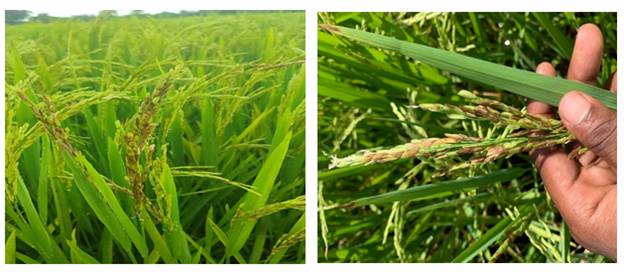
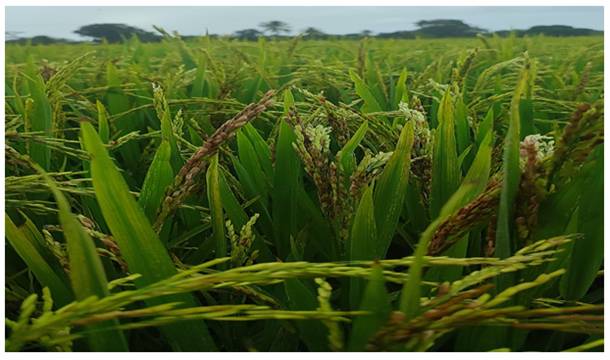
Images of the discolored grains
observed under field conditions in Essequibo and Demerara (Region # 2, 3, and
4, Guyana) (Photo:
GRDB, 2023).
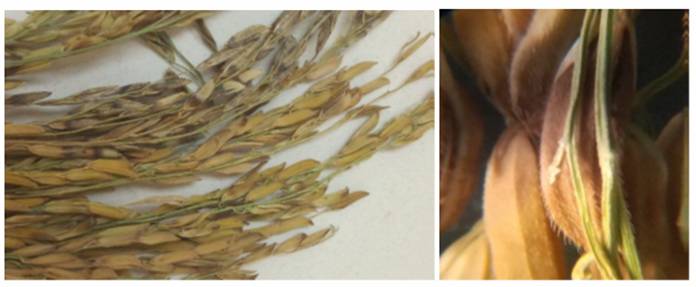
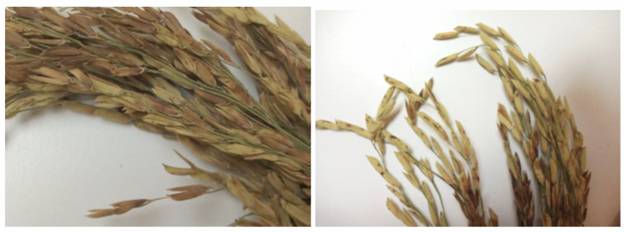
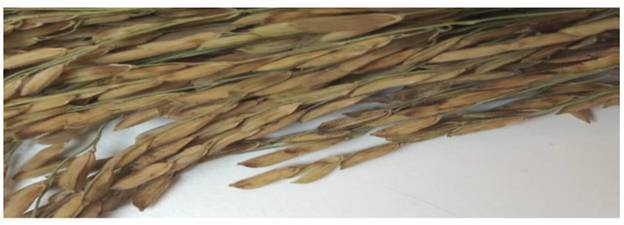
Images of the discolored grains at
harvest in Essequibo and Demerara (Region # 2, 3, and 4, Guyana) (Photo: CABI, 2023)
Reference:
Center
for Agriculture and Bioscience International (CABI or CAB International). 2023.
Final report of analysis. Diagnostic and
Advisory Service. United Kingdom (UK).
Cite this Article: Persaud, R; Gilkes, J; Casey, A; Persaud,
DA; Charles, E (2024). Discovery of Curvularia sp., Pantoea sp., and Pseudomonas oryzihabitans, Associated with Symptoms of Dirty Discolored Grains of Paddy and Panicle Blight in Guyana. Greener Journal of Agricultural Sciences,
14(1): 15-22. https://doi.org/10.5281/zenodo.10683147
|