|
Greener Journal of Biological Sciences Vol. 3 (6), pp. 229-237, August, 2013 ISSN: 2276-7762; ICV: 5.99 Copyright ©2013, the copyright of this article is retained by the author(s) DOI Link: http://doi.org/10.15580/GJBS.2013.6.070913712 http://gjournals.org/GJBS |
|
A Survey of Plants Used in the Treatment of Ante-Natal and Post-Natal Disorders in Nneochi Local Government Area of Abia State, Nigeria
*CHIMA U.D., OFODILE E.A.U. and OKORIE M.C.F.
Greener Journal of Biological Sciences, vol. 3 (6), pp. 229-237, August, 2013
Department of Forestry and Wildlife Management, University of Port Harcourt- Choba, P.M.B. 5323, Port Harcourt, Rivers State, Nigeria.
|
ARTICLE INFO |
ABSTRACT |
|
|
Article No.: 070913712 Type: Research DOI: 10.15580/GJBS.2013.6.070913712
|
This study evaluated plants in homesteads employed in the treatment of ante-natal and post-natal disorders in four communities within Nneochi Local Government Area of Abia State, Nigeria. A total of 18 plant species belonging to 12 families were found to be used in the handling of pregnancy-and post-pregnancy-related issues including infertility, breast lump, placenta delivery, womb cleansing, milk production, anaemia, miscarriage, umbilical wound, among others. Plant remedies were prepared mostly as infusions or decoctions from different plant parts using water, palm-wine, gin, stout beer and soft drinks. The diversity, species richness and abundance of the medicinal plants varied among the sampled communities. Similarity in the identified plant species composition between communities also varied and ranged from 50 – 79%; indicating varying levels of knowledge of their medicinal attributes, cultivation and usage. Conservation and laboratory screening of the species are suggested to complement global efforts towards a drastic reduction in child and maternal mortality. |
|
|
Submitted: 09/07/2013 Published: 28/08/2013 |
||
|
*Corresponding Author Chima U.D. E-mail: punditzum@ yahoo.ca Phone: +234-803-812-1887 |
||
|
Keywords: Ethnomedicine, pregnancy, child and maternal mortality, Eastern Nigeria |
||
|
|
|
INTRODUCTION
Many women die each year from cases related to pregnancy and childbirth despite incessant claims of a positive turning point in the battle to keep mothers alive during pregnancy and childbirth. WHO (2012) reported that globally, maternal mortality had fallen by 47% between 1990 and 2010, observing that the overall aim of MDG 5 (a 75% reduction) is very unlikely to be achieved by 2015 unless there are remarkable further reductions from 2011 to 2015. Developing countries account for 99% of the global maternal deaths with the majority of the deaths in sub-Saharan Africa and Southern Asia. At the country level, India (contributing 19%) and Nigeria (contributing 14%) account for one third of global maternal deaths (WHO 2012). Maternal health has become a critical topic in global development.
Maternal ill health and death impact families, communities and societies and has far reaching effects across socio-economic strata. Lack of skilled and motivated staff as well as inadequate drugs and equipment in inadequate health centres have been identified as the major factors responsible for maternal and child deaths. These challenges are more in the rural areas where local people hardly have access to modern medical facilities. Though public health centres were established in both rural and urban areas in Nigeria with the intention of equity and easy access, regrettably, the rural populations in Nigeria are seriously underserved when compared with their urban counterparts (Abdulraheem et al., 2012). The need for increased access to care and insurance coverage is especially crucial for rural populations because they receive less preventive care and have higher rates of all chronic diseases than their urban counterparts (Bailey, 2010).
However, plant materials have continued to play a major role in primary health care especially in the developing countries. Herbal medicine is the oldest form of healthcare known to mankind and over 50% of all clinical drugs are of natural products origin, and natural products play important roles in drug development in the pharmaceutical industry (Preethi et al, 2010).
Although, available literature parades an avalanche of published materials on medicinal plants and claims on their efficacies in the treatment of various ailments, none has focused exclusively on medicinal plants used in the treatment of ante-natal and post-natal disorders which are chiefly responsible for child and maternal mortality. Due to paucity of modern health facilities, the rural dwellers in Nneochi Local Government Area rely heavily on traditional medicine for remedies to various ailments. This paper focuses on local approaches to the treatment of ante-natal and post-natal disorders in Nneochi Local Government area of Abia State, Nigeria with a view to providing knowledge that will complement efforts at tackling the menace of pregnancy – and birth- related ailments.
Given the alarming rate of deforestation in various parts of the globe including Nigeria, and the concomitant loss of species (including medicinal plants), the study went beyond the conventional ethno-medicinal survey to include the evaluation of populations of the identified plant species relevant to the subject matter, at the homestead level, with a view to providing information that will enhance their conservation. It is hoped that the conservation and laboratory screening of these species may achieve results that will corroborate global efforts towards a drastic reduction in child and maternal mortality.
METHODOLOGY
Description of the study area
The study was carried out in Nneochi Local Government Area of Abia State. Abia State occupies 584sqkm. It is bounded on the north and northwest by Anambra, Enugu and Ebonyi States. To the west is Imo State, and the east and south-east are Cross- Rivers and Akwa Ibom States; to the south is Rivers State. It has an annual rainfall of 2400mm. The area is characterized by tropical wet climate usually from the month of March to October and dry climate usually from November to March. The most important Rivers in Abia State are the Imo and Aba Rivers which flow into the Atlantic Ocean through the Niger Delta (www.abiastate-ng.com). Abia State has seventeen (17) Local Government Areas (LGAs) of which Nneochi Local Government Area is one. The population of Nneochi L.G.A. is 163, 928 (as at the 2006 Census) and the major occupation of the people are trading and farming. Figure 1 is the Map of Abia State showing the study area.
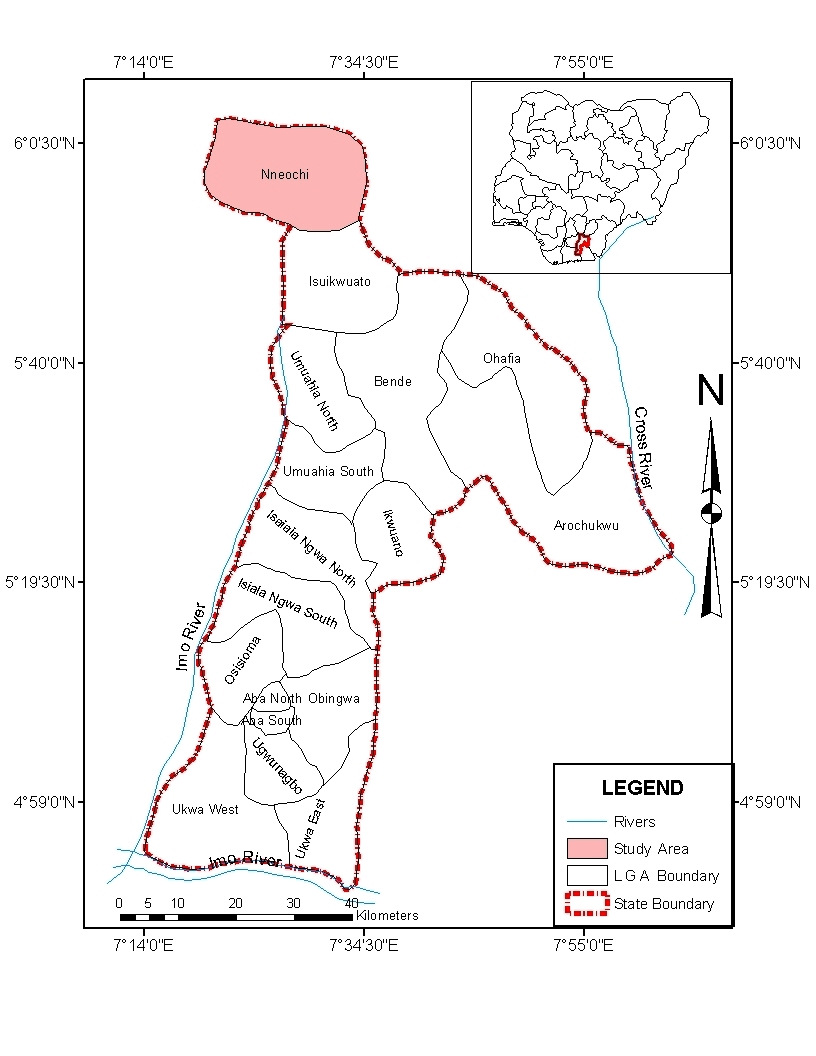
Figure 1: Map of Abia State showing the Study Area
Selection of Study Sites
Multistage sampling procedure was used in selecting the study sites. In the first stage of sampling, four (4) communities were randomly selected. In the second stage of sampling, three (3) villages were randomly selected from each of the communities. In the third stage of sampling, ten (10) compounds were randomly selected from each village for visiting. This gave a sample size of 120 compounds.
Data Collection
Data for the study were collected mainly through oral interview and field enumeration. In each compound visited, information sought from the head of the compound and recorded included: The plant species used to treat pregnancy-related-and-post-natal ailments and their local names; number of each of such plant species encountered and their habits; parts of the plant species used as medicines; method of preparation; and the form in which they are taken for medication.
Data Analysis
Measurement of medicinal plant species diversity within communities
Simpson diversity index (Simpson, 1949) was used to measure the diversity of plant species used for treating ante-natal and post-natal disorders in each of the four communities.
 Simpson’s Index is expressed as:
D = 
Where:
ni = the number of individuals in the ith species.
N = the total number of individuals counted.
Since Simpson’s Index as expressed above has an inverse relationship with diversity (i.e. the lower the index, the higher the diversity and vice versa), the diversity of communities based on the Simpson’s index was expressed as (1 – D), to allow for a direct relationship with diversity.
Measurement of similarity in medicinal plant species between communities
Sorensen’s similarity index was used to ascertain the level of similarity in medicinal plant species composition between each pair of the communities. The computation of Sorensen’s similarity index in this study followed the method of Margurran (2004) as expressed below:
SI = 2a / {2a + b + c}
Where:
a = number of species present in both communities under consideration
b = number of species present in community 1 but absent in community 2.
c = number of species present in community 2 but absent in community 1
The Paleontological Statistics (PAST) software was also used to obtain a hierarchical classification of the communities using Sorensen’s similarity indices such that communities with very high similarity cluster together while those that are dissimilar are far apart.
RESULTS
Species used in the treatment of ante-natal and post-natal disorders in the study area
The plant species used to treat ante-natal and post-natal disorders in the communities are shown in Table 1. A total of 18 plant species belonging to 12 families were enumerated. The species were mainly trees and herbs, and are used to treat specific cases like infertility, breast lump, placenta delivery, womb cleansing, difficulty with breast-milk production, anaemia, miscarriage, umbilical wound, among others (Table 2). Parts of the plants used include leaf, stem, pod, spadix and seed.
Table 1: Checklist of plant species used in treating ante-natal and post-natal disorders
|
S/No. |
Botanical name |
Common name |
Igbo name |
Family |
Habit |
|
1. |
Bryophyllum pinnatum (Lam) Oken |
Africa never die plant |
Odunduafuoweya/Odaopuo |
Crassulaceae |
Herb |
|
2. |
Centrosema pubescens Benth |
Beans |
Akidi |
Leguminosae – Papilinionaceae |
Herb |
|
3. |
Cnestis feruginae Vahl ex DC |
- |
Amunkita |
Connaraceae |
Herb |
|
4. |
Commelina africana L |
Lions claw |
Mboagu |
Commelinaceae |
Herb |
|
5. |
Elaeis guineensis Jacq |
Palm tree |
Nkwu, Akwu |
Arecaceae |
Tree |
|
6. |
Eleusine indica (L) Gaertn |
Wire grass, fowl foot |
Ichite |
Poaceae |
Herb |
|
7. |
- |
Ntiele |
Asteraceae |
Herb |
|
|
8. |
Euphorbia kamerunica Pax |
- |
Udo-ogwu |
Euphorbiaceae |
Herb |
|
9. |
Ficus exasparata Vahl |
Sandpaper |
Wagiriwa |
Moraceae |
Tree |
|
10. |
Ficus thonningii Blume |
- |
Obu, okpoto |
Moraceae |
Tree |
|
11. |
Jatropha gossypifolia L |
Wild cassava |
Mbo ogwu |
Euphorbiaceae |
Shrub |
|
12. |
Kigelia africana (Lam) Benth |
Sausage tree |
Uda agu |
Bignoniaceae |
Tree |
|
13. |
Mallotus oppositifolius (Geiseler) Müll.Arg |
Indian kamila |
Kpokoko |
Euphorbiaceae |
Tree |
|
14. |
Senna occidentialis (L) Link |
- |
Nchummuo |
Leguminosae-Caesalpinaceae |
Tree |
|
15. |
Telferia occidentalis Hook. f. |
Fluted pumpkin |
Ugu |
Cucurbitaceae |
Herb |
|
16. |
Tetrapleura tetraptera Taub |
- |
Ohiohio |
Leguminosae – Mimosaceae |
Tree |
|
17. |
Vitelleria paradoxa (Gaertn f.) Hepper |
Shea butter |
Oguma |
Sapotaceae |
Tree |
|
18. |
Xylopia aethiopica (Dunal) A. Rich |
Guinea pepper |
Uda |
Annonaceae |
Tree |
Table 2: Specific cases treated by different species, parts used, methods of preparation and administration
|
S/N |
SPECIES |
USES |
PARTS USED |
PREPARATION |
ADMINISTRATION |
|
1. |
Bryophyllum pinnatum (Lam) Oken |
Umbilical wound healing |
Leaf |
The leaves are squeezed, and blanched in some cases. |
Juice from the squeezed leaves is applied to a newly born baby’s umbilical cord daily for five days. |
|
2. |
Centrosema pubescens Benth |
Womb cleansing after delivery |
Pod |
The pod is prepared as pepper soup |
The soup is taken twice daily by the woman who just delivered. |
|
3. |
Cnestis feruginea Vahl ex DC |
Prevention of miscarriage |
Root |
The root is cut into pieces and boiled in water. |
The decoction (10cl) is taken to stabilise pregnancy. |
|
4. |
Commelina africana L |
Treatment of softness of core of the head in babies, and infertility in women |
The whole plant |
The plant juice is extracted by squeezing or pounding the leaves/roots. The plant parts can also be boiled in water. |
The squeezed plant juice is applied topically on the soft-core of the head of a baby to harden it. The decoction is drunk to enhance fertility in women. |
|
5. |
Elaeis guineensis Jacq. |
Prevention of miscarriage |
Spadix, root |
The fresh spadix is cut into pieces and cooked together with the root. |
The water (20cl) from the cooked flower and root is taken daily from conception to the day of delivery. |
|
6. |
Eleusine indica (L) Gaertn. |
Abortion |
Leaf |
The leaves are boiled with water and the water used to make ‘eba’ (Garri from cassava soaked in hot water). |
The ‘eba’ is eaten with soup.
|
|
7. |
Confirmation of pregnancy |
Leaf, stem |
The leaves and stem are boiled in water or soaked in alcohol. |
The boiled water or alcoholic extract (5cl) is given to a woman to confirm if she is pregnant. |
|
|
8. |
Euphorbia kamerunica Pax |
Placenta delivery |
Leaf |
The leaves are squeezed and the juice extracted with water |
10cl of the extract is given to the woman who delivers immediately for the removal of placenta. |
|
9. |
Ficus exasparata Vahl |
Breast milk booster |
Leaf |
The leaves are squeezed and the juice extracted with palm-wine after soaking for an hour. |
50cl of the decoction is taken 3 times daily every 3 days. |
|
10. |
Ficus thonningii Blume |
Treatment of sour-breast- milk |
Leaf |
The leaves are cut into pieces and soaked in about 2 litres of palm-wine. |
The palm wine decoction of leaves (20-40cl) is drunk daily for 2 weeks in the case of sour breast milk. |
|
11. |
Jatropha gossypifolia L |
Treatment of softness of core of the head in babies, placenta delivery |
Leaf |
The leaves are squeezed |
The leaf-juice is rubbed on the soft part of the baby’s head and it hardens after 7 days. About 10cl juice is also drunk by the woman having difficulty in delivery of placenta. |
|
12. |
Kigelia africana (Lam) Benth. |
Fibroid, infertility in women |
Root |
The root is cut into pieces and boiled in water. Also the leaves of Newbouldia laevis are boiled with the roots for conception. |
It is taken 10cl twice daily.
|
|
13. |
Mallotus oppositifolius (Geiseler) Müll.Arg |
Infertility |
Leaf, root |
Leaves/roots ground, cooked in water and filtered, or cut into pieces and soaked in gin. |
Taken 10-20cl daily.
|
|
14. |
Senna occidentalis (L) Link |
Inability to produce breast milk |
Leaf |
The leaves are pounded and a pinch of salt is added to it with pepper. It is then moulded into small balls and sundried. |
The balls (with roasted groundnut) are eaten by a breastfeeding mother having difficulty in milk production.
|
|
15. |
Telfairia occidentalis Hook. f. |
Anaemia |
Leaf |
The leaves are blanched, cut into pieces and steamed, or squeezed and the juice mixed with stout or Maltina drink. |
The steamed leaves are eaten with rice or alone while the decoction is taken 1 cup full twice daily.
|
|
16. |
Tetrapleura tetraptera Taub. |
Womb cleansing |
Pod |
The pod is cooked with leaves of Ocimmum gratissimum, Piper guineense and salt. |
A small quantity of the soup is taken twice daily for a month to cleanse and set the womb.
|
|
17. |
Vitelleria paradoxa (Gaertn f.) Hepper |
Breast lump |
Seed |
The seed is heated on fire. |
The heated seed is placed on the lump on daily bases till the lump dissolves.
|
|
18. |
Xylopia aethiopica (Dunal) A. Rich. |
Womb cleansing |
Fruit pod |
The pod is slashed with a cutlass and cooked with other spices in form of soup. |
The soup is taken twice daily. |
Populations of plant species used in the treatment of ante-natal and post-natal disorders within homesteads
The populations of the enumerated species are shown in Table 3. Within communities, species populations ranged from 0 – 60 in Amuda, 0 – 270 in Mbala, 0 – 45 in Nneato and 0 – 35 in Umuaku. Across communities, species populations ranged from 1 for Vitelleria paradoxa to 290 for Centrosema pubescens. The highest number of individuals was found in Mbala, followed by Amuda, Umuaku and Nneato respectively.
Table 3: Populations of plant species used in the treatment of pre-natal and post-natal disorders in the four communities
|
Species |
Population |
||||
|
Amuda |
Mbala |
Nneato |
Umuaku |
Total |
|
|
Bryophyllum pinnatum |
52 |
26 |
10 |
18 |
106 |
|
Centrosema pubescens |
20 |
270 |
0 |
0 |
290 |
|
Cnestis feruginae |
4 |
0 |
0 |
0 |
4 |
|
Commelina africana |
0 |
7 |
0 |
0 |
7 |
|
Elaeis guineensis |
11 |
21 |
14 |
35 |
81 |
|
Eleusine indica |
15 |
0 |
0 |
0 |
15 |
|
Emilia sonchifolia |
4 |
2 |
6 |
4 |
16 |
|
Euphorbia kamerunica |
12 |
48 |
0 |
12 |
72 |
|
Ficus exasparata |
0 |
4 |
1 |
0 |
5 |
|
Ficus thonningii |
2 |
4 |
0 |
0 |
6 |
|
Jatropha gossypifolia |
15 |
8 |
0 |
4 |
27 |
|
Kigelia africana |
3 |
1 |
0 |
3 |
7 |
|
Mallotus oppositifolius |
0 |
2 |
0 |
0 |
2 |
|
Senna occidentialis |
5 |
7 |
1 |
0 |
13 |
|
Telferia occidentalis |
60 |
30 |
45 |
25 |
160 |
|
Tetrapleura tetraptera |
0 |
0 |
2 |
4 |
6 |
|
Vitelleria paradoxa |
0 |
1 |
0 |
0 |
1 |
|
Xylopia aethiopica |
1 |
2 |
0 |
0 |
3 |
|
Total |
204 |
433 |
79 |
105 |
821 |
Diversity of plant species used in the treatment of ante-natal and post-natal disorders in different communities
The within community diversity indices are shown in Table 4. Species richness was highest in Mbala, followed by Amuda, Umuaku, and Nneato respectively. However, medicinal plant diversity was highest in Amuda, followed by Umuaku, Nneato, and Mbala respectively.
Table 4: Medicinal plant species diversity indices for different communities
|
|
Amuda |
Mbala |
Nneato |
Umuaku |
|
Species richness |
13 |
15 |
7 |
8 |
|
Simpson 1 - D |
0.82 |
0.587 |
0.6214 |
0.7846 |
Similarity in ante-natal and post-natal medicinal plant species composition between communities
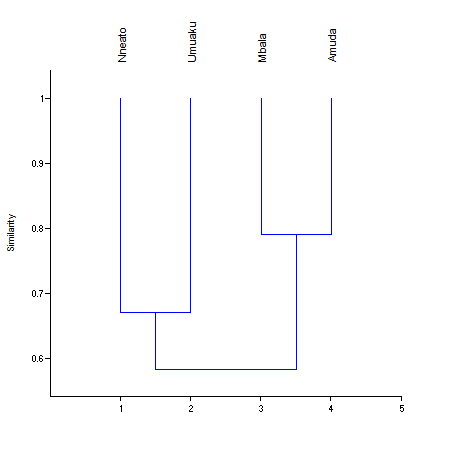
Table 5 shows the level of similarity in ante-natal and post-natal medicinal plant species between communities. The highest similarity was observed between Amuda & Mbala; followed by Amuda & Umuaku and Nneato & Umuaku; Mbala & Umuaku; Mbala & Nneato; and Amuda & Nneato, respectively. Figure 2 shows the hierarchical classification of the communities based on their similarities in medicinal plant species composition. Mbala and Amuda showed a closer association on one hand while Umuaku and Nneato showed a closer association on the other hand.
Table 5: Sorensen’s similarity indices for the four communities
|
|
Amuda |
Mbala |
Nneato |
Umuaku |
|
Amuda |
* |
0.79 |
0.50 |
0.67 |
|
Mbala |
|
* |
0.55 |
0.61 |
|
Nneato |
|
|
* |
0.67 |
|
Umuaku |
|
|
|
* |
Figure 2: Cluster dendogram classification of communities based on Sorensen’s similarity indices
DISCUSSION
Given the far-reaching consequences of maternal and child mortality, there has been a global battle for some time now to keep mothers and children alive during pregnancy and child birth. This global concern has been well captured in the Millennium Development Goals (MDGs) of the United Nations. However, many women and children continue to die each year from cases related to pregnancy and child birth.
The challenges of maternal and child mortality are more in the rural areas where medical facilities are either lacking or grossly inadequate. This study has shown that the rural people of Nneochi rely heavily on herbal medicine to handle ante-natal and post-natal disorders which are chiefly responsible for maternal and child mortality. Traditional herbal remedies provide health services even in highly industrialized setups because they are important pillars of culture and human socialization (Owuor et al., 2005).
Medicinal plant species diversity was higher in Amuda community than in the other communities though, medicinal plant species richness and abundance were higher in Mbala than in the other communities. This implies that the medicinal plants in Amuda were more evenly distributed among the species present than in the other communities. The lowest diversity in Mbala despite its highest species richness and medicinal plant populations is attributable to high species dominance. It should be noted that only one species – Centrosema pubescens, accounted for 62% of the total medicinal plant populations in Mbala Community. Ambasht and Ambasht (2008) noted that species diversity accounts for not only the number of species in a community (i.e. species richness) but also the evenness in the distribution of the individuals among the species present; and that species dominance reduces diversity. Looking at the cluster dendogram, Mbala and Amuda showed a closer association on one hand while Umuaku and Nneato showed a closer association on the other hand. This implies that Mbala and Amuda have a very close ecological distance with respect to their medicinal plant species composition and the same thing applies to Umuaku and Nneato.
The differences in species richness, diversity, abundance and similarity of these species across communities in the study area are indicative of varying levels of awareness and knowledge of their medicinal attributes. This underscores the need to conduct similar surveys in as many rural areas as possible in order to document and disseminate information on the subject matter. Okello et al. (2010) observed that change in lifestyle has impacted negatively on the maintenance of traditional knowledge on herbal remedies; hence the danger of it being lost. Moreover, knowledge in traditional treatment has been observed to be on the decline due to the death of aged traditional healers (Cox and Balick, 1994).
The need for appropriate authorities to encourage the conservation of these medicinal plants of importance ex situ at homesteads given the high spate of deforestation in many parts of the developing countries including the study area is emphasized. It is hoped that further laboratory and clinical investigations of these species may achieve results that will corroborate global efforts towards a drastic reduction of child and maternal mortality.
REFERENCES
Abdulraheem, I.S., Olapipo, A.R., and Amodu, M.O. (2012). Primary health care services in Nigeria: Critical issues and strategies for enhancing the use by the rural communities. Journal of Public Health and Epidemiology 4(1): 5 – 13.
Ambasht, R.S. and Ambasht, N.K. (2008). A Textbook of Plant Ecology (15th Edition). CBS Publishers & distributors, New Delhi, 444pp.
Bailey, J.M. (2010, February 10). Why Health Reform Can’t Wait: The Benefits of Health Reform for Rural America. Center for Rural Affairs. Retrieved on June 15, 2011 from: http://www.cfra.org/10/cant-wait.
Cox, P.A. and Balick, M.J. (1994). Ethno-botanical approach to drug discovery. Scientific American 270(6): 82 – 87.
Magurran, A.E. (2004). Measuring Biological Diversity. Blackwell, Oxford.
Okello, S.V., Nyunja, R.O., Netondo, G.W. and Onyango, J.C. (2010). Ethnobotanical study of medicinal plants used by Sabaots of Mt. Elgon, Kenya. African Journal of Traditional, Complementary and Alternative Medicine 7(1): 1 – 10.
Owuor, B. Mulemi, B. and Kokwwaro, J. (2005). Indigenous snake bite remedies of the Luo of western Kenya. Journal of Ethnobiology 25(1):129 – 141.
Preethi, R.M.; Devanathan, V.V. and Loganathan, M. (2010). Antimicrobial and antioxidant efficacy of some medicinal plants against food-borne pathogens. Advance in Biological Research 4: 122 – 125.
Simpson, E.H. (1949). Measurement of diversity. Nature 163: 688.
World Health Organization (WHO) (2012). Trends in Maternal Mortality 1990 to 2010. WHO Geneva, 72pp.
|
Cite this Article: Chima UD, Ofodile EAU and Okorie MCF (2013). A Survey of Plants Used in the Treatment of Ante-Natal and Post-Natal Disorders in Nneochi Local Government Area of Abia State, Nigeria. Greener Journal of Biological Sciences, 3(6): 229-237, http://doi.org/10.15580/GJBS.2013.6.070913712. |