|
Greener Journal of
Economics and Accountancy
Vol. 7(1), pp. 01-10, 2019
ISSN: 2354-2357
Copyright ©2019, the
copyright of this article is retained by the author(s)
DOI Link: https://doi.org/10.15580/GJEA.2019.1.041819072
http://gjournals.org/GJEA
|

|
Foreign
Direct Investment (FDI) Dynamics in India: What Do Arima
Models Tell Us?
Nyoni, Thabani1; Muchingami,
Lovemore2; Jambani,
Lawrence3; Njanji, Robert4
1
University of Zimbabwe, Department of Economics (Student), Harare, Zimbabwe.
Email: nyonithabani35@ gmail.
com
2 BA ISAGO University, Department of Accounting & Finance,
Gaborone, Botswana.
Email: lavmuch@ gmail. com
3 BA ISAGO University, Department of Accounting & Finance,
Gaborone, Botswana.
Email: Lawrence.jambani@
baisago.ac. bw
4 BA ISAGO University, Department of Accounting
& Finance, Gaborone, Botswana.
Email: Robert.njanji@
baisago.ac. bw
|
ARTICLE INFO
|
ABSTRACT
|
|
Article
No.: 041819072
Type: Research
DOI: 10.15580/GJEA.2019.1.041819072
|
Using annual time series
data on net FDI inflows in India from 1960 to 2017, the study examines net
FDI inflows using the Box – Jenkins ARIMA methodology. The ADF tests reflect
that India FDI net FDI inflows data is I (1). Based on the AIC, the study
presents the ARIMA (1, 1, 0) model. The diagnostic
tests further show that the presented parsimonious model is not only stable
but also suitable for explaining net FDI dynamics in India. The results of
the study indicate that, net FDI inflows in India are likely to weaken over
the next 10 years. The study identifies two (2) significant policy
recommendations in an effort to aid policy makers on how to promote and
stimulate the much expected net FDI inflows in India.
|
|
Submitted: 18/04/2019
Accepted: 20/04/2019
Published: 20/09/2019
|
|
*Corresponding
Author
Muchingami,
Lovemore
E-mail:
lavmuch@ gmail. com
|
|
Keywords: Foreign
Direct Investment; Forecasting; India
JEL Codes: C53, E27, F21
|
|
|
|
1.0 INTRODUCTION
In the vein of enhancing economic growth, one
of the contemporary policies adopted by developing countries is the attraction
of Foreign Direct Investment (FDI). This can be in the form of both human and
financial capital inflows. Foreign direct investment and foreign investment
sound to be synonyms. However, the main difference is that, foreign direct
investment requires control of the enterprise whilst foreign investment will
just influence the management of the enterprise, (Cambazoglu
and Karaalp, 2014). Domestic capital in emerging
economies is usually confined to low risk investments which are not enough to
sustainably boost economic growth. Due to these apparent reasons, many
developing economies now focus on policies needed to attract FDI inflows to
supplement their limited domestic capital.
To this end, FDI can
be defined as an investment option that comprises a long term relationship,
interest and management influence by a resident of one country (foreign direct
investor / parent enterprise) in an enterprise residing in a foreign economy (Prasanna, 2015). This may allow foreign investors to gain
access to the economies which are highly regulated. FDI is also critical in the
development of any economy as it facilitates the transfer of financial
resources, technology and innovative & improved management strategies along
with raising productivity (Nyoni, 2018i). Thus, FDI
supplements domestic investments by bringing in the required capital stock and
boost the overall capital formation of any economy (Gupta & Chaturvedi, 2017).
Historically, India
has adopted a vigilant and selective approach regarding foreign capital. This
has seen the economy experiencing unmanageable balance of payments crisis
characterized with socially intolerable high rates of inflation prior to 1991,
forcing the liberalization of economic policies inclusive of the FDI policy, (Palit, (2009) and Wadhva (1991)).
There have been delays and reverses in the adoption of new economic policies to
allow the interaction of democratic politics, coalition governments, and
pressure groups which had vested much interest in the economy. Based on Suriyakanth (2016), from the year 1991-1992 to 2014 – 2015,
India has realized US $ 426,318 million FDI inflows, becoming the most preferred
investment destination after China and the US. This stimulated Indian’s
domestic investments and facilitated improvement in both human capital and
local institutions, making India an investment hub over the past decade,
(Chopra and Sachdeva, 2014).
According to the
Indian Brand Equity Foundation (IBEF, 2019), the
government’s policy regime and a robust business environment have warranted
that foreign capital keeps flowing into the country. The key identified Indian sectors
that require to be resuscitated through FDI now include defense, PSU oil refineries,
telecom, power exchanges and stock exchanges. Apart from being a critical
driver of economic growth, FDI is a major source of non-debt financial resource
for the economic development of India (IBEF, 2019). In return, foreign
companies benefit from relatively lower wages and special investment privileges
such as tax exemptions. Whilst the host country achieves the technical know-how,
making locally produced products competent in the global market and improving
the well-being through employment of the Indian citizens. To ensure
sustainable economic growth through FDI inflows, this study seeks to model and
forecast net FDI inflows in India using the Box-Jenkins ARIMA technique.
2.0 LITERATURE REVIEW
2.1 Theoretical
Literature Review
The
nexus between FDI and economic growth has been extremely researched, though
there are still some contradictory findings. One of the well-established
orthodox theoretical viewpoints on FDI is the Ownership, Location and Internal
(OLI) paradigm (Aydin.N and Kulali 2016) as propounded by Dunning
(1980). It is almost important
to recognize that there are quite a number of theories that can easy the understanding
of why FDI exists. These include the Hecksher – Ohlin model (Hecksher and Ohlin, 1933), the
Product Life Cycle theory (Vernon,
1966), the market imperfections theory, the path dependence theory (Martin & Sunley, 2006) and the internalization theory (Buckley and Casson, 1976; Dunning and Rugman,
1985 Hennart, 1985).
In their uniqueness
in interpreting the flow of FDI, The Hecksher – Ohlin
model, a well-known model of International Economics (Trade), argues that
countries will import products that use their limited factors and export those
products that use their abundant and cheap factors of production. The Product
Life Cycle theory, another popular model in International Economics (Trade),
basically argues that a product passes through four (4) consecutive stages of
development namely: the innovative stage, the take off stage, the maturity
stage and the decline stage. The firm will begin producing for its domestic
market in the innovative and take off stages but as the product matures, the
firm will export to other countries. In the final stage, rival firms produce the
same product and sell it to other countries including the innovating firm back
in the originating domestic market. In this theory, via this channel, FDI can
move from developed countries to developing countries and vice-versa.
2.2 Empirical
Literature Review
2.2.1 Vector Error Correction Model (VECM)
Using Pedroni co-integration test and VECM, Erickson and Owusu-Nantwi (2019) found that there is a positive
relationship between FDI and economic growth in South America. Their conclusion
conquered with many researchers such as Anyanwu and Yameogo (2015), Saqib, Masoon and Rafique (2013), Lonzi and Abadi (2011) and
Alfaro, Chanda, Kalemli-Ozcan
and Sayek (2004). Palamalai,
Kalaivani and Ibrahim (2011) established a
bidirectional causal link between FDI and economic growth for all SAARC nations
except India. Gupta and Singh (2016) in their study of the BRICS nations using
VECM and Granger Causality test concluded that in Brazil, India and China,
there exist a unidirectional long-run causality running from GDP to FDI.
2.2.2 Autoregressive
Integrated Moving Average (ARIMA) and The Box – Jenkins models
In India, Biswas
(2015) investigated net FDI inflows using the Box-Jenkins technique over the
period 1992 – 2014 and concluded that FDI in India will follow an increasing
trajectory over the period 2015 – 2034. Dhingra et al (2015), in yet another Indian
study, analyzed foreign institutional investment inflows to India using the
Box-Jenkins ARIMA models over the period January 2004 – September 2012 and
finalized that the various AR and MA terms influence the current inflow or
outflow of foreign institutional investment. In Africa, Jere et al (2017) forecasted FDI inflows
using Box-Jenkins ARIMA models over the period 1974 – 2014 and established that
there will be a gradual increase in annual net FDI inflows of about 44.36% by
2024 in Zambia. More recently, and in yet another African study, Nyoni (2018i) analyzed net FDI inflows in Zimbabwe using
the Box-Jenkins ARIMA technique over the period 1980 – 2017 and revealed that
net FDI inflows in Zimbabwe over the next 2 decades will follow a relatively poor
and unimpressive growth trend.
3.0 MATERIALS
& METHODS
3.1 ARIMA
Models
ARIMA models are often considered as
delivering more accurate forecasts then econometric techniques (Song et al, 2003b). ARIMA models outperform
multivariate models in forecasting performance (du Preez
& Witt, 2003). Overall performance of ARIMA models is superior to that of
the naïve models and smoothing techniques (Goh & Law, 2002). ARIMA models
were developed by Box and Jenkins in the 1970s and their approach of
identification, estimation and diagnostics is based on the principle of
parsimony (Asteriou & Hall, 2007). The forecasting equation for net Foreign
Direct Investment (FDI) with ARIMA (p, d, q) models, where the p denotes the
order of the autoregressive part, the d, the order of integration and the q,
the order of the moving average part of the model, can be given, in terms of
the lag operator notation as:

3.2 The
Box – Jenkins Methodology
The first step towards model selection is to
difference the series in order to achieve stationarity. Once this process is
over, the researcher will then examine the correlogram
in order to decide on the appropriate orders of the AR and MA components. It is
important to highlight the fact that this procedure (of choosing the AR and MA
components) is biased towards the use of personal judgement because there are
no clear – cut rules on how to decide on the appropriate AR and MA components.
Therefore, experience plays a pivotal role in this regard. The next step is the
estimation of the tentative model, after which diagnostic testing shall follow.
Diagnostic checking is usually done by generating the set of residuals and
testing whether they satisfy the characteristics of a white noise process. If
not, there would be need for model re – specification and repetition of the
same process; this time from the second stage. The process may go on and on
until an appropriate model is identified (Nyoni,
2018i).
4.0 Data
Collection
This research article is based on 42 data
points [observations] (1975 – 2017) of net FDI (USD) in India. The data was
taken from the World Bank online database, whose integrity and reliability is
well known, especially in academia.
4.1 Diagnostic
Tests & Model Evaluation
4.1.1 Stationarity Tests: Graphical Analysis
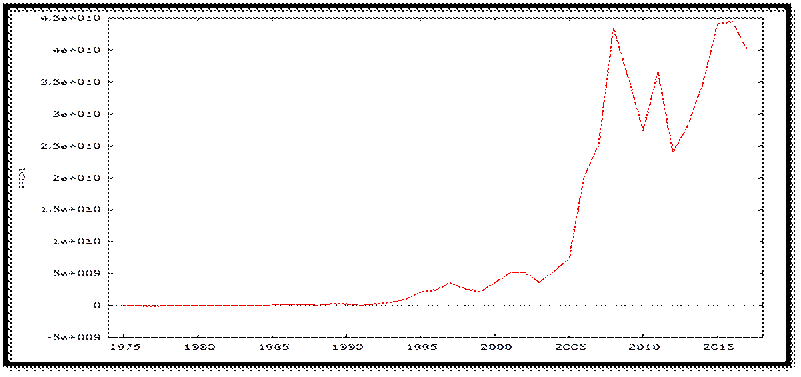
Figure 1
The Correlogram in Levels
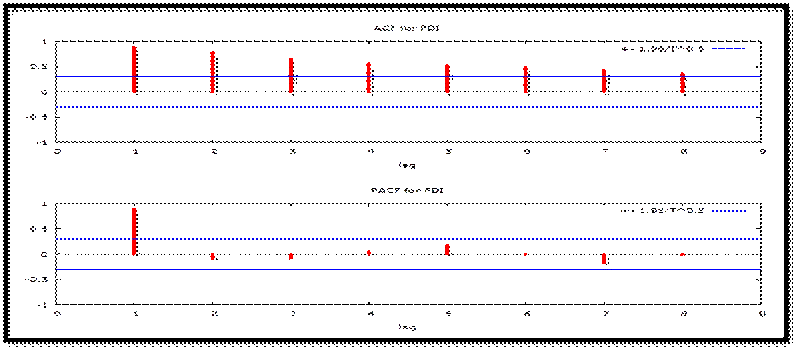
Figure 2
4.1.2 The
ADF Test
Table 1:
Levels-intercept
|
Variable
|
ADF Statistic
|
Probability
|
Critical Values
|
Conclusion
|
|
FDI
|
4.102105
|
1.0000
|
-3.646342
|
@1%
|
Not stationary
|
|
|
|
-2.954021
|
@5%
|
Not stationary
|
|
|
|
-2.615817
|
@10%
|
Not stationary
|
Table 2:
Levels-trend & intercept
|
Variable
|
ADF Statistic
|
Probability
|
Critical Values
|
Conclusion
|
|
FDI
|
3.554059
|
1.0000
|
-4.262735
|
@1%
|
Not stationary
|
|
|
|
-3.552973
|
@5%
|
Not stationary
|
|
|
|
-3.209642
|
@10%
|
Not stationary
|
Table 3: Without
intercept and trend & intercept
|
Variable
|
ADF Statistic
|
Probability
|
Critical Values
|
Conclusion
|
|
FDI
|
4.200696
|
1.0000
|
-2.636901
|
@1%
|
Not stationary
|
|
|
|
-1.951332
|
@5%
|
Not stationary
|
|
|
|
-1.610747
|
@10%
|
Not stationary
|
Figure 1 and 2 and tables 1 – 3 indicate that
the Indian FDI series is non-stationary in levels and hence not I (0).
The researcher will proceed to test for stationarity in first differences.
4.1.3 The Correlogram (at 1st Differences)
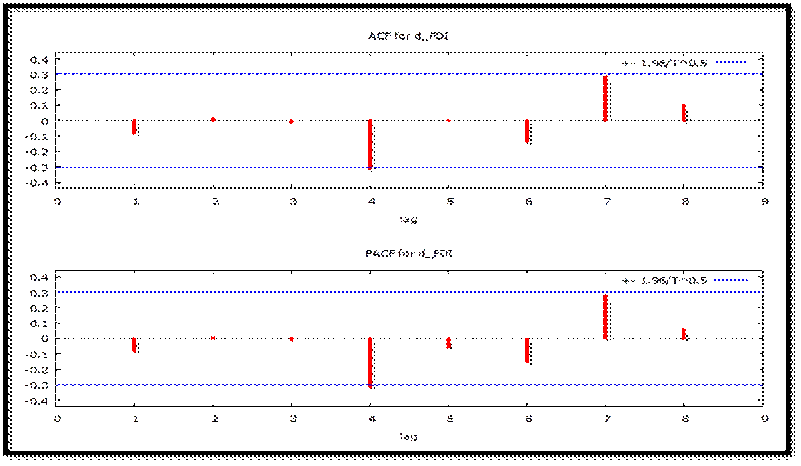
Figure 3
Table 4: 1st
Difference-intercept
|
Variable
|
ADF Statistic
|
Probability
|
Critical Values
|
Conclusion
|
|
FDI
|
-6.701686
|
0.0000
|
-3.600987
|
@1%
|
Stationary
|
|
|
|
-2.935001
|
@5%
|
Stationary
|
|
|
|
-2.605836
|
@10%
|
Stationary
|
Table 5: 1st
Difference-trend & intercept
|
Variable
|
ADF Statistic
|
Probability
|
Critical Values
|
Conclusion
|
|
FDI
|
-6.817384
|
0.0000
|
-4.198503
|
@1%
|
Stationary
|
|
|
|
-3.523623
|
@5%
|
Stationary
|
|
|
|
-3.192902
|
@10%
|
Stationary
|
Table 6: 1st
Difference-without intercept and trend & intercept
|
Variable
|
ADF Statistic
|
Probability
|
Critical Values
|
Conclusion
|
|
FDI
|
-6.519517
|
0.0000
|
-2.622585
|
@1%
|
Stationary
|
|
|
|
-1.949097
|
@5%
|
Stationary
|
|
|
|
-1.611824
|
@10%
|
Stationary
|
Figure 3 and tables 4 – 6 demonstrate that
the Indian FDI series is stationary in first differences and thus I (1).
4.2 Evaluation
of ARIMA models (without a constant)
Table 7
|
Model
|
AIC
|
U
|
ME
|
MAE
|
RMSE
|
MAPE
|
|
ARIMA (1, 1, 1)
|
2001.964
|
0.9925
|
990300000
|
2688600000
|
5049300000
|
51.333
|
|
ARIMA (1, 1, 0)
|
1999.985
|
0.99276
|
993010000
|
2685700000
|
5050600000
|
51.293
|
A model with a lower AIC value is better
than the one with a higher AIC value (Nyoni, 2018n).
The researcher will only make use of the AIC in selecting the optimal model.
Thus, the ARIMA (1, 1, 0) model was preferred.
Residual
& Stability Tests
ADF Tests
of the Residuals of the ARIMA (1, 1, 0) Model
Table 8:
Levels-intercept
|
Variable
|
ADF Statistic
|
Probability
|
Critical Values
|
Conclusion
|
|
εt
|
-6.361404
|
0.0000
|
-3.605593
|
@1%
|
Stationary
|
|
|
|
-2.936942
|
@5%
|
Stationary
|
|
|
|
-2.606857
|
@10%
|
Stationary
|
Table 9:
Levels-trend & intercept
|
Variable
|
ADF Statistic
|
Probability
|
Critical Values
|
Conclusion
|
|
εt
|
-6.471011
|
0.0000
|
-4.205004
|
@1%
|
Stationary
|
|
|
|
-3.526609
|
@5%
|
Stationary
|
|
|
|
-3.194611
|
@10%
|
Stationary
|
Table 10:
without intercept and trend & intercept
|
Variable
|
ADF Statistic
|
Probability
|
Critical Values
|
Conclusion
|
|
εt
|
-6.173446
|
0.0000
|
-2.624057
|
@1%
|
Stationary
|
|
|
|
-1.949314
|
@5%
|
Stationary
|
|
|
|
-1.611711
|
@10%
|
Stationary
|
The residuals of the chosen optimal model are
stationary as illustrated in tables 8 – 10 above.
Stability
Test of the ARIMA (1, 1, 0) Model
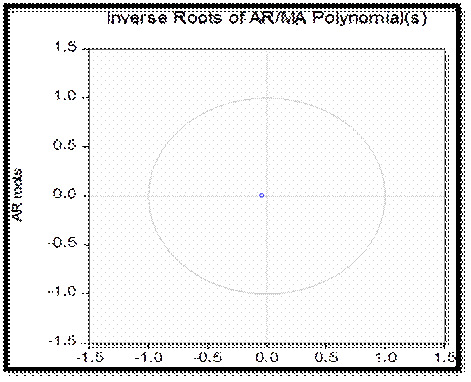
Figure 4
As illustrated in figure 4 above, the ARIMA
(1, 1, 0) model is stable as the corresponding inverse
roots of the characteristic polynomial lie in the unit circle.
5.0 FINDINGS
Descriptive
Statistics
Table 11
|
Description
|
Statistic
|
|
Mean
|
10460000000
|
|
Median
|
2168600000
|
|
Minimum
|
-36060000
|
|
Maximum
|
44459000000
|
|
Standard deviation
|
15306000000
|
|
Skewness
|
1.1932
|
|
Excess kurtosis
|
-0.22068
|
The average net FDI in India over the study
period is positive, i.e 10460000000 USD. The minimum
net FDI is -36060000 USD while the maximum is 44459000000 USD. Skewness is 1.1932
and it’s positive, meaning that the India’s net FDI over the period under
study, is positively skewed and non-symmetric. Excess kurtosis is -0.22068,
meaning that the FDI series is not normally distributed.
Results
Presentation
Table 12
|
ARIMA (1, 1, 0) Model:

P:
(0.8026)
S. E:
(0.155654)
|
|
Variable
|
Coefficient
|
Standard Error
|
z
|
p-value
|
|
AR (1)
|
-0.0389045
|
0.155654
|
-0.2499
|
0.8026
|
6.0
Interpretation of Results
The coefficient of the AR (1) is positive and
statistically insignificant. The model shows that a 1% increase in previous
period net FDI inflows will lead to approximately 0.04% decrease in the current
net FDI inflows in India, but since the AR (1) coefficient is insignificant, it
again reveals another salient issue: that the described interaction is less
important in explaining current and future values of net FDI inflows in
India.
Forecast Graph
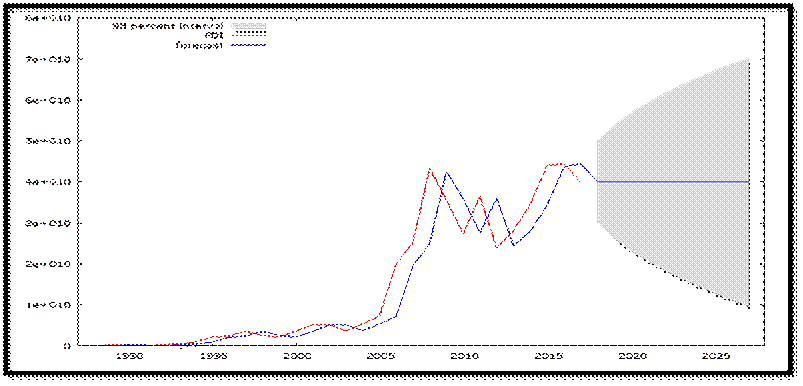
Figure 5
Our best-fit model, the ARIMA (1, 1, 0) model
predicts that India’s net FDI is likely to be lingering somewhere around USD 40
134 300 000 per year over the next decade. This may be rectified in the event
that comprehensive policy actions are made in terms of improving not only the
general investment environment but also the particular FDI policy stance of
India.
6.1 Policy
Implications
I.
The Indian government should thrive to create
a general investor friendly environment if FDI inflows are to increase in
India. This may be through strengthening a
one-stop window clearance system to easy the approval processes.
II.
The Indian government should also take more
stern measures against corruption, especially political corruption which
continues to frustrate both domestic and foreign investors in India.
7.0 CONCLUSION
This study showed that the ARIMA (1, 1, 0) model is the optimal model to model and forecast net FDI
inflows in India. The study illustrates that net FDI inflows in India are
expected to degenerate over the next decade, as long as nothing is done to
improve the investment environment in the Indian economy.
REFERENCES
1.
Alfaro, L., Chanda, A., Kalemli-Ozcan, S. and Sayek, S. (2004), “FDI and economic growth: the role of local financial
markets”, Journal of International Economics, Vol. 64 No. 1, pp. 89-112.
2.
Asteriou, D. &
Hall, S. G. (2007). Applied Econometrics: a modern approach, Revised Edition, Palgrave MacMillan, New York.
3.
Aydin.N and Kulali. G (2016) "How do foreign
direct investors group by their investments in Turkey and Germany?" International
Journal of Emerging Markets, Vol. 11 Issue: 3, pp.288-315.
4.
Biswas, A (2015).
Forecasting net Foreign Direct Investment in India: Box-Jenkins ARIMA model, International Journal of Management and
Business Studies, 5 (3): 49 – 58.
5.
Buckley,
P.J. and Casson, M. (1976), The Future of the Multinational Enterprise, Macmillan,
London.
6.
Cambazoglu.B
and Karaalp, H.S (2014) "Does foreign direct
investment affect economic growth? The case of Turkey", International Journal of Social Economics, Vol. 41 Issue: 6, pp.434-449
7.
Chopra, S and Sachdeva,
S. K (2014). Analysis of FDI Inflows and Outflows in India. Journal of Advanced Management Science
Vol. 2, No. 4, pp 326-32.
8.
Dhingra, V. S.,
Bulsara, H. P & Ghandhi, S (2015). Forecasting
foreign institutional investment flows towards India using ARIMA modeling, Management, 75: 13 – 26.
9.
Du Preez, J. &
Witt, S. F. (2003). Univariate and multivariate time series forecasting: An
application to tourism demand, International
Journal of Forecasting, 19: 435 – 451.
10.
Dunning,
J.H. (1980, “Toward an eclectic theory of international production:
some empirical tests”, Journal of International Business Studies,
Vol. 11 No. 1, pp. 9‐31.
11.
Dunning, J.H. and Rugman, A.M. (1985),
“The influence of Hymer’s
dissertation on the theory of foreign direct investment”, The American
Economic Review, Vol. 75 No. 2, pp. 228-232.
12.
Goh, C. & Law, R. (2002). Modeling and
forecasting tourism demand for arrivals with stochastic non-stationary
seasonality and intervention, Tourism
Management, 23: 499 – 510.
13.
Gupta, J & Chaturvedi,
R (2017). A Study to Analyze FDI Inflow to India, IOSR Journal of Economics and Finance (IOSR-JEF), 8 (5): 44 – 52.
14.
Hecksher,
E. and Ohlin, B. (1933). Interregional and International
Trade, Harvard University Press, Cambridge, MA.
15.
Hennart, J.-F. (1986), “What is
internalization?”, Review of World Economics
Publication, Vol. 122 No. 4, pp. 781-804.
16.
Jere,
S., Kasense, B & Chilyabanyama,
O (2017). Forecasting foreign direct investment to Zambia: a time series
analysis, Scientific Research Publishing
– Open Journal of Statistics, 7: 122 – 131.
17.
Martin,
R. and Sunley, P. (2006), “Path
dependence and regional economic evolution”, Journal of Economic Geography,
Vol. 6 No. 4, pp. 395-437.
18.
Nyoni, T (2018n). Modeling and Forecasting Inflation in
Kenya: Recent Insights from ARIMA and GARCH analysis, Dimorian Review, 5 (6): 16 – 40.
19.
Nyoni, T.
(2018i). Box – Jenkins ARIMA Approach to Predicting net FDI inflows in
Zimbabwe, Munich University Library –
Munich Personal RePEc Archive (MPRA), Paper No.
87737.
20.
Palamalai
Srinivasan, M and Kalaivani,
P. Ibrahim. (2011). “An empirical investigation of foreign direct investment
and economic growth in SAARC nations", Journal
of Asia Business Studies, Vol.
5 Issue: 2, pp.232-248.
21.
Palit, A
(2009), “India’s Foreign Investment Policy: Achievements and Inadequacies,
Centre Asia Ifri, Paris, July, pp. 6, 7.
22.
Prasanna, P. W. L
(2015). Modeling and forecasting Foreign Direct Investment (FDI) into SAARC for
the period of 2013 – 2037 with ARIMA, International
Journal of Business and Social Science, 6 (2): 264 – 272.
23.
Priya Gupta,
Archana Singh (2016) "Causal nexus between
foreign direct investment and economic growth: A study of BRICS nations using
VECM and Granger causality test", Journal
of Advances in Management Research,
Vol. 13 Issue: 2, pp.179-202
24.
Saqib, N., Masnoon, M. and Rafique, N. (2013), “Impact of foreign
direct investment on economic growth of Pakistan”, Advances in
Management & Applied Economics, Vol. 3 No. 1, pp. 35-45.
25.
Song, H., Witt, S. F. & Jensen, T. C.
(2003b). Tourism forecasting: accuracy of alternative econometric models, International Journal of Forecasting,
19: 123 – 141.
26.
Suriyakanth, S
(2016). A Critical Analysis of Foreign Direct Investment Inflows in India. Ahead International Journal of Recent
Research Review, Vol.1, Issue.1.pp 5.
27.
Teli, R. B
(2014). A critical analysis of foreign direct investment inflows in India, Procedia – Social and Behavioral Sciences,
133 (2014): 447 – 455.
28.
Vernon, R
(1966).International Investment and International Trade in the Product Cycle.
Quarterly Journal of Economics. 80(2): 190-207.
29.
Wadhva. C.D
(1991). The Indian Economy. Reforms and
Prospects. New Delhi. Viking Publishers. India.
|
Cite this Article: Nyoni, T; Muchingami, L; Jambani, L; Njanji, R (2019).
Foreign Direct Investment (FDI) Dynamics in India: What Do Arima Models Tell Us? Greener Journal of Economics and Accountancy,
7(1): 01-10, https://doi.org/10.15580/GJEA.2019.1.041819072
|