|
Greener Journal of Economics and Accountancy
Vol. 8(1), pp. 6-11, 2020
ISSN: 2354-2357
Copyright ©2020, the copyright of this article is retained by the
author(s)
https://gjournals.org/GJEA
|

|
COVID-19
Outbreak, Oil Price Shock and Banking System Liquidity: The Nigeria Evidence
KOCHA, Chukwunenye Nkwadochi (PhD); IWEDI,
Marshal (PhD); BARISUA, Sirah Patience
Department of Banking and
Finance
Rivers State University, Nkpolu-Oroworukwo Port Harcourt, Nigeria
|
ARTICLE INFO
|
ABSTRACT
|
|
Article No.: 110220137
Type: Research
|
The
study investigates impact of COVID-19 and oil price shock on banking system
liquidity in Nigeria from the period dated 1st June, 2019 to 30th June,
2020. Using confirmed cases of COVID-19, global price of crude oil and
deposit liabilities as variables of study. The results reveal that there is
a positive significant impact between COVID-19 and changes in banking system
liquidity in Nigeria. On the other hand, the results of the followings the
of oil price slump reveal that there is a negative significant relationship
between oil price and banking system liquidity. Also the results of Johansen
co-integration test reveal that the series are co-integrated that is exhibit
a long run relationship. The results of the granger causality tests suggest
evidence of bidirectional causality flowing from COVID-19 to banking system
liquidity vice versa while there is no evidence of causality running from
oil price shock to banking system liquidity vice versa. Based on this, the study concludes that
COVID-19 and Oil price shocks impacted significantly on banking system
liquidity in Nigeria.
|
|
Accepted: 04/11/2020
Published: 30/12/2020
|
|
*Corresponding Author
IWEDI, Marshal
E-mail: iwedimarshal@ yahoo.com
|
|
Keywords: COVID-19; Oil Price Shock; Liquidity; Banking System;
Nigeria
|
|
|
|
1. INTRODUCTION
COVID-19 outbreak arrived
the shore of Nigeria when the country was already recoveringy
from economic recession. The health crisis gave rise to a number of challenges
such as heightened economic contraction, job losses, high inflationary
pressure, increased unemployment rates, increase crime among others (Iwedi, Kocha and Oriakpono, 2020). As at last count oil price which account
for bulk of the nation’s revenue was as low as 15 USD per barrel and revenue
accruing from oil funds the nation budget, this shocks led to spiraling of
every other macroeconomic indices in Nigeria.
Thus, as the engine of
the Nigeria economy, banking system was impacted and reacted to the double
shocks of COVID-19 and oil price slump. The sector was heightened with the risk
of reduction in fee and trading income including pressure on net-interest
income, increased non-performing loan and its attendant impact on overall asset
quality, capital and liquidity, breaches in cyber security, operational
constraints of meeting customers expectation and staff safety, reduction in
domestic deposits level and increase deposits rates with interbank rates. The
impact on the sector is so profound that cash inflow from net interest income
and trading income have significantly decline while cash withdrawal by bank
customers through various digital platform increased during this period of
shocks.
Despite the impact,
we still do not know much about how COVID-19 outbreak, oil price slump have empirically
impacted on the banking system liquidity. Therefore, the goal of this study is
to empirically test the impact of COVID-19 and oil price shock on banking
system liquidity in Nigeria.
2. LITERATURE REVIEW
Tesfaye (2020)
explore the impact of COVID-19 pandemic on the Ethiopia’s private banking
system. Ten (10) years historical data from 2010 to 2019 was used to found that
the pandemic has effect on both balance sheet and income statement of banks.
Wakode (2020)
studied the influence of COVID-19 on the credit exposure of a bank. The study
employed the statistical tool of the multivariate analysis of variance to
choose and found out that there is a significant impact between COVID-19 and
bank risk metrics.
Denurjuc-Kunt, Pediaza and Ruiz (2020) assessed the impact of banking
sector performance during the COVID-19 crisis. The study found that the crisis
and the countercyclical lending role that banks are expected to play have put
banking systems under significant stress with bank stocks underperforming in
their domestic market than other non-banking financial firms.
Baret, Celner, O’Reilly and Shilling (2020) investigated the
impact of the COVID-19 pandemic on the financial market and banks. The study
found evidence of significant effects of COVID-19 on the general financial
markets as recently the world experienced fall in share prices, oil prices,
equities and bonds’ prices.
Mert &
Omer (2020) investigate the impact of COVID-19 on emerging stocks markets over
the period March 10-April 30, 2020. The study found that there is a negative
impact of COVID-19 on emerging stock markets, though this negative impact has
gradually fallen and has begun to tape off since mid April.
Nuhu (2020)
examined the impact of the COVID-19 on the financial market: Evidence from
China and U.S.A. The study applied a regression model time series data from
China COVID-19 statistics reports and trading economics from 1st of
March 2020 to 25 March 2020. The study used the Shanghai Stock Exchange as a
sample for China and the New York Dow Jones as a sample for the U.S.A. The
study found that there is a positive significant relationship between the
COVID-19 confirmed cases and all the financial markets.
Xinhuao (2020)
found that there is a significant impact between COVID-19 pandemic and the
Chinese financial market such that the financial market in China have remained
generally stable compared to overseas markets despite the spread of the corona
virus.
Iwedi, et al
(2020) assessed COVID-19 global pandemic trade and impact on the Nigerian
economy. The study employed descriptive methodology to evaluate Covid-19
pandemic global trade wars and its impact on the Nigerian economy. The study
revealed that coronavirus cripple the Nigerian economy in terms of social,
religious and economic activities while the measures taken to contain the
spread of COVID-19 impacted on Nigerian citizens in many ways including job
losses, higher prices, and damage to healthcare and seriously on education
services.
Zhang, Hu and Ji (2020) studied financial markets under the COVID-19
global pandemic. The study employed descriptive statistics to map the general
patterns of country specific risks and systemic risks in the global financial
markets. The researchers analyzed possible consequences of policy intervention
like the US implementation of zero-percent interest rate and unlimited
quantitative easing (QE) and the extent to which such policies may introduce
further uncertainties into financial markets. They observed that the rapid spread
of the pandemic has created an unprecedented level of risk causing investors to
suffer huge losses within a short period of time. They observed that QE stopped
investors panic but may create inconsistencies between investors’ short-term
and long-term expectations as well as further uncertainties to the global
market and create trouble for developing economies as occurred in 2008 global
financial crisis leading to greater systemic risk.
3. DATA
AND METHODOLOGY
The descriptive and analytical techniques
were used to investigate the impact of double shocks (COVID-19 pandemic, crude
oil price) on the liquidity of Nigeria banking system. Time series data on
Covid-19 confirmed cases for Nigeria, crude oil prices, bank deposits
liabilities were use as variables for this study while ordinary least square
(OLS) were use as tool for the analysis. Thus, the model for this study is
specified as:
BLQ =
f(COVID19, OILPRICE)
1
When equations 1 is transformed into econometric
equation, we have equations 2
BLQt = βo + COVID19t +
 OILPRICEt + eit 2
Where BLQt is dependent variable. BLQ is
banking sector liquidity proxy by bank deposits liabilities COVID-19 is
confirmed cases of COVID-19 for Nigeria and OILPRICE is the crude oil price
proxy by crude petroleum – bonny light.
4. RESULTS
AND INTERPRETATIONS
This section presents the descriptive and
econometric results of the multiple regressions, Johansen co-integration test
and the pairwise granger causality test. The first result is the graphical
analysis as label figure 1 and 2.
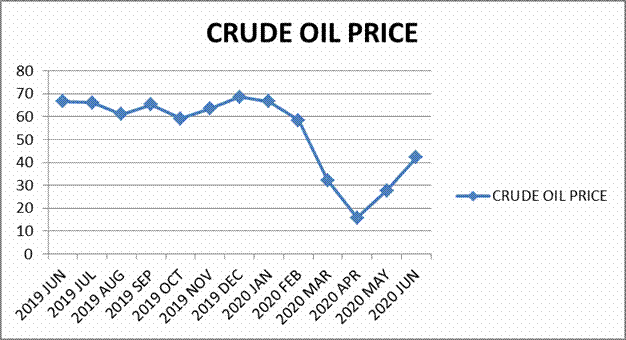
Oil price maintained an irregular trend; it
recorded a major in December, 2019 and major trough in April, 2020.
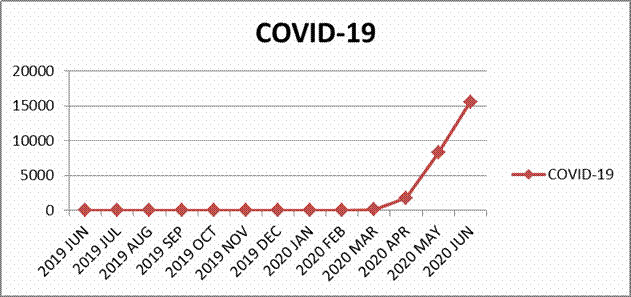
COVID-19 shows a rising trend and
recorded major peaks in the month June 2020.
Table 1
Unit Root Test
|
|
D(BANK
LIQUIDITY)
|
D(COVID19)
|
D(OILPRICE)
|
|
ADF
Statistics
|
-3.784051
|
-10.98561
|
-4.809839
|
|
1%
|
-3.324070
|
-4.200056
|
-3.523070
|
|
5%
|
-2.986225
|
-3.175352
|
-2.986225
|
|
Probability
|
0.0001
|
0.0000
|
0.0000
|
Source: Eview 9.0 output
The unit root test in table 1 shows that the
variables of double shock COVID-19 pandemic, oil price, and the liquidity of
the Nigeria banking system were stationary at first difference. The stationarity properties of these variables were further
confirmed by its associated probability which is less than 0.05 level of
confidence.
Table 2 Regression Analysis
|
Dependent
Variable: BLQ
|
|
|
|
Method:
Least Squares
|
|
|
|
Date:
09/25/20 Time: 22:25
|
|
|
|
Sample:
2019M06 2020M06
|
|
|
|
Included
observations: 13
|
|
|
|
Variable
|
Coefficient
|
Std. Error
|
t-Statistic
|
Prob.
|
|
C
|
31032.51
|
953.2230
|
32.55535
|
0.0000
|
|
COVID19
|
0.178813
|
0.061024
|
2.930211
|
0.0150
|
|
OILPRICE
|
-75.81726
|
16.11813
|
-4.703849
|
0.0008
|
|
R-squared
|
0.846213
|
Mean
dependent var
|
27340.98
|
|
Adjusted
R-squared
|
0.815456
|
S.D.
dependent var
|
2041.616
|
|
S.E. of
regression
|
877.0504
|
Akaike info criterion
|
16.59018
|
|
Sum
squared resid
|
7692174.
|
Schwarz
criterion
|
16.72055
|
|
Log
likelihood
|
-104.8362
|
Hannan-Quinn criter.
|
16.56338
|
|
F-statistic
|
27.51250
|
Durbin-Watson
stat
|
1.915488
|
|
Prob(F-statistic)
|
0.000086
|
|
|
|
Source: Eview 9.0 output
The regression result in table 2 shows that there
is a positive significant impact between COVID-19 and changes in banking system
liquidity in Nigeria. This means that the follows of COVID-19 increase the
liquidity position of banks in Nigeria during these periods of crisis in a good
way. On the other hand, the follows of oil price slump reveals that there is
significant negative relationship between oil price and banking system
liquidity. This is because the probability follow of OILPRICE (0.0008) is less
than 0.05 percent, which is an indication that the oil price shock explains the
liquidity position of banks in Nigeria in a bad way. This implies that, unit
increase in oil price shock will lead to -75.81726 unit fall in banking system
liquidity in Nigeria. The results of other important statistical tools applied
in this study reveal that the coefficient of determination (R2), as used to
measure the success of the regression in predicting the value of the dependent
variables within the sample and test the goodness of fit, is considered high
(over 81.54%). The adjusted R-square, the Durbin-Watson statistics and the
entire regression test are statistically significant, including the f-test.
Table
3 Johansen Unrestricted Co-integration Rank Test (Trace)
|
Hypothesized
No. of CE(s)
|
Eigenvalue
|
Trace Statistic
|
0.05
Critical Value
|
Prob.**
|
|
None *
|
0.996242
|
74.49687
|
29.79707
|
0.0000
|
|
At most 1
|
0.634270
|
13.07432
|
15.49471
|
0.1121
|
|
At most 2
|
0.166994
|
2.009859
|
3.841466
|
0.1563
|
Table 4 Johansen Unrestricted Co-integration Rank Test (Maximum
Eigenvalue)
|
Hypothesized
No. of CE(s)
|
Eigenvalue
|
Max-Eigen Statistic
|
0.05
Critical Value
|
Prob.**
|
|
None *
|
0.996242
|
61.42254
|
21.13162
|
0.0000
|
|
At most 1
|
0.634270
|
11.06446
|
14.26460
|
0.1510
|
|
At most 2
|
0.166994
|
2.009859
|
3.841466
|
0.1563
|
|
|
|
|
|
|
Max-eigenvalue
test indicates 1 cointegrating eqn(s)
at the 0.05 level
* denotes
rejection of the hypothesis at the 0.05 level
**MacKinnon-Haug-Michelis (1999) p-values
Source: Eview 9.0 output
The result of the first hypothesis shows that
the value of trace (74.49687) and max-eigen statistic (61.42254)
is greater that the critical value (29.79707 and
21.13162) at 5 percent level of significance, therefore, we reject the
null hypothesis of there is no co-integration equation in this model. The
second and third null hypotheses say that there is at most 1 or 2
co-integrating equation. A look at the
value of trace and max-eigen statistic shows that
value of trace and max-eigen statistic are less than
the critical value at 5 percent. Therefore, we fail to reject the null
hypotheses, so we agree with the null hypotheses that in this model we have at
most 1 or 2 co-integration equation. This implies the series are co-integrated
that is exhibit a long run relationship.
Table 5 Pairwise Granger Causality Tests
|
Date:
09/25/20 Time: 22:35
|
|
Sample:
2019M06 2020M06
|
|
Lags: 1
|
|
|
|
Null
Hypothesis:
|
Obs
|
F-Statistic
|
Prob.
|
|
|
|
|
|
|
COVID19
does not Granger Cause BLQ
|
12
|
3.73182
|
0.0454
|
|
BLQ
does not Granger Cause COVID19
|
9.36875
|
0.0136
|
|
|
|
|
|
|
OILPRICE
does not Granger Cause BLQ
|
12
|
0.26752
|
0.6175
|
|
BLQ
does not Granger Cause OILPRICE
|
1.47504
|
0.2555
|
|
|
|
|
|
|
OILPRICE
does not Granger Cause COVID19
|
12
|
44.8491
|
9.E-05
|
|
COVID19
does not Granger Cause OILPRICE
|
2.15840
|
0.1759
|
Source: Eview 9.0 output
The pairwise granger causality tests suggest
evidence of bidirectional causality flowing from COVID-19 to banking system
liquidity vice versa. This means that the follows of
COVID-19 cause banking system liquidity to change. In other hand, there is no
evidence of causality running from oil price shock to banking system liquidity
vice versa. By implications it suggests that oil price shock does not cause changes
in the banking system liquidity.
5. CONCLUSION
The study investigates impact of
COVID-19, oil price shock on banking system liquidity
in Nigeria from
the period dated 1st June, 2019 to 30th June, 2020. Using
confirmed cases of COVID-19, global price of crude oil and deposit liabilities
as variables of study. The results reveal that there is a positive
significant impact between COVID-19 and changes in banking system liquidity in
Nigeria. This means that the follows of COVID-19 increase the liquidity
position of banks in Nigeria during this period of crisis in a good way. On the
other hand, the follows of oil price slump reveals that there is significant
negative relationship between oil price and banking system liquidity. Also the results of Johansen co-integration test reveal
that the series are co-integrated that is exhibit a long run
relationship. The results of the granger causality tests suggest evidence of
bidirectional causality flowing from COVID-19 to banking system liquidity vice versa
while there is no evidence of causality running from
oil price shock to banking system liquidity vice versa. Based on this, the study concludes that
COVID-19 and Oil price shocks impacted significant on banking system liquidity
in Nigeria.
REFERENCES
Baret,
S., Celner, A., O’Reilly, M. & Shilling, M.
(2020). Covid-19 potential implications for the banking and capital
markets sector. Maintaining
business and operational resilience. Deloitte
Insights.
Demirgue-Kunt, Pedraza & Ruiz (2020).
Banking sector performance during the Covid -19 crises. The World Bank Policy Research working paper
series, 9363.
Mert,
T & Omer, S.G. (2020). The impact of COVID-19 on
emerging stock markets. Finance
Research Letter 36(2020), 1-6
Iwedi,
M., Kocha, C.N. & Onakpono,
A. E. (2020). Covid-19 pandemic, global trade wars and impact on the Nigeria
Economy. Academic Journal of Current Research, 7(5), 71-82.
Nuhu,
S. (2020). The impact of the
Covid-19 on the financial markets:
Evidence from China and USA.
Tesfaye, B. L.
(2020). The impact of
Covid-19 on the Ethiopian private banking system. Published PhD thesis of
University of South Africa.
http://www.researchgate.net/publication/342106350.
Wakode,
S. (2020). Efficacious scrutinizing of COVID-19 impact on banking using credit
risk metrics. International Journal of finance and Banking Research, 6(3),
51-56.
Xin’hua
(2020). China Financial market remains stable and
Covid-19 impact China Daily-Hong Kong.
Zhang, D.,
Hu, M., & Ji, Q., (2020) Financial markets under
the global pandemic of COVID-19. Elsevier Finance Research Letter 36(2020) 101691
|
Cite this Article: Kocha, CN; Iwedi, M; Barisua, SP (2020).
COVID-19 Outbreak, Oil Price Shock and Banking System Liquidity: The Nigeria
Evidence. Greener Journal of Economics and Accountancy, 8(1):6-11,
|