1.0
INTRODUCTION
The issue of gross domestic product (GDP) has become
topical as it forms the prime worry in the macroeconomics fraternity. Policy
makers and analysts are continually assessing the state of the economy since it
is perceived to be one of the primary aggregate indicators used to measure the
healthiness of any economy. Economic growth can be referred to as a sustained
increase in per capita national output or net national product over a
comprehensive period of time. A sustainable economic growth mainly rest on a
country’s ability to invest and make a well-organized and productive resource
endowment (Nyoni & Bonga,
2017f).
GDP per see does not reflect the
overall state of the standard of living or well-being of a country, however,
GDP per capita is often considered to reveal the condition of the average
citizen in any country. To this end, GDP per capita in Botswana recorded at 7523.22 US dollars
in 2017 which is equivalent to 60 percent of the
world's average. GDP per capita averaged 3427.73 USD from 1960 - 2017,
recording the highest rate of 7574.30 USD in 2014 and lowest of 390.80 USD in
1960 (tradingeconomics.com). During the same period, Botswana gained a high
middle income status as rated by the World Bank and UNDP Human Resource
Development Index (Maipose & Matsheka,
2009). In Africa, the country was ranked top in terms of governance and
transparency indices as reflected by political stability and
constitutional democracy (Honde & Abraha, 2015).
This
remarkable growth was attributed to prudent economic policies and mining
sector contributions, which proved to be an important variable of growth in
Botswana (IMF,2017). The sector contributed 24.5% to
the country’s GDP in 2013. This makes Botswana a success story of Africa, with
a strong government commitment to policies and a regulatory environment that
foster private sector development (Todaro, 2012).
Just like any other economy, the country requires a reliable, consistent and
accurate GDP forecasts to conduct a progressive monetary and fiscal policies.
Hence, this research attempts to model and forecast GDP per capita for the
period 1960-2017.
2.0
LITERATURE REVIEW
In comparing the
power of forecasting between ARIMA models and Artificial Neural Networks (ANN),
Okasha and Yaseen (2013)
agreed that the Box-Jenkins, ARIMA models proved to be more accurate than the
Artificial Neural Network (ANN) making it an alternative to the Box-Jenkins
approach. Using an econometric ANN model, Junoh
(2004) modeled and forecasted GDP growth in Malaysia (1995-2000), found out
that the ANN has an increased potential to predict GDP growth based on
knowledge-based economy indicators compared to the Box-Jenkins approach. Lu
(2009), in China; forecasted GDP using ARIMA models with annual data from 1962
to 2008 and noted that the ARIMA (4, 1, 0) model was the optimal model. In
India, Bipasha & Bani
(2012) forecasted GDP growth rates based on ARIMA models using annual data from
1959 to 2011 and established that the ARIMA (1, 2, 2) model was the optimal
model to forecast GDP growth in India. In Greece, Dritsaki
(2015) looked at real GDP basing on the Box-Jenkins ARIMA approach during the
period 1980 – 2013 and noted that the ARIMA (1, 1, 1)
model was the optimal model. In the case of Kenya, Wabomba
et al (2016); modeled and forecasted
GDP basing on ARIMA models with an annual data set ranging from 1960 to 2012
and concluded that the ARIMA (2, 2, 2) model was the optimal model for modeling
GDP in Kenya.
3.0
MATERIALS & METHODS
3.1 ARIMA
Models
ARIMA models are often considered as
delivering more accurate forecasts than econometric techniques (Song et al, 2003b). ARIMA models outperform
multivariate models in forecasting performance (du Preez
& Witt, 2003). Overall performance of ARIMA models is superior to that of
the naïve models and smoothing techniques (Goh &
Law, 2002). ARIMA models were developed by Box and Jenkins in the 1970s and
their approach of identification, estimation and diagnostics is based on the
principle of parsimony (Asteriou & Hall, 2007).
The mathematical formulation of the ARIMA (p, d, q)
model using lag polynomials can be simply written as:
4.1
Diagnostic Tests & Model Evaluation
4.1.1Stationarity
Tests: Graphical Analysis
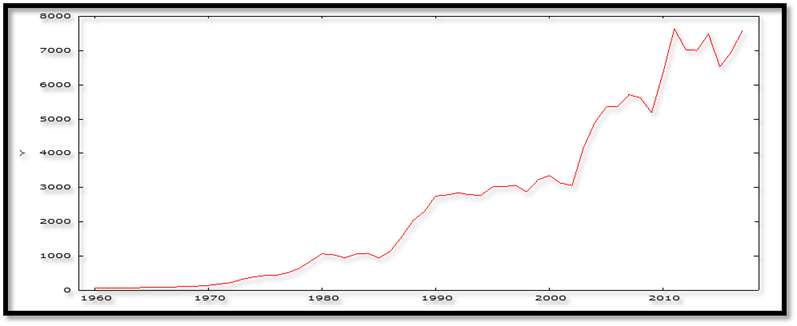
Figure 1
The Botswana GDP per capita variable, as
shown above is not stationary because it is trending upwards and this implies
that its mean is changing over time and thus its varience
is not constant over time.
4.1.2 The Correlogram in Levels
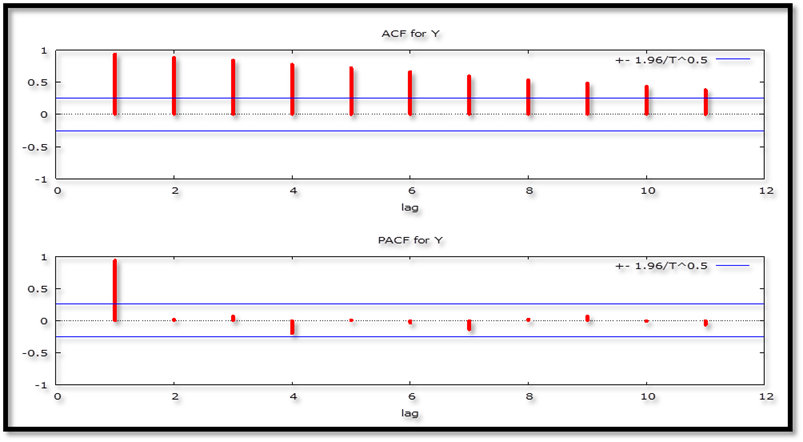
Figure 2
4.1.3 The
ADF Test
Table 1:
Levels-intercept
|
Variable
|
ADF Statistic
|
Probability
|
Critical Values
|
Conclusion
|
|
Y
|
1.295578
|
0.9983
|
-3.560019
|
@1%
|
Not stationary
|
|
|
|
-2.917650
|
@5%
|
Not stationary
|
|
|
|
-2.596689
|
@10%
|
Not stationary
|
Table 2: Levels-trend
& intercept
|
Variable
|
ADF Statistic
|
Probability
|
Critical Values
|
Conclusion
|
|
Y
|
-2.022603
|
0.5766
|
-4.127338
|
@1%
|
Not stationary
|
|
|
|
-3.490662
|
@5%
|
Not stationary
|
|
|
|
-3.173943
|
@10%
|
Not stationary
|
Table 3: without
intercept and trend & intercept
|
Variable
|
ADF Statistic
|
Probability
|
Critical Values
|
Conclusion
|
|
Y
|
2.541447
|
0.9970
|
-2.606163
|
@1%
|
Not stationary
|
|
|
|
-1.946654
|
@5%
|
Not stationary
|
|
|
|
-1.613122
|
@10%
|
Not stationary
|
Figures 2 and tables 1 – 3, all indicate the non-stationarity of GDP per capita in levels. Thus Y is not I
(0).
4.1.4 The Correlogram (at 1st Differences)
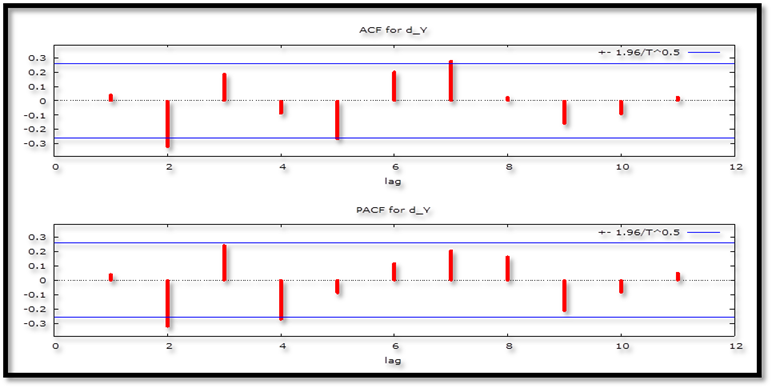
Figure 3
Table 4: 1st
Difference-intercept
|
Variable
|
ADF Statistic
|
Probability
|
Critical Values
|
Conclusion
|
|
Y
|
-4.503592
|
0.0006
|
-3.560019
|
@1%
|
Stationary
|
|
|
|
-2.917650
|
@5%
|
Stationary
|
|
|
|
-2.596689
|
@10%
|
Stationary
|
Table 5: 1st
Difference-trend & intercept
|
Variable
|
ADF Statistic
|
Probability
|
Critical Values
|
Conclusion
|
|
Y
|
-5.021871
|
0.0008
|
-4.140858
|
@1%
|
Stationary
|
|
|
|
-3.496960
|
@5%
|
Stationary
|
|
|
|
-3.177579
|
@10%
|
Stationary
|
Table 6: 1st
Difference-without intercept and trend & intercept
|
Variable
|
ADF Statistic
|
Probability
|
Critical Values
|
Conclusion
|
|
Y
|
-2.882143
|
0.0047
|
-2.608490
|
@1%
|
Stationary
|
|
|
|
-1.946996
|
@5%
|
Stationary
|
|
|
|
-1.612924
|
@10%
|
Stationary
|
Figure 3 as well as tables 4 – 6, all show
that the Botswana GDP per capita series became stationary after taking first
differences; therefore, it’s I (1).
4.2 Evaluation of ARIMA models (without a
constant)
Table 7
|
Model
|
AIC
|
U
|
ME
|
MAE
|
RMSE
|
MAPE
|
|
ARIMA (1, 1, 1)
|
839.9019
|
0.89648
|
107.56
|
227.93
|
362.18
|
9.6045
|
|
ARIMA (2, 1, 1)
|
839.8412
|
0.94968
|
125.54
|
222.42
|
355.6
|
7.3849
|
|
ARIMA (3, 1, 1)
|
836.7766
|
0.87654
|
86.698
|
214.22
|
338.87
|
9.3593
|
|
ARIMA (4, 1, 1)
|
838.1568
|
0.88295
|
95.013
|
213.4
|
336.71
|
9.4365
|
|
ARIMA (4, 1, 0)
|
836.3743
|
0.88418
|
97.428
|
212.98
|
337.47
|
9.4365
|
|
ARIMA (3, 1, 0)
|
836.9577
|
0.87648
|
83.069
|
215.25
|
346.11
|
9.32248
|
|
ARIMA (0, 1, 1)
|
842.8361
|
0.85898
|
95.404
|
230.55
|
379.05
|
9.2927
|
|
ARIMA (0, 1, 2)
|
839.7101
|
0.91968
|
119.14
|
226.61
|
361.8
|
9.7583
|
|
ARIMA (2, 1, 2)
|
830.9423
|
0.88362
|
104.73
|
205.8
|
316.24
|
9.556
|
|
ARIMA (3, 1, 3)
|
830.887
|
0.81334
|
57.541
|
202.41
|
303.28
|
9.0468
|
A model with a lower AIC value is better
than the one with a higher AIC value (Nyoni, 2018n).
The research will only make use of the AIC in selecting the optimal model.
Thus, the ARIMA (3, 1, 3) model was preferred.
4.4
Residual & Stability Tests
ADF Tests
of the Residuals of the ARIMA (3, 1, 3) Model
Table 8:
Levels-intercept
|
Variable
|
ADF Statistic
|
Probability
|
Critical Values
|
Conclusion
|
|
εt
|
-7.393910
|
0.0000
|
-3.562669
|
@1%
|
Stationary
|
|
|
|
-2.918778
|
@5%
|
Stationary
|
|
|
|
-2.597285
|
@10%
|
Stationary
|
Table 9: Levels-trend
& intercept
|
Variable
|
ADF Statistic
|
Probability
|
Critical Values
|
Conclusion
|
|
εt
|
-7.459138
|
0.0000
|
-4.144584
|
@1%
|
Stationary
|
|
|
|
-3.498692
|
@5%
|
Stationary
|
|
|
|
-3.178578
|
@10%
|
Stationary
|
Table 10: without
intercept and trend & intercept
|
Variable
|
ADF Statistic
|
Probability
|
Critical Values
|
Conclusion
|
|
εt
|
-7.462036
|
0.0000
|
-2.610192
|
@1%
|
Stationary
|
|
|
|
-1.947248
|
@5%
|
Stationary
|
|
|
|
-1.612797
|
@10%
|
Stationary
|
The residuals of the chosen optimal model are
stationary as shown in tables 8 – 10.
4.5
Stability Test of the ARIMA (3, 1, 3) Model
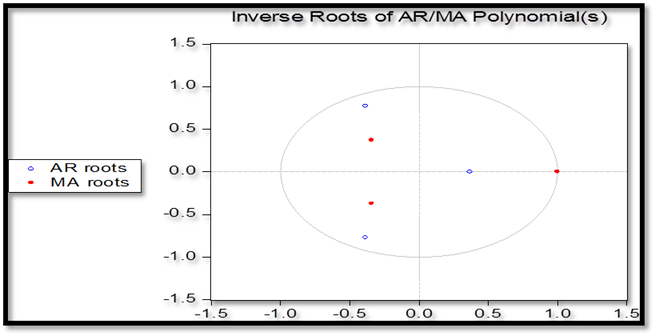
Figure 4
As illustrated in the figure above, the ARIMA
(3, 1, 3) model is stable as the corresponding inverse
roots of the characteristic polynomial lie in the unit circle.
5.0 FINDINGS
5.1
Descriptive Statistics
Table 11
|
Description
|
Statistic
|
|
Mean
|
2579.3
|
|
Median
|
2166.5
|
|
Minimum
|
58
|
|
Maximum
|
7646
|
|
Standard deviation
|
2453.9
|
|
Skewness
|
0.71616
|
|
Excess kurtosis
|
-0.77802
|
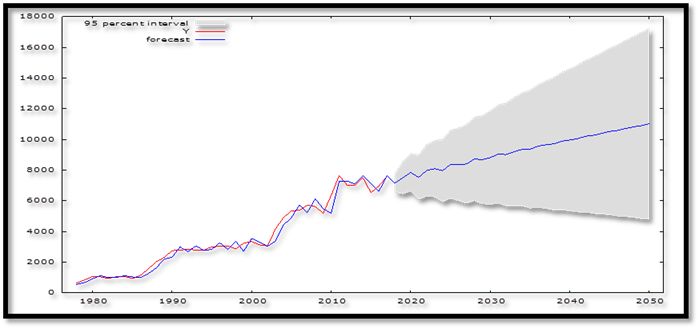
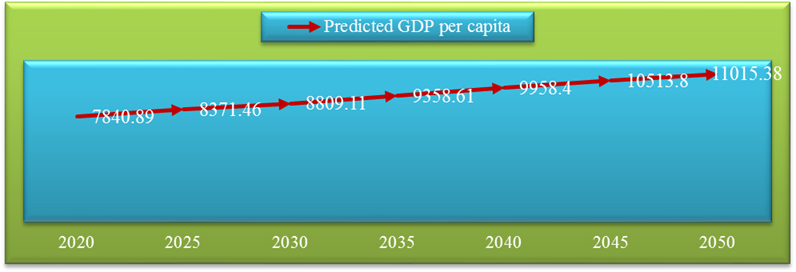
As portrayed in figures 5 and 6, Botswana is
now an upper middle income country, with a projected GDP per capita of
approximately 8809.11 USD by 2030. Botswana’s GDP per capita is on an upwards
trajectory which is expected to continue for at least 10 years. This clearly
proves beyond any reasonable doubt that the Batswana living standards will be
greatly improved and poverty levels are set to tumble low minimal levels with
the next decade. Indeed, Botswana; is an “African Success Story”, which can be
emulated by other African countries. It is important to note that a number of
factors have resulted in such a success story of Batswana. These include non-other-than good governance,
political stability and prudent macroeconomic management.
6.0 POLICY RECOMMENDATIONS
i.
The government of Botswana should maintain
the existing political stability and good governance, something which most
African countries always fail to do.
ii.
Botswana monetary authorities should continue
implementing the crawling peg exchange rate with preset basket weights because
it has indeed served the country well.
iii.
The government of Botswana should continue
working tirelessly to remove barriers to private sector – led growth I order to
increase the government revenue pool.
iv.
The country should use the rich diamond
reserves to diversify their economy.
7.0
CONCLUSION
Economic growth is always the priority of any
credible government around the globe (Adebayo, 2016) and in the case of
Botswana, successive governments have proved to be credible by being able to
conduct good governance and seriously prioritizing economic growth and price
stability ahead of selfish and politically motivated objectives. The continued
increase in GDP per capita in Botswana is clear testimony that Botswana is
indeed an “African Success Story” and is a good example of an African nation
where rule of law is a reality and corruption is an enemy of the society. The
results of this research are envisaged to help Botswana policy makers in
planning for an even brighter future for Batswana.
8.0
REFERENCES
1.
Adebayo, A. G (2016). Forecasting the Gross
Domestic Product in Nigeria using time series analysis and a sample frame of
1960 – 2015, Journal of Business and
African Economy, 2 (2): 1 – 14.
2.
Asteriou, D. &
Hall, S. G. (2007). Applied Econometrics: a modern approach, Revised Edition, Palgrave MacMillan, New York.
3.
Barhoumi, K., Darne,
O., Ferrara, L., & Pluyaud, B (2011). Monthly GDP
forecasting using bridge models: application for the French economy, Bulletin of Economic Research, 1 – 18.
4.
Bipasha, M & Bani,
C (2012). Forecasting GDP growth rates of India: an empirical study, International Journal of Economics and
Management Sciences, 1 (9): 52 – 58.
5.
Dritsaki, C (2015). Forecasting real GDP
rate through econometric models: an empirical study from Greece, Journal of International Business and
Economics, 3 (1): 13 – 19.
6.
Du Preez, J. & Witt,
S. F. (2003). Univariate and multivariate time series
forecasting: An application to tourism demand, International Journal of Forecasting, 19: 435 – 451.
7.
Goh, C. &
Law, R. (2002). Modeling and forecasting tourism demand for arrivals with
stochastic non-stationary seasonality and intervention, Tourism Management, 23: 499 – 510.
8.
Honde, G. J
& Abraha, F. G (2015). Botswana Economic Outlook
– Botswana, AfDB.
9.
International Monetary Fund (2017). Botswana Staff
Report for the 2017 Article IV consultation, IMF, Washington DC.
10.
Junoh, M. Z. H. J (2004). Predicting
GDP growth in Malaysia using knowledge-based indicators: a comparison between
Neural Network and econometric approaches, Sunway
College Journal, 1: 39 – 50.
11.
Lu, Y (2009). Modeling and forecasting China’s GDP
data with time series models, Department
of Economics and Society, Hogskolan Dalarna.
12.
Maipose, G.S and Matsheka, T.C (2009). The Indigenous Development State and
Growth in Botswana. Chapter 5. Volume 2: 01-66
13.
Nyoni, T & Bonga, W. G (2017f). An Empirical Analysis of the
Determinants of Private Investment in Zimbabwe, DRJ – Journal of Economics and Finance, 2 (4): 38 – 54.
14.
Nyoni, T & Bonga, W. G (2018a). What Determines Economic Growth In Nigeria?
DRJ – Journal of Business and Management,
1 (1): 37 – 47.
15.
Nyoni, T
(2018n). Modeling and Forecasting Inflation in Kenya: Recent Insights from
ARIMA and GARCH analysis, Dimorian Review, 5
(6): 16 – 40.
16.
Nyoni, T.
(2018i). Box – Jenkins ARIMA Approach to Predicting net FDI inflows in
Zimbabwe, Munich University Library –
Munich Personal RePEc Archive (MPRA), Paper No.
87737.
17.
Okasha, M.K and Yaseen, A.A (2013). Comparison Between
Arima Models And Artificial Neural Networks In
Forecasting Al-Quds Indices Of Palestine Stock Exchange Market. Conference
paper. Research Gate.
18.
Onuoha, D. O., Ibe,
A., Njoku, C., & Onuoha,
J. I (2015). Analysis of the Gross Domestic Product (GDP) of Nigeria: 1960 –
2012, West African Journal of Industrial
& Academic Research, 14 (1): 81 – 90.
19.
Song, H., Witt, S. F. & Jensen, T. C.
(2003b). Tourism forecasting: accuracy of alternative econometric models, International Journal of Forecasting,
19: 123 – 141.
20.
Wabomba, M. S., Mutwiri,
M. P., & Mungai, F (2016). Modeling and forecasting
Kenyan GDP using Autoregressive Integrated Moving Average (ARIMA) models, Science Publishing Group – Science Journal
of Applied Mathematics and Statistics, 4 (2): 64 – 73.