|
Greener Journal of Economics and Accountancy
Vol. 9(1), pp. 10-16, 2021
ISSN: 2354-2357
Copyright ©2021, the copyright of this article is retained by the
author(s)
https://gjournals.org/GJEA
|

|
Comparative
Assessment of Impact of Agricultural Cooperatives on Agricultural Efficiency
in Ugwunagbo Local Government Area, Abia State, Nigeria.
Okoro,
CN1*; Amaechi, ECC1; Chijioke-Okoro, CG1; Eze,
CG1
1Department
of Cooperative Economics Technology, Imo State Polytechnic Umuagwo, Nigeria.
|
ARTICLE INFO
|
ABSTRACT
|
|
Article
No.: 111021120
Type: Research
Full Text: HTML; EPUB
|
The study assessed the impact of
Agricultural Cooperatives on Agricultural Efficiency decomposed into Farm
Income, Farm size, Output and Productivity in Ugwunagbo Local Government
Area, Abia State, Nigeria. To ascertain this, a sample size of 216
respondents was chosen from the members of agricultural cooperatives and
same was also done for farmers who do not belong to cooperative societies.
It was necessitated by the curiosity to establish the economic differences
between farmers who belong to cooperatives and those who do not, to aid
proper policy formulation in agricultural practice and productivity. A paired
Z-statistic was employed to compare the values of the test variables from
both cooperators and non-cooperators of 432 respondents on farm income, farm
size, output and productivity. The result showed that the impacts of
agricultural cooperatives on food production, farm income, farm size, output
and productivity were significant using a Z-statistic to compare cooperators
and non-cooperators. The variable means for the first three were in favour
of cooperators; while, non-cooperators’ productivity was higher than those
of cooperators. The study recommends a policy framework that will encourage sensitization
of the practitioners of agricultural production on the benefits of
cooperative ideology that aids group action for increased common gains.
|
|
Accepted: 13/11/2021
Published:
23/11/2021
|
|
*Corresponding
Author
Okoro, Chijioke Nwankwo
E-mail:
vieng663@
hotmail. com
|
|
Keywords:
Agricultural
Cooperatives, Farm Income, Farm Size, Output and Productivity
|
|
|
|
INTRODUCTION
The standard of
living in Nigeria with regards to nutrition would be understood from recent
times that the presentation of standard meals on the table has become a battle
of life (Ahaotu and Mbaegbu, 2017). Very low food output is witnessed. Cooperative
farming/Agricultural Cooperatives suggest a way out owing to collective
bargaining power (Okoro, 2005). Cooperative farming includes all those jointly
undertaken activities in agriculture which go beyond the provision of auxiliary
services, such as marketing, supply and credit, and which directly influence
the primary production process. Cooperative farming denotes collective pooling
of lands, which the farmer does not always connote, showing that collective
farming is a subset of cooperative farming. Cooperative farming is the
commonest type of group farming referring to an administratively non-formalized
kind of agricultural activities normally involving one or very specific farm
tasks (Igbozuruike 1985). It shares with formal cooperative agriculture the
common attribute of mutuality.
In reaction to the
continuing agricultural crisis, government in many countries of the developing
world, non-socialist as well as socialist has recently turned to some form of
cooperative agricultural production as a means of coming to grips with the
complex problems of rural and agricultural development (Reed, 1985; Ahaotu et al, 2015; Ezeafulukwe et al, 2017). Arua (1985) sees a lot of
possibilities for modern large-scale agricultural production through farmers’ cooperatives.
In the opinion of Downey and Trockey (1981), the cooperative movement “more
than any other agency, is in the best position to stimulate food production
through the extension of credits to the cooperators as well as the financing of
large scale food production schemes in the rural areas”. Frequently, it is
argued that the cooperative system of agriculture constitutes a radical
improvement over traditional farming practices.
Traditional farming
or agriculture as Knapp (1963) explained ranges from minimum level of
commercial interest as against strong level of commercial orientation. The
requirement of the family unit is first of all met before the commercial
interest could be considered. It has been gathered that over 80% of Nigerian
farmers do so at subsistence level. Only little portions are cultivated solely
for commercial purposes using mostly manual farm tools and sometime improvised.
As opined by Knapp (1963), the traditional farming or traditional agriculture
is sometimes hazy so that some description is needed.
Agricultural
Cooperation versus Traditional Farming Practice
The intent of this
comparison is to analyze the relative importance of the farming practices of
the cooperative farmers as against the traditional farmer listing what, when,
how and why of the production processes and outputs. Agricultural Cooperation
as has been noted above are societies that are engaged in the production,
processing, distribution and marketing of agricultural produce. To Onwuchekwa
(1985) they are organized fundamentally to assist member farmers to improve
their production and marketing activities. It is a conglomeration of individual
family farm units into a joint large farm unit.
The
Concept of Traditional Farming of Agriculture
The expression
“traditional farming or traditional agriculture” is sometimes hazy, so that a
brief descriptive characteristics is necessary. It is frequently known as
subsistence agriculture. By subsistence, it means that all but a small amount
of output is consumed by the farmer himself, while a negligible proportion of
production is sold. Knapp (1963), who has discussed it at length, classified it
into three.
Classification
of Traditional Agriculture
According to Knapp
(1963) traditional agriculture is classified into:
1.
Subsistence farming, which comprises
a.
Pure subsistence
b.
Subsistence plus earnings for taxes
2.
Quasi-Subsistence Farming not more than 25%
of working time devoted to cash crops.
3.
Semi-Subsistence Farming: 25% to 50% of
working time is devoted to cash crops.
The principal issue
this classification brings out however is the occurrence of distinct gradations
of traditional agriculture. A strong level of commercial interest from that,
with a minimum of commercial content to that, marks the range.
Comparison
of the both Farming System
In reaction to the
continuing agricultural crises, government in many countries of the developing
world, non-socialist as well as socialist has recently turned to some form of
cooperative agricultural production as a means of coming to grips with the
complex problems of rural and agricultural development, Reed (1985). Back to
Nigeria, Arua (1985) sees a lot of possibilities for modern large-scale
agricultural production through farmers’ cooperatives. In the opinion of Downey
and Trockey (1981), the cooperative movement “more than any other agency, is in
the best position to stimulate food production through the extension of credits
to the cooperators as well as the financing of large scale food production
schemes in the rural areas”. Frequently, it is argued that the cooperative
system of agriculture constitutes a radical improvement over traditional
farming practices. Anyway, this paper will compare these two systems of
agriculture, with a view to:
a.
Determining the significant differences
between the two
b.
Ascertaining the responsiveness of these
systems to the challenges of the revolution programme.
Cooperative Farming
System
As had always been
argued, that cooperative system of agriculture constitutes a radical
improvement over traditional farming practices, if however given appropriate
scientific guidance and managerial input, the chances of effective ecological
reorientations are high in cooperative agriculture. This has been a
characteristic feature of the modern farmer over traditional farmer. It is also
far easier for a cooperative society to borrow or hire, say, a bulldozer and a
power-saw from the centre than it is for the unorganized traditional farmers to
do the same. This case results primarily from the cooperatives’ collective and
officially recognized bargaining power which, in turn, derives largely from its
large capability for capital accumulation and its overall resource mobilization
ability. Furthermore, under normal circumstances the cooperative operates a larger
and less fragmented farm than does the traditional farmer. A large terrain has
inherent economy of scale. For example, the utilization of machinery and labour
here is less costly per unit of space, if only the cost of elimination of
inter-fragmental commuting. Such commuting consumes a very considerable
proportion.
Essentially, the
comment in regard to farm inputs is applicable to farm produce. With each
larger bargaining power and more importantly, it’s greater organizational
capability, the cooperative out distances the traditional farmers. It is
efficient in the collection and disposal of produce. Equally important as
Igbozuruike (1985) saw, the cooperative is eminently well-placed to integrate
farm production with agricultural produce processing. There exist a very wide
scope for the processing at rural village or cottage industry levels, of farm
produce from grains and vegetables to sugarcane and root crops (Mittal 1983).
Concerning the possibilities of such integration of farm and industrial activities,
he rightly observed that the cooperative system of agriculture has a strong
edge over traditional agriculture.
Obiechina (1985) has
diagrammatically presented the analysis of alternative rice farming practices
using the ADA cooperative farmer as a case study. He observed that ADA
cooperative farmer produces firstly for the market and secondly for food and
seed requirement; contrasting that of the private traditional farmer who
markets the surplus (if any) after the food and seed requirements are met. Once
again, the Researcher wants to put that, from this research cooperative
organization is a fusion of some traditional farm family unit. Making reference
to some of the above mentioned points, it was gathered that the cooperative
farming system is classified into three farming societies, namely cooperative
collective society, cooperative joint farming society, cooperative part-joint,
part collective societies.
TABLE
1. ANALYSIS OF ALTERNATIVE RICE FARMING
PRACTICES
|
Farming Questions
|
Private/Traditional
Farmers
|
ADA Cooperative
Farmer
|
|
What?
|
Economic,
environmental and private consideration, 5 rice verieties, Late exposure to
opportunity and technology.
|
Economic,
environment, private/public considerations, 9 rice varieties, early exposure
to opportunity and technology.
|
|
How?
|
Resources:
underdeveloped land, rained water, cutlass, sickle, hoe and limited loan
facilities.
|
Resources:
developed land, irrigation facilities, tractor and implements, cutlass,
sickle and soft loan.
|
|
|
Activities:
fertilizer application, hand pudding and human hauling of harvested paddy.
|
Activities
fertilizers, insecticides and herbicides applied at levels and intervals,
tractor ploughing, harrowing, rotovating and pudding, close supervision.
|
|
When?
|
Environmental and
personal consideration.
|
Environmental and
personal/public consideration.
|
|
Why?
|
Food basket, seed
and market. Middlemen.
|
Market seed, food
basket. Direct market, integration.
|
Source: Okoro (1985), Cooperative and Nigeria
Economy.
Traditional
Farming System
Traditional farming
or agriculture as Knapp (1963) explained ranges from minimum level of
commercial interest as against strong level of commercial orientation. The
requirement of the family unit is first of all met before the commercial
interest could be considered. It has been gathered that over 80% of Nigerian
farmers do so at subsistence level (Berko, 2001). Only little portions are
cultivated solely for public consumption using mostly manual farm tools and
sometime improvised (Umebali, 2006). As opined by Knapp (1963), the traditional
farming or traditional agriculture is sometimes hazy so that some description
is needed. Having identified it as subsistence agriculture, explains that all
but a small amount of output is consumed by the farmer himself. Noted above is
the classification of such agriculture into:
a.
Subsistence farming comprising of pure
subsistence plus earnings for taxes etc.
b.
Quasi subsistence farming where 25% of
working time is devoted to cash crops.
c.
Semi-subsistence farming: where 25% to 50% of
working time is devoted cash crops.
Igbozuruike (1985)
had elaborated on a concept of traditional agriculture called the concept of
reciprocity, or the idea of reciprocal relationship between farmers. In
traditional agriculture, he said, “this relationship often entails an ad hoc
gathering of farmers. These people after performing a specific task e.g. land
clearing or mound making for a member of the group, move on to do an identical
or comparable kind of job for the other member. They disperse as soon as the
agreed-upon job circuit is completed”. In Nigeria, land clearing appears to be
the commonest traditional farm task in which reciprocal group activity
features. It is quite a heavy work. This factor coupled with the relative
crudeness of the predominant implements (cutlass, axe and hoe) and the
expensiveness of labour, spells the need for many unpaid lands to be engaged
simultaneously. In fact, while the traditional cultivator devotes some forty
man days to clearing a hectare of forestland, it takes the agricultural
cooperative as little as one to two man days, mainly because of direct or
indirect government involvement in its affairs. Igbozuruike (1985) clarified
that, “of course, an individual or traditional farmer can have the same degree
of access to the same farm inputs as the agricultural cooperative has. But then
he (traditional agriculturist) needs to be relatively wealthy, own or have or
use a large space and posses a certain amount of ‘savior fair’. Though he put
that such farmer who have all these three characteristics could never be
classified as a traditional agriculturist. Thus, the small-scale traditional
farmers all the while, becoming fewer and older, find themselves cultivating
shrinking hectares, with a decreasing or at best stagnating aggregate crop
outputs. Few, old, and usually illiterate and poor; these traditional farmers
often appear inflexible in the face of necessary technological change. They
posses a very low bargaining power. This deficiency as Igbozurike (1985) found
reflected, for instance, in their patent inability to fix, enforce and
sometimes even influence farm commodity prices beyond the farm gate. More
pitiable is there insignificant degree of access to modern farm inputs-be they
compound fertilizers, mealy bug resistant cassava stems, or advice from
extension personnel. Farm commodity output per capita is expectedly low.
“Still, many traditional farmers are known to respond positively and with
commendable alacrity to agricultural innovation accompanied by clear economic
incentives (Igbozurike, 1985).
Igbozuruike (1985)
clarifying this opinion said that, “it is regrettable, though, that such
positive response never seems to last long enough to spawn and sustain
desirable momentum towards ‘bigness’”. This however is not to say that big
farms are always preferable to small ones or (that all things being equal) the
small scale farmer cannot perform better than his large scale counterpart”. As
clarified above it explains that the farmer can have the same degree of access
to farm inputs as the agricultural cooperatives but should be bought out
financially, own enough lands and have the ability to do right thing in any
situation. Though, this according to him can never remain a traditional
agriculturist.
An Overview of the Outcome of the Comparison
Having seen the
characteristic features of the both farming practices, the cooperative
agriculture as a fusion of some traditional farm family units has been used as
a basis to provide a comparative framework of farming practices. Where the
traditional farming practices create resource disequilibrium in the
agricultural sector, the cooperative system of farming is intended to correct
the imbalance.
The same fundamental
difficulty facing an industrial firm or any other organization aggregating human
beings from outside of one nuclear family confronts the modern cooperative
agriculture. It is a recurrent problem emanating from differences in personal
backgrounds, interests and expectations. This problem is rare or non-existent
in the traditional agriculture where the basic functional unit is a farm family
or less commonly an individual. However, the provision and exercise of
appointing managerial and supervisory skills will minimize this difficulty in
cooperative farming.
This problem aside,
the cooperative (in sharp contrast to the traditional farmer) has immense
potentials for contributing to the success of the Green Revolution programme.
Its farm resource mobilization capability is large. It can operate at medium to
large scale. It has a high degree of access to farm inputs. It is readily
adaptable to changing economical and technological circumstances. More often
than not, enrolment in the cooperative movement is the genuine expression of
participants’ desire for socio-economic development.
As noted earlier, the
desirable attributes of the cooperative system can be extended beyond
agricultural production to the processing of (its own and other) agricultural
produce. Processing can be initiated on a small scale and decentralized basis.
In terms of immediacy, the farmer will realize a higher income and experience
higher food security. There will be a greater measure of rural employment. With
time this agro allied industrial base will expand, and the rural-urban migration
will decline, as it is certain when there is acceleration of the transition
from traditional to modern cooperative agriculture. Here again, serious
official policy-making and greater practical support for agricultural
cooperatives are called for bearing in mind that the Federal Department of
Agricultural Cooperatives was established
to carry out the objectives of the Green Revolution programme which
majorly is to increase food production.
METHODOLOGY
The Researchers in
this study employed the use trained enumerators to collate data from both
members and non-members of Agricultural Cooperative Societies in the study area
with the aid of a descriptive survey design. The study was carried out at
Ugwunagbo L.G.A, Abia State; which was predominantly occupied by farmers that
deal on food crops, palm produce, vegetables; and traders who facilitate the
exchange of the agricultural produce with final consumers.
To aid effective
study deductions, 216 Agricultural Cooperators, and 216 Non-Cooperative Farmers
were selected for the study using a multi-stage sampling technique. The
objective on the impact of Agricultural Cooperatives on farm income, farm size,
output and productivity was analyzed using a paired Z-test statistic, impinged
on the fact that the sample is large (n>30) which is a veritable condition
for the use of the test statistic.
Model
Specification
The multiple
regression models of which its four functional forms were tried is specified in
explicit form as follows:
The paired Z-test
statistic is specified thus:
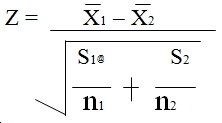
 Where: Z =
Z-test statistic
Where: Z =
Z-test statistic
X1
= Mean value of output, farm income, farm size and productivity of Cooperators.
 X2 = Mean
value of output, farm income, farm size and productivity of non-Cooperators.
X2 = Mean
value of output, farm income, farm size and productivity of non-Cooperators.
S1 = Sample variance of Cooperators
S2 = Sample variance of
non-Cooperators
n1 = Sample size of Cooperators
n2 = Sample size of non-Cooperators.
Data
Presentation and Analysis
To assess the impact
of agricultural cooperatives on farm income, farm size, output and
productivity; paired Z-test statistic was employed. It compared the values of
the test variables from both cooperators and non-cooperators as shown in table
2.
Table 2. Paired Z-test for farm income, size, output
and productivity.
Variables Variable Mean Mean Paired Diff Std. Dev
Z-test
Income
(Coop)
70175.47 -58063.92 131239.67 -6.442
Income
(Non-Coop) 12111.55
Farm
size (Coop) 3.26
-0.45 2.07 -3.165
Farm
size (Non-Coop) 2.81
Output
(Coop) 323.63 -103.25 185.93 -8.162
Output
(Non-Coop) 220.38
Productivity
0.007 3.54 4.29 10.964
Source:
Computed from field survey, 2009.
Std. Dev = Standard
Deviation.
From table 2, it
could be observed that the test variables namely from farm income, farm size,
output and productivity were statistically significant at 1% probability level
as confirmed by the Z-values. The variable means of income, farm size and
output for cooperators were higher than those of non-cooperators. This implies
that agricultural cooperative exerted a positive impact on the cooperators and
that justifies the differential in means, in favour of the cooperators.
However, the productivity level of non- cooperators was higher than that of
cooperators and it indicates that agricultural cooperatives never impacted on
it. This result is similar to the findings of Nwachukwu and Ezeh (2007) who
assessed the impact of related development programmes on poverty alleviation;
and those of Salahi and Onyegbami (2008) who evaluated agricultural production
among cooperatives and non-cooperatives in Oyo State.
CONCLUSION
/ RECOMMENDATIONS
This study on
agricultural cooperatives and agricultural efficiency is a revelation of the
instrumentality of agricultural cooperatives on food production. Agricultural
cooperatives by this study are found to assume a positive ground for food
production only when their operational variables are properly put in place. A strengthening
of the ability of cooperatives in accessing production facilitating variables
will achieve the objective of a hunger free economy. This means the
encouragement of collective farming as against traditional farming system. This
is the focus of Fadama to enable farmers sustainably increase their income.
Deductions from the objective of Fadama support the idea of a formalized
collective action of farmers for accessing grants for agricultural activities.
It is unequivocal that group action leads to achievement of a corporate goal.
To assess the impact
of agricultural cooperatives on food production, farm income, farm size, output
and productivity were significant using a Z-statistic to compare cooperators
and non-cooperators. The variable means for the first three were in favour of
cooperators, non-cooperators productivity was higher than those of coopeartors.
Generally, agricultural cooperatives need to be strengthened. From the research
outcome, the Researchers recommend the development of a policy framework that
will encourage the formation of group farming activities like Cooperatives, for
increase in farm sizes, farm income and output.
REFERENCES
Ahaotu,
E.O and Mbaegbu, I. (2017). Effects of
Water Leaf (Talinum triangulare) Shoot Mealon the Performance of Weaner
New Zealand White Rabbits. Greener
Journal of Animal Breeding and Genetics. Vol. 3 (3): 18-24. DOI: http://doi.org/10.15580/GJABG.2017.3.071217084.
Ahaotu,
E.O., Adeyeye, S.A. and Nnorom, N (2015).Effects of Amaranthus spinosus (green leaf) on the performance of broiler
chicks. Scientific Journal of Veterinary
Advances, 4(3): 21-24. Doi:10.14196/sjva.v413.1851.
Arua
E.O (1986). “The Politics of Cooperative Development in a Developing Country
like Nigeria”, in Okoro Okereke
(ed) Cooperatives and the Nigerian
Economy, Enugu.
Berko
S.Y (2001). “Agricultural Producer Cooperative and Agricultural Development in
Nigeria” Okeke E.U (ed): Nigerian Journal
of Cooperative Economics and Management (NJCEM) voi.1 No 1.
Downey,
W. D. and J. K. Trockey (1981). Agribusiness Management. McGraw-Hill, Inc.
Tokyo.
Ezeafulukwe, C.F, Onuoha, L.C and Ahaotu, E.O. (2017).
Growth Performance of Clarias gariepinus (Buchell 1822) Fed Varying
Inclusion Levels of Cassava Flour. Greener
Journal of Biological Sciences Vol. 7 (5): 45-49. DOI: http://doi.org/10.15580/GJBS.2017.5.081417104.
Igbozuruike
U.M (1985). “Cooperative Farming Practices”, in Okoro Okereke (ed),
Cooperatives and the Nigerian Economy, Enugu, UNN press.
Knapp, J. C (1963)...farmers in Business and Cooperative
Enterprise. American Institute of Cooperation, Washington DC.
Mittal, J. P. (1983). Agricultural Produce
Processing Systems at Village Level in Nigeria. A Paper Presented at the
National Seminar on Quality of Life in Rural Nigeria. Illorin.
Nwachukwu,
I. N. and C. I. Ezeh (2007) Impact of Selected Rural Development Programmes on
Poverty Alleviation in Ikwuano LGA of Abia State. African Journal of Food, Agriculture, Nutrition and Development.
7(5).
Obiechina
C. B. O (1985). A Comparism of Traditional Farming Practices with Cooperative
System in Okoro Okereke (1985). Cooperative and The Nigerian Economy. Enugu,
UNN press Nsukka.
Okoro
C. N (2005). Agricultural Cooperatives; A Strategy for High Food Production. A
B.Sc Project Submitted to the Department of Cooperative Economics and
Management, Nnamdi Azikiwe University, Awka.
Onwuchekwa
C. I (1985). Agricultural Cooperatives and The Problem of Transition. Sweden,
University of Stockholm.
Reed I. (1985). Organizational Issues in
Group Farming in South Korea; in Okoro Okereke eds. Cooperative and The Nigerian
Economy. Enugu, UNN press Nsukka.
Salahi,
B. F. and A. Onyegbami (2008). Agricultural Production Among Cooperative and Non-Cooperative
Farmers Revisited in Oyo West Area, Nigeria.
Journal of Sustainable Development. 5 (1/2)
Umebali,
E. E. (2004). Agribusiness and Financial Analysis. Computer Edge Publishers,
Lagos.
.
|
Cite this Article: Okoro,
CN; Amaechi, ECC; Chijioke-Okoro, CG; Eze, CG (2021). Comparative Assessment of Impact of Agricultural
Cooperatives on Agricultural Efficiency in Ugwunagbo Local Government Area,
Abia State, Nigeria. Greener Journal of Economics and Accountancy, 9(1):10-16,
|