By
Nwaeze, NC
(2021).
|
Greener Journal of Economics and Accountancy
Vol. 9(1), pp. 17-25, 2021
ISSN: 2354-2357
Copyright ©2021, the copyright of this article is
retained by the author(s)
https://gjournals.org/GJEA
|

|
Application
of a Heterogeneous Panel Non-Linear Autoregressive Distributive Lag (ARDL) on
Energy Sources, Economic Growth and Environmental Quality in West African
Monetary Zones (WAMZ)
Nwaeze, Nnamdi Chinwendu
(PhD)
Department
Of Economics, Abia State University, Uturu.
Email; nwaeze.nnamdi@ abiastateuniversity. edu.ng
Phone number:
09030349821
|
ARTICLE INFO
|
ABSTRACT
|
|
Article No.: 122021156
Type: Research
Full Text: PDF, PHP
|
This study explores the asymmetric effect
of energy sources and economic growth on the environmental quality (carbon
dioxide emission) in WAMZ with a view to testing the efficacy of EKC
hypothesis. The study adopts Panel Non-Linear Autoregressive Distributed Lag
(PNARDL) Model to a panel of six WAMZ countries with data covering 1990 to
2016. Results indicate that RGDP outcome for zone does not support the EKC
hypothesis. Findings showed a long-run asymmetric relationship between
renewable energy-carbon emission and between economic growth - CO2 in WAMZ,
while there exists no long-run asymmetric association between non-renewable
(fossil fuel)-Carbon dioxide emission in WAMZ. We conclude that negative
shock to renewable energy use and shocks to economic growth are factors that
improve environmental quality in WAMZ.
Since the use of non-renewable energy shows positive but
insignificant impact on CO2, we recommend the use of renewable energy for
WAMZ in order to mitigate the damage done by fossil fuel.
|
|
Accepted: 23/12/2021
Published: 31/12/2021
|
|
*Corresponding Author
Nweze,
Nnamdi Chinwendu
E-mail: nwaeze.nnamdi@ abiastateuniversity.edu.ng
Phone: 09030349821
|
|
Keywords: EKC
hypothesis, non-renewable energy, renewable energy, asymmetric, Carbon
emission, PNARDL.
|
|
|
|
1.
INTRODUCTION
West
African monetary Zones (WAMZ) are among the developing nations and just like
other developing nations of the world, they are in need of rapid economic
development which is needed for poverty reduction (Chakravarty
& Mandal, 2020) as one of the key goal of
sustainable development. Energy use has
been seen as engine of economic development (Adedoyin,
Abubakar, Bekun, & Sarkodie, 2020). Non-renewable energy as one of energy
sources (Khan, Peng,
& Li, 2019) is a key emitter which accumulates greenhouse gases that
deteriorate the environment (United Nations Framework Convention on Climate
Change, 1994). WAMZ as such like every other developing countries are face with
the twin problem of attaining economic development in order to reduce poverty
and at the same time achieve a sustainable environment.
Africa
depends mostly on the consumption of fossil-fuel which contributes to about 81%
of total energy consumption (Adedoyin et al, 2020). Consumption
of Fossil fuel such as, coal, oil, and natural gas, etc. in Africa at large has
led to increase in the greenhouse gas emission as well as fast exhaustion of
non-renewable resources (coal, oil, and natural gas, firewood, etc). The need for sustainable development points toward
management and planning of energy resources. Thus, the energy management
recently for Africa is going transformation transition from non-renewable
(fossil fuels) to renewable resources and energy-efficient technology to tackle
global challenges. Developing nations
and of course WAMZ states have seen the
necessity of adopting clean technology which uses more of renewable energy such
as solar, wind, tidal, waste, etc. rather than non-renewable energy mix (Paramati,
Sinha, and Dogan, 2017).
The linkage
between environmental quality and energy sources inclusive of economic growth has
been a debatable topic without consensus. For instance, the relationship has
been examined on the basis of Environmental Kuznets Curve (EKC) hypothesis in
which different researchers found different conclusions or versions of the
theory. That is, some empirical studies such as Elshimy
and El-Aasar (2019), Khan, et al, (2020) and Onuoha et al (2021) have validated the EKC Hypothesis of
inverted U-shape association between economic growth and the environmental
quality, while Ameyaw, et al, (2020) assert that the
association is of ‘N-shaped instead of ‘U-shaped. Others like Mohamed et al.,
2019, could not find support for the EKC hypothesis but instead observed a
linear linkage. This controversies of divergent
opinions of the nature of the relationship between energy mix, economic growth
and environmental quality motivated further inquiry into this subject matter
for the WAMZ area, which includes Gambia, Ghana, Guinea, Liberia, Nigeria and Sierra
Leone.
Studies
like Çıtak, et
al, (2020) employed time series non-linear ARDL to the USA to verify EKC
Hypothesis, Mert and Bölük
(2016) employed Panel ARDL to 21 Kyoto nations, and Attiaoui
(2017) adopted Panel PMG to 22 African nations etc. This study differs from
existing studies and attempts to adopt Panel Non-Linear ARDL that examines both
symmetric and asymmetric nature of the linkages between energy sources, economic
growth and environmental pollution in the WAMZ nations. By so doing, we believe
that a better insight will be revealed for the WAMZ as group of countries with
similar economy.
Thus, the
aim of this study is to investigate the Environmental Kuznets Curve (EKC)
Hypothesis for WAMZ nations using improved method so as to provide explanation
for the divergence in conclusions reached by previous studies. The rest of the study
is categorized as follows; section 2 gives a review of relevant literature
while Section 3 provides the method and procedure adopted in the advancement of
this study. Section 4 presents result of the study and its discussion while
Section5 concludes the paper with recommendations and policy implications.
2.
LITERATURE REVIEW
We adopted
the Environmental Kuznets Curve (EKC) Hypothesis in this study. According to Panayotou, 1993, the EKC Hypothesis has inverted “U”-shape,
explaining the association between economic growth and environmental degradation.
Hence, “at the early stages of development, less attention is given to
environmental purity, and the quest for growth usually leads to excessive
extraction of resources which together with the unavailability of
environmentally friendly technologies result in high pollution of environmental
resources”. This means that pollution rises with rise in income up to a threshold,
beyond which pollution reduces with further rise in income. Ameyaw, et al,
(2020) document that in the long-run, such a ‘U’-shaped linkage may not hold
because surges in income may bring about positive relationship between the pollution
and economic growth beyond a specific set limit of income level, thus making
the relationship ‘N’-shaped.
Less
developed nations are faced with the twin burden of achieving and sustaining
economic development alongside ensuring environmental cleanness which
constitute part of sustainable development goals. But, developing countries in which WAMZ
nations belong to, largely depend on the use of non-renewable energy for
economic growth, which causes environmental pollution (Onuoha
et al, 2021).
Conceptually
figure 1 illustrates the environmental quality caused by economic activities
from industrial operations due to the exploitation and use of non-renewable and
renewable energy sources. The use of these energy sources contribute to
economic growth and development, which in turn influences the environment
positively or negatively. Also it indicates
that income rises due to improved economic activities.
Review of Related
Empirical Literature
The
linkage between energy sources, economic growth, and environmental pollution on
has received empirical attention over the years. In Arab nations, Elshimy and El-Aasar (2019), analyzed
the effect of energy sources and livestock on carbon footprint in a FMOLS and
DOLS framework and found a support for EKC hypothesis. Also, they observed that
while non-renewable energy and livestock increase carbon foot print, renewable
energy reduces it. Ameyaw, et al, (2020) adopting
spatial Durbin panel data technique in the examination of the linkage between
CO2 and RGDP in West Africa an N-Shape association rather than inverted
U-shape.
Saidi and Rahman (2020) explored the causal effect of economic growth
and energy use on CO2 emission in five OPEC nations (Algeria, Nigeria,
Indonesia, Saudi Arabia, and Venezuela) from 1990–2014. Employing FMOLS and
DOLS, they found a bi-directional causal relationship between GDP and energy
consumption for all five OPEC nations while all the countries under
investigation except Algeria recorded bi-directional causal relationship
between GDP and CO2 emissions. Dabachi, et al, (2020) explored the causal links
among environmental degradation, energy consumption, energy price, energy
intensity, and economic growth using simultaneous-equations models with panel
data for OPEC African nations from 1970 to 2018. They found that economic
growth and carbon emission, energy consumption and economic growth; and economic
growth and energy prices respectively have bi-directional causal relationship
for all OPEC African countries. In a similar study, Onuoha
et al (2021) employed panel non-linear ARDL to determine the linkages among
economic growth, energy sources and environmental quality in ECOWAS sub-region.
They found support for EKC hypothesis for the case of low income nations while
no evidence of EKC was found in the lower-middle income nations.
In
country-specific studies, Khan, et al, (2020) examined the relationship
between energy consumption, economic growth, and carbon dioxide emissions in
Pakistan for the period 1965 to 2015. Employing ARDL technique, they observed
fossil fuel and RGDP add to CO2 in both short run and long run. They did not
validate the EKC hypothesis.
Minlah and Zhang
(2020) examined the causal relationship between economic growth and carbon
dioxide emissions for the existence of the Environmental Kuznets Curve for carbon
dioxide emissions in Ghana with data spanning 1960 to 2014. Employing the rolling window Granger causality
test and a time-varying approach, their findings indicate that economic growth
has a positive effect on carbon dioxide emissions. Similarly, it was also
observed that carbon dioxide emissions had a positive effect on GDP.
Furthermore, results did not also validate the Environmental Kuznets Curve for
carbon dioxide emissions for Ghana, which was observed to be upward
sloping.
Zvereva et al, (2018) set out to
investigate the interrelationship among CO2 emission, economic growth,
disaggregated energy (fossil fuel and renewable) consumption, and population
for China. Employing the Autoregressive Distributive Lag Model to data set
spanning the period 1971 to 2013, results of the study show that energy
consumption (fossil fuel) increases CO2 emissions, both in the short and the
long run, but renewable energy consumption reduces CO2 emissions in the long
run. Furthermore, economic growth and population increase CO2 emissions in the
short run, but a diminishing impact in the long run, which validates the
Kuznets curve hypothesis for China.
3.
METHODS AND PROCEDURE
3.1 Data Description
Our panel data consist of six nations such as
The Gambia, Ghana, Guinea, Liberia
Nigeria and Sierra Leone. This paper also employs carbon dioxide emission
as the dependent variable to proxy for environmental quality, and energy
sources (renewable, non-renewable energy) and economic growth as explanatory
variables of interest while urbanization is the control variable. Data for our
study covers the period 1990-2016 due to data availability.
3.2
Model Specification
The
aim of the study is to investigate the linkage between energy sources
(renewable and nonrenewable) and economic growth influence environmental
quality (carbon dioxide emission). We adopt urbanization as control variable
for the model. Following the works of Elshimy and El‑Aasar, 2019; and Onuoha et al,
2021), the functional model is specified thus;
CO2 = f (REN, FOS, RGDP, URB) (1)
Where:
CO2 denote carbon dioxide emission as a proxy for the environmental indicator,
REN is renewable energy, FOS is fossil fuel representing non-renewable energy,
RGDP is gross domestic product per capita, while URB denotes urbanization.
The
regression form and log transformation of equation 1 is;
LCo2 = β0+ β1LRENit
+β2LFOSit + β3LRGDPit +
β4LURBit + μit (2)
Where:
L represents the natural log of the variables described in Equations 1. μit error
terms, the subscripts ‘i’ and ‘t’ represent the country (i = 1. . .6) and time
(1990–2016). The coefficients, β1, β2, β3, and β4 represent
the long-run elasticity estimates of the dependent variable.
3.2.1. Panel
Non-linear ARDL
We
adopt the Shin and Greenwood-Nimmo (2014) non-linear
autoregressive technique in panel dimension representing a dynamic
heterogeneous panel used for large T panels. To justify for why we use this is
the fact that (i) our panel data has large T and small N meaning, N<T and N=
6 and T= 27. (ii) the method will enable
us estimate both long-run and short-run elasticities which
applies to series that are stationary mixed order or at all first difference, and (iii) lastly, it will help us obtain the
possibility of an asymmetric effect of positive and negative effect of the independent
variables on the dependent variable in both long and short-term periods. Thus,
the long-run linkage can linearly modeled as:

I =
1,2 3……….N;, T = 1, 2, 3,……..T
where  is the log of Carbon dioxide for each country ‘i’ over some
time ‘t’;
is the log of Carbon dioxide for each country ‘i’ over some
time ‘t’;
LRENt represents the log of renewable energy at period ‘t’; LFOSt is the log of fossil fuel consumption
(non-renewable energy) at period ‘t’; LRGDPt
denotes the log of RGDP per capita over time t; and LURBt
is the log of urbanization. μi is the
group-specific effect; ‘i’ is the unit of countries, and ‘t’ is the number of
periods. α1-5 are the long-run
coefficients, and  is the error term.
Reframing
the works of Attiaouil & Boufateh,
2019 who adopted panel linear ARDL and Munir and Riaz, 2020 that employed NARDL on time series data, we incorporate
the non-linear panel aspect of the model to establish the long run and
short-run asymmetric relationships among the variables. Thus, we
specify the PNARDL equation as:

 denote coefficient
vectors for long-run parameters to be estimated and
denote coefficient
vectors for long-run parameters to be estimated and  ,
,  ,
,  and
and  indicate the positive and negative partial sum
process variation in LREN, LFOS and LRGDP respectively. The values of , , and can be derived from the following equations;
indicate the positive and negative partial sum
process variation in LREN, LFOS and LRGDP respectively. The values of , , and can be derived from the following equations;
 (4a)
(4a)
 (4b)
(4b)
 (4c)
(4c)
 (4d)
(4d)
 (4e)
(4e)
 (4f)
(4f)
Substituting Eq. (4) into Eq. (3) to determine
the asymmetric PARDL model by differentiating the long-run and short-run
asymmetric linkage such as:
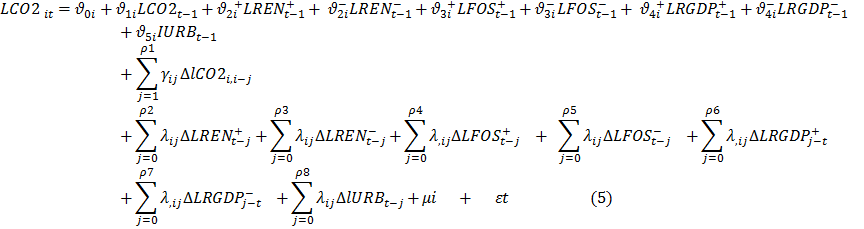
Where
Δ represent differenced variables,  to
to  denote respective lag
orders,
denote respective lag
orders, = (
= ( ,
,  ,
,  ,
,  ,
,  ,
,  ,
,  ,) are the coefficients of the long-run positive and
negative changes of REN, FOS and RGDP on CO2 emissions, while
,) are the coefficients of the long-run positive and
negative changes of REN, FOS and RGDP on CO2 emissions, while  and
and  capture
the short-run positive and negative effects of renewable energy on CO2
emissions;
capture
the short-run positive and negative effects of renewable energy on CO2
emissions;
 and
and express the short-run positive and negative
effects of non-renewable energy on environmental quality;
express the short-run positive and negative
effects of non-renewable energy on environmental quality;
 indicate the short-run positive and negative impact of
economic growth on CO2. More so, the long term effect of positive and negative
changes on the CO2 can be calculated as λ1 = − 2i/
indicate the short-run positive and negative impact of
economic growth on CO2. More so, the long term effect of positive and negative
changes on the CO2 can be calculated as λ1 = − 2i/ 1i,
λ2 = −3i/1i, λ3 = − 4i/1i.
1i,
λ2 = −3i/1i, λ3 = − 4i/1i.
Data Descriptive Properties
The
data in our model are describe using descriptive
statistics (see table 1). The descriptive analysis shows that RGDP has
the highest mean value of 6.109704, followed by REN with the value of 4.808663 and
URB with mean value of 2.504397. This implies that RGDP, REN and URB matter so much
in determining the outcome for Co2 emission.
The
correlation analysis in Table 2 is used to show that regressors
do not have exact linear representations of each another. Hence,
a correlation statistic of 0.80 and above between the explanatory variables shows
evidence of a linear linkage between the variables. Our study reveals that
variables are not linearly dependent as none of the variables has up to 0.80 value against each other.
Table 1: Descriptive
Statistics
|
|
|
|
|
|
|
|
Variables
|
CO2
|
REN
|
FOS
|
RGDP
|
URB
|
|
Mean
|
-1.185584
|
4.808663
|
1.62734
|
6.109704
|
2.504397
|
|
Std. Dev.
|
0.8162254
|
0.9968501
|
5.794291
|
1.142952
|
1.708976
|
|
Minimum
|
-2.41272
|
3.933529
|
-3.912023
|
3.595667
|
-0.3683348
|
|
Maximum
|
0.000
|
7.405251
|
14.8105
|
7.849285
|
4.09301
|
|
Obs.
|
162
|
162
|
162
|
162
|
162
|
Source: Author’s computation using stata 15
Table 2: Correlation Analysis
|
Variables
|
lco2
|
lren
|
lfos
|
lrgdp
|
lurb
|
|
lco2
|
1.0000
|
|
|
|
|
|
lren
|
0.6443
|
1.0000
|
|
|
|
|
lfos
|
0.8243
|
0.2562
|
1.0000
|
|
|
|
lrgdp
|
-0.2697
|
-0.1282
|
-0.7479
|
1.0000
|
|
|
lurb
|
-0.4402
|
-0.6893
|
-0.3416
|
0.3491
|
1.0000
|
Source:
Author’s computation using stata 15
3.3.1 Cross-sectional
dependence Test
Cross-sectional
dependence developed by Pesaran (2004) is an important
pre-test for panel data analysis which is employed to decide on the generation
of Unit root test to estimate (first or second-generation). So, we employ the Breusch and Pagan (1980) LM test, Pesaran
(2004) scaled LM test, Pesaran (2004) CD test, and Baltagi et al. (2012) bias-corrected scaled LM test whose
null hypothesis assert that there is no cross-sectional dependence and alternatively there is cross-sectional
dependence. However, rejecting H0 means adopting the first-generation unit root
tests, otherwise, applying second-generation unit root test (which is the case
of this study as can be seen in table 3).
3.3.1
Panel unit root
The
study applied a second-generation unit root test as necessitated by the outcome
of the cross-sectional dependence test. Thus, CIPS test in heterogeneous
(balanced) panels developed by Pesaran (2007) was adopted
(see table 4).
4.0.
RESULTS AND DISCUSSIONS
4.1. Cross Sectional Dependence and Unit Root
Test
Looking
at table 3, all the LM tests including Pesaran CD indicate
the existence of cross-sectional dependence at a 1% significance level for almost
all the variables. So, we estimate a unit root test that allow for
cross-sectional dependence such as CIPS. Table 4 is the Pesaran
panel unit root test in the presence of cross-sectional dependence (CIPS) shows
that all the variables are integrated of order. Hence, the employment of Panel
ARDL in a non-linear framework is required.
Table 3: Cross-sectional Dependence Test
|
Variables
|
Breusch-Pagan LM
|
Pesaran scaled LM
|
Bias-corrected scaled
LM
|
Pesaran CD
|
|
LCO2
|
94.77526(0.000)
|
14.56490(0.000)
|
14.44952(0.000)
|
0.095898(0.000)
|
|
|
|
|
|
|
LREN
|
143.7197(0.000)
|
23.5009(0.000)
|
23.38551(0.000)
|
0.048065(0.000)
|
|
|
|
|
|
|
LFOS
|
77.50694(0.000)
|
11.41215(0.000)
|
11.29677(0.000)
|
1.299449(0.000)
|
|
|
|
|
|
|
LRGDP
|
133.2264(0.000)
|
21.58509(0.000)
|
21.4697(0.000)
|
2.654169(0.0080)
|
|
|
|
|
|
|
LURB
|
169.8431(0.000)
|
28.27035(0.000)
|
28.15496(0.000)
|
6.145346(0.000)
|
Source:
Author’s computation using Eviews 10
Table 4: CIPS Unit root test
|
|
CIPS
|
|
|
|
|
Level
|
Ist Diff
|
Decision
|
|
LCO2
|
-2.294
|
-4.471
|
I(1)
|
|
|
|
|
|
LREN
|
-1.357
|
-3.839
|
I(1)
|
|
|
|
|
|
LFOS
|
-0.841
|
-4.891
|
I(1)
|
|
|
|
|
|
LRGDP
|
-2.053
|
-3.634
|
I(1)
|
|
|
|
|
|
LURB
|
-2.018
|
-3.597
|
I(1)
|
|
|
|
|
|
|
critical values
|
|
10%
|
5%
|
1%
|
|
|
-2.21
|
-2.33
|
-2.57
|
Source:
Author’s computation using Stata 15.
4.3 Panel
Non-Linear ARDL results
Table 5 contain the panel Non-linear ARDL estimates of our model. Both mean
group and pool mean group were estimated and then run the Hausman
test specification which helps us to choose between the two ARDL techniques.
Rejecting the Ho of the Hausman test means
the application of the PMG otherwise, adopt MG estimator. Hence, the Hausman test results reveals that PMG estimator is the most
appropriate estimator for modeling the Energy sources, economic growth and carbon
emission linkage for the West African Monetary Zone countries. Below the
short-run elasticities estimates in table 5 are the
asymmetric tests for both long-run and short-run periods. The asymmetric test as
the Wald test has its null hypothesis of no asymmetric relationship while the
alternate hypothesis is that there is an asymmetric relationship among the
variables.
Table 5: Panel
NARDL
|
|
Specification LCO2
|
|
|
|
|
|
Mean Group
|
|
Pool Mean Group
|
|
Variables
|
Coefficient
|
Prob
|
|
Coefficient
|
Prob
|
|
Long Run Elasticities
|
|
|
|
|
|
Constant
|
-14.69364
|
0.168
|
|
-0.97916
|
0.036
|
|
lren_p
|
-1.32312
|
0.33
|
|
-1.126538
|
0.178
|
|
lren_n
|
-3.367215
|
0.015
|
|
-9.168208
|
0.0000
|
|
lfos_p
|
-0.0545736
|
0.163
|
|
0.0849037
|
0.281
|
|
lfos_n
|
-0.3391386
|
0.271
|
|
0.0997866
|
0.100
|
|
lrgdp_p
|
-0.7180346
|
0.218
|
|
-1.722958
|
0.000
|
|
lrgdp_n
|
-0.4207297
|
0.500
|
|
-0.358257
|
0.006
|
|
Lurb
|
5.470194
|
0.195
|
|
0.3052027
|
0.175
|
|
Shor Run Elasticities
|
|
|
|
|
|
ECT(-1)
|
-0.6789552
|
0.0000
|
|
-0.348515
|
0.021
|
|
lren_p
|
0.3611168
|
0.827
|
|
-0.041689
|
0.933
|
|
lren_n
|
0.0535385
|
0.916
|
|
-0.184211
|
0.738
|
|
lfos_p
|
0.0616521
|
0.369
|
|
0.0486418
|
0.438
|
|
lfos_n
|
0.1367283
|
0.289
|
|
0.1129013
|
0.189
|
|
lrgdp_p
|
0.2131512
|
0.47
|
|
0.2911555
|
0.390
|
|
lrgdp_n
|
-0.0675389
|
0.782
|
|
-0.028969
|
0.893
|
|
Lurb
|
-5.241481
|
0.269
|
|
-1.072063
|
0.492
|
|
Asymmetric
relationship
|
|
|
|
|
|
Long run Asymetery
|
|
|
|
|
|
LREN
|
35.86
|
0.000
|
|
|
|
|
LFOS
|
0.03
|
0.862
|
|
|
|
|
LRGDP
|
8.58
|
0.003
|
|
|
|
|
Short Run Asymetery
|
|
|
|
|
|
LREN
|
0.05
|
0.8184
|
|
|
|
|
LFOS
|
2.09
|
0.148
|
|
|
|
|
LRGDP
|
0.49
|
0.483
|
|
|
|
|
Hausman test
|
0.1379
|
|
|
|
Source:
Author’s computation
4.4 DISCUSSIONS
Our
panel unit root test results using CIPS indicate that all the CIPS statistics
are greater than their critical values of 5%, and 1% only at their first differences.
This means that the variables are integrated of order one [I(1)].
This test is motivated by the outcome of the cross-sectional dependence test
(see table 3).
On the panel non-linear ARDL results using PMG output;
findings from the long-run estimates show that a rise in renewable energy
brings about a decrease in CO2 emissions insignificantly, while a decrease in
renewable energy tends to depress CO2 significantly. These findings are in
tandem with the outcome of Citak et al, 2020. The
negative effect of renewable energy on carbon dioxide emission is in line with
the findings of Attioui, 2017 and contradicts the
findings of Zvereva et al, 2020. Also, the
insignificant association between positive shock of renewable energy and CO2 is
in tandem with the findings of Onuoha et al, 2021.
As for non-renewable energy, positive and negative shocks in
fossil fuel consumption add to CO2 emissions insignificantly in WAMZ. More so,
the result suggests that both positive and negative components of economic
expansion (RGDP) significantly reduce CO2emission in WAMZ nations. Urbanization models has
an insignificant positive impact on environmental quality. However, the based on the outcome of the signs
of economic growth coefficients, we could not establish or validate the EKC
hypothesis which corroborates with the findings of Khan et al (2020): and Minlah and Zhang
(2020).
The short-run estimates suggest that Error correction term is
negative and significant with error term of 0.349.
The sign and significant nature of the ECM meet the theoretical expectation and
this further entails the restoration of the long-run equilibrium after an
exogenous shock. This further means that errors are corrected at the adjustment
speed of about 34.9 percent annually. All
the variables exhibit no significant influence on carbon emission in the short
run which means there is no short run causal linkages
among the variables.
The long-term asymmetric test revealed a Wald test
probability values of 0.000, 0.862, and 0.003 for LREN, LFOS, and LRGDP respectively. This
means rejection of null hypothesis for LREN and LRGDP but acceptance of Ho for
LFOS. This further means that there is a long-run asymmetric relationship
between renewable energy-carbon emission and between economic growth - CO2 in
WAMZ, while there exists no long-run asymmetric association between
non-renewable (fossil fuel use)-Carbon dioxide emission in WAMZ. However, the
three variables are seen to exert no short-run asymmetric effect on CO2 (see
table 5).
5.0. CONCLUSION AND RECOMMENDATION
Energy
consumption irrespective of the source is known as the engine that drives
economic development. But economic development has posed a great challenge for developing
nations as well as Africa in general and WAMZ in particular. The issue of how
to exploit energy sources to address the developmental needs of the WAMZ area has
become the central focus of the development agenda of the zone with sustainable
development gaining attention recently because of the need to recognize the
importance of not destroying the planet as the exploitation of resources go on.
The current study sought to investigate the influence of exploitation of
different energy sources with economic growth inclusive that comes as a result
of environmental pollution (CO2) to validate the Environmental Kuznets Curve
Hypothesis for WAMZ.
The study found that the association between environmental
quality and economic growth does not validate or find support for inverted
U-shape proposed by Panayotou (1993) for WAMZ. Furthermore, the significance of the asymmetric
relationship between carbon emission with renewable energy and economic growth
in the long run for WAMZ supports our argument that Panel Non-linear ARDL is a
superior method of estimation than previous methods used by earlier empirical
studies.
We conclude that negative shock to renewable energy use and shocks
to economic growth are factors that improve environmental quality in WAMZ. Since the use of non-renewable energy shows
positive but insignificant impact on CO2, we recommend the use of renewable
energy for WAMZ in order to mitigate the damage done by fossil fuel.
5.1. Policy implications
The
study opines that the ECOWAS sub-region is still in dire need of development
and so would be exposed to environmental challenges. Strong
ecological/environmental policies that accommodate best practices in the
exploitation of abundant resources within the sub-region should be pursued as
one of the policy options to drive development. Policy on environmental
quality should focus on carbon footprint rather than carbon 2 emission to achieve a holistic clean environment safe for
humans, plants, animals, and other creatures. The study recommends
that policymakers in WAMZ should adopt and promote renewable energy sources
than old traditional energy sources such as coal, gas, and oil so as to obtain
sustainable environment.
REFERENCES
Adedoyin, F., Abubakar, I., Bekun,
F. V., & Sarkodie, S. A. (2020). Generation of
energy and environmental-economic growth consequences: Is there any difference
across transition economies? Energy Reports, 6, 1418-1427.
Ameyaw, B., Li, Y., Annan, A., & Agyeman,
J. K. (2020). West Africa’s CO 2 emissions: investigating
the economic indicators, forecasting, and proposing pathways to reduce carbon
emission levels. Environmental Science and Pollution Research,
1-25.
Attiaoui, I., Toumi, H., Ammouri, B., & Gargouri, I.
(2017). Causality links among renewable energy consumption, CO2
emissions, and economic growth in Africa: Evidence from a panel ARDL-PMG
approach. Environmental science and pollution
research, 24(14), 13036-13048.
Attiaoui, I., & Boufateh, T. (2019). Impacts of climate change on cereal farming in Tunisia: A panel
ARDL–PMG approach. Environmental Science and Pollution Research, 26(13),
13334-13345.
Chakravarty, D., &
Mandal, S. (2020). Is economic growth a cause or cure for environmental
degradation? Empirical evidence from selected developing countries. Environmental
and Sustainable Indicators, 7(2020), 100045.
Çıtak, F., Uslu, H., Batmaz,
O., & Hos, S. (2020). Do renewable energy and natural gas consumption
mitigate CO2 emissions in the USA? New insights from NARDL approach. Environmental
Science and Pollution Research, 1-12.
Dabachi, U. M., Mahmood, S., Ahmad, A. U., Ismail,
S., Farouq, I. S., Jakada,
A. H., & Kabiru, K. (2020). Energy consumption,
energy price, energy intensity environmental degradation, and economic growth
nexus in African OPEC countries: Evidence from simultaneous equations
models. Journal of Environmental Treatment Techniques, 8(1),
403-409.
Elshimy, M., & El-Aasar, K. M. (2019). Carbon footprint, renewable energy, non-renewable energy, and
livestock: Testing the environmental Kuznets curve hypothesis for the Arab
world. Environment, Development and Sustainability, 1-28.
Kais, S., & Mounir, B. M.
(2017). Causal interactions between environmental degradation, renewable
energy, nuclear energy and real GDP: A dynamic panel data approach. Environment
Systems and Decisions, 37(1), 51-67.
Khan, M. K., Muhammad, I. K., Khan, M. K., Khan, M. I., & Rehan, M.
(2020). The relationship
between energy consumption, economic growth and carbon dioxide emissions in
Pakistan. Financial Innovation, 6(1), 1-13.
Khan, S., Peng, Z., &
Li, Y. (2019). Energy consumption, environmental degradation, economic growth
and financial development of the globe: Dynamic simultaneous equation panel
analysis. Energy Report, 5(2019), 1089 - 1102.
Mert, M., & Boluk, G. (2016). Do foreign direct investment and renewable energy consumption affect
the CO2 emissions? New evidence from a panel ARDL approach to
Kyoto Annex countries. Environmental Science and Pollution
Research, 23(21), 21669-21681.
Minlah, M. K., & Zhang, X. (2020). Testing for the existence of the environmental
Kuznets curve (EKC) for CO2 emissions in Ghana: Evidence from the bootstrap
rolling window Granger causality test. Environmental Science and
Pollution Research, 1-13.
Mohammed Saud M, A., Guo,
P., Haq, I. U., Pan, G., & Khan, A. (2019). Do
government expenditure and financial development impede environmental
degradation in Venezuela?. PloS one, 14(1),
e0210255.
Munir, K., &Riaz, N. (2020). Asymmetric impact of energy consumption on environmental degradation:
evidence from Australia, China, and USA. Environmental Science and
Pollution Research, 1-11.
Onuoha, F. C., Uzoechina, B. I., Ochuba, O. I., & Inyang, N.
F. (2021). Economic expansion,
energy sources and environmental quality in ECOWAS sub-region: evidence from a
heterogeneous panel non-linear Autoregressive Distributed Lag (PNARDL). Environmental
Science and Pollution Research, 1-17.
Panayotou, T. (1993). Empirical tests and policy analysis of environmental degradation
at different stages of economic development (No. 992927783402676).
International Labour Organization.
Paramati, S. R., Sinha, A., & Dogan, E. (2017). The significance of renewable energy use for economic output
and environmental protection: evidence from the Next 11 developing
economies. Environmental Science and Pollution Research, 24(15),
13546-13560.
Pesaran, M. H. (2004)
General diagnostic tests for cross section dependence in panels, CESifo Working Paper Series No. 1229; IZA Discussion Paper
No. 1240. Available at SSRN: http://ssrn.com/abstract=572504 (accessed 25
January 2010).
Pesaran, M. H. (2007) A
simple panel unit root test in the presence of cross-section dependence, Journal
of Applied Econometrics, 22, 265-312.
Saidi, K., & Rahman, M. M. (2020). The link between environmental quality, economic growth, and energy
use: new evidence from five OPEC countries. Environment Systems and
Decisions, 1-18.
Shin, Y., Yu, B., & Greenwood-Nimmo, M. (2014). Modelling
asymmetric cointegration and dynamic multipliers in a
nonlinear ARDL framework. In Festschrift in
honor of Peter Schmidt (pp. 281-314). Springer,
New York, NY.
United Nation Framework
Convention on Climate Change . (1994). Global climate action. UNFCCC.
Tokoyo: UN..
Zvereva, E. E., Vandyukova, I. I., Vandyukov, A. E., Katsyuba, S.
A., Khamatgalimov, A. R., & Kovalenko,
V. I. (2012). IR and Raman spectra, hydrogen bonds, and
conformations of N-(2-hydroxyethyl)-4, 6-dimethyl-2-oxo-1, 2-dihydropyrimidine
(drug Xymedone). Russian Chemical
Bulletin, 61 (6), 1199-1206.
|
Cite this Article: Nwaeze, NC
(2021). Application of a Heterogeneous Panel Non-Linear
Autoregressive Distributive Lag (ARDL) on Energy Sources, Economic Growth
and Environmental Quality in West African Monetary Zones (WAMZ)
Greener Journal of Economics and Accountancy, 9(1):17-25.
|