INTRODUCTION
Due to the multifaceted applications of water as
an essential resource to all organisms, human-water consumption has become
inevitable. Potable water is essential for total
health and survival of humans, especially infants (Ohimain
et al., 2013). According to Nwabor, (2016),
water-borne diseases encompasses all ailments arising from either direct
and/or indirect contact of contaminated water, through bathing, consumption, or
the aesthetic use of water.
The consumption of contaminated water has become
a leading cause of most gastrointestinal illness in all regions of the world (Ahmed
et al., 2014). Water-borne
diseases have caused major health problems across the world (Clasen, et al., 2007; WHO, 2010). For instance, survey and estimates of WHO had
it that over 1 million persons dies from water-borne diseases on annual basis
(WHO, 2005).
Understanding the
pattern of disease spread is a basic pre-requisite for assessing the causes of
disease outbreaks (Schuster et al., 2005). Instances of water-borne diseases resulting from the
consumption of contaminated water have been documented in literature (Raji et al., 2001; Oguntoke et al.,
2009). Raji
et al. (2010a) reported that potable
water samples from two towns in Sokoto metropolis were found to be contaminated
with pathogenic microbes like; E. coli, Salmonella, Shigella and Vibrio.
Besides microbial
contamination, potable water was also found to have heavy metal contaminants
that exceeded the WHO allowable limits (Raji et al., (2010b). However, there is
paucity of information on waterborne diseases in relation to the sources of
water in Bayelsa State. Bayelsa is a coastal state with a lot of riverine
community settlements having inadequate potable water. Hence, there is need for
comparative analysis of water sources and water borne diseases.
MATERIALS AND METHOD
3.1
Study Area
Bayelsa state (N05o 07∣ 13.8∣∣ and longitudes E006o
18∣ 04.5) is located in
the southernmost part of Nigeria. It is one of the states in the Niger Delta areas
with a major central tributary called River Nun. The climatic condition of the area is tropically humid with two
prevailing seasons; the rainy season ranging from the months of March to
October and the dry seasons spanning from November to February
3.2
Research Design
The study adopted field survey design to collect
relevant data on the communal sources of water and water-borne diseases data
from individuals and Primary Health Care Facility in some selected coastal
communities along the river Nun.
3.3
Population of the Study
The population of the study were
riverine communities. The information on the history about the waterborne
diseases were collected by questionnaires and health data
bank from the PHC in all the study communities.
3.4 Research Instrument
The instrument used for this research was a designed
questionnaire titled: Prevalence of water borne diseases in some coastal
communities of Bayelsa State (PWBDISCCOBS). The questionnaire was structured
into two parts. The Part A contains items on the community sources of water,
while Part B contains items on the awareness of the health impacts of
water-borne diseases.
3.6 Validity and Reliability of
instrument
The questionnaire was verified by experts and certified okay by an
expert in the field of public health. The
questionnaires were first tested on a pilot scale around some households 1 km
adjacent to the study area. The scores were analysed using t-test. The data was
significant at p ═ 0.05 and confirmed the instrument to be reliable.
3.8 Method of Data Collection
Five
(5) communities were selected for the study based on accessibility. The
communities are; (Gbarantoru, Ogobiri, Tombia, Ikibiri,
and Amasoma), Two hundred and fifty (250) households was randomly selected; 50
from each community. From each household, the head was presented with the copy
of the questionnaire to fill. In any household where the head was not literate,
the content of the questions was read and the respondent was guided. This
continued until a sample size was obtained. Sample size was determined as per
Daniel (cited in Ebenezer et al, 2015). In the same community, the health data on
water borne diseases were sought from the existing PHC facility data bank
through the permission of the Medical director.
3.9 Method of Data Analysis
Data arising from the study was verified for accuracy
using the 2016 version of Microsoft
office excel. Thereafter, it was subjected to SPSS (version 20.0) for
descriptive and analytical statistic. Descriptive statistics like percentage
was use to express the frequency occurrence of an event. Significant
differences between variables were determined in ANOVAs at a confident level of
0.05.
RESULT
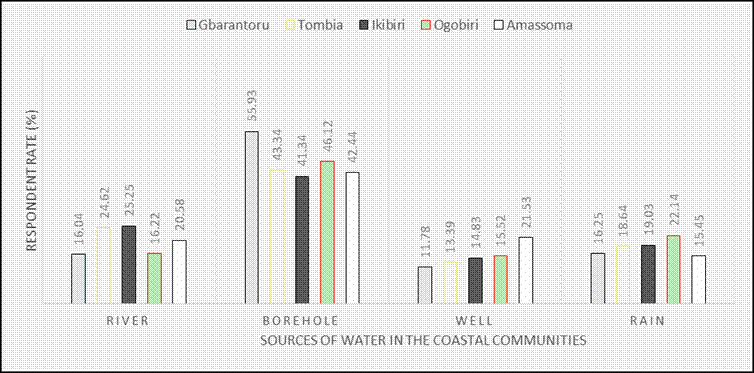
The sources and utilization
of water in the coastal communities in this present study is presented in Figure
1. Base on the preferred
source of water, the use of borehole recorded the highest frequency (45.79%)
and the lowest frequency (15.93%) was recorded in well water. Other sources of
water were River (20.52%) and Rain water (18.29%) respectively. With the
exception of river and rain water (p>0.05), every other sources of water
showed significant difference (p<0.05). The communal sources of water in order of
increasing frequency are; Ikibiri:(borehole>river>rain>well);Amasoma:(borehole>well>river>rain);Tombia:(borehole>river>rain>well);
Ogobiri (borehole> river>rain> well) and Gbarantoru (borehole>rain> river> well) respectively.
Details are shown in Figure 1.
DISCUSSION
The sources of water observed
in this present study have been reported elsewhere (Oguntoke
et al., 2009, Raji and Ibrahim, 2011). Borehole was the most preferred sources
of water and accounted for 45.79% of all the water sources used. This result is moderately high and indicate that community
enlightenments on the safe source of water is ongoing. However, the use of other sources of water
put together in the study location was 54.91% higher than borehole. Similar study
by
Temitayo and Bolarinwa,
(2017) reported that 66.82% of the households in rural communities in Nigeria,
drinks water from unprotected sources such as open wells, springs and streams. However,
the present observation contradicts the result of Olowe et al., (2016), who
reported that the predominant source of water in Addo Ekiti was well. The
observation in this present study highlights that majority of the inhabitants in
the study location are still depending on unsafe water for consumption. Nevertheless,
the reason for their dependence on unsafe water for consumption is yet
uncertain at this time.
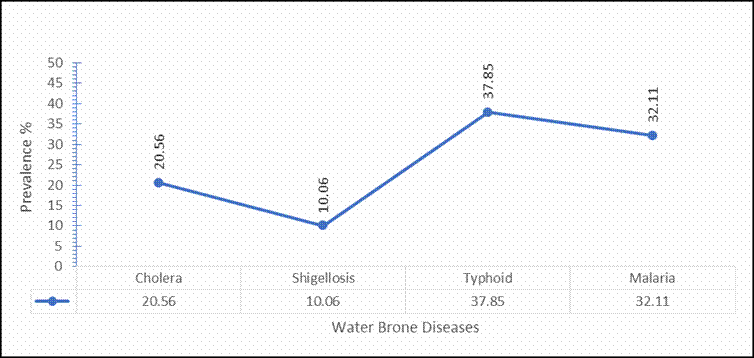
Five water-borne diseases in an increasing order of prevalence in the study
locations were; typhoid (37.85%) malaria (32.11%), Cholera (20.56%) and shigellosis
(10.06%). This
result agrees with the similar study conducted in North-western Nigeria (Raji
and Ibrahim, 2011 but contrasted the result of Temitayo
and Bolarinwa , (2017), who reported the following
water related diseases in the rural communities
of Nigeria, such as river blindness, (61.97%), schistosomiasis (22.34%), elephantiasis (13.12%)
and guinea worm (about 3%). The higher prevalence of typhoid reported in
this present study contradicts the result of Olowe et al. (2016) and Raji and Ibrahim, (2011). Both reported that diarrhoea was the most predominant water borne
diseases recorded in South western and North-western
of Nigeria. Raji and Ibrahim, (2011) emphasized further that the diarrhoea cases increased from 6.23% in
2004 to 10.04% in 2005.
The prevalence of typhoid, Cholera and shigellosis
in the present study is an indication that the sources of
water in the study location is highly contaminated with several disease
pathogens. Typhoid
is caused by Salmonella serotypes
such as Salmonella typhi, S. paratyphi A, S. paratyphi B and S. paratyphi C.
(Crump et al., 2004), and is
transmitted through the ingestion of water or food that has been contaminated
by faeces in a crowded and impoverished environment, where the populations has
little or no access to sanitation facilities (Eba and
Bekele, 2019). The prevalence of typhoid in this
present study is an indication that the table water level in the environment is
high, which may have easily contaminated the sources of water supply with
pathogenic agents.
Cholera
is caused by a strain of bacteria species called Vibrio cholera. It strives where there is lack of social amenities
and poor environmental sanitation. Shigellosis is a bacterial infection caused
by Shigella species. It is considered
as a potential factor in infectious diarrhoeas (Sousa
et al., 2013). Their presence in this study is an indication that the
locations where sources of water is sited may be
exposed to the bacterial contaminations.
Malaria
is a water wash disease caused by a protozoan parasite of the genus Plasmodium.
It is predominant where there are several stagnant water bodies. Such
environment encourages the breeding of mosquito and the emergence of adults.
Their presence in this present study is not surprising, because malaria is
endemic in the Niger Delta area and its prevalence has been reported (Abah and Temple, 2015; Ezenwaka, and Ivoh, 2018).
CONCLUSION
It is apparent from the
results of this study that most locations in the study area lack safe and
portable drinking water. This have translated to the
prevalence of four water-borne diseases in rural communities of Bayelsa State.
The frequencies of the water-borne diseases were; typhoid> malaria > Cholera >shigellosis. This
result is a cause for public attention. It is therefore recommended government should
provide portable drinking water to the community and sensitize rural
communities on the need to improve community base environmental sanitation.
REFERENCES
Abah,
A. E., and Temple, B. (2015). Prevalence of Malaria Parasite
among Asymptomatic Primary School Children in Angiama
Community, Bayelsa State, Nigeria. Trop Med Surg, 4(1).
http://dx.doi.org/10.4172/2329-9088.1000203
Ahmed, S. M, Hall, A. J, Robinson, A. E., Verhoef,
L., Premkumar, P., and Parashar U. D. (2014). Global prevalence of norovirus in cases of gastroenteritis: A
systematic review and meta-analysis. Lancet
Infect Dis., 14(8), 725 – 30.
Clasen, T., Schmidt, W.,
Rabie, T., Roberts, I., and Cairncross, S. (2007).
Interventions to improve water quality for preventing diarrhoea: systematic
review and meta-analysis. British Medical
Journal, 1-10.
Crump, J. A,
Luby, S. P and Mintz, E. D.
(2004). The global burden of typhoid fever. Bull World Health Organ.;82(5), 346–353.
Daniel, W. W, (in Ebenezer et al., 2006): Practical issues in
calculating the sample size for prevalence studies. Medical Statistics,
1, 9-14.
Eba,
K, and Bekele, D. (2019). Prevalence
of Typhoid Fever and its Risk Factors in Lalo Assabi District, West Wollega, Oromiya. Ethiopia. J Bacteriol
Parasitol., 10, 365. DOI:
10.35248/2155-9597.19.10.365
Ezenwaka,
C. O. and 2 Ivoh, C. J. (2018). Prevalence
of Malaria Infection among Students Attending Federal University Otuoke Health Centre, Bayelsa
State, Nigeria. Int. Journal of
Basic Science and Technology, 4(1), 17-22.
Ibrahim, M., Odoemena,
D. I., and Ibrahim, M. T. (2000). Intestinal Helminthic infestations among primary
school children in Sokoto. Sahel. Med.
J., 3(2), 65 - 68.
Nwabor, O. F., Nnamonu, E. I.,
Martins, P. E., and Ani, O. C. (2016). Water and Waterborne Diseases: A Review.
International Journal of Tropical Disease & Health, 12(4), 1-14.
Oguntoke,
O., Aboderin, O.J. and Bankole, A.M. (2009). Association of water-borne
diseases morbidity pattern and water quality in parts of Ibadan City, Nigeria. Tanzania Journal of Health Research, 11( 4).189-195.
Ohimain, E. I., Angaye, TCN., and Okiongbo, K. (2013). Removal of Iron, Coliforms and Acidity
from Ground Water Obtained from Shallow Aquifer Using Trickling Filter Method. Journal
of Environmental Science and Engineering, 2, 549 - 555.
Raji, M. I. O, Ibrahim Y. K. E, and Ehinmidu,
J. O. (2010b). Physico-chemical characteristics and heavy metal levels in drinking water
sources in Sokoto metropolis in North-western Nigeria. J. Appl. Sci. Environ. Manage.,14(3), 81 - 85.
Raji, M. I. O., Ibrahim, Y. K. E., and Ehinmidu,
J. O. (2010). Bacteriological quality of public water sources in Shuni, Tambuwal and Sokoto towns in North-Western Nigeria. J. Pharm. Biores., 7(2), 55-64.
Schuster, C. J.,
Ellis, A. G., Robertson, W. J., Charron, D. F., Aramini,
J. J., Marshall, B. J. (2005). Infectious disease outbreaks related to
drinking water in Canada, 1974–2001. Can
J Public Health, 96(4), 254–8.
Sousa
MÂB, Mendes EN, Collares GB, Péret-Filho
LA, Penna FJ, Magalhães PP(2013). Shigella in Brazilian
children with acute diarrhoea: prevalence, antimicrobial resistance and
virulence genes. Mem
Inst Oswaldo Cruz; 108(1):30–35
Temitayo A. A., Bolarinwa T. O, (2017). Estimating the
Incidence of Water Related Diseases: the case of Neglected Tropical Diseases in
Rural Nigeria , Journal of Agriculture
and Veterinary Science, 10( 7): 49-57 DOI: 10.9790/2380-1007014957
World Health Organisation
(2005).
Guidelines for Laboratory and Field Testing of Mosquito
Larvicides. WHO communicable disease control,
prevention and eradication. WHO pesticide evaluation scheme,
WHO/CDS/WHOPES/GCDPP/2005.13.
WHO/UNICEF. (2000).
Global Water supply and sanitation assessment report. Geneva and New
York: WHO and UNICEF; 2000.