|
Greener Journal of Educational Research Vol. 4 (4), pp. 091-098, July 2014 ISSN: 2276-7789; ICV: 6.05 Copyright ©2017, the copyright of this article is retained by the author(s) DOI Link: http://doi.org/10.15580/GJER.2014.4.021714113 http://gjournals.org/GJER |
|
Integration of Information Communication Technology (ICT) in the Curriculum of Federal Unity Schools (FUS) in Nigeria: Implications for Learning
*1Emmanuel Chukwunweike Nwangwu,
1Chiaka Augusta Obi, & 2Edna Nwanyiuzor Ogwu
Greener Journal of Educational Research, vol. 4, no. 4, pp. 091-098, July 2014
1Department of Vocational Teacher Education, University of Nigeria Nsukka.
2Department of Arts Education, University of Nigeria Nsukka, Enugu-State Nigeria.
|
ARTICLE INFO |
ABSTRACT |
|
|
Article No.: 021714113 Type: Research DOI: 10.15580/GJER.2014.4.021714113
|
The study examined the extent to which Information Communication Technology (ICT) is integrated into various school subjects in the curriculum as well as students’ utilization of and access to ICT, in order to establish a fact on its implications to e-learning. Data were collected from 105 Form 2 Junior Secondary School students from four Federal Unity Schools (FUS) in South Eastern Nigeria. Questionnaire was used for data collection that were analysed descriptively and quantitatively using frequency, percentages, charts, and cross tabulation chi-square to test the null hypotheses. Findings indicate that except for computer studies, ICT was not integrated into other school subjects in the curriculum. Although ICT is seldom used, the level of ICT integration into the curriculum χ2 (8, n=105) =7.704 p> .05 has no significant influence on the level of ICT utilization. Alternatively, students’ access to ICT package, χ2 (12, n=105) =22.207 p< .05 has a significant influence on ICT utilization; majority (66%) never had access to ICT usage. Recommendations were directed towards government assistance in equipping FUS with adequate facilities, teacher preparation towards ICT usage as well as monitoring and assessment of ICT utilization. |
|
|
Submitted: 17/02/2014 Accepted: 06/06/2014 |
||
|
*Corresponding Author Emmanuel Chukwunweike Nwangwu E-mail: emmanuel.nwangwu @unn.edu.ng
|
||
|
Keywords: Access, Information Communication Technology, Junior Secondary School, Integration, Utilization |
||
|
|
|
1. INTRODUCTION
There has been a tremendous transformation in the education sector as a result of rapid advances in Information and Communication Technology (ICT). Rosen and Michelle cited in Aduwa-Ogiegbaen and Iyamu (2005) affirm that the role of technology in teaching and learning is rapidly becoming one of the most important and widely discussed issues in contemporary education policy. Information and Communication Technology (ICT) is a set of activities which is facilitated by electronic means such as processing, transmission and display of information (Rodriguez & Wilson, 2000). Ozoji in Jimoh (2007) refers to ICT as the handling and processing of information (text, images, graphics, instructions, etc) for use, by means of electronic and communication devices such as computers, cameras, and telephone. When ICT combines with internet, it creates a channel for students to obtain a huge amount of human experience and guide students to enter the global community. In this way the students not only can extend their personal view, thought, and experience, but also can learn to live in the real world.
The use of ICT in teaching and learning is a relevant and functional way of providing education to learners in order to assist them in imbibing the required capacity for the world of work (Kosoko-Oyedeko and Tella, 2010). Ajayi (2008) posited that with the aid of ICT, teachers can take students beyond traditional limits, ensure their adequate participation in teaching and learning process and create vital environments to experiment and explore. However, the application of ICT needs expensive hardware and software which becomes the big obligations for schools and parents. It is also necessary that both teachers and learners should have basic technology knowledge before they apply ICT. This new development is a strong indication that the era of teachers without ICT skills are gone. Unfortunately, most teachers today do not have technological training to guide their students in the use of computers to enhance their learning achievement.
Integration is an art of combining or adding parts to make a unified whole (Drake and Burns, 2012). Non-integration and poor access to Information Communication Technology (ICT) in Nigerian schools and some developing countries in Africa seem to be affecting students’ ICT utilization level thereby influencing achievement and competitiveness globally (Adenuga, Owoyele and Adenuga, 2011). Aduwa-Ogiegbean and Iyamu (2005) noted that many developing countries, especially in Africa, are still low in ICT application and utilization.
In some advanced countries of the world, such as China and Japan, integration of technology into some school subjects in the curriculum has brought changes, development and efficiency into their system. Successful integration of ICT into the classroom depends on the ability of teachers to structure the learning environment from non-traditional way, to new technological pedagogy (Kyriakides, Demetriou, and Charalambous, 2006). The integration of ICT to education empowers learners, teachers, educators, managers and leaders to use ICT judiciously and effectively for expanding learning opportunities and ensuring educational quality and relevance (MoEVT, 2007). The use of ICT in education is the bedrock of knowledge that would enable any country to contribute both to achieving Education for All (EFA) goals and reducing the digital divide world towards the aim of globalization.
1.1Theoretical Model
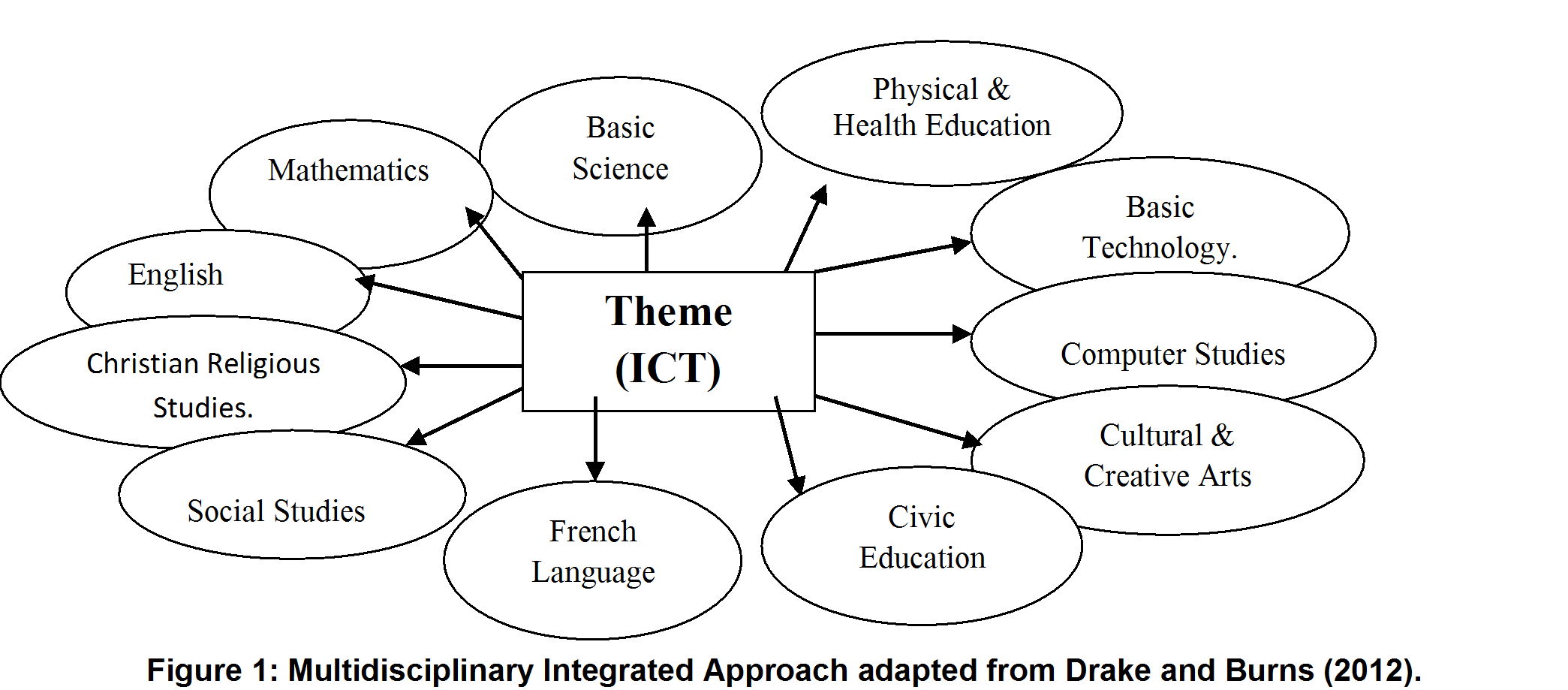
Integrated curriculum model is about making connections across and within disciplines based on skill, knowledge and attitude (Drake and Burns, 2012). Three approaches to integration as identified are: multidisciplinary, interdisciplinary, and trans-disciplinary. For the purpose of this study, a multidisciplinary approach was used. This approach focuses primarily on the various disciplines in the Junior Secondary School curriculum and how these disciplines integrate to a particular theme (ICT). These standardized disciplines as adapted from Drake and Burns (2012) include English, Mathematics, Basic Science, Physical and Health Education, Basic Technology, Computer studies, Cultural and Creative Arts, Civic Education, French Language, Social Studies, and Christian Religious Studies, while the theme of integration is Information Communication Technology (ICT). Figure 1 shows the relationship between the various subjects taught at the Junior School level in Federal Unity Schools in Nigeria and ICT as the main theme. Therefore, the current study examined the degree of infusion of ICT into the various school subjects in the Federal Unity Schools.
The utilization of ICT is determined by its integration and accessibility in the curriculum. Technology existed since the first human began to seek control over the environment and by the manipulation of materials; it has led to an ever-increasing range of application of ICT for the purpose of wealth and development of individuals’ full personality (Black, 2007). The need for integration of ICT could enhance learning and knowledge as well as provide foundation for operational excellence in a globalised world.
1.2 Statement of the Problem
The utilization of ICT in the teaching and learning process in Federal Unity Schools has been an issue that needs to be assessed in order to determine the extent to which ICT integration has impacted on knowledge delivery. The Federal Government of Nigeria (FGN) has spent over N1.32 billion in building ICT laboratories and equipping them with ICT facilities in 102 Unity schools in Nigeria (Waziri, 2006, October, 2004). The policy on ICT has been developed which aims at empowering the youth with ICT skills and preparing them for global competitiveness and also encouraging capacity building of ICT in the country’s secondary schools. The utilization of ICT has also been made mandatory at all levels of educational institutions through adequate financial provision for tools and resources. In spite of the effort of the Federal Government of Nigeria in promoting ICT integration into teaching and learning in Federal Unity Schools, the attainment of objectives of ICT in these schools seems to suffer some defects as observed from poor performance in ICT utilization among students going to higher institutions. This problem could also be as a result of poor accessibility of ICT resources by the students of Federal Unity schools.
If ICT tools are adequately accessed, they will be utilized for both academic and non-academic activities. This will bring about high degree of infusion into the various subjects in the curriculum of Federal Unity Schools.
Hence, the purpose of this study is to examine the extent to which ICT facilities are accessed, utilized and integrated into the curriculum of Federal Unity Schools in Nigeria. Expected findings will be significant to students, teachers, policy makers, literature, theory and practice of ICT.
1.3 Research Questions
Questions are outlined thus:
1. To what extent is ICT integrated into various school subjects in the curriculum?
2. To what extent are ICT facilities utilized for teaching?
3. How accessible is ICT for learning?
4. To what extent does the level of ICT integration significantly influence students’ level of ICT usage for learning?
5. To what extent does students’ level of access to ICT significantly influence their level of ICT usage?
1.4 Research Hypotheses
In this study, two null hypotheses were formulated and tested at 0.05 based on the two last research questions. This was done in order to determine the various relationships that exist in ICT integration and usage, as well as ICT access and usage. Research questions one to three were not chosen since no relationship in findings was determined.
H01: Level of perceived ICT integration in the curriculum does not significantly influence students’ level of ICT utilization.
H02: Students level of ICT access does not significantly determine the level of their usage of ICT in the school.
2. REVIEW OF LITERATURE
The integration of ICT into education is a critical issue since it has had a critical role in enhancing the quality of education (Bhukuvhani, Zezekwa and Sunzuma (2011). According to Goktas and Yildrim (2003) as cited in Bhukuvhani et al., 2011), ICT helps students to learn and teachers to perform their teaching profession more effectively. A good deal of research has shown that effective integration of ICT into various subject areas in the curriculum supports instructions and learning (Olakulehim, 2007)); empowers learning towards development (Osakwe, 2010); deepens students’ content knowledge and supports the development of complex thinking skills (Light, 2009); makes learning faster, interesting, and for accessing and retrieving information quickly (Gahala, 2007; Salle, 2006); prepares students for innovative and productive activity (Ogwu, and Ogwu, 2010; Urdzina-Deruma and Selvaha, 2007). However, Bhukuvhani et al. (2011) noted that despite the abundance of ICT tools, effective use of them is a critical issue.
Ochuku, Amakaino and Chamberlain (2013) carried out a study to find out the extent of utilization of e-learning technologies for instructional delivery in Colleges in Delta State Nigeria. The authors found out that various e-learning technologies and applications are available for utilization in education for instructional delivery but were little utilized. In addition, Ezeani and Ishaq (2013) stated that poor performance of students in the field of ICT could be as a result of teachers’ non utilization and application of appropriate ICT tools in classroom instruction. Ochuku et al. (2013) identified some constraints to effective utilization of ICT especially the e-learning technologies to include poor perception and conservative attitude of lecturers on the use of e-learning technologies for instructional delivery, shortage of qualified staff with capacity in e-learning applications, lack of training and retraining of staff and students in e-learning technologies and applications and inadequate time allocated to e-learning instruction and applications among others.
Many researchers have argued that ICT integration into the curriculum could be made efficient for utilization through financial and technological support such as: equipment upgrading; regular maintenance; and teacher preparation (Gahala, 2007; Hitch, 2007; Staples, Pugach, and Hims, 2005; Ogwu and Ogwu, 2010). Research has also shown a slow access to basic ICT equipment, has affected low utilization of internet and computers in schools in Nigeria (Osakwe, 2010); poor access to quality of Instructional Technology (IT) poor achievements in school subjects as in Botswana (Lauglo, 2004; Ogwu, and Ogwu, 2010). However, emphasis has been only on the importance of ICT, barriers and Instructional Technology utilization as it influences performance. Related research has over-looked the relationship between ICT integration in relation to access and usage. Hence this study intends to fill this gap.
3. RESEARCH METHODOLOGY
This is a descriptive and analytical survey design study carried out using a random sampling of four Federal Unity Schools (FUS) in Anambra and Enugu states of Nigeria because of the nearness to the researcher. Out of 120 copies of questionnaire used for data collection, from Junior Secondary School (JSS) 2 students that were randomly selected, 105 (88%) were returned. The JSS 2 students in the Federal Unity Schools were chosen since they had been exposed to ICT as a result of the recent re-introduction of the Junior Secondary component in the Federal Unity Schools by the Federal Government of Nigeria. A questionnaire was face-validated by two experts from measurement and evaluation and computer science unit from University of Nigeria, Nsukka, with 13 close-ended response items designed to measure the variables of ICT level of integration in the school curriculum using 4 point option scale such as: 4-highly integrated, 3-moderately integrated, 2-slightly integrated and 1-not integrated. Frequency of ICT utilization and accessibility were also measured using 4 and 5 point options respectively such as: (Never, sometimes, several times, and every day for access to ICT) as well as (Never, once a month, more than twice a week, twice a week & once a week for ICT Usage). Questionnaire consisted of items designed to measure students’ level of ICT integration into various subjects in the curriculum, as well as their frequency of utilization and access to ICT facilities. Data were analysed using SPSS version 19 package, comprising chi-square, percentages, frequency and bar chart; while the hypotheses were tested in the null form at an alpha level of 0.05 using cross tabulation chi-square.
4. FINDINGS
Results in Table 1 show that 71% of the respondents perceived that ICT is moderately integrated into computer studies. Less than one quarter (24%) reported that ICT was slightly integrated while 5% noted that ICT is not integrated at all into computer studies. However, no indication of ICT integration was made in the other school subjects.
Table 1: Frequency Distribution of Students ’Perception Level of ICT Integration in Teaching
various Subjects (n=105)
|
S/N |
Subjects |
Level of ICT Integration |
|
|||
|
HI |
MI |
SI |
NI |
Total |
||
|
F |
F |
F |
F |
F |
||
|
1 |
Computer Studies |
0 |
75 |
25 |
5 |
105 |
|
2 |
Basic Technology |
0 |
0 |
0 |
105 |
105 |
|
3 |
French Language |
0 |
0 |
0 |
105 |
105 |
|
4 |
Physical and Health Education (PHE) |
0 |
0 |
0 |
105 |
105 |
|
5 |
Christian Religion Studies (CRS) |
0 |
0 |
0 |
105 |
105 |
|
6 |
Cultural and Creative Arts (CCA) |
0 |
0 |
0 |
105 |
105 |
|
7 |
Civic Education |
0 |
0 |
0 |
105 |
105 |
|
8 |
Social Studies |
0 |
0 |
0 |
105 |
105 |
|
9 |
Basic Science |
0 |
0 |
0 |
105 |
105 |
|
10 |
Mathematics |
0 |
0 |
0 |
105 |
105 |
|
11 |
English Language |
0 |
0 |
0 |
105 |
105 |
Key: Highly Integrated (H.I), Moderately Integrated (M.I), Slightly Integrated (S.I) Not Integrated (N. I.)
Results in Table 1 indicates that apart from computer studies, ICT is not integrated into other school subjects in the curriculum.
Results in Table 2 show the frequency of ICT utilization in Federal Unity Schools in Nigeria. Majority (36%) indicated using ICT package just twice a week, while 22% perceived using ICT once a month. However, one fifth (20%) claimed that they have never used ICT in the school before (see Table 2 & fig. 2 for more information).
Table 2: Frequency Distribution of ICT Usage in Teaching (n=105)
|
S/N |
Frequency of ICT Usage |
F |
% |
|
1 |
NEVER |
21 |
20.0 |
|
2 |
ONCE A MONTH |
23 |
21.9 |
|
3 |
MORE THAN TWICE A WEEK |
6 |
5.7 |
|
4 |
TWICE A WEEK |
38 |
36.2 |
|
5 |
ONCE A WEEK |
17 |
16.2 |
|
|
Total |
105 |
100.0 |
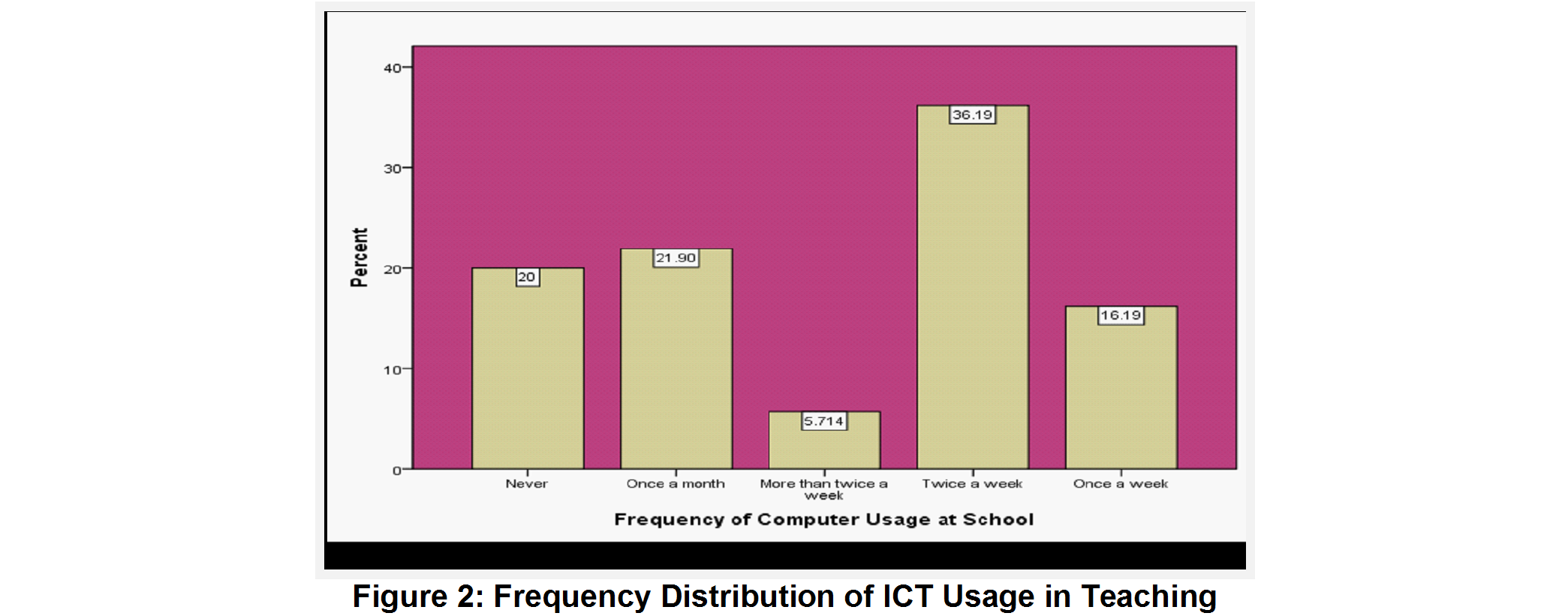
Results indicate that ICT is seldom used at the Federal Unity Schools in Nigeria. However, from a cross tabulation analysis of null hypothesis one carried out, results showed that the level of ICT integration into the curriculum χ2 (8, n=105) =7.704 p> .05 have no significant influence on the level of ICT utilization among students. This explains the fact that ICT integration does not make any difference on the extent of using ICT in the Federal Unity Schools in Nigeria. This was reported this way as a support report since result was not significant.
Results in Table 3 show the frequency of ICT access in Federal Unity Schools in Nigeria. Majority (63%) never had access to ICT facilities. One fifth (20%) have access to ICT just several times in a month while just 2% access ICT everyday (See Table 3 & Fig. 3 for further information).
Table 3: Frequency Distribution of ICT Accessibility to Students (n=105)
|
S/N |
Frequency of ICT Access |
F |
% |
|
1 |
NEVER |
66 |
62.9 |
|
2 |
SEVERAL TIMES A WEEK |
16 |
15.2 |
|
3 |
SEVERAL TIMES A MONTH |
21 |
20.0 |
|
4 |
EVERYDAY |
2 |
1.9 |
|
|
Total |
105 |
100.0 |
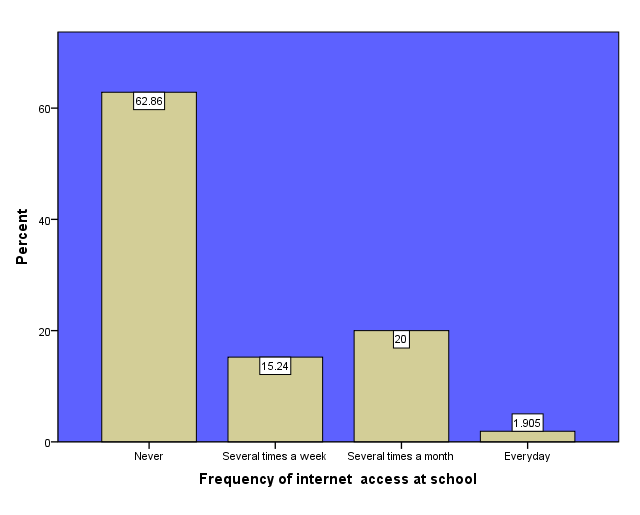
Figure 3: Level of Access to ICT
The results in table 3 as reflected in figure 3 indicate that many students do not usually have access to ICT in Federal Unity Schools. This could be a likely factor responsible for low level of ICT utilization in Federal Unity Schools.
H02: Students level of ICT access does not significantly determine the level of their usage of ICT in school.
This hypothesis was tested by relating the two variables using Pearson Chi-Square analysis technique. This gave aχ2 value of 22.207 (see Table 4) which was found to be higher than the critical χ2 value of 21.03, given 12 degrees of freedom at an alpha level of .05.From this observation, the null hypothesis that students’ level of ICT usage does not significantly determine the level of their access to ICT in Federal Unity School was rejected. Hence students’ level of ICT usage does significantly determine the level of their access to ICT.
This further indicates from cross tabulation chi-square that many (23) students that never had access to ICT and internet in school, utilise ICT twice a week. Also, for some (10) that had access to ICT several times a month, use ICT twice a week. A few (6) that had access to ICT several times a week utilize ICT once a week. Nevertheless, very small (1) that had access to ICT every day, either uses it twice or more a week.
Table 4: A Cross Tabulation Chi-Square Analysis of the Relationship between Levels of ICT Access and Level s of ICT Usage among Students in Federal Unity Schools
|
Level of Computer Usage |
Level of access to ICT and internet in school |
|
|||
|
Never |
Several times a Week |
Several times a Month |
Every Day |
Total |
|
|
Never |
17 (25.8)a |
2 (12.5) |
2 (9.5) |
0 (.0) |
21
|
|
Once a Month |
16 (24.2) |
2 (12.5) |
5 (23.8) |
0 (.0) |
23
|
|
More than Twice a Week |
1 (1.5) |
2 (12.5) |
2 (9.5) |
1 (50.0) |
6
|
|
Twice a Week |
23 (34.8) |
4 (25.0) |
10 (47.6) |
1 (50.0) |
38
|
|
Once a Week |
9 (13.6) |
6 (37.5) |
2 (9.5) |
0 (.0) |
17
|
|
Total |
66
|
16
|
21
|
2
|
105 |
a Expected frequencies are in parentheses;p< .05; χ2 (12, n=105) =22.207a ; critical χ2 = 21.03.
The findings indicate that utilization of ICT is determined by the level of ICT accessibility by the students of Federal Unity Schools. This shows that poor utilization of ICT facilities in the Federal Unity Schools could be attributed to low teacher ICT literacy, fluctuations in power supply, inadequate indigenous ICT packages, obsolete ICT facilities, poor internet connectivity among others.
5. DISCUSSION
Findings based on the research question one showed that apart from computer studies, ICT was not integrated into other school subjects in the curriculum of Federal Unity Schools (FUS) in Nigeria. This is in agreement with Mandoga, Matswetu and Mhishi (2013) who found out in their study that computers were not utilized in all facets of the curriculum but were being utilized solely for computer studies lessons. According to Mandoga et al. (2013), the respondents interviewed indicated that the use of the computers must spread across all subject areas, other than just being used as instructional tools in a single subject area. It should be noted that through utilization of suitable software, computers could be used to teach subjects like maths, science, geography, art, physics, biology and other subjects (Mandoga et al., 2013).
Further fact findings based on research questions two and three also revealed poor access to ICT by students of Federal Unity Schools in teaching and learning. The preliminary survey on the level of availability of ICT facilities in Federal Unity Schools indicated that the ICT facilities are available for use. This is in agreement with Waziri, (2006, October, 2004) who said that the Federal Government of Nigeria (FGN) has spent over N1.32 billion in building ICT laboratories and equipping them with ICT facilities in 102 Unity Schools in Nigeria. However, Bhukuvhani, Zezekwa and Sunzuma (2011) pointed out that availability of computers in schools does not imply that computers are readily accessible by teachers and students. The authors, in their study discovered that computers were available in computer laboratories and in administrative offices, but are not readily accessible for learning purposes.
Access to ICT infrastructure and resources in schools is a necessary condition to the integration of ICT in education (Plomp, Anderson, Law, and Quale, 2009). Effective adoption and integration of ICT into teaching in schools depends mainly on the availability and accessibility of ICT resources such as hardware , software , etc (Buabeng-Andoh, 2012).According to Buabeng-Andoh (2012), access to computers, updated software and hardware are key elements to successful adoption and integration of technology.
Findings based on the research questions four and five and the null hypotheses indicate that the level of ICT integration into various school subjects does not significantly influence the level of ICT utilization for teaching and learning. Since ICT was not integrated into other school subjects except computer studies, yet ICT was utilized by students occasionally, which could mean that most students utilize ICT in their homes or from other sources. It could also signify that teachers were either not trained or unavailable to use modern ICTs independently in teaching other school subjects.
Findings also indicated that students’ level of ICT utilization significantly determines their level of access to ICT for learning in Federal Unity Schools in Nigeria. These findings are in agreement with the study conducted by Bhukuvhani et al. (2011) who discovered that computer usage by students for learning purposes and other uses was very low, as well as their relatively low computer expertise. Also, the findings of this study converge with researchers like Osakwe (2010) and Ogwu and Ogwu, (2010) that poor access to ICT is responsible for poor utilization of ICTs in teaching and learning school subjects. Since many students never got access to ICT as indicated in their frequency responses, the extent of utilization of the ICT tools is low. Some students claimed that they had never utilized ICT in learning school subjects, however, some students claimed to utilize ICT once, twice or more in a week or in a month.
Since this is a fact finding study, it has added to the body of knowledge which also has implications to assessment programme of Federal Unity Schools by the Federal Government. Despite the fact the computers were supplied by the Federal Government of Nigeria to all Federal Unity Secondary schools in Nigeria, ICT integration, accessibility and utilization have remained very low.
5.1 Implications to Learning
The findings of this study have great implications to e-learning in a globalized world by providing opportunities for students to learn to operate in an information age as well as bring every learner to visual reality of classroom instructions. The use of ICT, particularly a computer stimulates a new atmosphere where teachers and students could utilize modern ICT resources for effective instructional delivery in order to promote students’ academic achievement. The curriculum of colleges ought to be computer based to enable ICT integration succeeds. ICT policies need to be formulated and planned to complement and support curricula with technologies infrastructure (Tedla, 2012).
5.2 Conclusion
The study determines the extent of ICT integration in the curriculum of Federal Secondary Schools in Nigeria. It was discovered that ICT was not integrated into various school subjects in the Federal Unity Schools except Computer Studies. Computer studies seem to be the only means through which knowledge of ICT could be acquired. In addition, the out come of the study indicate that the low utilization of ICT in teaching and learning in the Federal Unity Schools in Nigeria were as a result of low level of access to ICT facilities. Therefore, it can be said that the level of ICT utilization is determined by the level of ICT accessibility by the students of Federal Unity Schools. On the issue of ICT usage, majority of the respondents indicated that ICT was used twice a week in teaching and learning of computer studies as a subject, but was not used in teaching other subjects in the curriculum. ICT utilization has always been very low in many schools in Federal Unity Schools in Nigeria which has great implications for e-learning.
5.3 Recommendations
Based on the findings of the study, the following recommendations are made for effective learning using ICT in FUS:
1. The Federal Government of Nigeria should integrate ICT in teacher preparation curriculum.
2. Improve students’ access to ICT by providing adequate state-of-the-art ICT facilities such as: LCD monitors, multimedia projectors, interactive whiteboards, speakers, desktop and laptop computers, UPS systems, internet facilities, among others for usage.
3. Problems deterring ICT usage should be addressed such as poor electricity supply, to encourage the frequent use of ICT in the teaching and learning process.
4. Monitoring of the state of ICT facilities in the Federal Unity Schools should be carried out to determine those facilities that need to be replaced or upgraded for effective instructional delivery.
REFERENCES
Adenuga, RA, Owoyele, JW, & Adenuga, FT (2011). Gender and socio-economic differentials in students’ attitudes to information and communication technology education in Nigerian: Implications for policy, ICT education and counselling. International Journal of Psychology and Counselling, 3(9), 162-166.
Aduwa-Ogiegbaen, SE, &Iyamu, EOS (2005).Using information and communication technology in in Nigeria: Problems and prospects.Educational Technology & Society, 8(1), 104-112
Ajayi IA (2008). Towards effective use of information and communication technology for teaching in Nigerian colleges of education. Asian Journal of Information Technology 7(5): 210-214.
Black, P (2007). An international overview of curricular approaches and models in technology education.[Online] Available:http://Scholar.lib.ut.edu/ejournals/JOTS/Winter-spring-1998/black.html (September 3, 2007)
Bhukuvhani, C, Zezekwa, N, &Sunzuma, G (2013). Students’ Preparedness to Integrate Information and Communication Technology Tools and Resources for the Learning of Organic Chemistry. International Journal of Education and Development using Information and Communication Technology (IJEDICT), 7(2), 27-37.
Buabeng-Andoh, C (2012). Factors Influencing Teachers’ Adoption and Integration of Information and Communication Technology into Teaching: A Review of the Literature. International Journal of Education and Development using Information and Communication Technology (IJEDICT), 8(1), 136-155.
Drake, SM & Burns, RC (2012). Meeting standards through integrated curriculum. [Online]Available: http://www.ascd.org/publications/books/103011/chapters/What-Is-Integrated-Curriculum%C2%A2.aspx (June 11, 2012)
Ezeani, NS & Ishaq, AM (2013). Emerging Issues in Business Education: A Panacea to Effective Utilization and Application of ICTs as a Toolin Business Education in Nigerian Universities.Review of Public Administration and Management, 1(2), 89-107.
Gahala, J (2007). Critical issue: Promoting technology use in schools. [Online] Available: http://www.ncrel.org/sdrs/areas/issues/methods/technology/te200:htm (May 11, 2007)
Hitch, C (2007). Improving your technology utilization: [Online] Available: http://www.learnnc.org/1p/pages/hitch-technology-0702 (June 12, 2007)
Jimoh, AT (2007). Students’ Attitude towards ICT in Nigeria Tertiary Institutions. Education Focus, 1(1), 73-79.
Kosoko-Oyedeko, GA & Tella, A (2010). Teachers’ Perception of the Contribution of ICT to Pupils Performance in Christian Religious Education. Journal of Social Science, 22(1): 7-14.
Kyriakides, L, Demetriou, U, & Charalambous, C (2006). Generating criteria for evaluating
teachers’ effectiveness research. Journal of Educational Research,48(1), 1-20.
Lauglo, J (2004). Vocationalized education revisited. [Online] Available: http://www.worldbank.org/afr/seia/conf(October 31, 2006)
Mandoga, E, Matswetu, V, &Mhishi, M (2013). Challenges and Opportunities in Harnessing Computer Technology for Teaching and Learning: A Case of Five Schools in Makoni East District. International Journal of Humanities and Social Sciences, 3(1), 105-112.
Ministry of Education and Vocational Training (MoEVT) (2007).Information and communication technology (ICT) policy for basic education. ICT for improved education: United Republic of Tanzania.
Ochuku, IG, Amakaino, UJD, & Chamberlain, KP (2013). Utilization of E-Learning Technologies in Business Education Instructional Delivery in Colleges of Education in Delta State of Nigeria. International Journal of Education and Research, 1(10), 1-13.
Ogwu, EN, & Ogwu, FJ (2010): Technologies and utilizations in schools : Implications to learning. Journal of Technology Integration in the Classroom, 2(1), 47-55.
Olakulehin, FK (2007). Information and communications technologies in teachers training and professional development in Nigeria.Turkish Journal of Distance Education (TODJE)
Osakwe, NR (2010). The influence of information and communication technology (ICT) on teacher education and professional development in Delta State, Nigeria.Asian Journal of Information Technology, 9(5), 280-285.
Staples, A, Pugach, MC, &Hims, DJ (2005)” Rethinking the technology integration challenge: Cases from three urban elementary ”. Journal of Research on Technology in Education, 37(3), 285-311.
Tedla, BA (2012). Understanding the Importance, Impacts and Barriers of ICT on Teaching and Learning in East African Countries. International Journal for e-Learning Security (IJeLS), 2(3/4), 199-207.
Waziri, AM (2006), October 04). ICT centre by December in unity schools in Nigeria. Vanguard, p.15.[Online] Available: http://i4donline.net/news/news-details.asp?catid=3&newsid=5893 (October 04, 2006)
|
Cite this Article: Emmanuel CN, Chiaka AO, Edna NO, 2014. Integration of Information Communication Technology in the Curriculum of Federal Unity Schools in Nigeria: Implications for Learning. Greener Journal of Educational Research. 4(4):091-098, http://dx.doi.org/10.15580/GJER.2014.4.021714113. |