Greener Journal of Educational Research
ISSN: 2276-7797
Published: 15/10/2025
DOI: https://doi.org/10.15580/gjer.2025.100825100
RECORD MANAGEMENT AND ITS EFFECTS ON ADMINISTRATIVE EFFECTIVENESS IN SECONDARY SCHOOLS IN FAKO DIVISION, SOUTH WEST REGION OF CAMEROON
By
Jumangong Dickson Rinda
Prof. Ekome Sophie Etoms
UNIVERSITY OF BUEA
FACULTY OF EDUCATION
DEPARTMENT OF EDUCATIONAL FOUNDATIONS AND ADMINISTRATION
RECORD MANAGEMENT AND ITS EFFECTS ON ADMINISTRATIVE EFFECTIVENESS IN SECONDARY SCHOOLS IN FAKO DIVISION, SOUTH WEST REGION OF CAMEROON
By
Jumangong Dickson Rinda1
(ED19P097)
B.Ed. (Hons.) Curriculum Studies and Teaching/History
University of Buea
Prof Ekome Sophie Etoms2
(Supervisor)
A Dissertation Submitted to the Department of Educational Foundations and Administration, Faculty of Education of the University of Buea,
in Partial Fulfillment of the Requirements for the Award
of a Master of Education (M. Ed.) in
Educational Administration
Dr. Sophie Etomes Ekume
(Supervisor)
November 2023
To my father, Rev. Dr. Njerou Paul Jumangong
UNIVERSITY OF BUEA
FACULTY OF EDUCATION
This is to certify that the study entitled “Record Management and Its Effects on Administrative Effectiveness in Secondary Schools in Fako Division, South West Region of Cameroon”, submitted to the Department of Educational Foundations and Administration, Faculty of Education, University of Buea, is the original work of Jumangong Dickson Rinda (ED19P097) carried out under my supervision.
_______________________ ____________________
Dr. Sophie Etomes Ekume (Date)
(Supervisor)
I wish to express my profound gratitude to my supervisor, Dr. Sophie Etomes Ekume, who took time off her busy schedule to guide, read and make necessary corrections to this work. Her directives, advice and constructive criticisms helped in the successful completion of this work.
My sincere appreciation equally goes to Dr. Ndeley Samuel, Prof. Joseph Besong Besong and Dr. Njouny Emamnuel for having dedicated time and energy to examine this work at the various seminars. Their efforts contributed greatly to improve the quality of the work.
I am also thankful to the Head of the Department of Educational Foundations and Administration, Prof. Joseph Besong Besong for his fatherly love, patience and effective administration implemented in the Department which has enabled the researcher to conduct this study smoothly. My gratitude also goes to the administration of the Faculty of Education, especially to the Dean, Prof. Endeley Margaret Nalova for her effective administrative procedures put in place, which enhanced the smooth conduct of this research
I am also heavily indebted to the entire teaching staff of the Faculty of Education, and in particular, to the teaching staff of the Department of Educational Foundations and Administration, for the knowledge the impacted on me, which gave me the ability to conduct the study.
I am immensely thankful to my family who stood by me spiritually, materially and financially during the course of this. I equally wish to express my sincere gratitude to my EFA classmates of the 2019/2020 M.Ed. batch especially Mr. Akumeyam Elvis whose support and collaboration has led to the knowledge, skills and attitudes acquired so far, which has led to the realization of this work.
Record management has proven to have a bearing on administrative effectiveness in many institutions, including educational institutions. This study sought to examine the effect of record management on administrative effectiveness in secondary schools in the geo-political area of Fako Division, South West Region of Cameroon. The study had three specific objectives, which were; to investigate the effects the management of students’ records, school assets resources and staff records on school administrative effectiveness. Theories such as the system theory by Von Bertalanffy, the human relations theory by Elton Mayo, the scientific management theory by Frederick Taylor and the records continuum theory by Frank Upwards and Sue McKemmish were used. A descriptive survey design was used. Sampling technique was stratified random sampling. Data was collected by means of a questionnaire from a sample of 87 vice principals and 6 discipline masters/mistresses of public, lay private and confessional schools in Fako Division, South West Region of Cameroon. Data was analyzed descriptively and inferentially, and results presented as percentages frequencies on tables, bar charts and pie charts. Hypotheses were tested using the Chi-square test of correlation. Findings revealed that an average number (50.1%) of the respondents agreed that there is the existence of policies, procedures and processes in the management of students’ records in secondary schools in the study area. Amongst the measured indicators of students’ records management practices, those most regularly practiced are creation of student files, tracing of students’ records, ease of accessibility to students’ records. The findings equally reveal that there is no remarkable and positive relationship between adequate school assets resources record management and the administrative effectiveness of secondary schools in Fako Division as only 48.7% of the respondents accepted the opinion. Findings equally revealed that the respondents are positive on the effects of the management of staff records on administrative effectiveness. An average number of 53 (60.3%) responded with positive feedback (strongly agree and agree) to the items, meanwhile a minority of 39.7% responded with negative feedback (strongly disagree and disagree). From these findings, the study concluded that the management of school records is only averagely practiced in secondary schools in Fako Division of the South West Region of Cameroon. The study therefore recommended that in order to improve the practice of students’ records management in secondary schools in Fako, all stake holders in the management of records should be trained on the adoption of computerized records management skills and practices. Equally, a framework for the implementation of school assets resources management practices should be established, with follow-ups and evaluation strategies put in place. Finally, the study recommends that bearing in mind the importance of records management in the enhancement of teaching staff productivity, regular updates and communication of staff situations be made available and public for staff individual evaluation and hence adjustments to enhance productivity. As a contribution to theory and practice, this study has established an evidence-based relationship between records management and secondary school administrative effectiveness. This study has also proven that contrary to previous studies, the management of school assets resources records does not significantly affect secondary school administrative effectiveness in the area of the study.
Key words: Records Management, Student Records, School assets Resources Records, Staff Records, Administrative Effectiveness
Administrative effectiveness is the ability of an organization to carry out its functionalities with minimal hindrances. Administrative effectiveness is a concept that deals with the level of accomplishment of work activities. It is referred to as the degree administrative goals are achieved (Ademilua, 2022). The operational processes and functions in school administration depend on the good management of the documented activities of the school programs, infrastructures, staff and students found in school records for successful executions. Previous studies, such as the study by Babalola et al. (2021) found that school records were basically created in paper formats which ran into many volumes with the problems of inadequate storage and in-effective preservation methods among others, although the studies did not use the records life cycle in the appraisal of the records management practices. These reported poor records management practices made the retrieval of school records difficult and sometimes impossible resulting in in-effective school administration.
Record management is an important activity in schools. This is because school records keep vital information that is required for the smooth running of the school. It allows consistency and coherency to be established in the system. It is important to note that every school administrator in the system is duty bound to keep records of his/her professional activities. This cuts across, academic and non-academic staff: - teachers, examination officers, admission officers, disciple master, class masters, food masters, games masters, health masters, head of school and their assistants, secretaries, purchasing officers, ministry officials. An innovative principal has the responsibility of seeing to the smooth running of the secondary school. A number of factors are responsible for the extent to which the administrator success depends, among others, on the record that he is expected to keep. This has become even more vital with the inclusion of information and communication technology in administration. These records help to provide information about the school, and decision making and assessment of progress of the school. The practice of record management requires that some of these records are kept in school while others are not but an innovative school administrator should keep all records as they are useful in decision making (Bodang, 2019).
This study is undertaken, to discuss the effect of record management on administrative effectiveness in secondary schools in Fako division. In this introductory chapter, the research will bring out a background of the study, statement of the problem, research objectives and questions. The chapter will also highlight the significance and delimitation of the study. Terms related to the study will be defined. The chapter will end with a chapter summary.
The background of this study is presented in terms of historical, conceptual, theoretical and contextual subsections. Historically, records management at the secondary education level in many states have evolved in form and practice. According to Holth (2005), the practice has evolved greatly from traditional methods to the much recent electronic methods. Also, in the early years of the start of formal education, record management was done by manual filling of documents. These documents were classified as either administrative or student records. After a classification system has been determined and these files have been labelled, the files are then arranged accordingly and kept in a cabinet drawer. A filing cabinet was used for this purpose. The cabinet drawers in which the files were housed were labelled clearly and the files appropriately organized so as to maintain the relationship of the files to one another. Olagbaye (2004) reports that, along with private studies and public libraries, they are the loci of our apprenticeship as scholars and the warehouses from which we acquire the materials to build the history we write. Until recently, however, scholars of the early modern period (as of other eras) rarely paused to consider how and why these repositories came into being, despite the fact that these processes have fundamentally shaped and colored our knowledge of the past. Adler (1996) asserts that the tendency to regard archives as neutral and unproblematic reservoirs of historical fact is a legacy of the historiographical developments of the nineteenth century. According to Adler (1996), it reflected the presupposition that the conscientious scholar could reconstruct what really happened with precision and accuracy.
Up until the 1930s, there was no set standard for record management in the in world. Government offices and businesses alike kept records in whatever format suited those best. The records were stored until no longer needed, or until storage costs became too expensive and prohibitive. The national archives were created in 1934, with the purpose of cataloging and storing the nation's ever-increasing supply of old documents (Benadet, 2017). Before long, it became quite clear that the Unites States government needed a better, more efficient, more uniform way of creating, storing, and destroying its educational records. And so, the concept of records management in schools was born.
As the economy of the United States continued to grew during the years following WWII, specialized records management facilities began to emerge within the schools. At the time, these institutions had all the resources and know-how to get the job of record management done. They had setup the ground work including the format and manner of records to be kept in the schools. They had equally decided on how these records would be stored and preserved over time so that they serve the purpose for which they are intended (MacGinnis, 1995).
In the 1970s, two new developments led to the expansion of the records management in schools. First, computers were introduced to business during this time period. With computers and word processing software, documents could be produced at a much-accelerated rate. Second, new legislation in the 1970s required businesses to start retaining records for certain (usually lengthy) time periods (Start, 2004). The combination of these two factors- the increasing rate of document production, and required document retention-drove the need for even greater levels of records management. For the first time, records management firms began to make use of electronic file storage. They also, for the first time, began to branch out into larger geographic regions.
The 1980s saw two more new technological breakthroughs in records management and storage, (Kounin, 1999). First, bar code scanners were introduced. With these scanners, barcodes could be attached to files and boxes for identification later on. These systems greatly improved the management, control, and security aspects of records management. The second new piece of technology introduced in the 1980s was the compact disk (CD). These disks are capable of storing thousands of documents in a very small space indeed, and helped to cut the costs and hassles associated with paper documents. Finally, in the 1990s, computer technology advanced once again, and led to even greater efficiency gains for the records management field. With the advent of digital scanners, paper documents could be read and converted automatically into electronic files. This new technique saved many hours of expensive data entry labor. Furthermore, computer systems became ubiquitous during this time period, and those in the records management industry began to have a new vision for the future - the paperless office (Kounin, 1999).
Despite this new consciousness, there seldom exists any archival policy nor any managerial staff with proper training in order to be able to create this kind of policy. Therefore, the number of workers with necessary skills to carry out archival operations is still far from sufficient. Since December 2000, the programs of the government have concentrated on the urgency of organizing the collective memory of their country. For this reason, the National Assembly voted for the establishment of a law on archives: the law N°2000/010, 19th December 2000. In November 2001, the Cameroonian government also signed its enforcement decree N° 2001/958/PM, 1st November 2001. Even if this quite recent legislation doesn’t yet enable us to have a global vision of business archives in Cameroon, thanks to the obligations that these new laws have imposed, we are encouraged to notice some new attempts.
Conceptually, the main concepts of the study include records management and administrative effectiveness. Educational records management is a broad field in the educational administrative practice. It is the dynamic side of education that is concerned with educational institutions – right from the schools and colleges to the secretariat. It is concerned with the management of both human and material resources which are essential. This field is particularly important because the degree of success of the educational management of any educational programme depends upon the degree of co-ordination and organization of these resources (Sanders et al., 2016).
Commenting on the issue of records management in schools, Davis (2007), identified areas of school records management which include; historical records, financial records and academic records. He further stated that each record has its importance in helping to determine how school programs will be planned. Fasasi (2010) observed that the major areas of school records management affect are; information dissemination, accountability, teachers’ performance, students, students’ promotion. The researcher observed in the study area that keeping historical records of the school tends to make easier for the school to release or pass any information needed about students to parents, community and the public. Whereas keeping financial records tends to affect school accountability in terms of the need to know how much has come into school account and how much has been spent in the past and present.
Human Resources of an educational institution, as opined by Kashyap (2013), comprise the entire staff, the teaching and non- teaching – teachers, clerks, researchers and other elements such as students, parents, members of the community, members of the managing or governing body and departmental officials. Management of human resources is of vital importance at present and calls for selection, recruitment, appointment, hire, retention, development and motivation of the personnel to achieve the educational objectives. The individuals involved in the process should be provided with adequate facilities for reaching the highest levels of achievement and for improving the professional growth to the maximum. So, an educational institution or organization in order to be effective and efficient has to ensure that there are right types of people with the right skills, in the right place and at the right time for carrying out the various jobs and services. For this, human resource needs are to be identified.
Proper selection and recruitment are to be made, demands and supply of services be properly matched and suitable forecasting be made about the future requirements. There are problems of working conditions, promotion prospects, appointment and transfer, motivation and security, career development and so on which have to be handled with sympathy, understanding, fellow feeling and co-operation on the one hand and proper sense of commitment and accountability and involvement on the other hand.
School assetsmanagement include organization or institution, basic infrastructure in concrete terms is essential. Buildings, playgrounds, equipment’s, furniture’s, machineries and stationeries are required for various practical purposes. Libraries, laboratories, auditorium and so on are part and parcel of an educational institution for organizing different curricular and co-curricular programmes The modern age of science and technology has made it possible to equip the educational institution with various media and materials, electronic gadgets including radio, television computers, projectors of many kinds and traditional aids like illustrations, models, charts, maps etc. at reasonable prices. Like human resources, there must be proper identification of physical resource needs, installation, maintenance and the most important thing is their proper utilization. But the material resources must be of right type with right specifications to be available in the right place and at the right time so that the educational goals can be realized without difficulty, duplication and wastage. It is also necessary that physical resources should have adequate flexibility, adoptability and stability for meeting the future needs and conditions, (Burden, 1995)
The resources which are mostly based on ideas and ideals, heritage, image is the curriculum, methods of teaching, innovations and experiments. Like the individual, every organization has its own personality with integrity, its own culture and its own values which are unique and influential for the smooth functioning and effective management of the institutions for creating motivation and self- pride among individuals. All these create feelings, belongingness, involvement and self-satisfaction among the personnel for working and implementing the programmes in educational institutions. At last, it can be said educational management will be meaningful if there will be a great deal of co- ordination and inter relation among these three resources. The cause is that all these three resources are interdependent and immensely contribute to holistic development of every educational institution as a whole, (Smith, 2005)
Records are therefore information or permanent account of events or facts especially through writing and electronic devices. Chinyere et al. (2019) opined that school records are books, files containing information on what goes on in the school, persons in the school and types of properties owned by the school. These are preserved and retrieved when needed. Summarily, school records are therefore, data/information collected on regular basis about pupils, teachers, administrative, non-administrative and non-tutorial staff, facilities, funds, school events, visitors; written or electronically preserved and could be retrieved as need arises to attain educational objectives. They add that all school legitimate records should be accurate, original, truthful, comprehensive, and clearly stated, written or preserved electronically in a durable form. These school records should be accessible for educational planning and administrative purposes. School records are important and of great value to school heads, teachers, students, parents, government, Ministry of Education, philanthropists, industries, non-governmental agencies and in fact all stake-holders of education. Such records determine whether a school is effectively run or not.
According to Omoha (2013), statutory records are those prescribed by education law and so must be owned by every school and should be produced on demand by constituted authorities. Examples of statutory records include: admission/withdrawal register, attendance register, scheme of work, time-table, school diary, log book, finance record books, continuous assessments records, etc. Non-statutory records are of private use to schools that find them useful. These include: cash book, stock book, punishment book, school calendar, inventory book, staff minutes’ book, school magazine, inspection/supervision report file, confidential report forms and requisition book. All the above records are commonly kept in schools presently (Omoha, 2013).
Regarding the administration of educational institutions, school records management is the application of systematic and scientific control of recorded information that is required for the operation of the school (Bosah, 1997). Such control is exercised over the distribution, utilization, retention, storage, retrieval, protection, preservation and final disposition of all types of records within the school. The aim of records management is to achieve the best storage, retrieval and exploitation of school records in the school system and also to improve the efficiency of record making and keeping processes. Omoha (2013) posits that a school head (principal) must have accurate information to help him/her assess meaningfully the progress of the school. All school records are very useful; school records must be complete and be made available when the need arises. Records, which are not regularly kept, will be incomplete and misleading, badly kept records can hinder the progress of the school. The principal of secondary school is the chief executive, supervisor, coordinator and education appraiser. It becomes appropriate that the works for the welfare of staff and students are preserved using adequate records for evaluation (Chinyere et al. 2019).
More so, Idoko (2005) opined that school records are essential for evaluation, order lines, planning, administrative convenience, discipline, grouping, continuity, revision, legal defense, guidance and counseling. It becomes expedient that secondary school managers and administrators implement the use and preservation of school records in schools. Educational management and leadership are clear dual functions in that the school managers work with only organized structures with definite roles and get things done through staff and students as prescribed by the organization and not according to his whims and caprices
An important aspect of school record management for effective educational administration is on the sincerity and exactitude of the records. The school leader must see that school records are devoid of exaggerated reports or untrue statements. According to Idoko (2005), school records management can only be properly attained if the school administrators employ desirable strategies for improving school records management. These strategies could be; to place priority on the supply of necessary school records, funds ear-marked for records management should be retired accordingly, opportunity for professional training by staff through in-service professional training course should be given to school administrators, timely supply of school records, among others. Records management helps to control the quality and quantity of information that is created in a manner that effectively serves the need of the school (Akabue, 1991).
The effective management of school records by school administrators depends on certain management procedures and functions such as effective supervision, creation of records, effective leadership, monitoring, provision and training of adequate personnel, records storage and retrieval, discipline and effective communication, delegation of duty, developing record management skills and motivation (Ajayi, 1997). Information and data generated from an effective and efficient records management program aids the school to plan and make useful decisions, preserve facts and figures for future references, thereby enhancing the efficiency and effectiveness of the organization and administration of the school. The adequate provision of quality manpower, funds and equipment would ensure optimum management of school records; however, inadequate or non-availability of these resources would bring about problems and challenges in the efficient and effective management of records.
With regards to the various records school administrations keep and utilize for effective management of their schools, the school heads make use of student registers. As its name is, the register shows the list of students admitted into the school on yearly basis and records those that exit from the school from time to time with reasons for doing so. As stated by Alabi (2017), the register indicates the name, age, address of each student enrolled each year and the date of the enrolment. Each student is given an admission number just as matriculation number in the tertiary institution though this is not as pronounced as the matriculation number in the secondary school. This record is kept by the principal of the school. It serves so many useful purposes such as authenticating the claim of any student of that school, tracing the progress of any student of the school, giving some personal details about the students, their parents and guardians.
The admission register is kept under the custody of the school head/principal. Incoming secondary school students are formerly registered in the admission register to become bonafide members of the school (Alabi, 2017). The registration is usually orderly and contains the names of pupils of particular academic year e.g., Form one, form two. Students on transfer are also recorded in this book. According to “there is need to enter in-coming student transfer certificate numbers accepted on transfer likewise the out-going ones”. It helps to indicate the population of a school at a glance. The admission register contains detailed information about the child such as his name, information about parents, address, religion, sex, date of birth and so on.
Students Attendance Registers, as identified by Nakpodia (2009), are another important record kept for effective school management. This register is kept for each arm of classes within the school. It contains the names of students arranged in alphabetical order of surnames. Usually, boys’ names are firstly arranged before the girls. The names of the female students are usually written with red ink. Another manner of writing this is by doing a mix of the gender, but with the names of both genders written in different inks (Nakpodia, 2009). This register shows the daily attendance of each student in school. This record is kept and marked by the class/form teacher. It is marked twice a day or as required by the educational authority of the state; in the morning and in the afternoon the total weekly attendance of each pupil and of the whole class is made on Friday after which the record is passed to the principal or his designated vice for checking and signing. The teacher must sight every student he marks ‘present’. On no account should he (the teacher) mark a student he has not sighted as ‘present’ in the class or school. This record is very helpful in discovering whether any student is in school or not in any particular date and time. It can also help in identifying sick students, truants, absentees and those students that attend school regularly, (Alabi, 2017). This register shows the list of students enrolled each year. It is a historical document and contains the data on all pupils who had been admitted into any school since its inception. The attendance record is therefore a daily log of each enrolled student that shows who is present, and who is absent (both excused and unexcused absences). The attendance record is also supporting documentation for the enrollment record. The record of attendance verifies a student’s continuous enrollment and participation in school.
This document (student attendant register) is kept by the classroom teacher and it is used to record in detailed form when a child is present or absent from school. The record indicates total times a child is present or absent from school in weekly and term basis (Ajayi, 1997). The attendance register consists of personal data of pupils such as admission number, name of pupils, date of birth, name of parents, residential/official address of parents/guardian and religion of parents/guardian. Others include: class/form, year, sex, and column for the three terms school fees. Teachers should mark it at the beginning of each day/session and close it thirty minutes after the beginning of second session. No deletion or erasure should be made in the register, rather the errors could be encircled with red ink and correct entry be made alongside. Vertical lines are used to indicate holiday/days drawn with red pen and reason for the holiday/days indicated in the log book.
In addition, Staff Record Book is another record kept in secondary schools. This record contains the list of all the staff members in a school with their biographical data. It contains such information as when a teacher joins the staff of the school, his age, qualifications, experience, and date of assumption of duty, date of resignation and transfer and the reason for such.
Contextually, there are three types of secondary schools in Cameroon. These are: public, confessional and lay private schools. All these schools are expected to keep and manage records. Based on the nature and delivery of the curriculum, the various schools offer different types of training opportunities. The grammar schools offer academic courses. The commercial and technical schools devote most of their time to practical subjects as commerce, bookkeeping, typewriting, building construction, carpentry and much more. Secondary education operates in two phases of five and two-year duration in the Anglophone sector and two phases of four and three years in the Francophone provinces. At the end of the first five years (Anglophone area), the students take the Cameroon General Certificate of Education (GCE) Ordinary Level examination. Successful candidates then sit the government common entrance examination. On the basis of performance in this examination, students are selected to proceed to the next phase. At the end of the second cycle, the students take the Cameroon General Certificate of Education Advanced Level (GCE A level) examination. The Francophone equivalence of the GCE ordinary and advanced level certificates is Probatoire and Baccalaureate respectively. All certificates are awarded on the basis of examination scores and by the state. Individual institutions do not award certificates and diplomas.
Based on the type of record, they are kept by different authorities of the school. Administrative records for example are kept by the principal of the school since he is regarded as the Chief Executive Officer of the school, (Mbua, 2003). Syllabus coverage records, school timetable, records of work and all other documents related to pedagogy are kept by the vice principal that is in charge of pedagogical issues of the school. The bursar of the school (if any) also keeps financial records and presents them to the principal in times of need.
The practice of record management and management in Cameroon has significantly evolved over the years. The data base for school records kept has increased, as well as the quality of the practice. In the years behind, record management constituted solely the keeping of administrative and pedagogical information, mainly by manual means. The more important records kept included enrolment list, student progress reports, and financial accounts and staff records. This was done by means of filling of predesigned forms and kept in the schools for future use. This was closely followed by the use of software programs such as Microsoft excel and word for the creation and storage of school records. Today, electronic means are being used to generate a larger data base with regards to school records. More information is available and can be easily traced using computer designed software for the keeping of school records.
In the recent times in Cameroon, records management in particular and archives management in general have been given keen attention, given their importance. The National Assembly has voted for the establishment of a law on archives and this is seen in the law N°2000/010, 19th December 2000. In November 2001, the Cameroonian government also signed its enforcement decree N° 2001/958/PM, 1st November 2001 for the protection and management of records and archives. The researcher observed in the study area that the importance of records management cannot be underestimated because the keeping of these records most times remove the school heads or even the teachers out of trouble, (Omacha, 2013). Fako division habours one of the major pilot schools in the country (Bilingual Grammar School, Molyko), the first secondary school in West Cameroon (St. Joseph College, Sasse), one of the first and biggest Baptist Missionary schools (Saker Baptist College, Limbe) and a number of secondary schools. The importance of record-taking in these institutions cannot be over emphasized. It is in view of the above that the researcher will investigate administrative effectiveness through records-keeping in secondary schools in Fako division.
In presenting the Cameroonian context of secondary school record management, Egwuyenga (2000), indicates that school records kept in any educational system are numerous. Some are mandatory and others are optional or discretionary. As important as it is to keep records in an organization, Cameroon as a country has not fully acquired the culture of record management, especially in the school system. This according to Makinde (1991) accounts to a great extent for our inability to plan and administer our educational system without tears and serious embarrassment from time to time. In addition, Ajayi (1992) points out that materials for record management are: Filing, Cabinets, Duplicating Machines, Photocopy Machine, Computers (if fund is available), Cash saves, Perforators, Office pins, File jackets, File tags and Stationery. This usually includes classifying, storing, securing and destruction of records. It is primarily concerned with the evidence of an organization’s activities and is usually applied according to the value of the records than their physical formats. Records must be identified and authenticated. This is usually a matter of filing and retrieval; in some circumstances, more careful handling is required. If an item is presented as a legal record, it needs to be authenticated. Records are usually stored in such a way that they are accessible and safeguarded against environmental damage. Hence, documents are stored in a filing cabinet in an office. Vital records are stored in a disaster-resistant safe or vault to protect against fire, flood, earthquakes and conflict.
Today, record management has evolved from just manual keeping to the use of computerized devices. Many modern records environments use a computerized system involving bar code scanners, or Radio-Frequency Identification Technology (RFID) to track movement of the records. These can also be used for periodic auditing to identify unauthorized movement of the record so as to enhance a smooth administrative process.
Theoretically, the study will make use of systems theory and human relation theory, the human relations theory, the scientific management theory and the records continuum theory. The System Theory by Bertalanffy (1956) constitutes one of the main theoretical frameworks on which this study is based. It is used in order to foster the needed cooperation between schools and communities vis-à-vis the education of children. A major tenet of the system theory, according to Daft, (2001) as cited by Mekolle (2018) is that open systems are characterized by sets of interacting elements that acquire inputs from the outside or external environment; transform them in order to produce outputs for the environment. Open system theorists believe that organizations are strongly influenced by their environment which consists of other individuals, communities, groups and organizations that exert various forces of an economic, political, informational, or social nature. A system’s survival and the effectiveness of its transformational processes is largely a function of the quantity and quality of resources acquired from the environment through the various interactive mechanisms that exist between both.
This theory is of relevance to this study in that the school is a system that consists of various units. It exists, not in isolation, but in an environment that has many other socio-economic activities in progress. These units of the school’s environment have significant impact on the management of the school. It is evident that being a better manager whose aim is to ensure educational effectiveness will entail the maximum utilization of the components of the environment in which the school is found. The records on the inputs, the processes and the output of the school are all determined by environmental dynamics. Therefore, getting members of the schools’ immediate environment to be actively involved in the management of the school will go a long way to improve on the effectiveness of the school
Human relations theory is the humanistic way of managing people in an organization. It holds the belief that valuing employees’ feelings, emotions, needs, and attitudes, prompting teamwork, employee participation, non-directive supervision, good relationships between managers and workers, etc. are the key ways to employee motivation and productivity, of the whole organization. Assumptions of this theory include; a focus on people rather than machines or economics, human relations are important in motivating people, motivation depends on team work requiring co-ordination, human relations within teams must fulfill both individual and organizational objectives simultaneously an individuals and organizations desire efficiency by achieving maximum results with minimum input. Such knowledge and understanding will enable the school administrator to fashion out effective leadership, supervision, control and motivation and adoption of strategies necessary for attainment of organizational goals. This theory emphasized that managers should be more sensitive to employees’ needs and attitudes. Employees i.e., workers should be treated as human beings not only as factors of production.
The central idea in this human relation theory is the fact that the human factor is vital in the achievement of organizational goals. Thus, it was assumed that workers will achieve better if their personal welfare was taken into consideration. According to Nwankwo (1992), the theories relate to human relations brought into administration such concepts as democratic leadership policy-making by consultation, delegations of authority decentralization of administration, among others. In other words, it is called human theory of management. These theories shall be used to seek an understanding on how record management can enhance administrative effectiveness in secondary schools in Fako Division. They shall provide better understanding of how the functioning of components of educational system rely on the keeping of records of all these systems in a bit to ease administration.
The scientific management also called Taylorism is a theory of management that analyzes and synthesizes workflows, improving labour productivity. The core ideas of the theory were developed by Taylor in the 1880s and 1890s, and were first published in his monographs, “Shop Management “(1905) and “The Principles of Scientific Management” (1911). The Scientific method could be applied to all problems and to managers as workers. To him the old-fashioned dictator does not exist under Scientific Management. The man at the head of any organization is under Scientific Management governed by rules and laws which have been developed through hundreds of experiments just as much as the workman is.
The scientific management theory is relevant to this study as it is distinguished by three characteristics: hierarchical structure of school administration, specialization, and financial incentives. In a school, there is a rigid hierarchy. The administration is on top, teachers in the middle, and students are on the bottom. Everyone has a specialized, small-scale task.
The records continuum, developed in Australia, is a model of recordkeeping practice that conceptualizes the interactions of records across interrelated dimensions and axes, without distinguishing where the creation and active management of records ends and the archival management of them begins. The dimensions track the records across creation, capture, organization, and pluralization (making the records available as evidence). The axes represent different facets of accountability: the identity of the entity involved in a transaction documented by the records, what that entity did, what the records provide evidence of, and how the records are found and retrieved for later use.
In relation to the present study, from a records continuum perspective, the concept of an archival system also encompasses a framework-setting role, involving the administration of ownership, custody, access rights and responsibility for all records within a particular jurisdiction, including those of continuing value.
The importance of record management in administrative effectiveness in schools cannot be overemphasized. The ideal is for records to be properly kept and adequately managed by school administration. There is supposed to be a good filing system, good preservation of records either visual, audio visual, documents, pictures and records in all other forms. Report cards, log books, class registers and all the like are to me managed in such a way that when there is need for them, they are easily accessed. Records over the years should be labeled and kept in case the future ever needs it (Jonathan et al., 2020).
Within the study area, when management of records is looked at in secondary schools, it leaves much to be desired. Touray (2021) noted that Record management in schools is grossly neglected and has disastrous consequences on the effectiveness of school administration. Some records are either completely missing, destroyed or are nowhere to be found. Some records are either in the hands of private individuals, stored in private computers or phones, or even in private homes as if they were private properties. The records available in schools also still seem to have a problem. Records are not kept in an organized manner for easy accessibility. Most schools do not have an intentional, systematic way of managing and preserving records for the future wellbeing of the institution.
Proper management of records entails that personnel charged with this purpose effectively organize, store, protect and make available these records for usage. These will require a safe system including a good storage, quick access and easy retrieval procedures ( Nanje et al., 2019). To be effective, school Principals need some information from the past, and when they cannot get it, it handicaps their work leading to ineffectiveness. Record management in schools when poorly done or neglected has disastrous consequences on the effectiveness of school administration though it is an important part of school work (Oyetunde, 2017).
Unfortunately, some schools do not have a data base system for the management and preservation of records. Even in this technological age, most schools still struggle to keep and manage records only in hard copies making it easy for destruction and misplacement in case of transition, transfer or an incident or accident. There is little or no intentionality in the management of school records. This problem of proper management of records presents a big challenge to administrative effectiveness in the school system.
The poor management of records make decision-making by school administrators difficult as it may delay or frustrate the tracking of students’ progress and make it difficult for counselors to adequately counsel and follow up students’ behavioral changes. School administrators may attract for themselves significant penalties due to poor financial record management and other records such as class registers and log books. The reputation of some administrators and some schools maybe be affected due to its negligence in keeping good records of the institution. Others may likely suffer due to the loss or theft of some important documents which may further lead to the loss of confidential administrative information. Sometimes in schools, some school records may become personal documents as some people may carry it away or keep in their homes, which may pose a big challenge to administrative effectiveness. Some records may be kept under terrible conditions such that they get bad or destroyed by the time administration needs them.
The disparity between the present reality on record management in our secondary schools and what is supposed to be call for a study like this. We observed that as far as record management is concern, we are not yet doing what is expected for the effective administration of secondary schools. This problem calls for our serious attention on this study.
This study was designed to meet the following general and specific objectives;
The general objective of this study was to investigate the effect of the management of school records on administrative effectiveness in secondary schools in Fako Division, South West Region Cameroon.
Specifically, the study sought to:
1 Find out the effect of the management of staff records on administrative effectiveness in secondary schools in Fako Division, South West Region Cameroon.
2 Investigate the effect of the management of students’ record on administrative effectiveness in secondary schools in Fako Division, South West Region Cameroon.
3 Explore the effect of the management of school assets records on administrative effectiveness in secondary schools in Fako Division, South West Region Cameroon.
This study sought to answer the following general and specific research questions;
What is the effect of the management of school records on administrative effectiveness in secondary schools in Fako Division, South West Region of Cameroon?
Specifically, the study sought to answer the questions;
1 What is the effect of the management of staff records on administrative effectiveness in secondary schools in Fako Division, South West Region Cameroon?
2 What is the effect of the management of students’ records on administrative effectiveness in secondary schools in Fako Division, South West Region Cameroon?
3 What is the effect of the management of school assets records on administrative effectiveness in secondary schools in Fako Division, South West Region Cameroon?
Research Hypotheses
The study was designed to ascertain the following general and specific hypotheses;
Ho: The management of school records does not significantly affect administrative effectiveness in secondary schools in Fako Division, South West Region Cameroon.
Ha: The management of school records significantly affects administrative effectiveness in secondary schools in Fako Division, South West Region Cameroon
Ho1: The management of staff records does not significantly affect administrative effectiveness in secondary schools in Fako Division, South West Region Cameroon.
Ha1: The management of staff records significantlyaffects administrative effectiveness in secondary schools in Fako Division, South West Region Cameroon.
Ho2: The management of students’ records does not significantly affect administrative effectiveness in secondary schools in Fako Division, South West Region Cameroon
Ha2: The management of students’ records significantly affects administrative effectiveness in secondary schools in Fako Division, South West Region Cameroon.
Ho3: The management of school assets records does not affect administrative effectiveness in secondary schools in Fako Division, South West Region Cameroon.
Ha3: The management of school assets records significantly affects administrative effectiveness in secondary schools in Fako Division, South West Region Cameroon.
Contemporary challenges in the field of educational administration require the development of extra-ordinary problem solving, decisive thinking and interpersonal skills if these complex and multi-dimensional challenges are to be productively surmounted. There is therefore the need for school administrators to develop strategies to improve their administrative effectiveness, amongst which is the effective management of school records. Approaching record management in school systems from a theoretical perspective provides an opportunity for educational managers, supervisors, planners, students and practitioners to explore education issues in an environment that is conducive for their respective professional development and effectiveness (Oluwole, 2015).
It is evident from literature that so much has been documented on record management and school/administrative management. Anjah (2017) demonstrated that educational effectiveness is compromised due to poor administrative skills of principals and the poor management of resources in Cameroon secondary schools. In another study by Wirba in 2005 on leadership training effective administration of secondary schools, the scholar concluded that educational effectiveness suffers drawbacks due to lack of training of principals in the domain of human resource management, conflict and information management. Therefore, very little has been written on the subject “records management and educational administrative effectiveness” in Cameroon in general and Fako division in particular. It is thus justifiable that this study is undertaken, to discuss the effects of records management on administrative effectiveness in secondary schools in Fako Division.
Records on student performances in examinations and shown on table 1 below reveals information on whether there is an increasing or decreasing trend in student performance, help educational stakeholders diagnose the probable causes of the change and hence effect appropriate remedial mechanisms. A study on record management therefore is of great necessity for effective management of schools.
Secondary School Record of Fako division for the year 2015-2020
|
S/N |
Academic year |
No of secondary schools in Fako |
No of studen ts |
No of classroom teachers |
No of principals and vice principals |
|
1 |
2015/2016 |
49 |
36,621 |
610 |
98 |
|
2 |
2016/2017 |
24 |
15,312 |
255 |
48 |
|
3 |
2017/2018 |
44 |
42,524 |
408 |
98 |
|
4 |
2018/2019 |
76 |
50,212 |
836 |
162 |
|
5 |
2019/2020 |
85 |
50,900 |
848 |
180 |
Source: Regional Delegation of Secondary Education (2015-2020), GCE Board (2015-2020)
The data on table 1 shows that there is a steady increase in the number of schools, students, teachers and administrators in secondary schools in Fako division. As supported by Amanchukwu and Ololube (2015), as enrollment in schools increases globally on a daily basis, the available resources may become over-stressed. Therefore, adequate record management of the human, financial and material resources is needed to address the issue of ever-increasing enrollment
Amanchukwu and Ololube (2015), argue that contemporary challenges in the field of educational administration require extraordinarily developed problem-solving, decisive-thinking and interpersonal skills if these complex and multi-dimensional challenges are to be productively surmounted. Findings of this study will reveal how administrative effectiveness can be enhanced through effective records management. The findings may be of significance in the following ways;
Firstly, the study may be of significance to educational policy makers. It could provide information and recommendations that may guide them in educational planning. Accurate data assists educational planners to identify areas of need that should be addressed or accorded priority attention. This information will be provided in the study. The study may be of significance to school administration especially to the principal. This is because records guide the principal in his/her administrative, pedagogic, social and financial functions. It will therefore help the principal in decision making. Records provide raw data that enable coherent, balanced and objective decisions on issues such as promotion, student and staff discipline, and teaching and learning performances.
The study may also be of significance to Principals because findings effective records management serve as proof or accountability for the administrator’s actions. Record management is vital to an education system’s information cycle as a whole, because of its fundamental role in the process of efficient information production and collection. School records are an important means of accountability because they provide proof. Records such as cash books and stock books help to ensure accountability as they show income, expenditures and stock levels in a school. These cash and the stock books can then be made available to auditors on demand for the auditing of school funds and facilities. Thus both, the school administration and external school auditors will find this study useful.
The study may also be significantly useful to guidance and counseling. School records are of great importance to school guidance counselors as these records can provide counselors with a holistic picture of the students they counsel (academic grades and achievements, disciplinary measures taken and/or extracurricular activities) and can help counselors to track student progress.
The study may also be useful to parents. Parents often want to know how their children perform academically. Records of school report cards and/or end of term results provide such information to parents. Since this study examines the effect of students’ register and logbook on administrative effectiveness, the results will be useful to parents in tracking their children’s academic progress.
The research may also be of significance to students. Certificates and testimonials are issued to graduating students to show how they performed during their studies. Properly kept records can help considerably in the accurate production of thorough certificates/testimonials. This study will therefore inform students of the importance of records management, knowledge will guide them in the usage of their certificates (implying that they can easily retrieve their certificates if misplaced).
To Supervisors/Inspectors, the availability of records enables supervisors or inspectors to objectively assess student and staff performance and offer advice or proposals for improvement. Findings of the study will therefore guide supervisors or inspectors in their supervisory functions.
The study will also guide other researchers who may be carrying similar study. The findings will therefore serve as literature to subsequent researchers.
The scope of the study is geographical, conceptual, theoretical and methodological. Geographically, the study is limited to secondary schools in Fako Division of the South West Region of Cameroon. Conceptually, discussions in the study are limited to administrative effectiveness through records management in secondary schools in Fako division. Specifically, discussions examined the effect of students’ records management, staff records management and school assets records management on the administrative effectiveness in secondary schools in Fako Division.
Theoretically, the study made use of the systems theory by Bertalanfy (1946), human relations theory by Elton Mayo (1945), the scientific management theory by Frederick Wilson Taylor (1911) and the records continuum theory by Frank Upwards and Sue McKemmish (2012). From a methodological standpoint, the study adopted a survey research design and used stratified random sampling to get the sample population. A questionnaire was used to collect data.
Operational Definition of Terms
Records: According to Weggant (2005), records are information or data on a particular subject or activity collected and preserved for future use. According to Ololube (2013), school records refer to all existing and accessible records, books, files and other documents containing useful information that relates to what goes on in the school system. These records may also be in the form of reports, letters, memos, pictures, films, journals, diaries.
Record Management: Recording to oxford languages record management is “the activity or occupation of keeping records or accounts”. Our working definition shall look at record management preserving information in some permanent form by way of written documents photographs recordings and other forms. Records management, according to Emerson (1999), is the art of keeping school records, by which educational law must be kept by every educational institution at all levels, for the effective and smooth running of the school administration. In this study, it the process of collecting, processing and keeping official school information.
Administrative Effectiveness: Besong (2014), defines administrative effectiveness as the positive response to administrative efforts and actions to administrative skills possessed by in individual to run an organization in an easy and effective manner. Administrative effectiveness is the positive response to administrative efforts and actions with the intention to accomplish stated goals (McCrimmon, 2007). In this study, administrative effectiveness refers to the ability of an educational administrator to effectively and efficiently achieve assigned tasks and keep records of them.
Staff Records: This is a record of the number and categories of staff resumption and assumption, staff transfer, death of staff, appointment/advancement and change of marital status (Alabi, 2017). According to Amanchukwu and Ololube (2005), it is a document that contains information on appointments, transfers retirements and registration. In this study, staff record is a document containing all information about teachers such as their assumption, appointment, reclassification, advancement and other personal information.
Students’ Records: This refers to a record that is useful in showing pupils/students’ full names, admission number, date/place of birth and daily record of who attend classes regularly (Ololube (2013). According to Onwurah (2004), it a document showing the learners’ demographic information, number of pupils present and those absent on daily basis. In this study, students’ register refers to the school document that contains the personal information of students and the daily attendance of students in a particular class.
School Assets: According to Shuani (2022), school assets are tangible things or objects that exist externally of people. Within the context of this study school assets resources refer to those resources that are outside human beings. School assets resources are tangible things or objects that exist externally of people.
Summary of the Chapter and the Study
In this chapter, records management and educational administration have been conceptualized. The manifestations of these concepts within the geographical scope or boundaries of the Fako Division have equally been looked at. Fundamental study objectives, questions and hypotheses have been presented. Equally, light has been thrown on the significance and scope of the study to include both the geographical and context scopes. A conceptual as well as contextual definition of key terms has also be abundantly established.
Chapter two shall present the review of related literature in the conceptual, theoretical and empirical frames. Chapter three shall present the methodology of the study, chapter four shall present the findings and chapter five shall discuss the findings, make conclusion and recommendations
The current subject of study is records management and its effects on administrative effectiveness in secondary schools. This chapter is a review of available literature related to record management and administrative effectiveness. This chapter reviews the works related literature conceptually, theoretically and empirically
The conceptual review of this study is presented according to the study variables and indicators. In this study, the dependent variable in this study is administrative effectiveness. The independent variable is record management. The study identified three indicators of the independent variable students’ register, non- human resources and Staff records which affects administrative effectiveness.
Effectiveness means to bring about or to accomplish; thus before an action, or an institution or an individual is regarded as effective, there must be an accomplishment. An organization therefore may be termed effective if it accomplishes specific goals (Sane, 2019). Consequently, administrative effectiveness is the positive response to administrative efforts and actions with the intention to accomplish stated goals. These include administrative performance in decision making, delegation of duties and setting of examples. Supporting this definition is Azhar (2018)’s findings that effective administration entails efficiency, getting things done with least cost. Administrative effectiveness in organizations follow some principles; not just about getting results, the “how” is also critical as it entails efficiency which means reaching a destination with minimal cost. An effective administrator is an asset to an organization or institution providing the link between organizations’ various parts and ensures the smooth communication and transmission of information from one part to the other. Effectiveness is the ability to plan, organize and coordinate many and often-conflicting social energies in a single organization so adroitly (Adams, 1963), cited in Lubis et al. (2019). It implies that, it is the right and duties attached to an individual irrespective of the gender of the incumbent. Effectiveness is equivalent to achievement muted by incumbent administrator or principal of secondary school. It implies that, it is an antecedent of function or role’s achievement of the principal. It could be identified as a plan proposed in advance and accomplished later but within a stipulated time or duration of school. Dewis (2021) noted in his study of effectiveness, that effectiveness is a part of function assumed by someone, a set of specific responsibilities, assumed by a professional in a setting.
The implication is that when a principal maintains high morale discipline and decorum among his staff and also students, he exhibits a personality of effectiveness worthy of emulation. Uche (2018) identified effectiveness in a series of his studies related to effectiveness, that it is a symbol of good administrative style of the incumbent, team work, morale or motivation of staff, good teaching conducive social climate and counseling as well as rules and regulations. The principal’s ability to control and maintain school assets, initiates projects and completes both the new ones and also those abandoned by his predecessor(s) is exemplary of effectiveness. Equally, monitoring performance regular staff meeting, interaction, encouraging staff participation in decision-making is an evident of effectiveness but when the principal is all-wise, seems more knowledgeable, there is bound to be a disparity in the school at such, the staff may not be productive.
Naomi (2018) observed that administrative ineffectiveness of principals is a factor inhibiting attainment of secondary school goals. Supporting this observation is Timilehin (2020) who opined that school administrators must motivate staff to use their creativity and initiative as necessary inputs, towards the accomplishment of school goals. In this light, effective school principals are liked and respected, rather than feared. They communicate, care for students and are willing to impose punishment if necessary.
Good education is the product of good administration. Administration is not simply a managerial occupation; it demands new dimensions of knowledge, techniques and skills (Chandrasekaran, 2014). In the present world, education is a complex and highly specialized field. Its efficient administration requires technical competence, administrative acumen and understanding of the educational development. Competent and effective administrators are of vital importance to the success of every dynamic organization. Today, educational administrators have multifaceted roles to play. They are expected to uphold the highest standards in professional commitment communication interpersonal skills, classroom personality, emotional maturity and academic integrity. The effective administration of a college or a university requires administrators with good management skills, productive occupational efficacy, effective administrative Behavior, appropriate managerial aptitude, high degree of organizational commitment and high degree of job satisfaction (Philips, 2020).
Focusing on standards in secondary schools is timely and an attempt at giving direction to the nation in determining if it is on course. When we get it right in the secondary school level, there is the livelihood that we would get it right at the tertiary level of education. However, it has been observed that over the years, the mode of school inspection has tended to be encumbered by its narrow focus and absence of synergy with other stakeholders, that its emphasis has been largely diagnostic rather than remedial and lacking in scope and the law to apply appropriate sanctions on erring proprietors and school administrators. Principals as administrative leaders and implementers of education policies in secondary schools must continually strive to satisfy recipients of the system to ensure that quality is attained in all its’ ramifications. This can be achieved by harnessing efforts of all stakeholders; teachers, students, parents and the school community towards attaining quality assurance standards. These standards are based on benchmarks that should guide the performance of the educational system including goals or targets to which learners, teachers, staff and school managers should aspire to attain such that what is implemented meets standards.
A study carried out by Omoike and Idogho (2011) on administrative effectiveness between male and female heads of departments in Nigerian universities, showed that there was no significant difference in male and female leaders. Similarly, Hemphill, Griffiths and Fredrickson (2012) found in their study of ‘Administrative Performance and Personality’ in New York that male principals didn’t demonstrate superior performance than their female counterparts. Oluwele (2017) in a survey of group of teachers rated male and female principals as equal in ability and personal qualities. On the other hand, Ibrahim and Al-Tanaji (2012) in a study they carried out in Dubai schools on principals’ leadership style and school performance found out that principals’ level of effectiveness differed according to gender; female principals were more effective than their male counterparts, that schools with female principals had better performance than schools with male principals. Osakwe (2011), in a comparative analysis of administrative performance of male and female principals in selected schools in Nigeria, discovered that female principals had above average performance in their supervisory roles.
Experience also constitutes another major factor in principals’ effectiveness as attested to by Blanchard (2007). From his findings in a study of the leadership effectiveness of Wisconsin elementary schools, he concluded that some schools experience more conflicts than others due to the principals’ level of leadership effectiveness as a result of experience on the job. Fasasi (2010) in a study carried out on the performance of primary school headmasters in Nigeria discovered that there was a significant difference in the performance between primary school head teachers with 4-11years experience and those with 20 years and above. Findings from the work also demonstrate that principals with experience and skills are found to be more effective. It can thus be inferred that experience significantly contribute to their performance.
Indicators of Administrative Effectiveness
Numerous books and journal articles attempting to discover identifiable characteristics of effective administrators and excellent schools have focused on the central role of the principal as the leader of the school (Pugh et al., 2019). In addition to the educational models of effectiveness, other researchers have referred to key aspects from the business world and its practices in defining the effective principal. Nilsson (2017) cites similarities in the effective management of schools and of private business. His study focuses on the importance of forming a vision, creating an environment to foster success, coaching, role modeling, getting people to work together, setting high standards and expectations, and problem solving. Effective school and business leaders rely less on external controls and more on the dynamic process that takes place on site, with an eye on the overall goals of the larger organization. They emphasize cultural linkages that function as bonds to provide the necessary energy for connection and success (Sergiovanni, 1987). These leaders possess a common set of characteristics that sets them apart from others in educational leadership. That is not to say, however, that they are alike in style, personality, or practice.
A wide variety of styles, personalities, and practices have been observed; yet common markers appear along the way or within their styles (Lake et al., 2019). The key seems to be the ability of the leader to remain focused on excellence and the ability to motivate others regardless of the diversity that lies within the community that Reproduced with permission of the copyright owner. Further reproduction prohibited without permission. 20 makes up his or her school (Cunningham, 2015). The traditional model of principal performance states that the principal should focus on discipline and administrative tasks, while not interfering with teacher activities. Research has found, however, that a principal who is an effective instructional leader is crucial for the provision of support to teachers and the facilitation of the long-range impact that teachers have on students. Marshall (2013) held that a central characteristic of effective instructional leadership by a principal is obtaining the resources that make teachers’ work with children easier and more effective. Such resources include supplies and materials, computers for classrooms, and reliable substitute teachers. Additionally, an effective principal must ensure that the school environment is orderly, safe, and clean.
The principal also must assure access to social workers for problem students. Marshall (2018) also noted that an effective principal develops a school-wide focus on basic skills and learning outcomes. In addition, according to Dan (2021), for a school to be successful, the principal must ensure that a set of shared beliefs is developed to create a constant drive for improvement. Within this context, there must be a pervasive belief among all teachers that all children can and will learn. In the late 1980s and into the mid-1990s outcome-based education was one of the catch phrases used in part to describe educational and academic excellence and the primary process by which many schools during that period managed and measured mastery learning. Outcome-based education, however, poses additional problems for the principal. Opposition to the concept of outcome-based education is not centered so much in objections to mastery learning as it is in the specifications of what is to be learned. Reproduced with permission of the copyright owner. Further reproduction prohibited without permission. Thus, a mathematics learning objective within the context of the capability to apply a specific procedure to solve a specific problem likely would encounter little opposition.
The specification of a social studies learning objective that required a student to emphasize multiethnic contributions to the early development of the American republic, however, would be challenged by vocal and organized groups of parents and conservative interest groups (Towers, 2014). "If outcome-based education is the darling of the educational reformers, it is the devil to conservative parents, taxpayer groups, and legislators who oppose it" (Zlatos, 2012, p. 13). Disagreements arise when the character and specificity of standards are considered. Competency-based education and mastery learning are not generally rejected at a conceptual level. The central issue on which outcome-based education tends to be attacked is the focus on psychological and ideological orientations as opposed to academic performance (Schwartz & Cavener, 2014).
While variations as to what constitutes above-average principal effectiveness exist, Clark et al. (2019) posit that the following list comprises what seems to be the core skills for above-average and highly effective principals:
 High commitment to academic goals and vision
Clear, effective, and inspiring communication skills
Organizational skills and control
Forceful and dynamic leadership skills and ability to manage conflict
Excellent use of time and the ability to delegate
One on one and group people skills
High visibility
Excellent resource manager Reproduced with permission of the copyright owner. Further reproduction prohibited without permission.
Multiple task management
Additionally, effective principals are informed and take an interest in student achievement beyond the classroom, teacher’s personal growth, parent/community attitudes toward school, and the ongoing commitment to personal growth and development (Clark, Lotto, & McCarthy, 1980; Lemley, 1997).
Factors Influencing Administrative Effectiveness
In a study conducted by Orlosky (2009) adequacy of finance and its effective record management determines the way the school is managed and whether or not the school will meet its objectives. If finances from the government are not adequate, then the schools are not able to procure all the necessary goods and services needed to meet their objectives. Similarly, the government is expected to ensure that funds are released to schools in time (Saavedra, 2012). The principal’s role in financial record management includes budgeting, accounting and internal auditing. With the introduction of FSE, schools get some funding from the government while parents are required to meet various other costs such as school development projects and boarding fees (Aboka, 2008). It is not clear whether this arrangement is friendly to schools, and whether it poses a challenge to quality of education. The availability of finances hence affects the performance of administrative duties by the school principal (Irungu, 2002).
In addition, school principals can be said to be effective in their human resource management duties if they carry out the Human Resource Management (HRM) practices in a way that produces the desired results among the teaching and non-teaching staff. HRM is an important factor that is critical in any business success. Without it, vision and opportunities of the business will be squandered. Without it, there can be wastage of business resources and the workforce full potential will not be utilized. Acquiring employees with the right talents is the key to building a company leadership pool. Therefore, good recruitment and selection require clear understanding about the type of talent needed (Kamau, 2012).
Also, according to Onyango (2011), it is the responsibility of the principal to promote school community relations. Head teachers should seek to foster a good working relationship with the Board of management (BOM) and Parents Teachers Associations (PTA). The BOM constitutes members of the school community which is the supreme school management body whose responsibilities encompass management of finances, physical resources, discipline, and ensuring the implementation of policy relating to school education. The PTA on the other hand is a committee of selected parents and teachers to discuss and inform parents the matters arising within school activities. It is also important for the school administration to co-operate with teacher agencies or organizations in the community that renders important service to the students in the school, (Onyango, 2011). The school should also create programmes that would help to develop the standard of the community around them. Schools also, should involve the community in their own programmes that the community can help in improving the school.
School Records and Administrative Effectiveness
The records of a school consist of all the books, files and electronic devices such are compact disc, hard discs, etc. which contain information relating to what goes on in a school, who is in the school as well as what types of property the school owns. Some of these records are statutory while others are non-statutory. The statutory ones are those that are required by the education law. The non-statutory ones are those which the school keeps because they are needed for the smooth administration of the school. The following types of records were identified by Aja (2022) as the statutory records, which must be kept be every post-primary school to facilitate effective administration. These may include; the admission register, attendance register, the log book time table, the scheme of work, record of work/diary, visitors book, punishment book, students’ academic record/dossier, inventory duty record book, announcement book, transportation and leaving certificates, minutes book, staff attendance, register, financial records, and staff records. Each of these aforementioned records would still be explained in detail.
In realizing educational goals, record management is very crucial. Records, according to Chifwepa (2018), are those documents in whatever medium, received or created by an organization in the course of business because of the information contained. Record management is the art of managing school records, which by educational law must be kept by every educational institution at all levels, for the effective and smooth running of the school administration. Records give details about the students and entire staff in the schools. Record management in educational management and utilization are very vital to the continual existence of the school as an organization. Such records, if made available and put to use at the appropriate time, will enable both principals and teaching and non-teaching personnel to know something about their students and through this, will be in a better position to assist the students academically, morally and socially. In addition, they would be able to present the information to whoever may need it (Ajayi, 2017).
School records are documented statement of facts about persons, events, facilities, proposal and activities in and about the school. They are numerous and are usually assigned or delegated to members of staff. However, the responsibility for school records lie squarely on the shoulders of the chief executive of the school the school head (Osunu, 2012). As could be seen in schools, there are many educational activities such as registration of new students, recruitment of teachers, timetabling, and organization of school programmes, among others. All these are school activities which need to be recorded and stored for retrieval when they are needed. In essence, records simply mean those official document, books and files containing vital information of actions and events concerning school which are kept and preserved in school for utilization when needed.
The school is a formal organization with a high degree of permanency, staff come and go but the schools endure (Eresimadu & Nduka, 2010). Consequently, records of schools as institutions cannot be left to the documents. The memories of people, even when existing schools are closed, the documents, of the schools are transferred to the Ministry of Education for safe keeping and used later. It is because of the various activities that take place in the schools as well as the difference in ages and socio-economic background of student, academic attainment religious affinity, among others, that it is necessary for an accurate account of what happens to individuals and groups within the schools to be documented and properly managed. This involves preservation of information on people events or things within schools, be it primary, secondary and tertiary (Iloko, 2015).
Adequate record management is one of the important roles of the school administrators. In every y school, education law demands, that essentials school records must be kept and well managed. Robins (2018) pointed out that many people forget things easily and find it difficult to remember events in their lives, therefore, the good management of records helps to solve some of the problems that could arise from forgetting things. When records are properly managed, they help to reconstruct the history of the school.
The managing of school records is a professional obligation of teachers, school managers and principals. Records provide information for the school head and the teachers, which enables them to plan and prepare their work effectively. For example, through schools’ records, an incoming principal can acquire enough information and knowledge about the history of the school, its tradition and problems, as well as its administrative set up and its relationship with its environment. Also, school records can help a teacher taking up a subject or class from another know where the other one stopped, and also from the assessment recorded by his predecessor, he could have an idea of the average ability of the class and the behaviour of the students (Bosah, 2011). The guidance and counseling unit of each school need accurate and up to date records of each pupil/student in the school, as such records enable these specialists to offer useful career guidance and adjustment to students.
School records management tends to capture those various meaningful activities and roles rendered by school administrators (principals and staff) of the school to maintain and keep an up-date of date regarding the school. School record management is of paramount value, this is because it is the basis through which effective and efficient school administration can be achieved. Generally speaking, record management deals with the documentation of data to its at most update towards achieving of any organizational goals. In other hand, the efforts of school principals and staff to preserve and retrieve the information of an individual staff and students and making use of them when need be referring to school record management. According to Ogbonnaya (2014), it is the administrative responsibility of both principals and teachers to embrace ideal administrative practices that ensures effective and efficient school records management in school system. Some of the administrative practices include delegation of work to staff, recording fact as accrued, keeping of accurate custody of record, monitoring of teachers’ adherence to instructions regarding record management, among others.
Record management is one of the most important administrative functions in school organization which the school administrator/principal must adhere to. It is impossible to plan and administer any formal organization effectively in which records are not properly kept or mismanaged. To successfully achieve effective school management record must be safely kept and properly managed. Records management is the systematic control of an organization’s vital documents and records. Records and record management constitute the arteries that supply life-sustaining blood to the system and sub-systems of organizations and institutions (Nwagwu, 2010). It will definitely be an impossible task to plan and administer any known organization in which records are not kept, or are carelessly or fraudulently kept. The education system as a social organization has numerous sub-systems or levels that are managed to ensure some coherence and continuity. To successfully achieve this, records must be stored in such a way that they are accessible and safe guarded against environmental damage. The principals/teachers must be very careful in keeping records, checking and crosschecking every item of information going out under their signatures. The principal must also check all the statutory books kept by the class teachers with emphasis placed on honest and faithfulness in keeping them.
The importance of school records management cannot be over emphasized. This is because record management in the school system acts as information bank through which data, record and events of school can be viewed by the school ministries, PTA members and school community in general. In every social organization like educational institution, school records are very vital tool which can be kept in the school to provide useful information on both staff and student personnel administration. Specifically, the importance of school records management can be expressed in many categories. The 21st century is seen as the information age. Information about the school system is important to the government for financial planning and to study the nature and the structure of the school. According to Elele (2015), it is argued that if school records are properly kept, they serve as an information base from which the principal and staff can recall or retrieve stored information when needed. Therefore, records serve as accurate and authentic information regarding school activities. Equally, record management helps teachers and students to excise control over the distributions, utilization, retention, storage and retrieval of information that concerned the operation of the school. Therefore, school record could be served as a good reference point of whoever intends to know the happening in the school management.
Also, the term data (records) and information are used interchangeably but the two words have different meaning. Data have to undergo some processing before they become useful information. It therefore means that data are in form of raw materials that goes into the processing system after which, the useable information come out as the output. Hence data can be defined as a set of unorganized facts often representing quantities, measure things (Ikpe, 2000). Such things as the number of telephone calls, staff address, student’s grades and involvements are data items whereas, information is the data/records that has been processed in a way that is beneficial to the recipient.
Data bank is useful to educational planners in projecting into the future. A plan, whether educational, political or economic, that is premised on faulty statistics (data) can be compared to a house that is built on faulty foundation. Consequently, the educational planner at different levels has the duty of “information of accurate premises” upon which to base their plans if such plans are to succeed (Duku, 2017). It is very important that the principal being an organizer and administrator of a school must keep some records that will give, to an extent, information on the day-to-day activities of the school. The records must fulfill certain conditions if they are to serve any useful purpose. Records must be used, records must be available, records must be complete and must be honest (exaggeration and untrue statement must be avoided) (Ojelabi, 2011).
There must be authentic source of information for referencing on staff and students of schools when need be Elele (2015) had argued that if school records are properly kept, they serve as an information bank from which the principal and his staff can recall stored information when needed. Eresimadu and Nduka (2017), pointed out that since records cannot be left to the memories of the people, they must be kept to form a repertoire of useful information for individual staff, the school, the community and other educational institutions, the nation and the rest of the world. School records is a source of school history Kempner (2019) noted that records enable the school head to understand the background nature, problems activities, and progress of the school and of each child. Kempner acknowledges the fact that it is the duty of school heads, teachers and the administration to provide records when needed.
School records are a veritable guide for school inspection/supervision; record management is an important guide to secondary school principal to adopt efficient administrative procedures in the keeping of school records. These procedures, as enunciated by Ehiametalor and Aderonmu (2015), include prompt procurement of records from the appropriate authorities, proper delegation of duties to teacher on the keeping of records and efficient monitoring and supervising of teachers delegated to keep record. School records form Empirical base for assessing school performance and budget evaluation. Importance of records as a store house of information to students, teachers and administrators is stressed by Ogbonnaya (2015), when he observed that records are kept for the purpose of assessing school performance and budget evaluation. It has been recognized that resources devoted to education can be used more effectively if there is a process of decision for action in the future. This process is known as planning. The process of educational planning comprises collection and analysis of quantitative and qualitative performance and also related statistics to serve as a basis for policy decisions regarding the future development of education.
It is obvious that qualitative statistical data (approach) is very important for educational planning. According to Ogbonnaya (2015), all projects for improvement and expansion are supposed to be properly costed before any decision is taken. The reliability of such costing of educational projects depends on adequacy and accuracy of the collected data/record and also on the skill of analyzing them. For instance, if a planner is asked to formulate plan for the shortage of teachers, the planner cannot step forward without knowing the number of teachers shot fall, at what level, within what type of or area of specialization. After getting all these information, decisions can be taken as regards whether new teacher training institutions are to be set up and the financial involvement. Therefore, it is important that all necessary efforts should be made to widen and improve the basic statistical data/records used for educational planning.
Alabi (2017) argued that there are two types of records that a secondary school can keep. These are statutory and non-statutory records. Statutory school records are those records that are mandatory or compulsory under the law to be kept by each school as such they are expected to be kept by all schools. Under the education law in Nigeria, the following are some of the statutory records to be kept in schools; Admission Register, Daily Attendance Register, Diary of Works, Log Book, Lesson Note or Plan, Time-Table, School Budget Record, Visitor’s Book, Corporal Punishment Book, Continuous Assessment Book, Time Book, Testimonial and Transfer Certificate Book, National Policy on Education, Examination Records, etc.
Non-statutory records, on the other hand, are not mandatory to be kept but they are nevertheless equally important and useful for record purposes for the schools that can keep them. Such records if kept in schools usually help the principal and his management in the day-to-day administration of the school’s affairs. Among such records are: Inventory Book, Stock Book, Requisition Book, Duty Roster Book, Movement Book, School Calendar, Staff Minutes Book, Staff Record, Physical Development Record, Health Record Book, Accounts Record, The Cash Book, Fees Register, Payment Voucher, Announcement Book, PTA Minutes Book, Record of Progress, Staff Union Minutes, Cooperative Society Record, etc. The list of the records is in exhaustive. The more the need for having an accurate keeping of necessary information on any area of administration of a secondary school, the more the necessity to create a record for such imperative areas. The register shows the list of students admitted into the school on yearly basis and records those that exit from the school from time to time with reasons for doing so. The register indicates the name, age, address of each student enrolled each year and the date of the enrolment. Each student is given an admission number just as matriculation number in the tertiary institution though this is not as pronounced as the matriculation number in the secondary school. This record is kept by the principal of the school. It serves so many useful purposes such as authenticating the claim of any student of that school, tracing the progress of any student of the school, giving some personal details about the students, their parents and guardians etc.
The attendance register often qualifies or modifies by ‘daily’ to read Daily Attendance Register. This register is kept for each arm of classes within the school. It contains the names of students arranged in alphabetical order of surnames. Usually, boys’ names are firstly arranged before the girls. The names of the female students are usually written with red ink. This register shows the daily attendance of each student in school. This record is kept and marked by the class/form teacher. It is marked twice a day; in the morning and in the afternoon the total weekly attendance of each pupil and of the whole class is made on Friday after which the record is passed to the principal or his designated vice for checking and signing. The teacher must sight every student he marks ‘present’. On no account should he (the teacher) marks a student he has not sighted as ‘present’ in the class or school. This record is very helpful in discovering whether any student is in school or not in any particular date and time. It can also help in identifying sick students, truants, absentees and those students that attend school regularly.
The log book keeps daily records of significant happenings and events in the life of a school. Events that are recorded in the log book include resumption and vacation for the term, sports and founder’s day’s activities, school excursions, changes of staff, examinations, names of important visitors and purpose(s) of visiting, PTA meetings, school routine inspection, etc. This book gives a summary of the historical development of the school. The record is absolutely kept and handled by the principal and it is out of bounds to other teachers. The book is at times referred to as “black book” and it is always kept under lock and key. Also, each school must have the approved syllabus/curriculum which contains topics to be treated for each subject, for each class and for each year of the course. At the secondary school level, the syllabus or curriculum is prepared by the Ministry of Secondary Education (MINESEC) and the examining bodies such as the Cameroon G.C.E Board and the Baccalaureate Board. The syllabus/curriculum is usually kept in the office of the school principal or vice principal (academics).
The teacher’s record of work diary is a record of work showing what area of the syllabus/curriculum in a subject a teacher has covered. The record is kept by each teacher and must be produced on demand. It is important that each teacher enters in the record all the topics taught in the subject weekly and submit to the principal through his head of department for checking, signature and date. This important record is very useful when a teacher is transferred and another teacher has to take over his job. The teacher taking over would not have problem in identifying at what point he should start his job. Equally, every subject teacher is expected to prepare his plan or notes of teaching on each subject for the class (es) he has daily. The notes are expected to be comprehensive enough to be understood by any other teacher in the same subject area to be able to use it to teach in case the teacher is officially engaged or indisposed that he cannot teach the subject. The lesson plan or notes are expected to be examined “marked” and approved by the head of department before it can be used by the teacher. The lesson plan is a mark of level of preparation by a teacher for his teaching hence it is expected that such a teacher should be able to deliver his teaching well.
The school time-table is a record that shows the daily activities/routine of the school. The time-table shows the time the school opens daily, the time for morning devotion, recesses (short and long breaks) and closing time. It also shows the time a subject or a class is to hold; the teacher, the class and the classroom. The school time-table is usually displayed in the office of the principal or vice principal (academics), head of department’s office, the staff room, on the notice board(s) and each teacher should be conversant with it or is expected to extract the time-table as it affects his teaching functions and other duties in the school.
The staff record book is a record that contains the list of all the staff members in a school with their biographical data. It contains such information as when a teacher joins the staff of the school, his age, qualifications, experience, and date of assumption of duty, date of resignation and transfer and the reason for such. The teachers’ time book is filled by each teacher on daily basis. It shows how punctual and regular a teacher is in school. It is always kept in the school office where every teacher will see it, write his/her name, time he/she arrives school and append his/her signature. Also, at the close of the school or before the close of the school for the day, the teacher still has to indicate the time he/she is leaving the school. The principal or any of his designated vice has to check the time book at the end of the day and enter his remarks.
The visitor’s book is a book which every visitor that is on special duty or assignment to the school signs. Such visitors include officers from the Ministry of Education and other stakeholders. Names and addresses of such visitors are recorded in the book. Also, the record will contain date, time of visit and purpose of the visit. The visitor will put down his remarks about the school with regard to his impression about the school. The record is always in the custody of the school head. The staff movement book is a book in which any teacher going out of the school during the school hours enters his name, destination, the reason for going out and the time he is going. The time he returns is also indicated when he comes back. This serves as a control measure to reduce unauthorized movement of teachers during official hours of work.
The cash book is a book that shows the incomes and expenditures of the school. The book is prepared by the bursar on daily basis. School incomes that are recorded in the cash book include grant-in-aid, school levies, agricultural sales, gifts and donations to the school etc, while the school expenditures that are recorded in the book include stationeries, repairs and maintenance, transportation, utilities etc. The record indicates the financial management and ability of the school principal and the school as well. The stock book is the record of consumable and non-consumable goods in the school. The consumable goods are chalk, rulers, biros, dusters, etc, which are constantly used and mostly used off. The non-consumables consist of furniture and fittings, equipment, radio television sets, etc. The record should contain the date of purchases, quantity, type of article, date of issue and return. It is very useful when the principal wants to make a requisition for materials for the following year.
The punishment book records all cases of punishment especially corporal ones administered to an offending student in the school. The record shows the name of the student, his class, age, sex, the offence committed, the punishment given, the date, the teacher who administered the punishment, any inquiry and the result of the punishment on the offender. The book protects the child from unreasonable punishment by the teachers. It also protects the teacher from unwarranted criticism by parents resulting from exaggeration of punishments by the students. The staff minutes’ book records the minutes of staff meetings. Staff is expected to meet from time to time to take decisions on how they can be more productive and effective in the discharge of their duties. This record helps the teacher to know the future line of action and to follow same in line with the decision they had jointly taken together in the staff meeting. The school inventory is the record of major equipment and facilities in the school. Such facilities include the buildings, furniture, vehicles, generating plants, mowers, tractors, etc. The date, the time, the value at the construction of the building or the purchase of the materials is recorded down. It helps in keeping track of the major facilities of the school. It also helps to monitor or indicate the depreciation of the facilities and equipment.
Students’ Records and Administrative Effectiveness
The class attendance register is a record that is useful in showing pupils/students’ full names, admission number, date/place of birth and daily record of who attend classes regularly. It is usually kept by class teachers, and marked twice a day, one in the morning and one in the afternoon to ascertain whether the pupil is in school at a particular time or not. The information regarding the number of pupils presents and those absent on daily basis must be submitted to the school head teacher so that he can bring the school’s daily attendance notice board up to date (Caroline, 2015). Improperly kept attendance registers can lead to the embarrassment of a head. In a situation where the teacher arbitrarily marks a student who was not in the class present, such student unfortunately dies or is involved in a criminal act outside the school leading to his/her arrest, the school may be forced by the pupils’ parents and the law to account for the death or the arrest of such a student.
According Onwurah (2014), cases of pupils leaving home in the morning for school but never got to school, pupils playing truancy, some students answering present in the attendance register in the morning and later disappeared from the school. The school attendance register is therefore helpful in checking habitual absenteeism of pupils/students from school. It helps to reveal if a pupil has been sick. Schools are advised to call the attendance register twice a day, in the morning before the first lessons and in the afternoon after the school break preferably after the mid-day.
According to Oyeniyi et al. (2010), this book contains the name of every student admitted into the school. The details about each child is recorded, this include admission number, name, sex, date of birth, date of admission, names and addresses of parents. Occupation of parents: promotion/repetition/ withdrawal/transfer/completion of course. This is one of the important class records kept by the teacher. This record must be filled neatly, accurately and honestly by the class teacher. Every child should be seen before he/she is marked present. Every student should be seen physically. Class teachers can be indicted and charge for conspiracy, if any student commit criminal offence. At the end of the term, all the calculations should be done and the register closed appropriately. The register is to be marked at the beginning of each class session either in the morning or in the afternoon. At the end of the term, there is need for the class teacher to calculate average attendance for term which could be gotten through the use of this formula (Oyeniyi et al., 2010).
Staff Records and Administrative Effectiveness
This is a record of the number and categories of staff resumption and assumption, staff transfer, death of staff, appointment/advancement and change of marital status. Alabi (2017) argues that this is a record of work showing what area of the syllabus/curriculum in a subject a teacher has covered. The record is kept by each teacher and must be produced on demand. It is important that each teacher enters in the record all the topics taught in the subject weekly and submit to the principal through his head of department for checking, signature and date. This important record is very useful when a teacher is transferred and another teacher has to take over his job. The teacher taking over would not have problem in identifying at what point he should start his job. It also records teachers’ lesson plans. Lesson plans are records kept to guide teachers during their teaching activities. These are written on a weekly basis to determine what and how the teacher will teach. A lesson plan is developed based on the school’s scheme of work, unit plan or curriculum. It is presented to the head teacher for assessment, signature, date and name before it can be used for teaching (Amanchukwu & Ololube, 2019)
The Importance of Records Management in Schools
Records are meant to be kept in such a way that they supply accurate information all the times. According to Ujah (2016) the significance of school records includes the following: Keeping of school records provides information for the Head teacher, Principal, counsellor and teachers which enable them to plan, prepare and execute their work effectively. More so, an incoming school head acquires enough information and knowledge about the history of the school, programmes, its administrative set up and its relationship with the host community. This can be obtained from good school records. In addition, record management provides useful information to employers of labour who may be interested in recruiting a particular staff. They assist higher institutions of learning which may seek information about students’ academic achievement.
Also, parents who want to know the progress of their children in school concerning their academic performance and general behaviour make use of school records. School records enable school inspectors to assess the Head teacher or Principal and staff regarding their performance as well as the performance of their students. This is very important because the inspectors are placed in a better position to advise and suggest possible ways of improvement to the Head teacher or Principal, counsellor and the staff that are found wanting. School records enable school administrators to take disciplinary actions against students or staff. This is done by collating information from the past records and presenting the issues at stake to either the Board of Governors or the supervising agency. The keeping of school records is essential to the overall growth and success of the school system. Some other significance of school records as outlined by Ujah (2016) includes the following:
Challenges of Good Record management in Schools and Quality Education
The setbacks to keeping of school records are many and include the following: Fire outbreaks: Fire outbreaks have become a common phenomenon in our school system. Most schools in the rural areas are without perimeter fences which expose them to bush burning by hunters (Ngale, 2009). Even where perimeter fences are erected, the negligence of school personnel in the misuse of electrical appliances do result to electrical fire outbreaks which tend to burn down most school buildings and consequently school records.
The issue of fire disaster has been a major issue in the management of public schools in Kumba. Fire disasters in schools have become a source of concern in all parts of the world. They cause enormous loss of lives and property. Fire disasters are by far the most common disaster in learning institutions in Nigeria. According to Hanior (2014), Nigerian schools are ill equipped in the face of a fire disaster. Most of them have no capacity to handle emergency and even implement safety standards manuals. Flooding: Flooding according to Fadi (2014) is the discharge of water exceeding the channel capacity of a river and the preceding to inadequate the adjacent flood plain to destroy agricultural and land settlement, therefore causing disaster to lives and property. According to Bolt (2014) flood though a natural disaster, the construction of artificial lakes like dams can cause artificial flooding. Schools that are built near dams and rivers are mostly affected by flooding. School buildings and records are completely submerged in water, thereby creating a big challenge for record maintenance. For instance, many schools were affected in Cameroon due to the following;
Pests and rodents: Pests and rodents are common challenges facing the maintenance of school records in most public schools in Kumba. Most schools’ surroundings are shrouded with overgrown grasses thereby making the inhabiting of rodents possible. When cockroaches and rodents invade a school, they chew anything that resembles food or nesting material including cardboard, boxes, books, art projects, plastic bags and their contents and electrical wires. Mice and rats also make a mess by urinating and defecating wherever they feed and leaving smelly trails of furniture and droppings (Beri, 2013).
Improper storage: This phenomenon occurs when the responsibility of keeping school record is manned by inexperience personnel or an organization has low priority of record management in their scheme of things. Audet (2000) views the problem of records management from the perspective of government agencies and their staff records, school management and their students’ records. It was alleged that these bodies are responsible for unavailability, inaccurate, incomplete and dishonest records of individuals in their organizations. Utulu (2001) asserts that this affects planning for and provision of structures and facilities, adequate funding, proper formulation and review of policies. Other associated problems of record management identified in the educational system in Nigeria include: lack of records manual and filing guidelines which leads to loss of vital information (Egwunyenga, 2002) and inadequate computer terminals. Ogundele (2001) believes that there is serious training need for staff in this wise.
Many secondary school teachers and secretariat staffs possess insufficient knowledge and understanding of the use of records that they need to keep in the classroom (Agenyi, 2013). According to Bosah (1997), the driving force behind any venture is the knowledge of the need and utility value of the said venture. This knowledge motivates and sustains the efforts of the operatives in seeing the venture to fruition. This observation according to Agenyi (2013), suggests that inadequate record management, attitude by teachers and secretariat staff to record management in Secondary Schools in the Kumba Municipality may be due to the following factors inefficiency of knowledge of the usefulness of the records kept by them in school, inadequate supervision of teachers and secretariat staff by Principals, on-utilization of submitted data to government agencies and fragile nature of electronic records.
Irresponsibility on the part of teachers and secretariat staff: Irresponsibility on the part of teachers and secretariat staff may result to falsification of school records. Lack of appropriate record management can be due to teachers allowing unauthorized persons like the class prefect or non-academic staff to mark register or schemes of work. These categories of persons have no relevant experience to keep accurate records of activities. They may even be too lazy to exercise the function since it is not their duty to do it.
Inadequate supervision of teachers and secretariat staff: Allied to this point above is inadequate supervision of teachers and secretariat staff by Principals, which may hinder effective record management in schools. When the Principal or the Vice Principal designated to supervise the record, management fails in his/her duty, the result is that teachers according to Agenyi (2013) may keep shady records or may not keep them at all. Odiba (2000) asserts that average men need to be coerced to exercise appropriate behaviour. Principals and Vice Principals need not assume that teachers and secretariat staff are doing their work and need no supervision. Every one whether effective or ineffective, needs supervision that can launch him/her into greater responsibility.
Non-utilization of submitted data to government agencies: Non-utilization of submitted data to government agencies affects effective record management in our public secondary schools. A situation where school boards or government agencies do not give attention to the figures submitted to them when allocating educational equipment does not augur well with the system. Bosah (1997) observes that decision on allocation of scarce resources should be based on facts and not the rule of thumb. This has resulted to lack of commitment to good record management.
Fragile nature of electronic records: Electronic records on the other hand are extremely fragile. They can be corrupted or rendered unreadable with the stroke of a key, this requires that for school and organization records to be effectively and efficiently kept, they should be handled by experience personnel with computer literacy. Lack of public electricity supply and high cost of running private power supply also affects the use of some electronic gadgets.
To explore the relationship between records management and administrative effectiveness, the study is anchored on the systems theory by Bertalanfy (1946), human relations theory by Elton Mayo (1945) and the scientific management theory by Frederick Wilson Taylor (1911).
The Systems Theory by Ludwig Von Bertalanfy (1946)
The systems theory was proposed by the biologist Bertalanfy in the 1940s.Von Bertalanfy was reacting against both reductionism and attempting to revive the unity of science. He is considered to be the founder and principal author of general systems theory. Von Bertalanfy (1968) wrote that “a system is a complex of interacting elements and that they are open to, and interact with their environments”. In addition, they can acquire qualitatively new properties through emergence, thus they are in a continual evolution. When referring to systems, it also generally means that they are self-regulating (they self-correct through feedback). The view of organizations as open social systems that must interact with their environments in order to survive is known as the systems theory approach. Organizations depend on their environments for several essential resources: customers who purchase the product or service, suppliers who provide materials, employees who provide labor or management, shareholders who invest, and governments that regulate. According to (Cutlip et al., 2006), public relations’ essential role is to help organizations adjust and adapt to changes in an organization’s environment.
The open-systems approach was first applied by Katz and Kahn, who adapted General Systems Theory to organizational behavior (Katz & Kahn, 1966). This approach identifies organizational behavior by mapping the repeated cycles of input, throughput, output, and feedback between an organization and its external environment. Systems receive input from the environment either as information or in the form of resources. The systems then process the input internally, which is called throughput, and release outputs into the environment in an attempt to restore equilibrium to the environment. The system then seeks feedback to determine if the output was effective in restoring equilibrium. As can be seen, the systems approach focuses on the means used to maintain organizational survival and emphasize long-term goals rather than the short-term goals of the goal-attainment approach.
Theoretically, systems can be considered either open or closed. Open organizations exchange information, energy, or resources with their environments, whereas closed systems do not. In reality, because no social systems can be completely closed or open, they are usually identified as relatively closed or relatively open. The distinction between closed and open systems is determined by the level of sensitivity to the external environment. Closed systems are insensitive to environmental deviations, whereas open systems are responsive to changes in the environment. Organizations that exist in dynamic environments must be open systems in order to maintain homeostasis. Because dynamic environments are constantly changing, they create a lot of uncertainty about what an organization must do in order to survive and grow. The key to dealing with uncertainty is information. An open organization monitors its environment and collects information about environmental deviations that is labeled as input. Input can also be thought of as a form of feedback.
The most important information is negative input, according to systems theorists, because this information alerts the organization to problems that need to be corrected. Negative input tells the organization that it is doing something wrong and that it must make adjustments to correct the problem; positive input tells the organization that it is doing something right and that it should continue or increase that activity.
Organizations then organize and process this information to formulate solutions or responses to these changes. Open systems use information to respond to environmental changes and adjust accordingly. The adjustments affect the structure or process of the organization, or both. The structure is what the organization is, whereas process is what the organization does. Adjustments are “intended to reduce, maintain, or increase the deviations.” For example, an organization can alter its structure by downsizing to remain competitive. Other organizations may change their processes in order to adhere to new environmental laws. Processing positive and negative input to adjust to environmental change is called throughput. In the throughput of information, the organization analyzes it and tailors it strategically to fit with the organization’s goals, values, and within the relationship context it holds with publics. After an organization adapts to environmental changes, its actions and messages represent its output.
The systems theory is used in this study because the school cannot exist in isolation, it depends on its environment to survive (students, teachers, principals, government, parents and community) and operate successfully. By implication, the management of all records regarding the activities of the various school stakeholder is therefore inevitable in a society where education is decentralized. A school as an open system should permit parents to involve in cultural aspects so as to suggest or bring in some interesting Cameroonian values which have been plagued by modernism and western civilization. Culture which identifies a people should be brought into the school milieu by parents to students so that they are prone to it never to depart from it. Considering our contemporary society, such cultural aspects like dance steps, vernacular, herbs, storytelling, myths and some respectable customs of the dominant tribe in a particular area should be taught to students in school by parents so as to maintain Cameroon’s cultural heritage. Adapting to dominant cultural heritage in schools will not only benefit the learners but will go a long way to buttress one of Cameroon’s objectives in education which is to train learners who are deeply rooted in culture.
The Human Relations Theory by Elton Mayo (1945)
Human relations theory is the humanistic way of managing people in an organization. It holds the belief that valuing employees’ feelings, emotions, needs, and attitudes, prompting teamwork, employee participation, non-directive supervision, good relationships between managers and workers, etc. are the key ways to employee motivation and productivity, of the whole organization. Assumptions of this theory include; a focus on people rather than machines or economics, human relations are important in motivating people, motivation depends on team work requiring co-ordination, human relations within teams must fulfill both individual and organizational objectives simultaneously an individuals and organizations desire efficiency by achieving maximum results with minimum input. Such knowledge and understanding will enable the school administrator to fashion out effective leadership, supervision, control and motivation and adoption of strategies necessary for attainment of organizational goals. This theory emphasized that managers should be more sensitive to employees’ needs and attitudes. Employees i.e., workers should be treated as human beings not only as factors of production.
The central idea in this human relation theory is the fact that the human factor is vital in the achievement of organizational goals. Thus, it was assumed that workers will achieve better if their personal welfare was taken into consideration. According to Nwankwo (1992), the theories relate to human relations brought into administration such concepts as democratic leadership policy-making by consultation, delegations of authority decentralization of administration, among others. In other words, it is called human theory of management. These theories shall be used to seek an understanding on how record management can enhance administrative effectiveness in secondary schools in Fako Division. They shall provide better understanding of how the functioning of components of educational system rely on the keeping of records of all these systems in a bit to ease administration.
The relevance of this theory to this work lies in the ability of the principals to take cognizance of teachers’ welfare towards achieving the overall school goals. This means that principal should not emphasis on the school productivity alone but should also emphasis alongside the condition of staff thereby bring in, friendly relationship among staff. When this is achieved by school heads, issue of falsification of data (records) among staff and students will be a past story in the history of school records management in the school system.
The Scientific Management Theory by Frederick Wilson Taylor (1911)
This is a classical theory of management which focuses on the productivity, output and efficiency of workers, rather than the differences in behaviour that exist among them. The Scientific Management theory was developed by F.W. Taylor, the father of Scientific Management. The basic principle of scientific management is an adoption of a scientific approach to managerial process and decision-making. It is mainly concerned with improving the operational efficiency at the shop floor level.
Scientific management also called Taylorism is a theory of management that analyzes and synthesizes workflows, improving labour productivity. The core ideas of the theory were developed by Taylor in the 1880s and 1890s, and were first published in his monographs, “Shop Management “(1905) and “The Principles of Scientific Management” (1911). The Scientific method could be applied to all problems and to managers as workers. To him the old-fashioned dictator does not exist under Scientific Management. The man at the head of any organization is under Scientific Management governed by rules and laws which have been developed through hundreds of experiments just as much as the workman is. According to this theory, the way to improve performances, a good working relationship and a free conflict environment among members was for the managers to study the way work was being done by identifying a more effective approach (Wright & Noe, 1996). Taylor, a mechanical engineer by training, seeks to apply a positivistic, rational perspective to the conflicting and inefficient work organization.
Another "misfortune of industry" that impedes the progress of improving work is what Taylor refers to as the "soldiering" of the worker, which essentially means to make a show of work not necessarily doing one's best. The worker tries to balance the inner conflict he feels as a result of worry about job security versus expectations of productivity. Taylor believes that the scientific management of work will alleviate conflict and common work problems of inefficiency, slow rate of work, and decreased productivity. Logically, according to Taylor’s view, soldiering would disappear as workers’ productivity and security improved. Taylor based his Scientific Management theory on the 4 principles. The science of work would be achieved by measuring output, and by performing detailed studies of time human relation and human movement. With these studies, improvements could be made with regard to principals’ technical skill to the tools and workstation designs which would increase effectiveness in management and conflict resolution.
Secondly, Workers should be scientifically selected and trained. Frederick Taylor theorized that workers had different aptitudes, and that each worker should be fitted to the job. The task of principals is therefore to select the workers fitting to the specific job, and also to scientifically train every worker in the most productive way of performing the specific task. By doing this correctly, every worker would be selected and trained to achieve his/her utmost potential. In addition, both workers and managers should be educated in understanding the benefits of scientific management. Finally, management should focus on developing, designing and supervising improved systems, whereas workers should concentrate on performing their manual duties. If every teacher fulfils their respective role, no conflict would arise between them, since the Scientific Management approach would find the best solution for all parties concerned.
The scientific management theory is relevant to this study as it is distinguished by three characteristics: hierarchical structure of school administration, specialization, and financial incentives. In a school, there is a rigid hierarchy. The administration is on top, teachers in the middle, and students are on the bottom. Everyone has a specialized, small-scale task. Anyone who is especially successful is rewarded with some financial or related benefits. Taylorism does a good job of addressing the physical needs of workers, but it ignores social needs and creativity. Inflexible hierarchies make it difficult for talented people to rise the ranks of leadership. Specialization is efficient, but it discourages people from experimenting, and therefore prevents the development of new methods. And although good pay incentivizes good behavior, money isn’t the only thing workers care about. Teachers also want to feel valued and take pride in their work.
The Records Continum Theory by Frank Upwards and Sue McKemmish (2004)
The records continuum, developed in Australia, is an indicator of the increasingly ‘holistic’ approach to records discussed earlier. It is a consistent and coherent regime of management processes from the time of creation of records (and before creation, in the design of recordkeeping systems), through the preservation and use of records as archives. It recognizes that the processes carried out (separately) in the traditional records management domain and in the traditional archival domain are basically similar: we create or receive records, we classify, appraise, control and maintain them, and we make them accessible. It argues that these processes are so interrelated, overlapping and integrated – especially, but not only, in the electronic environment – that it is counterproductive to maintain any distinction.
In relation to the present study, from a records continuum perspective, the concept of an archival system also encompasses a framework-setting role, involving the administration of ownership, custody, access rights and responsibility for all records within a particular jurisdiction, including those of continuing value. The framework is set at a high level by legislation, regulations, standards, rules and policy, but the implementation of the framework occurs simultaneously at different points, at all operational layers within the framework encompassing each of the layers of the archives, archive, records and document
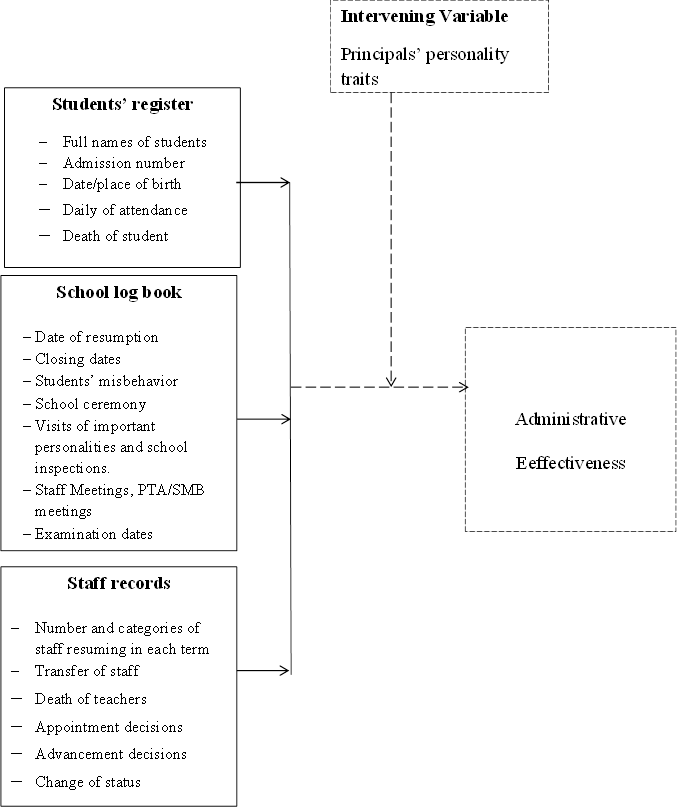
Source: Research Work (2022)
It can be seen from the figure above that the independent variable of this study is school records management which is measured in this study by the following indicators; students’ register school log books and staff records while the dependent variable is administrative effectiveness. The intervening variable is the principals’ personality traits.
In this section, the researcher presents the works of others researchers on the issues under investigation. These have presented according to the specific objectives of the study.
Management of Students’ Records and Administrative Effectiveness
In another study, Onweh (2014) carried out research to determine the relationship between record management and administrative effectiveness in Secondary Schools in Akwa Ibom State. The population of the study was 640, comprising 600 teachers, 20 principals and 20 cashiers. A sample size of 340 was studied, this comprised 20 principals and 20 cashiers that were not sampled and 300 teachers representing 50% of the teachers were obtained through stratified random sampling from the 20 secondary schools. Two research questions were used for the study. Structured questionnaire items that were 15 in number were generated and used to elicit answers to the two research questions. Two research hypotheses used were tested at 0.5 probability level by using Pearson Product Moment Correlation (PPMC) analysis. The instruments were truly validated. The relationship between academic record management and administrative effectiveness and relationship between academic record management and administrative effectiveness and relationship between adequate financial record management an administrative effectiveness. The two hypotheses revealed that the relationships were both significant at .05 level of probability. Based on the findings, it was recommended among others that; school authorities should organize seminars for principals, teachers and cashiers on proper record management for administrative effectiveness.
Also, Oluwole (2015), conducted research on record management and effective management of secondary schools in Zone B Senatorial District of Benue state, Nigeria. Four research questions and four research hypotheses guided the study. The descriptive survey design was therefore adopted. The population of the study comprised of 3,704 teachers from 232 public and private secondary schools in Zone B Senatorial District. A sample of 370 teachers from 23 public and private selected secondary schools constituted the sample of the study. A-12 item structured questionnaire constructed by the researcher titled “Record management and Effective Management of Secondary Schools Questionnaire (RKEMSSQ)” was used for the collection. Descriptive statistics of mean and standard deviation were used to answer research questions while the chi-square x2 test of goodness of fit was used to test the hypotheses at 0.05 level of significance. The findings revealed that historical records have significant impact on information dissemination and financial records have significant impact on accountability in Zone B Senatorial District of Benue State. Based on the findings of the study, the researcher recommended among other things that, school administrators should imbibe the culture and practice of keeping regular records of students and the activities or events that goes on in the school so that if need arises for use in future, it will be easily ascertained without any stress and doubt.
Management of School Assets Resources Records and Administrative Effectiveness
Omoha (2013) conducted a study aimed at finding out the management of school records in secondary schools in Otukpo education zone. The study was carried out with four (4) research questions and three (3) hypotheses. The study used a descriptive survey design and a study population of 364 teachers drawn from 52 state-owned secondary schools in Otukpo education zone using simple random sampling technique. Close-ended questionnaire was the instrument used in collecting data and was analyzed using descriptive and inferential statistics. Research results revealed that there are so many problems associated with records management in secondary school system. Secondly, it was found that through various ideal administrative practices and strategies, there will be wholistic improvement on records management in school system. In view of these findings, it was recommended that principals and teachers should employ ideal administrative practices and strategies to improve on records management in secondary school system towards ensuring valid and reliable school information.
Alabi (2017), carried out a study which examined records management for effective administration of secondary schools. The types of records available in schools-statutory and non-statutory were identified, explained and listed. Many of those records were fully discussed pinpointing their relevance to the effectiveness of secondary school administration. Importance of keeping school records to all stakeholders of secondary school education and even beyond was well stated. The paper postulates that without keeping appropriate, adequate and relevant school records, there cannot be effective and efficient administration of secondary schools. Conditions for keeping and maintenance of school records were discussed. Certain problems about records management in secondary schools were highlighted and practical solutions to those problems were given. Records management are very central to effective administration of any secondary school.
Management of Staff’s Records and Administrative Effectiveness
Adebowale and Osuj (2008), conducted a research study which investigated the record management practices of primary school teachers in selected local government areas in Ondo state of Nigeria. The population of the study constituted of 100 teachers drawn using simple random sampling technique. Data were collected with a questionnaire titled "Questionnaire on Record Management Practices of Primary School Teachers" and data were analyzed using descriptive statistics. The findings showed that although the teachers were familiar with some principles of record management, they were not proficient in most of the operational procedures and did not demonstrate the knowledge of using record management to further the development of teaching and learning activities. Equipment that could be used for safe keeping of records were not available. Recognizing the importance of record management towards the successful implementation of the country's Universal Basic Education programme, the researchers recommend that teachers should be given regular in-service training in record management and retrieval. Development of record management skills should also be included in teacher preparation programmes.
In another study, Amanchukwu and Ololube (2015) conducted research on excellent school records behaviour for effective management of educational systems in secondary schools in Lagos, Nigeria. The study adopted a correlation survey research design. Simple random sampling technique was used to select twenty (20) secondary schools. In each of the schools, 10 teachers were selected. On a whole, 200 teachers served as subjects for this study. A researcher-designed questionnaire titled: “Principal Records Skills Questionnaire” (PRSQ) was used to elicit relevant data for the study. To ascertain the validity of the instrument, content validity was adopted. Also, the reliability co-efficient of the instrument was obtained through test-re-test method and the co-efficient of 0.65 was obtained. Four research hypotheses were formulated to guide the study. Thus, Pearson Product Moment Correlation Statistics was used to test the research hypotheses at0.05 significance level. The findings revealed that poor records management results in difficulties in administering, development and supervision of educational systems. In fact, poor school records management and the lack of staff development with regards to the entire information cycle are responsible for a number of management and policy implementation problems in schools.
This chapter describes the study area, research design, population of the study, sampling procedure, instruments, validity and reliability. Furthermore, it also involves procedure for data collection, data analysis and ethical concerns in the process of data collection.
This study adopted a descriptive survey research design. This design was deemed appropriate because predetermined set of questions were given to a sample with a representative population that is part of a large population. From the responses the researcher could measure the attitudes of the population concerning the research problem. Surveys are a common way of conducting quantitative research involving the use of questionnaires. Such a design allows the researcher to gather data from a few people considered to be the representative of the entire group or population, summarize and interpret data for purposes of clarification. The descriptive survey design is useful in collecting information about peoples’ attitudes, opinions, habits or perceptions about issues under investigation (Orodho & Kombo, 2002). It is for these reasons that the present study will adopt a descriptive survey design to collect data on record management and its effect on administrative effectiveness in secondary schools.
This study was conducted in Fako Division, South West Region of Cameroon. Fako Division is an administrative sub region found in the South West Region of Cameroon. This division occupies an area of 2,093 km² with an overall population of 466,412 as of 2005. The Division is located in latitude 4⁰ 10ᶦ north and longitude 9⁰ 10ᶦ east, with a terrain elevation of 2833 meters equivalent to 9295 feet. Limbe is the capital of Fako division. The division also has as it sub-divisions Buea, Limbe I, Limbe II, Limbe III, Tiko, Muyuka and the West Coast. Fako is also referred in other languages as Fano or Victoria Division. Fako Division is endowed with a lot of touristic sites, which act as a source of attraction to tourists from all over the world and in the country. These sites include; Mount Fako being the highest mountain in West Africa with an elevation of 4,040m. It is an active volcano found near the Gulf of Guinea.
Education is ranked very high, compared to other divisions in the country. Hundreds of schools are found here and include Universities, colleges, teachers' training centers etc. School attendance is very high. Fako is divided into four sub divisions which include: Buea, Tiko, Muyuka and Limbe. Buea municipality is found in the Fako Division of the south west region of Cameroon. It is located between latitude 4012 to 4031 north of the Equator and longitude 9⁰09 to 9⁰ 12 east of the green which meridian. It is bounded to the north by the tropical rainforest on the slopes of Mount Fako, to the south by the Limbe sub division, to the south –east by Tiko sub division, to the east by Muyuka Sub Division and to the west by Idenau Sub Division, (CVUC Buea 2018). The Buea municipality with regards to climate has an average sunrise of 06:16am and sunset of 06:16pm.
The town has an average equatorial climate with two major seasons being the rainy season and the dry season. The soil and geology of Buea municipality consist of fairly high and low lands which are made of basalts as a result of volcanic activities of Mount Fako. The rocks have been weathered over time producing volcanic soils which are dark in color, well drained because of the sloping nature of the terrain/relief. The soils are very fertile and rich in nutrients and favour the growth of crops like tomatoes, pepper, maize, yams, and cassava. The sedimentary rocks alongside the climate are very supportive for plant growth (Buea-CVUC, 2018). Agricultural activities are very evident in the area, given this climatic and geological condition. This involvement of parents in agricultural activities may tend to distract attention towards participating in school managerial activities.
The population of Fako Division consists of a mix of people from different regions of Cameroon and from different ethnic backgrounds or tribes. The natives of this area are the Bakweri people. The economic activities in Buea are of great importance to the whole country as activities practiced here include education, commerce and agriculture. The output from this activity is not only consumed within Buea but also exported to other countries. With regard to commerce and trade, primary products like food items harvested such as cocoyams, tomatoes are sold in the markets and shops as well as building materials, household’s provisions among others found almost everywhere in the town. Education in the Buea municipality area has over the years been on an increase as a host of nursery, primary, secondary schools and universities are found almost everywhere here in the town. This has unavoidably increased parent population in Buea and inevitably presents more burdens on the management of schools.
Map of Fako Division Showing the Study Area
LIMBE

Source: (Mapcarter, 2017)
The population of this study constituted Vice Principals and Discipline masters/mistresses in secondary schools in Fako division. These groups of administrators are responsible for the day-to-day management of student as well as staff-related affaires of the school. The discipline masters and mistresses are charged with the responsibility of monitoring student attendance and moral aspects while the vice principals are mostly concerned with pedagogical aspects of the school. The target population of this study is made up of 136 Vice Principals and 222 Discipline Masters/Mistresses selected from public, lay private and denominational secondary schools in Fako Division
The Target Population of Vice-Principals, Discipline Masters/Mistresses in Fako Division
|
S/N |
Sub-Division |
No of Vice Principals |
No of Discipline Masters/Mistresses |
Total |
|
1 |
Buea |
50 |
80 |
130 |
|
2 |
Limbe |
38 |
61 |
99 |
|
3 |
Tiko |
28 |
49 |
77 |
|
4 |
Muyuka |
20 |
32 |
52 |
|
|
Total |
136 |
222 |
358 |
Source: Regional Delegation of Basic Education, Service in Charge of School Map, Buea (2023)
Accessible Population of the Study
The accessible population of this study included 99 Vice Principals and 132 Discipline Masters/Mistresses selected from public, lay private and denominational secondary schools in Fako Division. These were the reachable vice principals and discipline masters of the schools that are functional in Fako Division at the time of the study as shown on table 3 below
Accessible Population of Vice-Principals, Discipline Masters/Mistresses
|
S/N |
Sub-Division |
No of Vice Principals |
No of Discipline Masters/Mistresses |
Total |
|
1 |
Buea |
41 |
52 |
93 |
|
2 |
Limbe |
32 |
43 |
75 |
|
3 |
Tiko |
19 |
28 |
47 |
|
4 |
Muyuka |
7 |
12 |
19 |
|
|
Total |
99 |
132 |
234 |
Source: Regional Delegation of Basic Education, Service in Charge of School Map, Buea (2023)
Sample Population of the Study
The sampled population of this study was made up of 87 Vice Principals and 6 Discipline Masters/Mistresses selected from public, lay private and confessional secondary schools in Fako Division, randomly as shown on table 4 below
Sampled Population of Vice-Principals, Discipline Masters/Mistresses
|
S/N |
Sub-Division |
No of Vice Principals |
No of Discipline Masters/Mistresses |
Total |
|
1 |
Buea |
35 |
2 |
37 |
|
2 |
Limbe |
30 |
2 |
32 |
|
3 |
Tiko |
15 |
1 |
16 |
|
4 |
Muyuka |
7 |
1 |
8 |
|
|
Total |
87 |
6 |
93 |
Source: The Researcher (2023)
In this study, a stratified random sampling was used to select schools, Vice Principals and Discipline Masters/Mistresses for the study. The stratified sampling was used to first separate schools into Sub-Divisions. The schools as well as participants were then be chosen randomly through the balloting technique. In this procedure, the researcher wrote the names of all the schools on pieces of papers and put in a basket and shuffled, then a little boy of about 12 years old was called to draw out the required number of the papers and the names of the schools picked were considered selected for the study by the researcher, and constituted the sample of the study
From all the secondary schools in Fako division, the researcher selected 30 schools, from which 87 Vice Principals and 6 Discipline Masters/Mistresses were selected randomly, giving a total of 93 respondents.
The information which follows depicts the demographic characteristics of the sampled population as revealed through analysis of respondents’ demographic data
Representation of Respondents based on Gender
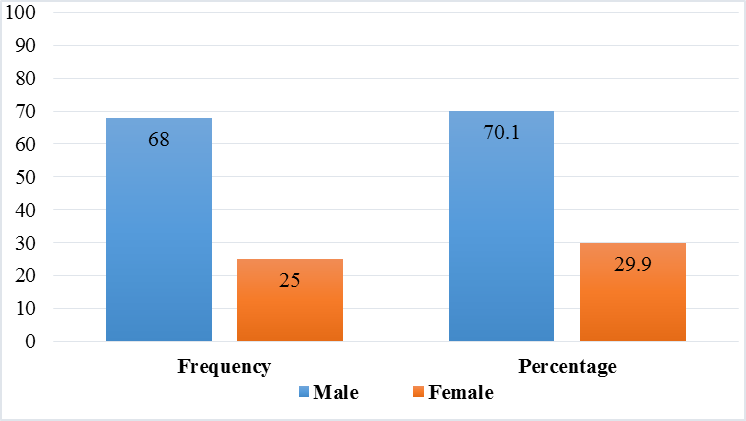
Source: The Researcher (2023)
As presented on figure 3 above, the majority of 68 (70.1%) of the respondents were males
Representation of Respondents based on Academic Qualification
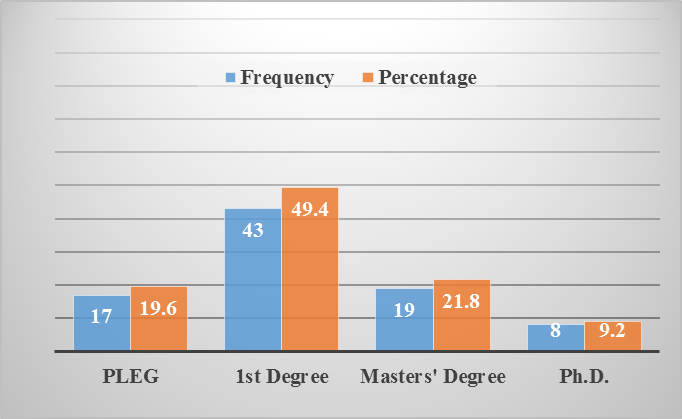
Source: The Researcher (2023)
As presented on figure 4 above, a majority of 43 (49.4%) of the respondents were 1st degree holders, followed by Masters’ Degree holders (21.8%) and the least was Ph.D. holders (9.2%)
Representation of Respondents based on age
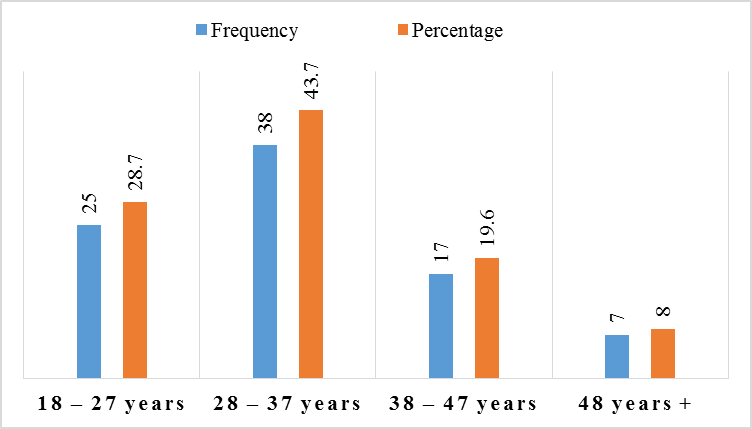
Source: The Researcher (2023)
As presented on figure 5 above, the most represented age group was 28-37 years (43.7%) and the least represented was 48 years + (8%)
Representation of Respondents based on Working Experience
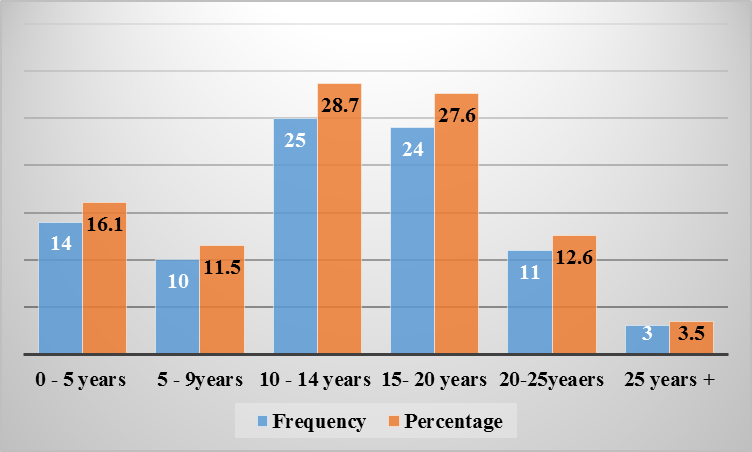
Source: The Researcher (2023)
As presented on figure 6 above, the most represented working experience was 10-15 years (28.7%), closely followed by 15-20 years (27.6%) and the least represented was 25 years + (3.5%)
Instrument for Data Collection
This study collected data by the use of a structured questionnaire administered to Vice Principals. The questionnaire contained closed ended questions that addressed all three specific research objectives. A four-point Likert type scale (Strongly Agree-SA, Agree-A, Disagree-D and Strongly Disagree-SD) was used. Participants were required to respond by placing a tick on the appropriate option. The questionnaire was divided into two parts. Section A contained items to collect data pertaining to the respondent’s demographic information such as age, gender, academic qualification, years of teaching). Section B was made up questions drawn from the specific research questions; each research question had 8 questionnaire items.
Validity of a research instrument is the measure of degree to which a research instrument measures what is intended to by the study (Borg and Gall, 2004). Furthermore, according to Kombo & Tromp (2006), validity of a test is a measure of how well a test measure what it is supposed to measure. In this study, the face, content and construct validity will be ensured.
Face validity: An instrument has face validity if it seems to measure what it is expected to measure. To ensure validity of the instruments, the questionnaire was formulated and submitted to the supervisor for necessary corrections. In this light, the researcher under the guidance of the supervisor ensured that all the items in the questionnaire reflected the specific objectives of the study. All the items of the questionnaire will critically have examined, some will be reframed to make them look simple and unambiguous while the unsuitable ones will be eliminated.
Content validity: content validity shows the degree to which a measure covers the range of meanings included within a concept (Borg and Gall, 2004). In this study, the content validity will be done by sampling the opinions or perceptions of a few Principals and Vice principals about the main topic of interest. With the assistance of the research supervisor and the statistician, it was checked to address the appropriateness of the content, the comprehensiveness of the instruments, the logicality of the instruments in getting at the intended variables, the adequacy of the sample of items or questions in representing the complete content that is intended to be measured and the appropriateness of the format of the instrument.
Construct validity: Construct validity is a device commonly used in educational research. It is based on the logical relationship among variables. Walden (2012) says construct validity refers to whether the operational definition of a variable actually reflect the theoretical meaning of a concept. The questionnaire was given to experts (such as the supervisor and a statistician) who are versed with to test the construct validity.
It is the degree to which a research instrument yields consistent results or data after repeated trails (Borg and Gall, 1989). To establish reliability in this study, a pilot study of 3 Principals and 5 Vice Principals was done in some school not included in the sample population in Buea municipality. The researcher then categorized all the responses and assigned values to them depending on the response given. This was used to compute the co-efficient of correlation (r).
Administration of the Instrument
After the validation of the instrument, the researcher self-administered the instrument. The instrument was administered to 87 Vice Principals of secondary schools in Fako Division. With the authorization from the HOD of EFA, University of Buea, the researcher went round the selected schools and issued copies of the questionnaire to the respondents. Table 5 below presents the results of the statistical test of reliability performed on the research questionnaire.
Reliability Analysis of Questionnaires
|
Variables |
Cronbach Alpha Coefficients |
Variance |
No of items |
|
|
Students’ Records |
0.8 |
0.042 |
08 |
|
|
School assetsRecords |
0.803 |
0.082 |
08 |
|
|
Staff Records |
0.707 |
0.026 |
08 |
|
|
Administrative Effectiveness |
0.71 |
0.004 |
08 |
|
|
Overall Reliability |
0.755 |
0.033 |
32 |
|
Source: The Researcher (2023)
As shown on table 5 above, the internal consistency of the students’ responses was not violated for any of the variables with Cronbach Alpha coefficients values ranging from 0.71 to 0.803 which was high. The overall reliability of the instrument was 0.755 which was above the recommended threshold of 0.7 thus, making the instrument to be reliable for the study. Using this test, coefficient value of above 0.755 implies that the participants are consistent and objective in their responses
In this study, the collected data was analyzed using quantitative approach. Before analyzing, the data was coded with serial numbers. After the process of coding, a pre-designed Excel version 2016 was used to used key in the data and render it more easily exploitable. The descriptive statistical tools used were frequency counts and percentages. Inferentially, Pearson Chi-square tests was conducted.
In order to ensure ethical consideration, the researcher took into consideration the interests of the respondents by only seeking their personal details that are relevant to the study. The researcher also made every effort to explain to the respondents his agenda. The researcher also ensured that participants gave their consent verbally. The respondents were informed that their participation in the study was voluntary and that they could withdraw from participating at any point if they wished to do so. The participants’ right to remain confidential was extended to include exclusion of any information that could identify them. Also, gender bias was avoided, as the construction and administration of the questionnaire was gender friendly in such a way that both male and female respondents took part in the study on equally grounds.
The chapter above revealed the methodology that was used to achieve the objectives of the study. The chapter presented the research design, area of study, population of the study, sample and sampling technique, instruments for data collection, validation of instruments, reliability of instruments, administration of instruments, procedure for data collection, method of data analysis and the study’s ethical consideration.
This chapter presents findings gotten from research study. These findings have been presented according to the research questions. The findings are presented in the form of tables of frequencies.
Management of Students’ Record and Administrative Effectiveness
The table below displays the computed results showing the frequencies and percentages of respondents regarding the management of students’ records and administrative effectiveness. The results show respondents’ percentage agreement to the various items in the questionnaire, categorized into agree, strongly agree, disagree and strongly disagree
Table 6
Extent to which the Management of Students’ Records Affects Administrative Performance
|
S/N |
Items |
No SA and A |
% SA and A |
No SD and D |
% SD and D |
Decision |
|
1 |
All students have record files in the school |
53 |
60.9 |
34 |
39.1 |
60.9% Accepted |
|
2 |
Students’ progress record can easily be traced from their records kept in school |
67 |
77 |
20 |
23 |
77% Accepted |
|
3 |
Students’ records are kept via electronic means in school |
20 |
23 |
67 |
77 |
77% Rejected |
|
4 |
Accessibility to students’ record is easy |
49 |
56 |
31 |
44 |
56% Accepted |
|
5 |
Students’ records are regularly updated in the school |
12 |
13.8 |
75 |
86.2 |
86.2% Rejected |
|
6 |
Students’ records usually serve as a guide for school decision making |
64 |
73.6 |
23 |
26.4 |
73.6% Accepted |
|
7 |
The school has staff responsible for the management of students’ records |
18 |
20.7 |
69 |
79.3 |
79.3% Rejected |
|
8 |
The academic records of students is what guides the school to determine the students’ level of preparation for their exams |
66 |
75.9 |
21 |
24.1 |
75.9% Accepted |
|
Average Total |
44 |
50.1 |
43 |
49.9 |
50.1% Accepted |
|
Source: The Researcher (2023)
Table 6 shows the levels of agreements/disagreements of respondents to the research items related to research question 1. The findings revealed, as shown on table 5, that a majority of 53(60.9%) of the respondents agree all students have record files in their school, 67 (77%) agreed that students’ progress record can easily be traced from their records kept in school, 49 (56%) agreed that accessibility to students’ record is easy, 64 (73.6%) agreed that students’ records usually serve as a guide for school decision making and 66 (75.9%) agreed that the academic records of students is what guides the school to determine the students’ level of preparation for their exams
On the other hand, the findings revealed that only 20 (23%) agreed that students’ records are kept via electronic means in school, 12 (13.8%) agreed that students’ records are regularly updated in the school and 18 (20.7%) agreed that the school has staff responsible for the management of students’ records
Generally, research question 1 aimed at investigating whether the management of students’ records has an effect on administrative effectiveness. Findings revealed that the respondents are undecided on the effects of the management of students’ records on administrative effectiveness. An average number of 44 (50.1%) responded with positive feedback to the items, meanwhile a minority of 49.9% responded with negative feedback (strongly disagree and disagree).
Verification of Specific Research Hypothesis 1
Ho1: The management of students’ records does not significantly affect administrative effectiveness in secondary schools in Fako Division, South west Region Cameroon
Ha1: The management of students’ records significantly affects administrative effectiveness in secondary schools in Fako Division, South west Region Cameroon
Table 7
Chi-Square Correlation Test for Management of Students Records and Administrative Effectiveness
|
|
Value |
Df |
Asymp. Sig. (2-sided) |
|
Pearson Chi-Square |
43.981a |
30 |
0.048 |
|
Likelihood Ratio |
45.048 |
30 |
0.038 |
|
Linear-by-Linear Association |
3.098 |
1 |
0.078 |
|
N of Valid Cases |
370 |
|
|
|
10 cells (20%) have expected count less than 5. The minimum expected count is 1.44. |
|||
Source: The Researcher (2023)
Table 7 above presents the Chi-square correlational statistics computed to the management of students’ records and administrative effectiveness at a 0.05 level of significance (p=0.05). The chi-square correlation coefficient (X2) was found to be 43.981 and the P-value was 0.048. Since X2 = 43.981 and p<0.05, it indicates that there exists a significant relationship between the management of students’ records and administrative effectiveness. This implies that the more or less the administration manages students’ records properly, the more or less it becomes effective respectively. This study therefore rejects the null hypothesis and concludes that the management of students records significantly affects administrative effectiveness
Management of School Assets Records and Administrative Effectiveness
Table 8 displays the computed results showing the frequencies and percentages of respondents regarding the management of school assets resources and administrative effectiveness. The results show respondents’ percentage agreement to the various items in the questionnaire, categorized into agree, strongly agree, disagree and strongly disagree
Table 10
Extent to which Management of School Assets Records Affects Administrative Effectiveness
|
Items |
No SA and A |
% SA and A |
No SD and D |
% SD and D |
Decision |
|
|
9 |
I have record of the usage of the school library |
59 |
67.8 |
28 |
32.2 |
67.8% Accepted |
|
10 |
I keep records of materials of the school laboratory |
19 |
21.8 |
68 |
78.2 |
78.2% Rejected |
|
11 |
Higher authorities have easy access to school school assets resources records |
55 |
63.2 |
32 |
36.8 |
63.2% Accepted |
|
12 |
I ensure to document all sports equipment of the school |
32 |
36.8 |
55 |
63.5 |
63.5% Rejected |
|
13 |
I document all cases of destruction of school equipment |
15 |
17.2 |
72 |
82.8 |
82.8% Accepted |
|
14 |
I include in my annual report all school materials |
59 |
67.8 |
28 |
32.2 |
67.8% Accepted |
|
15 |
I make use of the record of school materials while planning the school budget |
48 |
55.2 |
39 |
44.8 |
55.2% Accepted |
|
16 |
All duly registered students have easy access to school assets available for students |
52 |
59.8 |
35 |
40.2 |
59.8% Accepted |
|
Average Total |
42 |
48.7 |
45 |
51.3 |
51.3% Rejected |
|
Source: The Researcher (2023)
Table 10 shows the levels of agreements/disagreements of respondents to the research items related to research question 2. The findings revealed, as shown on table 7, that a majority of 59(67.8%) respondents agreed that they have record of the usage of the school library, 55 (63.2%) agreed that higher authorities have easy access to school school assets resources records, 59 (67.8%) agreed that they include in their annual report all school materials, 48 (55.2%) agreed that they make use of the record of school materials while planning the school budget and 52 (59.8%) agreed that all duly registered students have easy access to school assets available for students
On the other hand, the findings revealed that only 19 (21.8%) agreed that they keep records of materials of the school laboratory, 32 (36.8%) agreed that they ensure to document all sports equipment of the school and 15 (17.2%) agreed that they document all cases of destruction of school equipment
Generally, research question 2 aimed at investigating whether the management of school assets resources records has an effect on administrative effectiveness. Findings revealed that the respondents are negative on the effects of the management of school assets resources records on administrative effectiveness. A majority average number of 44 (51.3%) responded with negative feedback to the items, meanwhile a minority of 48.7% responded with positive feedback (strongly agree and agree).
Verification of Specific Research Hypothesis 2
Ho2: The management of school assets records does not affect administrative effectiveness in secondary schools in Fako Division, South west Region Cameroon
Ha2: The management of school assets records significantly affects administrative effectiveness in secondary schools in Fako Division, South west Region Cameroon.
Chi-Square Correlation Test for Management of School Assets Records and Administrative Effectiveness
|
|
Value |
Df |
Asymp. Sig. (2-sided) |
|
Pearson Chi-Square |
53.920 a |
25 |
0.095 |
|
Likelihood Ratio |
52.758 |
25 |
.001 |
|
Linear-by-Linear Association |
13.341 |
1 |
.000 |
|
N of Valid Cases |
87 |
|
|
|
a: 8 cells (16%) have expected count less than 5. The minimum expected count is 0.82. |
|||
Source: The Researcher (2023)
Table 11 above presents the Chi-square correlational statistics computed to the management of school assets records and administrative effectiveness at a 0.05 level of significance (p=0.05). The chi-square correlation coefficient (X2) was found to be 53.920 and the P-value was 0.095. Since X2 = 53.920 and p>0.05, it indicates that there exists an insignificant relationship between the management of school assets records and administrative effectiveness. This study therefore fails to reject the null hypothesis and concludes that the management of school assets records does not significantly affect administrative effectiveness
Management of Staff Records and Administrative Effectiveness
The table below displays the computed results showing the frequencies and percentages of respondents regarding the management of staff records and administrative effectiveness. The results show respondents’ percentage agreement to the various items in the questionnaire, categorized into agree, strongly agree, disagree and strongly disagree
Extent to which the Management of Staff Records Affects Administrative Effectiveness
|
S/N |
Items |
No SA and A |
% SA and A |
No SD and D |
% SD and D |
Decision |
|
17 |
I keep records of syllabus coverage of all staff |
53 |
60.9 |
34 |
39.1 |
60.9% Accepted |
|
18 |
I make available records regarding staff attendance when required |
67 |
77 |
20 |
23 |
77% Accepted |
|
19 |
Records of staff are used in monitoring staff job performance |
20 |
23 |
67 |
77 |
77% Rejected |
|
20 |
Staff records are used to determine the level of students’ readiness for national exams |
49 |
56 |
31 |
44 |
56% Accepted |
|
21 |
Staff records serve as a guide for allocation of teaching hours and classes to staff |
72 |
82.8 |
15 |
17.2 |
82.8% Accepted |
|
22 |
I make sure that every staff presents an updated file in my office |
59 |
67.8 |
28 |
32.2 |
67.8% Accepted |
|
23 |
Staff information can easily be gotten from their preserved records in my office |
48 |
55.2 |
39 |
44.8 |
55.2% Accepted |
|
24 |
Staff records are saved in digital systems in my office |
52 |
59.8 |
35 |
40.2 |
59.8% Accepted |
|
Average Total |
53 |
60.3 |
34 |
39.7 |
60.3% Accepted |
|
Source: The Researcher (2023)
Table 12 shows the levels of agreements/disagreements of respondents to the research items related to research question 3. The findings revealed, as shown on table 9, that a majority of 53(60.9%) respondents agreed that they keep records of syllabus coverage of all staff, 67 (77%) agreed that they make available records regarding staff attendance when required, 49 (56%) agreed that staff records are used to determine the level of students’ readiness for national exams, 72 (82.8%) agreed that staff records serve as a guide for allocation of teaching hours and classes to staff, 59 (67.8%) agreed that they make sure that every staff presents an updated file in my office, 48 (55.2%) agreed that staff information can easily be gotten from their preserved records in their offices and 52 (59.8%) agreed that staff records are saved in digital systems in their offices
On the other hand, the findings revealed that only 20 (23%) agreed that records of staff are used in monitoring staff job performance
Generally, research question 3 aimed at investigating whether the management of staff records has an effect on administrative effectiveness. Findings revealed that the respondents are positive on the effects of the management of staff records on administrative effectiveness. An average number of 53 (60.3%) responded with positive feedback (strongly agree and agree) to the items, meanwhile a minority of 39.7% responded with negative feedback (strongly disagree and disagree).
Verification of Specific Research Hypothesis 3
Ho3: The management of staff records does not significantly affect administrative effectiveness in secondary schools in Fako Division, South west Region Cameroon.
Ha3: The management of staff records significantlyaffects administrative effectiveness in secondary schools in Fako Division, South west Region Cameroon.
Table 13
Chi-Square Correlation Test for Management of Staff Records and Administrative Effectiveness
|
|
Value |
Df |
Asymp. Sig. (2-sided) |
|
Pearson Chi-Square |
79.201a |
25 |
.026 |
|
Likelihood Ratio |
84.579 |
25 |
.000 |
|
Linear-by-Linear Association |
46.322 |
1 |
.000 |
|
N of Valid Cases |
87 |
|
|
|
a: 6 cells (16.7%) have expected count less than 5. The minimum expected count is 2.16. |
|||
Source: The Researcher (2023)
Table 13 above presents the Chi-square correlational statistics computed to match the management of staff records and administrative effectiveness, at a 0.05 level of significance (p=0). As shown, with a degree of freedom of (df= 25), the chi-square correlation coefficient (X2) was found to be 79.201 and the P-value was 0.026. Since X2 = 79.201 and p < 0.05, there exists a significant relationship between the management of staff records and administrative effectiveness. This implies that the more or less the staff records are well managed, the more or less the administration becomes effective respectively. This study therefore rejects the null hypothesis and concludes that there is a significant relationship between the management of staff records and administrative effectiveness
Extent of Administrative Effectiveness
|
Items |
No SA and A |
% SA and A |
No SD and D |
% SD and D |
Decision |
|
|
25 |
I organize staff and student activities to follow a regularly calendar |
59 |
67.8 |
28 |
32.2 |
67.8% Accepted |
|
26 |
Students and staff are aware of their responsibilities |
48 |
55.2 |
39 |
44.8 |
55.2% Accepted |
|
27 |
Students’ performance in national exams is above average every year |
52 |
59.8 |
35 |
40.2 |
59.8% Accepted |
|
28 |
Staff complete their syllabus |
72 |
82.8 |
15 |
17.2 |
82.8% Accepted |
|
29 |
Staff attendance is satisfactory |
59 |
67.8 |
28 |
32.2 |
67.8% Accepted |
|
30 |
Students are provided with all facilities for their learning to be successful |
48 |
55.2 |
39 |
44.8 |
55.2% Accepted |
|
31 |
There is team spirit amongst staff in school |
48 |
55.2 |
39 |
44.8 |
55.2% Accepted |
|
32 |
Both staff and students work in collaboration to make school activities go as planned |
52 |
59.8 |
35 |
40.2 |
59.8% Accepted |
|
Average Total |
55 |
63 |
32 |
37 |
63% Accepted |
|
Source: The Researcher (2023)
Table 14 shows the levels of agreements/disagreements of respondents to items on administrative effectiveness. The findings revealed, as shown on table 11, that a majority of 59 (67.8%) respondents agreed that they organize staff and student activities to follow a regularly calendar, 48 (55.2%) agreed that students and staff are aware of their responsibilities, 52 (59.8%) agreed that students’ performance in national exams is above average every year, 72 (82.8%) agreed staff complete their syllabus, 59 (67.8%) agreed that staff attendance is satisfactory, 48 (55.2%) agreed that students are provided with all facilities for their learning to be successful, 48 (55.2%) agreed that there is team spirit amongst staff in school and 52 (59%) agreed that both staff and students work in collaboration to make school
Generally, research question 3 aimed at investigating respondents’ level of agreement to items regarding administrative effectiveness. Findings revealed that the respondents are positive on the effects on administrative effectiveness. An average number of 55 (63%) responded with positive feedback (strongly agree and agree) to the items, meanwhile a minority of 37% responded with negative feedback (strongly disagree and disagree).
|
S/N |
Specific Research Question |
X2, p-value |
Major Findings |
|
|
1 |
How does the management of students’ record affect administrative effectiveness in secondary schools in Fako Division, South west Region Cameroon? |
X2 = 43.981, p=0.048 |
Findings revealed that the respondents are undecided on the effects of the management of students’ records on administrative effectiveness. An average number of 44 (50.1%) responded with positive feedback to the items, meanwhile a minority of 49.9% responded with negative feedback (strongly disagree and disagree). |
|
|
2 |
How does the management of school assets records affect administrative effectiveness in secondary schools in Fako Division, South west Region Cameroon? |
X2 = 53.920, p=0.095 |
Findings revealed that the respondents are negative on the effects of the management of school assets resources records on administrative effectiveness. A majority average number of 44 (51.3%) responded with negative feedback to the items, meanwhile a minority of 48.7% responded with positive feedback (strongly agree and agree). |
|
|
3 |
How does the management of staff records affect administrative effectiveness in secondary schools in Fako Division, South west Region Cameroon? |
X2 = 79.201, p=0.026 |
Findings revealed that the respondents are positive on the effects of the management of staff records on administrative effectiveness. An average number of 53 (60.3%) responded with positive feedback (strongly agree and agree) to the items, meanwhile a minority of 39.7% responded with negative feedback (strongly disagree and disagree). |
|
Source: The Researcher (2023)
DISCUSSION, CONCLUSION AND RECOMMENDATIONS
The general aim of every study is to identify a problem, investigate and present solutions to the identified problem following a scientific procedure. This chapter reiterates the main findings of the study. It also consists of the general conclusion, recommendations, limitations of the study and suggestions for further research.
Discussion of Findings
The discussion of findings was done in accordance with the specific research questions as stated in chapter one. Discussion for each research question was with the support of the existing literature as reviewed in chapter two. Discussions were comparatively done to show the extent to which the findings of the present study agree or contradict previous research in this area.
Management of Staff Records and Administrative Effectiveness
Research question 3 sought to investigate the extent to which the management of staff records affect administrative effectiveness in secondary schools in Fako Division. The study found that staff records management practices account significantly to the effective administration of secondary schools. Staff records management practices adopted by vice principals for effective administration broadly included; documenting, verifying the accuracy of information before documenting it, complying to the order from higher authorities regarding documentation of relevant information and documenting information that is backed up with original documents where necessary. These findings support the finding of Osakwe (2013) which reported that record creation practices include; documentation of correspondences, reports, memo from higher authorities and information backed up with original documents. This is also in line with the finding of Owan, Arop, and Agunwa (2019) that records are created from reports, minutes, personnel records, administrative decisions, notices and other correspondences. The possible reason for the agreement in the findings could be attributed to the fact that the studies were all conducted in Africa countries, where similar record management are practiced in secondary schools across the continents.
This study found that school administrators require a functional strategy to manage information well in their respective schools. These records or information can be kept or stored effectively through the use of electronic system such as computer. Computer has become an important device for handling voluminous information for corporate bodies or the government. The use of computer ensures that records of services and activities are stored and retrieved immediately when needed by the administrators provided there is light. Records stored in the system can be secured long enough for future use. Unfortunately, most records in some schools are not secured because of the use of manual record system, which involves the use of manual files, pen, and paper in the production and storage of records.
Edem (2002) reiterated that administrative effectiveness of any organization or institution can be seen in proper and timely generation of reports. Unfortunately, some educational administrators have failed to make use of effective record management for the past decades. Most of the administrators in the government offices and institutions of learning do not know how to maintain proper records of activities performed daily in their respective establishments. Results revealed that school records that are currently kept in secondary school include; admission and withdrawal register, logbook, attendance register, school time table, diary, visitors’ book, exam records, time movement book and a host of others. This is in line with the view of Olubebe (2013) which highlights the kind of records kept in schools. To further elucidate the impact of records management on administrative effectiveness, Scheier (1981) in the cybernetic theory stated that the management of records by means of advanced ICT tools is an interdisciplinary process and can impact multiple stakeholders in the organization.
Management of Students’ Records and Administrative Effectiveness
The findings of the study revealed that the management of students’ records only averagely affect administrative practices in secondary schools in Fako Division. These findings therefore corroborate previous studies that revealed that managing school records throughout the life cycle enhanced school administrative effectiveness (Ereh & Okon, 2015). Conversely, poor records management practices result in difficulties in administering, planning and monitoring of educational systems (Amanchukwu & Ololube, 2015) and thus inhibit school administrative effectiveness (Bibi, 2016). A finding of the study suggests a positive correlation exists between good records management practices and administrative effectiveness of school managers.
It was deduced from the study that the records management practices observed in this study were done by the school vice principals to systematically control the schools’ records in order to meet school needs, national and local educational requirements, and community expectations. This implies that the benefits of school records management practices can be maximized when all the activities involved in record creation to its’ eventual disposition are properly coordinated. These findings therefore corroborate previous studies that revealed that managing school records throughout the life cycle enhanced school administrative effectiveness (Ereh & Okon, 2015).
Students’ records storage was found to be less stored via electronic means. These findings are in tandem with those of Adebowale and Osuji (2008), Owo (2014) and Sunmola (2008) where they reported that most schools store records in file cabinets and metal cupboards. However, records storage in vaults based on the value of the record had the lowest mean which implied that attention was not given to sensitive and vital school records. This agrees with Allahmagani (2014), who found that vital records were not stored securely using modern security equipment in the schools covered by his study but were also stored inside file cabinets or drawers which are prone to both man- made and natural disasters.
Accessibility and update of records were found to be high. The findings agreed with that of Owo (2014) and Osakwe (2011), where they reported that school records were not properly preserved. Findings showed that retention scheduling has a mean of 2.87 which implies that schools follow a time schedule of where and when the records should be kept and retained. Even though, it was a fair practice it differs from the findings of Allahmagani (2014) and Owo (2014) who found that the schools studied did not have retention schedule policy, but the staff used self- discretion to appraise the records for retention. Bertanlanfy (1946) mentioned that the school is a system made of various stakeholders, students being a part of it. Therefore, the proper management of records relating to students’ academic and moral activities leads to the success of the school and its administrator.
This study equally found that the keeping and management of students’ records were useful for assessing students’ academic progress and preparedness examinations. These findings were in line with Edem (2002) who stated that record management on academic performance of students is imperative for academic decisions. It was also in agreement with the opinion of Abuke (1999) who added that there is great need for academic record management for effective school management.
Management of School Assets Records and Administrative Effectiveness
The findings of the study revealed that the management of school assets resources records does not significantly affect administrative practices in secondary schools in Fako Division. Several studies (Davis, 2007 and Fasasi, 2010) have affirmed this finding and revealed that record management in some institutions are poorly done. They found that almost all the institutions in Akwa Ibom State have not been able to adopt an enhanced information management system to improve upon their administrative tasks. A close observation of government institutions in Akwa Ibom State revealed that majority of the offices are still using manual record management system, which involves the use of office file, pen, paper, pencil to process records (Benjamin, 2002). This is one of the reasons why office tasks are not performed effectively and productively, in terms of accuracy, neatness, and easy retrieval of information required.
The findings of the presents study concluded that schools’ administrators do not attach much importance for the use of Information and Communications Technologies (ICT); example, computers and other information management tools/devices for proper record management. This is evident in the fact that majority of respondents agreed to the fact that it becomes difficult for them to share files and documents within higher authorities. Provision of records the organization would enhance effective record management and retrieval and sharing among the users. Benjamin (2013) revealed that often times, students miss their admission because the schools they attended cannot supply them with the transcripts and other essential documents. Cases also abound when people miss employment opportunities and promotion due to their inability to obtain certificates from schools where they were trained.
The present study found that school administrators keep records on materials inventories and destruction. These are in line with those of Smith (2003) who revealed that information or data which are written manually or electronically are preserved in books, files and computers, and other electronic devices. He revealed that within the schools, administrative records include: budgetary information, students’ academic assessment booklet, number of schools in the state and students, training and development of the civil servants, income and expenditure records, economic empowerment records, resource allocation to all tiers of government. In a school system, some of these records kept are: number of teachers recruited, staff disposition, students’ personal files, log book, the school diary, note of lesson, transfer certificate, terminal report cards, teachers’ time book, movement book, the supervisory notebook, staff minutes’ book, visitors’ book and so on.
The study found that the management of school assets records was necessary for the planning of school budgets. The significance of the result is in agreement with the opinion of Akubo (2004) who stated that the financial position of a school is determined through the school records. The expenditure made in a school is usually entered into appropriate ledger and in appropriate accounting books. It also agreed with opinion of Olaboye (2004) who stressed that data collected from school records on students or pupils’ enrolment and school assets can be used for strategic planning purposes. They equally concluded that proper record management is a useful guide to intelligent decision making and effective administration in schools and other organizations.
Still in line with the present study, Jones (2003) maintained that what gives the administrator the power and control to manage the resources is the availability of information. This explains why the study found a low level of administrative effectiveness as well information based administrative practices in the study area. It is interesting to note that proper storage and security of information or data in the administration could bring about the effectiveness of the administration of any organization.
Just as stated by Kauffman (1980) in his complexity theory, the management of school assets resources is a complex process that requires the constant manipulation and interactions with various stakeholders in the school, and this culminates in the effectiveness of the administrator. Equally, Mayo (1945) in his human relations theory stated that successful administration relies greatly on the ability of the school head to interact with the human components in the school. The management of all school assets resources to ensure that human needs and welfare are taken care of, inevitably leads to the success of the principal as an administrator.
Based on the findings of the study, the researcher concluded that the management of students’ records is only averagely practiced in secondary schools in Fako Division of the South West Region of Cameroon. There is the existence of policies, procedures and processes in the management of students’ records in secondary schools in the study area. Amongst the measured indicators of students’ records management practices, those most regularly practiced are creation of student files, tracing of students’ records, ease of accessibility to students’ records. This study therefore rejects the null hypothesis and concludes that the management of students records significantly affects administrative effectiveness
The findings reveal that there is no remarkable and positive relationship between adequate school assets resources record management and the administrative effectiveness of secondary schools in Fako Division as portrayed by the findings of the study. This study therefore fails to reject the null hypothesis and concludes that the management of school assets resources records does not significantly affect administrative effectiveness
Finally, findings revealed that the respondents are positive on the effects of the management of staff records on administrative effectiveness. An average number of 53 (60.3%) responded with positive feedback (strongly agree and agree) to the items, meanwhile a minority of 39.7% responded with negative feedback (strongly disagree and disagree). This study therefore rejects the null hypothesis and concludes that there is a significant relationship between the management of staff records and administrative effectiveness
Contributions to Theory and Practice
This study has established an evidence-based relationship between records management and secondary school administrative effectiveness. This study has also proven that contrary to previous studies the management of school assets resources records does not significantly affect secondary school administrative effectiveness in the area of the study. This study has equally provided evidence-based recommendations to support those of other researchers in this area, emphasizing on the relevance of records management in administrative effectiveness. Finally, the study has raised issues and offers insight intended to stimulate education policy makers towards action.
Limitations of the Study
A study of this subject nature is naturally subjected to a number of methodological as well as personal limitations that may tend to affect the above presented results.
1) Firstly, this study was limited by the fact that the study adopted a purely quantitative approach, getting only quantitative data as required by the close ended questionnaires. It is believed that if the study adopted a mixed method approach where respondents will have the chance to elaborate on their opinions, more insight would be made on the issues under investigation.
2) Secondly, due to the inability of the researcher to access remote areas of the study, due to the ongoing socio-political unrest in the area, most data was collected from participants in the urban or semi-urban settlements. It is believed that if much more participants were sampled from the rural communities; the results would have differed a little.
1) Generally, since the study found at some points the significant relationship that exists between records management and administrative effectiveness, and given the fact that this process is marred by numerous challenges, the study recommends that improvements initiatives in the practice of records management should be made a matter of priority to all educational administrators.
2) To improve the practice of students’ records management in secondary schools in Fako, all stake holders in the management of records should be trained on the adoption of computerized records management skills and practices
3) In order to continually enhance information-based decision-making processes within secondary schools, a framework for the implementation of school assets resources management practices should be established, with follow-ups and evaluation strategies put in place
4) Finally, bearing in mind the importance of records management in the enhancement of teaching staff productivity, the study recommends that regular updates and communication of staff situations be made available and public for staff individual evaluation and hence adjustments to enhance productivity
Suggestions for Further Study
1) Training and enhancement of computerized skills for effective records management practices in secondary schools
2) Development of a framework for the implementation of school assets resources records management practices in secondary schools
3) Information communication practices within the contexts of records management for staff productivity within secondary schools
Abenga, F.M. (1995). Principles and practices of school administration in Nigeria. Onaivi Printing and Publishing Co. Ltd.
Adebowale, O. & Osuji, M. (2008). Record keeping practices of primary school teachers in Ondo state: Implications for Successful Implementation of the Universal Basic Education Policy. Retrieved from, https;//scholaroauife.edu.ng.
Adeyemo, P.O. (2001). Principles and practice of education. Omolayo Standard Press.
Adeyemo, T. (2008). The influence of management strategies on the effective keeping
Agbe, J.I. (2007). A handbook on school business and office management. Selfers publication.
Ajayi, I. A., & Ayodele, J. B. (2002). Fundamentals of Educational Management. Greenline Publishers.
Akanbi, O. (1999). Records in school administration. Ilorin: Haytee Press and Publishing
Akubo, A. (2004). Proper record keeping and effective management. Concept Publications Limited.
Amanchukwu, R. & Ololube, N. (2015). Managing school plant for effective service delivery in public secondary schools in Rivers state, Nigeria, Human Resource Management Research, 5(4), 95-102.
Amos, O. (2017). Records management for effective administration of secondary schools, Journal of Public Administration and Governance, 7 (2), 66-74
Association of Records Managers and Administrators ARMA (2013). Records Management, Lexena: ARMA Press.
Atulomah, B. (2011). Perceived records management practices and decision making among University administrators in Nigeria, Library Philosophy and Practice, 7(ejournal, 754)
Azeez, R. (2019). Doing things right, Lagos: LASG Press.
Azhar, A. (2013). Factors inuencing the administrative behavior of school leaders, Journal of Educational Administration, 55 (2), 110-120.
Bantin, P. (2008). Understanding data and information systems for record management, London: Oxford Press. Case study of Kaduna North Local Government, Kaduna, State, Nigeria. Journal of Humanities and Social Science, 19 (1), 55-60.
Chifwepa, V. (n.d). Managing records at school level: National education statistical information systems, Retrieved, from http://www.adeanet.org Company
Dada, R. (2020). Records management practices, Lagos: Eze & Bros
Davis, P. (2007). School record system and educational administration in colleges. Pan Book Ltd. Vol.3.
Davis, P. (2007). School records system and educational administration in colleges, New York: Panbook Ltd. IJDSHMSS
Durosaro, D.O. (2002). Management of school records. In The Craft of Educational Management. Indemac, Ilorin.
Ejeh, E.J (2013). Introduction to Educational Administration. Ankpa: Elite Printers
Ereh, E. & Okon, N. (2015). Keeping of teachers' records and principals' administrative effectiveness in Akwa Ibom state secondary schools, Nigeria, International Journal of Education, Learning and Development, 4(1), 40-44.
Farah, I. (2013). School mmanagement: Characteristics of effective principal, Global Journal of Human Social Science, Linguistics & Education, 13 (13) 134-150.
Fasasi, O. (2010). School record and effective administration. Educational Journal, 2(3), 33-41.
Fasasi, Y. (2004). School record management; A strategy for the management of Nigerian secondary schools educational institutions, Ilorin Journal of Education, 23 (19, 73-78.
Federal Ministry of Education (2018). Manual for school records keeping in Nigeria, Lagos: NERDC. Federal Republic of Nigeria (2013). National policy on education (4 ed.), Lagos: NERDC
Florida Bureau of Archives and Records Management (2018). Records management
FOIP, Guidelines and Practices (2009). Records and information management services Albbertica, Retrieved from http://www.im.gov.ab.ca.
Gama, U. (2010). A survey of records management practices in circular primary schools in Metropolitan Local Government Area (MLGAs) of Kano State. Journal of Information Studies, 10(1&2), 23-30
Government Records Service (2011). A guideline to adequate records management: implementation Plan. Retrieved from http://www.archives.sa.gov.au/
Hassan, K. (2017). Assessment of the provision, utilization and maintenance of records in public secondary schools in Kaduna Metropolis, Kaduna State, Nigeria. An Unpublished
Ifedili, C. & Agbaire, J. (2011) Managements of educational records in Nigerian universities for better results, Review of European Studies 1 (2), 52-58
International Organization for Standardization (2001). ISO 30300: Information and documentation, management systems for records – Fundamentals and Vocabulary, International Organisation for Standardization, Geneva.
Kanchana, P. (2004). What makes a person good educational administrator? Peabody Journal of Education, 63(1), 202-205.
M.Ed. Thesis, Department of Educational Foundations, Ahmadu Bello University, Zaria, Nigeria
Okpetu, S. A., & Peretomode, O. (2004). “School Records in Educational Administration” in V. F. Peretomode(ed) Introduction to Educational Administration, Planning and Supervision. Nigeria, Lagos: Joja Educational Research and Publishers
Osakwe, N. R. (2011). Management of School Records by Secondary School Principals in Delta State, Nigeria. The Social Sciences, 6(1), 40-44.
Oyedeji, N.B. (1990). Discipline as administrative responsibility of school principal. International Journal of Education Management (IJEM), 1 (2), 80 – 87.
Oyewobi, G. O., & Alabi, A. O. (2002). Primary School Administration and Supervision (Revised) Ibadan: Falola Commercial Publishers.
Ozigi, A. O. (1977). A handbook on School Administration and Management. London: Macmillian Educational Limited.
Paseda, J. A. (2009). “School Records” in Contemporary School Administration in Nigeria. Tai Solarin University of Education practices. Florida, Florida Press.
Republic of Cameroon (1995). Hand book for School Heads in Cameroon. Yaoundé: National Printing Press
Salami, K. A., Alabi, A. O., & Okemakinde, T. (2002). Basic Text on Educational Administration, Planning and Supervision. Immaculate-City Publishers.
school records in secondary schools in Ekiti state, Nigeria, The Social Sciences, 3 (2), 28-35.
Taylor F.W (1911) The Principles of Scientific Management. Van Nostrand.
Taylor, F. W. (1996). “The principles of scientific management.”In J.M. Shafritz& J.S. Ott (Eds.),Classics of organization theory (pp.66-79). Belmont, CA: Wadsworth Publishing Company.
Tella, P. O. (1991). “School Records” in P. O. Tella, T. O. Awoyele, R. A. Alani(ed). Introduction to Administration in Education. Nigeria, Ikeja: Basic Books Publishers
UNESCO (2005). School Management: A Training Manual for Educational Management. Paris: UNESCO.
Usen, S. M., Udofia, A. E., & Offiong, A. A. (2012). Effective Management of Wastages in Vocational Education for Sustainable Development in Nigeria. African Research Review, 6(3), 176-187.
Weggant, J. (2005). Effective record keeping in educational management. Educational Journal. 7(1), 42-50
APPENDICES
Appendix A: Authorization to Carryout Research
Appendix B: Questionnaire for Vice Principals
UNIVERSITY OF BUEA
FACULTY OF EDUCATION DEPARTMENT OF EDUCATIONAL
FOUNDATIONS AND ADMINISTRATION
QUESTIONNAIRE FOR VICE PRINCIPALS
Dear Respondent,
I am a master’s degree student of the Department of Educational Foundations and Administration, Faculty of Education of University of Buea. I am carrying out a research on, ‘‘Record Management and its Effects on the Administrative Effectiveness in Secondary Schools in Fako Division of the South West Region’’. Please, this exercise is conducted just for research purposes. Therefore, the whole process is going to be kept completely confidential. Your names are not going to be published or publicized anywhere at all.
Yours Sincerely
SECTION A - DEMOGRAPHIC DATA
Instruction: Please kindly tick (√) against your chosen responses
1. Gender: Male [ ] Female [ ]
2. Qualification: PLEG [ ], 1st Degree [ ] Master’s Degree [ ] Ph.D. [ ]
3. Age: 18 – 27 years. [ ] 28 – 37 years. [ ]; 38 – 47 years. [ ] 48 years +
4. Working experience: 0 - 5 years [ ], 5 - 9years [ ], 10 - 14 years [ ], 15- 20 years. [ ], 20-25yeaers [ ], 25 years + [ ].
SECTION B – Questionnaire Items
Instruction: Respond by ticking any of the following options in the spaces provided based on the following metrics below.
SA -Strongly Agree (4), A – Agree (3), D – Disagree (2), and SD- Strongly disagree (1).
Research Objective One: Management of students’ records affects administrative effectiveness in secondary schools in Fako Division, South west Region Cameroon
|
S/N |
Items |
SA |
A |
D |
SD |
|
1 |
All students have record files in the school |
|
|
|
|
|
2 |
Students’ progress record can easily be traced from their records kept in school |
|
|
|
|
|
3 |
Students record are kept via electronic means in school |
|
|
|
|
|
4 |
Accessibility to students’ record is easy |
|
|
|
|
|
5 |
Students’ records are regularly updated in the school |
|
|
|
|
|
6 |
Students’ records usually serve as a guide for school decision making |
|
|
|
|
|
7 |
The school has staff responsible for the management of students’ records |
|
|
|
|
|
8 |
The academic records of students is what guides the school to determine the students’ level of preparation for their exams |
|
|
|
|
Research Objective Two: Management of School assets Resources Records and Administrative Effectiveness
|
S/N |
Items |
SA |
A |
D |
SD |
|
9 |
I have record of the usage of the school library |
|
|
|
|
|
10 |
I keep records of materials of the school laboratory |
|
|
|
|
|
11 |
Higher authorities have easy access to school school assets resources records |
|
|
|
|
|
12 |
I ensure to document all sports equipment of the school |
|
|
|
|
|
13 |
I document all cases of destruction of school equipment |
|
|
|
|
|
14 |
I include in my annual report all school materials |
|
|
|
|
|
15 |
I make use of the record of school materials while planning the school budget |
|
|
|
|
|
16 |
All duly registered students have easy access to school assets available for students |
|
|
|
|
Research Objective Three: Management of Staff Records and Administrative Effectiveness
|
S/N |
Items |
SA |
A |
D |
SD |
|
17 |
I keep records of syllabus coverage of all staff |
|
|
|
|
|
18 |
I make available records regarding staff attendance when required |
|
|
|
|
|
19 |
Records of staff are used in monitoring staff job performance |
|
|
|
|
|
20 |
Staff records are used to determine the level of students’ readiness for national exams |
|
|
|
|
|
21 |
Staff records serve as a guide for allocation of teaching hours and classes to staff |
|
|
|
|
|
22 |
I make sure that every staff presents an updated file in my office |
|
|
|
|
|
23 |
Staff information can easily be gotten from their preserved records in my office |
|
|
|
|
|
24 |
Staff records are saved in digital systems in my office |
|
|
|
|
Administrative Effectiveness
|
S/N |
Items |
SA |
A |
D |
SD |
|
25 |
I organize staff and student activities to follow a regularly calendar |
|
|
|
|
|
26 |
Students and staff are aware of their responsibilities |
|
|
|
|
|
27 |
Students’ performance in national exams is above average every year |
|
|
|
|
|
28 |
Staff complete their syllabus |
|
|
|
|
|
29 |
Staff attendance is satisfactory |
|
|
|
|
|
30 |
Students are provided with all facilities for their learning to be successful |
|
|
|
|
|
31 |
There is team spirit amongst staff in school |
|
|
|
|
|
32 |
Both staff and students work in collaboration to make school activities go as planned |
|
|
|
|
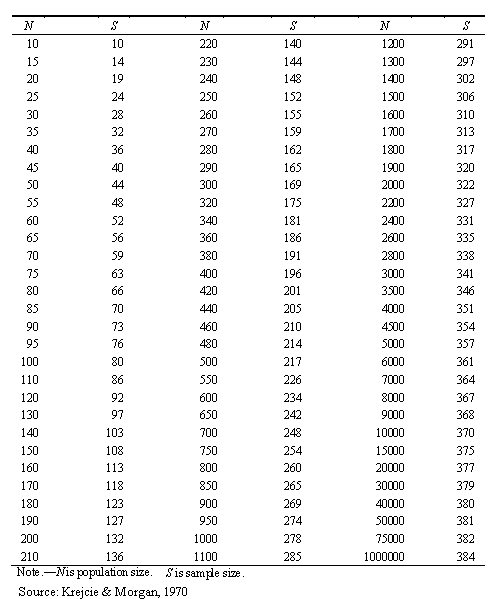
Appendix D: Student/Personnel/Infrastructure Data per School
|
PUBLIC SCHOOLS |
|
|
|
||||
|
BUEA SUB DIVISION |
|
|
|
||||
|
NAME OF SCHOOL |
CREATED |
ENROLMENT |
STREAMS |
||||
|
|
BOYS |
GIRLS |
TOTAL |
|
|||
|
1 |
B.G.S. MOLYKO |
1963 |
1524 |
1838 |
3362 |
56 |
|
|
2 |
G.T.H.S. MOLYKO |
1979 |
1146 |
254 |
1400 |
73 |
|
|
3 |
G.H.S BUEA |
1987 |
506 |
710 |
1216 |
26 |
|
|
4 |
G.B.H.S. MUEA |
1991 |
471 |
759 |
1230 |
61 |
|
|
5 |
G.H.S. BONJONGO |
1992 |
0 |
0 |
0 |
11 |
|
|
6 |
G.H.S BUEA RURAL |
1993 |
655 |
595 |
1250 |
26 |
|
|
7 |
G.T.C. BOVA |
2001 |
58 |
25 |
83 |
7 |
|
|
8 |
G.H.S. BUEA TOWN |
2005 |
473 |
751 |
1224 |
19 |
|
|
9 |
G.S.S. BWIYUKU |
2003 |
117 |
202 |
319 |
10 |
|
|
10 |
G.T.C. LYSOKA |
2005 |
0 |
0 |
0 |
16 |
|
|
11 |
G.H.S. BOLIFAMBA |
2006 |
0 |
0 |
0 |
15 |
|
|
12 |
GHS GREAT SOPPO |
2007 |
236 |
338 |
574 |
10 |
|
|
13 |
G.H.S. BOMAKA |
2007 |
0 |
0 |
0 |
11 |
|
|
14 |
G.S.S WOKEKA |
2011 |
0 |
0 |
0 |
5 |
|
|
15 |
GSS LIONGO |
2013 |
0 |
0 |
0 |
3 |
|
|
16 |
GSS DIBANDA |
2014 |
0 |
0 |
0 |
4 |
|
|
|
TOTAL |
|
5186 |
5472 |
10658 |
353 |
|
|
|
|
||||||
|
|
LIMBE SUB DIVISION |
|
|
||||
|
|
NAME OF SCHOOL |
CREATED |
SEX |
TOTAL |
STREAMS |
||
|
|
|
BOYS |
GIRLS |
|
|||
|
1 |
G.H.S. LIMBE |
1975 |
1162 |
1475 |
2637 |
28 |
|
|
2 |
G.B.H.S. LIMBE |
1988 |
955 |
1405 |
2360 |
50 |
|
|
3 |
G.H.S. BATOKE |
1999 |
376 |
491 |
867 |
21 |
|
|
4 |
G.T.H.S. LIMBE |
2001 |
788 |
202 |
990 |
36 |
|
|
5 |
G.H.S. MBONJO |
2007 |
355 |
465 |
820 |
14 |
|
|
6 |
G.H.S. BONADIKOMBO |
2007 |
253 |
647 |
900 |
22 |
|
|
7 |
GSS MABETA |
2012 |
38 |
22 |
60 |
5 |
|
|
8 |
GTC BIMBIA |
2018 |
5 |
2 |
7 |
3 |
|
|
|
TOTAL |
|
3932 |
4709 |
8641 |
179 |
|
|
|
TIKO SUB DIVISION
|
||||||
|
|
SCHOOLS |
CREATED |
SEX |
TOTAL |
STREAMS |
||
|
|
|
BOYS |
GIRLS |
||||
|
1 |
G.T.H.S. OMBE |
1952 |
728 |
114 |
842 |
80 |
|
|
2 |
G.B.H.S. TIKO |
1982 |
|
593 |
####### |
45 |
|
|
3 |
G.B.H.S. MUDEKA |
1996 |
228 |
262 |
490 |
10 |
|
|
4 |
G.B.H.S. MUTENGENE |
1998 |
575 |
1076 |
1651 |
27 |
|
|
5 |
G.H.S. MOTOMBOLOMBO |
2006 |
454 |
860 |
1314 |
18 |
|
|
6 |
G.T.H.S TIKO |
2000 |
330 |
162 |
492 |
41 |
|
|
|
TOTAL |
|
2315 |
3067 |
####### |
221 |
|
|
|
WEST COAST |
||||||
|
1 |
G.H.S. IDENAU |
1997 |
0 |
0 |
0 |
7 |
|
|
2 |
G.T.C. BAKINGILI |
2007 |
51 |
27 |
78 |
12 |
|
|
|
TOTAL |
|
51 |
27 |
78 |
19 |
|
|
|
MUYUKA SUB DIVISION |
||||||
|
1 |
G.B.H.S. MUYUKA |
1983 |
0 |
0 |
0 |
42 |
|
|
2 |
G.T.H.S. MUYUKA |
1992 |
0 |
0 |
0 |
60 |
|
|
3 |
G.H.S. EKONA |
1996 |
0 |
0 |
0 |
15 |
|
|
4 |
G.H.S. BAFIA |
1997 |
0 |
0 |
0 |
13 |
|
|
5 |
G.H.S. MALENDE |
2003 |
0 |
0 |
0 |
12 |
|
|
6 |
G.T.C. MUNYENGE |
2006 |
0 |
0 |
0 |
20 |
|
|
7 |
G.H.S. MUNYENGE |
2008 |
0 |
0 |
0 |
14 |
|
|
8 |
G.T.C. EKONA |
2009 |
0 |
0 |
0 |
12 |
|
|
9 |
GSS OWE R |
2013 |
0 |
0 |
0 |
5 |
|
|
|
TOTAL |
|
0 |
0 |
0 |
193 |
|
|
|
SUMMARY ENROLMENT |
STREAMS |
|||||
|
|
SUB DIVISION |
|
BOYS |
GIRLS |
TOTAL |
|
|
|
|
BUEA |
|
5186 |
5472 |
10658 |
353 |
|
|
|
LIMBE |
|
3932 |
4709 |
8641 |
179 |
|
|
|
TIKO |
|
####### |
3067 |
####### |
221 |
|
|
|
MUYUKA |
|
0 |
0 |
0 |
193 |
|
|
|
WEST COAST |
|
51 |
27 |
78 |
19 |
|
|
|
GRAND TOTAL |
|
####### |
13275 |
####### |
965 |
|
Source: Regional Delegation of Basic Education, Service in Charge of School Map, Buea (2023)