|
Greener Journal of Physics and Natural Sciences Vol. 4(1), pp. 1-6, 2019 ISSN: 2384-6410 Copyright ©2019, the copyright of this article is
retained by the author(s) DOI Link: https://doi.org/10.15580/GJPNS.2019.1.102619193 https://gjournals.org/GJPNS |
|

Condensed Lagrange Equations
in Theoretical Mechanics
Anastas Ivanov Ivanov
Todor Kableshkov
University of Transport, Sofia, Bulgaria
|
ARTICLE INFO |
ABSTRACT |
|
Article
No.:102619193 Type: Review DOI:10.15580/GJPNS.2019.1.102619193 |
In this article, new equations
called Condensed Lagrange equations (CLE) are defined. With their help, the
rigid body absolute general motion is studied. The rigid body is considered
to be homogeneous and unsymmetrical. CLEs are similar in structure to the
classical Lagrange equations from second type, applied in vector-matrix
form, but CLE are differing from them by four indicators. These differences
are commented in detail in this article. The use of the CLE is fully
equivalent to the application of the theorem, called Theorem for change of
the rigid body generalized impulse. Using CLEs the differential equations in
a matrix form, describing the rigid body absolute general motion, are
obtained. CLEs enrich the theory of Rigid Body Mechanics. Moreover, CLEs
represent a second alternative variant of the Theorem for change of the
rigid body generalized impulse, they serve for verification, and finally,
they make the study completely. |
|
Submitted: 26/10/2019 Accepted: 29/10/2019 Published: |
|
|
*Corresponding
Author Anastas Ivanov E-mail: aii2010@abv.bg |
|
|
Keywords: |
|
|
|
|
1. INTRODUCTION
On
April 5th, 1788, the great Italian-French mathematician and physicist Joseph
Louis Lagrange (1736-1813) has presented to the
Analytical
mechanics has been developed over the years. There are many modifications to
these equations, for example (Tzenov, 1953; Dolapchiev, 1969).
The Lagrange equations from the second type
are scalar. After the introduction of matrices and matrix calculations in1858
by Arthur Cayley (1821-1895), who could reasonably be
considered not only a great British but also a world mathematician, it becomes
possible to type them in a vector-matrix form, (Cayley, 1858).
Usually, the differential equations of the
rigid body generalized motion in matrix form are obtained by means of the two
main theorems of Classical Mechanics – The Theorem for change of linear
momentum and Theorem for change of angular momentum are always applied, (Wittenburg, 1977; Featherstone, 2008; Awrejcewicz
et al., 2012). Of course, the author of this article managed
to unite these two theorems into one. This new theorem is called Theorem for change of the rigid body
generalized impulse.
In this article, in a shortened form, new
equations in vector-matrix form, called Condensed
Lagrange equations (CLE), are presented. With their help, the differential
equations of the rigid body general motion are obtained easily and clearly.
CLE are presented a second additional and
alternative variant of the Theorem for change of the rigid body generalized
impulse (TCRBGI). Moreover, these equations are served
for verification of the TCRBGI and they make the
study completely.
CLE has already been used in some
author's publications, for example (Ivanov, 2017; Ivanov, 2018). Here, the title of this article coincides
with their name. In this way, the main purpose of the study is to promote them to a wide range of scientists.
2. RIGID BODY KINETIC
ENERGY
The kinetic energy of
a free rigid body that performs an absolutely general motion, at an arbitrarily
chosen pole  , has the form (Fig1):
(1)  ,
,
(2) 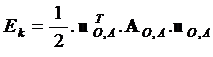 .
.
It
has been proven the following theorem: the doubling value of the kinetic
energy of a body, that performs a general motion, is equal to the scalar
product of the vector-real generalized velocity and the vector-generalized
impulse of this rigid body.

Fig.1: Dynamics of
rigid body absolute general motion
Indeed, the lower two
equals lead to the same result, since the matrix of mass and inertial
characteristics  is symmetrical, or
 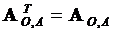 , (Ivanov, 2018, a, b):
(3)  ,
,
(4)  .
.
If the pole coincides with
the mass center  , (Fig. 2), the kinetic energy will be determined by
the König Theorem (Johann Samuel König,
1712-1757):
, (Fig. 2), the kinetic energy will be determined by
the König Theorem (Johann Samuel König,
1712-1757):
(5)  ,
,
(6) 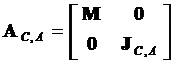 .
.
3. CONDENSED LAGRANGE EQUATIONS
At an arbitrarily
chosen pole , the main variant of Condensed Lagrange equations has
two forms of presentation:
(7) 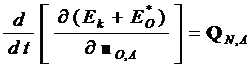 ,
,
(8)  .
.

Fig.2: Dynamical model
where the pole coincides with
the mass center
The scalar magnitude  , which an additional energy is presented, is
constructed by the following manner:
, which an additional energy is presented, is
constructed by the following manner:
(9)  ,
,
(10)  .
.
Formulas (2) and (9)
are substituted in equation (8):
(11)  .
.
Then formula (10) is substituted in equation (11):
(12)  .
.
From now on, in order
to obtain the differential equations of the general motion of this asymmetric
rigid body at arbitrary chosen pole , it is necessary to apply the methodology described
in the publications, (Ivanov, 2018, a, b).
Using a pole that coincides with the mass center of the body, Condensed Lagrange equations
will take the following form:
(13)  ,
,
(14)  ,
,
(15)  .
.
Formulas (5) and (14)
are substituted in equation (13):
(16)  .
.
Then formula (15) is substituted in equation (16):
(17)  .
.
Condensed Lagrange
equations in formula (13) are fully equivalent to the following kind:
(18) 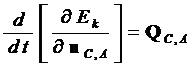 .
.
The two variants of
Condensed Lagrange equations – formulas (13) and (18), lead to the same result.
In order to obtain a
more complete perception about Condensed Lagrange equations it is necessary to
compare them with the classical Lagrange equations from the second type.
Such a comparison can
be made if the classical Lagrange equations from the second type are written in
the matrix form as follows:
(19) 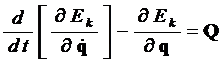 .
.
The main differences between
the most general version of Condensed Lagrange equations – formula (8) and the
classical Lagrange equations from the second type – formula (19), are as
follows.
1.
Instead of a private derivative of kinetic
energy  towards the vector of generalized velocities
  , which is written in classical Lagrange equations from the
second type (19), in Condensed Lagrange equations (8), the analogous private
derivative is formed towards the new vector-real generalized velocity
, which is written in classical Lagrange equations from the
second type (19), in Condensed Lagrange equations (8), the analogous private
derivative is formed towards the new vector-real generalized velocity  .
.
2.
The private derivative  , which
is standing on the second place in the classical Lagrange equations from the
second type, in Condensed Lagrange equations such private derivative is absent.
, which
is standing on the second place in the classical Lagrange equations from the
second type, in Condensed Lagrange equations such private derivative is absent.
3.
Instead of the member  in classical Lagrange equations
from the second type, in Condensed Lagrange equations, the analog member is
modified in the type
in classical Lagrange equations
from the second type, in Condensed Lagrange equations, the analog member is
modified in the type 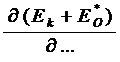 , where an
additional energy is added to the kinetic energy of the body –
formulas (9) and (10).
, where an
additional energy is added to the kinetic energy of the body –
formulas (9) and (10).
4.
Instead of classical form of the
vector-generalized forces  , used in
Lagrange equations from the second type, in Condensed Lagrange equations, when
the general motion of a rigid body is studied with arbitrary chosen pole , the new vector-real generalized forces
, used in
Lagrange equations from the second type, in Condensed Lagrange equations, when
the general motion of a rigid body is studied with arbitrary chosen pole , the new vector-real generalized forces  for the stationary (fixed) center
  is defined –
formulas (7) and (8).
is defined –
formulas (7) and (8).
The name
"condensed" is related to the major private derivative 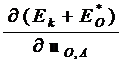 , in which differentiation is performed towards the
vector-real generalized velocity .
, in which differentiation is performed towards the
vector-real generalized velocity .
According to the
equation 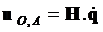 , which is described
in many author’s articles, (Ivanov, a;Ivanov, 2018, a, b), this
vector
, which is described
in many author’s articles, (Ivanov, a;Ivanov, 2018, a, b), this
vector  seems to have condensed within itself the other major
vector , known as the vector of generalized velocities.
seems to have condensed within itself the other major
vector , known as the vector of generalized velocities.
4. CONCLUSION
New equations, called
Condensed Lagrange equations, have been formulated. These equations are similar in structure to the classical Lagrange equations
from second type, applied in vector-matrix form. Moreover, Condensed Lagrange
equations leads to the same result as the Theorem of change the rigid body generalized impulse.
Condensed Lagrange
equations differ from the classical Lagrange equations of the
second type by four indicators. These indicators are fully described in this article.
The obtained system of nonlinear differential
equations in matrix form is convenient for a numerically integrating by the
contemporary mathematical programs, which are projected to use matrices and
matrix calculations, for example MatLab, MathCAD, Maple, MuPAD and others.
REFERENCES
Awrejcewicz J., Koruba Z., (2012). Classical Mechanics.Applied Mechanics and Mechatronics, Springer.
CayleyA.
(1858). A memoir on the theory of matrices. Philosophical Transactions of the
Royal Society of
Dolapchiev B.I., (1969). Summary
of the Nilsen-Tzenov equations.Bulletin of the BulgarianAcademy of
Sciences.Mathematics, № 10.
Eiserman M.A., (1974). Classical Mechanics. Moscow, Nauka.
(in Russian)
Featherstone R., (2008). Rigid Body Dynamics. Algorithms.
Springer Science and Business Media, LLC.
Ivanov A.I., (2017). Theoretical Matrix Study of Rigid Body
General Motion. Greener Journal of Physics and Natural Sciences, 3 (2), 009-020.
Ivanov A.I., (2017), Theoretical Matrix Study of Rigid Body
Pseudo Translational Motion. Greener Journal of Physics and Natural Sciences, 3 (2), 021-031.
Ivanov A.I., (2018). Motion of Asymmetrical Rigid Body in Fluid Area. Annual
of the
Ivanov A.I., (2018). Motion of Ellipsoid in Fluid Area. Annual of the
Pars L.A., (1964). A Treatise on Analytical Dynamics.
Suslov G.K., (1976). Fundamentals
of Analytical Mechanics. Sofia, Nauka. (in Bulgarian)
Tzenov I.A., (1953). On a new form
of equations of Analytical Mechanics.Moscow, DAN, USSR,
vol. 89, book 1. (in Russian)
Wittenburg J., (1977). Dynamics
of Multibody Systems.Springer-Verlag.
Zlatev I.S., (1965).
Theoretical Mechanics.Sofia, Nauka i
Izkustvo. (in Bulgarian)
|
Cite this
Article: Ivanov A (2019). Condensed Lagrange Equations in Theoretical Mechanics. Greener Journal of Physics and Natural Sciences, 4(1): 1-6, https://doi.org/10.15580/GJPNS.2019.1.102619193. |