|
Greener Journal of Physics and
Natural Sciences Vol. 4(1), pp. 07-12, 2019 ISSN: 2384-6410 Copyright ©2019, the copyright
of this article is retained by the author(s) DOI Link: https://doi.org/10.15580/GJPNS.2019.1.102619194 http://gjournals.org/GJPNS |
|

Theorem for Change of
Generalized Impulse in Theoretical Mechanics
Anastas Ivanov Ivanov
Todor Kableshkov
University of Transport, Sofia, Bulgaria
|
ARTICLE INFO |
ABSTRACT |
|
Article No.:102619194 Type: Research DOI:10.15580/GJPNS.2019.1.102619194 |
In this
article, a rigid body absolute general motion is studied. The rigid body is assumed
as homogeneous and unsymmetrical. New additional kinetic characteristics are
used. The most important of these are the following: the vector-real
generalized velocity of the rigid body, the vector-generalized impulse of
the rigid body and the vector-real generalized force of the rigid body.
Using these new kinetic characteristics, a new theorem is defined. It is
called Theorem for change of the rigid body generalized impulse. With its
help, the differential equations in matrix form are obtained. These
equations describe the rigid body absolute general motion. Two cases are
studied - a pole that coincides and does not coincide with the rigid body
mass center. The new theorem enriches the theory of Rigid Body Mechanics.
The compact matrix equations provide an excellent opportunity for studying
the most complicated dynamic models. They are suitable for numerical
solutions with modern mathematical programs such as MatLab, MathCAD and
others. |
|
Submitted: 26/10/2019 Accepted: 29/10/2019 Published: |
|
|
*Corresponding Author Anastas Ivanov E-mail: aii2010@abv.bg |
|
|
Keywords: |
|
|
|
|
1. INTRODUCTION
During the Renaissance period of the
evolution of science, Mathematics and Mechanics with all of their branches,
such as Rigid Body Mechanics (Goldstein et al., 2000), Mechanics of Material
(Timoshenko, 2002), Fluid Mechanics (Krause, 2005), Analytical Mechanics (Pars,
1964), and others, have been developing in parallel and
jointly. The mathematical apparatus, that serves the various branches of
Mechanics, is complicated. The equations become long and complex. This
necessitates the introduction of many new abbreviated forms of mathematical
recordings, such as “Nabla operator”, “Gradient”,
”Divergence”, “Curl”, “Convective derivative”, “Laplace operator”, “Tensor
derivative” and others. Nevertheless, during this period, Mechanics remains in
scalar-vector form. In 1857, British
mathematician Arthur Cayley (1821-1895) published his
treatise “A memoir on the theory of matrices” (Cayley,
1858). So,
he gave a powerful weapon in the hands of scientists. Matrices and matrix
calculus are used in Mechanics later after the development of one of the most
powerful method – Finite Element Method (Kazakov., 2010; Handruleva et al., 2012),
as well as when numerical methods and electronic computings
are being developed (Karamanski, 1976). It turns out
that many branches of Mechanics, and mainly Rigid Body Mechanics, remain
preserved in their original classical form, namely in scalar-vector form, for
example (Yablonsky, 1984, a, b).
This
article shows in a briefly and essential form a new theorem called Theorem for
change of the rigid body generalized impulse. It has already been used in some
author's publications, for example (Ivanov, 2017, a,
b; Ivanov, 2018, a, b). Here, the title of this paper
coincides with the name of that theorem. In this way, the main purpose of the
study is realized, namely, it has to promote this very interesting and useful
theorem.
2. ADDITIONAL
KINETICAL CHARACTERISTICS
Two ideal rigid
bodies  and
and  are studied,
(Fig. 1).
are studied,
(Fig. 1).
The body  is considered
absolutely motionless. The body
is considered
absolutely motionless. The body  is free and
it performs a general motion. The coordinate system
is free and
it performs a general motion. The coordinate system  is connected
to body . The
coordinate system
is connected
to body . The
coordinate system  is connected
to the pole
is connected
to the pole  and it
performs a translational motion. The coordinate system
and it
performs a translational motion. The coordinate system  is constantly
connected to the pole and to the
body . All vectors
and matrices, which are referenced to the coordinate systems and , are indicated by a lower index and when they
are referenced to the coordinate system , they are indicated by a lower index . The
spherical component of the rigid body motion is described by Cardanangles
is constantly
connected to the pole and to the
body . All vectors
and matrices, which are referenced to the coordinate systems and , are indicated by a lower index and when they
are referenced to the coordinate system , they are indicated by a lower index . The
spherical component of the rigid body motion is described by Cardanangles  ,
,
 and
and  . The law of
rigid body motion is given by the vector of generalized coordinates:
. The law of
rigid body motion is given by the vector of generalized coordinates:
(2.1)  .
.
The
body is assumed as homogeneous and
unsymmetrical.

Fig.1: Dynamics of
rigid body absolute general motion
A vector-real generalized velocity of the
rigid body is defined. It refers to a random chosen pole from the body
and to a coordinate system or :
(2.2) 
 .
.
Similar vector-real generalized velocity of the
rigid body is defined. It refers to a random chosen pole from the body
and to a coordinate system :
(2.3) 
 .
.
Two transition matrices  and
and having a dimension
  are
constructed.
They are composed by the basic transition matrices
are
constructed.
They are composed by the basic transition matrices  and
and with dimension
  :
:
(2.4)  ,
, 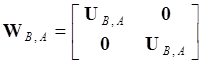 .
.
The relationship between the vector-real generalized velocity  and the vector of generalized velocity
  is performed
by the equations:
is performed
by the equations:
(2.5)  ,
,  ,
,  ,
,  ,
,
(2.6)  .
.
A vector-generalized
impulse of the rigid body is defined. This vector, for a random chosen pole
from the body,
has the form:
(2.7) 
 ,
,
(2.8)  .
.
The matrix  is described in the publication (Ivanov,
2017, a).
is described in the publication (Ivanov,
2017, a).
A vector-generalized
impulse of the rigid body for an immovable pole  is defined, (Fig.1). This vector is also linked indirectly with the pole and with the
mass center
is defined, (Fig.1). This vector is also linked indirectly with the pole and with the
mass center  of the body:
(2.9) 
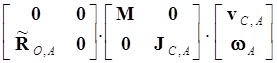 ,
,
(2.10) 
 ,
,
(2.11)  ,
,
(2.12)  .
.
A vector-real generalized force of the rigid
body is defined. This vector, for a random chosen pole from the body,
has the form:
(2.13)  .
.
Another vector-real generalized force of the rigid
body for an immovable pole is defined. This vector is also linked indirectly with the pole of the body:
(2.14) 
 ,
,
(2.15)  .
.
3. THEOREM OF CHANGE OF RIGID BODY GENERALIZED IMPULSE
The theorem states: The first
time derivative of the rigid body generalized impulse for a fixed pole is equal
to its real generalized force determined for that pole.

Fig.2: Dynamical model
where the pole coincides with
the mass center
The mathematical
record of the stated above theorem has the form:
(3.1)  ,
,
(3.2)  ,
,
(3.3) 
 .
.
Now, the theorem of
the mass center motion is used:
(3.4)  .
.
Through this theorem
equation (3.3) takes the following
form:
(3.5)  .
.
Let us assume the
pole coincides
with the mass center of the
body, (Fig.2).
Then equation (3.5)
take the following form:
(3.6)  .
.
The equation (3.6) is written shortly by the following manner:
(3.7)  .
.
Equation (3.7)
performs the Theorem for change of the rigid body generalized impulse towards
the movable pole ,
which coincides with the mass center . This variant of the theorem is speaking that way: The first time derivative of the rigid body
generalized impulse for the body mass center is equal to its real generalized
force determined for that center.
4. CONCLUSION
Some new kinetic
characteristics have been introduced.
The most important
characteristics are the vector-real
generalized velocity and the vector-generalized impulse for an ideal rigid
body.
A new theorem, called Theorem for change the rigid body generalized impulse for the fixed
pole or for the
movable pole coinciding with the mass
center is defined. It
is applied to study the absolute general motion of a free asymmetric ideal
rigid body.
The stated theorem is formulated directly.
Nevertheless, it represents a summary of the two main theorems in Dynamics: Theorem for
change of linear momentum and Theorem for change of angular momentum, applied to the studied rigid body.
The directly defining of that new theorem became
possible thanks to introducing the new kinetical characteristics
and using the matrix operations.
REFERENCES
Cayley A. A memoir on the theory of
matrices, Philosophical Transactions of the Royal Society of London, vol. 148,
1858, 17-37.
Goldstein H., C. Pole, J. Safko,
Classical Mechanics. Columbia Univ., Univ. of South Carolina, 2000, 646 p.
Handruleva A.K., V.D. Matuski, K.S.Kazakov,
Modeling of building constructions with program
product SAP 2000, VSU “LyubenKaravelov”, Sofia, 2012,
365 p. (in Bulgarian).
Ivanov A.I., Theoretical Matrix Study of Rigid Body General Motion. Greener
Journal of Physics and Natural Sciences, vol. 3 (2), 2017, 009-020.
Ivanov A.I., Theoretical Matrix Study of Rigid Body Pseudo Translational
Motion. Greener Journal of Physics and Natural Sciences, vol. 3 (2), 2017,
021-031.
Ivanov A.I., Theoretical matrix study of rigid body relative motion.
International Journal of Advancement in Engineering Technology, Management and
Applied Science (IJAETMAS), Vol. 05, Issue 05, 2018, 21-28.
Ivanov A.I., Theoretical Matrix Study of Rigid Body Absolute
Motion.
The International Journal of Engineering and Science (IJES), Vol. 7, Issue 6, Ver. II, 2018, 01-08.
Karamanski T.D., Numerical methods in Structural Mechanics, Technika, Sofia, 1976, 528 p. (in Bulgarian)
Kazakov K.S., Finite Element Method for modeling of building constructions,
Academic publishing house “Prof. Marin Drinov”,
Sofia, 2010, 518 p. (in Bulgarian)
Krause E., Fluid Mechanics, Springer-Verlag, Berlin, Heidelberg, 2005, 363 p.
Pars L.A., A Treatise on Analytical Dynamics, Heineman, London, 1964, 636 p.
Timoshenko S.P., J.M. Gere, Mechanics of Matrials, Lan,
Sankt Petersburg, 2002, 670 p. (in Russian).
Yablonsky A.A., Course of Theoretical mechanics. vol. 1, “Vishayashkola,
Moscow, 1984, 344 p. (in Russian)
Yablonsky A.A., Course of Theoretical mechanics. vol. 2, “Vishayashkola,
Moscow, 1984, 424 p. (in Russian)
|
Cite this
Article: Ivanov
A (2019). Theorem for Change of Generalized Impulse in Theoretical Mechanics.
Greener Journal of Physics and Natural Sciences, 4(1): 07-12,
https://doi.org/10.15580/GJPNS.2019.1.102619194 |