|
Greener Journal of
Physical Sciences
Vol. 6(1), pp. 1-9, 2020
ISSN: 2276-7851
Copyright ©2020, the
copyright of this article is retained by the author(s)
https://gjournals.org/GJPS
|

|
Development and Performance Evaluation of a
Slicing Machine for Selected vegetables
Ezeanya, Nnaemeka
Charles
Department of Agricultural and Bioresources
Engineering, Federal University of Technology, PMB 1526, Owerri,
Nigeria.
|
ARTICLE INFO
|
ABSTRACT
|
|
Article No.:01162010
Type: Research
|
The purpose of this study was to develop an efficient and
ergonomically safe slicing machine that is affordable to a small scale farmer.
Slicing machine is useful for farmers in chopping of fodder; and for crop
processing industries in slicing of vegetables in readiness for other
processing activities. A slicing machine, equipped with two slicing blades
was designed, fabricated and evaluated for performance. The machine was
powered by a 0.25hp, single phase electric motor. The performance of the
machine was evaluated using three selected crops (onion bulbs, carrots, and
Irish potatoes); grouped into small-sized samples (22.62-33.14 mm) and
medium-sized samples (33.35-49.9) ; at four machine
speeds of 53, 58, 62, and 69 rpm. The parameters investigated were slicing
efficiency and throughput capacity. Results showed that the highest mean
slicing efficiency of 87.6% was attained from the machine when slicing
small-sized Irish potatoes at rotational speed of 58 rpm; while the lowest
mean slicing efficiency of 60.7% was attained from the machine when slicing
medium-sized onion bulbs at rotational speed of 69 rpm. The throughput
capacities developed by the slicer were affected by slicing speeds; and
ranged from 20.52 – 44.28 kg/hr. It was also observed that the machine could
slice onion bulbs, carrots and Irish potatoes satisfactorily with slice
thicknesses ranging from 5mm to 6mm.
|
|
Accepted: 21/01/2020
Published: 27/06/2020
|
|
*Corresponding
Author
Ezeanya,
NC
E-mail: n_ezeanya@yahoo.com
Phone:
08037529679
|
|
Keywords: Vegetable
slicer; Single phase; electric motor; machine speeds; Slicing efficiency;
throughput capacity
|
|
|
|
1.
INTRODUCTION
Most of the
horticultural commodities are larger in size and therefore size reduction is a
preliminary stage for various food processing activities. Depending on whether
the material is solid or liquid, the operation of size reduction can be
subdivided into two major categories. In the case of solids the operations are
called grinding and slicing (cutting) while in the case of liquids the process
is defined as emulsification or atomization. The general term ‘size reduction’
includes cutting, crushing, grinding and milling. Such processes as cutting of fruits
and vegetables for canning, shredding of sweet potatoes for drying, chopping of
corn fodder, grinding limestone for fertilizer, grinding grain for livestock
feed, and milling of flour are all size reduction processes (Federick, 2008). Slicing involves cutting materials into
smaller sizes by the use of a sharp blade or cutter.
The three selected vegetables used in this research are
onion bulbs, carrots, and Irish potatoes. These vegetables are of great
importance both as source of food for mankind as well as valuable raw materials
for the industry. In 2018, the global production data for onion bulbs, Irish
potatoes and carrots are 5.47 million tonnes, 36.82
million tonnes, and 39.99 million tonnes
respectively (FAO, 2019). Processed onion products include dried onion flakes
and powders usually made from white cultivars with high dry matter content, and
onion oil which is produced by distillation. Medically onion reduces the
clothing of platelet in the body, lowers raised blood sugar, and cures all bronchial
complaints like cough (Elesha, 2002). Carrot is
generally consumed due to high content of beta-carotene. In the food sector,
potatoes are processed into deep frozen chips, crisps, and mashed potato.
By-products such as potato starch, glucose, and dextrose are used in biscuit
production and brewing industries in the production of confectioneries and distillation
of alcohol. In the non-food sector, by-products such as potato starch and dextrins are used as ingredients for the manufacture of
cardboard, glues, textiles, and paints (Raemaekers,
2001).
Traditionally fruits are sliced using sharp kitchen
knife. Above a certain scale of production, this method is labourious,
time consuming and prone to finger injury and eye irritation. Also slices
produced in this method are not normally of uniform size. Some slicing machines
had been developed by several researchers for slicing crops. Rajesh et al. (2016) developed and evaluated a
plantain peeler cum slicer. Research findings from their work revealed that the
developed slicer had an average slicing efficiency of 88.94% and throughput
capacities of 89.27, 89.16, and 79.59 kg/hr. Ehiem
and Obetta (2011) developed a motorized yam slicer
which was operated by a 1.5 hp motor. Research
findings from their work revealed that a maximum slicing efficiency of 52.3%,
average throughput capacity of 315 kg/hr, and
percentage of non-uniform slices of 42.65% were developed by the slicer. Agbetonye and Balogun (2009)
developed a multi-crop slicing machine which uses a set of nine blades for
slicing carrot, potato, onion and yam. Their research established that the
slicing efficiency and throughput capacity increased with slicing speed. A
maximum efficiency of 97.9% and maximum throughput capacity of 135.7 kg/hr was reported by their work. However, these developed
crop slicers are relatively bulky in size and thus have high cost of production
and therefore needs to be improved upon. This work aimed at developing and
evaluating an improved vegetable slicer which will slice with greater
efficiency and reduced cost.
2. MATERIALS AND METHOD
2.1
Design considerations
The
following factors were considered in the design of the slicing machine:
1. The
machine should be portable
2. The
slicing components should be corrosion resistant to avoid contamination of the
crops being sliced
3.
The machine would be cost effective
4.
Ergonomics was given due consideration in the design to reduce operator
fatigue.
2.2
Description of the machine
The
machine consists of hopper, slicing disc, slicing blade, power drive mechanism,
processing chamber, electric motor, speed regulator, and frame. The
orthographic view of the slicing machine is shown in Figure 1, while the
exploded view is shown in Figure 2.
The Hopper
The
hopper has dimensions of 135 x 75 mm in cross section with length of 170 mm and
is attached to the front of the machine. The crops to be sliced were fed into
the hopper. It has a feed control plate which exposes only the desired vegetable
to be fed to the slicing blade. The base of the hopper opens into the slicing
chamber from the top such that feeding of the crops is aided by gravity. This
was achieved by tilting the hopper at an angle of 35º. Angle of 35º was chosen
because it is slightly greater than the angle of repose of the selected crops.
Stainless steel (grade 304: ISO 3506 ‘A2’) was used in constructing the hopper,
so as to reduce corrosion and rust.
Slicing disc
This is a
detachable disc, having radius of 145mm and thickness of 2mm which houses the
two slicing blades.It was constructed with stainless
steel (grade 304: ISO 3506 ‘A2’) so as to minimize corrosion and food
contamination. It was connected to the shaft via the flange and held by series
of screws.
Slicing blades
The slicing
blades are sharp slits on the surface of the disc which are hollow beneath. They
were fixed adjacent to each other and equally spaced on the slicing disc. They each
have thickness of 2.5mm and length of 150mm. They were constructed with
stainless steel (grade 304: ISO 3506 ‘A2’).The blades were designed to slice
the product and in the same motion push the sliced piece downward where it
drops by gravity into the discharge chute. A slice clearance of 5 mm was
designed for the output thicknesses. The slicing blades are held firmly to the
disc with series of bolts.
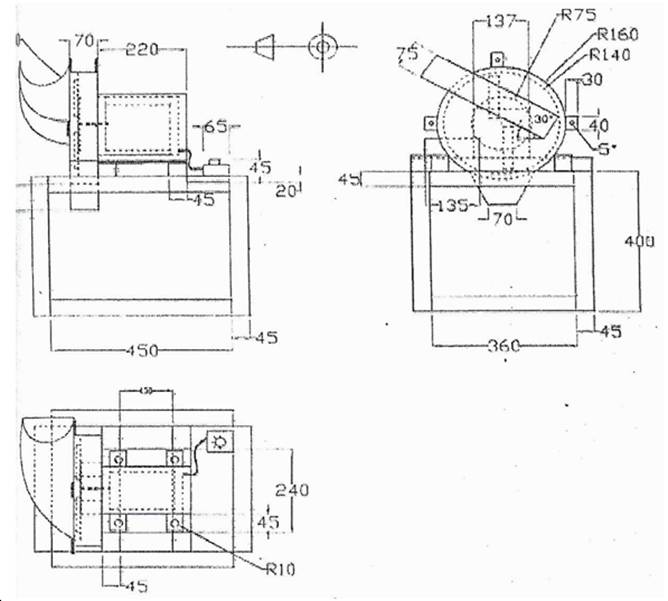
Figure 1.
Orthographic view of the slicing machine (All dimensions are in mm)
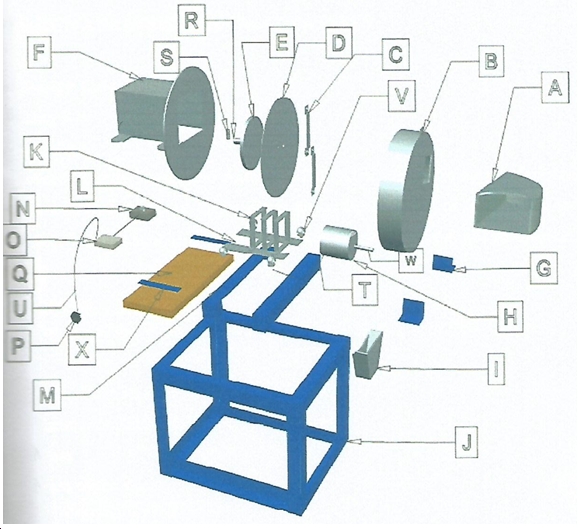
Figure 2. Exploded
view of the slicing machine
Legend: A, hopper,
B, processing chamber, C, slicing blade, D, slicing disc, E, flange, F, motor
housing, G, processing chamber base support, H, electric motor, I, discharge
chute, J, frame, K, motor bracket, L, motor base, M, motor base support, N,
speed regulator, O, junction box, P, fused plug, Q, regulator base, R, flange
shaft, S, key, T, motor wire, U, supply wire, V, bolts and nuts, W, motor
shaft, X, regulator base holder.
Power drive mechanism
The slicing
machine is powered by a single phase, 0.25 horsepower 200 rpm electric motor,
which converts the electric energy into mechanical (rotational) motion. This rotational
force is transmitted via the shaft and is utilized by the slicing discs for
operation.
Processing chamber
This is a
hollow cylinder made of stainless steel; having radius of 160 mm and length of
70 mm. It houses the internal components of the machine like the slicing disc
and blades. The design of the processing chamber enables the temporary opening
of the chamber for easy maintenance and changing of the slicing blades. It also
contains an internal partition that separates the slicing chamber from the
motor.
Frame
This was
constructed with mild steel and serves as the support for the machine. It has
length of 540mm, width of 450mm and height of 400mm.
2.3 Design
calculations
i
Radius of slicing disc
Saravacos and Kostaropoulos (2002) recommended that radius of slicing
disc for cutting equipment should be above thrice the diameter of product to be
sliced. The average diameter for the crops to be sliced was obtained from
sampling as 4.5 cm. Therefore 3×4.5 cm=13.5 cm.
Therefore a disc radius of 14.5cm (0.145m) was chosen.
ii Volume of slicing disc
Volume (V)
of slicing disc was determined using

Where r
= radius of slicing disc
h = thickness of slicing disc (2mm = 0.002m)
Therefore,
V =
π× (0.145m)2×0.002m = 1.32 × 10⁻⁴m3
iii Mass
of Slicing Disc
Mass of
slicing disc was determined using

Where ρ
= density of stainless steel = 7800 kgm-3
Therefore M
= 7800 kgm-3×1.32 × 10-4m3
= 1.0296 kg
iv Power
required to drive the machine
Force due to
centrifugal action of the disc (F) is given by

Where V=
velocity = ωr
ω = angular velocity = 
Therefore,
angular velocity, ω = = 20.94 rad s-1
Velocity of
slicing disc, V=20.94 rad s-1 ×0.145m =3.036 m s-1
Therefore,  = 65.45 N
Total
torque required (T) is given as

Therefore,

Power
required to drive the machine is given as


P = 198.7 watts
= 0.25 horsepower
2.4
Experimental procedure
The test
samples used for the experiment were onion bulbs, carrots and Irish potatoes.
These were purchased from a local market in Owerri,
Imo state, Nigeria. The samples were prepared by washing, peeling and cutting
into shape. The test samples were classified into small-sized samples (22.62 –
33.14 mm) and medium – sized samples (33.35 – 49.9mm). A vernier
caliper was used to measure the major and minor diameters of the selected
crops; while the masses and volumes of the selected crops were determined using
electronic weighing machine and volume displacement method respectively. The
machine was switched on and operated under no load for 10 minutes to ensure
that all the components were functioning properly. A tachometer of model (Luitron: DT – 2236C) was used to detect and mark off accurate
calibrations on the speed regulator to ensure correctness of operating speeds
as determined in the design calculation. A measured mass of the samples was introduced
into the slicer, and operated at four different speeds of 53, 58, 62, and 69
rpm. The choice of these speed values was based on the speed values used in
previous research works. The machine was operated for 5 minutes for each
experimental test. Each experimental test was replicated three times, and the
average of the results was taken. The output materials obtained from the
machine outlet were collected and separated into two groups of sliced and
unsliced/damaged materials.
3.5
Determination of slicing efficiency
The slicing
efficiency (ηp) of the machine was
determined using Equation (6)

Where Ms = mass of sliced materials (Kg)
Mt = total mass of sliced
and damaged materials (Kg)
3.6 Determination of Throughput Capacity
The
throughput capacity of the slicing machine was determined using Equation (7)

Where: T= throughput capacity (kg/hr)
t =time of slicing (hr)
4 RESULTS AND
DISCUSSION
The size
classifications of the crops used in the experiment are summarized in Table 1.
Table 1. Size Classifications
of the crops used for the experiment
|
Crop
|
Category
|
Mean Size (mm)
|
|
Onion
|
Small
Medium
|
28.74
49.9
|
|
Carrot
|
Small
Medium
|
22.62
33.35
|
|
Potato
|
Small
Medium
|
33.14
48
|
The results
of slicing efficiencies obtained for different speeds are summarized in Tables
2, 3, and 4. The results in Tables 2 to 4 showed that the developed slicing
machine successfully sliced the selected crops to the required size range of
5mm to 6mm thick at high efficiency. The maximum efficiency of 87.6% was
attained by the machine for slicing small-sized Irish potatoes at rotational
speed of 58 rpm; while the least efficiency of 60.7% was attained by the
machine for slicing medium-sized onion bulbs at rotational speed of 69 rpm. The
throughput capacities obtained for the slicer ranged from 20.52 kg/hr to 44.28 kg/hr.
Table 2. Results of
slicing efficiency and Throughput capacity obtained for onion bulbs
|
Category
|
Speed (rpm)
|
Ms (Kg)
|
Md(Kg)
|
Efficiency
(%)
|
Time (mins)
|
T(Kg/hr)
|
|
|
Small
|
53
|
1.92
|
0.89
|
68.3
|
5
|
23.04
|
|
|
58
|
2.67
|
0.88
|
75.2
|
5
|
32.04
|
|
|
|
62
|
2.65
|
0.74
|
78.2
|
5
|
31.8
|
|
|
|
69
|
2.24
|
0.90
|
71.3
|
5
|
26.88
|
|
|
Medium
|
53
|
2.22
|
1.31
|
62.9
|
5
|
26.64
|
|
|
|
58
|
2.96
|
0.95
|
75.7
|
5
|
35.52
|
|
|
|
62
|
3.10
|
1.13
|
73.3
|
5
|
37.2
|
|
|
|
69
|
2.87
|
1.86
|
60.7
|
5
|
34.44
|
|
Ms=mass of properly sliced materials; Md=mass
of damaged and unsliced materials; T=Throughput capacity
Table 3. Results of
slicing efficiency and Throughput capacity obtained for carrots
|
Category
|
Speed (rpm)
|
Ms(Kg)
|
Md(Kg)
|
Efficiency
(%)
|
Time
(mins)
|
T (Kg/hr)
|
|
Small
|
53
|
1.71
|
0.57
|
75
|
5
|
20.52
|
|
|
58
|
2.07
|
0.46
|
81.8
|
5
|
24.87
|
|
|
62
|
2.25
|
0.61
|
78.7
|
5
|
27.00
|
|
|
69
|
1.97
|
0.83
|
70.4
|
5
|
23.64
|
|
Medium
|
53
|
1.89
|
1.01
|
65.2
|
5
|
22.68
|
|
|
58
|
2.40
|
0.81
|
74.8
|
5
|
28.8
|
|
|
62
|
2.65
|
0.70
|
79.1
|
5
|
31.8
|
|
|
69
|
2.38
|
0.92
|
72.1
|
5
|
28.56
|
Ms=mass of properly sliced materials; Md=mass
of damaged and unsliced materials; T=Throughput capacity
Table 4. Results of
slicing efficiency and Throughput capacity obtained for Irish potatoes
|
Category
|
Speed (rpm)
|
Ms(Kg)
|
Md(Kg)
|
Efficiency
(%)
|
Time
(mins)
|
T(Kg/hr)
|
|
Small
|
53
|
2.06
|
0.56
|
78.6
|
5
|
24.74
|
|
|
58
|
2.76
|
0.39
|
87.6
|
5
|
33.12
|
|
|
62
|
2.68
|
0.55
|
83
|
5
|
32.16
|
|
|
69
|
2.85
|
0.69
|
80.5
|
5
|
34.2
|
|
Medium
|
53
|
2.53
|
1.04
|
70.9
|
5
|
30.36
|
|
|
58
|
3.15
|
1.16
|
73.1
|
5
|
37.8
|
|
|
62
|
3.69
|
0.89
|
80.6
|
5
|
44.28
|
|
|
69
|
3.08
|
1.01
|
75.3
|
5
|
36.96
|
Ms=mass of properly sliced materials; Md=mass
of damaged and unsliced materials; T=Throughput capacity
It was
observed that the machine could not be operated beyond the rotational speed of
70 rpm because it pushed away the samples at this rotational speed instead of
slicing.
4.1
Effect of speed on the slicing efficiency
It was
observed from Tables 2, 3, and 4; and Figure 3, that the slicing efficiency of
the machine varied with the rotational speed of slicing disc for all the
selected crops. The slicing efficiencies increased from rotational speed of 53
rpm, reaching highest values at speeds of 58 and 62 rpm, and then reduced
slightly at speed of 69 rpm. Therefore, speed of 62 rpm is recommended as the
best slicing speed for the machine, for slicing the selected crops.


Figure 3: Effect of rotational speed on slicing
efficiency of the crop slicer
4.2
Effect of Size of Sample on Slicing Efficiency
From Figure
4, it was observed that the slicing efficiency varied with the different sizes
of the crops that were sliced. The slicing efficiency reduced with increase in
size of all the samples that were sliced. The experimental results revealed
that the efficiency of the slicer with small-sized onion samples increased and
reached optimum value at speed of 62 rpm. Beyond this slicing speed, there was
decline in efficiency. This implies that beyond the speed of 62 rpm the slicing
blade tends to push the products back instead of slicing them. This same
behavior was observed for small-sized carrots and potatoes at optimum speed of
58 rpm. However, medium-sized onion samples gave optimum efficiency at 58 rpm
beyond which there was a decline. This behavior of the onion samples could be
as a result its soft texture, which produced more damaged slices at higher
speeds. Medium sizes of potato and carrot produced optimum efficiency at 62 rpm
beyond which the efficiency decreased. This behavior of carrots and potatoes could
be due to the higher texture and fiber contents of these crops which tend to
require higher speed to slice. This variation of slicing efficiency with speed
and size of samples is in line with previous research findings conducted for
yam, carrots, onion, banana, and plantain (Agbetoye
and Balogun, 2009;
Sonawane et
al., 2011; Rajesh et al., 2016).
It was also observed from Figure 4 that the efficiency varied with the
particular crop being sliced. The efficiency was highest for potatoes and
lowest for onion bulbs.

Figure 4: Effect of size of sample on slicing efficiency
for the selected crops
Effect of Speed on Throughput Capacity
It was
evident from Tables 2, 3, and 4; and Figure 5 that the throughput capacities of
the slicer when slicing onion bulbs and carrots was lowest at speed of 53 rpm;
and then increased to maximum value at the speed of 62 rpm before dropping to a
lower value at speed of 69 rpm. However, the small-sized Irish Potatoes differed
from this trend by giving the highest throughput capacity value of 34.2 kg/hr at speed of 69 rpm. This slight difference in behavior
by the small-sized Irish potatoes may be attributed to the structural
difference between Irish potato and the other vegetables (onions and carrots).This
variation in throughput capacity with respect to slicing speed is in line with
previous research findings conducted for yam, carrots, onion, banana, and
plantain (Agbetoye and Balogun,
2009; Sonawane et
al., 2011; Rajesh et al., 2016).


Figure 5: Effect of rotational speed on throughput
capacity of the crop slicer
5 CONCLUSION
A machine
suitable for the slicing of onion bulbs, carrots and potatoes, for the purpose
of drying, grinding, and processing has been designed and fabricated. During
the slicing of the crops using the slicer, it was observed that the machine
sliced the selected samples with high efficiency. It was also observed that the
speed of the slicing disc and size of the samples affected both the slicing
efficiency and throughput capacity. The slicing efficiency increased with
increase in rotational speeds of the slicing disc from speed of 52 to 62 rpm.
Beyond this speed, the slicing efficiency decreased for all the samples. The
slicing efficiency also increased with decrease in size of the samples as well
as with the samples themselves. The throughput capacity also increased with
increase in rotational speeds of the slicing disc from speed of 52 to 62 rpm.
Beyond this speed, the throughput capacity decreased for most of the samples
except for the small-sized Irish potato.
6 REFERENCES
Agbetoye, L.A., and A. Balogun. 2009. Design and performance evaluation of a multi-crop slicing
machine. Proceedings of the 5th CIGR Section VI International
Symposium on Food Processing, Monitoring Technology in Bioprocess and Food
Quality Management.Postdam, Germany, 31st
August – 2nd September, 2009. Pp 626-635.
Ehiem, J.C., and S.E. Obetta. 2011. Development of a motorized yam slicer. CIGR
Journal, 13(3): 1-10
Elesha, G.C. 2002.Uses and preservation of onions. Unpublished HND project report, Department of Hotel and
Catering Management, Kwara state Polytechnic, Ilorin.
Pp: 15-23
FAO. 2019. World crop production for 2018. FAO
Statistics, 2019.
Federick, A.M. 2008. Size Reduction Equipment, Mc-Graw Hill Book Company, New York. Pp50-53.
Raemaekers, R.H. 2001. Crop Production in
Tropical Africa. Brussels, DGIC, Pp. 480-485.
Rajesh, G.K.,
R. Pandiselvan., and A. Indulekshmi. 2016. Development and performanceevaluation
of plantain peeler cum slicer. Agric Engineering,
2016(2): 41-50
Saravacos, G.D., and A.E. Kostaropoulos. 2002. Hand book of Food Processing Equipment. Kluwer/Plenium Publishers, New York.Pp. 140.
Sonawane, S.P., G.P. Sharma., and A.C. Pandya. 2011. Design and development of a poweroperated
banana slicer for small scale food processing industries. Res. Agr. Eng,57(04): 144-152.
|
Cite this Article: Ezeanya, NC (2020). Development
and Performance Evaluation of a Slicing Machine for Selected vegetables.
Greener Journal of Physical Sciences, 6(1): 1-9.
|