Greener Journal of Science, Engineering and Technological Research
ISSN: 2276-7835
Submitted: 23/07/2015
Accepted: 31/07/2015
Published: 16/09/2015
Short
Comm.
Lifting Chandra Matrix to Solve
Goldbach Conjecture
Mi Zhou1, Steed Huang*2
1Huaiyin Institute of
Technology, Jiangsu, China. Email: zhoumi19920626@ 163. com
29920 Pacific Heights
BLVD, San Diego, CA 92121, USA.
*Corresponding Author’s Email: junh @
sqc.edu.cn
ABSTRACT
This
paper hints a very simple method of lifting Chandra matrices to solve Goldbach
conjecture, by lifting we mean to add a positive integer to every element of
the matrix, this way we constructed a set of Chandra matrices, which are
equivalent to a progressive modulo operations until any large number, for
judging if the number is a prime or not. The advantage of this method is that
it offers a quick and an easy understandable way for any prime number
verification or partition. The disadvantage of this method is that both the
number of matrices and the dimension of each matrix are infinite. In this
paper, we show that all positive even integers n ≥ 40 can be expressed
as the sum of two primes, those n < 40 are trivial cases.
Keywords: Chandra matrix; Goldbach conjecture; Prime numbers.
INTRODUCTION
Goldbach's original conjecture was written in June 7,
1742 letter to Euler, states "at least it seems that every number that is
greater than 2 is the sum of three primes”. Goldbach's conjecture is one of the
oldest and best-known unsolved problems in number theory. Today it stands as:
“Every even integer greater than 4 can be expressed as the sum of two primes”
[1]. It seems that this conjecture was observed by Descartes even earlier, as
remarked by Erdös, we shall continue to call this Goldbach’s conjecture. The
conjecture has been shown to hold up through 4×10^18 [2] at least, but remains
unproven in a strictly mathematical sense, despite considerable effort from
researchers all over the world. The main reason is simple, because there are
infinite numbers of numbers. For an engineer, any small number can be thought
as a relatively big number; for mathematician, however, any big number is still
a small number. Bearing this philosophy in mind, we declared following matrix
based derivations, inspired by Chandra matrix, hope it will be beneficial to
both engineers and scientists communities.
Note that here Goldbach considered the number 1 to be a prime,
a convention that is no longer followed. As re-expressed by Euler, an
equivalent form of this conjecture:
Every even integer greater than 4 can be expressed as the sum of two primes. There are a number of ways to approach
this conjecture, the most authentic way is to use the
circle method [3], which is hard to understand;
the next practical method is to use the
Sieve [4], still not that easy to get it, another way is to use probabilistic analysis [5], preferred more by engineer; the modern
one is using the matrix
[6], which is very intuitive; anyway, what we are interested in is some construction
of relatively big numbers, that are used to
manipulate the encryption key [7], as such we focus on the latest matrix method.
Main Derivations
Let us look at a matrix: in 1934, one ground breaking mathematician
from the East Indian (now Bangladesh) Harish Chandra (1923–1983), in the field of number theory, has made a founding
contributions of harmonic analysis on semisimple Lie groups. This subject is
equally important for an engineer, as a synthesis of Fourier analysis, special
functions and invariant theory etc., and it has also become a basic tool in
analytic number theory, via the theory
of automorphic forms, leading
to Langlands program
eventually. It became
one of the major mathematical edifices of the second half of the twentieth century [8], after World War II.
Chandra matrix is a square
sieve, where the first row of the square sieve consists of the first element of 4, the difference between next every two
adjacent numbers is 3, forms an arithmetic sequence: 4,7,10, ... The first
column equals to the first row. The
second row, third row, ...... any subsequent rows are also
arithmetic sequence, but the difference between two adjacent numbers gradually
become larger, and they are 5,7,9,11,13, ... respectively, and
they are all odd numbers, and the matrix is symmetrical, as shown below with
modulo equivalent representation:
|
4
|
7
|
10
|
13
|
16
|
19
|
22
|
25 ……
|
i.e. mod(n,3)=1
|
|
7
|
12
|
17
|
22
|
27
|
32
|
37
|
42 ……
|
i.e.
mod(n,5)=2
|
|
10
|
17
|
24
|
31
|
38
|
45
|
52
|
59
……
|
i.e.
mod(n,7)=3
|
|
13
|
22
|
31
|
40
|
49
|
58
|
67
|
76
……
|
i.e.
mod(n,9)=4
|
|
16
|
27
|
38
|
49
|
60
|
71
|
82
|
93
……
|
i.e.
mod(n,11)=5
|
|
19
|
32
|
45
|
58
|
71
|
84
|
97
|
110 …….
|
i.e. mod(n,13)=6
|
......................................................
The secret of this square sieve is: If a natural number N appear in
the table, then 2N+1 certainly is not a prime number, because 2 times of
remaining plus 1 is at least one of the divisors in the above modulo
operations. If N does not appear in the table, then 2N+1 is definitely a prime
number, because 2 times of remaining plus 1 is not any of the divisor in the
above modulo operation. Primes are left out, when we look at the first row, it
sounds like 2/3 of the numbers are left out, i.e. mod(n,3)=0 or 2, and for the
second row, 4/5 of the numbers are left out, i.e. mod(n,5)=0, 1, 3, 4, and so
on so forth, however, since the matrix is symmetrical, or triangularly
shiffted, there is an overlap, as such the gaps are made up by more and more
next rows. That’s why we have infinitie primes, but less and less as the number
becomes big.
Let's look at a few examples. Beginning with 4,
skipped three numbers 1,2,3, of course, they will never appear in the table.
Then, 2×1+1 = 3, 2×2+1 = 5, 2×3+1 = 7. You see, 3, 5, 7 are prime numbers. Look
at the number 17, 17 is in the symmetric matrix,17*2+1=35 and 35 is a prime number. Almost all primes can be
launched from this table, assume that the number of primes follow the prime
number theorem x/ln(x) in arithmetical range of the numbers.
Based on above observations, we made a few similar matrices
accordingly (lifting by 1):
|
5 8
|
11
|
14
|
17
|
20…….
|
i.e. mod(n,3)=2
|
|
8 13
|
18
|
23
|
28
|
33…….
|
i.e. mod(n,5)=3
|
|
11 18
|
25
|
32
|
39
|
46…….
|
i.e. mod(n,7)=4
|
......................................................
If natural number N in the matrix, then 2N-1 is certainly not a
prime number, if not, 2N-1 is a prime number, because 2 times of remaining
minus 1 is the divisor now, say, in the first matrix 5 is not appear, and 6
does not appear in the second matrix, 2*6-1=2*5+1=11, so it was established.
Similarly, then set out a matrix (lifting by 2):
|
6 9
|
12
|
15
|
18…….
|
i.e. mod(n,3)=3
|
|
9
14
|
19
|
24
|
29…….
|
i.e.
mod(n,5)=4
|
|
12 19
|
26
|
33
|
40…….
|
i.e. mod(n,7)=5
|
......................................................
If the natural number N can be drawn from this matrix, 2*N-3 is
certainly not a prime number, if not 2N-3 is a prime number, the reason is the
same as stated above by the modulo representations.
Also listed (lifting by x):
|
4+x
|
7+x
|
10+x
|
13+x…….
|
i.e. mod(n,3)=1+x
|
|
7+x
|
12+x
|
17+x
|
22+x…….
|
i.e.
mod(n,5)=2+x
|
|
10+x
|
17+x
|
24+x
|
31+x…….
|
i.e. mod(n,7)=3+x
|
......................................................
Lifting by any positive integer can be obtained if the natural
number N in the matrix, 2*N-(2x-1) is certainly not a prime number, if not
2*N-(2x-1) must be a prime number. Beginning with 5’s matrix, natural number N
does not appear, then 2N-1 is a
prime number. Matrix beginning with 6’s, natural
number N does not appear, then 2N-3 is a prime number; the beginning of 7’s,8’s,9’s, etc., the natural number N
does not appear in these matrix, then 2N-5, 2N-7, 2N-9, 2N-11, etc. are prime
numbers.
Notice that minuend 2N is an even number, and the
subtrahend are all odd numbers, now let’s only consider the lifted matrices
that corresponding to the prime number 2x-1, skip all others, then 2N can be
expressed as a sum of two prime numbers, in another word:
There are four kinds of situations:
Case A: 2N-prime
= prime number Case B: 2N-prime = composite number
Case C:
2N-composite number = prime number Case D: 2N-composite number =composite
number
Case B and
Case C can be transformed into each other, because a-b=c, then the a-c=b, the N
in B is the numbers which appear in the matrix beginning of minus prime numbers, the N in C is the
numbers not appear in the matrix beginning of
minus composite numbers, the two
N are of the same family, that is to say all
the numbers which appear in the matrix beginning of minus prime numbers are the same as the numbers not appear
the matrix beginning of minus
composite numbers, then all the numbers which not appear in the matrix
beginning of minus prime numbers is same as the numbers appear in the matrix
beginning of minus composite number, so the N in A and D is of same family as well.
Based on Chen’s theorem [4], the family of BC goes all
over the entire integer range until infinite, by using Goldbach partition
pyramid shown in Figure 1, it is not hard to prove that the family AD sit right
in between BC, as such, both families should have the comparable size, more
over, the case A also sit in between case D, as such, 2N will cover all even
numbers above 40, as shown below.
For example, all
the even numbers not less than 40 can
be expressed as an odd composite number
plus an odd composite number, reason, due to the end of n must be 0,2,4,6,8, if we choose
mod(n,10):
(1)
If the end is 0,
then n = 15 + 5k (k≥5 is odd);
(2) If the end is 2,
then n = 27 + 5k (k≥3 is odd);
(3)
If the end is 4,
then n = 9 + 5k (k≥7 is odd);
(4)
If the end is 6,
then n = 21 + 5k (k≥5 is odd);
(5) If the end is 8,
then n = 33 + 5k (k≥3 is odd);
In summary, any even number not less than 40 can be expressed as an
odd composite number plus an odd composite number. So the N in D include all even numbers big than 20, equivalently
the N in A also contains all the numbers,
A; 2N- prime number = prime number then 2N can be expressed as the sum of two prime
numbers, so all the even
numbers big than 40 can be expressed as
the sum of two prime numbers, and the even numbers less than 40 can use the method of enumeration shown in
Figure 1 as well.
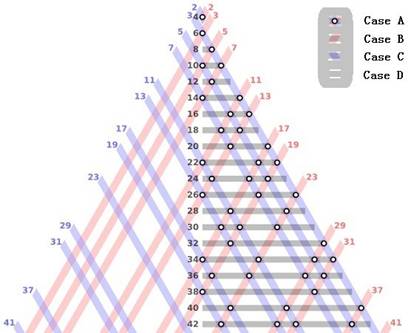
Figure 1: Goldbach Partition Pyramid
CONCLUSION
All the even numbers great than 40 can all be expressed as the sum of two
prime numbers, finding these primes is hard by using hand calculation though,
as such, we made a program in Matlab
to compute that. This matrix based method will be supported with the Matlab
program available on Matlab server, showing
that the any even number can
be split into two prime numbers.
AUTHOR CONTRIBUTIONS
Mr. Mi Zhou conceived and
derived the original work that led
to this submission, responded many comments from experts in the number theory
in the past three years, he made the corrections, and played
an important role in completing the final results. Prof. Steed Huang
contributed to polishing and preparing of the
manuscript, adding introduction, modulo
representation and references, besides providing the guidance and encouragement.
REFERENCES
[1] Eric W. Weisstein, "Goldbach Number",
MathWorld; http://mathworld.wolfram.com/GoldbachNumber.html
[2]
Tomás Oliveira e
Silva, "Goldbach conjecture verification", http://sweet.ua.pt/tos/goldbach.html
[3]
Jeff Law, "The Circle Method on the Binary Goldbach
Conjecture", 36 Pages Report, Mathematics Department, Princeton
University, April 3, 2005.
[4]
Jingrun Chen, "On the representation of a large even integer as the sum of a prime and the product
of at most two primes". Kexue Tongbao 11
(9): 385–386, 1966.
[5]
Henry
F. Fliegel; Douglas S. Robertson, "Goldbach's Comet: the numbers related
to Goldbach's Conjecture”, Journal of Recreational
Mathematics, v21(1) 1-7, 1989.
[6]
Roger
Ellman, A PROOF OF "GOLDBACH'S CONJECTURE", May 10, 2000, Roger
Ellman, 320 Gemma Circle, Santa Rosa, CA 95404, USA.
[7]
Subhash Kak, Goldbach Partitions and
Sequences, Resonance, Volume 19, Issue 11,
pp 1028-1037, November 2014,.
[8] Roger Howe, “A Biographical Memoir for Harish
Chandra”, National Academy of Sciences, 2011.
Cite this Article: Zhou M; Huang S (2015). Lifting Chandra
Matrix to Solve Goldbach Conjecture. Greener Journal of Science Engineering and
Technological Research, 5 (2): 26-32, http://doi.org/10.15580/GJSETR.2015.2.072415103.