|
Greener Trends in Plant Pathology and Entomology
Vol. 2(2), pp. 19-28, 2019
ISSN: 2672-4510
Copyright ©2019, the copyright of this article is
retained by the author(s)
DOI Link: https://doi.org/10.15580/GTPPE.2019.2.070519127
https://gjournals.org/GTPPE
|

|
Field Evaluation of the Insecticidal Activity of Some
Plant Extracts against Major Insect Pests of Mung
bean (Vigna radiata L. Wilczek) in Nigeria
*Emeasor, KC; Ngwobia, MU
Department of Plant Health
Management, Michael Okpara University of Agriculture Umudike, P.M.B. 7267 Umuahia, Abia State Nigeria.
|
ARTICLE INFO
|
ABSTRACT
|
|
Article No.: 070519127
Type: Research
DOI: 10.15580/GTPPE.2019.2.070519127
|
A field trial was conducted at the Teaching and Research Farm of the
Michael Okpara University of Agriculture, Umudike during
the 2018 cropping season to evaluate efficacy of selected plant extracts from
five plant species against insect pests of Mung bean
(Vigna radiata L. Wilczek). The extracts tested were obtained from leaves
of Vernonia amygdalina,
Tephrosia vogelii, Alchornea cordifolia,
Azadirachta indica, Moringa oleifera and
untreated plot was introduced as the check (control) in the trial. The
experimental design was a Randomized Complete Block Design (RCBD) with four
replicates. Data were collected weekly on the insect population densities,
yield and yield components. The results indicated that there was a
significant P<0.05) reduction in the population of insects on the plots
treated with plant extracts compared with the control plot. The results
indicated that all the treatments were effective against major field insect
pests of Mung bean (Aphis craccivora (Aphid), Ootheca mutabilis, (brown
leaf beetle), Megalurothrips sjostedti (flower
bud thrips), Maruca vitrata (legume pod borer), and pod
sucking bugs (Nezara viridula “green
vegetable bug”), (Riptortus seripes “large
brown bean bug”), Anoplocnemis curvipes, Melanacanthus scutellaris
(small brown bean bug). Plots treated with Tephrosia vogelii recorded high insecticidal
properties when compared with other plant extracts. The plots treated with Tephrosia vogelii and
Moringa oleifera recorded
the highest grain yield of 406.0kg/ha and 289.5kg/ha in 2018 cropping season.
All the plant extracts used exhibited insecticidal activity against insect
pests of Mung bean in the field.
|
|
Submitted: 05/07/2019
Accepted: 30/07/2019
Published: 25/09/2019
|
|
*Corresponding Author
Emeasor,
KC
E-mail: kingsleychidiemeasor@ yahoo.com
|
|
Keywords: Plant extracts; Insecticides; Insect pests; Mung bean
|
|
Peer Review Link: https://gjournals.org/GTPPE/peer-review/2019/070519127.pdf
|
|
|
|
INTRODUCTION
Mung bean (Vigna radiata ) (L) Wilczek belongs to the
family Fabaceae. The genus Vigna
has been broadened to include about 150 species but only twenty-two species are
native to India (Pochill and Vander, 1995) where they
are grown in large numbers and are often grouped under distinct varieties and
sub-species. The annual world production area of Mung
bean is about 5.5 million ha of which about 90% is confined to Asia (Lambrides and Godwin, 2007). Mung
bean is grown on more than 6million ha worldwide (about 8.5% of global pulse
area). India is the leading producer of Mung bean
with 65% of the world average and 54% of the global Mung
bean production (Lambrides and Godwin, 2007;
http://avrdc.org/intl.mungbean-network, 2019).
A minimum intake of pulse by a human should be 80.0g per day (FAO,
1999). It is an important source of protein and several essential
micronutrients. It contains 24.5% protein and 59.9% carbohydrate, 75mg calcium,
8.5mg iron and 49mg β-carotine per 100g of
grains (Bakrr et
al., 2004). Among pulses, mung bean is favoured for children and the elderly people because of its
easy digestibility and low production of flatulence. It is drought tolerant,
grown twice a year and fits well in our crop rotation program. Production of Mung bean is however hampered by insect pest attack as it
tends to increase yield loss. Insect pests that attack Mung
bean can be distinguished based on their appearance in the field as it is
related to the phenology of Mung bean plant. They are
stem feeders, foliage feeders, pod feeders and storage pests. Mung bean is attacked by different species of insect pests
especially sucking insect pests (aphid, jassids,
white leaf hopper and white fly) are of the major importance (Islam et al., 2008). Aphids, jassids, whiteflies, pod borer, thrips,
stemflies are pests of Mung
bean which are vectors of yellow mosaic virus (MYMV) disease, which is the
major cause of unsuccessful cultivation of Mung bean.
These insect pests not only reduce the vigor of the plant by sucking the sap
but transmit diseases and affect photosynthesis as well (Sachan
et al., 1994). Although many options
are available for the management of these insect pests, farmers mostly use
synthetic chemicals because of their quick effect with or without knowing the
ill effects of these chemicals; the recurrent use of chemical insecticides
destabilizes the ecosystem and enhances the development of resistance to pest
population (Asawalam and Ekemezie,
2018). Previously many research workers have also used and evaluated different
synthetic chemicals against different insect pests of Mung
bean. These conventional chemical control measures adequately control these
pests but the indiscriminate use of these chemicals for the control of insect
pests leads to phyto-toxicity, environmental
pollution and insect resistance resulting in severe yield losses.
The objectives of this research were to identify the
major insect pests associated with Mung bean, to
evaluate the insecticidal potentials of selected plant extracts for the control
of insect pests of Mung bean in the field and to
evaluate the effect of these treatments on the yield and yield components of Mung bean.
MATERIALS
AND METHODS
Experimental
Site
The experiment was carried out at the Teaching and
Research Farm of the Department of Plant Health Management, Michael Okpara University of Agriculture, Umudike
(longitude 07033E, latitude 05029N, altitude 122m) with
annual rainfall of 2177mm, 27% relative humidity,
monthly and ambient temperature of 170C to 360C. The
climate is a rainforest environment characterized by a long rainy season (7-8
months) and a short dry weather of (3 months) with light sandy soil.
Field Operation
The experimental site was cleared with machete and beds
were made using hoe. Planting was done in the month of April 2018. The
experimental bed size was 2.4m x 3m, with inter-bed space of 1.5m. Three Mung bean seeds per hole were sown at the spacing of 60cm x
30cm. Seeds that failed to germinate were supplied 4 days after planting, and
thinning to one plant per stand took place 10 days after plant emergence. Each
experimental plot consisted of the rows of 10 plants to give 40 plants per
plot.
Planting
Materials and Experimental Design
The variety of Mung bean used
in this study is the bold seeded variety, VC6372 (48-8-1) of Mung bean obtained from Department of Agronomy, College of
Crop and Soil Sciences. The treatments
in (Table 1) were five plant materials. The experiment was laid out in a
Randomized Complete Block Design (RCBD) with four replicates.
Table 1:
Plants evaluated for insecticidal properties
|
Scientific Name
|
Common name
|
Family
|
Part used
|
|
Alchornea cordifolia
|
Christmas bush tree
|
Euphorbiaceae
|
Leaves
|
|
Azadirachta indica
|
Neem
|
Meliaccae
|
Leaves
|
|
Tephrosia vogelii
|
Fish poison-bean
|
Fabaceae
|
Leaves
|
|
Moringa oleifera
|
Moringa (Drumstick tree)
|
Moringaceae
|
Leaves
|
|
Vernonia amygdalina
|
Bitter leaf (Onugbu)
|
Asteraceae
|
Leaves
|
During the spray operations, a polythene sheet (1m high) was
held and lowered to stop the drift of insecticide from each nursery bag. A
control was set up in which there was no treatment.
Preparation of Plants Extracts and Application of
Treatments
The leaves of Azadirachta indica, Moringa oleifera, Vernonia amygdalina, Alchornea cordifolia and Tephrosia vogelii were collected from Umudike
environment.
Fresh and mature leaves of the botanicals
were plucked and air-dried to a very low moisture level so as to make sure that
the process of drying did not affect the potency of the active ingredients.
Thereafter, the plant materials were milled with a milling machine so that the
active ingredient in the leaves can be freely released in water. Afterward,
300g of the blended leaves from each botanical were soaked in 4 litres of distilled water and the mixtures were allowed to
stand for 24 hours after which the mixtures were filtered using a muslin cloth
to obtain a homogenous filtrate that was used for spraying. The five (5)
botanicals were sprayed at weekly intervals with the aid of a hand sprayer.
Experimental
evaluations of A. craccivora
damage assessment
A. craccivora infestation was assessed by visual rating on a 10 point
scale (Table 2) (Litsinger et al., 1977). Ten randomly selected Mung
bean plants tagged in the two middle rows of each plot was used. Each stand was
carefully inspected and the size of A. craccivora colony on each plant was rated, recorded and
the mean of the 10 plants were calculated. Observations commenced from 26 days
after planting (DAP), between 8.00 – 10.00am. Six weekly observations were
made.
Table 2: Scale for rating Aphids infestation
on Mung bean
|
Rating
|
Number of Aphids
|
Appearances
|
|
0
|
0
|
No infestation
|
|
1
|
1-4
|
A few individual Aphids
|
|
2
|
5-10
|
A few isolated colonies
|
|
3
|
11-30
|
Several small colonies
|
|
7
|
31-50
|
Large isolated colonies
|
|
9
|
> 50
|
Large continuous colonies
|
Source: Iitsinger et al., 1997
Experimental evaluations of Megalurothrips sjostedti damage
assessment
Megalurothrips sjostedti damage to Mung bean was assessed between 8.00 – 10.00am beginning from 30 DAP. Ten Mung bean stands
were randomly tagged from the two middle rows of each plot and each stand were
inspected for damage and rated on a scale of 1-9 points (Table 3), based on M. sjostedti
symptoms such as browning/drying of stipulus and
leaves and bud abscissions. Mean for the 10 stands were calculated. Four
observations were made at 6 days intervals.
Table 3: Scale for rating flower bud thrips infestation on Mung bean
|
Rating
|
Appearance
|
|
1
|
No browning/drying (that’s scaling) of stipules, leaf
or flower buds, no bud abscission
|
|
3
|
initiation of browning of stipules and leaf or flower
buds, no bud abscission
|
|
7
|
serious bud abscission accompanied by browning drying
of stipules and buds, non-elongation of peduncles
|
|
9
|
very severe bud abscission, heavy browning drying of
stipules and buds, distinct non-elongation of (most or all) peduncles
|
Source:
Jackai and Singh, 1988
A second assessment of thrips
was carried out at 45 DAP. At least 10 flowers were randomly picked from the
two rows set aside for data collection. Also, the population of M. sjostedti
in each flower was determined by counting when the flowers are opened.
Experimental evaluations of Maruca vitrata assessment
Damage to Mung bean pod by Maruca vitrata was
determined in the field between 3-5pm beginning from 45 DAP at 5 days
intervals. The presence of holes and larva on flowers was the Maruca damage
index. Ten flowers were randomly selected from the two outer rows of each plot.
Each flower was carefully open and inspected the spot for Maruca larva or flower damage.
The mean for the 10 flowers were calculated. Four observations were made.
Table 4: Scale for rating Maruca vitrata damage to Mung
bean
|
Pod Load
(PL)
|
Pod Damage
(PD)
|
|
Rating
|
Degree of podding
|
Rating
|
%
|
|
1
|
Mot most ( < 60% peduncles bare (that’s no pods)
|
1
2
|
6 – 10
11 – 20
|
|
2
|
31 – 50% peduncles bare
|
3
|
21 – 30
|
|
5
|
16 – 30% peduncles bare
|
4
5
6
|
31 – 40
41 – 50
51 – 60
|
|
7
|
up to 15% peduncles bare
|
7
8
|
61 – 70
71 – 80
|
|
9
|
occasional bare peduncles
|
9
|
81 – 90
|
Source: Jackai and
Singh 1988
Assessment of pod sucking bugs (PSB)
infestation
Population of pod sucking bug on Mung
bean stands in the two middle rows was determined by counting weekly between
8.00 – 10.00am at 45 days after planting. Since all PSBs do similar damage, all
will be counted together. Four observations were made (Egho
and Emosairue 2010).
Yield assessment
Pod load and pod damage: At 60 DAP
When the pods are filled, mature but still green, the pod
load and pod damage were assessed in the field by rating on a scale of 1-9
points (Jackai and Singh, 1988) from the two rows of
each plot. Maruca
damage index used where holes and presence of frass
on pods and sticking of pods.
Number of pods per plant
At 60 DAP numbers of pods per plant were assessed from
the 2 middle rows of each plot by visual counting. The numbers of pods were
divided by the number of Mung bean plants and the
value recorded.
Grain yield
At 65 to 70 DAP the pods were harvested for hands into black
medium sized polythene bags. They were sun dried for 2 weeks and then shelled
with hands. Then grains were weighed with Triple Beam Balance (Haus Model) and the weight recorded. The yield per plot was
extrapolated to Kg ha-1. One hundred (100) seeds were handpicked
from the grains in bags (plot) weighed and the weight recorded (Egho and Emosairue, 2010).
STATISTICAL ANALYSIS
All the collected data were subjected to analysis of
variance (ANOVA) and significant means were separated by Fisher’s Least
Significance Difference Test (LSD) at 5% level of probability.
Field layout of the experiment
|
Replicate I
|
|
Replicate II
|
|
Repijcate III
|
|
Replicate IV
|
|
|
|
Tephrosia vogeli
|
|
Moriger oleifera
|
|
Tephrosia vogeli
|
|
Moriger oleifera
|
|
Trt. I
|
|
|
|
|
|
|
|
|
|
|
|
Moriger oleifera
|
|
Alchornea cordifolia
|
|
Azadirachta indica
|
|
Azadirachta indica
|
|
Trt. II
|
|
|
|
|
|
|
|
|
|
|
|
Azadirachta indica
|
|
Vernonia amygdalina
|
|
Vernonia amygdalina
|
|
Vernonia amygdalina
|
|
Trt.
III
|
|
|
|
|
|
|
|
|
|
|
|
Vernonia amygdalina
|
|
Azadirachta indica
|
|
Moringer oleifera
|
|
Control
|
|
Trt. IV
|
|
|
|
|
|
|
|
|
|
|
|
Control
|
|
Tephrosia vogelii
|
|
Control
|
|
Alchornea cordifolia
|
|
Trt. V
|
|
|
|
|
|
|
|
|
|
|
|
Alchornea cordifolia
|
|
Control
|
|
Alchornea cordifolia
|
|
Tephrosia vogelii
|
|
Trt. VI
|

RESULTS
Effects of plant extracts on aphid incidence on Mung bean
The result
in Table 5 showed that aphids population was higher at 4 weeks after planting
(WAP) and 5 WAP) and significantly and consistently (P<0.05) reduced from (6
WAP to 9 WAP) in all the treatments.
Among the treatments at 6 WAP, T. vogelii had the least number of aphids
infestation (2.52) which was not significantly different (P<0.05) from M. oleifera (5.15)
but significantly different from A. indica, V. amygdalina, A. cordiforlia (8.4, 8.35 and 10) respectively. The result
observed at 7 WAP was similar to that of 6 WAP. At 8 WAP and 9 WAP there were
significant (P<0.05) difference among all the plant extracts in reducing
number of aphids infestation. However, T.
vogelii had the least number of aphids
infestation (1.02 and 0.75) which was significantly different (P<0.05) from
the control that had the highest aphids population (26.98 and 38.45).
Table 5: Effect of treatments on incidence of aphid on Mung bean
|
Treatment
|
Aphids infestation
|
|
4 WAP
|
5 WAP
|
6 WAP
|
7 WAP
|
8 WAP
|
9 WAP
|
|
Tephrosia vogelii
|
4.38
|
4.38
|
2.52
|
1.05
|
1.02
|
0.75
|
|
Moringa oleifera
|
9.35
|
9.0
|
5.15
|
4.75
|
3.47
|
1.3
|
|
Azadirachta indica
|
10.28
|
9.55
|
8.4
|
5.8
|
2.07
|
2.4
|
|
Vernonia amygdalina
|
12.78
|
6.75
|
8.35
|
5.6
|
3.72
|
3.28
|
|
Alchornea cordifolia
|
6.83
|
12.18
|
10
|
8.77
|
5.42
|
3.93
|
|
Control
|
16.12
|
16.43
|
17.23
|
17.62
|
26.98
|
38.45
|
|
Mean
|
9.95
|
9.71
|
8.61
|
7.27
|
7.12
|
8.35
|
|
LSD (0.05)
|
4.874
|
4.85
|
4.451
|
4.404
|
3.889
|
3.272
|
|
CV (%)
|
2.7
|
5.2
|
10.1
|
10.5
|
20.6
|
12
|
*
Effects of plant extracts on the population of Ootheca mutabilis in
the field
The
population of O. mutabilis
decreased with weekly application of aqueous plant extract treatments
compared to control that increased weekly (Table 6). At 4 WAP, the minimum
number of O.mutabilis was observed at T. vogelii (2.8) which was not
significantly (P>0.05) different from plots treated with M. oleifera, A. indica and V. amygdalina (4.4, 3.9 and 3.6) but significantly
different (P<0.05) from A. cordifolia (5.6) and control (16.8) that recorded the
highest number of O. mutabilis.
Similar result was observed at 5 WAP. At 6 WAP and 7 WAP.
There were no significant (P>0.05) differences among the plant extracts,
however, T. vogelii
recorded the least number of O. mutabilis (1.9 and 1.4) which was significantly
(P<0.05) different from control (19.0 and 18.0) respectively.
Table 6: Effect of plant extract on the population of Ootheca mutabilis in
the field
|
Treatment
|
Ootheca mutabilis count
|
|
1WAP
|
2WAP
|
3WAP
|
4WAP
|
5WAP
|
6WAP
|
7WAP
|
|
Tephrosia vogelii
|
4.0
|
3.3
|
3.8
|
2.8
|
2.7
|
1.9
|
1.4
|
|
Moringa oleifera
|
5.7
|
5.4
|
5.1
|
4.4
|
4.4
|
3.5
|
3.2
|
|
Azadirachta indica
|
5.6
|
4.5
|
4.7
|
3.9
|
3.9
|
3.1
|
2.7
|
|
Vernonia amygdalina
|
9.2
|
8.4
|
5.0
|
3.6
|
3.6
|
2.8
|
1.6
|
|
Alchornea cordifolia
|
5.3
|
4.9
|
6.2
|
5.6
|
5.6
|
4.9
|
3.2
|
|
Control
|
10.4
|
12.5
|
13.6
|
16.8
|
16.8
|
19.0
|
18.0
|
|
Mean
|
6.7
|
6.5
|
6.4
|
6.2
|
6.2
|
5.9
|
5.0
|
|
LSD (0.05)
|
2.2
|
1.5
|
1.3
|
2.0
|
2.0
|
2.9
|
5.5
|
|
CV (%)
|
3.5
|
7.2
|
5.1
|
10.6
|
11.1
|
16.8
|
18.0
|
Effects of plant extracts on the population of flower bud
Thrips on Vigna radiata in the Field
Data on
flower bud Thrips were recorded and analysed statistically as presented in Table 7. The result
of flower bud thrips showed that all the aqueous
plant extracts significantly (P<0.05) reduced the number of flower bud thrips with weekly application of treatments compared to
untreated control that increased in number weekly. At 4 WAP, T. vogelii had
the lowest number of flower bud thrips (Maruca vitrata) (7.8)
which was not significant from M. oleifera, A. indica and V. amygdalina (10.1, 11.1 and 10.8) but significantly
different from A. cordifolia
(12.6) and control that had the highest number of flower bud thrips (16.2). Similar result was observed in 5WAP and 6
WAP. At 7 WAP, there were no significant (P>0.05) differences among all the
aqueous plant extracts in number of flower bud thrips
recorded but significant (P<0.05) difference from control with highest
number of flower bud thrips (22.8). Among the plant
extracts, T. vogelii
had the least number of flower bud thrips (1.6)
followed by A. indica
(3.0), M. oleifera
(3.1), V. amygdalina
(3.9) and A. cordifolia
(4.9) respectively.
Table 7: Effect of plant-extracts on the population of
flower bud Thrips on Vigna radiata in the Field
|
|
Population of Flower bud Thrips
at
|
|
Treatment
|
|
4 WAP
|
5 WAP
|
6 WAP
|
7 WAP
|
|
Tephrosia vogelii
|
7.8
|
6.3
|
4.1
|
1.6
|
|
Moringa oleifera
|
10.1
|
8.2
|
6.2
|
3.1
|
|
Azadirachta indica
|
11.1
|
7.6
|
5.1
|
3.0
|
|
Vernonia amygdalina
|
10.8
|
10.3
|
7.1
|
3.9
|
|
Alchornea cordifolia
|
12.6
|
11.0
|
8.2
|
4.9
|
|
Control
|
16.2
|
16.9
|
17.6
|
22.8
|
|
Mean
|
11.4
|
10.0
|
8.1
|
6.5
|
|
LSD (0.05)
|
3.7
|
3.1
|
2.4
|
4.4
|
|
CV (%)
|
15.1
|
14.8
|
11.3
|
8.6
|
Effects of plant extracts on the population of legume pod
borer on Vigna radiata in
the field
The effect of
some plant extracts on the incidence of legume pod borer is shown in Table 8.
The result of legume pod borer showed that, all the treatments significantly
(P<0.05) reduced the number of legume pod borer weekly with weekly
application of treatment compared to control in which legume pod borer
increased weekly. At 8 WAP and 9 WAP, T. vogelii exhibited
the lowest number of legume pod borer (1.1 and 1.3) which was not significantly
(P>0.05) different from other treatments but statistically different from control
that had highest number of legume pod borer (19.5 and 21.6).
Table 8: Effect of plant extracts on the population of
legume pod borer on Vigna radiata in
the field
|
|
Population of Legume pod borer at
|
|
|
Treatment
|
|
6 WAP
|
7 WAP
|
8 WAP
|
9 WAP
|
|
Tephrosia vogelii
|
3.8
|
2.8
|
1.1
|
1.3
|
|
|
Moringa oleifera
|
10.0
|
5.2
|
2.3
|
0.5
|
|
|
Azadirachta indica
|
3.7
|
2.1
|
1.0
|
1.6
|
|
|
Vernonia amygdalina
|
7.6
|
4.1
|
2.3
|
2.2
|
|
|
Alchornea cordifolia
|
12.8
|
7.4
|
4.5
|
0.5
|
|
|
Control
|
14.1
|
17.8
|
19.5
|
21.6
|
|
|
Mean
|
8.7
|
6.6
|
5.1
|
4.6
|
|
|
LSD (0.05)
|
4.0
|
2.2
|
2.1
|
1.3
|
|
|
CV (%)
|
21.9
|
17.4
|
8.1
|
5.8
|
|
|
|
|
|
|
|
|
|
|
|
|
Effects of plant extract on the population of pod sucking
bug attacking Mung bean (Vigna radiata) in the field
Result in
Table 9 revealed that the plant extracts significantly (P<0.05) reduced pod sucking
bug infestation in the field. From general point of observation, all the tested
plant-derived insecticide were effective against pod sucking bugs on Mung bean compared to the control plot (16.98) which is the
untreated plot. At 4 WAP and 5 WAP, the infestation level of pod sucking bug
was very high on the plots treated with V.
amygdalina, A. cordifolia
and A. indica (12.78, 12.18 and 10.28)
respectively. Reduction in the population of pod sucking bug was observed at
7WAP to 9WAP. However, T. vogelii leaf aqueous extract was most effective against
pod sucking bug at 9WAP (0.75) which was not significantly different
(P>0.05) from the plots treated with M.
oleifera (1.3), A. indica (2.4), V. amygladina (3.28) and A. cordifolia (3.93).
However, the results also show that the control plot had the highest level of
infestation and reduction of pod sucking bug was lowest, hence the plots
treated with plant derived insecticide were significantly different (P<0.05)
from the control plot.
Table 9: Effect of plant extract on the population of pod
sucking bug attacking Mung bean (Vigna radiata) in the field
|
Pod sucking bug
|
|
Treatment
|
6 WAP
|
7 WAP
|
8 WAP
|
9 WAP
|
|
Tephrosia vogelii
|
8.65
|
6.22
|
3.8
|
2.13
|
|
Moringa oleifera
|
11.25
|
10.75
|
5.32
|
5.5
|
|
Azadirachta indica
|
8.3
|
7.35
|
4.72
|
4.43
|
|
Vernonia amygdalina
|
11.38
|
11.25
|
6.22
|
6.3
|
|
Alchornea cordifolia
|
11.77
|
11.2
|
6.42
|
7.68
|
|
Control
|
13.02
|
17.47
|
13.73
|
16.98
|
|
Mean
|
10.73
|
10.71
|
6.7
|
7.17
|
|
LSD (0.05)
|
2.318
|
2.559
|
2.058
|
1.987
|
|
CV (%)
|
6.5
|
6.5
|
13
|
13
|
Effects of plant extract application on pod damage by Mung bean per plant
Fig. 1 shows
the effects of plant extracts on pod damage. The results of the study indicated
that the plot treated with T. vogelii leaf aqueous plant extract had the lowest pod
damage per plant (3.9) followed by A. indica (6.3) and M.
oleifera (6.4) which had significant difference
at (P<0.05) from control which had the highest pod damage per plant (14.5).
The results also indicated that all the plant-derived insecticides were able to
reduce the number of pod damage significantly (P<0.05). However, A. cordifolia (8.2)
and V. amygdalina
(7.1) were poorly effective in the reduction or control of pod damage per
plant.
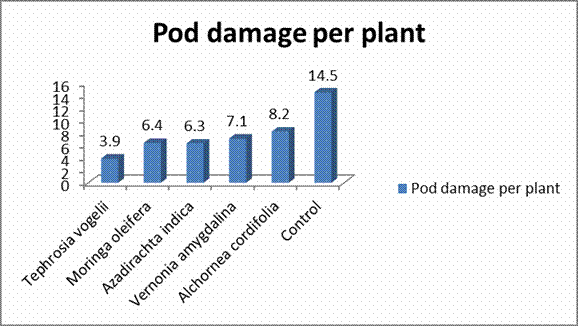
Figure 1: Effects of plant extract
application on pod damage by Mung bean per plant
Effects of plant extract on yield and yield related
traits of Mung bean (Vigna radiata)
Table 10
shows the effects of some plant extracts on the yield and yield components of Mung bean. The result obtained showed that with respect to
number of pod per plant, plants treated with T. vogelii produced the highest number of
pod (27.2), followed by plot treated with M.
oleifera (17.4). However, the control plot
recorded the least number of pod per plant (7.2). This
was followed by plants treated with V. amygdalina that had 7.5 number of pod per plant.
Table 10: Effects of plant extract on the yield and yield
related traits of mungbean (Vigna radiata)
|
Treatment
|
Number of pod per plant
|
Pod yield per plant (g)
|
Grain yield per plant (g)
|
Grain yield per hectare (kg/ha)
|
|
Tephrosia vogelii
|
27.2
|
345.3
|
243.6
|
406.0
|
|
Moringa oleifera
|
17.4
|
234.4
|
173.7
|
289.5
|
|
Azadirachta indica
|
15.0
|
207.2
|
133.1
|
221.8
|
|
Vernonia amygdalina
|
7.5
|
132.5
|
78.4
|
130.6
|
|
Alchornea cordifolia
|
9.3
|
115.7
|
83.4
|
138.9
|
|
Control
|
7.2
|
176.7
|
60.3
|
100.4
|
|
Mean
|
13.9
|
202.0
|
128.7
|
214.5
|
|
LSD (0.05)
|
10.3
|
111.6
|
74.5
|
124.2
|
|
CV (%)
|
24.5
|
23.3
|
11.3
|
11.3
|
DISCUSSION
This
research findings support the earlier reports of Russel
and Lane (1993) and Emimal (2010) that plant extracts
consist of complex mixtures of bioactive constituents and plant metabolites
which produce toxic effects if ingested by the insect pests and leading to
rejection of host plants. Also these bioactive constituents and metabolites act
as anti-feedants which inhibit oviposition,
disturb insect growth and development.
Findings from the present study revealed that all the
plant derived insecticides significantly reduced the population of Megalurothrips sjostedti,
thereby reducing their infestation and enhanced plant growth and yield. These
findings agree with the report of Asawalam (2006) and
Isman (2008) who reported the insecticidal activities
of plant extracts in suppressing the populations of Megalurothrips sjostedti on Mung bean.
The result of the present study also agree with the
findings of Hossain et al., (2010), who reported that the application of neem leaf reduced the population of sucking insects of Mung bean.
The effectiveness of T.
vogelii and M.
oleifera in controlling insect pests of Mung bean in this study agree with the finding of Alao and Timothy (2015) that evaluated the efficacy of T. vogelii and
M. oleifera extracts
at three concentrations (5, 10 and 20% v/v) against insect pests of water
melon. It was reported that M. oleifera extracts had 62% reduction of Phyllotreta cruciferae compared
with T. vogelii
that had 45% control. However, T. vogelii extract had 64% control of Diabrotica undecimpunctata and Bactrocera curcubitea but M. oleifera extract had 50% control.
The results are in agreement with that of Asawalam and Osondu (2013) and Ibekwe and Emosairue (2011) who
reported reduced pod damage on cowpea treated with plant extract. The reduced
pod damage with the plant extract could be because of the ability of the plant
extracts to penetrate tissues of the insects, thereby disrupting the cell cycle
(Isman, 2008).
Rouf and Sardar (2011) reported a significant reduction in pod
damage with significantly higher yield of Country bean treated with crude seed
extract of neem. This result also agree with that of Asawalam and Constance, (2018) who reported that plant
extracts from different parts of A. indica, Allium sativum, C. longa,
M. paradisiacal, O. gratissimum, V. amygdalina and X.
aethiopica have insecticidal activity against
insect pests of Mung bean. This result also agrees
with Emeasor et
al., (2017). Who reported that the plant derived insecticides used for the
control of P. uniforma,
and P. sjostedti
in okra field were effective and significantly reduced the population of
the insect pests.
This result also agree with the findings of Ogunjobi and Ofuya (2007), Adesina and Idoko (2013) and Adesina and Afolabi (2014), who
reported in their various works that okra plants treated with plant extracts
recorded higher yield compared to the untreated okra plants.
CONCLUSION
Insect pest
infestation is one of the factors militating against effective and meaningful
cultivation of Mung bean. The results from this study
showed that the major insect pests identified in Mung
bean cultivation in Umudike, Nigeria were Aphis craccivora,
Ootheca mutabilis, Megalurothrips sjostedti, Maruca vitrata and the pod
sucking bugs. It also showed that the treatments significantly (P<0.05)
lowered insect populations as recorded in the plots treated with the plant
extracts (Vernonia amygdalina, Tephrosia vogelii, Alchornea cordifolia, Azadirachta indica, Moringa oleifera) when
compared with the control. The study
showed that yield and yield parameters were significantly higher in treated
plots than in the control plots. The findings demonstrated that the application
of plant-derived insecticides significantly reduced the population of the major
field insect pests of Mung bean, thereby minimizing
leaf surface area damage, pod damage and consequently increased yield compared
to the untreated Mung bean plants. The plant
materials reduced population of insects mainly due to contact toxicity and
action upon the nervous system of the insects. Based on the results of this
study, it is recommended that concerted efforts should be made towards the
enhancement of extraction and formulation of the active ingredients of these
botanicals at the best dosages. It is also recommended that T. vogelii, A. indica, A. cordifolia, M. oleifera and V. amygdalina be
widely adopted low-input and organic farmers for the control of insect pests of
Mung bean; since these plant-derived insecticides are
readily available have low phyto- and mammalian
toxicities.
REFERENCES
Adesina, J.M. and Afolabi, L.A.
(2014). Comparative bio-efficacy of aqueous extracts
of Loncocarpus cyanenscens
and Trema orientalis
against flea beetle (Podagrica spp.) (Coleoptera: Chysomelidae)
infestation and yield of okra. Int.
J. Horticulture. 4(2):4-9.
Adesina, J.M. and Idoko, J.E. (2013). Field evaluation of insecticidal activity of Demopodium abrodiodes
and Spondias mombin crude
extract for the control of okra flea beetle Podagrica uniforma (Coleoptera:Chrysonelidae) RSJ. Agric. Sci. 4(1):37-39.
Alao, F.O. and Timothy A.A. (2015). “Comparative efficacy of Tephrosia vogelii and Moringa oleifera against insect pests of WAP rmelon (Citullus lanatus thumb)’ International
Letters of Natural Sciences 35, 71-78.
Asawalam, E.F. (2006). ‘Effect of four plant extracts on the
infestation of cowpea (Vigna unguiculata L). walp by MegaluroThrips sjostedti (frybom) and Mylabris postulate
Thunberg; Global Journal of Pure and Applied Sciences,12(1), 19-21.
Asawalam, E.F. and Constance, E.E. (2018). “Control of field insect pests of mungbean (Vigna radiata. Wilczek)
using some plant extracts in Umudike Nigeria, Journal of Medicinal Plants for Economic
Development 2(1) a27.
Asawalam, E.F. and Ekemezie, C. (2018). Control of field insect pests of mungbean
Vigna radiata L.
Wilczek using some plant extracts in Umudike Nigeria. Journal of medicinal plants for
Economic development 2(1) 1-5.
Asawalam, E.F. and Osondu, H. (2013). Control of field insect pests of
cowpea (Vigna unguiculata L.
Walp) in Umudike Nigeria
using medicinal plant extracts, Journal
of Sustainable Agriculture and the Environment 14, 31-37.
Bakr, M. A, Afzal, M. A, Hamid, A., Haque, M. M.; and Aktar, M. S. (2004). Black gram in Bangladesh lentil
Blackgram and mung bean
development pilot project, publication no. 25, pulses research centre, BARI Gazipur, bop.
Emeasor, K.C.; Uwalaka, O.A. and Nnaji, M.C. (2017). Use of Plant derived insecticides for the control of Podagrica spp. of Abelmoschus esculentus (L.) in South Eastern
Nigerian. International Journal of
Advance Agricultural Research 5: 95-100
Emimal, V.E. (2010). Pest infestation on the
biochemical modulation of Adhatoda vasica.
Journal of Biopesticides, 3(2):413-419.
FAO. (1999), food and agriculture
organization. Production year book. Rome, Italy.pp.45-48.
Hossain, M. A. I.; K. M. S and Mondal,
A. T. M. A. I. (2000). Effect of
sowing date on lentil Aphid,Aphis
craccivora Koch infestation and yield contributing
characters of lenti (Lens culinatis Medik). Journal of Biological
Science. 8:115-117.
Ibekwe, H.N., and Emosaime, S.O.
(2011). Evaluation of neem
seed kernel extracts for the control of insect pests of mungbean
(Vigna radiata L. Wilczek) in Okigwe South Eastern Nigeria;
Nigerian Journal of Horticultural Science
16, 56-60
Isman, M.B. (2008). Botanical insecticides: for richer for
poor; pest management science 64 (1), 8-11.
Lambrides, C.J. and I. Godwin, (2007). Mung bean in Genome mapping and molecular
breeding in plants 3: pulses, sugar and tuber crops kole.
C. (pd). Spinger,
Berlini pp:60-69.
Ogunjobi, S.O. and Ofuya, T.I. (2007). Field comparism of aqueous neem seed extract and a synthetic
insecticides for reducing post flowering insect attack in cowpea Vigna unguculata (L)
walp in a South Guinea Savannah of Nigeria. In proceeding of the Akure-Humbioldt Kellog/3rd.
SAAT annual conference: medicinal plants in Agriculture. The
Nigerian experience edited: Onibi G.E. Agele S.O. Adekunle VAJ. Olufayo M.O pp. 60-63.
Pochill, R. M. and L. J. G. Vander Maessan
(1995). Taxonomy of grain legume
pp3-36. In R.J. summer field and E.H Roberts (eds) grain legume crops, Collins London.
Rouf, R.M.A and Sardar, M.A.
(2011). “Effect of crude seed extract of some
indigenous plants for the control of
legume pod borer (Maruca vitrata F.) on country benn”, Bangladesh. Journal of Agricultural Research 36(1),
41-50.
Russel, G.B. and Lane, G.A (1993). Insect antifeedants
a new Zealand Plant Protection Conference. Pp. 079-186.
Sachen, J. N.; Yadava, C. P.; Ahmad,
R.; and katti, G. (1994), insect pest management in
pulse crop. In: Dhalivaal,
G.S. and Arora R. (eds) Agricultural insect pest management. Common wealth publishers, New Delbi,
India. Pp. 45-48.
Singh D. P. (2005). Green gram (Vigna radiata and black gram (V. mungo)
improvement India-past, present and future prospects.
Indian J Agric sci. 75: 243- 250.
|
Cite this
Article: Emeasor, KC; Ngwobia, MU
(2019). Field Evaluation of the Insecticidal Activity of Some Plant Extracts
against Major Insect Pests of Mung bean (Vigna radiata L. Wilczek) in Nigeria. Greener Trends in Plant Pathology
and Entomology 9(2): 19-28, https://doi.org/10.15580/GTPPE.2019.2.070519127.
|