INTRODUCTION
Sudan
is characterized by multiple climates that have brought about great diversity
of livestock where camels are concentrated in the northern belt and cows in the
southern and western belts while small ruminants (sheep and goats) spreading in
all parts of Sudan.(El Hag et al.,2001).
In addition to this, the country is endowed with fisheries, poultry and
equine species adapted to the climatic conditions. Rainfall ranges in Sudan from almost zero to
75mm in arid areas and to 1000 mm, at
least while temperatures ranging between 45 degrees (in summer) and to 10
degrees (in winter).Agricultural land represents more than a third of Sudan area,
while actually exploited portion does not exceed 20% of this arable land. Sudan
has water resources with a variety of sources, including the possibility of rain
water harvesting (Khatir and Jadalla, 2014). The importance of the livestock
sector is well recognized by economists and planners. Sudan food supplier animals (cattle, sheep,
goats, camels) were estimated at 105 million heads (MARF, 2015). There are as
well other animals and wild life. The importance of livestock is attributed to
their economic and social contributions
Animal resources in the Sudan that comprised
of sheep, goats, cattle camel, poultry and wild game is mainly dependent on the
natural rangelands as source of feed.
Less important feed sources are crop residues, agro-industrial by-products,
feed of animal origin, fodder crops and synthetic feed (El Hag et al.,2001).
Establishing a competing and sustainable
program for exporting live animals and good quality meat is required in
order to enable the country to meet the international trade standard this
entails a vital effort to improve the livestock production systems based on
natural feed sources mainly rangelands (Ali and Suleiman, 1988). It is important
for this purpose to impose strict hygienic measures to provide healthy and
wholesome meat to fulfill the international requirements and domestic needs.
Natural grazing from rangelands provides very good option for this purpose
(Khatir and Jadalla, 2014).
The rapidly growing livestock population
imposes a continuing pressure on this shrinking range resource. Agricultural
areas, mining and urban residential places are expanding on rangeland (Ali and
Suleiman,1988). On this limited area, livestock population is concentrated with
communal continuous grazing. The eventual result is overgrazing where palatable
species are excessively consumed leading to their disappearance. Since no
systematic activities are carried out to collect seeds of such nutritive and palatable
species, range land will be turned into areas covered with species that are
known being of little acceptance to livestock species with low nutrients
contents (El Hag et al., 2001).
To recommend for candidate species, those
highly good quality and palatable species must be determined, their nutritive
value be accessed before being selected for conservation.
The objective of the study
The
overall objective of the study is to assist in development of sustainable
production systems based on natural grazing from rangelands of the country. The
development of such sustainable livestock production systems is essential since
the natural resources especially browse trees and shrubs are main feed source
in Sudan
Direct objectives of this study is to estimate
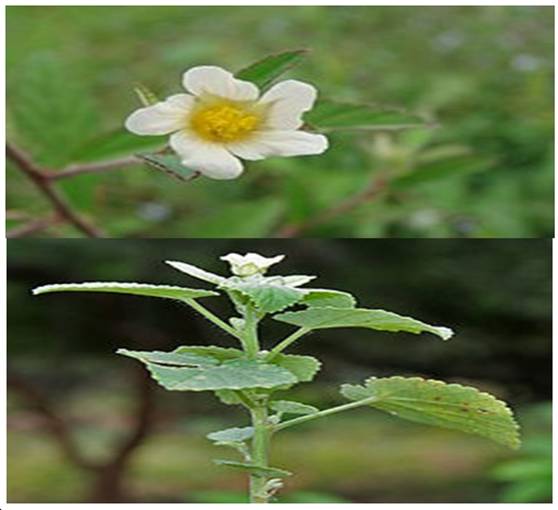
biomass production from Sida alba shrub and its nutritive value, in vitro and in
vivo digestibility and energy value
of this draught resist plant for feeding animals and try to domesticate
it.
MATERIALS AND METHODS
The study area
This
study is conducted in the city of Elobeid, Sheikan locality in North Kordofan
state Sudan. The state lies between the longitude (29o-34’, 300-30’
East) and the latitudes (12o-25’, 13o-30’ North) with an
area of 8080 km2. This City is the capital of Sheikan locality
and North Kordofan State.
Sheikan is characterized by undulating
plains, depressions; sand covered with hilly areas and some mountain clusters.
There are three climatic regions that cover
North Kordofan State. These are dry, semi-arid dry and low rainfall savanna on
sand areas. The long term average rain is between 250-400 mm. The maximum
temperature is 40-42 mm and the minimum is 13°C. In the semi-arid region,
rainfall is between 300-600 mm and the maximum temperature is 390C.
The humidity reaches 25% during the dry
season. In the autumn, the air humidity reaches 65-67% (Elobeid Meteorology
Department office,1999).
Rainfall starts as sporadic showers in May
and becomes regular from June to October.
It usually heavier in July and reaches peak in August before declining
in September to reach its lower pattern in October. Temperatures are modified
by rain at this time though it is hot and humid in general. Temperatures and
precipitation increase the amount of evaporation in July and August and the
highest rainfall recorded in 2010 was 620 mm (Sheikan locality, 2011).
This city is also considered the largest
market for gum Arabic, as primary and important market of livestock brought
from different parts of western and Southern Sudan in a continuous movement of
the presence of different types of animals. There are some food industries and
Agro-industrial companies such as vegetable oil production and flour mills
(Sheikan locality, 2011). Elobeid Petroleum Refinery is set at 10 km from the
city center. In general this city is a main marketing city for the country.
Rural areas are farming and livestock producing areas.
There are trees of Hashab (Acacia senegal), Marrekk (Boscia
senegalensis) and Seyal (Acacia
tortilis) in the northern regions. Southern and central parts are covered
with desert palm (Balanites aegyptiaca), Sidr (Ziziphus spina-christi),
tebeldi (Adansonia digitata) habeel (Combretum cordofanum), kitr
(Acacia mellifera), ghobeesh (Guiera senegalensis), Haraz (Faiherbia
albida), Arrad (Albizzia amara), Aradaib (Tamarindus indica)
and many other trees and shrubs species of the zones indicated above. The under
storey is dominantly covered with herbs such as Alysicarpus species
(Fraisha), Zorniagleo chidiata (lisaig), Cassia obtusiflora (Kawal),
Cassia occidentals (Soreib), Amaranethesis flavicans (Lisaneltair)
, Blepharis inarrifolia (Beghail) and many others. Grasses dominant in this
are Eragrostis tremula (bino), Aristida pallida (gaw), Cenchrus
biflorus (Huskaneet khashin), C.
setigrus (Huskaneet Naeem) Pennisetum pedicellatum (Umdofofo),
sida alba (mug Animals) and others, (Khatir and Jadalla, 2014).
The Experimental Animals
Fifteen
Desert sheep lambs were used in this study.
The animals were divided into three similar groups each with five
animals. The animals were individually penned, equipped with feeding and
drinking troughs. Prior to commencement of treatments the animals were ear
tagged and vaccinated against diseases endemic to the study area. One week is
considered adaptation period where the animals were to be adapted for feed and
treatments.
The animals were weighed at the beginning of
trial, and once every week until the end of the trial to monitor their weight
change as effected by type of rations.
Sampling of Sida alba
1.
For determination of biomass production two
methods were followed. The first technique was to estimate biomass from a
number of shrubs, determine numbers of branches per a shrub, get weight of
leaves per branch, branch and stem diameter were determined to get the amount
of biomass produced in several cuts.
2.
For biomass estimation also forage amount from
unit area was estimated. That was obtained through growing the species in a
plot for three months.
The experimental feed
The
study was proposed to feed the experimental animals three type of feed, these
were:-
A.
natural grazing supplemented with small ruminants concentrate
B.
natural grazing supplemented with Sida alba
biomass
C.
natural grazing alone
Chemical analysis
The
plant biomass was analyzed using proximate analysis, and forage fiber analysis
and minerals, in vitro and in vivo digestibility analysis as
described by The Association of the Official Analytical chemists (A O A C,
2000). In Vitro dry matter and organic matter was determined according to Telly
and Terrie (1967).
Statistical
analysis
The
experimental design was a complete randomized design (CRD) that had three
treatments and five replicates. The data was analyzed using analysis of
variance, (Steel and Torrie (1996). the difference among treatment means were
detected using least significance difference (LSD) (Snecedor and Cochran,
1976).
RESULTS AND DISCUSSION
4.1 Chemical composition of Sida alba leaves
The
biomass production of Sida alba is presented in table (1). Average dry
matter from Sida alba (kg / ha) and the average productivity of dry
matter per plant in grams/plant is also estimated and shown in same table.
Average amount of biomass per a plant was estimated being 75g dry matter from
one cut. This gives an estimation of one feddan (4200m2) that had a
stand of 8400 plants at 630 kilogram (1.5ton per hectare). Since this plant is
perennial, possibly more biomass could be expected in several cuts throughout
the year. The amount of biomass estimated here is comparable to that of results
reported by Jadalla et al.,(2014) who found that Ailanthesis excelsa could produce amount of biomass of 1.75-3 tons
/hectare in two cuts a year. Following
the other method of estimating biomass, the expected amount of biomass in one
cut was 713kg approximately from one feddan (1.697 ton per hectare). Hence this
drought tolerant species is of great potential for production of biomass that
can supplement grazing ruminants on low quality roughage especially during dry
season.
The chemical composition of the Sida alba
plant (Mugshasha) is shown in Table (1). The proximate analysis results of the
biomass harvested from the plant showed that it had 83.2% Dry matter, 72.9%
organic matter, 21.3% crude protein 16.23%
crude fiber, 33.6% Nitrogen free extract and ether extract 1.75% when
sundried and analyzed.
Table (1)The chemical
composition of ingredients used in formulating the rations in the trial
|
FEED
|
DM
|
OM
|
CP
|
CF
|
EE
|
NFE
|
ASH
|
|
GNSC
|
90.52
|
79.55
|
23.3
|
6.5
|
4.5
|
28.55
|
10.97
|
|
Sorghum grains
|
95.5
|
92.9
|
10.9
|
2.3
|
3.2
|
75.31
|
2.6
|
|
Wheat bran
|
90.78
|
85.38
|
16.92
|
12.5
|
4
|
51.96
|
5.40
|
|
Sida alba
|
83.2
|
72.9
|
21.3
|
16.23
|
1.75
|
33.6
|
10.31
|
|
Natural grazing
|
95.51
|
88.23
|
4.11
|
37.25
|
1.23
|
48.10
|
7.28
|
GNSC=groundnut
seed cake, DM=Dry matter, OM=Organic matter CP=Crude protein, CF=Crude fiber,
EE=Ether extract, NFE=Nitrogen free extract.
Chemical
composition of ingredients used in formulation of rations usually fed to sheep
is also presented in Table (1). Those ingredients were groundnut, sorghum
grains, wheat bran and natural grazing.
Table (2) rations
chemical composition an affected by supplementation with Sida alba
leaves in the ration
|
Ration
|
DM
|
OM
|
CP
|
CF
|
NFE
|
EE
|
ASH
|
|
I
|
95.5
|
88.2
|
4.11
|
37.5
|
48.10
|
1.2
|
7.3
|
|
II
|
83.2
|
72.9
|
21.3
|
16.2
|
33.6
|
1.7
|
10.3
|
|
III
|
94.0
|
91.9
|
13.2
|
2.3
|
73.9
|
2.5
|
2.0
|
I=Natural
grazing ,II=Natural grazing plus sida
alba , III=Natural grazing plus concentrate .
Chemical composition of the rations as
affected by supplementation with Sida alba leaves is presented in table
(2).
Dry matter was similar in ration I and III
where ration I was natural grazing only ration III was natural grazing and
concentrate .Dry Matter was lowest in ration II that was formulated with
natural grazing and Sida alba leaves .the value of dry matter were 95.5%
,83.2and 94% for ration I ,II and III respectively .
Organic matter was the highest in ration III
(Natural grazing plus concentrate) followed by ration I (natural grazing ) and
lastly ration III (Natural grazing plus Sida alba ) .
Crude protein was highest in ration II (22%)
where sida alba leaves were added to natural grazing while in ration III at
23.2% CP and was next to ration II and ration I had the lowest value of crude
protein .there were significant differences among the ration in crude protein .
Nitrogen free extract (NFE) was the highest
in ration III (Natural grazing supplemented with concentrate followed by the
natural grazing and lastly that of natural grazing supplemented with Sida
alba leaves .
Ether extract (EE) was the highest in natural
grazing supplemented with concentrate followed by the ration containing natural
grazing plus sida alba .
The lowest EE was that of the natural grazing
only .the three feed had 1.2 ,1.7 and 2.5% EE for ration I ,II and III
respectively .
Ash in the three rations was 7.3, 10.3 and
2.0 % for natural grazing alone, natural grazing plus Sida alba and
natural grazing supplemented with concentrate ration.
General performance of the experimental animals
General
performance of the Desert sheep lambs on natural grazing with Sida alba
biomass, supplemented with small ruminants' ration or only natural grazing is
presented in Table 4.
The treatments were three where the first one
was natural grazing the second supplementation with Sida Alba leaves and
their one was natural grazing supplemented with concentrate. In each treatment
five animals were used. The trial extended for sixty days .The first group
consumed 1316.73g and second 1381.50g and the last consumed 1207.65g a day.
The weight change amount to 2.6, 3.3 and 5.4
kg, during the experimental period hence live weight gain during the daily
weight gain was 42.8,53.8 and 58.9 g per a day for group I on the natural
grazing , group II supplemented with Sida alba leaves and the group the
group on natural grazing supplemented with concentrate
CONCLUSION
The
study concluded that sida alba in rations increase the weight wile reducing the
cost of nutrition ,although reduced consumption of sheep for feed ,the feed
intake of feed was sufficient to maintain the rates of gain in live weight.
RECOMMENDATIONS
It
is recommended that Sida alba must be collected and purified before use
because it is always mixed with sand and trashes.
-advanced
analyses to determine content of the plant biomass
-more
research to take advantage of the close meal in feeding ruminants and other
species to reduce the cost of nutrition
-factor
imitating diarrhea in sheep upon ingestion of Sida alba biomass be
determined -mineral content of the tested plant hay be detected
REFERENCES
AOAC (2002).Official Methods of Analysis, 19th Edition AOAC
Inter. Inc. Washington, DC Pp 1219.
El-Hag F M, Fadlalla B and El madih M A1998 Effect of
strategic supplementary feeding on ewe productivity under range conditions in
North Kordofan, Sudan. Small Ruminant
Research 30:67-71.
El-Hag ,F.M., Fadlalla ,B. and
Mukhtar , H.K .(2001). some production characteristics of Sudan desert sheep
under range condition in north Kordofan ,Sudan .Tropical Amin ..Health and
production.33:229-
Elobeid
Meteorology Department office,(1999). The annual report on metrological and
climatic variables.
Khatir, A.A and J.B. Jadalla (2014).Assessment of rangelands
biomass using Remote Sensing and Geographical Information System (GIS) in
Kordofan, Sudan. University of Kordofan Journal of Natural Resources and
Environmental Studies, UKJNRES, 1(1): 60-70,www.kordofan.edu.sdMARF, 2015
MARF,
Ministry of Animal Resources and
Fisheries (2015). Department of the animals statistics and Economics, Annual
report.
Sheikan
locality, (2011). Annual report for the activities and general situation of the
locality, North Kordofan State Achievements
Snecedor GW,
Cochran WG (1980). The Statistical
Methods the Iowa State University Press. USA.
Suleiman, M. and Ali,
Darrag Ali (1988). Training Course in Range Management and Rang Improvement. Range and Pasture
Administration. Sudan. 47pp.
Telly, J. M. A., R. A.Terry (1967). A Two-Stage Technique
For The In Vitro Digestion Of Forage Crops First Published: June 1963 Https://Doi.Org/10.1111/J.1365-2494.1963.Tb00335.X
Volume 18, Issue 2 June 1963 Pages 104-111.