By
Leonard, JA; Kudra, AB; Baijukya,
F; Tryphone, GM (2022).
|
Greener Journal of Agricultural Sciences
Vol. 12(1), pp. 75-85, 2022
ISSN: 2276-7770
Copyright ©2022, the copyright of this article is
retained by the author(s)
https://gjournals.org/GJAS
|

|
Common Weeds
Found in Selected Cassava Farms in Eastern Zone of Tanzania
Joseph A.
Leonard1; Abdul B. Kudra1; Frederick Baijukya2; George M. Tryphone1
1Department of Crop Science and Horticulture,
Sokoine University of Agriculture,
P. O. Box 3005 Chuo Kikuu, Morogoro, Tanzania.
2Internatioal Institute of Tropical Agriculture, P. O. Box 34441 Dar Es
Salaam, Tanzania.
|
ARTICLE INFO
|
ABSTRACT
|
|
Article No.: 022422022
Type: Research
Full Text: PDF, HTML, PHP, EPUB
|
A field study was conducted at Kiimbwanindi village, Mkuranga
district and Ilonga village, Kilosa
district. Coast and Morogoro regions of Tanzania,
respectively to identify the common weeds affecting cassava fields. A total
of 24 random 1 m × 1 m quadrat were placed in each cassava field where by all
weed species found in each quadrat were identified to a species level. During
weed identification, weed density, uniformity and frequency were calculated
according to Thomas methodology and used to determine weeds’ relative
abundance. Also, a composite soil samples were collected based on random
sampling procedure at a depth of 0 to 50 cm from each field before land
preparation and analysed in the laboratory in order to determine the amount
of nutrient content available in the soil. A total of 22 weeds species
belonging to 16 families were identified, whereby out of these 14 were broad
leaved weeds, 6 grassy weeds, 1 mushroom and 1 sedged
weed belonging to 10 perennial and 12 annual weeds plant. During weed
identification, Cyperus rotundus and Echinochloa colona were the most abundantweed
species while Dactyloctenium aegyptium, Portulaca
oleracea, Agaricus sp
and Bidens pilosa
were the least occurred weed species.
Perennial weeds Cyperus rotundus, Echinochloa colona,
Trichodesma zeylanicum,
Reissantia sp, Mucuna
pruriens and Commelina benghalensis
found to be the mostly abundant weed
species due to their ability to adapt into various soil types and their
ability to reproduce as compared to other weeds. The study recommended that, research toward new or improved weed control measures is needed and also more survey work is needed on a regular
basis to identify possible weed population shifts.
|
|
Accepted: 03/03/2022
Published: 04/04/2022
|
|
*Corresponding Author
Tryphone
GM
E-mail: muhamba@ sua.ac.tz
|
|
Keywords: Weed,
Thomas methodology, Relative Abundance, Weed density.
|
|
|
|
INTRODUCTION
Weed is any plant that originated in a natural environment and in
response to imposed or natural environments evolved, and continues to do so, as
an interfering associate with crops of interest and its activities. Weeds can
also be defined as the plants, which grow where they are not wanted that is objectionable or interferes with the
activities or welfare of man (Rana and Rana, 2016; Conrad et al., 2018). The interference of
weeds in the farm, they interface with the utilization of natural resources,
harmful, dangerous, prolific, persistent, resistant, competitive, even
poisonous, and economically detrimental and can grow under adverse climatic
conditions (Rana and Rana, 2016). Weeds have the following characteristics;
they have long seed life in soil, they are quick in emergence, they have
ability to survive and prosper under the disturbed conditions of a cropped
field, they have rapid early growth and they do not have any special
environmental requirements for their seeds to germination. Example Rana and
Rana (2016), explained that Cyperus rotundus which
have 78% viability can propagate through tubers.
Weeds can be classified using taxonomic key
(Scientific identification method) where by all the visible characteristics of
the plant that remain roughly constant among all individuals within a specific
species are identified. Due to that, Rana and Rana (2016) mentioned, there are
at least 450 families of flowering plants and over 350,000 different species,
in which only about 3,000 of them have been used by humans for food. Fewer than
300 species have been domesticated, and of these, there are about 20 that stand
between humans and starvation. Other classification methods are based on life
history, habitat and morphology or plant type (Rana and Rana, 2016).
Cassava is highly
susceptible to weed infestation especially from perennial weeds. This is
because of its initial slow growth rate, wide plant spacing used on its
production and the long maturity period of between 12 and 18 months (Chikoye et al., 2001; Howeler,
2007; Ekeleme et al., 2019). According to Olorunmaiye
et al., (2013), cited by Ekeleme et al.,
(2019), in West Africa, environments where cassava is growing tend to be
dominated by perennial weed species such as Imperata
cylindrica, Chromolaena odorata, Panicum maximum, Cyperus rotundus, and Mimosa
invisa (Ekeleme et al., 2019). Also, Reshma et al. (2016) reported cassava requires good weed
management during the first three to four months after planting, as it has a
tendency of exhibiting slow initial growth and incomplete canopy cover. When
the field is kept free from weeds for the first several weeks after planting,
it gives the cassava a competitive edge that allows it to out compete weeds
that would emerge later in the season (Reshma et al., 2016; Ekeleme et al., 2019).
Since weeds vary not only in their ability to
compete with crops and reduce yields but also vary in their response to
different management strategies, thus it has been reported that, in Africa, the
annual cost of weed control has been estimated to be $ 4.3 billion (Kayeke et al., 2018). Also, Rana
and Rana (2016) and Ekeleme
et al. (2019), reported that, in cassava production, weeding activities take 50
to 80 percent of the total cassava production budget and poor and improper
weeding has been reported to cause cassava root yield losses ranging from
40%-90% (Chikoye et al., 2001; Ekeleme et al., 2019). Therefore,
proper weed management, and accurate weed identification (information on
weed species diversity, frequency of occurrence, competitive ability and
abundance) is the first step to successfully managing these weeds in a proper
timing and using improved technologies.
MATERIALS AND METHODS
Description of the study sites
The study was conducted in Eastern zone of
Tanzania where by two fields were selected, one at Ilonga
village, Kilosa district, Morogoro region (6°46’ 27”
S, 37°2’14” E, and 479.95 m asl) and another at Kiimbwanindi village, Mkuranga district
Coastal region (7°12’19” S, 39°20’38” E and 93.87 m asl). At Ilonga Kilosa, the district
experiences the mean annual temperature of about 25°C with an average of eight
months of rainfall starting from October to May (Kajembe
et al., 2013; Zakayo, 2015). According to Zakayo (2015) stated that the rainfall distribution at Kilosa site is bimodal, with short rains begins from
October to January, followed by long rains starting from mid-February to May.
While at Kiimbwanindi Mkuranga,
average monthly temperature ranges from 18.8 °C during the coolest months of
July and August to the highest monthly means of 31.9 °C to 32.6 °C during the
hot season from December to March (Mkuranga, 2009).
Relative humidity ranges from 67-70 % from August to October and increasing to
82 % during the wettest month of April, and the site is experiencing bi-modal
rainfall pattern; form March to May (the main wet season) with averaged 550 mm
of rain and November to December (short rains) with averaged 235 mm of rain (Mkuranga, 2009; RCO, 2011).
Sampling procedure
A survey of weeds in the selected cassava
fields of 861 square meters each at Ilonga, and Kiimbwanindi was conducted between November 2019 and April
2020. A total of 24 quadrats (1 m × 1 m) were placed at random in each cassava
field. In each quadrat all available weed species were identified to a species
level, counted and recorded. Clear pictures of these weeds (including those
weeds found out of the quadrats) were taken for records. The position of each
field sampled was recorded using a Global Positioning System (GPS) whereby the
information on history of cultivation, methods of land preparation, fertilizer
application, troublesome and most challenging weeds and weed management
practices were also collected.
Data collection
Weed data: Data
collected include weed species, density, frequency, uniformity and relative
abundance of each weed found within a placed 1 m × 1 m quadrat.
Soil data: At
each studied field, a minimum of six soil samples collected at the depth of
0-20 cm and 21-50 cm separately, were collected at a zigzag sampling procedure
and then bulked to form one composite sample for each depth and each field.
These soil samples were collected before land preparation and taken to IITA
analytical soil laboratory to be analysed for the assessment of the soil
fertility status (physical and chemical properties) of the studied area.
Data analysis
Weed data analysis: For the
determination of relative abundance (RA) of each species in the Thomas method,
five quantification measures were used, these are weed frequency, relative
frequency, uniformity, relative uniformity, and mean field density (Thomas,
1985). The following are procedures and
formulae used to determine the RA as describe by by
Thomas (1985).
i.
Weed density of each weed species was obtained by taking
the number of real plants in each field/quadrat divide by the number of
fields/quadrats. Thus
Dki =  (i)
(i)
Where by
Dki = density (number of plants or spikes/panicles/m2) of the
species k in field i
Zj = number of plants/spikes/panicles in each 1m2 sample
n = number of fields
ii.
Weed frequency of each weed species was obtained by taking
the ratio of the number of fields where the species was present, to the total
number of fields. Thus
Fk =  (ii)
(ii)
Where by
Fk = frequency of the species k
Yi
= present (1) or absence (0) of the species k in the field i and n = number of
fields
iii.
Weed uniformity indicates the percentage of
quadrats infested by a species and is an estimate of the area infested by a
weed. Thus
Uk = 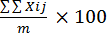 (iii)
(iii)
Where by
Uk = field uniformity value for species k,
Xij = presence (1) or absence (0) of species k in
quadrat j in field i, and
m = number
of quadrats per field.
iv.
Relative
abundance is the
overall evaluation of the importance of each species with respect to others,
and the RA of each weed species was obtained by the formula
 (iv)
(iv)
Where by
RAk = the relative abundance of species k
RFk = (the frequency of species k / sum of all frequencies of all
species) × 100
RUk = (uniformity of species k / sum of all uniformity values of all
species) × 100
RDk = mean density of species k / sum of mean field densities of all
species) × 100
Soil data analysis: Soil pH, amount of N, P, K, Ca and Mg nutrients were analysed in the
laboratory at IITA in Dar es Salaam to assess fertility status following the
soil analysis procedures stated by Jones (2001)
and Jones (2012). These data were helpful in proper weed
identification and in the study of the best weed management combination.
RESULTS
Physical and chemical characteristics of the
soils at studied sites
Soil chemical characteristics and particle
size class (0 to 20 cm and 21 to 50 cm deep) at experimental sites in 2019 are
shown in Table 1. The soil of the two sites were found to be silty clay loam
(24% cay, 15% silt and 61% sand) with sufficient available phosphorus, total
nitrogen and exchangeable potassium (5.07 ppm, 0.25% and 0.67 cmolckg-1),
respectively and pH of 5.88 at Ilonga.
Also, there was loamy sand (12% clay, 3% silt and 85% sand) with sufficient
available phosphorus, total nitrogen and exchangeable potassium (10.79 ppm, 0.25% and 0.23 cmolckg-1),
respectively and pH of 5.47 at Kiimbwanindi.
This soil
condition was optimal hence the locations support the cassava production
(Soil staff, 1993).
Table 1: Soil characteristics of the studied sites
|
Parameter
|
Method used
|
Ilonga
|
Kiimbwanindi
|
Range suitable for
cassava production
|
Rated according to:
|
|
0-20 cm
|
21-50 cm
|
0-20 cm
|
21-50 cm
|
|
pH (in H2O)
|
pH meter
|
5.88
|
5.61
|
5.47
|
5.24
|
4.5 - 7.0
|
CIAT (2011)
|
|
OC (%)
|
Walkley - Black
|
1.48
|
1.26
|
0.66
|
0.3
|
4.0 - 10.0
|
Landon (2014)
|
|
P (mgkg-1)
|
Bray 1
|
5.07
|
2.86
|
10.79
|
5.86
|
< 4.2
|
Howeler (2002)
|
|
N (%)
|
Kjeldahl
|
0.25
|
0.2
|
0.25
|
0.2
|
0.20 - 0.50
|
Landon (2014)
|
|
Ca (cmolckg-1)
|
Ammonium Acetate
Extraction pH 7.0
|
10.8
|
10.82
|
2.21
|
0.93
|
1.0 - 5.0
|
CIAT (2011)
|
|
Mg (cmolckg-1)
|
2.57
|
2.66
|
0.9
|
0.32
|
0.40 - 1.00
|
CIAT (2011)
|
|
K (cmolckg-1)
|
0.67
|
0.38
|
0.23
|
0.17
|
0.15 - 0.25
|
CIAT (2011)
|
|
Na (cmolckg-1)
|
0.08
|
0.12
|
0.04
|
0.03
|
< 2
|
Howeler (2002)
|
|
Cu (mgkg-1)
|
DTPA Extraction pH 7.3
|
2.04
|
2.24
|
0.6
|
0.83
|
0.3 - 0.8
|
Motsara and Roy (2008)
|
|
Zn (mgkg-1)
|
0.59
|
0.39
|
2.07
|
1.18
|
1.0 - 3.0
|
Motsara and Roy (2008)
|
|
Mn (mgkg-1)
|
21.5
|
21.31
|
26.61
|
26.92
|
1.2 - 3.5
|
Motsara and Roy (2008)
|
|
Fe (mgkg-1)
|
55.35
|
50.56
|
20
|
22.39
|
4.0 - 6.0
|
Motsara and Roy (2008)
|
|
|
Hydrometer
|
SCL
|
SCL
|
LS
|
SL
|
|
|
|
|
|
|
|
|
|
|
SCL = silty clay loam soil, LS
= loamy sand soil and SL= sandy loam soil
RESULTS
Weed species, families and their
lifecycle
The results of the occurred weeds in the
surveyed fields are presented in table 2 and table 3 for Ilonga,
Kilosa site and Kiimbwanindi,
Mkuranga site, respectively. A total of 22 weed
species belonging to 16 families were identified. These 16 weed families
include Poaceae with five species, Asteraceae and Fabaceae with two species
each and Agaricaceae, Apocynaceae,
Boraginaceae, Commelinaceae,
Convolvulaceae, Cyperaceae,
Euphorbiaceae, Lamiaceae, Nyctaginaceae, Phyllanthaceae, Portulacaceae, Celastraceae, and Malvaceae had one species. Out of these
identified weed species, 14 were broadleaf weeds, 6 grassy weeds and 1 sedge
weed.
Table 2: Weed species, families, life cycle
and plant morphology found at Ilonga, Kilosa site during the 2019/2020 planting season
|
Sn
|
Scientific name
|
Family
|
Life
cycle
|
Morphology
|
|
1
|
Agaricus
sp
|
Agaricaceae
|
Annual
|
Convex cup mushroom
|
|
2
|
Asclepias
syriaca
|
Apocynaceae
|
Perennial
|
Broad
leaved
|
|
3
|
Bidens
pilosa
|
Asteraceae
|
Annual
|
Broad
leaved
|
|
4
|
Boerhavia
erecta
|
Nyctaginaceae
|
Annual/Perennial
|
Broad
leaved
|
|
5
|
Commelina
benghalensis
|
Commelinaceae
|
Perennial
|
Broad
leaved
|
|
6
|
Corchorus
olitorius
|
Malvaceae
|
Annual
|
Broad
leaved
|
|
7
|
Cynodon
nlemfuensis
|
Poaceae
|
Perennial
|
Grass
|
|
8
|
Cyperus
rotundus
|
Cyperaceae
|
Perennial
|
Sedge
|
|
9
|
Dactyloctenium
aegyptium
|
Poaceae
|
Annual
|
Grass
|
|
10
|
Echinochloa
colona
|
Poaceae
|
Annual
|
Grass
|
|
11
|
Euphorbia
hirta
|
Euphorbiaceae
|
Annual
|
Broad
leaved
|
|
12
|
Ocimum
gratissimum
|
Lamiaceae
|
Perennial
|
Broad
leaved
|
|
13
|
Phyllanthus
amarus
|
Phyllanthaceae
|
Annual
|
Broad
leaved
|
|
14
|
Portulaca
oleracea
|
Portulacaceae
|
Annual
|
Broad
leaved
|
|
15
|
Trichodesma
zeylanicum
|
Boraginaceae
|
Annual
|
Broad
leaved
|
|
16
|
Cynodon
plectostachyus
|
Poaceae
|
Perennial
|
Grass
|
|
17
|
Tridax
procumbens
|
Asteraceae
|
Perennial
|
Broad
leaved
|
Table 3: Weed species, families, life cycle and plant morphology found
at Kiimbwanindi, Mkuranga
site during the 2019/2020 planting season
|
Sn
|
Scientific name
|
Family
|
Life
cycle
|
Morphology
|
|
1
|
Commelina
benghalensis
|
Commelinaceae
|
Perennial
|
Broad
leaved
|
|
2
|
Cynodon
plectostachyus
|
Poaceae
|
Perennial
|
Grass
|
|
3
|
Cyperus
rotundus
|
Cyperaceae
|
Perennial
|
Sedge
|
|
4
|
Digitaria
sp
|
Poaceae
|
Annual
|
Grass
|
|
5
|
Ipomoea
sp
|
Convolvulaceae
|
Perennial
|
Broad
leaved
|
|
6
|
Mucuna
pruriens
|
Fabaceae
|
Annual
|
Broad
leaved
|
|
7
|
Reissantia
sp
|
Celastraceae
|
Perennial
|
Broad
leaved
|
|
8
|
Tephrosia
sp
|
Fabaceae
|
Perennial
|
Broad
leaved
|
Weed density, uniformity, frequency and
relative abundance
Table
4 shows the result of density, uniformity, frequency
and relative abundance of weeds found in the selected farm at Ilonga, Kilosa site. Cyperus rotundus occurred in highest mean field densities followed by Echinochloa colona while Bidens pilosa, Portulaca
oleracea and Agaricus
sp were least
in density. Cyperus rotundus, Echinochloa colona
and Trichodesma zeylanicum
were the highest
abundant species and the most disturbing weed species at the
studied site.
Table 5 shows the result of density, uniformity, frequency and
relative abundance of weeds found in the selected farm at Kiimbwanindi,
Mkuranga site. Reissantia
sp had thehighest mean field densities followed by Mucuna pruriens while other weed species
found to be very minimal. Reissantia sp, Mucuna pruriens, Cyperus rotundus and Commelina benghalensis were the highest occurred and the most
disturbing weed species at this site.
Table 6 shows the result of density, uniformity, frequency and
relative abundance of weeds found in the studied areas. Cyperus rotundus had high mean field densities
of 130 plants m-2 followed
by Echinochloa colona which occurred in 39.4 plants
m-2 while Euphorbia
hirta,
Ipomoea sp, Dactyloctenium aegyptium, Bidens pilosa, Portulaca oleracea and Agaricus sp were least in density in descending order ranging from 0.06 to 0.02
plants m-2 mean field densities. The most
widespread weed species in terms of frequency was Cyperus
rotundus, Cynodon plectostachyus and Commelina
benghalensis. Cyperus
rotundus with 87.59% relative abundance, Echinochloa colona
with 41.19% relative abundance, Trichodesma
zeylanicum with 23.24% relative abundance and
Reissantia sp with
20.65% relative abundance were the highest occurred and the most disturbing
weed species in the studied sites.
Table 4: Mean
field density (MFD), relative mean density (RD), frequency (F), relative
frequency (RF), uniformity (U), relative uniformity (RU) and relative abundance
(RA) of weed species collected during the 2019/2020 season at Ilonga village, Kilosa.
|
SN
|
Weed species
|
MFD
(plant/m2)
|
RD (%)
|
F (%)
|
RF (%)
|
U (%)
|
RU (%)
|
RA (%)
|
|
1
|
Cyperus rotundus
|
258.25
|
71.27
|
100.00
|
5.88
|
100.00
|
22.64
|
99.80
|
|
2
|
Echinochloa colona
|
78.79
|
21.75
|
100.00
|
5.88
|
100.00
|
22.64
|
50.27
|
|
3
|
Trichodesma zeylanicum
|
18.58
|
5.13
|
100.00
|
5.88
|
87.50
|
19.81
|
30.82
|
|
4
|
Cynodon plectostachyus
|
1.92
|
0.53
|
100.00
|
5.88
|
25.00
|
5.66
|
12.07
|
|
5
|
Commelina benghalensis
|
1.21
|
0.33
|
100.00
|
5.88
|
25.00
|
5.66
|
11.88
|
|
6
|
Corchorus olitorius
|
0.29
|
0.08
|
100.00
|
5.88
|
16.67
|
3.77
|
9.74
|
|
7
|
Ocimum gratissimum
|
1.00
|
0.28
|
100.00
|
5.88
|
12.50
|
2.83
|
8.99
|
|
8
|
Boerhavia erecta
|
0.63
|
0.17
|
100.00
|
5.88
|
12.50
|
2.83
|
8.89
|
|
9
|
Asclepias syriaca
|
0.54
|
0.15
|
100.00
|
5.88
|
12.50
|
2.83
|
8.86
|
|
10
|
Phyllanthus amarus
|
0.17
|
0.05
|
100.00
|
5.88
|
12.50
|
2.83
|
8.76
|
|
11
|
Tridax procumbens
|
0.17
|
0.05
|
100.00
|
5.88
|
8.33
|
1.89
|
7.82
|
|
12
|
Euphorbia hirta
|
0.13
|
0.03
|
100.00
|
5.88
|
8.33
|
1.89
|
7.80
|
|
13
|
Cynodon nlemfuensis
|
0.46
|
0.13
|
100.00
|
5.88
|
4.17
|
0.94
|
6.95
|
|
14
|
Dactyloctenium aegyptium
|
0.08
|
0.02
|
100.00
|
5.88
|
4.17
|
0.94
|
6.85
|
|
15
|
Bidens pilosa
|
0.04
|
0.01
|
100.00
|
5.88
|
4.17
|
0.94
|
6.84
|
|
16
|
Portulaca oleracea
|
0.04
|
0.01
|
100.00
|
5.88
|
4.17
|
0.94
|
6.84
|
|
17
|
Agaricus sp
|
0.04
|
0.01
|
100.00
|
5.88
|
4.17
|
0.94
|
6.84
|
Table 5: Mean field density (MFD), relative
mean density (RD), frequency (F), relative frequency (RF), uniformity (U),
relative uniformity (RU) and relative abundance (RA) of weed species collected
during the 2019/2020 season at Kiimbwanindi village, Mkuranga.
|
SN
|
Weed species
|
MFD
(plant/m2)
|
RD (%)
|
F (%)
|
RF (%)
|
U (%)
|
RU (%)
|
RA (%)
|
|
1
|
Reissantia sp
|
6.17
|
37.95
|
100.00
|
12.50
|
91.67
|
33.33
|
83.78
|
|
2
|
Mucuna pruriens
|
5.00
|
30.77
|
100.00
|
12.50
|
79.17
|
28.79
|
72.06
|
|
3
|
Cyperus rotundus
|
1.75
|
10.77
|
100.00
|
12.50
|
33.33
|
12.12
|
35.39
|
|
4
|
Commelina benghalensis
|
2.46
|
15.13
|
100.00
|
12.50
|
20.83
|
7.58
|
35.20
|
|
5
|
Digitaria sp
|
0.42
|
2.56
|
100.00
|
12.50
|
25.00
|
9.09
|
24.16
|
|
6
|
Tephrosia sp
|
0.17
|
1.03
|
100.00
|
12.50
|
8.33
|
3.03
|
16.56
|
|
7
|
Cynodon plectostachyus
|
0.17
|
1.03
|
100.00
|
12.50
|
8.33
|
3.03
|
16.56
|
|
8
|
Ipomoea sp
|
0.13
|
0.77
|
100.00
|
12.50
|
8.33
|
3.03
|
16.30
|
Table
6: Frequency (F), relative frequency (RF), uniformity (U), relative uniformity
(RU), mean field density (MFD), relative mean density (RD), and relative
abundance (RA) of the 22 weed species collected during the 2019/2020 season in
selected cassava fields in Eastern zone, Tanzania.
|
Sn
|
Weed
|
F (%)
|
RF (%)
|
MFD
(plant/m2)
|
RD (%)
|
U
(%)
|
RU (%)
|
RA (%)
|
|
1
|
Cyperus rotundus
|
100
|
8.00
|
130
|
68.67
|
66.67
|
10.92
|
87.59
|
|
2
|
Echinochloa colona
|
50
|
4.00
|
39.40
|
20.81
|
100.00
|
16.38
|
41.19
|
|
3
|
Trichodesma zeylanicum
|
50
|
4.00
|
9.29
|
4.91
|
87.50
|
14.33
|
23.24
|
|
4
|
Reissantia sp
|
50
|
4.00
|
3.08
|
1.63
|
91.67
|
15.02
|
20.65
|
|
5
|
Mucuna pruriens
|
50
|
4.00
|
2.50
|
1.32
|
79.17
|
12.97
|
18.29
|
|
6
|
Commelina benghalensis
|
100
|
8.00
|
1.83
|
0.97
|
22.92
|
3.75
|
12.72
|
|
7
|
Cynodon plectostachyus
|
100
|
8.00
|
1.04
|
0.55
|
16.67
|
2.73
|
11.28
|
|
8
|
Digitaria sp
|
50
|
4.00
|
0.21
|
0.11
|
25.00
|
4.10
|
8.21
|
|
9
|
Corchorus olitorius
|
50
|
4.00
|
0.15
|
0.08
|
16.67
|
2.73
|
6.81
|
|
10
|
Ocimum gratissimum
|
50
|
4.00
|
0.50
|
0.26
|
12.50
|
2.05
|
6.31
|
|
11
|
Boerhavia erecta
|
50
|
4.00
|
0.31
|
0.17
|
12.50
|
2.05
|
6.21
|
|
12
|
Asclepias syriaca
|
50
|
4.00
|
0.27
|
0.14
|
12.50
|
2.05
|
6.19
|
|
13
|
Phyllanthus amarus
|
50
|
4.00
|
0.08
|
0.04
|
12.50
|
2.05
|
6.09
|
|
14
|
Tridax procumbens
|
50
|
4.00
|
0.08
|
0.04
|
8.33
|
1.37
|
5.41
|
|
15
|
Tephrosia sp
|
50
|
4.00
|
0.08
|
0.04
|
8.33
|
1.37
|
5.41
|
|
16
|
Euphorbia hirta
|
50
|
4.00
|
0.06
|
0.03
|
8.33
|
1.37
|
5.40
|
|
17
|
Ipomoea sp
|
50
|
4.00
|
0.06
|
0.03
|
8.33
|
1.37
|
5.40
|
|
18
|
Cynodon nlemfuensis
|
50
|
4.00
|
0.23
|
0.12
|
4.17
|
0.68
|
4.80
|
|
19
|
Dactyloctenium aegyptium
|
50
|
4.00
|
0.04
|
0.02
|
4.17
|
0.68
|
4.70
|
|
20
|
Bidens pilosa
|
50
|
4.00
|
0.02
|
0.01
|
4.17
|
0.68
|
4.69
|
|
21
|
Portulaca oleracea
|
50
|
4.00
|
0.02
|
0.01
|
4.17
|
0.68
|
4.69
|
|
22
|
Agaricus sp
|
50
|
4.00
|
0.02
|
0.01
|
4.17
|
0.68
|
4.69
|
A weed compendium
All weeds found in
the selected farms at both sites were recorded. These weeds were then
identified to species level, their habit and life cycle. A total of 57 weeds belongs to 28 families
were identified within and out of the random placed quadrats Appendix 1. Sample
of weed pictures found at a studied sites are present below in Figure 1:
Figure 1: Some of the weeds found at studied
sites
DISCUSSION
Weed density, uniformity, frequency and
relative abundance from the studied sites
In the studied areas where cassava was grown,
perennial weeds such as Cyperus rotundus tend to dominate with high density (130 plantsm-2) as
compared to annual weeds. This might be attributed by the reproductive ability
of these perennial species, their ability to make use of the available
resources in the soil and history of previous cropping systems and weed
management practices. Similar results were reported by Olorunmaiye
et al. (2013) who reported the
high presence of perennial weeds in cassava filed.
Commelina benghalensis, Cynodon species and Cyperus rotundus had
highest frequency. Frequency describes
the percentage of the fields that are infested with weeds in which having high frequency is the indication of the availability
of these weeds in cassava fields. Similar results to this were reported by Ekeleme et al.
(2019), who stated that, environments where cassava is growing tend to be
dominated by perennial weed species such as Imperata
cylindrica, Panicum
maximum, Cyperus rotundus,
and Mimosa invisa.
Echinochloa colona, Reissantia sp, Trichodesma zeylanicum, Mucuna pruriens and Cyperus
rotundus showed the highest uniformity than other
weeds. Weed uniformity indicate how even these weeds are, across the fields.
Weeds like Cynodon nlemfuensis,
Dactyloctenium aegyptium,
Bidens pilosa,
Portulaca oleracea
and Agaricus sp had
the lowest uniformity which indicate they were only found in patches.
In this study, Commelina benghalensis, Cynodon spp and Cyperus rotundus were highly in frequency but varied in their relative abundance. Cyperus rotundus was highly abundant weed (87.59%) followed by Echinochloa colona (41.19%) and Trichodesma zeylanicum (23.24%). This highly
abundance of these weeds is the due to their high density and frequency which
reflect their dominance to the fields. The reasons that made Cyperus rotundus to be abundant might be due to its ability
to grow in almost every soil type over a range of soil moisture, pH and
elevation as it grows best in moist fertile soils and also frequent cultivation
has been suggested to promote/favour its growth. Similar results were reported by Olorunmaiye et al.
(2013) that Cyperus rotundus can grow over a high range of soil types. Reissantia sp, Mucuna pruriens and Commelina benghalensis having 20.65%, 18.29% and 12.72%, respectively were also highly abundant weed species, this
might be due to their ability to reproduce both sexually and asexually and
highly adapted on the
areas having temperature ranging from 30° C to 35° C (Webster et
al., 2005) similar to that of
studied sites.
CONCLUSION
The study played an important role
in identifying common weed species that are mostly found in cassava fields in
Eastern zone Tanzania, and hence proven that, perennial weeds Cyperus rotundus, Echinochloa colona,
Trichodesma zeylanicum,
Reissantia sp, Mucuna
pruriens and Commelina benghalensis are the mostly and abundantly occurring weed
species with intrinsic adaptive characteristics compared to other species. Thus, this study document probably the first-time common
weed and its behaviour as influenced by density,
uniformity, frequency and relative abundance as they are associated with cassava production systems in Eastern zone
Tanzania.
Based
on the above-mentioned study findings, the following have been recommended,
firstly more
survey work is needed on a regular basis to identify possible weed population
shifts, secondly research toward new or improved control measures is needed and
lastly farmers should be trained on weed management practices for increased
cassava yield to optimum level.
CONFLICT OF INTEREST
I declare no potential conflict of interest.
CONTRIBUTIONS OF AUTHOR
The experiment, collection of data, data
analysis, and the write-up of the manuscript was carried out by Joseph Adonia Leonard. The supervisors of this study were Abdul Kudra, George Tryphone and
Frederick Baijukya. The final manuscript read and
approved by all authors.
ACKNOWLEDGMENT
This is part of MSc. Research Dissertation by
Joseph Adonia Leonard funded by International
Institute of Tropical Agriculture (IITA) under the African Cassava Agronomy
Initiative (ACAI) project.
REFERENCES
Baron, R. J.
(2005). Spatial weed distribution determined by ground cover
measurements. Dissertation for Award Degree of Master of Science in the
Department of Agricultural and Bioresource Engineering at University of
Saskatchewan Saskatoon. 121pp.
Chikoye, D., Ekeleme, F. and Udensi, U. E. (2001). Cogongrass
suppression by intercropping cover crops in corn/cassava systems. Weed
Science 49(5):
658-667.
CIAT (2011). The Cassava Handbook. Thai Watana Panich Press Co. Ltd.,
Bangkok. 801 pp.
Conrad, B., Ignacio, C. M., Corrie, M. S. and
Zira, M. (2018). Weed species composition and density under conservation
agriculture with varying fertiliser rate. South
African Journal of Plant and Soil 35(5): 329-336.
Ekeleme, F., Atser, G., Dixon, A., Hauser,
S., Chikoye, D., Olorunmaiye,
P. M., Sokoya, G., Alfred, J., Moses C. O., Korieocha, D. S. and Olojede, A.
O. (2019). Assessment of weeds of cassava and farmers management practices in
Nigeria. Tropical Agriculture 37(2):
1-22.
Howeler, R. H. (2007). Cassava research and development in Asia:
Exploring new opportunities for an ancient crop: Proceedings of the seventh
regional workshop held in Bangkok, Thailand, Oct 28-Nov 1, 2002.
Howeler, R. H. (2002). Cassava Mineral Nutrition and Fertilization. In: Cassava: Biology, Production and Utilization.
(Edited by Hillocks, R. J. et al.) CAB International, New York. pp. 115 - 147.
Jones Jr, J. B. (2012). Plant
nutrition and soil fertility manual. CRC press. 304pp.
Kajembe, G. C., Silayo, D. S. A., Mwakalobo, A. B. and Mutabasi, K.
(2013). The Kilosa District REDD+ pilot project, Tanzania.
A socioeconomic baseline study IIED. Turkish
Journal of Fisheries and Aquatic Sciences 12(4): 743–749.
Landon, J. R. (Ed.) (2014). Booker Tropical
Soil Manual: A Handbook for Soil Survey and Agricultural Land Evaluation in the
Tropics and Subtropics. Routledge Taylor and Francis Group, New York and
London. 530pp.
Mkuranga ICMAP. (2009). Mkuranga District Integrated
Coastal Management Action Plan. Prime Minister’s Office Regional administration
and local government, Mkuranga District Council.
170pp.
Motsara, M. R. and Roy, R. N. (2008). Guide to Laboratory Establishment for
Plant Nutrient Analysis. FAO, Rome. 204pp.
Olorunmaiye, P. M., Lagoke, S. T. O., Adigun,
J. A. and Orija, O. R. (2013). Effect of
intercropping with maize on weed diversity in cassava. Environmental
and Experimental Biology 11(4):
189-193.
Rana, S. S. and
Rana, M. C. (2016). Principles and practices of weed management. Department
of Agronomy, College of Agriculture, CSK Himachal Pradesh Krishi
Vishvavidyalaya, Palampur. 138pp.
RCO. (2011). Pwani
Regional Website - Regional Commissioner’s Office. [http://www. pwani.go.tz/bagamoyo/d_acl.php] site visited on 1/4/2020.
Reshma, N., Sindhu, P. V.,
Thomas, C. G. and Menon, M. V. (2016). Integrated weed management in cassava (Manihot esculenta Crantz). Journal of Root Crops 42(1): 22-27.
Thomas, A. G.
(1985). Weed survey system used in Saskatchewan for cereal and oilseed
crops. Weed Science 33(1):
34-43.
Webster, T. M.,
Burton, M. G., Culpepper, A. S., York, A. C. and Prostko,
E. P. (2005). Tropical Spiderwort (Commelina
benghalensis): A Tropical Invader Threatens
Agroecosystems of the Southern United States1. Weed Technology 19(3): 501-508.
Zakayo, R. (2015). Pastoral adaptive
capacity in the changing climate in Kilosa district.
Doctoral Dissertation for Award Degree at Sokoine University of Agriculture.
[www.weadapt.org › system › files_force › annotated_bibliography_ecosyst] site visited on 10/04/2021.
Appendix 1: Other Weeds found in the selected cassava farms during the
2019/2020 season at Ilonga, Kilosa
and Kiimbwanindi, Mkuranga
in Eastern Zone of Tanzania
|
Sn
|
Scientific name
|
Family
|
Life cycle
|
|
1
|
Agaricus sp
|
Agaricaceae
|
Annual
|
|
2
|
Amaranthus viridis L.
|
Amaranthaceae
|
Annual
|
|
3
|
Celosia trigyna L.
|
Amaranthaceae
|
Erect annual plant
|
|
4
|
Annona senegalensis
|
Annonaceae
|
Perennial
|
|
5
|
Asclepias syriaca
|
Apocynaceae
|
Perennial
|
|
6
|
Acanthospermum hispidium
|
Asteraceae
|
Branched annual plant
|
|
7
|
Ageratum conyzoides L.
|
Asteraceae
|
Annual plant
|
|
8
|
Bidens Pilosa L.
|
Asteraceae
|
Annual plant
|
|
9
|
Conyza sp
|
Asteraceae
|
Annual plant
|
|
10
|
Emilia javanica L.
|
Asteraceae
|
Annual herb
|
|
11
|
Kleinia sp
|
Asteraceae
|
Perennial herbs
|
|
12
|
Launaea cornuta
|
Asteraceae
|
Herbaceous perennial
plant
|
|
13
|
Tridax procumbens L.
|
Asteraceae
|
Annual, sometimes perennial
|
|
14
|
Markhamia obtusifolia
|
Bignoniaceae
|
Perennial
|
|
15
|
Trichodesma zeylanicum
|
Boraginaceae
|
Annual plant
|
|
16
|
Reissantia sp
|
Celastraceae
|
Perennial
|
|
17
|
Gloriosa superba L.
|
Colchicaceae
|
Perennial
|
|
18
|
Commelina benghalensis L.
|
Commelinaceae
|
Herbaceous perennial plant,
|
|
19
|
Bonamia mossambicensis
|
Convolvulaceae
|
Perennial
|
|
20
|
Ipomoea sp
|
Convolvulaceae
|
Perennial
|
|
21
|
Jacquemontia sp
|
Convolvulaceae
|
Perennial
|
|
22
|
Merremia tridentate L.
|
Convolvulaceae
|
Perennial herb
|
|
23
|
Cucumis sp
|
Curcubitaceae
|
Perennial plant
|
|
24
|
Cyperus rotundus
|
Cyperaceae
|
Perennial
|
|
25
|
Kylinga erecta
|
Cyperaceae
|
Creeping perennial glabrous sedge
|
|
26
|
Acalypha ciliate
|
Euphorbiaceae
|
Annual herb
|
|
27
|
Euphorbia heterophylla L.
|
Euphorbiaceae
|
Annual plant
|
|
28
|
Euphorbia hirta
L.
|
Euphorbiaceae
|
Annual herb
|
|
29
|
Phyllanthus amarus
|
Euphorbiaceae
|
Annual plant
|
|
30
|
Mucuna pruriens
|
Fabaceae
|
Annual
|
|
31
|
Senna hirsuta L.
|
Fabaceae
|
Herbaceous perennial
shrub
|
|
32
|
Tephrosia sp
|
Fabaceae
|
Perennial
|
|
33
|
Cenchurus mitis
|
Gramineae
|
Annual crop
|
|
34
|
Cynodon dactylon L.
|
Gramineae
|
Perennial grass
|
|
35
|
Cleodendrum johnstonii
|
Lamiaceae
|
Perennial
|
|
36
|
Ocimum sp
|
Lamiaceae
|
Perennial
|
|
37
|
Cassia mimosoides L.
|
Leguminaceae
|
Annual, or short-lived
perennial herb
|
|
38
|
Corchorus aestuan L.
|
Malvaceae
|
Annual or perennial
herb
|
|
39
|
Corchorus olitoris L.
|
Malvaceae
|
Annual or biennial
herb
|
|
40
|
Hibiscus surattensis L.
|
Malvaceae
|
Climbing annual plant
|
|
41
|
Melochia corchorifolia L.
|
Malvaceae
|
Spreading perennial
plant
|
|
42
|
Waltheria indica L.
|
Malvaceae
|
Perennial plant
|
|
43
|
Corchorus olitorius
|
Malvaceae
|
Annual
|
|
44
|
Boerhavia diffusa L.
|
Nyctaginaceae
|
Herbaceous perennial
plant
|
|
45
|
Boerhavia erecta L.
|
Nyctaginaceae
|
Erect annual to
perennial plant
|
|
46
|
Cynodon nlemfuensis
|
Poaceae
|
Perennial
|
|
47
|
Cynodon plectostachyus
|
Poaceae
|
Perennial
|
|
48
|
Dactyloctenium aegyptium
|
Poaceae
|
Annual
|
|
49
|
Digitaria sp
|
Poaceae
|
Annual
|
|
50
|
Echinochloa colona
|
Poaceae
|
Annual
|
|
51
|
Portulaca oleraceae L.
|
Portulacaceae
|
Annual
|
|
52
|
Agathisanthemum bojeri
|
Rubiaceae
|
Shrubby perennial herb
|
|
53
|
Richardia scabra L.
|
Rubiaceae
|
Annual plant
|
|
54
|
Spermacoce pusilla
|
Rubiaceae
|
Prostrate annual
|
|
55
|
Tecca leontopetaloides L.
|
Teccaceae
|
Perennial herb
|
|
56
|
Lantana camara L.
|
Verbenaceae
|
Perennial
|
|
57
|
Tribulus terrestris L.
|
Zygophyllaceae
|
Annual plant
|
|
Cite this Article: Leonard, JA; Kudra, AB; Baijukya, F; Tryphone, GM (2022). Common Weeds Found in Selected
Cassava Farms in Eastern Zone of Tanzania. Greener Journal of Agricultural Sciences, 12(1): 75-85.
|