INTRODUCTION
Date palm varieties are very similar; however, studies have
shown that there are clear differences based on the vegetative characteristics
and Spath (Djerouni et al., 2015).Since the palm leave
constituents look very different, the measurements which were taken from leaf
palm like thorns length, pinnae number and leaf palm length have shown the
similarities and the differences between the palms (Haider
et al., 2015).
Genotype identification of date palm is commonly based on
morphological characters (Sedra et al., 1998). In date palm most of the female cultivars are
recognized by their fruit characteristics such as size, shape, colour and taste along with the morphological characters of
the tree for cultivar identification. During the ripening process, the date
fruits pass through four distinct stages of maturity, i.e. kimri,
beser (khalal), rutaband tamar,
(Al-Ghamdi, 1993).
According to Al-Khalifah et al. (2012), some date palm cultivars
have similar or narrow distinguishing morphological
characters that complicate cultivar identification and requires evidence
to prove phylogenetic relationships at the interspecific level.
Morphological characterization needs a generous set of
phenotypic records that are sometimes problematic to measure as a result of
sensitivity to the environmental influences (Rao,
2004). The vegetative parameters are informative for description, phenotypic
diversity and phylogenic relationship among date palm ecotypes.
Haider et al. (2015),
studied assessment of morphological attributes of date palm accessions from
Pakistan. From their results, they concluded that quantitative and qualitative
traits such as leaves, number of leaflets, length and grouping of spines, spathe, fruit and spideces
possess quantitative markers mainly used for identification, description,
differentiation and characterization of date palm
Furthermore, Ahmed et
al. (2016) studied the phenotypic characteristics of 75 cultivars from
Algeria, from their findings on the morphological
parameters observed, they concluded that the precise number of cultivars is
still unknown since the cultivars exhibited homogenous traits and differ mainly
by the fruit parameters, and also they are morphologically nearly similar and
are of similar denomination.
Despite
its great diversity, date-palm is currently menaced by genetic erosion mainly
due to abiotic stresses (high seasonal temperature, drought and rainfall
irregularities). Since problems of synonymy and homonymy often occur, the
establishment of research strategies aiming at the evaluation of the genetic
diversity of this local date-palm germplasm has
become imperative. Criteria related either to the vegetative or the fruit
parameters are useful for cultivar characterization, phenotypic diversity
analysis and phylogenic relationship exploration among date-palm ecotypes.
Moreover, phenotypic diversity evaluation constitutes an available basic step
for the elaboration of a program to improve germplasm
management and utilization of any crop (Chang, 1992).
MATERIALS AND METHODS
Exploration and Collection of Plant
Materials
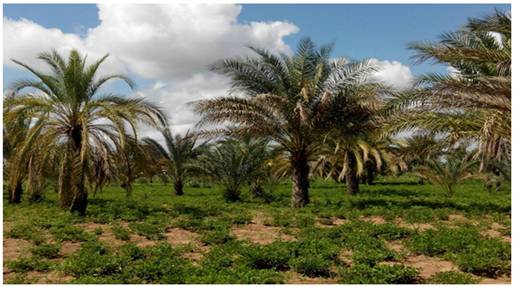
A survey and exploration were undertaken to collect the
fruits from the population of the Female date palm (Phoenix dactylifera L.) trees germplasm across the gene pools in the experimental field
of Nigerian Institute for Oil palm Research (NIFOR) date palm research
substation, Jigawa state, Nigeria. The Institute has
the national mandate for the crops cultivation. The exploration and collection
mission were undertaken to Gene pool 1 which contains germplasm
originally collected from Sokoto, kebbi
and Zamfara States); Gene pool 2 (collections from
Kaduna and Katsina State); Gene pool 3 (containing
collections from Kano and Jigawa State), Gene pool 4
(which contains germplasm from Bauchi
and Gombe State) and Gene pool 5 (containing germplasm from Borno and Yobe State) Nigeria. The collection of fruits were done
during the harvesting period between February and March, 2018 which involved a
systematic random sampling from selected matured Female trees in all the gene
pools. The collected date fruit were checked for physical damage and injury
from insects and fungal infection. They were then brought to the Department of
Plant Biology, Federal University of Technology, Minna,
for studies. The fruits were then depulped (removal
of seeds from the fruits). The depulped seeds were
packed and sealed in thick polythene bag. Each of the seed samples was assigned
an entry number, the gene pool name and palm number.
Description
of Study Area
The
area for this study are Nigerian
Institute for Oil palm Research (NIFOR), Date Palm Research Substation Dutse, Jigawa state where
the fruit samples were collected
and Federal University of
Technology, Minna, Niger state in which the field experiment and some laboratory work was
carried out. The substation of NIFOR is situated on latitude 10o141N
and longitude 4O121E.The substation ecology is within the
Sudan savannah with annual rainfall of about 600mm per annum and average
temperature of 32OC. The soil type is sandy to loam. The
Experimental Garden is situated at the Department of Biological Sciences,
Federal University of Technology, Minna, Niger State,
Nigeria. Geographically, Minna
is located in the North central geopolitical zone of Nigeria. It is located
within longitude 6o34 East and latitude 9o36 north. It
covers a long area of 88 square kilometers with an estimated human population
of 348,788 (Niger State Ministry of Agriculture 2008). The area has a tropical
climate condition with mean annual temperature, relative humidity and rainfall
of 20-30oC, 61% and 1334cm respectively. The climate presents two
distinct seasons: a raining season between May and October and a dry season
between November and April each year. The vegetation is a typical Guinea
savannah type consisting majority of grassland with scattered trees.
Experimental Design and Raising of Nursery
The viable sprouted date seeds were planted and grown in a
randomized complete block design (RCBD) with five replicates. Each accession
was grown in a polythene bag, with inter and intra block spacing of 2 feets the polythene bags. Three seeds of each accession
were planted per hole and later thinned to single plant per stand. Twenty one
date seedling plants per row were planted and data were taken from 105 plants
per block. All the cultural practices on cultivation of date palm were carried
out.
Percentage Emergence
Germination counts were made 7 days after Sowing. Number of
seeds showing germination were counted and expressed in percentage (Songsri et al.,
2011). The percentage emergence was calculated using the formular
below:
Germination (%) =  x 100
x 100
Morphological Parameters
The morphological parameters were determined following a
standard descriptor to characterize date palm by (IPGRI, 2005; Rizk & Sharabasy, 2007). All
measurements were performed in triplicate using measuring tape. Specifically,
the days to Emergence (DE) were determined as the interval between sowing of
seeds and day a germinating seedling emerges above soil level. Plant height
(from ground to lowest green leaf) using tape rule. Petiole
length was determined using meter rule, width of leaf was determined using metre rule, girth of plant was determined using tape rule,
and Leaflets length (cm) was measured using a tape rule. Petiole width (cm)
using a tape rule. Length of Internodes was determined using meter rule.
RESULTS AND DISCUSSION
Plant height at different stages of
growth
The analysis of variance (ANOVA) revealed interesting
variations among the date palm accessions in plant height at different stages
of growth. It showed that there were highly significant differences (P<0.05)
among the accessions.
The accession with
the highest height at four(4) weeks after planting was due to R1P18
but it was not significantly different
(P>0.05) from R4P12 but are significantly different from the values
of all other accessions. The lowest was recorded in accession R4P29
respectively, no significant differences were observed in accessions R6P20 and
R5P8, but are significantly different from all other accessions. At eight (8)
weeks after planting, the accession R1P10 showed the highest mean of (27.33),
this value is significantly the same with accession ZARIYA, but are
significantly different from other accession. The least was recorded in
accession R16P31 respectively.
However, the accession R1P10 had the highest height at 12
weeks with the mean value of (30.67), this was closely followed by accession
R13P5 with the mean (29.93), and this value was the same with the value
obtained in accessions R1P18 but are significantly different from the values of
all other accessions statistically. At 16 weeks after planting, the highest
mean was due to accession ZARIYA (35.00), followed by
R1P10 (32.17), no significant differences were
observed in accessions R7P1, R2P4 and R9P12 respectively.
In addition, at 20th weeks after planting,
accession ZARIYA was the highest with the mean value of (35.00), this was
closely followed by the accession R24P9 ,this value was significantly the same
with accession R1P18 but significantly different from all other accessions at P<0.05. While the lowest was due to accession R14P21.
At 24th weeks, the highest accession
was due to R13P5 with the mean value (39.00), this was followed by R1P10
(38.67), this value was significantly the same with accession ZARIYA, but are
significantly different from the values of all other accessions. The lowest
plant height was recorded in accession R13P9 respectively.
Length of petiole (LOP)
The length of petiole showed significant variations among
the accessions at P<0.05 as revealed by ANOVA. The highest petiole length
was due to accession R15P6 with the mean value (4.27),
however, this value is significantly the same with accession R9P2 with the
value (4.10), but is significantly different from the values of all other
accessions (Table), while accession R24P9 being recorded as the lowest (1.87).
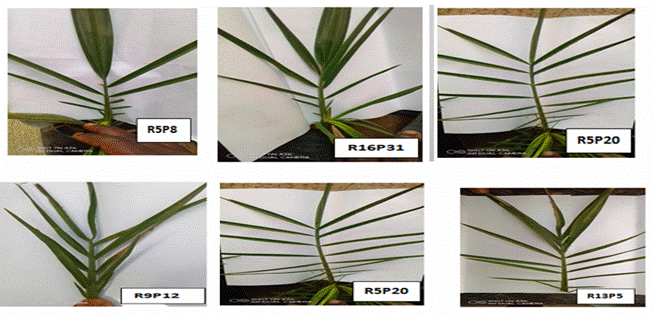
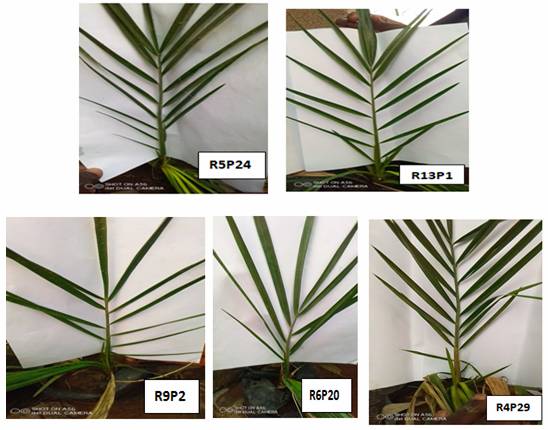
Width of leave
The width of leave showed interesting variations
among the accessions at P<0.05,with accession R6P20
recorded to have the highest mean value (3.50), this is followed by accession
R13P5, this value is significantly the same with the accessions R16P31, R5P24,
R1P18, R5P20, though they are significantly different from all other accessions
at P>0.05.however, the lowest leave width was observed in accession R3P22
respectively.
Girth
of plant
The girth of plant among the accessions showed highly significant
differences at P<0.05 among the accessions. The lowest mean value (5.10) was
recorded for accession R13P9, this value was significantly the same with
accession R16P31 with the value (5.20) but are significantly different from all
other accessions. The highest was recorded for accession R5P20 with the mean
value of 10.0, which is significantly different from the value of all other
accessions.
Length
of leaflets
The length of leaflets showed significant variation among
the accessions studied as revealed by analysis of variance (ANOVA). The
accession R5P8 (25.92) was recorded to have the highest length of leaflet,
while the lowest was recorded in accession R7P1 (13.48), No significant
differences were recorded in the accessions R5P24,R14P21,R4P29,R5P20 and R13P1
with the mean values 16.20,15.96, 16.06,16.42, 15.48 respectively.
Length of Internodes
There was significant differences among the accessions in
the internode length, the highest was recorded in accession R1P10 with the mean
value of (3.80), this value is significantly the same with accession R7P1 but
are significantly different from the values of all other accessions, the least
was recorded in the accession R13P1 with the mean value of 1.60 respectively.
The pronounced variation observed in the vegetative
characters revealed the broad range of variability among the accessions which
might be an indication of phenotypic diversity in relation to varietal
differences. Hanane and Halima (2020) reported that
many traits related either to vegetative and reproductive organs could be a
useful tool to assess phenotypic diversity and constitute a complementary
approach for other characterization methods.
Furthermore, (Salem et
al., 2008; Eissa et al., 2009; Hammadi et al., 2009) also reported that
Morphological traits such as plant height, length of petiole, girth of plant ,
length and grouping of spines, spathe, fruit and spideces possess quantitative markers mainly used for
identification, description, differentiation and characterization of date palm
cultivars.
However, most
accessions gave different results in relation to the different parameters taken
on the morphology, this agrees with the report by Djerouni
et al.(2015) who opined that
Vegetative characteristics can be considered as a principle to know the
differences between the date palm varieties,
Mohamed et al. (2014)
also affirmed in their study of 28
Mauritanian date palms, Haider et al. (2 015 ) reported in their study on the sixteen Pakistani
palm dates varieties from different origins in terms of vegetative
characteristics that the pinna number, length and width and the Leaf palm
length are characteristics that help to differentiate between the types of date
palm.
Leaf width which ranged from 1.10 cm-3.40 cm among the
studied accessions is statistically among the traits causing variability; this
is in contrast to the report of El-Merghany and Al Daen (2014) who found no significant difference in leaf
base width of date palm cultivars under Toshki
conditions in Egypt. The result of this study is similar to the report by Saleem et al.
(2008) on the study of morphological variability in some Mauritanian date-palm
and opined that leaf width to be an important discriminant parameter among
their cultivars. Leaf width was found to be a measure of variation among the
studied date palm cultivars. (Faqir et al., 2018 )
In addition, Faqir et al. (2016), also observed in their
study on some pakistani date
palm varieties, They opined that Leaf length is an important characteristic
that can discriminate among the cultivars.
The significant variations in the girth size among the
accessions revealed an interesting one. Because the size of
the girth in palm crops indicates evidence of maturity, (Marie et al., 2007). moreover,
variations in girth size might be due to the division and enlargement of parenchymatous cells in the ground tissue (secondary
growth) which is genetically controlled by the process of cell division. However
Marie et al. (2007) further opined
that repeated divisions cause increase in girth of stem and this type of growth
is referred to as diffused secondary growth. The accession R5P20 with the
highest girth size is however important in the development of breeding programmes for growth selection among the accessions. In
contrast, El-kosary et al. (2009) in their Comparison study on Barhee
cultivar and two strains of Barhee palm seedling in
Egypt, found slight variation in the girth that was non-significant.
The length of leaflets recorded in this study are of the
short type, this is in conformity to
reported of Ahmed et al.
(2016) who opined that the leaves less
than less than 325 cm are regarded as short. The variations recorded in the
leaflets length might be due to varietal differences among the accessions.
The internode length play an important role in the growth
and health in plants, this has been supported by several authors like Pearson et al. (1995) who reported in their
study that the Final stem length of
plants are determined both by number of internodes and internode lengths, the variations in the internode length recorded among the
accessions might be due to varietal differences
or environmental conditions, Carvalo et al. (2002) also reported in their
study on varieties of Chrysanthemum spp and concluded that the internodal
length can be an easy visible indicator of a plant’s health and
productivity, but can also be affected
by several factors which includes fertilizer application, sunlight and other
environmental conditions.
CONCLUSION
This study highlighted some strong relationship among some
accessions with regard to some quantitative vegetative characteristics which
has proved that morphological markers are very useful in cultivars
characterization. Thus, will serve as a baseline
information to select morphologically distinct accessions for breeding and
development of the fruit crop.
Declaration of Interest
The Authors declared no conflict of Interest
REFERENCES
Ahmed S., Adel C., Aissa D., &
Mouhamad E.B. (2016). Phenotypic diversity of date palm
cultivars (Phoenix dactylifera
L.) from Algeria. Gayana Botany.
73(1),42-53.
Ahmed
S., Adel C., Aissa D., & Mouhamad
E.B. (2016).Phenotypic diversity of date palm cultivars (Phoenix dactylifera L.) from Algeria. Gayana Botany. 73(1),42-53,
2016
Al-Khalifah, S. N., Askari, E., & Khan, A.E.S. (2012).“Molecular
and morphological identification of some elite varieties of date palms grown in
Saudi Arabia”, Emir Journal of Food
Agriculture, 24, (5), 456 – 461.
Carvalo,
S.M.P, Heuvelink., E,
Cascais., R, Van cooten.,
O. (2002). Effect of Day and Night Temperature on Internode
and Stem Length in Chrysanthemum. Annals of Botany,
90, 1(1 ), 111–118.
Chang, T. T. (1992). Availability of plant germplasm for use in crop improvement proceeding development of the vascular system. Journal of
Experimental Botany, 58 (13), 3485-3501
Djerouni,
A., Chala, A,. Simozrag, R., Benmhaia, A., &
Baka M .(2015). Evaluation
of male palms used in pollination and the extent of its relationship with
cultivars of date-palms (Phoenix dactylifera L.) grown in region of Oued
Righ, Algeria. Pakistan Journal of Botany, 47(6), 2295-2300.
Eissa, E.A., A.B. Abd El-Razek, S.F. El-Sharabasy and R.M.
Rizk. (2009). Morphological and
molecular genetic characterization of soft date palm (Phoenix dactylifera
L.) cultivars in Egypt. Egypt. Journal
of Genetics Cytology, 38, 269-284.
El-Kosary, S. (2009). Comparison study on Barhee
cultivar and two strains of Barhee palm seedling
trees. Egypt Journal of
Applied Science, 24,768-783.
El-Merghany, S., and E.M.A.Z. El-Daen.(2014). Evaluation of some date palm
cultivars grown under Toshky conditions. In: Zaid, A., and G.A. Alhadrami, (eds). Proceedings
of the Fifth International Date Palm Conference. Abu Dhabi, UAE. Pp.
16-18.
Faqir N, Muhammad A,
Shehzad A, Rahman H, Hyder MZ, Ali GM. 2016. Simple Sequence Repeat (SSR)
markers show greater similarity among morphologically diverse Date palm
(Phoenix dactylifera L.) cultivars grown in Pakistan.
Pure and Applied Biology 5: 483-498.
Faqir., N, Aish, M., Ghulam, M.A, Armghan., S.H, Farhatullah and
Muhammad, Z.H. (2018). Utility of Morphological Features,
Chemical Composition of Fruit and Chloroplast Genes in Date Palm (Phoenix dactylifera
L.) Characterization. Sarhad Journal of Agriculture, 34(2), 378-388.
Haider,
M.S., Khan, I.A., Jaskani, M.J., Naqvi,
S.A., Hameed, M., Azam, M.,
Khan, A.A. & Pintaud, J.C. (2015). Assessment of morphological
attributes of date palm accessions of diverse agro-ecological origin. Pakistan Journal of Botany, 47(3),
1143-1151.
Hammadi, H., R. Mokhtar, E. Mokhtar and F. Ali.
(2009). New approach for the morphological identification of date palm (Phoenix dactyliferaL.) cultivars from Tunisia. Pakistan. Journal of Botany,41(6),2771-2681
Hanane, B., & Halima, B. (2018). Assessment of phenotypic diversity
of local Algerian date palm (Phoenix dactylifera L.) cultivars. Journal of the
Saudi Society of Agricultural Sciences,
26, 1-11
Marie, B., Mondher, E., and
Olivier, V. (2007). From primary
to secondary growth: origin and
Mohamed,
L., Mohamed, V.O., Mohamed, A. L., Ben, M.M., Zein., A.O.(2014). Antioxidant activity of various Mauritanian
date palm (Phoenix
dactylifera L.) fruits at two edible ripening
stages. Food Science & Nutrition, 2(6): 700–705.
Pearson, S., Hadley, P., Wheldon,
A.E. (1995). A model of the
effect of day and night temperatures on the height of chrysanthemums. Acta Horticulturae,
3(78), 71–79.
Rao, R., & Hodgkin, T. (2002). Genetic diversity and conservation and
utilization of plant genetic resources. Plant Cell Tissue and Organ Culture, 68, 1-19.
Salem,
A.O.M., Yarhouma, S., Zehdi,
S., Marrakchi, M., and Trifi., M. (2008). Morphological variability of Mauritanian date-palm (Phoenix dactylifera
L.) cultivars as revealed by vegetative traits. Acta. Botanica. Croatica, 67(1), 81-90.
Sedra, M.H., Lashermes, P., Trouslot, P., Combes, M.C., & Hamon, S.
(1998). Identification and genetic diversity analysis of
date-palm (Phoenix dactylifera
L.) cultivars from Morocco using RAPD markers. Euphytica, 103, 75-82.