INTRODUCTION
To gain more foreign
currency (or save foreign exchange when primary products are imported) and to
create a larger domestic manufacturing market, agriculture must grow to provide
food for a growing non-agricultural working population, raw materials for
industrial production, savings, and tax revenue to support the development of
the rest of the economy (Meier, as cited in Gatawa
& Mahmud, 2017). Nigeria has a big population that can support a healthy
and cultivable agricultural sector, as well as an abundance of land, rivers,
streams, lakes, woods, and grasslands, according to Gatawa
and Mahmud (2017). Despite these resources, the sector often fell short of
expectations.
The Nigerian economy
was dominated by agricultural exports and trade before to independence in 1960
and up to the early 1960s. According to Tule (2015), despite shifts in the
pricing of commodities globally, agriculture accounted for about 70% of all
exports and around 65% of GDP in Nigeria. As peasant farmers produced enough
food to feed the entire population and raised significant amounts of money
through the various marketing boards, agriculture provided the foreign exchange
needed to import raw materials and capital goods. The government then used the
remaining funds to build the essential infrastructure needed for long-term
growth (Tule, 2015).
Petroleum oil has
dominated the nation's export portfolio since 1973/1974 and has been more
dominant since the 1980s. The fundamental problem was that non-oil exports were
declining while oil exports were rising, hastening, and widening the dominance.
Although oil still accounts for the majority of the country's exports, attempts
to buck these trends (begun in 1986) often have little success. "Petroleum
oil was discovered in Nigeria and since then has not only been the backbone of
the nation's economy but also, with a share of over 90%, its principal export,
source of income, and source of foreign money. As a result, the output of
non-oil items has been disastrously little. The nation has continued to post an
enormous balance of trade and payment deficits in international commerce due to
the high level of imports and low level of non-oil exports. Experts claim that
this was the country's economic development's albatross (Fosu
& Twumasi. 2022). The decline of the non-oil
sector appears to have stopped, and several unconventional exports, including
horticultural goods, apparel, textiles, furniture parts, and other manufactured
goods, seem to have their origins in Nigeria's export inventory, according to Fosu & Twumasi. (2022)
The bulk of Nigeria's
workforce roughly three-quarters is engaged in agriculture, like the majority
of sub-Saharan Africa (SSA). Since agriculture is Nigeria's main source of food
and means of livelihood, projects aiming at preventing famine and achieving
food security in Nigeria must include it. Interest in raising agricultural
productivity has been prompted by the realisation
that revenue growth is reliant on productivity increase and investment funded
by savings. Estimates of Nigeria's agricultural production showed a drop in
growth from the early 1960s to the late 1980s. Economic growth in Nigeria has been
strong, with real annual GDP growth averaging 8.8% from 2000 to 2007. Although
it increased, the agriculture sector has lagged behind economic growth (Etale, Suwari, & Adaka, 2021).
One of the most
dramatic occurrences in Nigeria during the last several decades was the
depreciation of the naira in 1986 as a consequence of the adoption of a
structural adjustment programme (SAP). Restructuring
the economy's production base with a focus on agricultural export output was a
key goal of the SAP. Foreign currency measures that caused the effective
exchange rate to depreciate cumulatively were expected to improve domestic
output by accelerating local agriculture export prices (CBN, 2000). This
devaluation resulted in significant changes in the structure and amount of
Nigeria's agricultural exports, as determined empirically by several scholars
(Hassan, & Onoshole 2022; Oye,
Lawal, Eneogu, & IseOlorunkanmi, 2018; and. Nweke,
Eze & Atuma, 2020).
Studies have indicated that agricultural export volumes have grown significantly
over time, and the devaluation also raised agricultural export prices. The
influence of these swings on agricultural trade flows, however, is disputed
given the volatility, rapidity, and unpredictable nature of exchange rate
movements since the implementation of the floating exchange rate.
The relationship
between exchange rate and inflation is crucial, especially in emerging
economies. In such economies, exchange rate fluctuations can have a significant
impact on the general price level (Musa, 2020). According to the work when the
exchange rate (defined as the rate of change between two national currencies)
rises, the aggregate price level will rise. Then, when the exchange rate falls,
i.e., when the domestic currency appreciates, it is anticipated that general
prices will decline. According to Olubukoye et al.,
as cited in Enilolobo et al., (2021), exchange rate
plays an important role in agriculture sector performance in Nigeria, owing to
the fact that machineries required for mechanized farming are usually imported.
Therefore, changing exchange rates would impact production costs as the price
of imported goods rises (Enilolobo et al., 2021).
Therefore, it can be inferred that the exchange rate and inflation have a very
close relationship. In this regard, it is necessary to investigate how
inflation and exchange rates influence agricultural exports in Nigeria. This
research aims to objectively determine the impact of exchange rates and
inflation on the export markets for agricultural goods from Nigeria. The paper
also analyses the type and direction of causation amongst inflation, exchange
rate, and agricultural export in Nigeria.
LITERATURE REVIEW
Exchange rate changes
and agricultural credits have a positive impact on cocoa exports in Nigeria,
while relative cocoa prices have a negative effect, according to Ufoeze et al.,
(2018) on the Effects of Price and Exchange Rate Fluctuations on Agricultural
Exports in Nigeria. The investigation of factors that affect Nigeria’s cocoa
export flows by Abdullahi et al., (2021) was carried
out in the work which used a commodity-specific gravity model, with three
different analytical approaches: Heckman Sample Selection Model, the Generalised Least Square, and Poisson Pseudo Maximum
Likelihood over a period of 24 years for Nigeria and her 36 importing
partners. The results found that GDP,
exchange rate policy, World Trade Organisation,
European Union, and colonial link have positively correlated with cocoa export flows in Nigeria.
Akinlo and Adejumo (2014) examined
the effect of exchange rate fluctuations on Nigerian non-oil exports between
1986 and 2008 using the error correction model (ECM) technique and found that
lagging foreign income and real exchange rates had positive and significant
effects on exports outside the oil industry. For Russia and Nigeria,
respectively, Bernadina (2004) and Rano (2008) discovered a negative link between the real
exchange rate and non-oil export (including agricultural export). Although it
relies on the interaction of demand and supply elasticities,
research by Kandil and Mirzaie
(2004), Colacelli (2008), Essien
et al. (2011), and Umaru et al. (2013) indicated that
unanticipated local currency appreciation enhanced agricultural production from
the supply side.
According to Mbutor et al., (2013), agricultural finance frees farmers
from the cycle of poverty by raising productivity and living standards.
According to Essien et al. (2011), Abdullah et al.,
(2009), and Saboor et al. (2009), as cited by Mbutor et al. (2013), farmers can buy the heavy equipment
and inputs they need to run their farms and increase production with timely and
straightforward access to agricultural credit. As the value of the currency
declines, agricultural producers mostly small-scale
farmers must increase their output to sustain the same level of revenue. Export
prices are based on agricultural exports, claim Sabouni
and Piri (2008) and Essien
et al., (2011). Therefore, the relationship between the export price and
agricultural exports is positive. The demand for American agricultural exports
would decline proportionately to the price difference between domestic and
overseas exports, according to Batten and Belongia
(1984).
Additionally, using
the Vector Error Correction Model (VECM), Bernardina
(2004), Mustapha and Nishat (2004), and Hasanov and Samadova (2011)
investigated the causal link between exchange rate deregulation and Nigeria's
agricultural GDP share. The Autoregression
Distributed Lag (ARDL) model was used by Goudarzi et
al. (2012) and Mehare and Edriss
(2013) to investigate the impact of currency rate volatility on specific
Iranian agricultural exports (pistachios, saffron, and dates). Akinlo and Adejumo (2014) looked
at how changes in the exchange rate affected Nigeria's non-oil exports, and
their results confirm that there is a steady, strong link between real exports
and exchange rate changes.
Taiga and Ameji (2020) looked analysed the
relationship between agricultural exports and economic development in Nigeria
from 1981 to 2017. They found a strong and positive correlation between
agricultural exports and economic development using the Ordinary Least Square
(OLS) regression model. The findings of the Co-Integration test also showed a
long-term link between the variables under investigation. However, the research
did discover that, at 5%, the contribution of agricultural exports to economic
development was rather marginal. The study recommended policies like government
funding for cutting-edge farm equipment, increased budgetary allocation to the
agricultural sector, and stronger collaborations between research institutions
and higher education to close the gap between theory and practice to increase
the benefits of agricultural exports.
Enilolobo et al., (2021) investigated the impact of exchange rate
and FDI on Agricultural productivity in Nigeria from 1986 to 2018 using Vector
autoregressive (VAR) method of analysis and found out that FDI and exchange
rate both have a negative impact on agricultural output in Nigeria.
METHODOLOGY
The study employed
the time-series secondary data, which was sourced from the Central Bank of
Nigeria (CBN) Statistical Bulletin, the Food and Agriculture Organization
Statistical Database (FAOSTAT), and the World Development Indicator (WDI).
Annual data was used
and covered the period from 1986 to 2019 that is, 34 observations. The
variables employed in this study include the following: Agricultural export
value, inflation, and exchange rate, while trade openness and interest rate
were employed as control variables.
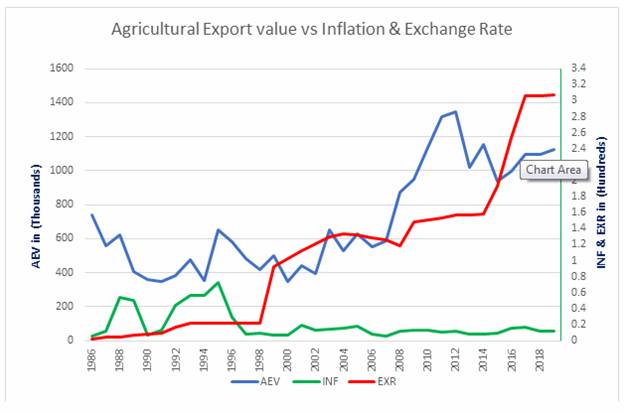
The trend of
Inflation, exchange rate and Agricultural export were analysed
graphically as depicted in Figure 1 below in other to achieve the first
objective of this study; also, a unit root test was carried out using Augmented
Dickey-Fuller (ADF) & Phillip-Perron (PP) Test.
In other to achieve the second objective of this study which is to evaluate the
nature and direction of causality among inflation, exchange rate and
agricultural export, Granger Causality (GC) test was employed. The third objective
of this study was achieved by employing the autoregressive distributed lag
(ARDL) estimation technique.
Model Specification
The model of Gatawa and Mahmud (2017) is
adopted and presented below as;
AEV = f(OER, REP, AGL)
--------------------------------- (1)
lnAEVt = βo + β1lnAGLt+
β2lnOERt+ β3lnREPt + Ut --------- (2)
Where; AEV = agricultural export volume. REP = relative
export price. OER = official exchange rate. AGL = agricultural
loans.
Equation 2 will be specified in other to incorporate the
objectives of this current research as follows. The model is given as;


Where;
AEV = Agricultural export value. ER = Exchange rate. INF =
Inflation rate. TO = Trade
openness. INR = Interest rate. β0 = vector of the
intercept. β1 = vector of the parameter of exchange
rate. β2 = vector of the parameter of Inflation rate. β3
= vector of the parameter of Trade openness. β4 = vector
of the parameter of interest rate. U = error term. t = time.
Table 4 above shows the result of the estimated ARDL model.
From the results above, the value of the r-squared is 0.865 indicating that the
exogenous variables have been able to successfully explain 86.5% of the total
variation in the dependent variable (AEV) hence the model has high goodness of
fit. Also, the remaining 13.5% is been explained by variables not captured in
the model. The value of the F-statistics is 34.501 which is
significant at 1% levels of significance depicting that the model is
statistically reliable in explaining the system. The Durbin-Watson Statistics
value of 2.458 indicates the absence of serial autocorrelation in the model.
The Breusch -Pagan Statistics was employed to test
for Heteroscedasticity. The probability value of
(0.618) indicates the absence of heteroscedasticity
in the model. Also, the probability value of Jarque-Bera
statistics is (0.543) indicating that the error term is normally distributed.
Similarly, the P-value of Ramsey REST statistics was (0.406) indicating that
the regressors of the model are stable.
The coefficient of
the constant term (c) is 139.772 which is
statistically insignificant. From the estimated
model, it is evident that there exists a significant and positive relationship
between AEV and exchange rate which implies that a unit increase in exchange
rate (appreciation of naira) will cause AEV to increase by 1057.724 and this is
because the appreciation of naira will result in increased earnings from
Agricultural export, which is in line with the empirical findings of Akinlo and Adejumo (2014), who
examined the impact of exchange rate fluctuations on Nigerian non-oil exports
between 1986 and 2008 and found that real exchange rates had positive and
important effects on exports outside of the oil industry (inclusive of
agricultural exports). The finding is also in correlation with the findings of Essien et al.,
(2011), Umaru et
al., (2013), and Gatawa and Muhmud (2017). Likewise,
INF with a coefficient of 3661.635 have a direct relationship with the
dependent variable and it is statistically significant at 5%. INT with a
coefficient of -11629.32 has an inverse relationship with the dependent
variable although it is statistically insignificant. This implies that
a unit decrease in interest rate will cause AEV to increase by 11629.32 this is
because when the interest rate is reduced farmers are attracted to access loans
at cheaper rates which will boost their productivity and hence increase
Agricultural export value. This is supported by Mbutor
et al., (2013), who asserted that agricultural credit consequently enhances
productivity and promotes living standards by breaking the vicious cycle of
poverty among farm owners. Finally, trade openness has a positive and
significant relationship with Agricultural export value.
CONCLUSION AND RECOMMENDATION
The study empirically
investigated the impact of inflation and exchange rate on agricultural export
in Nigeria. The findings of the study show that the exchange rate has a
positive and significant relationship with agricultural export value, implying
that exchange rate is a major determinant of agricultural export value.
Inflation rate also had a positive significant relationship with agricultural
export value. Also, interest rate has an indirect and insignificant
relationship with agricultural export value. Trade openness has a positive
impact on Agricultural export value.
Finally, the result from the Granger causality test shows that there exists a unidirectional causality running from AEV to
inflation rate and likewise from exchange rate to inflation rate.
From the findings of
this study, the following policy recommendations are postulated;
i.
To
increase Agricultural export, the government should implement an appropriate
policy mix in other to stabilise and improve the
value of the naira to boost agricultural export value.
ii.
Trade
openness should be encouraged in other to increase agricultural export value
and improve the standard of living in the country.
iii.
Interest
rates should be reviewed by policymakers and reduced as this will encourage
farmers to access Agricultural credit which will improve their productivity and
as a result, improve Agricultural export value in Nigeria.
REFERENCES
Abdullah, N. M., K. Mushtaq and
S. Kouser (2009). “The
role of agricultural credit in the growth of livestock sector: A case study of
Faisalabad”, 29(2), 81-84.
Abdullahi, N. M., Shahriar, S., Kea, S., Abdullahi,
A. M., Zhang, Q., & Huo, X. (2021). Nigeria’s
cocoa exports: a gravity model approach. Ciência
Rural, 51, e20201043.
Akinlo,
A.E. &Adejumo, V.A. (2014).
“Exchange rate volatility and Non-oil exports in Nigeria: 1986-2008”. CS
Canada International Business and Management, 9(2)70-79
Batten, S.D and Belongia,
M.T. (1984). The Recent Decline in
Agricultural Exports: is the exchange rate the culprit? Federal
Bank of St. Louis.
Bernardina, A. (2004). Price and Income Elasticities of Russian
Exports. The European Journal of
Comparative Economics, ISSN 1824-2979, 1(2), 175-193.
CBN, (2002). Seminar on Issues in
Foreign Exchange Rate Management in Nigeria: Published by Central Bank Nigeria
Training Centre, Lagos, 2, 36-40.
Colacelli, M.
(2008). “Export Responses to Real-Exchange Rate Fluctuations:
Development Status and Exported Good Effects,” Barnard College, Columbia,
University Press.
Dornbusch, R.
(1976). Expectations and exchange rate dynamics. Journal of political Economy, 84(6), 1161-1176.
Enilolobo S.O, Esedeke J.F, Nnoli
I.T, Hassan C.O, Babalola A. B (2021). “Impact
of Exchange Rate and Foreign Direct Investment on Agricultural Productivity in
Nigeria” Bells University of Technology Journal of Management Sciences 1(2): 129-141
Essien,
E.B., Dominic, A.O., & Sunday, E.R. (2011). Effects of Price and
Exchange Rate Fluctuations on Agricultural Exports in Nigeria, International Journal of Economic
Development Research, and Investment, 2(1), 1-10.
Etale,
L. M., Suwari, T. P., & Adaka,
R. M. (2021).
Empirical Assessment of Agricultural Development and Growth
of the Nigerian Economy.
Fosu,
P., & Twumasi, M. A. (2022). Infrastructure and
economic growth: Evidence from the United States. Journal of Infrastructure,
Policy and Development,6(1),1419
Gatawa N.M & Mahmud
A.A. (2017) The impact of exchange rate fluctuations
on agricultural export (crop) in Nigeria. 65-70
Goudarzi, M. et al (2012):
“Investigation the Role of Exchange Rate Volatility on Iran’s Agricultural
Exports (Case Study: Date, Pistachio and Saffron”. Qaemshahr,
Iran. World Applied Sciences Journal. 20(6) 904-909
Hasanov, F. &Samadova,
I. (2011): “The Impact of Real Effective Exchange Rate on the Non-oil Export:
The case of Azerbaijan”, Institute of Scientific Research on Economic
Reforms. Munich Personal RePEc Archive (MPRA)
Paper no.29556.
Hassan, B., & Onoshole, M.
A. (2022).
The Impact of Exchange Rate On Economic Growth In
Non-Oil Export In Africa: Evidence From Oil And Non-Oil Producing African
Countries? exchange.
Kandil,
M., &Mirzaie, A. (2003). The Effect of
Exchange Rate Fluctuations on Output and Prices: Evidence from Developing
Countries. I.M.F. Working Paper WP/03/200
Mbutor, O.M & Al-Hassan, U.I. (2013)
“Nigeria 2002-2012: High Economic Growth Rate, High Incidence of Poverty, Why? Publication of the Central Bank of Nigeria, Vol.36 No.3 pp.13-22.
Mbutor,
O.M., Ochu, R.E., & Okafor,
I.I. (2013).
The Contribution of Finance to Agricultural Production in Nigeria, Central Bank
of Nigeria, Economic and Financial
Review, 51(2), 1-20
Mehare,
A. and Edriss, A.K (2013). “Evaluation of the Effect
of Exchange Rate Variability on the Export of Ethiopia’s Agricultural Product:
A Case of Coffee”, National Council of Applied Economic Research (NCAER),
Journal of Applied Economic Research. Vol. 7 (2), 171-183
Meier,
G.M (1998). Leading
Issues in Economic Development: Stanford University New York, Oxford
University Press. Fourth Edition, VII, 423
Mussa,
M. (2019).
The exchange rate, the balance of payments and monetary and fiscal policy under
a regime of controlled floating. In Flexible Exchange Rates and Stabilization
Policy (pp. 97-116). Routledge.
Mustapha, K. & Nishat, M.
(2004).
“Volatility of Exchange Rate and Export Growth in Pakistan: The Structure and
Interdependence in Regional Markets”.
Nweke,
A. M., Eze, O. M., & Atuma,
E. (2020).
Analysis of the Effect of Exchange Rate Depreciation on
Export Performance in Nigeria. IORS Journal of Business and Management,
22(6), 48-60.
Okputu, R. (2012). The effect of Exchange
Devaluation on Selected agricultural export Commodities in Nigeria, 10(2)
Okputu, R., Opue, J. A.,
& Bankong, B. (2012). The effect of exchange rate devaluation on selected
agricultural export commodities in Nigeria. Journal of Agriculture,
Forestry and the Social Sciences, 10(2), 85-93.
Oye,
O. O., Lawal, A. I., Eneogu,
A., & IseOlorunkanmi, J. (2018). Does exchange rate
devaluation affect agricultural output? Evidence from
Nigeria. Binus Business Review, 9(2), 115-123.
Rano, S.
U. (2009). Real exchange rate misalignment: an application of behavioral
equilibrium exchange rate (BEER) to Nigeria. Available
at Social Science Research Network.
Saboor A.,
H. Maqsood and M. Madiha
(2009). “Impact of micro credit in alleviating poverty: An Insight
from rural Rawalpindi, Pakistan”, Pak. j. life soc.
sci. (2009), 7(1): 90-97.
Sabouni, M.S & Piri,
M. (2008) “Consideration the Effect of Exchange Rate Volatility on Agricultural
Product Export Price, The Case study of Iran’s Saffron”, American-Eurasian
J. Agric and Environ Sci., vol.2 (1), pp. 97-100.
Taiga, U. U., & Ameji,
N. E. (2020). Agricultural Exports and its Impact on
Economic Growth in Nigeria. Greener Journal of Agricultural
Sciences, 10(1), 43-50.
Tule, M.K. (2015). Crude Oil Price Volatility:
Implications for External Reserves and Exchange Rate Management in Nigeria.
Bullion Published by Central Bank of Nigeria. 39(3),3
Ufoeze,
L. O., Okuma, C. N., Nwakoby, C., & Alajekwu, U. B. (2018). Effect
of foreign exchange rate fluctuations on Nigerian economy. Annals of Spiru Haret
University. Economic Series, 18(1), 105-122.
Umaru,
A., Sa'idu, B. M., & Musa, S. (2013). An empirical analysis of exchange rate volatility on export trade
in a developing economy. Journal of emerging
trends in economics and management sciences, 4(1), 42-53.
Yanikkaya, H., Kaya, H., & Kocturk, O.
M. (2013). The effect of real exchange rates and their volatilities on
the selected agricultural commodity exports: A case study on Turkey, 1971
2010. Agricultural Economics, 59(5), 235-246.