This paper is a short-term research aimed to investigate the
awareness, acceptability and perceptions of selected farmers in Guimba, Marawi City and Roqero, Ramain, Lanao del Sur Province about silage. Selected demographic
profile of the farmers were also obtained. The study
used mixed method (quantitative and qualitative) design involving 36
purposively selected farmers through snowball technique. Data collection
tools were video presentation, focus group discussion and Likert scale survey
questionnaire. Descriptive and correlational statistics were used in the
analysis of data. Findings revealed that the farmers have varying ages, both
men and women are engaged in farming with cow as the main livestock they
rear, but in a very few numbers of heads, and they mostly have elementary
education only. However, despite their limited education and zero knowledge
and awareness about silage, they are willing to learn and adapt the silage
technology. Age, sex, and education positively influence on their type of
livestock and number of livestock raised, while awareness, acceptability and
perceptions on silage has varying influence to farmers demographic profile
per location. These findings implied that regardless of age, sex and
educational attainment, farmers are willing to learn new things, new skills,
and new technology for the augmentation of their knowledge and skills,
livelihood and economic status in life. As such, this study recommends that
farmer field school (FFS) program must be established in the area to educate
the farmer not only on silage making but to include various farm practices,
management strategies, and technological up-gradation.
This short-term research assessed the
awareness, acceptability and perceptions of Meranao
livestock growers and farmers about silage as feeds for their livestock. Silage
is a feedstuff produced from controlled fermentation under anaerobic conditions
of chopped crops or forages. Silage can be easily made using various crop or
forages and facilities from simple to complicated set-up. The naturally
occurring bacteria present in the crops or forages are responsible for
converting some of the plant sugars into organic acids that preserve
nutritional qualities. Silage making is one of the different methods of forage
conservations that is very important to ensure that
there is no feed gap of the livestock during extreme weather conditions.
According to Klopfenstein et al. (2013), Wilkinson and Toivonen (2003), silage is an important
method for preservation of forages for livestock feeding in the US and around
the world respectively.
Silage making and production is not only intended
for personal consumptions of the livestock owner but it is also a profitable
agricultural business all over the world. Various studies have been conducted
on the importance of silage in agriculture and many of them claimed the
importance of silage industry and forage conservation due to the unpredictable
and worsening climate change on the planet earth. Livestock productivity is mainly affected due
to limited nutritious forages during extreme weather condition brought by
climate change. Balehegn, Ayantunde,
Amole, and Njarui, et. al (2021), mentioned that livestock productivity is
currently constrained by complex systemic challenges due to limited supply of
quality feed. Yet the demand for animal-source food is predicted to improve the
livelihoods and food and nutrition security particularly among low and middle
economic countries (Ritchie & Roser, 2017). Balehegn,
et. al (2021), concluded in
their study that forage conservation in any form, be it silage or hay, is the
greatest opportunity to bridge the feed gap due to seasonal variability in feed
quality and availability.
In the Philippines, several farms are already
engaging corn silage making and production and build their cord silage business
such as the MW farm in Zambales, Lupao,
NuevaEcija. Furthermore,
the Department of Agriculture fully support silage production in the
Philippines, and they will provide financial assistance or funding on silage
production as it is mentioned during 14th Agricultural Fisheries
Technology Forum and Product Exhibition (Aug. 30 – Sept 2, 2018). Likewise, the
Philippine Carabao Center (2017), emphasize that the
provision of sufficient and nutritious feedstuff is one of the most important
issues faced by dairy buffalo management and also a challenge for farmers
especially because the source of nutritious forage or grasses is very limited
during summer season. As such, they encourage silage making here in the
Philippines to provide a steady source of feedstuff for dairy buffalo. Research
study conducted by Cañete, and Alvarez (2021), Commercialization
of Green Corn-Based Silage Production for Dairy in Cagayan Valley:
Profitability and Viability Assessment concluded that green corn silage was very
effective to the dairy animals both cattle and buffalo to increase milk
production. Silage making also provided options to the farmers to engage
business selling green corn silage to other dairy producers or sell green corn
to silage makers. They also emphasized that green corn silage has huge demand
waiting in the meat and dairy production in various provinces in the
Philippines. Based on their findings, silage making and production is
profitable and has greater income with greater return on investment with only
few years to recover the investment.
Based on some literature and studies cited
above on the great potential of silage not only for forage conservation but
also for business enterprise, still, only very few are engaging and using
silage as agribusiness and feedstuff respectively, not only in the Philippines
but also in other countries. Singh (2022) conducted
a survey on the Possible Reasons for Non-adoption of Silage Making in India
– a Practioner’s View, that the level of silage
making adoption by smallholder dairy farmers is poor and highly dependent on
farmer’s education, farming experiences, financial status and extension
services. Adoption of technologies greatly influences the socioeconomic
circumstances and skills of the end users. Developing strategies to enhance
adoption of forage conservation technologies is necessary to resource poor
farmers, enabling them to increase animal production and enter expanding
markets for livestock products. Likewise, Balehegn, Ayantunde, Amole, and Njarui, et. al (2021), research studies also concluded that capacity
should be built in forage production and conservation, as well as pertinent
aspects of ruminant production to ensure they understand and can promote their
products properly to farmers. Farmer cooperatives and dairy farmers,
should be linked and tied up for capacity building particularly on forage
conservation techniques (Kilelu et al., 2021). There are various reasons for the
non-adoption of silage in many low and middled-income countries. These reasons
include a) lack of financial and other resources, b) limited supply of
conservable forage, c) systemic limitations with the production system, land
tenure, and market access, and gender-related constraints (Balehegn,
Ayantunde, Amole, and Njarui,
et. al, 2021).
Fueled by the limitations on the adoption of
forage conservation more specifically on silage, due to various reasons or
factors, this study is aimed to assess the awareness, acceptability and
perceptions of selected Meranao livestock growers and
farmers in the Philippines about silage as feeds for their livestock, and as a
forage conservation technique. Specifically, it deals on the following
questions:
2)What
is the willingness of the Meranao livestock growers/farmers to accept silage technology?
3)What
is the perception of the Meranao livestock growers/farmers
on silage production technology?
4)Is
there a significant relationship between the awareness, acceptability and
perceptions of the farmers to their profile such as age, sex, educational
attainment, livestock raised and the number of heads of their livestock?
2.METHODOLOGY
2.1.Research Design
This short-term research made used a
cross-sectional descriptive survey employing a mixed-method design of a
qualitative-quantitative methodological triangulation to determine the
socio-demographic information, and perceptions of farmers about silage
utilization and production. The design employed a pragmatic approach through the
complementarity of the findings from a video presentation about silage, survey,
questionnaire and focus group discussions to permit the breadth and depth of
understanding about the subject matter and enable data collection within a
short period (Palinkas, et. al, 2015; Warfa, 2016).
2.2.Participants
The participants of the study were purposively
selected and with the use of snow ball technique with the following inclusion
criteria:
a)They
should be a residence of Lanao del Sur Province
b)The
municipality is accessible and with stable peace condition
c)A
ruminant animal’s raiser (cattle, buffalo, and goat), and
d)Willing
to participate in the survey and focus group discussion (FGD)
Based on the inclusion criteria, a total of
30 farmers who are livestock raisers successfully participated in the study, comprising
15 from Guimba and 15 from RogueroBubongLanao del Sur.
2.3.Data Collection and Analysis
Questionnaire was used as data collection
tool. The said questionnaire is divided into 3 parts. Part A is for the demographic
profile of the participants, Part B is an open-ended question for FGD, and Part
C is a survey questions on a Likert scale which will disclose the awareness,
acceptability and perceptions on silage.Prior to data collection, a video presentation about silage making and
its economic importance was played among them. There were 2 sets of videos
presented. After the video presentation, we supplemented with a brief
discussion about silage, followed by the open forum. After the open forum we
proceeded to our FGD and interview using the survey questionnaire.
Quantitative data obtain from the
participants was analyzed using the statistical software SPSS 16 version specifically
descriptive statistics (measures of central tendency and variability) and
correlation analysis.Qualitative data
from interview/ FGDs was transcribed, summarized, and categorized, and used as
illustrative quotes to support the findings of the study.
3.RESULTS AND DISCUSSION
The profile
distribution of the farmer’s participants in terms of their age, gender,
educational attainment, livestock reared and the
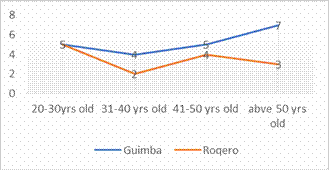
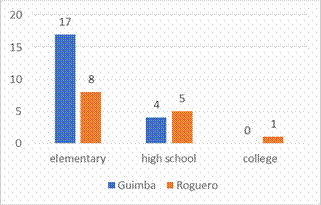
number of heads of their livestock are shown in Figure 1-5 respectively.
Figure 1. Age Profile of the Farmer’s Participants
Figure 1 shows the
age profile of the farmers’ participants from Barangay Guimba,
Marawi City and Barangay Roguero,
Ramain. These Barangays are located in the Lanao del Sur Province. As shown in the figure, majority of the
farmer’s participants in Guimba are aged 51 and
above, while in Roquero, majority are very young
farmers who are between 20-30 years old. Generally, the farmers who
participated in the FGD and assessment are of various ages. This implies that
despite their age range, they are willing to gain more knowledge to improve
their farming way of life. Research study conducted by Guo, Wen, and Zhu (2015)
pointed out that elderly farmers who do not intend to abandon farming had
higher agricultural output compared to other farmers. Farmers of different ages
operate with different technologies and use various inputs at different
efficiency.
Figure 2 also show
the sex distribution of the farmers. As can be gleaned in the figure, both male
and female are interested in gaining knowledge about farming particularly on
silage making, considering there is only a very small number difference with
regards to male and female who participated in the FGD and assessment. Globally,
reports of the United Nations’ Food and Agriculture Organization (FAO),
mentioned that the majority of economically active women in the least-developed
countries work in agriculture. And, according to the 2012 Census of Agriculture
(the latest data available), 30 percent of farmers in the U.S. are women
(Duckett, Nd). Male and female farmers can have different farming objectives.
According to the study conducted by Vercillo
(2020), the primary farming objectives of smallholder male farmers is to
produce enough food to feed their family, while women smallholders tended to
describe their farming largely in terms of cash generation. Despite their
different primary objectives, still they engage in farming regardless of their
gender.
Figure 2. Gender distribution of the farmer’s
participants
In terms of
educational attainment among the farmers who participated in this survey,
almost all of them only have elementary level of education as shown in Figure 3.
However, their limited educational attainment did not hinder their eagerness to
learn more on farming technologies that could help alleviate their economic
status and enhance their livelihood. Oduro-ofori and Anokye (2015) concluded in their study that education play
vital role in enhancing agricultural practices of the farmers.
Figure 3. Educational attainment of the
farmer’s participants
Figure 4 and 5 shows
that the most common livestock raised by the farmers who participated in the
survey are cows. However, they only have very limited number of heads being
raised. In barangay Roguero, they have other animals
raised but mostly chicken, which was not given much attention in this survey since
the primary objective of this survey is about silage feedstuff for large
ruminants.
Figure 4. Livestock raise
by the farmer’s
Figure 5. Number of livestock
raise by the farmers
3.1.Awareness, Acceptability and Perceptions of
Farmers on Silage as Feedstuff
Table 1.Awareness on silage among the farmers in Guimba, Marawi City (n=21) and Roqero, Ramain (n=14)
AWARENESS
Area
1
SDA
2
DA
3
U
4
A
5
SA
Statement
f
%
F
%
f
%
f
%
f
%
1.I am not aware about silage as feedstuff for animal
Guimba
3
14.3
18
85.7
Roguero
4
28.6
10
71.4
2.This is my first time to hear about silage
Guimba
8
38.1
13
61.9
Roguero
4
28.6
10
71.4
3.I am afraid to use silage because I am not familiar
with it
Guimba
3
14.3
4
19.0
6
28.6
8
38.1
Roguero
3
21.4
5
35.7
6
42.9
4.I heard about corn silage but I don’t have experience
in using it.
Guimba
3
14.3
11
52.4
7
33.3
Roguero
5
35.7
9
64.3
5.There is no such silage in Lanao del Sur, so I don’t
know about it
Guimba
11
52.4
10
47.8
Roguero
5
35.7
9
64.3
OVERALL
MEAN
Guimba
4.41 - Agree
Roguero
4.57 – Strongly Agree
Table
1 shows the awareness of the farmer’s participants about silage as feedstuff.
Based on the figure shown in the table, both farmers in Guimba
and Roguero are not aware and have no knowledge about
silage. This means that their level of awareness on silage is zero considering
they all agreed on the statement given. During the film showing on silage
making, the farmers were very interested and they were all excited about the
technology. However, they felt discouraged because they did not know anything
about silage. Excerpt below are some of their opinions during the focus group
discussion (FGD).
Farmers
in Guimba and Roguero all
said;
Oh, we don’t know about silage. This is the
first time we heard and saw the video. It is very interesting?
On the other hand, in terms of
acceptability on silage, the farmers in both barangays are willing to adopt the
technology, majority of them said that they are very
much willing to accept the technology as long as they will be trained. Table 2
shows their responses in terms of the acceptability of silage.
Table 2.Acceptability on silage among the farmers in Guimba, Marawi City (n=21) and Roqero, Ramain (n=14)
ACCEPTABILITY
Area
1
SDA
2
DA
3
U
4
A
5
SA
Statement
f
%
F
%
f
%
f
%
f
%
1.I am very interested to learn more about silage
Guimba
10
47.6
11
52.4
Roguero
1
7.1
13
92.9
2.I am willing to try something new to feed my cattle
Guimba
1
4.8
9
42.9
11
52.4
Roguero
3
21.4
11
78.6
3.I think it is nice since it has more nutrients and easy
to handle than pasturing
Guimba
1
4.8
7
33.3
7
33.3
6
28.6
Roguero
1
7.1
4
28.6
9
64.3
4.It is good to know that we can process those kinds of feedstuff
and I think it is very important particularly in raising more cattle due to
limited pasture area that we have.
Guimba
2
9.5
10
47.6
9
42.9
Roguero
1
7.1
3
21.4
10
71.4
5.If other grass/forage/plant can be used as silage like
water hyacinth it is better since water hyacinth has no use for us as of this
moment and it is easily grown in our locality.
As shown in Table 2, farmers in Guimba agreed to all the statement given with an overall
mean of 4.257, while farmers in Roguero strongly
agreed to all the statements given on acceptability with an overall mean of 4.7
= 5. During FGD, farmers in Guimba and Roguero has similar stand saying that Yes, if we know
the technology in silage making, we are willing to use silage as feedstuff for
our animals.
Others said that Yes, if we can earn money
from silage making, then we are willing to learn the technology, but how about
the young corn that we can sell if it is being used for silage, we have spent a
lot for the fertilizer.
Based on the FGD discussions, we explained to
them that other crops and forages can be used for silage making, and the young
corn could not be included for silage making if they wanted to sell if outright
to earn money. We also emphasize to them that if they will use the corn for
silage making their income will become doubled since instead of one cropping
for the whole development of corn, they can split it into 2 cropping since the
corn will be harvested young or 70-80 days after planting. Upon learning more
information about silage technology, they gain insights and became more
interested to learn the technology in silage making.
Table 3, shows the perceptions of farmers on
silage production. As shown in the table, farmers in Roqero
are more persistent and have agreed to the potential of silage as feedstuff and
business compared to the farmers in Guimba with an
overall mean of 3.97 or 4 and 4.43 respectively. Looking into the 5 statements
in Table 3, farmers in Roguero are more motivated, of
which most of them strongly agree (85.7%) on the statement number 5 stating
that “I am motivated to use silage as feeds for my cattle/livestock and at
the same time I am looking forward to have business on silage making as well.While more than 50% of the farmers in Guimba only agree
(61.9%) on that statement. Likewise, farmers in Guimba and Roguero has
also different perception levels on the aspect of forage conservation stated in
the statement number 3. Fifty percent (50%) of the farmers in Roqero strongly
agree and 42.9% agree on the needs for forage conservation while 57.1% of the
farmers in Guimba only agree on the statement, and only 23.8% strongly agree.
This implies that farmers in Roqero are more open minded on the possible
effects of climate change and much willing to do innovative actions compare to
the farmers in Guimba.From the
remaining statements presented regarding how they perceived silage making, both
farmers in Guimba and Roguero
perceived almost the same, in which they agree to the potential benefits on
silage technology.
Table 3. Perception of farmers in Guimba, Marawi City (n=21) and
Roqero, Ramain (n=14) on silage as feedstuff
PERCEPTION
Area
1
SDA
2
DA
3
U
4
A
5
SA
Statement
f
%
F
%
f
%
f
%
f
%
1.Silage is a good promising feedstuff for cattle and
other livestock.
Guimba
2
9.5
2
9.5
2
9.5
10
47.6
5
23.8
Roguero
1
7.1
7
50.0
6
42.9
2.Making water hyacinth into silage is very interesting
and promising as our source of feeds and source of income as well.
Guimba
12
57.1
6
28.6
3
14.3
Roguero
1
7.1
8
57.1
5
35.7
3.After knowing about silage, we learned that we need to
conserve forage and make silage for our cattle/livestock
Guimba
1
4.8
3
14.3
12
57.1
5
23.8
Roguero
1
7.1
6
42.9
7
50.0
4.I think silage making is good business particularly if
we can make use of our water hyacinth here in the lake
Guimba
1
4.8
12
57.1
8
38.1
Roguero
2
14.3
7
50.0
5
35.7
5.I am motivated to use silage as feeds for my
cattle/livestock and at the same time I am looking forward to have a business
on silage making as well.
Excerpt
below are some of their statements during FGD.
Farmers in Guimba said the
following:
Me,
I am willing to try so that I can earn more
Me,
I am hesitant because I expense a lot in my corn farming)
For me, we really need to conserve forage
because sometimes I find it difficult to find feedstuff for my animals specially during summer)
Farmers in Roguero
said;
Yap, that is a very good
program we hope we can learn how to make silage)
Can
we use other crops because it is a waste if we will use our corn
Yes
we need to conserve feedstuff specially during hot
season we find it difficult to look for feeds to our animals since the grasses
are died.
When
can we have training on silage making?
Several studies showed the advantages of
silage technology. Silage production provide
additional income and improve financial and economic status of the family
engaged in silage technology (Bosma, Roothaert, Asis, Saguinhon, Binh, and Yen,
2003). Silage making like corn silage is also a promising business not only in
the Philippines but to the foreign markets as well with greater return of
investments (Cañete and Alvarez, (2021). According to Singh (2022) silage
technology is not only good for agricultural business but it also helps
mitigate the dry season green fodder scarcity problems. However, research
studies also showed that silage technology is very limited due to farmers’ lack
of information, skills and technology. Farmers rarely make silage, despite its
potential to bridge the dry season feed gap, due to the limited resources,
knowledge, and skills of the farmers, Balehegn et al.
(2021).Singh (2022) pointed out some
reasons for non-adoption of silage making among farmers. These are (1) the
perceived need of the technology; (2) financial capability for initial capital
requirement; (3) risk aversion attitude; (4) perception of double handling of
forage; (5) green fodder is more nutritious than silage; (6) lack of
choppers/chaff cutters; (7) scarcity of surplus and quality fodder; (8) return
on investment; (9) poor extension services; (10) level of expertise of
extension workers; (11) education level; (12) gender; (13) lack of proper
communication channel; and (14) lack of information.
3.2.Relationship
between awareness, acceptability and perceptions of farmers on silage to their
demographic profile
To
determine the relationship between type of livestock
raised, the number of heads of the livestock raised, the awareness,
acceptability and perceptions of the farmers with their demographic profile,
Pearson correlation was established. The statistical results of the correlation
of these variables are shown in Table 4 and Table 5 for Guimba
and Roguero respectively.
Table 4. Relationship between awareness, acceptability and perceptions
of farmers in Guimba, Marawi City on silage to their demographic profile (n=21)
LIVESTOCK
NO. OF HEAD
AWARENESS
ACCEPTABILITY
PERCEPTION
AGE
Pearson
Correlation
.417
.697**
.831**
.861**
.624**
Sig.
(2-tailed)
.060
.000
.000
.000
.003
GENDER
Pearson
Correlation
.281
.469*
.642**
.539*
.609**
Sig.
(2-tailed)
.217
.032
.002
.012
.003
EDUC
Pearson
Correlation
.795**
.811**
.320
.364
.167
Sig.
(2-tailed)
.000
.000
.157
.105
.470
Legend: **. Correlation is significant at
the 0.01 level (2-tailed).*.
Correlation is significant at the 0.05 level (2-tailed).
Table 4 shows that
the age and gender of the farmers are significantly and positively correlated
to the type of livestock raised, farmers’ awareness,
acceptability and perceptions on silage. This means that the number of heads of
the livestock to be raised will depend on the age and sex of the farmers. In
the same manner, the awareness, acceptability and perception of the farmers on
silage technology is directly associated with the age and gender of the
farmers. Likewise, farmers education is positively
correlated to the type of livestock raised and the number of livestock, but not
correlated to their awareness, acceptability and perceptions about silage. The
relationship is significant at 0.01 level of significance.
This means that the higher the education is, the more livestock they wanted to raise.
Table 5. Relationship between awareness, acceptability and
perceptions of farmers in Roguero, Ramain on silage to their demographic profile (n=14)
LIVESTOCK
NO. OF HEAD
AWARENESS
ACCEPTABILITY
PERCEPTION
AGE
Pearson Correlation
.183
.192
.149
-.192
.345
Sig. (2-tailed)
.550
.530
.626
.530
.248
GENDER
Pearson Correlation
.659*
.693**
.539
.433
.234
Sig. (2-tailed)
.014
.009
.057
.139
.443
EDUC
Pearson Correlation
.513
.539
.420
.337
.182
Sig. (2-tailed)
.073
.057
.153
.260
.552
Legend: **. Correlation is significant at
the 0.01 level (2-tailed).*.
Correlation is significant at the 0.05 level (2-tailed).
Table 5 shows that
only gender is significantly related to the type of livestock and the number of
heads of the livestock raised. This means that these variables are associated
with each other positively, and the gender will influence the type of livestock
and the number of heads of livestock raised among farmers participants.
However, gender does not influence their awareness, acceptability and
perceptions about silage technology. Similarly, age, and education do not
influence the type of livestock, the number of heads of the livestock raised,
as well as their awareness, acceptability and perceptions towards silage
technology. This means that age and education has no influence and irrespective
of the type of livestock raised, its number of heads, and the farmers’ awareness,
acceptability and perceptions towards silage. This means that the farmers’ age,
sex and education, does not hinder their eagerness to learn new technology and
new livelihood or opportunity.
Research
studies show that farmers’ age affects the preferences and agricultural output
of the farmers (Guo, Wen, and Zhu, 2015), middle-aged farmers tend to be more
productive (Tauer, 1993). Similarly, gender also impacted farmers’
farming practices. Men's farming is primarily oriented for subsistence, and the
gender division of labor is an important aspect of social inequality and food
insecurity (Vercillo, 2020), and
closing the global gender gap in agriculture would grow food production and
build sustainable futures for women (Duckett, Nd). In the Philippines, the
involvement of women and children in tasks like herding and cutting diminished,
and men were responsible for more livestock tasks (Bosma, Roothaert, Saguinhon,
Binh, and Yen, 2003).
Paltasingh & Goyari (2018), analyzed the effects of education on farm
productivity. Their findings showed that education enhances farm productivity
in the case of adopters of modern technology. Educating farmers about the
application of various modern technologies needs to be emphasized.As such, they suggested that farmers’ field
school program must be implemented along with a strong extension network for a
wider dissemination of modern technology. As educational level increases,
output increases with secondary school education having the highest returns on
agricultural productivity. Extension service has a greater impact on
agricultural productivity than formal education (Oduro-ofori and Anokye, 2015).
This paper is a short-term research aimed to
investigate the awareness, acceptability and perceptions of selected farmers in
Guimba, Marawi City and Roqero, Ramain in the Lanao del
Sur Province about silage. Aside from the awareness, acceptability and
perceptions of the farmers participants about silage, selected demographic
profile of the farmers were also obtained such as their age, gender, education,
type of livestock, and the number of their livestock raised. From the findings,
the study concluded that the farmers have varying ages, both men and women are
engaged in farming with cow as their main livestock raised but in a very few
numbers of heads. Most of them are also having elementary education only.
However, despite of their limited education with zero knowledge and awareness
about silage, they are willing to learn and adapt the silage technology. It is
also concluded that farmers age, sex, and education have
a different influence on the type of livestock raised, number of heads of
livestock raise, awareness, acceptability, and perceptions. The influence of
their demographic profile varies from farmer to farmer.
Findings of this study implied that
regardless of age, sex and educational attainment, farmers are willing to learn
new things, new skills, and new technology for the augmentation of their
knowledge and skills, livelihood and economic status in life. Since they have
no knowledge about silage technology and they have low level of education, more
extension programs from educational institutions and the department of
agriculture must be established. There should be a farmer field school (FFS)
program along with strong extension service to guide the farmers. To educate
the farmer about silage and various farm practices, crop management strategies,
and technological up-gradation, the FFS approach should be innovative,
participatory, and interactive.The
farmer hands-on training keeps the farmer abreast with changing innovations and
ideas and allows them to share experience gained. Likewise, the government must
improve the quality of extension services to the famers to improve farmers productivity.
5.REFERENCES
Balehegn,
M.Ayantunde, A. Amole, T. Njarui,
D.Nkosi, B.D.Müller, Robin Meeske,
F.L. Tjelele, T.J. et al (2021). Forage conservation
in sub-Saharan Africa: Review of experiences, challenges, and opportunities. Agronomy Journal.https://doi.org/10.1002/agj2.20954
Bosma,R.H., Roothaert, R.L., Asis, P., Saguinhon, J., Binh, L.H. and Yen,V.H. (2003). Economic and social benefits of new
forage technologies in Mindanao, Philippines and Tuyen Quang, Vietnam.
CIAT Working Document No. 191. Centro Internacional
de Agricultura Tropical, Los Baños,
Philippines, 92 pages.
Cañete, D.C. and
Alvarez, T.S. (2021). Commercialization of
Green Corn-Based Silage Production for Dairy in Cagayan Valley: Profitability
and Viability Assessment. Universal Journal of Agricultural Research 9(3):
79-90, 2021 http://www.hrpub.org DOI: 10.13189/ujar.2021.090303
Duckett, M.K. (nd). Empowering female farmers to feed the world. National Geographic
Guo, G. Wen, Q.Zhu,
J. (2015). The Impact of Aging Agricultural Labor Population on Farmland
Output: From the Perspective of Farmer Preferences", Mathematical Problems
in Engineering, vol. 2015, Article ID 730618, 7 pages, https://doi.org/10.1155/2015/730618
Kilelu,
C. W., Van Der Lee, J., Koge, J., & Klerkx, L. (2021). Emerging
advisory service agri-enterprises: A dual perspective
on technical and business performance. The Journal of
Agricultural Education and Extension, 1– 21. https://doi.org/10.1080/1389224X.2021.1888759
Klopfenstein, T.J., Erickson, G.E., and Berger, L.L. (2013). Maize is a
critically important source of food, feed, energy, and forage in the USA. Field
Crops Res.153: 5–11.
Oduro-ofori,
E. and Anokye, P.A. (2015). Effects Of Education On The Agricultural Productivity Of Farmers In
The Offinso Municipality.
https://www.researchgate.net/publication/281032030
Palinkas LA, Horwitz SM, Green CA, Wisdom JP, Duan N, Hoagwood K. (2015).Purposeful Sampling for
Qualitative Data Collection and Analysis in Mixed Method Implementation
Research.Adm Policy Ment Health. 2015 Sep;42(5):533-44. doi:
10.1007/s10488-013-0528-y. PMID: 24193818; PMCID: PMC4012002.
Paltasingh, K.R.&Goyari, P.
(2018). Impact of farmer education on farm productivity under varying
technologies: case of paddy growers in India. Agricultural and Food Economics
volume 6, Article number: 7.
Philippine Carabao Center (2017). Silage-Making as
A Steady Source Of Feedstuff For Dairy Buffalo. ISSN:
2507-864x. Series No.: F-03-2017
Ritchie, H., & Roser, M.
(2017).Meat and seafood production, consumption.Our World in Data.
https://ourworldindata.org/meat-production.
Singh, R. (2022). Measuring Technology Adoption, Possible Reasons for Non-adoption of
Silage Making in India – a Practioner’s View, Reasons
for Non-adoption of Silage Making. Indian Veterinary Research Institute,
Bareilly. He served Animal Husbandry Department and Uttarakhand Livestock
Development Board (Govt. of Uttarakhand) in various capacities
USAID Training Manual (nd). Silage Making For Small Scale Farmers. Food And Agriculture Organizationof the United Nations.
Vercillo, S. (2020).The complicated gendering of farming and
household food responsibilities in northern Ghana. Journal of Rural
Studies, Volume 79, Pages 235-245. https://doi.org/10.1016/j.jrurstud.2020.08.020.
Warfa, A.M. (2016) Mixed-methods design in biology education
research: Approach and uses. CBE Life Sci. Educ., 15(5): 1-11.
Wilkinson, J. M., Bolsen, K. K.,
& Lin, C. J. (2003).History of silage.Silage Science and Technology, 42, 1– 30.
Cite
this Article: Valdez, A; Mangontra, S;
Manaol, N; Gomampong, AM;
Jumalon, RJr;Aliasgar, SD
(2023). Awareness, Acceptability and Perceptions of Meranao
Livestock Raiser on Silage as Alternative Feedstuff. Greener Journal of Agricultural Sciences, 13(2): 99-107, https://doi.org/10.5281/zenodo.8114745.