INTRODUCTION
Morphometric and meristic studies are key rigorous method distinguishing closely
related species of organism with high similarity indices
of characteristics (Fagbuaro, 2015). Morphometric characteristic are important not only for
understanding taxonomy, but also for a understanding
species health and reproduction in a habitat. Artisanal fishermen account for a
considerable portion of global fish landing (Cheunpagdee
et al., 2006). Along the Nigeria
coastline, artisanal fishermen land 90% of fresh water fisheries landing with
hook and line, with basket trap fishers accounting 40 to 60%. Tropical
artisanal fishers utilize a variety of gears to target a diverse array species
of fish using non-motorized craft (Van der Elst et al., 2005). Various nets (e.g.
seines, cast net etc.) hooks (e.g. handline and
logline) and traps (e.g. basket traps, weirs, fence trap etc),
have been mentioned in the literature. While the morphometric of fish landed
using net by artisanal fishers along the Nigerian coast and elsewhere have been
documented, those landed by bait fishers (hook and trap fishers), have received
less attention, which is why study this was conducted.
For example, descriptions of tropical artisanal bait fisheries include
the mention of unidentified baits, such as worms, squid, octopus and tiny fish,
for hook fishers, and seaweeds, urchin, mollusks and octopus for trap fishers
with no information on the species they target (Samoilys
et al., 2011). Wambiji
et al., (2008) report tropical baited
trap fish landing in general, however bait utilization is inadequately
described in the research. Fishery condition factor (k) is derived from the
morphometric indicator that infers the health of a fishery with high K
associated with fishery specializing in large healthy and plumpy
fish stocks. Gonadosomatic index (GSI) is an
indicator that indicates the fish fertility, spawning and fecundity (Nandikeswan and Ananda 2013), and
it has been demonstrated that fish condition and GSI fluctuate with season diet
and fish shape (Kihia et al., 2015). The condition factor is 0.2 to 1.2, with values near
close to or above unity denoting fish in excellent condition (Agembe et al.,
2010; Mbaru et
al., 2010). Depending on the fish species and sex, a GSI cut off of 1 to
10% is recommended to signify mature individuals. Seasonal changes in nutrition
and breeding pattern have an impact on both condition factor and gonadal
maturity. In fisheries with poor morphometric indicators, it is critical to
demonstrate the potential harm to the resource and ecosystem to both managers
and users prior to implementing changes. Size at first maturity of targeted
fish is also an important parameter that informs resource managers whether the
fishery target sub-adult or mature fish. A relevant index can be calculated by
comparing landing morphometric to typical adult dimensions recorded elsewhere
and measuring departures (Kihia et al., 2015).
As a result, the purpose of this study is to look at the morphometric and
developmental aspect of fish caught by artisanal bait fishers. The findings of
this study may be valuable to resource managers to identifying and designing
targeted interventions for unsustainable bait fisheries.
MATERIALS
AND METHODS
Study
Area
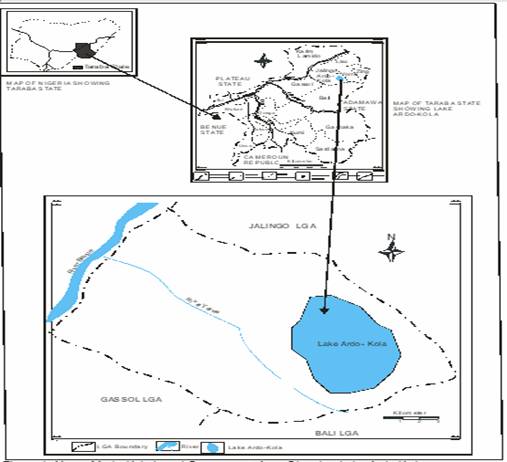
Yelwa Lake,
located on latitude 8.8036 and Longitude 11.1671, is a village located 25.4Km North
of Ardo-kola local government area of Taraba State that has been in existence since 1964. Yelwa lake covered an area of
31.6Km consisting of shrubs, sugarcane farm, mostly dominated by rice farm
(figure 1). The lake surrounding village has a population of around 5000 people
who are actively involved in fishing and small-scale businesses. Seasonal
migrants from Sokoto, Katsina
and Maiduguri also fished at Yelwa Lake from May to
August 2021.
Taking
Fish Samples
From May to
August 2021, the main fishing season in Yelwa lake,
55 fish samples were collected every month participant fishers were identified
and monitored over a period of ten days during each sampling occasion,
approximately 60 fishers are monitored (10 per day for 6 days), the type of
bait used, as well as the gear and fish landed were evaluated. The
obtained fish samples were labeled and promptly stored in ice for transit and
further refrigeration. In the laboratory, the persevering specimen was thawed,
identified and employed in morphometric analysis.
Trap
Fishing on Yelwa Lake
The Malian
trap used in this study was made from
lianas and nylon netting material
(2ply10d) with dimensions of 72 cm in width, and 100cm in depth, with two
non-return entrance valves of diameter 10cm in both ends made of stronger
netting material with mesh size 25mm, allowing for the capture of a variety of
fish. The top includes a loose hanging net that may be opened for baits
placement and fish retrieval. The traps are baited with (corn-offal,) gathered
from various sources Trap fishers insert 5 to 15 pieces of corn offal within
the traps, each traps fisher owns and
operates between four and five traps, the traps are weighted with stones and
gravels and the traps are retrieve after overnight soaking in the water.
Hook
Fishing on Yelwa Lake
Bait used by
hook Bait fishers in Yelwa lake is either earthworm (Lumbricina species) or snail (Gastropoda
species) or sometimes they used fish trash or live small fish to lure bigger
fishes, hook fishers at Yelwa lake preferred
earthworm and snail, on the other hand snail are gotten mostly in dammed
environment. Hook fishers attach appropriate bait to one or most hooks of size
8 to 18; and to a line, sinkers and Styrofoam float, hook fishing occurred from
a dugout canoe and the line is reeled in by hand, and catch placed at the
bottom of the canoe.
Determination of Morphometric Parameters.
1. Condition Factor
The Standard length of fish were taken using
a measuring board, as distance from the tip of snout to the tip of the caudal
fin, while height was taken as distance at widest part of the fish samples.
Excess moisture is removed prior to weight determination with a sensitive
balance, precision for the size and weight determined is 0.1cm and 0.01g
respectively. Data obtained was utilized to calculate condition factor (B)
using the modified foulton condition factor, as used
by Richter et al., (2000)
It was assumed that fish had isometric growth
due to correction factor by inclusion of height in the original Fulton
condition. Condition factor data were compared between gear and bait.
2. Gonadosomatic Index
The gonad of each fish was dissected out and
the weight determined. Data obtained was used to calculate the Gonadosomatic index (GSI) using the following equation:
GSI= × 100
× 100
Where GSI- Gonadosomatic
index
Wg = weight of gonad
Wf = weight of the fish
Data obtained were used to compare between
different gears and bait used by fishers.
3.
Fishing Index
Fishing impact was assessed using fishing
index (f1)
F1=
Where F1=fishing index
Lf =size of landed fish
Ls =size of adult
Data on fishing index were used to compare
between gear and bait.
Statistical
Analysis
By measuring
independent replicates, the results were expressed as mean values with standard
error of mean (SE). The Statistical Package for Social Sciences (SPSS) software
was used for the analysis.
RESULTS
Fish
Species Composition
Table 1. shows
the effect of bait type, gear used and species on
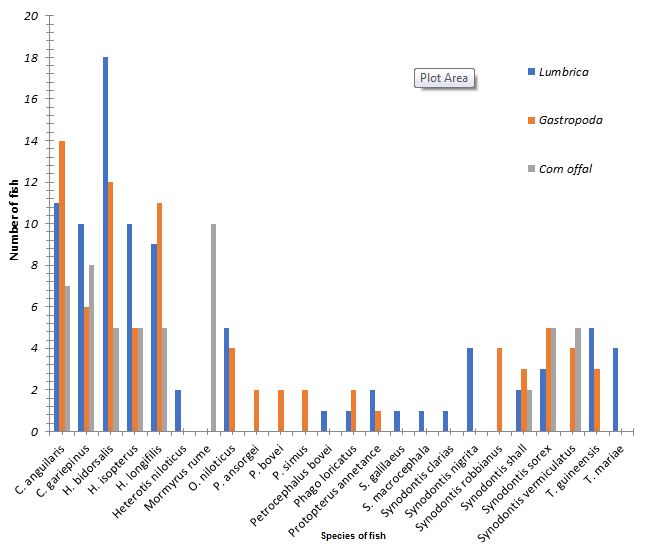
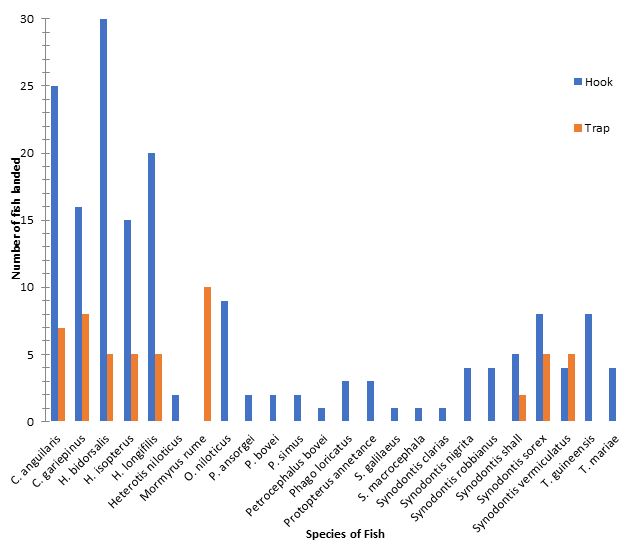
morphometric parameters of fish landed by fishermen at Yelwa lake. 220 individuals from 12 families, 16 genera and 24
species were seen over the study period from May to August, 2021, utilizing
various gears and bait. Clariidae, Arapaimidae, Mormyridae, Cichlidae, Amphiliidae, Araceae, Lemuridae, Distichodontidae, Protopteridae, Cichlidae, Mochokidae and Cyprinidae are among the families represented.
The family Clariidae
had the most species landed, while the families Aracea, Chichlidae and Mochokidae had the fewest.
Variation in condition factor, Gonadosomatic
index and fishing index of the gear used, as well as the bait types used,
different fish species.
Mormyrus rume (1.50±5.22), C. gariepinus
(1.21±0.37), Protopterus annectance (1.20±0.90) had the highest
condition factor, whereas Patricephalus ansorgei, P. bovei, and P. simus (0.04±0.00)
had the lowest. Among the bait anglers, corn offal has the highest condition
factor (1.31±1.02), while Lumbricina had the lowest (0.65±0.21). Mormyrus
rume (4.77±0.58), P. ansorgei,
(4.45±4.55), and P. simus (4.30±15.99) had the
greatest GSI among the fish species,
whereas T. mariae (0.37±0.06)
had the lowest.
C. anguillaris had the greatest
score among gastropoda fishers, while Protopterus annectance
had the lowest. Mormyrus rume was the most abundant corn offal fisher, while Synodontis schall
was the least abundant. Except C. anguillaris
and C. gariepinus, which landed above 30% in all three (3) baits
employed, the hook and trap gears landed less than 20%. When the fishing index
of different bait types was compared, it was discovered that corn offal fishers
had the highest fishing index up to 35%, while lumbricina
fisher had the lowest fishing index of 30%.
DISCUSSION
The variation in fish composition observed in
this study is due to the fact that these species constitutes the major
fisheries of Nigeria inland water, as stated by Olaosebikan
and Raji, (2013), as well as the relative abundance
of these species in northern Nigeria, as reported by Adeosun
et al., (2011), who reported Mormyridae, Cichlidae, Mochokidae, Characidae, Bagridae and Clariidae to be
more dominant in northern Nigeria. Allison and Okadi
(2013) also discovered six families of fish during their research on the lower
River Nun.
Landed fish with low condition factor in Yelwa lake did not agree
with the findings of Wambiji et al., (2008) while Agembe et al., (2010) found greater condition factor
of 0.9 to 1.2 for Siganids fish caught employing
basket and other gears in Kenya south coast. Mbaru et al. (2010) on the other hand,
reported condition factors of 0.01 to 0.4 for L. lentjan and L. fulviflamma caught using nets, which
are lower than values obtained in this work. The gonadosomatic
index (GSI) discovered in this investigation is consistent with the findings of
Fryer et al., (2002) who reported a
GSI of between 4.2 and 3.6g.
In this study, there
is a fluctuation in gonadal development; fish landed by bait fishers in Yelwa Lake were of moderate to poor condition and GSI. The
fish were caught after reaching around 35% of their potential adult size. As a
result, the Yelwa fishery focuses on immature subadult growth phases of rather large tropical fish from
over 23 species. This experiment shows that excessive harvesting of young fish
may result in the collapse of the Yelwa Lake
fisheries due to failure to recruit new cohorts. According to Kihia et al., (2015), increasing fishing effort
among jobless local resident will exacerbate the current scenario.
Although larger fish
are landed using maize offal bait, there is uniformity in the condition,
gonadal development and fishing index among the bait types evaluated. This
suggests that artisanal fishers’ baits attract and catch fish with similar
morphometric traits. This contrast with the findings of Kihia
et al., (2015) in a long line bait fishery in Mida
Creek, Kenya which revealed a variation in catch rates across the bait tested.
However, Jacobsen and Joensen (2004) report a higher catch using whelk bait than squid bait in long line
fishery. Fish types landed by bait fishers at Yelwa
have similar condition factor, indicating that the majority of the fish landed
by bait fishers at Yelwa lake
are in a sub-optimal condition. It is crucial to note that GSI levels vary
greatly with seasonal breeding patterns, hence the
results on GSI changes reported here should only be interpreted as an
indicative of prospective consequences.
The found species
differences in condition factor, GSI, and fishing index could imply that the
species use different habitats. Allowing local baits fishers to move into
different fishing location may boost landings while lowering pressure from the
immature lake fish population. However, more evidence is required before such
interventions may be implemented.
The gathering of
immature high value fish by bait fishers may limit the earning potential
because such little fish have a low market value. The reported landing of
juveniles’ fish is the result of a combination of fishing within fish nursery
areas and overfishing. Landing of small immature fish may be an indicator of
overfishing pressure, according to Gajdjzik et al., (2014). According to Kihia et al., (2015), the cause of heavy immature
fishing may be the use of long line for this species at vegetated shores areas
where juvenile fish grow, and thus the use of this poor size selective fishing
gear in areas where immature fish are abundant (shore area) enhances immature
fishing (Bertrand, 1988). While trap fishers land substantially larger fish,
there were no significant variation in condition
factor, GSI, or fishing index among the gears used. This means that trap gear
lands larger fish, and that the fish health and developmental stages were
similar to hook gears. The difference in fish sizes and taxa landed may be
attributable to gear selection and fish habitat usage. The netting of the malian traps allow smaller fish to escape, but the traps
are also drenched overnight and fish retrieved live, giving smaller fish more
opportunity to escape.
The similarity in
fish morphometric indexes may be related to the fish use of interconnected
mangrove forest seagrass beds and coral reefs
habitats (Garrison et al., 2004; Gajdjzik et al, 2014). Knowledge of exploited species reproduction
and habitat utilization techniques may provide more insight on this aspect.
Similarly, the use of small mesh malian
traps and small hooks must be assessed and regulated. While some resource poor
fishers may object at first, future enhanced earnings within participatory
management frameworks, may be critical to sustaining livelihoods in the
semi-enclosed Yelwa lake basin. Inadequate
administrative authority policing of remote areas may necessitate concerted
local community participation via stronger Lake Management Units.
CONCLUSION
The study found that bait fishers at Yelwa lake use Malian traps filled
with corn offal and hooks baited with gastropoda and lumbricina to catch identical
young fish with moderate to low condition factor, GSI and fishing index. This
is the first record describing the characteristics of fish landed using certain
types of bait in Yelwa lake tropical multi-bait
fishery. The observed disparities in landed fish features are mostly related to
overfishing, species specific growth diversity and habitat usage patterns.
Reducing fishing pressure, through voluntary catch and release of juveniles and
immature fish, as well as identifying alternative fishing grounds and
livelihoods, may allow for improvement in morphometrics
of landings and provide respite and sustainability to the Yelwa
lake fishery.
RECOMMENDATION
There is a need to educate the artisanal bait
fishers about the dangers of overfishing, as well as provide them alternative
means of livelihood, alternative fishing grounds, catch and release of immature
fish, mesh size restriction for sustainable fisheries in Yelwa
lake.
REFERENCES
Adeosun,
F. I., Omoniyi, I. T., Akegbejo
Samson, Y. & Olujimi, O. O. (2011). The
fishes of Ikere, Oyo State, Nigeria. Taxonomy and distribution. Asiatic Journal of Biotechnological Resources, 2(4), 347-383.
Agembe,
S., Mlewa, C. M. & Kaunda-Arara,
B. (2010).
Catch composition, abundance and length-weight relationship of groupers
(Pisces- Serranidae) from inshore waters of Kenya.
Western Indian Ocean Journal of Marine Science 9(1):91-102.
Allison, M. E. & Okadi, D., (2013). Gill Net Selectivity, seasonal, Tidal
and Photoperiod Variation in Catch in Lower Nun River, Niger Delta, Nigeria. Science Resources Essays, 8:108-114.
Bertrand, J. (1998).
Selectivity of hooks in the handline Fishery of the Saya de MalhaBa (Indian Ocean)
Fishery Research 6: 249 -255.
Cheunpagdee,
R., Liguori, L., Palomares,
M. L. D. & Pauly, D. (2006). Bottom
up global estimates of small-scale marine fisheries catch. Fishery
Centre Research Report 14(8).
Fagbuaro,
O., Oso, J. A., Olurotimi, M.
B. & Akinyemi, O. (2015). Morphometric
and Meristic Characteristics of Clarias gariepinus from Controlled and Uncontrolled Population
from Southwestern Nigeria. Journal of Agriculture and Ecology Research
International 2(1): 39-45.
Fryer,
G. & Isles, T. D. (2002). The cichlid fishes of the great lakes of
Africa. Oliver and boid London uk 345:675.
Gajdjzik,
L., Vanreusel, A., Koedam,
N., Reubens, J. & Muthumbi,
A. W. N. (2014).
The mangrove forest as a nursery habitat for the ichthyofauna of Mida creek (Kenya,
East Africa). Journal of Marine Association United
Kingdom pp. 1-13.
Garrison, V. H.,
Roger, S., Beets, J. & Friedlander, A. M. (2004). The habitats exploited
and the species trapped in a Caribbean island trap fishery. Environmental
Biology and Fishes 71:247-260.
Jacobsen,
J. H. & Joensen, J. (2004). Comparison
of bait in longline fishery. Bsc Thesis
University of Faroe Islands.
Kihia,
C. M., Hendrick, Y., Muthumbi,
A., Okondo, J., Nthiga, A.
& Njuguna, V. (2015). Morphometric
and developmental characteristics of fish landed by artisanal bait fishers at Mida Creek, Kenya. International
Journal of Fisheries and Aquaculture. 6(2): 15 – 24.
Mbaru,
E. K., Mlewa, C. N., & Kimani,
E. N. (2010).
Length weight relationship of 39 selected reef fishes in the Kenya coastal
artisanal fisheries. Fisheries Research. 106:567-569.
Nandikeswan,
R. & Anandan V. (2013). Analysis
of the gonadosomatic index and fecundity of Teraponputa from Nallavadu coast
Pondicherry. International Journal of Science Research
Publication. ISSN 3(2): 2250-3153.
Olaosebikan,
& Raji, B. D. A. (2013). Field
guide to Nigerian Fresh water Fishes (Revised edition), Unive
rsity of Illorin Press,
Nigeria, pp 1-89.
Richter H., Luckstadt C., Focken U. L. &
Becker K. (2000). An improved procedure for the assessment of
fish condition on the basis of length weight relationship. Archive of Fishery and Marine Research. 48(5):226-235.
Samoilys
M., Maina G. W. and Osuka
K. (2011).
Artisinal fishing gears of the Kenya coast. CORDIO, Mombasa, Kenya.
Van
der Elst, R., Everett, B., Jiddawi,
N., Mwatha, G., Afonso, P.
S., & Buolle, D. (2005). Fish, fishes and
fishers of the Western Indian Ocean; their diversity and status, A preliminary assessment. Philosophical
Transaction of the Royal Society A – Journals. 363:263-284.
Wambiji,
N., Ohtomi, J., Fulanda,
G.W., Kimani, E., Kulundu,
N., & Hossain M. Y. (2008). Morphometric
relationship and condition factor of Siganusstel
latus, S. caniculatus, S. sutor (Pisces; Siganidae)
from Western Indian Ocean waters. South Pacific Studies.
29(1):1-16.