INTRODUCTION
Aquaculture accounts
for approximately half of all fishes consumed globally, while developing nations
account for 61 % of all traded sea food (FAO, 2018). Aquatic animals’ diseases are
seen as a serious danger to the sustainability of aquaculture, as they
jeopardize the efforts and outcomes of millions of small fish farmers worldwide.
Aquaculture has become an important component of the animal health business due
to ongoing increase of cultured fish and shellfish species, and aquatic illnesses
are the most significant constraint in aquaculture output. Disease frequently
has a severe impact on fish feeding behavior, development and survival, resulting
in significant investment losses in the fisheries business. Meanwhile, farmed
fish are more sensitive to disease agents than wild caught fish.
Intensification of fish culture has resulted in numerous challenges, with bacterial
infections being identified as the primary issue for local fish farmers (Najiah
et al., 2009; Oyebola et al., 2017). Aeromonas is increasingly being blamed for illness outbreak in
farmed fishes around the world. These bacterial species are common in the
aquatic environment but have recently emerged as a difficult pathogen of
cultured fish and the phenotypic identification of these species is difficult due
to its complexity in employing growth and biochemical parameters, which causes
confusion, particularly among closely related species and strains (Puthucheary et al., 2012). Despite the documented
contributions of other Aeromonas species
to disease outbreak in fish, A.
hydrophila is the primary source of disease outbreaks in fresh water farmed
fish, contributing to food insecurity and economic loss globally. Aeromonas illnesses in fish farms are
accelerated by a variety of causes, including changes in pond water physical-chemical
properties. Increased turbidity, temperature, salinity, pH, water conductivity
and low dissolved oxygen are critical physical-chemical characteristic; these
environmental conditions create stressors that predispose fish to infections
and illnesses (Camus et al., 1998).
The employment of a genetic method has a
long-term influence in combating any illness challenge since the advantages are
heritable in later generations. Genetic enhancement for disease resistance may
be a practical and sustainable option to preventing diseases outbreaks, and
these techniques has the potential to aid in disease control (Yanez, 2014).
This method makes use of fish natural immunological response, which varies
within and across genotypes.
Crossbreeding to create intra-specific or inter-specific
hybrids has potentials to investigate heterosis, which could be important in
the evolution of genotypes that are resistant to a disease challenge. The
potentials, however, must be evaluated in different fish genotypes employing
different infections. Development of genotypes that are resistant to a disease
challenge would be especially important for commercially valuable species that are
widely farmed (Banito et al., 2010
and Yanez, 2014). Because most production features are generally controlled by many
gene and gene interactions, the observed phenotypes may co-vary with other
importance qualities like disease resistance. This must, however, be determined
for the purposes of use. In order to evolve strains of improved disease resistance
and growth productivity in the case of disease challenge in aquaculture, the
inbred and the intra-specific crossbred’s fingerlings of C. gariepinus were
evaluated for clinical symptoms, growth rate and survival rate in response to a
disease (A. hydrophila) challenge.
MATERIALS AND METHODS
Study Area
The study was conducted at the Fisheries and Aquaculture
Department research farm of Federal University Wukari, Taraba State 2022. The
research farm is located between latitude 7051 N 9047 E
and Longitude 7.8500N 9,7830E. It is a tropical zone with
an average annual temperature of 27.2- 37ᵒC, a relative humidity of 62,
and 260.4 hours of sunshine each month.
Experimental Fish
The experimental fish came from an ongoing study at the
experimental site. C. gariepinus brooders
strains were used to create the fish specimens. These strains were identified based
on previous descriptions (Oyebola et
al., 2016) and then used
to construct the inbred and crossbred progenies.
Experimentation Crosses
The generic combinations listed
below were tested;
|
Inbred
|
Crossbred
|
|
♀Dg
x ♂Dg
|
♀Dg
x ♂Bn
|
|
♀Bn
x ♂Bn
|
♀Bn
x ♂Dg
|
Note: ♀Dg x ♂Dg is Donga Female X Donga Male; ♀Bn
x ♂Bn is lower Benue Female X lower Benue Male; ♀Dg
x ♂Bn is Donga Female X lower Benue Male and ♀Bn
x ♂Dg is lower Benue Female X Donga Male.
Procedure and Culture of Aeromonas
hydrophila
40 g of Mac-conkey agar was weighed and placed into a
conical flask, then diluted with 100ml of distilled water using a heating
mantle to completely dissolve the agar particles. The mouth of the
conical flask was sealed and autoclaved at 121oc for 15 minutes, after
which the sterilize agar was allowed to cool at 45 oc. 15- 20 ml of
agar was put onto pre-sterilize Petri dishes and allowed to harden. The
prepared agar plates were kept in the refrigerator at 6-7 oc. Oracle
Farm Limited earthen and concrete pond water was utilized. Using a candle flame,
the wire loop was sterilized to a red-hot state. The wire loop was inserted deeply into
the earthen pond water, and a pool of inoculums was form and streaking was done
three times at varied dimensions. The Petri plates were covered and incubated for
48 hours at 35 oc.
Method of Culture
On one end
of the slide, a loopful growth from a blood agar subculture was mixed in a drop
of distilled water. Another loopful of growth was mixed in a drop of peptone
water on the other end of the slide. The preparations were covered with a cover
slip and viewed under a microscope with an X40 objective. The camera is an
Olympus CX21.
Biochemical test
Biochemical
test were performed in distilled water using L- arabinose, sucrose, Asculin, oxidase test, sodium chloride free
peptone (Nacl), and Motility.
Disease Challenge Test
A two weeks old cohort of inbred and crossbred genotypes
was challenged with cultured A. hydrophila at the
Department of Fisheries and aquaculture research farm, Federal University
Wukaria, Nigeria. After growing the bacterium from Benue State University Laboratory,
the colony of the A. hydrophila required
for the challenge was created. The cells were collected and re-suspended in
sterile saline. The bacteria suspensions were diluted with sterile saline to yield
an inoculum concentration of 2.56 x 10⁷ cfu/ml. This concentration
was chosen because 3.0 x10⁷ cfu/ml of A. hydrophila inoculum caused infection in adult C. gariepinus (Hanna et al.,
2014).
Each 30ml rearing medium prepared for
the challenge of the fry of Donga female
x Donga male, lower Benue female x lower Benue male, Donga female x lower Benue male and lower Benue female x Donga male received 0.5ml of the
inoculum. These were
prepared in threes. Earlier approaches were used in the challenge test (Schadich and Cole 2010). Fifty individuals from the two-weeks old
cohort of inbred and crossbred genotypes were immersed in each of the A. hydrophila inoculated, 0.5ml rearing
media and their replicates for 20 minutes. Each treatment was then transferred
to fresh rearing water of the same volume and reared for two weeks with two
ad-libitum feeding/day. 2mm blue crown feed was provided to the fingerlings.
The non-challenged specimens (control) of the inbred and the crossbred were likewise
created in duplicate and reared alongside the challenged specimens under the
identical water and feeding circumstances.
Parameters of Water Quality
Because water is utilized in
fish culture, its quality degrades quickly and requires extensive maintenance. To
allow for aeration, the unclean water was drained and replaced with clean water.
Water quality is affected by temperature, pH value, dissolved oxygen, ammonium content
and other factors. They were measured in situ with a thermometer for
temperature and a pH reagent for pH. Other parameters were measured by inserting
the measuring instrument probes in the water at a depth of about 4cm in the
middle of the cultured water and reading the meter when equilibria was
reached.
Statistical Analysis
The mean
values and standard error of mean (SE) of two independent replicates were used
to calculate the results. Statistical Package for Social Sciences (SPSS)
software (version 21, IBM SPSS) was used to perform one-way ANOVA and Duncan’s
test to examined the significance difference between mean values obtained among
treatments at the 5% level of significance. At p0.05, differences were
considered significant
RESULTS
Table-1 display the clinical symptoms of A hydrophila observed within 14 days of
the challenge. The symptoms include a darker skin colour, delayed mobility,
abnormal enlargement of the lower belly, red patches on the skin, loss of
appetite and death. Percentage individuals with darker skin colour appear
solely in ♀Dg x ♂Dg (1±0.0ab) and ♀Bn x ♂Dg
(1±0.0 a) and there is no significant difference (P>0.05) across
the C. gariepinus strains. Only ♀Bn x ♂Bn is unaffected by
slow movement, whereas the others are and there is no significant difference
(P>0.05) between strains (♀Dg x ♂Dg (2±1.0 ab),
♀Dg x ♂Bn (2±1.0 a), and ♀Bn x ♂Dg (2±0.0
a). Percentage individuals who had abnormal enlargement of the lower
abdomen were significantly the same (1±0.0 ab) in ♀Dg x
♂Dg, and (1±1.0 a) in ♀Bn x ♂Dg. Meanwhile,
♀Bn x ♂Bn and ♀Dg x ♂Bn were found to be statistically unaffected
by the symptom. The occurrences of red spot on the skin were seen to be high
(2±0.0 ab) in ♀Dg x ♂Dg, while the rest were low and
there was no significant difference (P>0.05) across the strains (1±0.0) in
♀Bn x ♂Bn, (1±1.0 a) in ♀Dg x ♂Bn, (1±0.0
a) in ♀Bn x ♂Dg. The
symptom Pale gill (1±0.0 a) affects only ♀Bn x ♂Dg. Individuals
with loss of appetite ranged from (3±1.0 b) in ♀Dg x
♂Dg, (2±0.0 a) in ♀Bn x ♂Dg and (1±1.0 a)
in ♀Dg x ♂Bn. Meanwhile, the symptoms loss of appetite does not
impact ♀Bn x ♂Bn. The symptoms was noticed on the ventral side of
the body, near the head.
DISCUSSION
Despite the
similarity in the number per treatment that showed other symptoms, the
significant differences in the number of individuals per treatment that shows
dark color of the body symptom in which all ♀Dg x ♂Dg individuals
and ♀Bn x ♂Dg had the symptoms, while ♀Bn x ♂Bn and ♀Dg
x ♂Bn were statistically similar without the symptom, could indicate the
possibility of different level of reaction in the genotypes as conditioned by the
extent of the pathogen effects on the strains. Except for ♀Bn x
♂Bn, all mortal specimens showed lack of appetite due to improper feeding;
this is attributed to the ability to withstand the sickness. All of the tested
strains exhibited appetite loss and death. In addition, the mortality rate in the
♀Dg x ♂Dg and ♀Bn x ♂Dg strains was higher than in the
other strains. This could imply that the challenged ♀Dg x ♂Dg and
♀Bn x ♂Dg were more sensitive to the A. hydrophila challenge, whilst the ♀Bn x ♂Bn and the
♀Dg x ♂Bn were more likely to have resisted the pathogen challenge.
This is consistent with Raghuvanshi et al., (2007) who reported that clinical
symptoms are seen in fish infected with
A. hydrophila. In this situation,
the sick fish move more slowly and remain stationary at the bottom of the tank.
In addition, the skin bleeds and ulcers form on the diseased area. Before
dying, the fish will swim to the surface of the water with unstable movement,
and bleeding may occur at the base of the caudal and dorsal fin, and the lower
belly seems swollen and swelling. According to Faktorovich (1969) and Saka et al., (2017), there may be very many, and
the scales may bristle out from the skin, giving the skin a “washboard”
appearance. The gills may bleed to varied degrees, and ulcers on the dermis may
form. Internal organs are enlarged and congested, with haemorrhages over the
viscera as a result of dermal ulcers forming superficial necrotic lesions. The
kidney and enlarged spleen typically contain a semi-fluid that may leak.
The challenge mean growth rate reveals that strain
♀Dg x ♂Dg has sluggish growth, which is cause by bacteria infecting
the strain, resulting in negative heterosis. Only ♀Dg x ♂Dg had
negative heterosis in this investigation. Heterosis for mean growth rate of the
strain (♀Bn x ♂Dg) was similarly shown to be positive. Similarly,
Akinwande et al., (2011) discovered
positive heterosis in C. gariepinus
and C. angularis inter-specific
hybrids. Ataguba et al., (2010) on
the other hand, found negative heterosis for growth (-42%) in hybrids of C. gariepinus and Herobranchus longifilus during 56 days of larval to fingerling
rearing. The superior growth rates in the challenged treatments over the
control, particularly in the challenged ♀Bn x ♂Dg and ♀Bn x
♂Bn genotypes, may be due to relatively higher mobilization for this
immune response, which may have resulted in their relatively higher growth
rates. Furthermore, despite their age similarities with other genotypes, the
♀Bn x ♂Dg and ♀Bn x ♂Bn genotypes had significantly
superior beginning weight.
The A. hydrophila
challenge may have activated a signal for this immunological response, which
all of the challenged specimens reacted to at varying degrees, resulting in
faster growth rates than the control. As a result, the discrepancies between
the challenged genotypes may be due to variances in their intrinsic endowment
for the immune response. Individuals can differ in their level of resistance to
a pathogen, with some being completely resistant, as characterized by a
gene-for-gene relationship (Verhagen et al., 2006), according to Oyebola
(2017). Meanwhile, the ♀Bn x ♂Dg crossbred was higher in this
quality, whereas the ♀Dg x ♂Bn crossbred was inferior due to being
more vulnerable to the disease. The high susceptibility of the ♀Dg x
♂Bn compared to the ♀Bn x ♂Dg agreed with the fact that hybridization
may produce relatively less fit hybrid genotypes with decreased performance and
ability to cope with emergent pathogens; and hybrid response to disease may
vary according to degree of genetic admixture (Parris 2004 and Oyebola 2017).
Mortality in the challenged specimens ranged from 10% to
70%, compared to 70% in the previous study. In this investigation, mortality
rates of 60% and 70% were recorded in fingerlings, infected with A. hydrophila. This finding is consistent
with the findings of Madubuike et al.,
(2015) who discovered a cumulative mortality rate of 30 – 90% in catfish
infected with A. hydrophila at a rate
of 1 x 10⁸ cfu/ml.
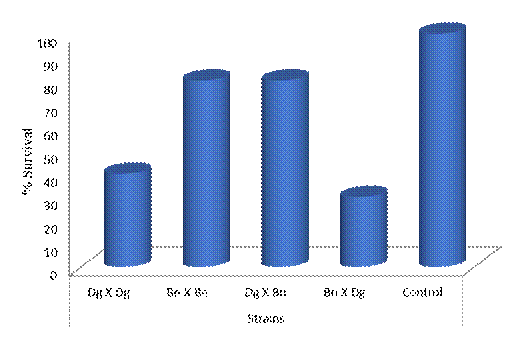
The survival rate of C. gariepinus strains 14 days after A. hydrophila challenge revealed that ♀Bn x
♂Dg and ♀Dg x ♂Dg had the lowest
survival rate among the challenged. The control had higher survivals than the
challenged in ♀Bn x ♂Bn and ♀Dg x ♂Bn, indicating that
the A. hydrophila challenge may have
caused extra stress, resulting in more mortality. This agrees with the findings
of Olakunle et al., (2020) who stated that the most important
fish pathogen was A. hydrophila, and
the highest prevalence is in polluted waters. According to Austin (1993),
bacterial infections are the most important illness concern in fish
aquaculture, accounting for 80% of mortalities. The water parameters values for
these observations are within pisciculture allowable ranges.
A tentative identification of the A. hydrophila strain was obtained by a biochemical
test. Gram negative, motile, oxidase-positive, L. arabinose-positive isolates
were discovered. A. hydrophila is
motile in both distilled and peptone water, which distinguishes it from other
bacteria. For example, Vibrio sp is immotile in distilled water but motile in
peptone water (Lamy et al., 2010;
Laith and Najiah, 2014). According to (Jayavignesh et al., 2011), members of this genus are Gram-negative bacilli, oxidase
and catalase positive, capable of degrading nitrates to nitrites, glucose
fermenters (It ferments glucose with or without the production of gas, which
distinguishes it from Pseudomonas).
CONCLUSION
This study gives
helpful information on the evolution of genotypes that are resistant to disease
challenge, broodstock selection, better productivity and lucrative C. gariepinus culture in the face of A. hydrophila infection.
REFERENCES
Akinwande,
A.A., Fagbenro, O.A. & Adebayo, O.T. (2011). Growth and heterosis in
reciprocal Clarias hybrids between Clarias gariepinus and Clarias angularis. Journal of fisheries Institute. 6(3): 67-70
Ataguba,
G.A., Annune, P.A. & Ogbe, F.G. (2010). Growth performance of two African
catfish Clarias gariepinus and Heterobranchus longifilis and their
hybrids in plastic aquaria. Livestock Research for Rural Development. 22 (2): 20.
Austin,
B. & Austin, D. A. (1993). Bacterial fish pathogens disease in farmed and
wild fish. 2nd edition.
Banito,
A., Kpemoua, K.E. & Wydra, K. (2010). Screening of cassava genotypes for
resistance to bacterial blight using strain x genotype interactions. Journal of Plant Pathology. 92(1):181-186
Camus,
A.S., Durborrow, R.M., Hemstreet, W.G., Thune R.L. & Hawke J.P. (1998). Aeromonas Bacterial Infections N Motile Aeromonad
Septicemia. SRAC Publication No.478.
Faktorovich,
K.A. (1969). Histological changes in the liver, kidneys, skin and brain of fish
sick with red rot. Pages 83-101 in Infectious diseases of fish and their
control. Division of Fisheries Research, Bureau of Sport Fisheries and
Wildlife. Washington, D. C.
FAO
(2018). The state of world fisheries and aquaculture 2018 - Meeting the
sustainable development goals. http://www.fao.org/documents/card/en/c/I9540EN.
Accessed 1 July 2019
Hanna,
M.I., Maha, A., El-Hady, M.A., Hanaa, A., Ahmed, H.A. & Elmeadawy S.A.
(2014). Contribution on Pseudomonas
aeruginosa infection in African Catfish (Clarias gariepinus). Research
Journal of Pharmaceutical, Biological and Chemical Sciences. 5(5):575-588.
Jayavignesh,
K. Sendesh, K. & Abhijith, D. (2011). Biochemical characterization and
cytotoxicity of the Aeromonas hydrophila
isolated from Catfish. Archives of Applied Science Research. 3
(3):85-93.
Laith,
A.R., & Najiah, M. (2014). Aeromonas
hydrophila: Antimicrobial susceptibility and histopathology of isolates
from diseased catfish, Clarias gariepinus
(Burchell). Journal of Aquaculture
Research and Development. 5:
215.
Lamy,
B., Laurent, F., Verdier, I., Decousser, J.W., Lecaillon, E., Marchandin, H.,
Roger, F., Tigaud, S., de Montclos, H. & Kodjo, A. (2010). Accuracy of 6
commercial systems for identifying clinical Aeromonas isolates. Diagnostic
Microbiological Infectious Disease. 67: 9–14.
Madubuike,
U.A., Kennedy F.C. & Vincent, S.S. (2015). Evaluation of pathogenicity of
motile Aeromonas species in African catfish. International Journal of Fisheries and Aquatic Studies 2: 93-98.
Najiah,
M., Lee, S.W., Wendy, W. & Nadirah, M. (2009). Bacterial diseases outbreak
of African Catfish (Clarias gariepinus)
from Manir River, Terengganu, Malaysia. Journal
of Life Sciences. 3:5(Serial No.18):10-20.
Olakunle,
S.T., Oladosu, G.A., Anifowose, O. R. & Ajayi O. L. (2020). Pathogenicity
and antibiotics sensitivity profile of Aeromonas
Bestiarum used in experimental infection of different developmental stages
of Clarias gariepinus. Journal of Aquaculture, Marine Biology and
Ecology. 103.
Oyebola,
O.O., Adekunle, O.M. & Setufe S.B. (2017). Growth rate and disease
resistance of inbreds and novel
intra-specific crossbreds’ larva of Clarias gariepinus (Burchell,1822) in
response to Pseudomonas aeruginosa challenge. Journal of Experimental
Agriculture International, 16(6), 1-11.
Oyebola O.O.,
Jacob, J.M., Omorodion, B.A., Akinsola, Y.Y. & Akinade, S. (2017).
Molecular marker (allozyme) assisted selection of latent production traits and fingerprints of novel strains of fish (Clarias gariepinus) and shellfish (Macrobrachium vollenhovenii). Aquaculture 472, Supplement, 1,
66-70
Parris,
M. J. (2004). Hybrid response to pathogen infection in interspecific crosses
between two amphibian species (Anura: Ranidae). Evolutionary Ecology
Research.6: 457–471.
Puthucheary,
S.D., Puah, S.M. & Chua, K.H. (2012). Molecular characterization of
clinical isolates of Aeromonas
species from Malaysia. PLoS One 7: e30205.
Raghuvanshi,
S. K., Agarwal, N. K. & Thapliyal, B. L. (2007). Induced breeding and artificial fertilization
of Snowtrout through the application of ovaprim. Journal of inland fish society India, 39(1), 12-19.
Saka,
B. A., Adeyemo, O. K. & Odeseye A.O. (2017). Fish and Wildlife Unit,
Department of Veterinary Public
Health and Preventive Medicine University of Ibadan, Ibadan, Nigeria; Nigerian Institute of Science
Laboratory Technology, Ibadan. African
journal of clinical and experimental
microbiology. 8; 2:1595-689.
Schadich,
E. & Cole, A. (2010). Pathogenicity of opportunistic bacterial pathogens, Aeromonas hydrophila, Klebsiella pneumoniae
and Proteus mirabilis towards New Zealand Litoria ewingii frogs. Comparative
and Experimental Medicine. 60(2):114-117.
Verhagen,
B. W. M., Van-Loon, L. C. and Pieterse, C. M. J. (2006). Induced disease
resistance signaling in plants, In;
Floriculture, Ornamental and Plant Biotechnology Volume III, Global Science Books; 2006.
Yanez,
J.M., Houston, R.D. & Newman, S. (2014). Genetics and genomics of disease
resistance in salmonid species. Frontier Genetics. 5:415-428.