In this study, the analysis of insurgency on food production status in
Benue State, Nigeria was investigated. The objectives of the study were analysed
as follows: examine the socio-economic characteristics of internal displaced
person and none displaced persons in the study area. Compare farmer level of
productivity before and after insurgency in the area. The study utilized data
from 383 farmers in areas affected by insurgency and 200 farmers in areas not
affected by insurgency. The collected data were analysed using descriptive
statistics and paired sample t-test, at the 0.05 level of significance.
Results of the socio-economic characteristics of the respondents in each
population revealed that they were mostly married male, illiterate, with
large household sizes, middle aged and well experienced in farming
activities. The socio-economic characteristics also show that the farmers
affected by insurgency earned less on-farm income as compared to those in
areas not affected by insurgency. Both populations lacked access to credit,
healthcare, extension services and piped borne water
and were not members of cooperative societies. The paired sample t-test
revealed that the productivity (yield/ha) of farmers before the advent of
insurgency was significantly higher than that after insurgency in the region.
The challenges faced by farmers as a results of the impact of insurgency in
the study area were found to be universal with all identified (22) challenges
having a score of 100 %. It was concluded that insurgency has a significant
impact on the productivity of famers in the study area. It was therefore
recommended that relevant organs of society should intervene by enhancing
agricultural productivity through the provision of qualitative agricultural
inputs and modern farming facilities. These organs should also strive to
improve household food security by expanding emergency food and nutrition
programs in the study area. Furthermore, relevant stakeholders should provide
access to health care and affordable education in the insurgency-affected
regions through the use of mobile clinics and provision of scholarships and
safe learning spaces.
Apart from the
development related challenges that confront every other developing country,
there has been a growing threat posed by insurgencies and violent conflicts carried
out by non-state actors and groups, whose actions are generally seen to
constitute grave security risks to the lives and property of the citizens (Aina, 2019). The growing strategic
and operational effectiveness of the violent non-state actors also engender
enormous human and economic costs (Osumah, 2013a).
This makes studies on insurgencies central as a way of understanding the
trends, pull and push factors as well as their consequences. Insurgency involves any kind of armed
uprising against an incumbent government. It is characterized by protracted,
asymmetric violence, ambiguity, the use of complex terrain (jungles, mountains,
and urban areas), psychological warfare, and political mobilization which are
all designed to protect the insurgents and eventually alter the balance of
power in their favour (Calvert, 2010).
Insurgent or terrorist activities have been
going on from time immemorial, but have not attracted much attention due to its
low level of operation in different political systems. Interest about the
scourge of terrorism has however, been re-invigorated due to the September 11th,
2001 attacks on America. Since then, the general attitude as observed in many
state-policies and the international community has been one condemning this
phenomenon, chiefly because of the great damage it has had on human lives and
properties. Insurgent attacks have become easier with the near annihilation of
state territorial boundaries in the age of globalization. Through the process
of globalization, the world’s societies are intricately linked, especially
through the current advancements in technology, which has enhanced global
communication resulting in what is considered as a global village, a world in
which national boundaries are fast crumbling and the state is gradually being
stripped of its most valued characteristic of sovereignty (Ochefu,
2003).
The continent has long been characterized by political violence,
border permeability, territorial disputes, trafficking of all kinds, and
ethnic-sectarian violence (Ujunwa, Okoyeuzu, & Kalu, 2019).
Recently, herdsmen
attacks in Africa and Nigeria have also attracted attention. Mwanfupe (2015) disclosed
that crop farmers-herders conflict is also prevalent in African countries such
as Cameroun, Tanzania, Sudan and Kenya among others. According to Bagu and Smith (2019), these conflicts are emerging and
disrupting communities in Democratic Republic of Congo, Central Africa
Republic, Mali, and across the West African sub-region. In a study conducted by
Idrissuo et al. (2017) in Northern Benin, it was
found that crop farmers-herders conflict arising from the competition over
access to land, water, and grazing resources have diverse causes. They are
related to crops damages, thefts, and aggression, the occupation of corridors
and systematic eviction of herders. These scholars observed that conflicts are
on the increase because of the erosion of societal values. For them,
herders’-crop farmers’ conflicts were in the past settled in an out-of-court
and friendly manner by elders of the communities which reduced tensions.
However, society has changed, and people nowadays are more individualistic.
Consequently, therefore, people prefer the formal institutional settlement
involving the police and the court.
In the North-central
region of Nigeria, agricultural farm products are majorly produced in the
region. The region has crop farmers such as Berom, Jukuns, Tivs and Idomas, who are sedentary landowners. The pastoralists are
of the Fulani tribesmen and are from Kanem Bornu, Kwoya, Manga, Fulbe, Kanuri, Tuaregs and Shuwa Arabs. In
December 2018 alone, the violent conflict between farmers and herders claimed
over 2, 000 lives in the North-central Nigeria (Bagga,
2019).
Benue State is the
most affected by the pastoralist-farmer conflict. In 2014 alone, 853 lives were
lost between January and March. Between 2014 and 2016, in 11 Local Government
Areas in Benue State, 4,194 Christians were killed while 2,957 Christians were
injured. In eight (8) Local Government Areas in Benue state, 195, 576 Christian
homes were destroyed by pastoralists and 30 churches were burnt down on 1st
January, 2018. On the other hand, the Fulani pastoralists lost 214 people and
3200 cows (Osumah, 2013a).
The violent conflict
between the herdsmen and the crop-farmers has been submerged under various perspectives, including the
perspectives of the State, farmers, herders, media and the NGO. (Benjamin, Maganga and Abdullahi, 2009; Okoli and Atelhe, 2014),
ethnicity, self-determination, cultural differences (Adogi,
2013; Ogu, 2016), increase in agro-pastoralism and
expansion in farming activities (Blench, 2010), land grabbing by the capitalist
farmers (Abass, 2012), and politics of the belly and
petty corruption (Aina, 2019) among others. All these views have
tried to explain the nature and dynamics of crop farmers-herders
conflict.
Specifically, the
research intends to:
i.examine the socio-economic characteristics of
internally displaced persons and non displaced
persons in the study area.
ii.Compare
farmers' level of productivity before and after insurgency in the study area.
2.0METHODOLOGY
2.1The study area
The study was
conducted in Benue State, North-Central Nigeria. The State is code named the Food Basket of the Nation. Benue State
is an agrarian society, with well over 70% of its population dependent on
agriculture (Terdoo & Giuseppe, 2020). The State
lies between latitudes 6° 25ʹ N and 8° 8ʹ N of the equator, and
between longitudes 7° 47ʹ E and10° 00ʹ E of the Greenwich meridian,
and has a total land area of 30,800 sq/km. Benue
State was carved out from the former Benue Plateau State in 1976 and was named
after River Benue. The State is structured into 23 Local Government Areas
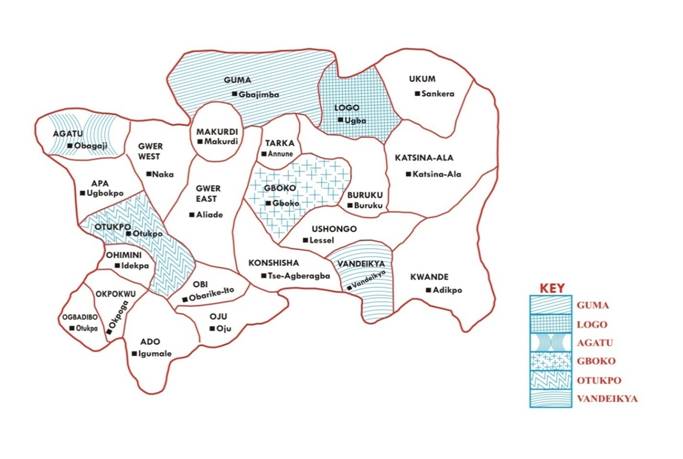
(LGAs), with Head Quarters in Makurdi (Figure 1 Map
of Benue State). The main ethnic groups in the State are Tiv,
Idoma and Igede. Benue
State shares boundaries with Nasarawa State to the
North, Taraba State to the East, Cross River State to
the South, Enugu State to the South-West and Kogi
State to the West. The State has a projected population of about 6,141,300based on growth rate of 3.2% (National
Population Commission (NPC) of 2006.
The
monthly distribution of rainfall in Benue State is bimodal, with the annual
total averaging between 1200 and 1400 mm (Osumah
2013a). The temperatures are
constantly high throughout the year, average ranges from 23° C –32° C. The
vegetation in the State is typical of that of the southern Guinea Savannah,
which is the dominant vegetation belt of Central Nigeria (Terdoo
& Giuseppe, 2020). The major crops produced in the State include: rice,
sweet potatoes, soya beans, maize, millet, cassava, yam, oil palm, tomatoes,
and cowpea among others. Benue State has remained the worst hit by
herders’-crop farmers’ conflict in North-Central Nigeria (Kwaja
2014; McGregor 2014; Fayonyomiet al, 2018), with 20% of the number of casualties recorded (Kwaja, 2019).
Fig. 1:
Map of Benue State showing the study areas
Source: Adopted from Convafresh, 2021
Experimental
Design and Data Collection
This
study employs cross-sectional survey design. The design enables the researcher
to collect data from a cross-section of the target population. The study
collected data through both primary and secondary sources.
Primary data was collected
using structured questionnaire. Data was collected on the socio-economic
characteristics of the respondents, level of productivity before and after the
insurgency, level of food security; factors affecting food security;
differences in food security in areas with insurgency and those areas without
insurgency; and the coping strategies with food insecurity.
The data for the study was
collected using a well-structured questionnaire and was administered with the
help of trained ADPS (Agricultural Development Project Staff) as enumerators.
The questionnaires consisted of seven (7) sections in line with the specific
objectives. Section A deals with the socio-economic characteristics of
respondents, Section B with the difference in farmers’ level of productivity
before and after the insurgency, Section C with the level of food security in
the study areas; Section D addressed the factors affecting food security;
Section E dealt with the coping strategies of the areas with food insecurity
while section F dealt with the comparative analysis of food security in areas
with insurgency and those areas without insurgency. Finally, Section G
addressed the challenges imposed on the respondents affected by insurgency in
the study area.
Model Specification/ Data Analysis Techniques
Descriptive statistics such as
frequencies and percentages, mean and standard deviation were used to analyse objective (I) while Paired Sample T-Test was used
to achieve objective (II).
2.2.1
Descriptive statistics
Descriptive statistics was used
to achieved the socio-economic characteristics of internally displaced persons
and non-displaced persons
2.2.2
Paired Sample T-Test
The model
equation and the specification of variables used in this research are shown
below:
(3)
Where;
d = the mean of the differences between the
paired observations
sd = standard deviation of the difference
between the paired observations
n = the
number of paired observations
3.0RESULTS AND DISCUSSION:
3.1Socio-Economic Characteristics of the
Farming Populations Affected by Insurgency
Results of the socio-economic characteristics of farmers affected
by insurgency in the study area are presented in Table 1.The age distribution
of the respondents indicates that a significant proportion of the population
affected by insurgency in Benue State, Nigeria, falls within the older age
brackets, with 46.7% being 46 years or older, and a mean age of 44 years. This
indicates that older people were more involved in farming activities in the
population affected by insurgency in Benue state as compared to the younger
ones. This can be attributed to the desire of the younger populations to move
into nearby towns to engage in menial jobs instead of taking refuge in the internally
displaced persons camps (Sulaiman and Ja’afar-Furo, 2010).
Furthermore, the average household size was found to be 7
persons, with 62.7% of households comprising 6-10 members (Table 3). This
indicates that populations affected by insurgency are associated with moderate
to large household sizes. These can be ascribed to boredom and some level of
idleness among the married populations in the IDP camps; a situation that
encourages pregnancies and consequent child births in the camps. Large household sizes can imply a higher
dependency ratio and greater strain on household resources, potentially
exacerbating the effects of insurgency on food security and economic stability
(Black et al., 2011).
Similarly, on-farm income is a critical
indicator of economic stability. In the current study, the mean farm income of
the respondents was observed to be ₦343,000 with a majority (58.7%) of
the farmers earning between ₦201,000 and ₦400,000 (Table 3). Such low
farm income compared with the moderate to large household sizes in the study
area indicates that farmers affected by insurgency are not earning much from
farm production. This is likely due to the small farm sizes and poor quality of
farm inputs among others (Hussaniet al., 2020).
The distribution of the respondents in
terms of years spent in education shows that the mean years of education among the respondents is 7 years, with
32.1% having 0-4 years of education. This shows that they are largely
illiterate as four years in school could barely guaranty a sound primary level
of education. Again this situation can be linked to the lingering farmer-herder
crisis that metamorphosed into the present insurgency situation in the area.
Furthermore, such low educational
attainment can limit access to information and resources, impacting the ability
to adopt improved agricultural practices (Bartolotta, 2011).). Similarly, access to health care among the
populations affected by insurgency in the study area was found to be relatively
balanced, with 51.2% of respondents having access (Table 1).
The
distribution of the farmers affected by insurgency with regards to monthly food
expenditure indicates that
average monthly food expenditure of the respondents is ₦30,000, with the
majority (62.1%) spending between ₦21,000 and ₦40,000.This
finding contradicts with the low farm incomes accruable to the farmers who are
displaced from their original homes as a result of insurgency as earlier
documented by Jayne, et al., (2014).
From Table 1 it was
found that a significant 84.3% of the
respondents lack access to credit, which is crucial for purchasing inputs and
investing in agricultural improvements. This shows that, the farmers
lacked financial support needed to aid them in their farming activities. (Maxwell & Caldwell, 2008).The distribution
of the respondents with respect to access to clean water shows that only 7% of
respondents have access to piped water, underscoring significant
infrastructural deficits.
The gender distribution shows that 76% of
respondents are male (Table 3). This skewed distribution might reflect cultural
norms and gender roles in agricultural labor. Gender disparities can affect
access to resources and decision-making in farming households (Doss, 2001).
This indicates that the male populations among people affected by insurgency
are more engaged in farming activities than their female counterparts.
The mean number of household members assisting
in farming is was found to be 5, with 72.1% having 1-5 members contributing
labor (Table 3). It has been established that family labour
is a crucial component of agricultural operations, especially in the absence of
hired labour due to financial constraints (Ellis,
2000).Thus populations affected by insurgency who suffer serious financial
constraints are likely to rely on family labour for
their agricultural production as observed in the current study.
Also, the distribution of the respondents in
terms of time spent on the farm per day show that they spend an average of 5.7
hours daily on farming activities, with 52.2% working 6-10 hours per day. Long
working hours can indicate high labor demands and possibly inadequate
mechanization (Binswanger & McIntire, 1987). Similarly, the average number
of days spent on the farm per week was found to be 5, with 67.4% working 5-8 days/week
(Table 1). This high level of labor input reflects the intensive nature of
farming in the region, potentially exacerbated by the need to recover from the
disruptions caused by insurgency as earlier asserted by Chayanov
(1966).
The distribution of the respondents with respect
to access to market information indicate that only 39.9% of them have access to
market information as shown in Table (1).. This finding may or may not be
impacted by the presence of insurgency in the study area and thus could be a
subject for further research.
The distribution of the respondents with regards
to involvement in off-farm activities show that small fractions (29.5%) of the
farmers affected by insurgency are involved in off-farm activities, which can
provide alternative income sources and diversify economic risks (Table 1). This
can be attributed to the challenge of internally displaced persons living in
make-shift abodes to find the rightful other economic engagements in their new
environments (Reardon,1997).
Again from Table 1 it was found that a
significant majority (79.9%) of the respondents are married. Fortunately,
marital status can influence household stability and labour
availability as married households might have better social support networks,
which can be vital in conflict situations such as insurgency (Ellis, 2001).
The mean farm size of farmers affected by
insurgency in the study area was found to be 4.4 hectares, with 53.3% of the
farmers having a farm size of 1-4 hectares (Table 3). Such low farm sizes could
be attributed to land fragmentation which is a common issue in rural areas of
developing nations, impacting agricultural efficiency irrespective of
insurgency or not. Jayne et al. (2014)
asserted that small farm sizes can limit economies of scale and productivity
among farmers. Furthermore, insurgency (which leads to displacement of persons
from their original land), non-availability of labour
and absence of mechanization tools required to cultivate large land areas could
be a further hindrance to large scale farming in the study area.
The distribution of the respondents with respect
to membership of cooperative societies shows that only 24.3% of respondents are
members of cooperative societies. However, it is established that cooperatives
can provide access to shared resources, credit, and market information,
enhancing productivity and resilience (Bernard & Spielman,
2009).
Furthermore, it was observed from Table 3 that a
mere 23.2% of respondents have access to extension services, which are vital for
disseminating agricultural knowledge and technologies. Lack of extension
services can hinder productivity and adaptation to new agricultural methods as
asserted by Haggblade, et al., (2004). Therefore, the attention of governmental and
non-governmental organization is needed towards the provision of extension
services to vulnerable populations in insurgency situations. Similarly, the
average farming experience of farmers affected by insurgency was found to be 30
years, with 67.9% having 21-40 years of experience (Table 1). This suggests
that, extensive farming experience can enhance productivity through accumulated
knowledge and skills (Wiggins, 2009). However, older farmers might also be
resistant to change and innovation.
The distribution of
the respondents in terms of level of education shows that 32.6% of them have
non-formal education, while 25.8% have primary education. Higher education
levels correlate with better farming practices and productivity just as
educational interventions can improve agricultural outcomes (Weir & Knight,
2000). Finally, it was observed that the mean livestock income of the
respondents is ₦84,000, with 74.9% earning ₦0-100,000. Livestock
farming provides crucial income and food security, especially in
conflict-affected regions where crop farming might be disrupted (Reardon,
1997).
Table 1: Socio-economic
Characteristics of Respondents in Areas Affected by Insurgency (N =383)
S/No
Variable
Frequency
Percentage (%)
Mean
1.
Age (Years)
44
≤ 25
25
6.5
26 – 35
64
16.7
36 – 45
115
30.0
≥ 46
179
46.7
2.
Household Size (Persons)
7
1 – 5
125
32.6
6 – 10
240
62.7
11 – 15
17
4.4
16 – 20
1
0.3
3.
On-farm Income (₦‘000)
343
≤ 200
66
17.2
201 – 400
225
58.7
401 – 600
63
16.4
601 – 800
25
6.5
≥ 801
4
1.0
4.
Education Years
7
0 – 4
123
32.1
5 – 9
100
26.1
10 – 14
105
27.4
15 – 19
55
14.4
5.
Access to Health Care
Yes
196
51.2
No
187
48.8
6.
Household Monthly Food Expenditure (₦‘000)
30
1 – 20
97
25.3
21 – 40
238
62.1
41 – 60
37
9.7
61 – 80
8
2.1
≥ 81
3
0.8
7.
Access to Credit
Yes
60
15.7
No
323
84.3
8.
Access to Piped Water
Yes
27
7.0
No
356
93.0
9.
Gender
Male
291
76.0
Female
92
24.0
10.
Household Members Assisting in Farming (Persons)
5
1 – 5
276
72.1
6 – 10
106
27.7
11 – 15
1
0.37
11.
Daily Hours on Farm
5.7
1 – 5
183
47.8
6 – 10
200
52.2
12.
Weekly Number of Days on Farm
5
1 – 4
125
32.6
5 – 8
258
67.4
13.
Access to Market Information
Yes
153
39.9
No
230
60.1
14.
Involvement in Off-farm Activities
Yes
113
29.5
No
270
70.5
15.
Marrital Status
Married
306
79.9
Single
77
20.1
16.
Farm Size (Ha)
4.4
1 – 4
204
53.3
5 – 8
179
46.7
17.
Membership of Cooperative Society
Yes
93
24.3
No
290
75.7
18.
Access to Extension Services
Yes
89
23.2
No
294
76.8
19.
Farming Experience (Years)
30.0
1 – 20
78
20.4
21 – 40
260
67.9
41 -60
41
10.7
61 – 80
4
1.0
20.
Level of Education
Non-formal
125
32.6
Primary
99
25.8
Secondary
96
25.1
Tertiary
48
12.5
University
14
3.7
Others
1
3.0
21.
Livestock Income (₦’ 000)
84
0 – 100
287
74.9
101 – 300
83
21.7
301 – 500
10
2.6
501 – 700
2
0.5
701 – 900
1
0.3
Source: Field Survey,
2024
Socio-Economic
Characteristics of the Farming Populations not affected by Insurgency
Results of the socio-economic characteristics
of the respondents not affected by insurgency are presented in Table 2. The age distribution of farmers not affected by insurgency
in Benue State shows that 50.5% of respondents are aged 46 years or older, with
a mean age of 44 years. This older demographic profile is indicative of an
aging farming population. Thus farming should be made attractive to the younger
ones to boost their participation if farming towards greater productivity in
the area.
The average household size of farmers living in areas not
affected by insurgency was observed to be 8 persons, with 59% of households
having 6-10 members (Table 4). Larger household sizes
can provide for labour advantages, as more family members would contribute
to farm activities. However, they also pose challenges in terms of resource
allocation and food security, especially, if economic resources are limited
(Black et al., 2011). As earlier
mentioned, on-farm income is a critical indicator of economic stability in any
human settlement. In this study the distribution of the respondents not
affected by insurgency in Benue State show that the mean on-farm income is
₦641,000, with 32% earning between ₦401,000 and ₦600,000, and
24.5% earning ₦801,000 or more. This higher income distribution suggests
better economic stability and potential for investment in farming inputs and
technology, which can enhance productivity and resilience (Haggbladeet al., 2004). Higher incomes in
non-affected areas likely reflect less disruption to farming activities and
access to market. The distribution of the respondents not affected by
insurgency show that the mean years of education among farmers is 6 years, with
36.5% having 0-4 years of education. However, limited educational attainment
can restrict access to information and modern farming techniques, potentially
hindering agricultural productivity (Adogi, 2013). The significant proportion of respondents with minimal
education underscores the need for educational interventions and adult
education programs in the study area.
It was also observed that only 42.5% of respondents not
affected by insurgency in the study area have access to health care, with a
significant 57% lacking access. This finding was not different from the
populations under insurgency. Nevertheless, adequate health care is essential
for maintaining a productive workforce as poor health can lead to reduced labour availability and increased household expenditure on
health services, affecting their overall economic stability (Ersado, 2006).Thus improving health care access to rural
populations can mitigate these negative impacts and enhance their overall
well-being.
Also, the socio-economic characteristics of the farmers not
affected by insurgency in the study area show that the mean monthly food
expenditure is ₦57,000, with 29% spending between ₦41,000 to
₦60,000, and 17.5% spending between ₦81,000 or more.
The distribution of the respondents not affected by
insurgency in Benue state shows that access to credit is available to only 38% of respondents,
while 62% lack such access. This is similar to the observation among the
farmers affected by insurgency in the study area. This shows that insurgency
may not be responsible for the lack of access to credit among the farming
populations in the area.
Furthermore the
distribution of the respondents indicate that only 21% have access to piped
water and a huge 79 % lack such access, indicating significant infrastructural
challenges Therefore, investment in water infrastructure is critical for
improving living conditions and agricultural output of the farming populations
in the study area (Howard & Bartram, 2003).
The gender distribution
shows that 66% of the respondents are male, while only 44 % are female. This
male predominance is similar to the observations in the farmer populations
affected by insurgency and similarly reflects the cultural norms of the people
where men typically dominate farming activities. Gender disparities can impact
access to resources and decision-making, often leaving women with limited
opportunities and support in agricultural roles (Doss, 2001).
The mean number of
household members assisting in farming activities in the populations that is
not affected by insurgency in the study area was observed to be 6 persons, with
56% having 0-5 members contributing labour.
It was further observed
that the farmers not affected by insurgency in Benue state spend an average of
6 hours daily on farming activities, with 72% working 6-10 hours. Just like
with the case of those affected by insurgency in the study area, this intensive
labour input reflects the demands of small-scale
farming and the absence of mechanization. Consequently, such long working hours
can lead to fatigue and reduced efficiency, highlighting the need for the
provision of labour-saving technologies in the area
(Binswanger & McIntire, 1987).
Also, the distribution of
the respondents revealed that the average time spent on the farm per week is 5
days, with 75.5% working 5- 8 days. This high labour
commitment underscores the importance of improving farming practices to enhance
productivity and reduce labour burdens on the farmers
(Chayanov, 1966).
The socio-economic
characteristics of the respondents show that 52.5% have access to market
information, while 47.5 % lack access. This reflects moderate access to market
information among farmers not plagued by insurgency in the region and reflects
a higher access level compared to the farmers impacted by insurgency stability
and economic resilience (Haggblade, et al., 2004). Therefore, enhancing
market information systems can empower farmers to maximize their earnings and
reduce market risks irrespective of the presence or absence of insurgency.
The socio-economic
distribution further shows that 38.5% of respondents are involved in off-farm
activities, while greater 61.5 % are not involved but rely only on farming for
income and other benefits. Similar finding was obtained among the faming
populations affected by insurgency Diversification into off-farm activities
provides additional income sources and reduces economic risks associated with
agricultural dependency. This diversification is essential for enhancing
livelihood resilience and stability in the region (Reardon, 1997).
Similarly, it was also
observed that a significant majority (90%) of respondents are married. This
could be ascribed to the cultural norms of the respondents which seem to permit
early marriage for obvious reasons related farming needs. Consequently, married
households might benefit from pooled resources and labour,
enhancing agricultural productivity and economic resilience (Ellis, 2000).
Table 2 also shows that the
mean farm size of the farmers not affected by insurgency in the study area
stood at 5 hectares, with 52 % having 5 - 8 hectares. Compared with the manual labour inputs observed among the respondents, such farm
sizes could be termed as large. Therefore, land consolidation, effective land
management strategies and technologies are crucial for maintaining large scale
cultivation towards optimizing agricultural output in the area (Jayne et al., 2014).
It was also observed from
Table 4 that 59 % of the respondents are members of cooperative societies,
while only 41 % are non-members. These large-scale involvements of the farmers
in cooperative societies underscore the well-informed nature of the farmers and
the availability of such schemes in the area as compared to the low involvement
observed from the farming populations affected by insurgency in the region.
Cooperatives can provide access to shared resources, credit, and market
information, enhancing productivity and resilience. Membership in cooperatives
has been shown to improve income stability and social capital among farmers and
should be further encouraged in the area (Bernard & Spielman,
2009).
On access to extension
services among the farming populations not affected by insurgency in the study
area, it was similarly observed that only 45% of respondents have access just
as with the case of those impacted by insurgency. Therefore, strengthening
extension services in the study area can significantly improve agricultural
outcomes and the livelihood of farmers (Anderson & Feder,
2007).
Table 4 also shows that the
mean farming experience of farmers not affected by insurgency is 26.7 years,
with 56.5 % having 21 - 40 years of experience. Therefore, farming populations
should be encouraged to get involved right from their childhood ages.
The distribution of the
respondents (farmers not affected by insurgency in Benue State) shows that just
like with the case of those affected by insurgency, 36 % have non-formal
education, while 33.5 % have primary education. Only a small fraction of the
farmers (8.5 %) has higher educational qualifications (Tertiary and University
combined) as shown in Table 2. This shows that the culture and location other
than insurgency are determinants of the educational levels of farmers in the
study area (Weir & Knight, 2000).
It was further
indicative from Table 2 that the mean livestock income of farmers not affected
by insurgency in the study area is ₦180,000, with 55 % earning between
₦ 0 - 100,000. This was considerably higher as compared with the
livestock earnings of those affected by insurgency. (Nwaforet al., 2011). Therefore, enhancing livestock farming
practices especially among vulnerable populations in the study area can improve
the overall household resilience and economic well-being of the farmers.
Table 2:
Socio-economic Characteristics of Respondents in Areas not affected by
Insurgency (N =200)
S/No
Variable
Frequency
Percentage (%)
Mean
1.
Age (Years)
44
≤ 25
17
8.5
26 – 35
34
17.0
36 – 45
48
24.0
≥ 46
101
50.5
2.
Household Size (Persons)
8
1 – 5
59
29.5
6 – 10
118
59.0
11 – 15
16
8.0
16 – 20
4
2.0
>20
3
1.5
3.
On-farm Income (₦‘000)
641
≤ 200
15
7.5
201 – 400
39
19.5
401 – 600
64
32.0
601 – 800
33
16.5
≥ 801
49
24.5
4.
Education Years
6
0 – 4
73
36.5
5 – 9
68
34.0
10 – 14
42
21.0
15 – 19
17
8.5
5.
Access to Health Care
Yes
85
42.5
No
114
57.0
Adamant
1
0.5
6.
Household Monthly Food Expenditure (₦‘000)
57
1 – 20
18
9.0
21 – 40
57
28.5
41 – 60
58
29.0
61 – 80
32
16.0
≥ 81
35
17.5
7.
Access to Credit
Yes
76
38.0
No
124
62.0
8.
Access to Piped Water
Yes
42
21.0
No
158
79.0
9.
Gender
Male
132
66.0
Female
68
34.0
10.
Household Members Assisting in Farming (Persons)
6
0 – 5
112
56.0
6 – 10
82
41.0
≥ 11
6
3.0
11.
Daily Hours on Farm
6
1 – 5
56
28.0
6 – 10
144
72.0
12.
Weekly Number of Days on Farm
5
1 – 4
49
24.5
5 – 8
151
75.5
13.
Access to Market Information
Yes
105
52.5
No
95
47.5
14.
Involvement in Off-farm Activities
Yes
77
38.5
No
123
61.5
15.
Marital Status
Married
180
90.0
Single
20
10.0
16.
Farm Size (Ha)
5
1 – 4
84
42.0
5 – 8
104
52.0
≥ 9
12
6.0
17.
Membership of Cooperative Society
Yes
118
59.0
No
82
41.0
18.
Access to Extension Services
Yes
90
45.0
No
110
55.0
19.
Farming Experience (Years)
26.7
1 – 20
67
33.5
21 – 40
113
56.5
41 -60
20
10.0
20.
Level of Education
Non-formal
72
36.0
Primary
67
33.5
Secondary
44
22.0
Tertiary
11
5.5
University
6
3.0
21.
Livestock Income (₦’ 000)
180
0 – 100
110
55.0
101 – 300
57
28.5
301 – 500
14
7.0
501 – 700
10
5,0
701 – Above
9
4.5
Source:
Field Survey, 2024
Farmers
Level of Productivity before and after Insurgency in the Study Area
The paired samples t-test conducted to compare crop yields
(Productivity) before and after the insurgency in the study area is shown in
Table 3 which reveals significant findings. The paired sample statistics and
correlation can be found in Appendix B. The results indicate a mean difference
of 181.32 units between the yields before and after the insurgency, with a
standard deviation of 170.70 and a standard error mean of 8.72. The 95%
confidence interval of the difference ranges from 164.17 to 198.47, with a
t-value of 20.79 and a significance level (p-value) of 0.00. This statistical
analysis underscores a profound impact of the insurgency on agricultural
productivity.
The substantial mean difference of 181.32 units
highlights a severe reduction in crop yields due to the insurgency. This
decrease can be attributed to various factors such as displacement of farmers,
destruction of farmlands, and disruption of agricultural activities. Similar
studies have documented the detrimental effects of conflict on agricultural
output. For instance, a study by Brück (2004) on the
impact of civil war on agricultural production in Mozambique found significant
declines in crop yields during periods of conflict. The findings from this
analysis align with these observations, indicating that the insurgency has led
to a notable decline in agricultural productivity in the study area.
Furthermore, the standard deviation of
170.70 suggests considerable variability in the differences between yields
before and after the insurgency. Research by Iqbal et al., (2010) on the impact of conflict on agriculture in
Pakistan's Khyber Pakhtunkhwa province similarly
noted that the extent of yield reduction varied significantly depending on the
intensity and duration of conflict in different areas.
Table 3: Paired
Sample t-test of Farmers Productivity before and after Insurgency
Paired Differences
t
df
Sig.(2-tailed)
Mean
Std. Deviation
Std. Error Mean
95% Confidence Interval of the Difference
Lower
Upper
Yield before Insurgency- Yield after Insurgency
181.324
170.704
8.723
164.173
198.474
20.788
382
0.000**
Source: Field Survey,
2024, ** = significant at P ≤ 0.05
4.0 CONCLUSION AND RECOMMENDATIONS
4.1
Conclusion
The t-value of 20.79 and the extremely low p-value (0.00) indicate
that the observed differences in yields before and after the insurgency are
statistically significant. This means that the likelihood of these results
occurring by chance is exceedingly low, reinforcing the conclusion that the
insurgency has had a profound and statistically significant negative impact on
agricultural yields. Statistical significance in this context provides strong
evidence to support policy interventions aimed at mitigating the adverse
effects of conflict on agriculture.
4.2Recommendations
Thus, the findings from this study have important implications for
policymakers and stakeholders involved in agricultural development and conflict
resolution. The significant reduction in yields underscores the need for
targeted interventions to support affected farmers, such as rehabilitation of
farmlands, provision of agricultural inputs, and implementation of security
measures to protect farming communities. Future research should focus on
longitudinal studies to assess the long-term impact of insurgency on
agriculture and explore strategies to enhance the resilience of farming systems
in conflict-prone areas. Moreover, comparative studies across different regions
affected by conflict could provide deeper insights into the mechanisms through
which insurgency affects agricultural productivity and inform more effective
policy responses.
REFERENCES
Abbass, I. M.
(2012). No retreat no surrender conflict for survival between fulani cattle herders and farmers
in northern Nigeria. European Scientific
Journal, 8 (1), 331-349.
Adogi, M.
(2013).Fulani-farmers conflicts in Nasarawa State:
The ecology, population and politics. Abuja: Murray Greens Consult/
Aina, F.
(2019).Political economy of insurgency in north east Nigeria. African Journal on Terrorism, 8(1), 21-35.
Anderson, JR.;Feder, G(2007), Hand book of
Agricultural Economics. Vol. 3, Pp 2343-2378
Bagga, F.(2019).Central Nigeria: Overcoming dangerous
speech and endemic religious divides. The United States Commission on
International Religious Freedom.
Bagu, C. &
Smith, K. (2019).Past is prologue: Criminality and reprisal attacks in
Nigeria’s Middle Belt. Washington DC: Search for Common Ground. Retrieved 17th
November, 2019 from https://www.sfcg.org.
Bartolotta, C., (2011). Terrorism in Nigeria: the Rise of Boko
Haram. The whitehead journal of Diplomacy and international Relations, 5(1),
pp. 44-57.
Benjamin, T. A., Maganga, F.P., & Abdullahi,
J. S. (2009). The Kilosa
killings: Political ecology of a farmer-herder conflict in Tanzania.
Development and Change. Hague: Institute of Social Studies, 40 (3), 423-445.
Bernard, T., & Spielman, D. J.
(2009). Reaching the rural poor through rural producer organizations? A study
of agricultural marketing cooperatives in Ethiopia. Food Policy,
34(1), 60-69.
Binswanger,
H. P., & McIntire, J. (1987). Behavioral and material determinants of
production relations in land-abundant tropical agriculture. Economic Development and Cultural Change,
36(1), 73-99.
Black,
R., Bennett, S. R. G., Thomas, S. M., & Beddington,
J. R. (2011). Climate change: Migration as adaptation. Nature, 478(7370), 447-449.
Blench, R (2010). Conflict between Cattle Herders and
Cultivators in Nigeria. Cambridge: Kay Wasiamson
Educational Foundation.
Brück, T. (2004). The effects
of conflict on household welfare in rural Mozambique. The Economics of Peace and Security Journal, 1(1),
64-75.
Calvert, P., 2010. Terrorism, Civil War and Revolution:
Revolution and International Politics. 3rd Ed. New York: The Continuum
International Publishing Group.
Chayanov,
A. V. (1966). The Theory of Peasant Economy. Homewood, Illinois:
Richard D. Irwin.
Cilliers, J.,
(2003).Terrorism and Africa. African
Security Studies, 12(4), pp. 91-103.
Doss,
C. (2001). Designing agricultural technology for African women farmers: Lessons
from 25 years of experience. World Development,
29(12), 2075-2092.
Ellis,
F. (2001). Rural Livelihoods and Diversity in Developing Countries.
Oxford University Press
Ersado, L. (2006). Income diversification in Zimbabwe: Welfare
implications from urban and rural areas. World Bank Policy Research
Working Paper, (3964)
Fayonyomi, S.O, Fatile, J.O, Bello, O.W, Opusunji,
M.I & Adejuwon, D.K (2018).Farmers/Herdsmen
Conflict and Food Security in North-CentralGeo-Political
Zone of Nigeria. International Journal of
Advanced Studies in Economics and Public Sector Management, 6 (2): 43-60.
Haggblade,
S., Hazell, P., & Reardon, T. (2004). Strategies for Stimulating Poverty-Alleviating Growth in the Rural
Nonfarm Economy in Developing Countries. International Food Policy
Research Institute.
Howard, G. and Bartram, J. (2003) Domestic Water
Quantity, Service, Level and Health. OMS, p. 39.
Hussaini, A.S., Oladimeji, Y.U., Sanni, S.A.,
& Abdulrahman, S. (2020).Determinants and
profitability of rice farmers investment in value
addition activities in Kebbi State, Nigeria. International Journal of Social Science and
Economic Research, 3(2), 101-109.
Idrissuo, L., Zakari, I.M., Egah, J. and Baco, N.M. (2017),Dynamics of conflicts between crop
farmers and pastoralists over agro-pastoral resources in northern Benin, European Journal of Business and Social
Sciences,6 (9), 12-28
Iqbal,
N., Khan, M. A., & Khan, Z. (2010). The impact of conflict on the
productivity of agriculture: Evidence from Pakistan. Pakistan
Journal of Life and Social Sciences, 8(1), 23-30.
Jayne,
T. S., Chamberlin, J., & Headey, D. D. (2014).
Land pressures, the evolution of farming systems, and development strategies in
Africa: A synthesis. Food Policy, 48, 1-17.
Kwaja, C. M. A.
(2014).Blood, Cattle, and Cash: Cattle Rustling and Nigeria’s Bourgeoning
Underground Economy. West Africa Insight,
4(3): 3-11
Maxwell,
D., & Caldwell, R. (2008). The Coping Strategies Index: Field Methods
Manual. 2nd Edition. CARE International.
McGregor, A. (2014). Alleged Connection between Boko Haram and Nigeria’s Fulani Herdsmen could spark a
Nigerian Civil War. Terrorism Monitor, 12
(10):8-10.
Mwamfupe, D.
(2015).Persistence of Farmer-Herder Conflicts in Tanzania. International Journal of Scientific and Research Publications, 5(2);
1-8
Nwafor, M.; Hor, E.C.E; Chukwu, O.J. and Muka, J.I.A
(2011): Cost-Effective Agriculture Growth Options for Poverty Reduction in
Nigeria: Evidence and Policy Implications. AIAE Research Paper 6. African
Institute for Applied Economics, Enugu.
Ochefu, Y. A.
(2003).TheIdoma and their Neighbours:
Past and Contemporary Issues and Perceptions of the Future. Paper Delivered at
the National Conference on the Idoma in the New
Millennium, Eldunial Hotel Otukpo.
Ogu, (2016). Engendering the attainment of the SDG-3 in Africa.
Overcoming the Socio- Cultural Factors contributing to maternal mortality.
African Journal of Reproductive Health 20, 62-67.
Okoli, A.
C., & Atelhe, G. A. (2014). Nomads against
Natives: A Political Ecology of Herder/Farmer Conflicts in Nasarawa
State, Nigeria. American International Journal of Contemporary Research, 4,
76-88.
Osumah O. (2013a). Boko Haram insurgency in northern Nigeria and the vicious
cycle of internal insecurity. Small Wars
& Insurgencies 24(3): 536–561.
Reardon,
T. (1997). Using evidence of household income diversification to inform study
of the rural nonfarm labor market in Africa. World Development,
25(5), 735-747.
Sulaiman, A. &
Ja`afar-Furo, M. R.
(2010).Economic Effects of Farmer-grazier Conflicts
in Nigeria: A Case Study of Bauchi State. Trends
in Agricultural Economics, 3:
147-157.
Terdoo, F &
Giuseppe, F. (2020).Rapid participatory system mapping builds agri-food system resilience: evidence from Nigeria, African
Geographical Review, DOI:10.1080/19376812.2020.1761410.
Ujunwa, A., Okoyeuzu, C., & Kalu, E. U.
(2019).Armed Conflict and Food Security in West Africa: Socioeconomic
Perspective. International Journal of Socialconomics, 46(2), 182-198.
Weir,
S., & Knight, J. (2000). Education externalities in rural Ethiopia:
Evidence from average and stochastic frontier production functions. University of Oxford, CSAE Working Paper Series.
Wiggins,
S. (2009). Can the smallholder model deliver poverty reduction and food security
for a rapidly growing population in Africa? Expert Meeting on How to Feed
the World in 2050. FAO.
Cite this
Article:Adu, VM; Iheanacho, AC; Atagher, MM; Nyiatagher, ZT; Agulebe, T
(2024). Analysis of Farmers’ Level of Productivity Before and After the
Insurgency in Benue State, Nigeria. Greener
Journal of Agricultural Sciences, 14(2): 128-139.