Greener Journal of Agricultural Sciences
ISSN: 2276-7770
Vol. 16(1), pp. 50-59, 2026
Copyright ©2026, Creative Commons Attribution 4.0 International.

|
Greener Journal of Agricultural Sciences ISSN: 2276-7770 Vol. 16(1), pp. 50-59, 2026 Copyright ©2026, Creative Commons Attribution 4.0 International. |
|
Evaluation of advanced bread wheat Genotypes against dominance races of wheat stem rust under greenhouse conditions in Guji Zone, Southern Ethiopia
Girma Teshome
Oromia Agricultural Research Institute, Bore Agricultural Research Center, Bore, Ethiopia.
|
ABSTRACT |
|||
|
Wheat (Triticum spp.) is one of the most important staple cereal crops cultivated for food worldwide including Ethiopia. Nevertheless, production and productivity of this crop is troubled by various factors, of which wheat stem rust caused by Puccinia graminis f.sp. tritici considered as the main diseases of wheat hindering the production. Hence, the study was aimed to evaluate the reaction of advanced bread wheat lines against virulent races. Forty four advanced bread wheat lines evaluated for their reactions against the dominant/virulent races TTKTT, TKTTF, TTTTF, TKKTF, and TTRTF. Ten advanced bread wheat lines, namely; ETBW-164008, ETBW-17.148, ETBW-9452, BW-17-2020, BW-17-4018, ETBW-17-133, BW-164006, BW-17-4456, BW164002 and BW-164004 showed resistance reactions (IT = fleck (;) to 2) to all dominant races. Though, to come up with a precise and reliable recommendation, the experiment should be done at adult stage resistance and the evaluated lines should be used for the future breeding program.
|
|||
|
ARTICLE’S INFO |
|||
|
Article No.: 031526037 Type: Research Full Text: PDF, PHP, HTML, EPUB, MP3 DOI: 10.15580/gjas.2026.1.031526037
Accepted: 16/03/2026 Published: 23/03/2026
Keywords: Virulent; Races; Dominant; Advanced lines
|
*Corresponding Author
Girma Teshome
E-mail: teshomegirma347@gmail.com |
Article’s QR code |
|
|
|
|
|
|
INTRODUCTION
Wheat (Triticum spp.) is one of the most important and major cereal crops in the world in terms of production and nutritional value. Wheat is the leading source of cereal proteins and primary staple food (Figueroa et al., 2017). It is the 2nd most important crop in the world next to rice (Ambika and Meenakshi, 2018). Its sources of food for human and livelihood for over one billion people in developing countries (FAO, 2020). It is one of the most important crops for human nutrition, due to 60-70 % of starch content in the grain as well as considered as the main source of calories for human diet (Shewry, 2009). Globally, wheat is cultivated on over 787 million hectares of land with a production of about 774.9 million metric tons (FAO, 2021), with an average productivity of around 3.56t ha-1 with high variability among countries and regions (FAO, 2021). It grows from an altitude of 1500 to 3000 m.a.s.l (White et al. 2001), the most suitable areas for bread wheat production ranges from 1900 to 2700 m.a.s.l (Gebre Mariam, 1991).
Ethiopia is the largest wheat producer in sub-Saharan Africa (Tadesse et al., 2018). In Ethiopia, wheat is one of the most important cereal crops cultivated and considered as the most important strategic food security crops, which is largely grown in the mid and highlands of the country (Beyene et al., 2016). It ranks 3rd after tef, maize, and sorghum in area coverage and 2nd in total production after maize and teff (CSA, 2021). The national average productivity in Ethiopia is estimated to be 3.09t ha-1 (CSA, 2021) with low productivity as compared to the global average yield which was 3.56 t ha-1(FAO, 2020).
According to CSA (2021), the major wheat producing regions in Ethiopia include Oromiya, Southern Nations Nationalities and Peoples’ Region (SNNPR), Amhara & Tigray. Smallholder production meets more than 70% of the national consumption demand (Shiferaw et al., 2011). In Orimiya region of Guji zone wheat is the most important cereal crop next to tef and barley with average yield of 2.4t ha-1 (CSA, 2020) as compared to national average 3.09t ha-1 (CSA, 2021). However, the harvested yield still is found low compared to national and global average production (CSA, 2021).The low productivity of wheat is principally due to the biotic and abiotic stresses that are increasing in intensity and frequency associated which climate change (Tadesse et al., 2018).
In Ethiopia, more than 30 fungal diseases of wheat have been identified (Fekadu et al., 2004). Rust diseases: stem rust (P. graminis f sp. tritici), leaf rust (P. triticina), and yellow rust (P. striiformis f.sp. tritici) were reported as the major biotic wheat production constraints and stem rust causes up to 70.7% yield losses (Netsanet et al., 2017). According to Singh et al. (2006) the highland of Ethiopia is considered as a “hot spot” for the epidemics of wheat stem rust diversity. The high virulence diversity and evolution rate of the pathogen puts a considerable proportion of wheat germplasm at risk (Abebe et al., 2012). Effective management of stem rust requires a coordinated effort, including race monitoring, collection and characterization of sources of resistance and resistance breeding (Boshoff et al., 2000). Physiological races prevalent in the central highlands of Ethiopia are among the most virulent in the world (Abiyot et al., 2014).
Moreover, some studies that were carried out in Ethiopia indicated that most previously identified races were virulent on most of the varieties grown in the country and they are among the most virulent in the world (Admassu et al., 2009). Nevertheless, recent information is scarce about virulence pattern of wheat stem rust races around Guji zone and was investigated in the current study. This study was also investigated the current virulence degrees of Pgt of wheat in Guji zone, and it’s association with advanced breeding lines, thereby rendering the busting wheat cultivars producing in the country for sustainable production. In Guji zone wheat stem rust was reported as a serious disease of wheat production and may cause high economic losses (Tolesa et al., 2014). Although Guji zone is one of the wheat producing areas in the country, but there was limited information regarding to the distribution, incidence, and severity of the wheat stem rust and the physiological races of Pgt.
Therefore, knowing the pathogens their virulence pattern, and variability is paramount in the management strategy of the pathogen (Duveiller et al., 2007). Currently, most of the released commercial bread wheat varieties by the national wheat research program frequently defeated by new races of stem rust. There was a need for producers to use improved wheat genotypes possessing high resistance to emerging new physiological races of Pgt by screening of advanced wheat lines at seedling stage. Therefore, this study was designed based on the following objective:
 Evaluate the advanced bread wheat genotypes against dominance races of wheat stem rust under greenhouse conditions
MATERIAL AND METHODS
Description of the Study Areas
Wheat stem rust disease survey and crop sample collection were conducted in the Guji zone, Oromiya regional state during the 2020 main cropping season across major wheat producing districts (Anna Sora, Bore and Dama). Those districts were considered as the “hot spot” for wheat stem rust in the previous report (Tolesa et al., 2014).
Evaluation of Advanced Wheat Bread Lines to Races of Stem Rust under Greenhouse Conditions
The evaluations of advanced bread wheat lines to the identified races were done at Ambo Agricultural Research Center, (from May 2020 to January 2021) by followed below procedures.
Description of stem rust races used for seedling stage evaluation
The spores of stem rust races diagnosed in the present race analysis study and previously identified in Ethiopia (Netsanet et al,. 2017) were multiplied on the McNair and collected in separate test tubes for inoculation of the wheat varieties. The races included (TKTTF, TKKTF, TTTTF, TTKTT and TTRTF) were used to test the lines.
Table 1: Description of stem rust races used for seedling evaluation
|
Race |
Virulence |
Avirulence |
Detected year |
|
TKTTF |
5,21,9e,7b,6,8a,9g, 36,30.17,9a,9d,10,Tmp, 38, McN |
11,24,31 |
2013 |
|
TTTTF |
5,21,9e,7b,11,6,8a,9g, 30,17,9a,9d,10,Tmp, 38, McN |
24,31 |
2017 |
|
TTRTF |
5,21,9e,7b,11,6,8a,9g, 17,9a,9d,10,Tmp, 38, McN |
30,24,31 |
2017 |
|
TTKTT |
5,21,9e,7b,11,6,8a,30.17,9a,9d,10,Tmp,24,31,38,McN |
36 |
2020 |
|
TKKTF |
5,21,9E,7b,6,8a,9g, 30.17,9a,9d,10,Tmp, 38, McN |
11,36,24,31 |
2019 |
Evaluated advanced bread wheat lines under greenhouse condition
A total of 44 advanced bread wheat lines including susceptible reference variety called “Mc Nair” and three standards checks (Digelu, Ogolcho and Kubsa) were used (Table 6). Advanced bread wheat lines were obtained from Kulumsa Agricultural Research Center (KARC) and standard checks were obtained from Ambo Agricultural Research Center (AARC).
Table 2: Lists of advanced bread wheat lines (n=40) with their corresponding Origin/pedigree and standard checks (n=4) used in the evaluation against stem rust races reaction.
|
Advanced wheat lines |
Pedigree |
Sources |
Reactions |
||||||
|
BW16401 |
NADIA-1/AKRAM |
KARC |
S |
||||||
|
ETBW17-134 |
NELOKI*2//KFA/2*KACHU
|
KARC |
MS
|
||||||
|
ETBW17-175 |
SUP152*2/HAWFINCH #1/3/2*KACHU #1/KIRITATI//KACHU
|
KARC |
MS
|
||||||
|
BW 164008 |
HUBARA-8/3/MUNIA/ALTAR84//MILAN/4/ANGI-2/5/YAMAMA/SD 8036
|
KARC |
MR
|
||||||
|
ETBW 17-148 |
QUAIU/5/FRET2*2/4/SNI/TRAP#1/3/KAUZ*2/TRAP//KAUZ/6/2*WBLL1*2/BRAMBLING/5/BABAX/LR42//BABAX*2/4/SNI/TRAP#1/3/KAUZ*2/TRAP//KAUZ
|
KARC |
R
|
||||||
|
ETBW-8583 |
MINO/898.97/4/PFAU/SERI.1B//AMAD/3/KRONSTAD F2004
|
KARC |
MS
|
||||||
|
ETBW 9547 |
MUTUS*2/AKURI//MUTUS*2/TECUE #1
|
KARC |
MS
|
||||||
|
BW 164009 |
MOUKA-4/RAYON//SIDS-12/5/SERI.1B//KAUZ/HEVO/3/AMAD/4/KAUZ/FLORKWA-1
|
KARC |
MS
|
||||||
|
BW 174457 |
FLORKWA-2/85 Z 1284//ETBW 4920/3/LOULOU-18
|
KARC |
MS
|
||||||
|
ETBW-17-193 |
BECARD#1/5/KIRITATI/4/2*SERI.1B*2/3/KAUZ*2/BOW//KAUZ*2/6/KFA/2*KACHU
|
KARC |
MS |
||||||
|
ETBW-9651 |
KACHU#1/4/CROC_1/AE.SQUARROSA (205)//BORL95/3/2*MILAN/5/KACHU*2/6/KFA/2*KACHU
|
KARC |
MS |
||||||
|
ETBW-17-143 |
REBWAH-19/HAAMA-14
|
KARC |
R
|
||||||
|
ETBW-9452 |
REBWAH-19/HAAMA-14
|
KARC |
R
|
||||||
|
ETBW 172020 |
NELOKI/5/FRET2/KUKUNA//FRET2/3/TNMU/4/FRET2*2/SHAMA/6/KINGBIRD #1//INQALAB 91*2/TUKURU
|
KARC |
R
|
||||||
|
ETBW174018 |
CHAM-4/MUBASHIIR-9
|
KARC |
R
|
||||||
|
ETBW-17-50 |
NGL//2*WHEAR/SOKOLL
|
KARC |
R
|
||||||
|
ETBW-17-214 |
W15.92/4/PASTOR//HXL7573/2*BAU/3/WBLL1*2/5/SAUAL/YANAC//SAUAL
|
KARC |
MS
|
||||||
|
ETBW-164013 |
MILAN/KAUZ//HD29/2*WEAVER/3/MILAN/PASTOR/4/REYNA-4
|
KARC |
MS
|
||||||
|
ETBBBW-17-174 |
SUP152*2/HAWFINCH #1/3/2*KACHU #1/KIRITATI//KACHU
|
KARC |
MS
|
||||||
|
ETBW-17-79 |
KS82W418/SPN/3/CHEN/AE.SQ//2*OPATA/4/FRET2/5/2*SOKOLL/3/PASTOR//HXL7573/2*BAU
|
KARC |
MS
|
||||||
|
ETBW-172233 |
KFA/2*KACHU/4/WBLL1*2/KURUKU//KRONSTAD F2004/3/WBLL1*2/BRAMBLING
|
KARC |
MS |
||||||
|
ETBW-9655 |
WBLL1/KUKUNA//TACUPETO F2001/3/BAJ #1*2/4/KINGBIRD #1
|
KARC |
MS
|
||||||
|
ETBW-9136 |
92.001E7.32.5/SLVS/5/NS-732/HER/3/PRL/SARA//TSI/VEE#5/4/FRET2/6/SOKOLL/3/PASTOR//HXL7573/2*BAU
|
KARC |
MS |
||||||
|
ETW-17-133 |
SW89.5277/BORL95//SKAUZ/3/PRL/2*PASTOR/4/HEILO*2/5/BLOUK #1//WBLL1*2/BRAMBLING
|
KARC |
MS
|
||||||
|
EETBW-9547 |
MUTUS*2/AKURI//MUTUS*2/TECUE #1
|
KARC |
R
|
||||||
|
ETBW-17-2289 |
SOKOLL/WESTONIA
|
KARC |
R
|
||||||
|
ETBW-9065 |
FALCIN/AE.SQUARROSA(312)/3/THB/CEP7780//SHA4/LIRA/4/FRET2/5/DANPHE#1/11/CROC_1/AE.SQUARROSA (213)//PGO/10/ATTILA*2/9/KT/BAGE//FN/U/3/BZA/4/TRM/5/ALDAN/6/SERI/7/VEE#10/8/OPATA
|
KARC |
MS
|
||||||
|
ETBW-9650 |
SOKOLL/3/PASTOR//HXL7573/2*BAU/4/GLADIUS
|
KARC |
MS
|
||||||
|
ETBW- 164010 |
HIDDAB/ATTILA-7//GIZA-168/3/Sids-4
|
KARC |
MS
|
||||||
|
ETBW-9545 |
ATTILA*2/PBW65*2//MURGA/4/MUU #1//PBW343*2/KUKUNA/3/MUU/5/ATTILA*2/PBW65//MURGA
|
KARC |
MS
|
||||||
|
ETBW-9657 |
CNO79//PF70354/MUS/3/PASTOR/4/BAV92*2/5/HAR311/6/PBW343*2/KUKUNA*2//FRTL/PIFED/7/CNO79//PF70354/MUS/3/PASTOR/4/BAV92*2/5/HAR311
|
KARC |
MS |
||||||
|
ETBW-9641 |
MELON//FILIN/MILAN/3/FILIN/4/PRINIA/PASTOR//HUITES/3/MILAN/OTUS//ATTILA/3*BCN/5/MELON//FILIN/MILAN/3/FILIN
|
KARC |
MS |
||||||
|
ETBW-164011 |
NADIA-1/AKRAM
|
KARC |
MS
|
||||||
|
ETBW-17-199 |
KAUZ*2/MNV//KAUZ/3/MILAN/4/BAV92/5/HEILO/6/CHIBIA//PRLII/CM65531/3/SKAUZ/BAV92/7/2*KFA/2*KACHU
|
KARC |
MS |
||||||
|
ETBW-164002 |
HUBARA-5/PASTOR-2/6/88ZHONG218//CTK/VEE/3/KVZ/GV//PR/4/KRASNOVODOPADSKAYA25/5/KS82117/MLT
|
KARC |
S |
||||||
|
ETBW-164004
|
CHAM-6/SHUHA-14//SOMAMA-3/3/SOONOT-7
|
KARC |
R
|
||||||
|
ETBW-9080 |
KACHU//WHEAR/SOKOLL
|
KARC |
R
|
||||||
|
ETBW-9128 |
FRNCLN*2/BECARD
|
KARC |
MS
|
||||||
|
Digelu |
SHA7/KAUZ
|
AARC |
MS
|
||||||
|
Ogolcho |
SOKOLL/EXCALIBUR
|
KARC |
MS
|
||||||
|
Kubsa |
YANAC/3/PRL/SARA//TSI/VEE#5/4/CROC-1/AE.SQUAROSA(224)//OPATTA
|
AARC |
MS
|
||||||
|
Mc nair |
KIRITATI//2*PBW65/2*SERI.1B
|
KARC |
S
|
||||||
Planting of advanced bread wheat lines and inoculation
Five seeds of each advanced wheat lines and susceptible checks were planted in 5 cm diameter plastic pots separately using Completely Randomized Design (CRD) in the greenhouse with three replications. Seven-day-old seedlings (the first leaf is fully expanded and the second leaf is just emerged to grow), were inoculated with spores of detected races from study area (approximately 4-5 mg spores per 1ml lightweight mineral oil suspension). For incubation, inoculated plants were moistened with fine droplets of distilled water by using atomizer after 30 minutes of inoculation. Seedlings placed in a dew chamber for 18 hrs dark period at 18- 22℃ and 98-100% relative humidity (RH) followed by exposure to light at least for 3-4 hrs to provide a favorable condition for stem rust infection. Seedlings were then allowed to dry/remove their dew/moisture for about 1-2 hrs. Following this, the seedlings were transferred from dew chamber to glass compartments in the greenhouse where conditions are regulated at 12 hrs photoperiod, and a temperature range of 18- 25℃ and RH of 60-70%.
Planted advanced wheat lines seedling for inoculation
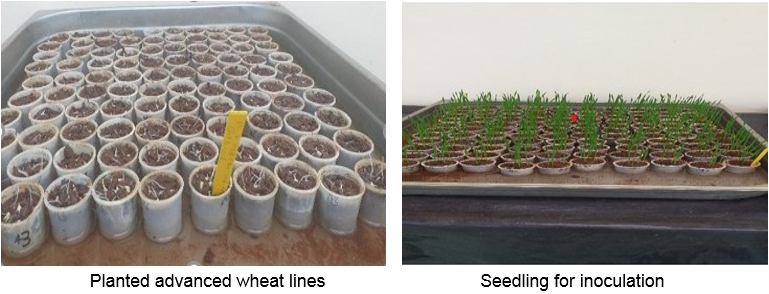
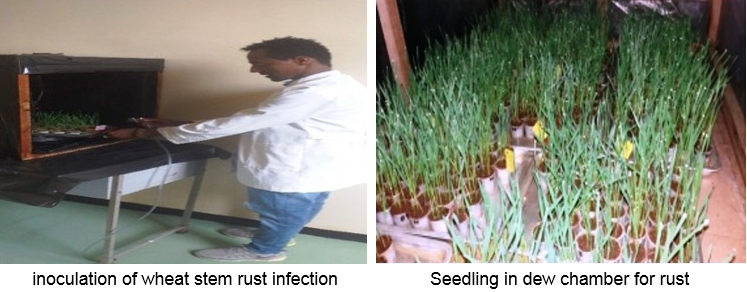
Figure 1. Procedure of inoculation wheat stem rust and occurrence of infection process
Disease assessment and collected data
Disease assessment was carried out 14 days after inoculation using the 0 to 4 infection type (IT) scoring scale (Stakman et al., 1962) (Figure 1). Infection types 0 to 2+ were regarded as incompatible (low infection types), whereas infection types 3 to 4 were considered as compatible (high infection types).
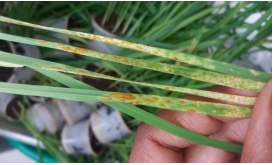
Figure 2. Susceptible wheat line seedling
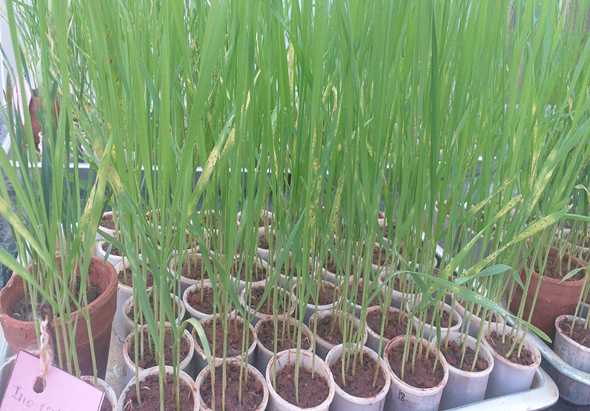
Figure 3. Resistant wheat line seedling
Data Analysis
Greenhouse evaluation of advanced bread wheat lines were computed on the Microsoft excel by using the descriptive statistical analysis.
RESULT AND DISCUSSION
Evaluation of Advanced Wheat Bread Lines for Reaction to Virulent Races of Stem Rust under Greenhouse Conditions
A total of 44 advanced wheat line including reference varieties (Digelu, Ogolcho, Kubsa and McNair were tested at seedling stage. The infection types (ITs) of stem rust on wheat lines evaluated at seedling stage are presented in (Figure 2). Susceptible controls McNair was heavily infected and exhibited the expected compatible ITs ranging from 3- to 3 for all stem rust races. This infection type indicated successful inoculation and high level of infection in each experiment. This in turn allowed for the reliable scoring of ITs in all wheat genotypes.
The greenhouse evaluation had shown that advanced bread wheat lines differed in their reaction to the dominant stem rust races; TTKTT, TKTTF, TTTTF, TKKTF and TRTTF. Out 44 of advanced bread wheat lines evaluated at the seedling stage, none showed complete resistant (zero IT) while 10 (ETBW-164008, ETBW-17148, ETBW-9452, ETBW-172020, ETBW-174018, ETBW-17-133, ETBW-164006, ETBW-17-4456, ETBW-164002 and ETBW-164004) had resistant infection types (IT = “;” or fleck to; 1+). The resistance reaction in these lines implied the presence of seedling resistance gene towards these virulent races. Nine advanced bread wheat lines namely; ETBW-8583, ETBW-17-214,ETBW-17-2233, ETBW-9080, ETBW-9065 ETBW-9651, ETBW-9655, ETBW-9655 and ETBW-9545 exhibited resistance to TTKTT virulent race might have sr36 but susceptible to TTTTF, TKTTF, TKKTF and TTRTF races (IT=3-). The incompatible reaction of these lines to TTKTT race and compatible reaction to TTTTF, TKTTF, TKKTF and TTRTF races this indicateds the presence of unidentified seedling resistance gene in these particular lines.
Among the 44 bread wheat lines evaluated, 22 (ETBW-16401, ETBW-17-175, ETBW-8583, ETBW-9547, ETBW-164009, ETBW-17-4457, ETBW-17-193, ETBW-17-50, ETBW-164013, ETBE-1779, ETBW-17-174, ETBW-9650, ETBW-164010, ETBW-9657, ETBW-9641, ETBW-164011, ETBW-17-199, ETBW-9128, Digelu, Ogolcho, Kubsa and McNair showed susceptible reaction (3- to 3+) to all selected virulent races TTKTT, TKTTF, TTTTF, TKKTF and TRTTF (Table 17). Seedlings of ETBW-17143 and ETBW-1779 were resistant to TKTTF and TKKTF races (“;” to 2+), however, they were susceptible to TTKTT, TTTTF, and TTRTF races. This could be due to the broadest virulence spectrum of the current races.
Table 3: Reactions of advanced bread wheat lines against dominant stem rust races at seedling stage in the greenhouse
|
Advanced bread wheat lines |
Seedling Reaction (IT) |
||||
|
|
TTKTT |
TKTTF |
TKKTF |
TTTTF |
TTRTF |
|
ETBW16401 |
3- |
3- |
3- |
3- |
3+ |
|
ETBW17-134 |
3- |
3- |
3- |
3+ |
3- |
|
ETBW17-175 |
3- |
3- |
3- |
3- |
3- |
|
ETBW 164008 |
;1 |
;1+ |
;1 |
;1 |
;1+ |
|
ETBW 17-148 |
;1+ |
;1+ |
;1 |
;1+ |
;1 |
|
ETBW-8583 |
2- |
3- |
3- |
3+ |
3- |
|
ETBW 9547 |
3+ |
3- |
3- |
3- |
3- |
|
ETBW 164009 |
3+ |
3- |
3- |
3- |
3- |
|
ETBW 174457 |
3+ |
3- |
3- |
3- |
3- |
|
ETBW-17-193 |
3- |
3+ |
3- |
3- |
3- |
|
ETBW-9651 |
2 |
3- |
3- |
3- |
3- |
|
ETBW-17-143 |
3- |
3 |
3 |
3- |
3- |
|
ETBW-9452 |
;1+ |
;1+ |
;1 |
;1 |
;1+ |
|
ETBW- 172020 |
;1 |
;1 |
;1 |
;1+ |
;1+ |
|
ETBW174018 |
;1 |
;1 |
;1+ |
;1+ |
;1+ |
|
ETBW-17-50 |
3- |
3- |
3 |
3- |
3- |
|
ETBW-17-214 |
;1+ |
3- |
3 |
3- |
3- |
|
ETBW-164013 |
3- |
3- |
3- |
3- |
3- |
|
ETBW-17-174 |
3 |
3 |
3- |
3- |
3- |
|
ETBW-17-79 |
2 |
2 |
2+ |
3- |
3- |
|
ETBW-172233 |
;1+ |
3- |
3- |
3- |
3- |
|
ETBW-9655 |
2 |
3- |
3- |
3- |
3- |
|
ETBW-9136 |
;1 |
;1+ |
;1+ |
3- |
3- |
|
ETBW-17-133 |
;1 |
;1 |
;1+ |
;1+ |
;1+ |
|
ETBW-9567 |
3- |
3- |
3+ |
3- |
3- |
|
ETBW 164006 |
;1+ |
;1+ |
;1 |
;1+ |
;1+ |
|
ETBW-174456 |
;1 |
;1 |
;1+ |
;1+ |
;1+ |
|
ETBW17-2289 |
3- |
3 |
3- |
3- |
3 |
|
ETBW-9065 |
;1+ |
3 |
3- |
3- |
3- |
|
ETBW-9650 |
3- |
3- |
3 |
3- |
3- |
|
ETBW-164010 |
3- |
3- |
3- |
3- |
3- |
|
ETBW-9545 |
;1 |
3- |
3- |
3- |
3- |
|
ETBW-9657 |
3- |
3- |
3- |
3- |
3- |
|
ETBW-9641 |
3 |
3 |
3 |
3+ |
3- |
|
ETBW-164011 |
3- |
3- |
3- |
3- |
3- |
|
ETBW-17-199 |
3 |
3- |
3- |
3- |
3+ |
|
ETBW-164002 |
;1+ |
;1+ |
;1+ |
;1+ |
;1 |
|
ETBW-164004 |
;1+ |
;1+ |
;1+ |
;1+ |
;1+ |
|
ETBW-9080 |
;1 |
3- |
3- |
3- |
3- |
|
ETBW-9128 |
3- |
3 |
3- |
3+ |
3- |
|
Digelu |
3- |
3- |
3- |
3- |
3- |
|
Ogolcho |
3 |
3- |
3- |
3- |
3- |
|
Kubsa |
3- |
3- |
3 |
3- |
3- |
|
Mc Nair |
3 |
3 |
3 |
3 |
3 |
*The scale described by Stakman et al. (1962) with ITs; 1, 2 considered resistant and 3, 4 considered susceptible. Negative (-) = smaller uredinia than the normal size and + larger than the normal uredinia
ETBW-1779 and ETBW-17-143 were resistant to TKTTF race while ETBW-17-143 was resistant to TKKTF. Infection type coding resistance was ranging from; (- flecks) to (2+) were regarded as resistant whereby the frequent infection type mostly displayed was “;1” on the primary leaves of the seedling.
Moreover high frequency of 22.2% of advanced bread wheat lines were resistant TTKTT, TKTTF, TTTTF, TKKTF, and TTRTF races, with low infection types ranging from (flecks) to (2), as well as 20.5% of bread wheat lines resistant to TTKTT race with low infection types (2). In Ethiopia devising a breeding strategy to develop stem rust-resistant wheat varieties is valuable and will definitely contribute to the stability of wheat production in the country. Several efforts were made towards resistant cultivars development in the country and many bread wheat cultivars with various levels of rust resistance were released for production. However, most of the released bread wheat varieties overcome to stem rust soon after their release due to either introduction of exotic races or evolvement of new local races and changes in environmental factors (Wubishet and Chemeda, 2016).
According to Ambika and Meenakshi (2018), the changing temperature and rainfall patterns have encouraged the emergence of new stem rust races and the currently resistant and popularly grown wheat varieties remain at constant stake of losing their resistance to it. In this study, none of the tested lines were immune to stem rust infection. Out of the tested advanced bread wheat lines and varieties, some wheat lines recorded low infection types (fleck (;) to 2). These could be due to these lines carry effective race-specific or seedling stem rust resistance genes to the virulent races. According to Sheikh et al., (2017), seedling stage resistance can be responsible for a large amount of the resistance to a particular race of a pathogen in their action and effective through all plant growth stages, it functions against certain stem rust races or biotypes but not against others. Seedling resistance can be very powerful and can sometimes offer the plant near immunity against a specific race of the pathogen. This is the reason that seedling type of resistance has been used for years and is frequently very successful. However, in almost all cases the pathogen overcome effectiveness of the genes because of once a seedling resistance gene is discovered it is often deployed over a broad area, which exposes the gene to incredible amounts of inoculum (Hulbert and Pumphrey, 2014).
Ogutu et al. (2017) also reported cultivars that exhibited low infection types at seedling stage could be either due to one or more of the stem rust genes or a combination that had similar infection type pattern towards the races. Major gene resistance/seedling resistance can offer complete protection and significant economic benefits to farmers. Therefore, these varieties can be used as sources of stem rust resistance when the aim of the breeding program is for the major gene (Cheruiyot et al., 2015)
CONCLUSION
Five dominant races; TTKTT TKTTF, TTTTF, TKKTF, and TTRTF were inoculated on 44 advanced bread wheat lines at seedling stage to evaluate their seedling reaction to stem rust. The results revealed that there was no complete resistance (zero infection type) observed among the evaluated advanced bread wheat lines. However, ETBW-164008, ETBW-17.148, ETBW-9452, ETBW-17-2020, ETBW-17-4018, ETBW-17-133, ETBW-164006, ETBW-17-4456, ETBW164002 and ETBW-164004 showed resistance reactions (IT = fleck (;) to (2) to all dominant races at seedling (or all-stage) resistance. Therefore, they can be used as source of resistance at adult stage resistance in wheat breeding program.
REFERENCES
Abebe Teklay, Getaneh Weldab and Woubit Dawit. 2012. Analysis of pathogen virulence of wheat stem rust and cultivar reaction to virulent races in Tigray, Ethiopia. African Journal of Plant Science, 6(9): 244-250.
Abiyot Lemma, Getaneh Woldeab, Yared Semahagn and Dilnesaw, Z. 2014. Survey and virulence distribution of wheat stem rust (P. graminis f.sp. tritici) in the major wheat growing areas of central Ethiopia. Science of African Journal of Scientific Issues, Research and Essays, 2:74-78.
Admassu Belaneh, H. Friedt, W. and Ordon, F. 2012. Stem rust seedling resistance genes in Ethiopian wheat cultivars and breeding lines. African Crop Science Journal, 20(3): 149-162.
Admassu Belaneh, Lind. V, Friedt. W. and Ordon, F. 2009. Virulence analysis of P. graminis f. sp. tritici populations in Ethiopia with special consideration of Ug99. Plant Pathology, 58(2):362 - 369.
Beyene Lulit, Shiferaw Bekele, Sahoo, A. and Gbegbelegbe, S. 2016. Economy-wide impacts of technological change in food staples in Ethiopia: A macro-micro approach.
Bhattacharya S. 2017. Deadly new wheat disease threatens Europe's crops. Nature, 9: 542-7640.
Bhavani, S., Singh, R., Argilliers, O., Huerta-Espino, J., Singh, S. and Njus, P. 2011. Mapping of durable adult plant stem rust resistance in six CIMMYT wheat to Ug99 group of races. Oral Presentations. BGRI Technical Workshop.
Boshoff. W., Van Niekerk. B. and Pretorius, Z. 2000. Pathotypes of P. graminis f.sp. tritici detected in South Africa during 1991-1997. South Africa Journal Plant Soil, 17:60-62.
Cheruiyot, D., 2015. Evaluation of advanced wheat (triticum aestivum l.) lines for stem rust (p. graminis f. sp. tritici) resistance and yield in Kenya (Doctoral dissertation, Egerton University).
CSA (Central Statistical Agency). 2020. Report on Area and production of Major Crops. The Federal Democratic Republic of Ethiopia; Central Statistics Agency Agricultural Sample Survey for 2017/2018. Addis Ababa, Ethiopia.
CSA (Central Statistical Agency). 2021. Agricultural Sample Survey. Report on area and production of major crops. Addis Ababa, Ethiopia.
Duvalier, E., Singh, R. and Nicol, J. 2007. The challenges of maintaining wheat productivity: pests, diseases, and potential epidemics. Euphytica, 157:417–430.
FAO (Food and Agricultural Organization of the United Nation). 2021. Food and Agricultural Organization of the United Nations (FAO): FAO Global Statistical Year book. http://www.fao.org/faostat/en/#data/QC. Metadata last certified.
FAO (Food and Agriculture Organization of the United Nations). 2020. Strengthening capacities and prompting collaboration to prevent wheat rust epidemics. Wheat Rust Diseases Global Programme. http://www.fao.org/3/a-i3730e, 5-35.
Fekadu Eshetu and Admassu Belaneh. 2004. Seedling and adult plant resistance in Ethiopian wheat varieties to local P. graminis isolates. African Crop Science Journal, 20(3): 149 – 161.
Figueroa, M., Kosack, K.E. and Solomon, P.S. 2017. A review of wheat diseases a field perspective. Molecular plant pathology, 19(6): 1523-1536.
Gizachew Hirpa Regasa, Girma. Adugna Senbeta and Netsanet Bacha Hei. 2018. Distribution and Occurrence of Wheat Stem Rust (P. graminis f. sp. tritici) in Tigray Region, Northern Ethiopia. International Journal for Research in Agricultural and Food Science, 5(7): 23-46.
Hailu Alemayehu, Getaneh Woldeab, Dawit Wubit and. Hailu Eshetu. 2015. Distribution of Wheat Stem Rust (P. graminis f.sp. tritici) in West and Southwest Shewa Zones and Identification of its Physiological Races. Advances in Crop Science and Technology, 3(4): 189.
Gebre-Mariam. 1991. Wheat production and research in Ethiopia. In: Historical Perspective. Addis Ababa, Ethiopia: Institute of Agricultural Research and CIMMYT, 1-15.
Netsanet Bacha Hei, Hussen Ali Shimelis and Laing, M. 2017. Appraisal of farmers’ wheat production constraints and breeding priorities in rust prone agro-ecologies of Ethiopia. African journal of agricultural research, 12: 944-952.
Shewry, P.R. 2009. Wheat. Journal of experimental botany, 60(6): 1537-1553.
Shiferaw Bekele, Negassa, Alemayo, Koo, J., Wood, J., Sonder, K., Braun, J.A. and Payne, T. 2011. Future of wheat production in Sub-Saharan Africa: analyses of the expanding gap between supply and demand and economic profitability of domestic production.
Shiferaw Bekele, Smale, M., Braun, H.J., Duveiller, E., Reynolds, M. and Muricho, G. 2013. Crops that feed the world. Past successes and future challenges to the role played by wheat in global food security. Food Security, 5(3): 291-317.
Singh, R. P., Huerta-Espino, J. and William, H.M. 2006. Genetics and breeding for durable resistance to leaf and stripe rusts in wheat. Turk. Journal of Agriculture for Forestry, 29: 121-127.
Tadesse Wuletaw, Zewudie Bishaw and Solomon Assefa. 2018. Wheat production and breeding in SubSaharan Africa: Challenges and opportunities in the face of climate change. International Journal of Climate Change Strategies and Management, 11 (5): 696-715.
Tolessa Taye, Chemada Fininsa and Getaneh Woldeab.2014. Importance of Wheat Stem Rust (P. Graminis f.sp. Tritici) in Guji Zone, Southern Ethiopia.Plant, 2(1): 1-5.
White, J.W., Tanner, D.G. and Corbett, J.D. 2001. An agro-climatological characterization of bread wheat production areas in Ethiopia.
Wubishet Alemu and Chemeda Fininsa. 2016. Effects of Environment on Wheat Varieties’ Yellow Rust Resistance, Yield and Yield Related Traits in South-Eastern Ethiopia. Science publishing group. Plant, 4(3): 14-22.
|
Cite this Article: Girma, T (2026). Evaluation of advanced bread wheat Genotypes against dominance races of wheat stem rust under greenhouse conditions in Guji Zone, Southern Ethiopia. Greener Journal of Agricultural Sciences, 16(1): 50-59, https://doi.org/10.15580/gjas.2026.1.031526037.
|