Greener Journal of Biological Sciences
Vol. 16(1), pp. 1-4, 2026
ISSN: 2276-7762
Copyright ©2026, Creative Commons Attribution 4.0 International.

|
Greener Journal of Biological Sciences Vol. 16(1), pp. 1-4, 2026 ISSN: 2276-7762 Copyright ©2026, Creative Commons Attribution 4.0 International. |
|
Preliminary Phytochemical Analysis and Antifungal Activity of Citrus sinensis Seed Extracts against Penicillium spp. and Aspergillus flavus
Eya, Maryrose Ujunwa1*; Suleiman, MN2; Ndukwe, Francis O3
1* Department of Biological Sciences, Federal University Lokoja.
2 Department of Biological Sciences, Federal University Lokoja.
3 Department of Physics and Industrial Physics, Nnamdi Azikiwe University, Awka.
|
ABSTRACT |
|||
|
Phytochemical and antimicrobial screening of seed of Citrus sinensis on fungi were carried out in the laboratory of Biological Science of Federal University Lokoja. Pulverized Citrus sinensis seeds were screened phyto-chemically and the presence of alkaloid, Flavonoid, Steroid and tannin were confirmed. Aqueous extract of Citrus sinensis seeds used to inhibit the vegetative growth of pencillium and Aspergillus flavus obtained from laboratory at different concentrations. The percentage inhibitory rate of pencillium was found to be higher than concentration than that of Aspergillius flavus. Complete inhibition was at 80% concentration of Pencillium and also 80% concentration of Aspergillius as compared to the control having the highest mycelia growth. The inhibition rate increased with the Extract concentration.
|
|||
|
ARTICLE’S INFO |
|||
|
Article No.: 041926056 Type: Research Full Text: PDF, PHP, HTML, EPUB, MP3 DOI: 10.15580/gjbs.2026.1.041926056
Accepted: 22/04/2026 Published: 14/05/2026
Keywords: Phytochemical, Antimicrobial, Citrus sinensis
|
*Corresponding Author
Eya, Maryrose Ujunwa
E-mail: ujunwarose1995@gmail.com; fo.ndukwe@unizik.edu.ng
Tel: +2349038987975, +2348136347709 |
Article’s QR code
|
|
|
|
|
|
|
INTRODUCTION
Citrus sinensis commonly known as sweet orange belongs to the family Rutaceae. Different tribe has a name for it; Yoruba called it "Osan", Igbos called it "Oroma", Igala called it "Alemu" and so on. Sweet orange probably was cultivated in China and it refer to as "Chinese apple" (Ehler, 2011). Citrus sinensis are important fruit crops with an estimated 60 million tons produced worldwide as at 2005 for a total value of 9 billion dollars. (Goudeau et al., 2008). Citrus sinensis is a small ever green tree; 7.5 m high and in some cases up to 15m. It originated from southern China where it has been cultivated for many years, but today grown commercial worldwide in tropical, semi-tropical and some worm temperate regions to become the most widely planted fruits tree in the world (Ehler, 2011). Citrus sinensis is widely grown in Nigeria and many tropical and subtropical regions (Piccinelli et al., 2008). Nigeria produces 0.3 million tonne and has the potential to produce more orange wastes in high proportion. Though Nigeria is not well noted for the exportation of citrus fruits, she has the potential to produce more for both local and international markets.
The therapeutic potential of plant products can be traced back to over five thousand years ago as there is evidence of its use in the treatment of diseases and for revitalizing body systems in Indian, Egyptian, Chinese, Greek and Roman civilizations (Mahesh and Satish, 2008). In India, plants of therapeutic potential are widely used by all sections of people both as folk medicines in different indigenous systems of medicine like Siddha, Ayurveda and Unani and also as processed product of pharmaceutical industry (Srinivasan et al., 2007). Serafinao et al., (2008) noted that many plant extracts are quite effective than the synthetic ones.
The problem of resistance of microorganism to most antimicrobial drugs is one of the world's current challenges. Plant-based antimicrobial is encouraging as they are often devoid of many side effects associated with synthetic antimicrobials. Peels seed, and pulps (around 50% of fruit) are dealt with as waste, while, potentially, they can be source of valuable by-product.
Sweet Orange usually contain sufficient amount of folacin, calcium, potassium, thiamine, niacin, magnesium, flavonoids, volatile oils and post abundantly vitamin C which is a powerful natural anti-oxidant and that build the body immune system. The positive health benefits of the Citrus sinensis have been ascribed in part to Vitamin C (ascorbic acid), the major vitamin found in fruits and vegetables. The bergapten present in coumarins found in Citrus sinensis sensitize the skin from the sun light and is sometimes added tannin preparation since it's promoted pigmentation in the skin, though it can cause dermatitis orallergy responds in some people. The fruit is also very useful for people with fever and it also treat catarrh.
Citrus sinensis juice is a rich source of dietary flavonoids that reduce the risks of adverse cardiovascular events within 6 to 9 four-week consumption of Citrus sinensis juice in healthy middle-age, normal- weight man has been suggested to reduce diastolic blood pressure (DBP). Citrus sinensis consumption has become a worldwide dietary habit.
Researchers have used two different strategies for the exploitation of the bioactive compounds from agro wastes (Spatafora and Tringali, 2012): 1. Identification and isolation of bioactive natural products in agro waste as possible source of lead compound. 2. Chemical and enzymatic modification of lead compound available from agro waste to obtain optimized analogues, food additives, drugs or cosmetics. This research study is aimed at evaluating the phytochemical composition and antimicrobial screening of Citrus sinensis on fungi.
MATERIALS AND METHODS
The study was conducted in Lokoja, Kogi State, Nigeria (7.02°N, 6.73°E), characterized by a tropical wet-and-dry climate. Sample Fresh fruits of Citrus sinensis were purchased from Lokoja markets. Seeds were separated, washed, air-dried for 84 days, pulverized, and stored in airtight containers. Phytochemical Screening: Qualitative phytochemical screening was performed following Harborne (1980) and Sofowora (1993). Extract Preparation: Seed powder (10–80 g) was boiled in 100 ml distilled water for 30 minutes, cooled, filtered, and stored at 4°C.
Test Organisms: Cultures of Aspergillus flavus and Penicillium were obtained from the Department of Biological Sciences, Federal University Lokoja. Antifungal Assay: The poisoned food technique was used. Extracts were incorporated into Potato Dextrose Agar at 10%, 20%, 40%, and 80% concentrations. Fungal discs were inoculated and incubated at 27 ± 2°C for 8 days. Radial growth was measured daily, and percentage inhibition was calculated as:
Inhibition (%) = (A - B)/A × 100
Where A = control growth and B = treatment growth.
Statistical Analysis: Data were analyzed using one-way ANOVA in SPSS v21 at 95% confidence level (p < 0.05).
Phytochemical screening procedures: The qualitative tests were conducted following standard methods. For alkaloids, Meyer’s and Dragendorff reagents were employed, producing characteristic precipitates in positive samples. Flavonoids were detected by the Shinoda test, in which a change in solution color following the addition of magnesium and hydrochloric acid indicates presence. Tannins produced blue-black or green precipitates with ferric chloride, indicating phenolic hydroxyl groups. Saponins were identified by persistent froth formation on vigorous shaking. These tests were performed in triplicate to ensure reproducibility.
Extract preparation and preservation: Aqueous extraction involved boiling measured quantities of seed powder with distilled water, followed by filtration and cold storage. This method preferentially extracts polar compounds, including many glycosides and phenolics, which are commonly implicated in antimicrobial activity. All extracts were handled aseptically to prevent contamination and degradation.
Antifungal assay details: The poisoned food technique was carefully implemented, with PDA cooled to approximately 45°C prior to addition of extracts to prevent heat denaturation of active compounds. Extracts were added aseptically and mixed thoroughly for uniform distribution. Positive controls involved plates treated with a known antifungal agent, while negative controls contained PDA with no extract. Plates were incubated under controlled conditions to ensure consistent growth rates for comparison.
Statistical analysis: Raw radial growth measurements were transformed into percentage inhibition values and summarized as mean ± standard error. Statistical comparisons were made using one-way ANOVA with post-hoc Duncan’s multiple range test where appropriate. All analysis were executed in SPSS v21 and R for confirmatory plotting and diagnostics.
RESULT
The phytochemical analysis was preliminary screened for the pulverized seed of citrus sinensis, represented on table1, where + indicate present and – indicate absent.
Table 1: Preliminary Phytochemical screening of Pulverized seed
|
Phytochemical |
Result |
|
Alkaloids |
+ |
|
Flavonoids |
+ |
|
Tannins |
+ |
|
Saponins |
+ |
|
Steroids |
– |
|
Reducing Sugar |
_ |
|
Glycosides |
– |
Table 2: Inhibition rate of Penicillium
|
Mean (B) |
Inhibition A-B |
% of Inhibition |
|
|
10 |
1.93 |
1.36 |
41.33 |
|
20 |
1.44 |
1.85 |
56.23 |
|
40 |
1.20 |
2.09 |
63.53 |
|
80 |
0.79 |
2.50 |
75.99 |
|
Control (A) |
3.29 |
0.00 |
0.00 |
Table 3: Inhibition rate of Aspergillus flavus
|
Concentration (%) |
Mean (B) |
Inhibition A-B |
% of Inhibition |
|
10 |
3.17 |
1.23 |
27.95 |
|
20 |
2.63 |
1.77 |
40.23 |
|
40 |
1.91 |
2.49 |
56.59 |
|
80 |
1.02 |
3.38 |
76.82 |
|
Control (A) |
4.40 |
0.00 |
0.00 |
Table 4: Percentage inhibition rate of Citrus sinensis on Penicillium and Aspergillus flavus
|
Concentration (%) |
Penicillium (%) |
Aspergillus flavus (%) |
|
10 |
41.33 |
27.95 |
|
20 |
56.23 |
40.23 |
|
40 |
63.53 |
56.59 |
|
80 |
75.99 |
76.82 |
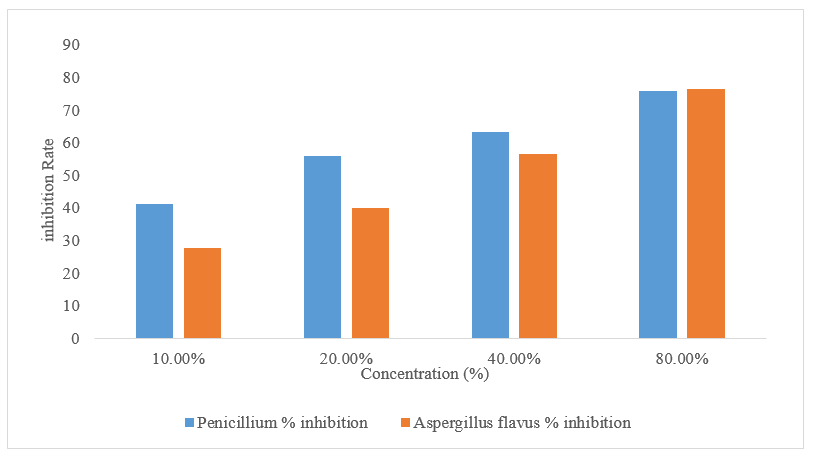
Figure 1: Cluster bar chart showing percentage inhibition of Aspergillus flavus and Penicillium by Citrus sinensis seed extracts at 10–80% concentrations.
Detailed observations showed that the radial growth of both fungi was progressively reduced with increasing extract concentration. The growth indicated an early lag phase followed by reduced exponential expansion, especially at higher concentrations. At 80% concentration, the mycelial extension was markedly curtailed, implying strong fungistatic or fungicidal activity dependent on species and concentration. These tendencies were statistically significant as indicated by ANOVA and post-hoc tests.
This revealed that Citrus sinensis seeds contain bioactive phytochemicals with antifungal potential. The presence of alkaloids, flavonoids, tannins, and saponins agrees with earlier reports linking these metabolites to antimicrobial activity. Alkaloids interfere with microbial metabolism, saponins disrupt fungal membranes, flavonoids inhibit enzymatic activity, and tannins precipitate proteins. Together, these compounds contribute to the observed antifungal effects. The inhibition of Aspergillus flavus and Penicillium increased with extract concentration, consistent with studies on other plant-derived antifungals. The slightly higher inhibition of A. flavus suggests species-specific sensitivity.
CONCLUSION
This study demonstrates that Citrus sinensis seeds, an abundant agro-waste, contain phytochemicals with significant antifungal activity against Aspergillus flavus and Penicillium species. The aqueous extracts produced concentration-dependent inhibition, suggesting potential for development of low-cost, eco-friendly antifungal formulations.
Acknowledgement
I sincerely thank Professor Nasirudeen Mohammed Suleiman, Department of Biological Sciences, Federal University Lokoja, for his supervision and guidance during this research. I also extend my heartfelt gratitude to my Head of Department at the time, Professor Jacqueline A. Badaki, for her support and encouragement throughout.
.
REFERENCES
Ehler, S. A. (2011). Citrus and its benefits. Journal of Botany, 5, 201–207.
Goudeau, D., Bernardi, J., Licciardello, C., Russo, M. P., Chiusano, M. L., Carletti, G., Recupero, G. R., & Marocco, A. (2008). Use of a custom array to study differentially expressed genes during blood orange (Citrus sinensis L. Osbeck) ripening. Journal of Plant Physiology, 165(3), 301–310. https://doi.org/10.1016/j.jplph.2007.06.007
Harborne, J. B. (1980). Phytochemical methods: A guide to modern techniques of plant analysis (2nd ed.). Chapman and Hall.
Karimi, H. R. (2011). Citrus taxonomy and hybridization. Horticultural Science, 46(2), 120–126.
Mahesh, B., and Satish, S. (2008). Antimicrobial activity of some important medicinal plant extracts against plant and human pathogens. World Journal of Agricultural Sciences, 4(S), 839–843.
Piccinelli, A. L., García Mesa, M., Arancibia-Avila, P., & Rastrelli, L. (2008). Citrus juices: Composition and properties. Food Chemistry, 107(4), 1531–1537. https://doi.org/10.1016/j.foodchem.2007.09.067
Shan, W. (2006). Sweet orange cultivation and production in China. Chinese Journal of Horticultural Science, 23(1), 14–20.
Sofowora, A. (1993). Medicinal plants and traditional medicine in Africa (2nd ed.). Spectrum Books.
Srinivasan, D., Nathan, S., Suresh, T., & Lakshmana Perumalsamy, P. (2001). Antimicrobial activity of certain Indian medicinal plants used in folkloric medicine. Journal of Ethnopharmacology, 74(3), 217–220.
|
Cite this Article Eya, MU; Suleiman, MN; Ndukwe, FO (2026). Preliminary Phytochemical and Antimicrobial Screening of the Citrus sinensis Seed on Fungi. Greener Journal of Biological Sciences, 16(1): 1-4. https://doi.org/10.15580/gjbs.2026.1.041926056. |