The study
investigated the impact of external reserves on economic growth in Nigeria.
Time series data spanning from 1981 to 2020 was sourced from the Central
Bank of Nigeria statistical bulletin. The ARDL bounds testing approach to
co-integration was used to analyse the data. Autoregressive Distributed Lag
(ARDL) model and Error Correction Model (ECM) were utilized to address the
main objectives of the study. The estimated short run coefficient result
revealed that exchange rate in the current period and in two periods have a
negative and significant impact on economic growth while one period lag of
exchange rate has a positive and significant impact on economic growth. The
coefficient of the current period of external reserves has a negative and
significant impact on economic growth while inflation rate in the current
period, two lag periods and three lag periods have a positive and
significant impact on economic growth. The speed of adjustment for
correcting disequilibrium from the previous year to equilibrium in current
year is 8 percent as shown by the coefficient of
ECM. The long run result showed that exchange rate has a negative and
insignificant impact on economic growth while external reserves have a
positive and insignificant impact on economic growth. The result also showed
that inflation rate has a negative and insignificant impact on economic
growth. Based on the findings, the study recommended that appropriate
macroeconomic policy that should stabilize prices and boost external
reserves should be formulated and implemented.
External reserves are seen as external assets
that are readily available to and controlled by monetary authorities for direct
financing of external payments imbalances, for indirectly regulating the
magnitudes of such imbalances through intervention in exchange markets to
affect the currency exchange rate, and/or for other purposes (IMF, 2003). They also regarded as
assets of a nation through the Monetary Authority of the country. The assets
are held in stocks, currencies or other financial instruments that allow one
country to settle amounts owed to other countries (Egbulonu and Akamike, 2018). According to Obaseki
(2007) the motives
for holding and accumulating reserves are also modes for the use and deployment
of the reserves. The motives are the transactions, precautionary (intervention)
and wealth preservation/ diversification motive. Nwafor (2017) opined that the
purpose of holding reserves is to allow the central bank an additional means to
stabilize theissued currencies from shocks. In
addition to meeting the transaction needs of countries, reserves are used as aprecautionary purpose to provide a cushion to absorb unexpected
shocks or a sharp deterioration in their terms oftrade or to meet unexpected capital outflows, like the
negotiated exit payment of the Paris Club Debt by Nigeria.
1.1.Statement of problem
Over the years, there have been
fluctuations in Nigeria’s external reserves. Sometimes it increases and at
other times it falls.For instance,
available records showed that Nigeria’s external reserve fell from 2441.60
million USD in 1981 to 710.10 million USD in 1984. It increased from 2836.66
million USD in 1986 to 7504.59 million USD in 1987. In 1991, it fell from
4149.30 million USD to 3403.91 million USD in 1996. It later increased from
7222.22 million USD in 1997 to 10267.10 million USD in 2001. It further
increased from 16955.02 million USD in 2004 to 42847.31 million USD and later
fell to 26990.50 million USD in 2016 and rose again to 36476.89 million USD in
2020 (Central Bank of Nigeria statistical bulletin). Scholars do not have a
general agreement on whether accumulation of external reserves encourages
economic growth or discourages economic growth. For instances some scholars
argued that
maintaining adequate reserves can boost investors’ confidence and enhance
investment and growth (Elhiraika and Ndikumana, 2007). While others believed that keeping
scarce resources in reserve when there is a series of issues to be attended to
domestically, such as education and health among others, may hinder economic
growth (Osabuohien and Egwakhe,
2008). Given that there is no general agreement on the impact of external
reserve on economic growth, the study therefore investigated the impact of
public expenditure on inflation rate in Nigeria.
1.2 Objectives of the study: The broad objective of the study was to
investigate the impact of external reserves on economic growth in Nigeria. The
specific objectives of the study were:
(i). To examine the impact of external
reserves on economic growth in Nigeria.
(ii).To investigate the impact of
inflation rate in economic growth in Nigeria.
(iii).To explore the impact of exchange
rate in economic growth in Nigeria.
1.3 Hypothesis of the study: In order to guide the study, the following
null hypotheses were formulated:
HO1: Eternal reserves do not
have any impact on inflation rate in Nigeria.
HO2: Inflation rate does not have any impact on
inflation rate in Nigeria.
HO3:Exchange
rate does not have any impact on inflation rate in Nigeria.
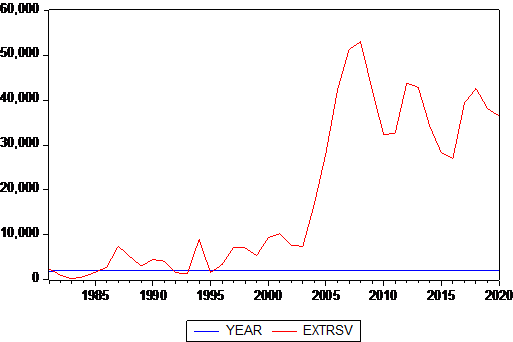
2.1 Trend Analysis of external Reserves
Figure1: Trend analysis
Source:
Computer analysis of E-views 10 and data from CBN statistical bulletin
Trend analysis of external reserves of Nigeria presented
in figure 1 showed that external debt witnessed an increase from 2004 when it
was 16955.02 million USD to 2007 when the figure stood at 51333.15 million USD
but started declining continuously in 2008 when its figure stood at 53000.36
million USD to 2011 when its figure stood at 32639.78 million USD. It started
rising again in 2012 when its figure stood at 43830.42 million USD till 2017
42594.84 million USD. It started rising again in 2018 when the figure stood at
42594.84 million USD. In 2019 it started declining when the figure stood at
38092.72 million USD.
2.2. Theoretical
Framework
2.2.1. Theory of
International financial
integration
The theory suggests
that international integration should cause capital to flow from high income
countries characterized by high capital labour ratios
to low-income countries with lower capital-labour
ratios. According to this theory, the process would improve the levels of
investment through the access to foreign capital. It would also boost growth in
poor countries and support higher returns to foreign investors who will be
induced to make capital flows abroad. The process of capital flows will be
facilitated foreign exchange liberalization (Nwafor,
2017).
2.2.2 Micro/MacroTheoriesbased
on the controversies of monetarists and Keynesians.
The monetarists say
that accumulation of reserves is as a result of the excess demand for the
domestic currency and the growth of world trade. For the Keynesians,
accumulation of foreign reserves is to improve the current account and thereby
positively impact on the aggregate input. This impact is in the short run and
will affect nominal exchange rates (Nwafor, 2017).
2.3 Conceptual literature
Haukur and Sturla
(2005) opined that reserve assets consist of those external assets that are
readily available to and controlled by monetary authorities for direct
financing of payments imbalances, for indirectly regulating the magnitude of
such imbalances through intervention in exchange markets to affect the currency
exchange rate, and/or for other purposes.” Reserve assets comprise monetary
gold, foreign exchange assets and other claims in foreign currency. In most
instances, reserves are safeguarded and invested by central bank. Iwueze et al (2013) external reserves include international
reserve assets of the monetary authority but exclude the foreign currency and
the securities held by the public including the banks and corporate bodies.Awoderu et al
(2017) asserted that external reserves are assets held by a central bank or
other monetary authority, usually in various reserve currencies, mostly the
United States dollar, and to a lesser extent the euro.
Reserves are used to intervene in the foreign exchange market to
influence the exchange rate, payment for the importation of goods and services,
services of the nation’s external debt and source of finance for domestic
fiscal expenditure, to insure against currency crisis by allowing relevant
authorities to support their currency. External reserves also act as a “shock
absorber” in terms of fluctuations in international transactions, such as
variations in imports resulting from trade shocks, or in the capital account
due to financial shocks. It also serves as an immediate purpose of either
fighting inflation or deflation, as a precautionary purpose to provide a
cushion to absorb unexpected shocks or a sharp deterioration in their terms of
trade or to meet unexpected capital outflows, like the negotiated exit payment
of the Paris Club Debt by Nigeria. It is also used to manage the exchange rate
through intervention in the foreign exchange market and help build
international community confidence in the nation’s policies and credit
worthiness (Akinwunmi and Ajala,
2020). Egbulonu and Akamike (2018)
opined that external reserves are regarded as assets of a nation
through the Monetary Authority of the country. The assets are held in stocks,
currencies or other financial instruments that allow one country to settle
amounts owed to other countries.Nzotta (2004)
argued that foreign reserves come about when foreign exchange disbursements are
lower than foreign exchange receipts. The surplus gives rise to foreign
reserves. Egbulonu and Akamike (2018) argued that
many countries in the world usually hold foreign reserves to have a favourable level of exchange rate especially with a view to
stabilizing it and maintenance of robust economy. Countries hold external reserves in foreign currencies in order
to maintain a desirable exchange rate policy by interfering significantly in foreign
exchange markets (Osabuohien and Egwakhe,
2008 as cited in Nwafor, 2017). According to Benediktsson
and Palsson (2005), foreign reserves perform an
important function under a fixed exchange-rate regime. A central bank operating
a fixed exchange rate policy needs to trade domestic currency in the forex market to balance supply and demand, which will keep
the exchange rate stable or, where applicable, within the fluctuation bands. To
conduct such transactions, the central bank needs to maintain a sufficient
level of foreign reserves to maintain confidence in the fixed exchange-rate policy.
Smaller reserves should generally suffice under a floating exchange rate, since
the central bank does not need to intervene to defend the currency.
2.3 Empirical literature
Elijah (2020) investigated the
connection between external reserve and economic growth in Nigeria. The study
covered the period 1986 to 2018. Data were soured from Central Bank of Nigerian
Statistical Bulletin (2018). The techniques adopted for analysis were Augmented
Dickey-Fuller Unit Root, Philip Perron Unit Root, Autoregressive Distributed Lag (ARDL) and Granger Causality
techniques. Base on Bound Co-integration test result, the study revealed that
external reserve, exchange rate, trade openness and
inflation rate had long run relationship with real gross domestic product. The
ARDL result indicated that external reserve and exchange rate positively
influenced economic growth while trade openness and inflation rate were found
to exert negative effect on economic growth. The causality result indicated
that external reserve had bidirectional causality with economic growth in
Nigeria. The study recommended that government should formulate policies to
improve the trade performance of the nation through the diversification of the
nation’s to other viable sector like agriculture and manufacturing sectors and
at the same time makes local made goods attractive for both local and foreign
consumption in order to boost the nation’s reserves through higher export.
Joseph et al.
(2022) examined the impact of external reserves on economic growth in Nigeria.
The study utilized the descriptive approach for the trend analysis, while the
autoregressive distributed lag (ARDL) model was relied upon in scrutinizing the
contemporaneous dynamics for the unrestricted ECM. The data that were culled
from several issues of the Central Bank of Nigeria’s annual report and
statement of account covered the period 1986–2020. Descriptively, the study
finds that economic growth rate and external reserves witnessed fluctuations
with the latter being relatively more pronounced. The study revealed that in
the long run, all the explanatory variables were key determinants of economic
growth in Nigeria. Specifically, economic growth is significantly and
positively responsive to changes in external reserves by 0.22%, inflation rate
by 0.08%, and a one period lag of GDP of 0.21% contrary to its negative
response to changes in exchange rate of 0.10% in the short run. The study
recommended that the government may consider providing a conducive
environment for increased productivity, thereby increasing foreign reserves.
Finally, inflation rate must be controlled within a single digit.
Johnny and Johnnywalker (2018) examined the
relationship between external reserve and economic growth in Nigeria from 1980
to 2016. The study used three explanatory variables (real gross domestic
product, market capitalization and agricultural output) and one explained variable
(external reserve). Test carried out include unit root test, co-integration
test, ordinary least square and Granger causality test. The study revealed
that: There is a positive and significant relationship between external reserve
and real gross domestic product in Nigeria; there is a positive and significant
relationship between external reserve and market capitalization in Nigeria; and
there is a negative and insignificant relationship between external reserve and
agricultural output in Nigeria. Based on the findings, the study recommended
that, Government should implement policies that will promote the level of real
gross domestic product in Nigeria; government should ensure that our capital
market is well capitalized and improved upon so as to boost the international
reserves.
Onah et al
(2022) examined the correlation between
external reserves and economic growth in Nigeria. The study specifically
examined effect of external reserve on; Gross Domestic Product of Nigeria,
Nigerian net national income and Agricultural exportation rate in Nigeria. The
study adopted the ex-post facto (after the facts) research design. Data for the
study was obtained from CBN statistical Bulletin. Result of the analysis showed
that external reserve has positive and significant effect on the Gross Domestic
Product of Nigeria. The study also showed that external reserve has a negative
and insignificant effect on the Nigerian net national income. Based on the
findings, the study recommends that there is need for prudent management of the
Nigerian external reserves to ensure more growth.
Egbulonu (2018) investigated
External Reserve Management and the Nigerian Economy over period 1990 to 2015.
The external reserve model was estimated using time series data on Gross
Domestic Product as the dependent variable while External Reserve, Inflation
and Exchange Rate were the independent variables. The study used the ARDL
Bounds test approach to estimate the long run relationship between External
Debt and Economic Growth in Nigeria. Data for the study were sourced from the
Central Bank of Nigeria (CBN) Statistical Bulletin (2016 edition). A pre-test
was carried out to check for the stationarity of the
data and it revealed that the data have mixed order of stationarity.
The test for long run relationship using the Bounds test showed that external
reserve management has a long run effect on Nigeria’s economic growth. The
findings revealed that external reserve has a positive effect on Nigeria’s
economic growth both in the short and long run, but this effect was not
significant. Similarly, exchange rate had an inverse relationship with economic
growth in the long run and was not significant. Inflation decreased economic
growth both in the short and long run periods. The implications of these
findings is that Nigeria’s external reserve has been fluctuating from moderate
to low and very low for most of the period reviewed and this has been adversely
affected by increasing exchange rates which in turn was being highly supported
by the Central Bank of Nigeria through Nigeria’s external reserve. The study
recommended that the government should ensure proper management of the nation’s
foreign reserve, invest a good percentage of the reserve in foreign high
yielding financial instruments and diversify the sources of foreign exchange
inflow into the country so as to ensure a sustained growth of the economy.
Vitalis et al. (2022) examined the correlation between
external reserves and economic growth in Nigeria. The study specifically
examined the effect of external reserve on; Gross Domestic Product of Nigeria,
Nigerian net national income and Agricultural exportation rate in Nigeria. The
study adopted the ex-post facto (after the facts) research design. Data for the
study was obtained from CBN statistical Bulletin. Result of the study showed
that external reserve has positive and significant effect on the Gross Domestic
Product of Nigeria. The study also showed that external reserve has positive
and significant effect on the Gross Domestic Product of Nigeria. The study
further revealed that external reserve has a negative and insignificant effect
on the Nigerian net national income. Based on the findings, the study
recommended that there is need for prudent management of the Nigerian external
reserves to ensure more growth.
Nwosa (2017) examined the relationship between external
reserves and economic growth in Nigeria from 1981 to 2014. The study used the
Ordinary least squares econometric method of analysis. The result of the study
showed that external reserves had positive and significant influence on the
economic growth in Nigeria. Based on the major finding of the study, it was
concluded that external reserve in Nigeria has over the period of study
contributed positively and significantly to the growth of the economy. Thus,
the study recommended the need for prudent management of Nigerian’s external
reserves to ensure more growth and also that government should put in more
policies that will enhance increased accumulation of external reserves.
3.0 METHODOLOGY
Multiple regression analysis was used in the study. Time series
data spanning from 1981 to 2020 was sourced from Central Bank of Nigeria
statistical bulletin.The data were analysed
using E-views 10.
3.1 Model specification
In order to investigate the impact
of external reserves on economic growth in Nigeria, the model for the study was
specified thus:
RGDP = f (RSV, EXR, INFL)….. (1)
Where:
RGDP=Real gross domestic product (proxy for economic growth)
RSV=External reserves
EXR =Exchange rate
INFL=Inflation rate
The model in its econometric linear
form can be written as:
RGDP = b0 + b1RSV
+ b2EXR + b3INFL + U …… (2)
U = stochastic or random error term
bo = constant intercept
b1 – b3 =
coefficients of associated variables
The model in the log linear form
can be expressed as:
Since the data for the analysis is time series, the Augmented
Dickey-Fuller (ADF) unit root test was employed to ensure data stationarity and avoid the problem of spurious regression.
The Augmented-Dickey Fuller (ADF) unit root test was employed to ensure data stationarity and avoid the problem of spurious regression
since the data for the analysis is time series. Bound test was applied to
determine the existence of long run equilibrium relationship among the variables
4.0 RESULTS AND
DISCUSSION
Table 1 Result of Augmented Dickey-Fuller unit root test
Variable
ADF
test statistic
1%
critical value
5%
critical value
10%
critical value
Order
of integration
LOG(RGDP)
-3.796873
-3.615588
-2.941145
-2.609066
1(1)
LOG(RSV)
-7.419240
-3.621023
-2.943427
-2.610263
1(1)
LOG(EXR)
-5.319630
-3.615588
-2.941145
-2.609066
1(1)
LOG(INFL)
-4.893674
-3.610453
-2.938987
-2.607932
1(0)
Source: Author’s computation using E-Views 10
The unit test result presented on
table 1 showed that LOG(RGDP), LOG(RSV) and LOG(EXR)
were stationary at first difference, while LOG(INFL) was stationary at levels.
This is because their various ADF test statistic were greater than their
various 1%, 5% and 10% critical values in absolute terms.
Table-2: ARDL
Bounds Test
Sample: 1981-2020
Included
observations: 37
Null
Hypothesis: No long run -relationships exist
Test
Statistic
Value
K
F-statistic
6.444662
3
Critical value
bounds
Significance
1(0)
bound
1(1)
bound
10%
2.37
3.2
5%
2.79
3.67
2.5%
3.15
4.08
1%
3.65
4.68
Source:
Author’s computation using E-Views 10
The unit test result showed that
the data employed in the work is a combination of 1(0) and 1(1) implying that
the date set is a combination of stationarity and
non- stationarity data as a result of this, the
applied Bound test was used to determine the existence of long run equilibrium
relationship among the Variables. Table 2 shows that there is a presence of
co-integrating relationship among the Variables in the model since the Null
hypothesis of no long run relationship could not be accepted because the upper
and lower Critical Value Bounds at all level of significance is less than the
value of F-Statistic. This implies thatLOG(RGDP),
LOG(RSV), LOG(EXR) and LOG(INFL)have a
long run relationship. This justifies the need to estimate both short run and long
run relationship among these variables in this study.
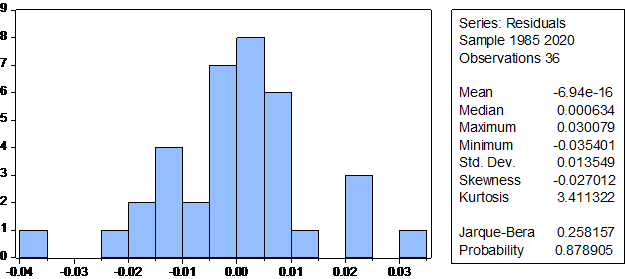
Fig 2 Normality test
Source:
Author’s computation using E-Views 10
Figure 2 above, shows that there
exists normal distribution of the residuals as the probability (0.878905) of Jaque-Bera statistics is greater than 5%. This is
encouraging as it exposes that our OLS estimates are unbiased, t-statistics and
confidence intervals are robust as well as prediction intervals.
Table 3: Estimated Short Run ARDL (4, 3, 1, 4) Result
Variable
Coefficient
Std. Error
t-Statistic
Prob.
DLOG(EXR)
-0.124626
0.014345
-8.687889
0.0000
DLOG(EXR(-1))
0.029630
0.019692
1.504663
0.1480
DLOG(EXR(-2))
-0.034594
0.014916
-2.319277
0.0311
DLOG(RSV)
-0.015807
0.005945
-2.658698
0.0151
DLOG(INFL)
-0.026844
0.004382
-6.126350
0.0000
DLOG(INFL(-1))
0.032781
0.006593
4.971766
0.0001
DLOG(INFL(-2))
0.019341
0.004670
4.141889
0.0005
DLOG(INFL(-3))
0.005267
0.003793
1.388724
0.1802
ECM(-1)*
-0.079699
0.012310
-6.474593
0.0000
R-squared
0.866992
Mean
dependent var
0.015155
Adjusted R-squared
0.806030
S.D.
dependent var
0.037151
S.E. of regression
0.016362
Akaike info criterion
-5.126475
Sum squared resid
0.006425
Schwarz
criterion
-4.598635
Log likelihood
104.2766
Hannan-Quinn criter.
-4.942245
Durbin-Watson stat
2.200567
Source: Author’s computation using E-views 10
The estimated short run
coefficient result as showed in table 3 revealed that EXR in the current period
and in two periods have a negative and significant impact on economic growth. While
one period lag of EXR has a positive and significant impact on economic growth.
The result also showed that the current period of RSV has a negative and significant
impact on economic growth while inflation rate in the current period, two lag
periods and three lag periods have a positive and significant impact on
economic growth. The error correction model (ECM) showed that the speed of
adjustments back to equilibrium in the estimated model is correctly sign and is
significant. The speed of adjustment for correcting disequilibrium from the
previous year to equilibrium in current year is 8 percent as shown by the
coefficient of ECM. In another words, this implies that an approximately 8
percent of disequilibrium from the previous year’s shock converge to the
long-run equilibrium in the current year.
Table 4: Estimated Long Run Coefficient of ARDL (4, 3, 1, 4)
The estimated long run coefficient
result in table 4 showed that exchange rate (EXR) has a negative and insignificant
impact on economic growth, while excess reserve (RSV) has a positive and
insignificant impact on economic growth. The result also showed that inflation
rate (INFL) has a negative and insignificant impact on economic growth. The
result also showed that a percentage increase in exchange rate will on the
average bring about 0.12 percent decrease in economic growth, while a percent
increase in excess reserve will on the average bring about 0.1004 percent
increase in economic growth. The result also showed that a percentage increase
in inflation rate will on the average bring about 0.627 percent decrease in
economic growth.
5.1 CONCLUSION:
The study examined the impact of
excess reserve on the economic growth of Nigeria for the period 1981–2020. The
estimated short run coefficient result revealed that EXR in the current period
and in two periods have a negative and significant impact on economic growth
while one period lag of EXR has a positive and significant impact on economic
growth. The coefficient of the current period of RSV has a negative and significant
impact on economic growth while inflation rate in the current period, two lag
periods and three lag periods have a positive and significant impact on
economic growth. The speed of adjustment for correcting disequilibrium from the
previous year to equilibrium in current year is 8 percent. The long run result
showed that exchange rate (EXR) has a negative and insignificant impact on
economic growth while excess reserve (RSV) has a positive and insignificant
impact on economic growth. The result also showed that inflation rate (INFL)
has a negative and insignificant impact on economic growth.
5.2 RECOMMENDATIONS:
Based on the findings, the study
recommended that appropriate macroeconomic policies that should stabilize
prices and boost external reserves should be formulated and implemented. There
should be efficiency in the management of the external reserves by the Central
Bank. The monetary authority should from time to time intervene into the
activities of the foreign exchange market to ensure that there is stability in
exchange rate.
REFERENCES
Akinwunmi, A.A and Ajala, R.B (2020).Study on External Reserves Management and Economic Growth in Nigeria
(1985-2013).Insights into Economics and
Management 3, 146 -157.
Awoderu, B. K; Ochalibe, A. I andHephziba O. O (2017). Policy implications of long-run relationship between external reserve and
economic growth in Nigeria.International Journal of Academic
Research and Reflection, 5(1), 82
– 95.
Benediktsson, H.C and Palsson, S (2005).Central Bank Foreign Reserves.Monetary bulletin, 3, 80
– 86.
Egbulonu, K.G and Akamike, O.J (2018).External Reserve Management and the Nigerian Economy (1990 –2015).International Journal of Business
& Law Research, 6(3), 60-68.
Elhiraika,
A. and Ndikumana, L. (2007). Reserves
Accumulation in African Countries: Sources, Motivations and Effects, University
of Massachusset, Economic Department Working Paper,
12, 19–27.
Elijah.
A.O (2020).ARDL
– Bound testing approach to the connection between external reserve and
economic growth in Nigeria. Journal of academic research in economics,12(2), 184 – 197.
IMF (2000).Debt-and
Reserves-Related Indicators of External Vulnerability. Prepared by the
Policy Development and Review Department in Consultation with other
Departments, IMF, p.11
Iwueze, I.S; Nwogu, E.C and Nlebedim, V.U
(2013).Time Series
Modeling of Nigeria External Reserves.Central Bank of NigeriaJournal of Applied Statistics, 4(2), 111
- 128
Johnny, N and
Johnny, W (2018).The relationship
between external reserves and economic growth in Nigeria (1980-2016).International Journal of Economics,
Commerce and Management, vi(5),
213 – 241.
Joseph, I.A ; Bright, O andAdemola, O (2022). Empirical assessment of the impact of external reserves on economic
growth in Nigeria.Investment
Management and Financial Innovations, 19(2), 295-305.
Nwosa, P.I (2017). External reserves on economic growth in
Nigeria.Journal of Entrepreneurship, Business and
Economic, 5(2), 110 – 126.
Nzotta S. M. (2004). Money, Banking
and Finance (Theory and Practice).Hudson-Jude Nigeria
Publishers.
Nwafor, M.C (2017). External Reserves: Panacea for Economic Growth in Nigeria.European
Journal of Business and Management, 9(33), 36 – 47.
Obaseki, P.J
(2007).Sources, currency composition and uses of external reserves.Bullion, Publication of Central Bank of
Nigeria, 31(2), 15 –
18.
Onah, V.C;Ihegboro,
I.M , andOjiakor,I(2022). External reserves and economic growth in
Nigeria.World Journal of
Innovative Research, 12(2), 10 – 20.
Osabuohien,
E. S. and Egwakhe, A. J. (2008). External
Reserves and the Nigerian Economy: The dualfolded
Debate. African Journal of Business and Economic Research, 3(2), 28-41.
Cite this Article:Nwamuo, C (2023). External
Reserves and Economic growth in Nigeria: An Empirical analysis. Greener
Journal of Economics and Accountancy, 10(1):1-8, https://doi.org/10.5281/zenodo.8123015