Greener Journal of Epidemiology and Public Health
ISSN: 2354-2381
Vol. 14(1), pp. 20-24, 2026
Copyright ©2026, Creative Commons Attribution 4.0 International.

|
Greener Journal of Epidemiology and Public Health ISSN: 2354-2381 Vol. 14(1), pp. 20-24, 2026 Copyright ©2026, Creative Commons Attribution 4.0 International. |
|
Awareness of Bacterial and Parasitic Organisms among Unhygienic Kindergarten Schools and its Effect on the Children Learning in Uli Anambra State
Ekekwe E. N¹, Chukwueze C. M², Okwuonu A³, Nwuko A. C⁴, Oguwike F. N⁵
1. Department of Medical Microbiology and Public health, Faculty of Medical Laboratory Sciences, Nnamdi Azikiwe University Awka, Anambra state.
2. Department of Medical Laboratory Sciences Faculty of Allied Health Sciences Enugu State University of Science and Technology Enugu, Nigeria.
3. Department of Medical Microbiology, Faculty of Basic Clinical Sciences College of Medicine Godfrey Okoye University Ugwuomu Nike Enugu State.
4. Department of Medical Laboratory Technicians Enugu state College of Health Technology Oji River Enugu state.
5. Department of Human physiology, Faculty of Basic Medical Sciences, Chukwuemeka Odumegwu Ojukwu University Uli Campus, Anambra state.
|
ARTICLE’S INFO |
|||
|
Article No.: 040226044 Type: Research Full Text: PDF, PHP, HTML, EPUB, MP3 DOI: 10.15580/gjeph.2026.1.040226044
Accepted: 03/04/2026 Published: 15/04/2026
Keywords: Parasites, bacteria, kids, Staph. aureus, organisms, school, kindergarten
|
*Corresponding Author
Dr Chidimma Chukwueze
E-mail: chukwuezechidimma@gmail.com
|
Article’s QR code
|
|
|
|
|
|
|
|
ABSTRACT |
|
|
|
The curiosity to have a learning outfit has made enlightened unemployed people to establish kindergarten schools in every nook and cranies of the village and people do not take hygiene into consideration. The Awareness of bacteria and parasitic organisms in our poor unhygienic schools at Uli village is what prompted this research study; to assist in educating the proprietors of the school for improvement of their learning centers hygienically. Sixty eight (68) kids were selected for this study and divided in to two groups namely group A consisting 20 kids (control) and group B consisting 48 kids (study group). Swab samples were collected from the palms and nostrils of the kids and universal bottles were given to them for stool sample collection. Various tests were conducted in this study which include culture tests using blood agar and Macconkey agar, other tests are coagulase tests, catalase test, urease test and stool analysis tests to identify the parasites. The result of this study showed that the most common bacteria among kids in kindergarten school is E. coli (40%) followed by staph. aureus (26%), salmonella (10%), Giardia 5%, rotavirus 4%, Norovirus 2%, rhinovirus 5%, influenza virus 5% and RSV 3%. The most common parasites found among them are Ascaris lumbricoides 70%, Trichuris trichiura 10%, Hookworm 7%, Taenia species 5%, Jigger flea 5% and leeches 3%. The effect this organisms have in the learning ability of these kids cannot be emphasized. They were found to cause absenteeism, poor focus and fatigue in the learning ability of the kids
|
|
|
|
INTRODUCTION
Teaching and learning became another source of income in our locality immediately the teachers’ council was formed in 1982. Before then only government schools and lesson centres thrived. The establishment of teachers’ council empowered teachers to have the right to establish private schools, viz kindergarten, nursery, primary, secondary and even tertiary institutions. Running private nursery and kindergarten schools became a hobby for the enlightened unemployed persons hence they establish it in every nook and corners, including uncompleted buildings, dilapidated buildings that can contain human beings. This is the order of the day in our education establishment in our local villages all over the country Nigeria.
Kindergarten is a fun preschool program for kids around 3–5 years old. It is like a big playgroup where they learn, play and make friends. They perform activities like arts and crafts, music and movement, story time, learning basic numbers and letters, social skills like sharing and taking turns. All these activities prepares them for primary school.
Kindergarten schools can also be said to be the environment where young children interact closely, share materials and often have under-developed hygiene habits. These conditions make them highly vulnerable to the transmission of bacteria and parasites especially in schools with poor sanitation, contaminated water and inadequate hygiene practices.
Unhygienic school environments can contribute significantly to the spread of infectious diseases among children
They can harbor bacteria and parasitic organisms, posing risks to toddlers for instance poor sanitation, contaminated water, inadequate handwashing and crowded conditions
A parasite is an organism that lives on or in a host, benefiting at the expense of the hosts (CDC, 2019). They can be classified by their location in the body. The ectoparasites are those that live outside the body e.g. Ticks, leeches etc., while the endoparasites are the ones that live inside human body eg Tapeworm Ascaris etc. Parasites exist in different forms, as protozoa, possess single cell eg plasmodium - malaria, as helminths (worms) eg hookworms, tapeworms Ascaris etc.
Bacteria are a type of micro-organisms that are prokaryotic, hence they lack a true nucleus and other membrane bound organelles. They can be classified into the following type of cell, the ovoid or spheroid called coccus, the rod or cylindrical bacillus, the curved vibrio, the spiral shaped spirillum and coil shaped spirochaetes (Ebede et al, 2021). The characteristics of bacteria include single celled prokaryotic lacking a true nucleus, cell walled, has metabolic diversity and reproduces by binary fission.
Types of bacteria include gram-positive bacteria that stain positive with Gram stain such as staphylococcus and Bacillus, gram-negative bacteria that stain negative with Gram stain such as Escherichia and Pseudomonas, spiral bacteria that have a spiral shape such as helicobacter and Campylobacter and lastly rod shaped bacteria that have a rod-like shape such as Bacillus and clostridium. Barri in 1836 helped to establish that micro organisms could cause disease when using a heat sterilised pin, he transmitted a disease from the silk worm infected with a fungus to a healthy silkworm.
According to the World Health Organization poor hand hygiene and environmental sanitation are major contributors to infectious disease transmission in schools. Young children frequently carry micro organisms on their hands which can spread through contact with surface toys and other children.
Learning is when one pick up new knowledge, skills or habits, learning can be from school (formal learning), from playing (informal) or practical.
The Awareness of bacteria and parasitic organisms in our poor unhygienic schools at Uli village is what prompted this research study to assist in educating the proprietors of the school for improvement of their learning centers hygienically.
MATERIALS AND METHODS
Study Design:
This present study is a cross sectional study to create the awareness of bacterial and parasitic organisms in unhygienic Kindergarten schools and their potential effects on the children learning abilities.
Experimental designs:
A total of sixty eight kids consisting of children within the age range of 1–5yrs were selected for this study. The study was carried out in local village Kindergarten schools that operates in uncompleted buildings and also in some schools that operate in a clean and well-furnished building.
The kids were divided into two groups of study; the control group A are 20 kids from neat and well-furnished building with good knowledge of hygiene while group B are 48 kids studying in uncompleted buildings and poor environment.
Collection of Samples:
The samples for study were collected with sterile swab sticks from the palms and nostrils of the kids, meanwhile universal bottles were given to them for stool sample collection.
Bacteriological study & identification:
The swab samples collected from the palms of both the control group and study group B kids were cultured in blood agar and MacConkey agar. The inoculum were incubated at 37°C for 24–48hrs to allow colony formation of bacteria (Aguoru et al 2015).
Pure cultures were prepared from the primary cultures of the bacteria and afterwards, Gram staining, coagulase and catalase tests were performed to identify the different bacteria present in the samples (Ogunleye et al, 2021)
Culture tests were carried out by plating the swab samples collected on blood agar and macconkey agar by the method described by Baker et al, 1998.
Catalase and coagulase tests were done using the procedure described by Baker et al, 1998.
Gram staining test was done using the procedure described by Baker et al, 1998.
Germ tube test by Larone, 2011.
Urease Test by the method described by Baker et al, 1998.
Stool analysis for parasite identification:
Stool samples collected from the kids were analysed for parasites using microscopic methods by Crewe (1977).
Statistical Analysis:
The results obtained from the parasitic and bacteriological studies were represented in histograms.
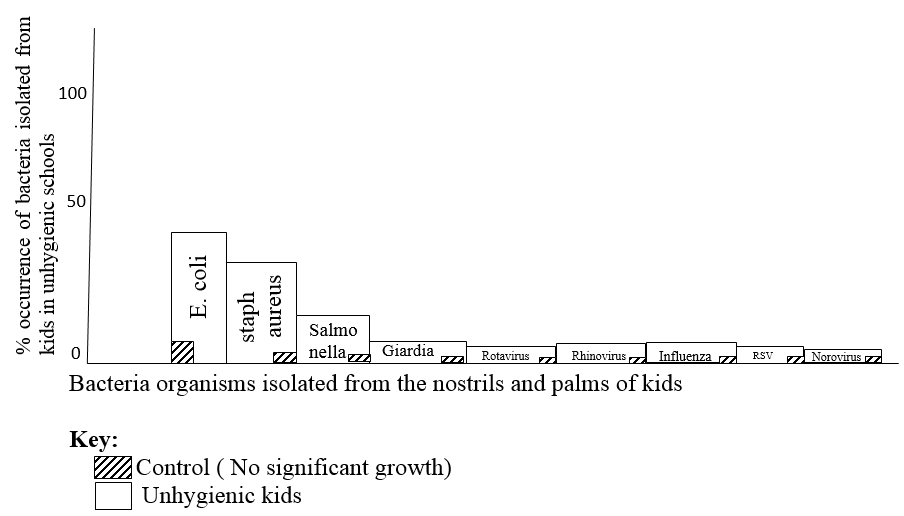
Figure 1: Histogram representing bacteria organisms isolated from kids in unhygienic kindergarten schools.
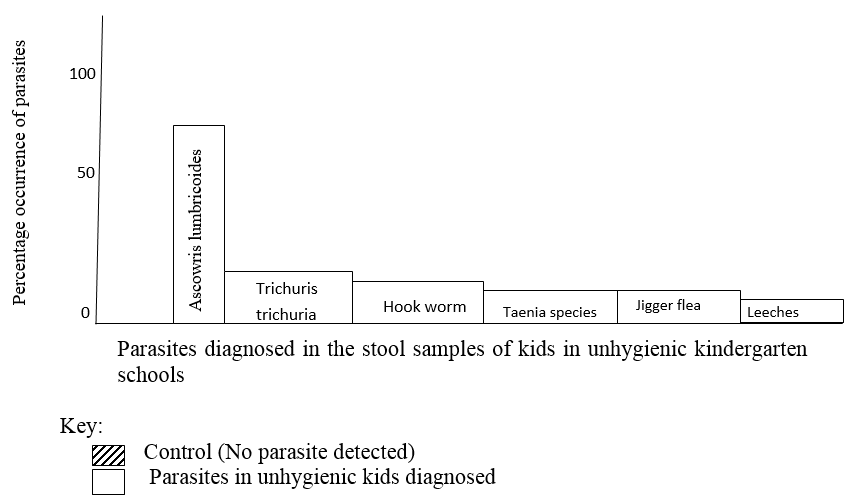
Figure 2: Histogram representing parasites diagnosed from the stool samples of kids in unhygienic kindergarten schools.
DISCUSSION
The awareness of bacteria and parasitic organisms in unhygienic kindergarten schools and its effect in the children’s learning ability in a serious concern in this research study.
According to the World Health Organization report, poor hand hygiene and environmental sanitation are major contributors to infectious diseases transmission in schools. Young children frequently carry micro-organisms on their hands which can be spread through contact with surfaces, toys, and other children.
The result of the study in figure 1 indicates of all the bacteria found in the kids in the kigndergarten schools in the villages viz Escherichia coli, staphylococcus aureus, salmonella species, Guardia lammblia, rhinovirus Influenza, rotavirus, RSV and norovirus, Escherichia coli occurred most.
The rate of occurrence of these bacteria in the kindergarten kids are Escherichia coli (40%), staphylococcus aureus (26%), salmonella species 10%, rhinovirus 5%, Guardiasis 5%, rotavirus 4%, norovirus 2%, RSV 3% and influenza (5%).
In figure 2, the parasites identified among the kindergarten kids are Ascaris (70%),
Trichuris trichuria (10%), Hookworm 7%, Taenia species 5%, Jigger flees 5% and leeches 3%.
Escherichia coli is a gram negative bacteria affecting the gut region of children and adult.
Some strains can cause diseases such as diarrhoea, abdominal pain and sometimes bloody stools (Natdno & Kape, 1998). Giardia infection (Giardiasis) causes abdominal cramps and bloating in toddlers (Ankarklev, 2010).
Some factors contribute to bacteria and parasite infection and subsequent transmission in the kindergarten schools. Such factors such as poor sanitation facilities viz no toilet facility at all resulting to rampant defecation of stool around the school, dirty toilets, lack of clean water, improper waste disposal, poor personal hygiene which includes failure to wash hands after using the toilet, dirty fingernails, sharing contaminated objects, Overcrowded classrooms which also involves close contact between the children; and using unclean drinking water can introduce parasites and bacteria into the children’s bodies.
The presence of these bacteria and parasites in the kids’ bodies can have impact in various ways in their learning abilities.
Absenteeism of the sick pupils from school due to infection can pull them backward from learning, hence poor performance during examination will result (Ismail, et al 2024). Other effects are fatigue, pain, or discomfort affecting focus, potential cognitive impairment such as stunted growth, malnutrition and anaemia.
The prevention strategies to curb multiplication and infection of kids in unhygienic schools are as follows, hygiene practices such as handwashing with soap & water, building of proper toilets & waste disposal and also clean water supply. Kids should be taught hygiene habits and there should also be Deworming programmes in the schools.
|
|
|
REFERENCES
Aguoru, C.E; Maaji, S.; and Olasan, J.O (2015) Bacteria contaminants on surfaces of some edible fruits sold in makurdi Metropolis, Benue State. Nigeria International Journal of current microbiology and Applied Sciences ISSB: 2319- 7706 Vol. 4 (6) P 334 – 340.
Ankarklev J. (2010). Clinical Microbiology Reviews 23 (1) Pg 35-54.
Asma’l, L, Ahmed A, Abdullahi K, Yusuf A.M, Yaradua Z.A, * Gidado S.M (2024). Prevalence and risk factors of intestinal parasitic infections among school children in Katsina Metropolis, Katsina state, Nigeria Sahel Jounal of life Sciences 2 (3) 62-68.
Centers for Disease Control and prevent (CDC), 2019. Parasites.
Cox F.E.G (2001). Parasitology 123 (suppl) S3-S14.
Crewe, W (1977) Examination of the faeces for Protozoa. A guide to Human Parasitology for medical practitioners. P 177. 10th Edition Printed in Great Britain for H.K Lewis & Co ltd B6 Gower Street London by Balding and Mansell London and Wisbech.
Ebede S.O, Emenuga V.N, Nwobodo H.A, Imanyikwa O.E.I Offor C.C, Usige E, Oguwike R.C, Oguwike F.N, Okeke J.C (2021). Evaluation of bacterial contaminants of over riped pear (Dacryodes Edulis) and their effect in the gastrointestinal system of children. Greener Journal fo Medical Sciences Vol. 12 (1) PP 1-5.
Larone D.H (2011). Medically important fungi. A guide to identification 5th ed.
Oguwike F.N, Emenuga V.N, Nwobodo H.A, Imanyikwa O.E.I, Onyinta O.I, Ubige E, Igwedibia C.P (2021). Effects of odours and decomposing materials in eth respiratory tracts of scavenging practitioners and waste management personnel in Enugu State. Greener Journal of Medical Sciences Vol. 11 (1) PP 8-12.
Baker F.J, Silverton R.E (1998). Microscopic examination of bacteria. Introduction to medical laboratory Technology 6th edition. Butter worth – Heinemahn publications. Linacare House, 225 wild Avenue, Woburn M.A 01801- 2041.
Nataro J.P & Kaper J.B (1998). Clinical microbiology reviews 11 (1): 12-201.
|
Cite this Article: Ekekwe, EN; Chukwueze, CM; Okwuonu, A; Nwuko, AC; Oguwike, FN (2026). Awareness of Bacterial and Parasitic Organisms among Unhygienic Kindergarten Schools and its Effect on the Children Learning in Uli Anambra State. Greener Journal of Epidemiology and Public Health, 14(1): 20-24, https://doi.org/10.15580/gjeph.2026.1.040226044. |