|
Greener
Journal of Languages and Literature Research
ISSN: 2384-6402
Vol. 7(1),
pp. 7-23, 2022
Copyright
©2022, the copyright of this article is retained by the author(s)
https://gjournals.org/GJLLR
|

|
Languages in Contact
are the same: a Case of Mupun and Miship Languages of Pankshin
Local Government Area of Plateau State
Poret Godwill
S.
Dept. of English Fed. Coll.
of Education, PMB 1027 Pankshin.
|
ARTICLE INFO
|
ABSTRACT
|
|
Article No.: 060722061
Type: Research
Full Text: PDF, HTML, PHP, EPUB
|
This research work investigated the similarity between two languages
in contact: Mupun and the Miship
languages of Pankshin Local Government Area of
Plateau State. The data for this study were collected through the aid of
oral interviews and recorded speeches of the informants. The results were
analyzed in accordance with the framework found suitable for this study,
which is the Variation Theory of Poplack
(1993).The major findings of the research work revealed that these two
languages, Mupun and Miship
have similar lexical items, tones and meanings, hence, the conclusion by the
researcher that they are the same language.
This research work will be of help to people that are interested in
the study of sociolinguistics, particularly language contact.
|
|
Accepted: 09/06/2022
Published: 05/07/2022
|
|
*Corresponding
Author
Poret Godwill
S.
E-mail: poret032002@ yahoo.com, andyporet0@ gmail.com
|
|
Keywords: Mupun,
Miship, Similarity, Language, Contact
|
|
|
|
ACKNOWLEDGMENT
I wish to your sincerely acknowledge Federal
College of Education, Pankshin, Plateau State,
Nigeria for the opportunity to serve and Tertiary Education Trust Fund (TETFund) for sponsorship of this Research.
INTRODUCTION
It is a common assumption
that in almost all parts of the world, hardly does a language find itself
spoken in a completely isolated environment with no contact at all between its
speakers and speakers of other languages. For various reasons, people from
different language backgrounds come in contact with each other and interact.
The motives, situations, conditions and effects are often investigated and
discussed in a given speech community (Nwaozuzu, Agbedo and Ugwuona, 2013,p.1).
Language
contact study goes back to the early 1950s.
It originated in the United States where Weinreich
(1953) and Labov (1966) works
revived what had been side-lined for a long time (Nwaozuzu,
Agbedo and Ugwuona, 2013,
p.1).
According
to Lehiste(1988,
p.1), language contact takes place between speakers of different languages and
for communication to take place; speakers must have a certain degree of
comprehension of the other language and must acquire a degree of facility in
producing inferences that will be comprehensible. With time, some speakers must
be able to alternate between languages in contact: that is, they have become
bilinguals or their languages becomes similar.
According
to Thomason (2001 p.1), language contact is the use of more than one language
in the same place at the same time. Language contact does not require fluent
bilingualism or multilingualism, but some communication between speakers of
different Languages is necessary. From this definition, one can rightly say
that there is no difference between the assertion of Lehiste
(1988) and Thomason (2001) since there is the possibility of having bilingual
and multilingual speakers where languages are in contact.
When speakers of different languages interact
closely, it is typical for their languages to influence each other. An example
is the contact between the Mupun and the Miship of Pankshin Local
Government Area.
Background to the Study
This study
is on the Mupun and the Miship
languages, both spoken in the southern part of Pankshin
Local Government Area of Plateau State. According to Danfulani
and Fwatshak (2012, p.11), “the Mupun
are found on the eastern edge of the Jos Plateau. The language is a member of
the Chadic family.”
The Chadic speaking neighbours of the Mupun, according to Dafulani and Fwatshak (2012, p.12) are the Ngas,
Mwaghavul, Miship, Chakfem, Fier, Tambes, and Gung. The 2006 National Population Census (NPC)
put the number of Mupun speakers at 27,865.
According to the National Population Commision (2006) census, the Miship
speakers have an estimated population of 28,858(NPC, 2006).
Geographical Location
of Pankshin Local Government Area
Pankshin Local
Government is one of the oldest local government areas in Plateau State. It has
passed through various stages of political change via military regimes or democratically
elected civilian administrations. The administrative evolution of Pankshin Local Government started in 1919, when it served
as a Divisional Headquarters for the British colonial administration. It
controlled an area that comprised the present Kanam, Mangu, Kanke, and Bokkos Local Government areas (
Shidams,2009, p.3).
In 1976
when the Federal Government set up local government areas, Pankshin
became one of the full-fledged pioneer local government areas in the country
with the headquarters at Pankshin town. The local
government area is home to the Ngas, Mupun, Miship, Pai, Tal, Fier, Tambes, and Kadung ethnic
nationalities, whose major occupation
is agriculture. Pankshin town is located about 120 kilometers from Jos, the Plateau State Capital. The local
government headquarters has a cool climate between Latitude 900 and
100 N and Longitude 1.434 square kilometers,
with an estimated population of 191,685 (NPC, 2006).
The local
government is bounded by these local government areas of Plateau State: Mangu Local Government Area to the West, Kanam Local Government to the North-east, Langtang North and south Local Governments to the
South-east and Mikang and Shendam
Local Governments to the South. The local government is also bounded by Bauchi State to the North.
Below is
the map of Plateau Showing Pankshin Local Government
Area.
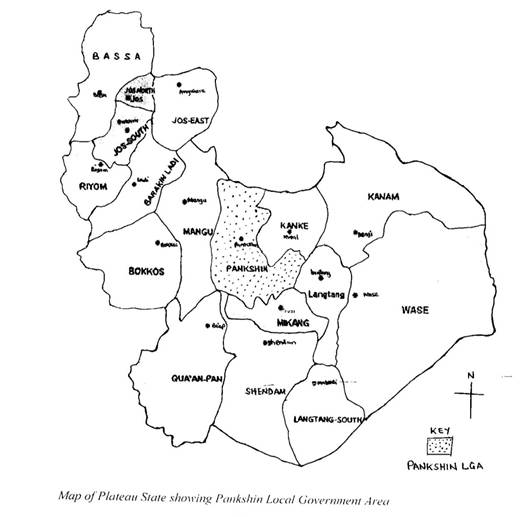
Fig. 1: Map of Plateau State showing Local Government
Areas.
Source: Plateau State
Ministry of Lands, 2003.
Historical Background
of the Mupun People
Mupun land or
chiefdom is located in Pankshin Local Government Area
of Plateau State of Nigeria in an area laying some 120 kilometres East of Jos.
The entire Mupun land or chiefdom is just one
district called Lankan district. The name ‘Lankan’ was given by the Ngas people, meaning groundnuts. This was because some Ngas people used to travel to Lankan to buy food stuff. The
land is relatively favourable for the production of maize, melons, cocoyam,
groundnut, sorghum, acha, millet, etc.(Danfulani & Fwatshak,2012,
p. 70)
The Mupun land has the following villages: Abwor/Dyis, Kagu, Sihin,
Ghitong, Nenlet, Jiblik, Jing, Lankan, Asaa, Akong, and Dung (Frajzungier,
1993, p. 1).
The Mupun people are bordered by Mwaghavul
people on the west and by Ngas on the east. It is
bordered by Chip, where the Miship language is
spoken, on the Southeast.
Danfulani
and Fwatshak (2012) report that the Mupun are found on the eastern edge of the Jos Plateau, in
central Nigeria. The people are called Mupun
and the language is also called Mupun. The term Mupun consists of two phrases; ‘Mu’ which means ‘we’, and
‘Pun’ which means “chased out from hiding” (Danfulani
& Fwatshak2012, p.71).
Origin
of the Mupun People
The Mupun people have two traditions of origin:
1,Borno,
and
2.Places within
the Jos Plateau. These places are Tambes, Dai, Zong, Muduut, Gung, and Ron
(Danfulani&Fwatshak,2012).The second tradition of origin from within the
Jos Plateau is further seen in the table of migration of the six major clans of
Mupun land – Tambes, Nendai, Jelbang, Mutkop, Diffir and Jepkul.
Below is the map of Pankshin Local Government showing Mupun
land.
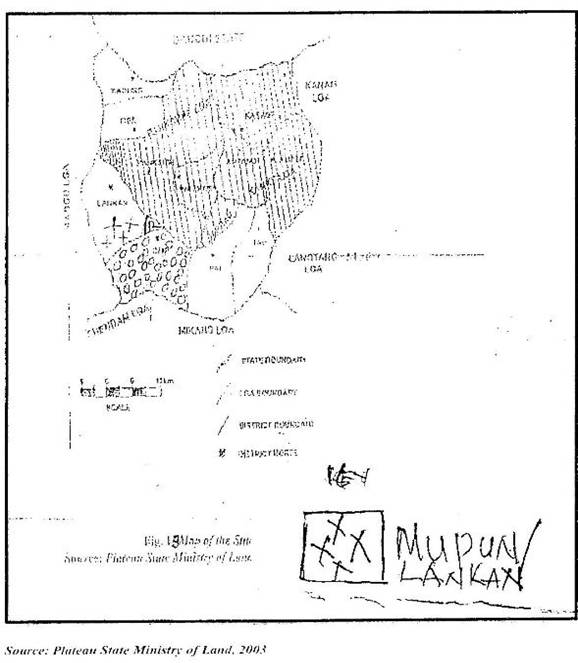
Fig 2 : Map of Pankshin Local Government Area showing Mupun
land
Source:
Plateau State Ministry of Lands, 2003.
Historical Background of the Miship People
Miship land or
Chiefdom is located in Plateau State, in the southern part of Pankshin Local Government Area. The land is some 120 miles
south-east of Jos. The word ‘Miship’ refers to both
the kingdom as well as to the language Mu’azu & Katwal(2010,
p.5). Miship land is in the communities of Jibam, Kapil, Mugulum,
Dyerok, Minzam, Kwala, and Jepmidyel, in Chip
district of Pankshin Local Government. The land is
bordered in the north-west by Lankan, in the north-east and south by Pai, south by Shendam and Mikang Local Government Areas and in the north by Ngas.
The land
is favourable for the cultivation of yam, beans, rice, guinea-corn and cowpea.
Other activities like blacksmithery, weaving, hunting
can be regarded as the secondary occupation of the people (Mu’azu
& Katwal, 2010, p.7).
Below is
the map of Pankshin showing Miship
land:
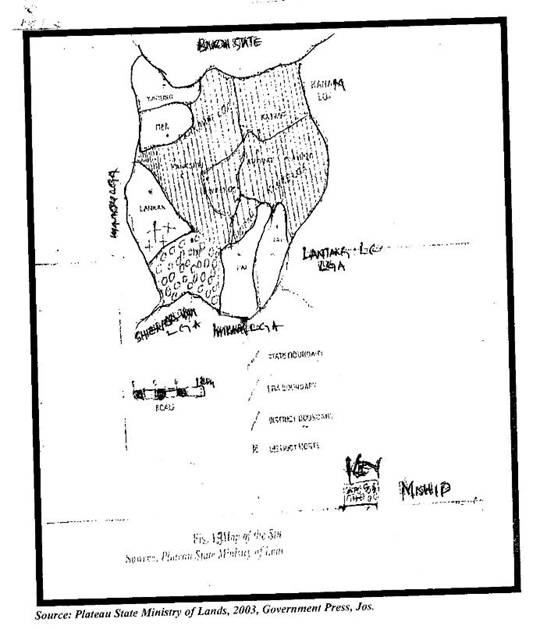
Fig.3 : Map of Pankshin
Local Government Area showing Miship
Origin
of the Miship People
According to Gofwen
(2007), the Miship man is also called Chip man and the Chip land was founded by an Angas man called Dawar and his
family. Dawar was from the ruling house of Garram in Ngas land. Dawar had three sons namely: Dazan,
Talam and Samlam.
On the
death of Dawar, Dazan, who
was the eldest son went to Shendam
to inform his uncle Lekni. But on his return to Chip,
his younger brother, Talam had already been installed
as chief and Samlam, the youngest son was appointed kbo, which means second in command to the
chief.
On the
death of Talam, his brother Samlam
became chief of Chip, and his son Ram became the kbo. Gofwen (2007) further said that the
Chip people speak a dialect of Angas language but
have given up the use of the Angas tribal mark. However,
elimination of tribal marks does not linguistically distinguish two different
languages rather mutual intelligibility of the linguistic groups.
There are
many oral traditions about the early migration of the Miship
people. The first tradition has it that they migrated from the Chad-Basin
between 1110 – 1150AD, along with other ethnic groups like Ngas,
Mupun, Tal, Tarok, Goemai and Suraas Mwaghavul, to KanemBorno before finally settling in their present place
of abode (Mu’azu&Katwal2010). Muazu and Katwal (2010) further say that an oral tradition has it
that the Miship people migrated from Kanem Borno, between the 15th
–18th Century and that the Miship people
are into two clans, Longmaar and Jibaam.
According to Mu’azu and Katwal
(2010), is that ‘Longmaar’ clan migrated from their
present place of abode, the Miship land. While ‘Jibaam’ believed they migrated from the Chad-Basin between
the 15thand 16th centuries. The second oral tradition
according to Mu’azu and Katwal
(2010) is that both Jibaam and Longmaar
migrated from Mwaghavul land, while Longmaar are from Jipari (Asaa) village, in Mupun land.Below is the Map of Pankshin
Local Government showing Mupun and Miship lands.
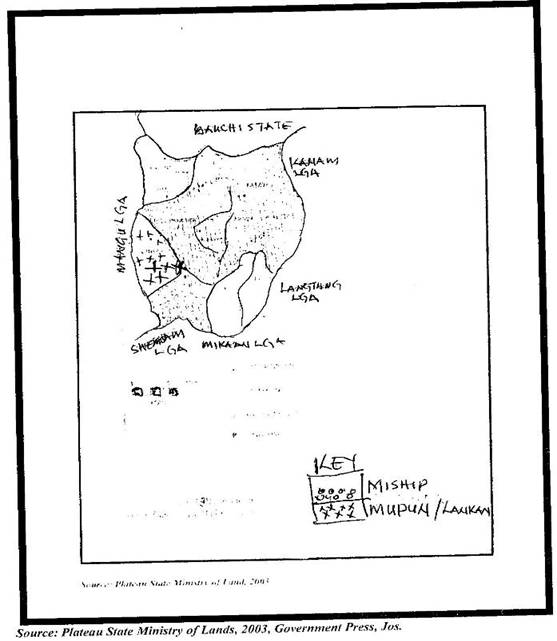
Fig
4: Map of Pankshin Local Government showing Mupun
and Miship lands
Sociolinguistic
Situation of Pankshin Local Government Area
The
following languages are domicile in Pankshin Local
Government Area Fyer, Mupun,
Miship, Tambes, Pai, Tal, Ngas, and Kadung, according to Shidams
(2009, p.4). Pai
and Kadung are seen as dialects of Ngas, all under the Ngas group.
His reason is the high level of mutual intelligibility of these languages. The
lumping of Kadung and Ngas
as one language because of their level of intelligibility is not correct. This
is because the level of intelligibility between these two languages is very
low. For instance:
Kadung Ngas English
Gloss
vi neen “God”
taari ji “come”
zanga mun “food”
Classification of the Mupun
and the Miship Languages
Mupun and Miship are members of the Chadic family in the Afroasiatic phylum, which includes languages that are
spoken in Africa and Asia. Newman (1977) regards the Chadic language family as
a constituent member of the Afroasiatic phylum.
According
to Heine and Nurse(2000, p.80), the Chadic phylum has an estimated number of
140 languages spread out in three directions from the Lake Chad on which the
family name is based and spoken in parts of Nigeria, Chad, Cameroon, Central
African Republic and Niger. The widely spoken and the best-known Chadic
language is Hausa. The Chadic sub-group is divided into four thus: West Chadic,
Central Chadic (Bui Mandara), East Chadic and Masa(Heine
& Nurse 2000).The Mupun and the Miship languages belong to the West Chadic family, which is
further divided into ‘A’ and ‘B’. Both Mupun and Miship still fall under group ‘A’ of the West Chadic,
alongside Ngas, Mwaghavul,
Bole etc. (Heine & Nurse, 2000).Greenberg (1963, p. 46), classified Chadic
languages as shown in Figure 1 below:
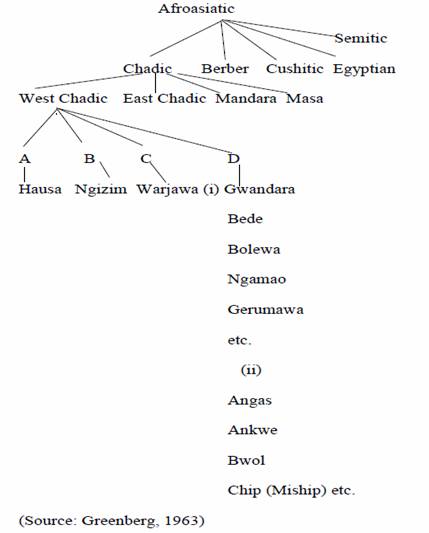
Fig. 5:
Greenberg’s classification of Afroasiatic languages
Newman
(1977), like Greenberg (1968), classified Chadic languages into four groups, a
classification which have not been disputed since it was classified. The
classification is seen below:
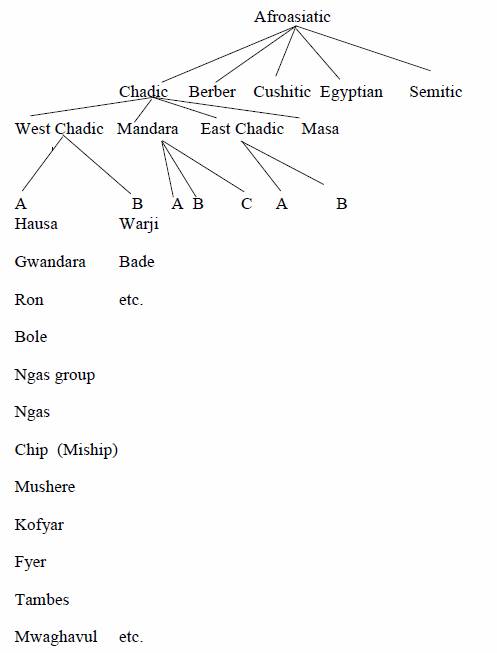
Fig. 6: Newman’s
(1977) classification of Afroasiatic languages
Blench (2012) did not have a separate entry for the Mupun in his classification of Chadic languages:
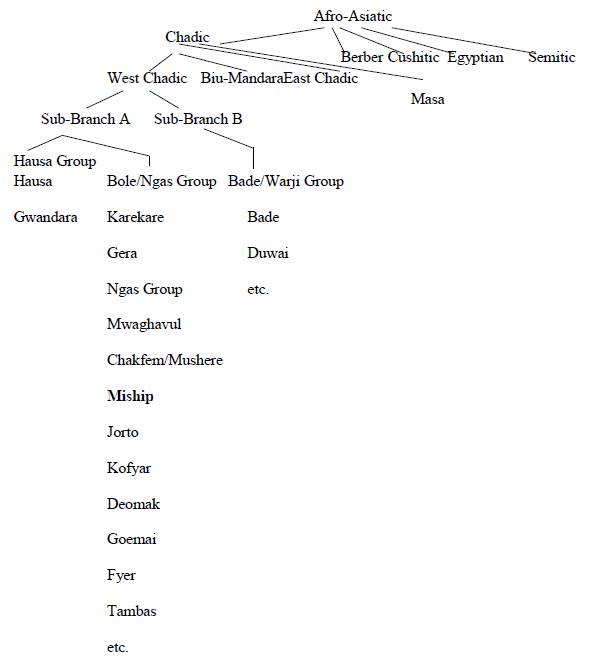
Fig. 7: Blench’s(2012) classification of Afroasiatic
languages
Pawlak (1994, p.30) has an
entry for Mupun in her West Chadic group as seen
below:
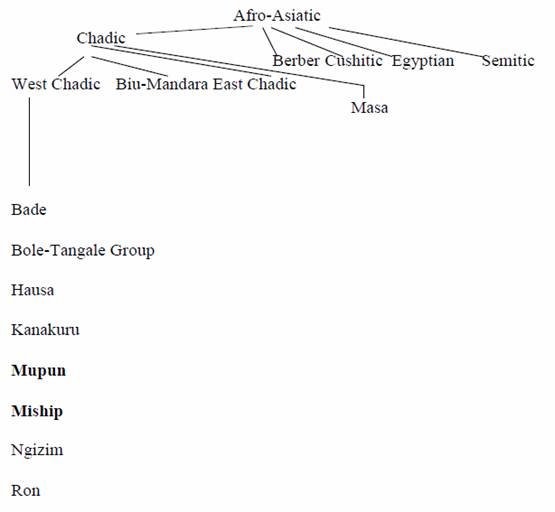
Fig. 8: Pawlak’s (1994) classification of Afroasiatic
languages
Aim
The aim of
this work to show that Mupun and Miship
languages are the same.
Hypothesis
i.
Mupun and Miship languages are similar.
ii.
Mupun and Miship languages are not similar.
Vowels
and Consonants of Mupun and Miship
Languages
Based on Jonglap (1985) and Frajzyngier
(1991), the inventory of the phonemes of the Mupun
language is as follows:
Short
Vowels Long
Vowels
Front
Central Back Front
Central Back
High
i ә u High ii әә uu
Mid e o Mid ee oo
Low a Low aa
Consonants
Labial Alveolar Palatal Velar Glotal
Stops p t k
b d g
Fricatives f s h
v z
Affricates c
j
Nasals m n ŋ
Liquids r
l
Implosives ƃ ɗ
Glides w y
Table 1: Mupun
Vowel/ Consonant Charts.
Miship Consonants
Mu’azu and Katwal (2010, p.12)studied the
phonology of the Miship language and stated that Miship language has 40 consonants and 6 vowel sounds, as seen
below in the various charts:
|
|
|
|
Labial
|
Alveolar
|
Alveolar palatal
|
Lateral
|
Velar
|
Labialized velar
|
Palatal
|
Labialized labial
|
laryngeal
|
|
Obst
|
Plo
|
Vl
|
P
|
T
|
|
|
K
|
kw
|
ky
|
pw
|
|
|
|
|
Vd
|
B
|
D
|
|
|
G
|
gw
|
gy
|
bw
|
|
|
|
|
Imp
|
Ƃ
|
ɗ
|
|
|
|
|
|
Ƃw
|
|
|
|
Afr
|
Vl
|
|
|
|
|
|
|
|
|
|
|
|
|
Vd
|
|
|
J
|
|
|
|
|
Jw
|
|
|
|
Fri
|
Vl
|
F
|
S
|
sh
|
|
|
|
|
fw
|
|
|
|
|
Vd
|
V
|
Z
|
|
|
|
|
|
Vw
|
gh
|
|
Son
|
Nas
|
Nas
|
M
|
N
|
|
|
Ng
|
|
ny
|
Mw
|
|
|
|
|
Stop
|
Mp
|
Nt
|
|
|
|
|
|
|
|
|
|
|
|
Mb
|
Nd
|
|
|
|
|
|
|
|
|
|
|
Afri
|
|
Nj
|
|
|
|
|
|
|
|
|
|
|
Fri
|
|
|
|
|
|
|
|
|
|
|
|
|
Liq
|
|
R
|
|
L
|
|
|
|
|
|
|
|
Son
|
Glid
|
|
|
y
|
|
W
|
|
|
|
|
Table 2: Miship
Consonant Chart
Front Central Back
High i u
Mid e o
ә
low a
Table: 3 Miship
Vowel chart
Theory
The theory used for
this work is the variation theory. The reason why the theory is adopted for the
study is because of the frequency of occurrence of similar words and tones. The
theory also seeks to discover the frequency of occurrence of similar structure
in the languages of study (Poplack, 1993, p.252). The
recorded speech demonstrated this. For example:
Terms for Human Family
Mupun Miship Transcription English Gloss
màt mát [mat]
“woman”
làa làa [la:]
“child”
màtlú màtlú [matlu] “wife”
gùlú gùlú [gulu] “husband”
nàa nàa [na:] “mother”
pūun pūun [pu:n] “father”
Nouns
Mupun Miship Transcription English
Gloss
kút kút [kut] “wind”
àm àm [am]
“water”
fúwán fúwán [fuwan] “rain”
Verbs
Mupun Miship
Transcription English Gloss
Shūwāa shūwāa
[ʃūā:]
“to drink”
āt āt [āt] “to bite”
fūut fūut [fū:t] “to vomit”
noōk noōk [nō:k] “to breath”
shūwar
shūwar [ʃūar] “to laugh”
mān mān [mān] “to know”
sāam sāam [sā:m] “to sleep”
mùut mùut [mù:t] “to die”
gàp gàp [gàp] “to cut”
būwān būwān [būān] “to dig
Body Parts
Mupun
Miship English Gloss
i.
Káa Káa “head”
ii.
Yiit Yiit “eye”
iii.
Pὸo Pὸo “mouth”
iv. Shíi Shíi
“leg”
v. Kōom Kōom “ear”
From the data above,
the similarity in sound and meaning of the above lexical items show that these
two languages are similar.
Speech Data
The raw data on which
this segment of the study is based consist of tape recorded conversation. The
tape recordings were typically searched exhaustively for features that are
similar and all instances of the feature were extracted. This procedure was
then repeated for each subsequent feature under study.
For
example:
a. Miship Rendition
i.
“wét Shàgháp à?” “
good afternoon”
ii.
“Téer Shàgháp à? “good
morning”
b. Mupun Rendition
i.
“Wét Koom ah?” “good
afternoon”
ii.
“Téer Koom
ah?” “good morning”
The words “wét” and “téer”, which mean
afternoon and morning, respectively, were used by both Mupun
and Miship.
Other lexical items
the researcher observed from the recordings are:
a.
Lexical
items for body parts:
Mupun Miship English Gloss
káa káa “head”
pәkēēn pәkēēn “forehead”
kōm kōm “ear”
yīt yīt “eye”
pὸo pὸo “Mouth”
tόok tόok “neck”
shii shii “leg”
sáar sáar “hand”
buut buut “belly”
wūur wūur “breast”
b. Lexical
Items for Crop/Plants
Mupun Miship English Gloss
shīt shīt “grass”
kàs kàs “millet”
páat páat “olive”
shūwáá shūwáá “maize”
kόm kόm “groundnut”
c. Numerals
Mupun Miship English
Gloss
mәndὸng mәndὸng “one”
vәl vәl “two”
kún kùn “three”
féer féer “four”
pàat pàat “five”
Mupun and Miship have been in contact due to geographic boundary
between them. From the data gathered from the speech data above, it showed that
there may be borrowing between the two linguistic groups at the border are
mutual since we cannot say which language has borrowed more from the other. For
instance in the greetings below:
Miship Rendition
a.
“wét shàgháp à?” “good
afternoon”
b.
“téer shàgháp à?” “good
morning”
Mupun Rendition
c.
“Wét Koom a?” “good afternoon”
d.
“téer koom
a?” “good morning”
The words “Wét” and “téer”, which mean
afternoon and morning, respectively, were used by both Mupun
and Miship.
The
recording was repeated so that the researcher could capture similarity in other
structures, and the following was dictated:
a. Miship
Luwáa nӛ kӛ lāt literally: Meat the
is finished “the meat is finished”
b. Mupun
Luwáa nӛ kӛ kīyēs literally: Meat the is finished “the
meat is finished”
From the data above,
“Luwáanӛkӛ” is used by both Mupun and Miship but “lāt” (finish) is a Miship
word, while “kīyēs” is a Mupun word, as the researcher was told. These forms were
spoken: “Luwáa nӛ kӛ lāt” and “Luwáa nӛ kӛ kīyēs” to say
“the meat is finished”, which is a switch between Mupun
and Miship languages.
To show
that Mupun and Miship
languages are the same, resemblance in tone and word was observed from the
recorded speech:
a. Lexical Items for Common Artifacts (Nouns)
Mupun
Miship English
Gloss
pās pās “arrow”
kòp kòp “spear”
dāa dāa “calabash”
túul túul “pot”
pét pét “broom”
b. Lexical Items for Animal (Nouns):
Mupun Miship English
Gloss
káap káap “baboon”
ās ās “dog”
káar káar “monkey”
yѐr yѐr “bird”
nwòo nwòo “snake”
c. Lexical
Items for Human Family (Nouns):
Mupun
Miship English Gloss
màt mát “woman”
làa làa “child”
màtlú màtlú “wife”
gùlú gùlú “husband
nàa nàa “mother”
pūun pūun “father”
d. Lxical Items for Nouns
Mupun
Miship English Gloss
kút kút “wind”
àm àm “water”
fúwán fúwán “rain”
e.
Lexical
Items for Verbs
Mupun Miship English
Gloss
náa náa “to
see”
āt āt “to
bite”
fūut fūut “to
vomit”
noōk noōk “to
breath”
shūwar shūwar “to laugh”
mān mān “to
know”
sāam sāam “to
sleep”
mùut mùut “to
die”
gàp gàp “to
cut”
būwān būwān “to dig”
The above
are instances of convergence as observed in data a, b, c, d, and e. The sounds of the lexical items of Mupun language converges (resembles) towards that of Miship language and vice versa.
Similarly,
the recorded speech was observed to confirm instances of similarity and the
following was observed:
a. Common
Artifacts:
Mupun
Miship English Gloss
cáan
cáan
“hoe”
chùuk shùuk “knife”
b.
Lexical Items for Nouns
Mupun
Miship English
Gloss.
pūus ápūus “sun”
sé sí “food”
chùk shùk “knife”
cáan
shaán “hoe”
màt mát “woman
c.
Lexical Items for Verbs
Mupun
Miship English Gloss
chѐet shѐet “to
cook”
sē sō “to
eat”
shūwāa shuu “to drink”
sē sō “to
eat” - Lexical Variation
d.
Personal Pronouns
àn án “I”
wun gu
“plural” “you”
wù gә “he”
wà yi “she”
nə ni “it”
mo mo “they”
mun mun “we”
mo mo “them”
e.
Adjectives
tip tip “black”
piya piya “white”
ɗes yon “big”
kat laani “small”
zuum zughum “cold”
milep milep “green”
milep milep “yellow”
f. Adverbs
Lala
lala “quickly”
lele lele “slowly”
retret retret “fairly”
biyalbiyal biyalbiyal “harshly”
bishbish bishbish “badly”
g. Prepositions
ka ka “on”
dəən dighin “in”
yil yil “down”
shi shi “at”
From the speech of
the individuals above, the researcher observed some negligible variations in
tones and words between Mupun and Miship,
which does not make the two languages dissimilar.
CONCLUSION
In conclusion, the
study revealed that there is language contact between the Mupun
and the Miship of Pankshin
Local Government Area of Plateau State.
It was also seen from the people’s speeches that the lexical items and
meaning of the items are similar. It is on this note that the researcher wish
to conclude linguistically that these two languages of Mupun
and Miship are the same and the speakers should see
themselves as such and they should unite for better progress even in politics.
REFERENCES
Appel, R. & Musykyen, P.(2005). Language contact and bilingualism.
Amsterdam: Amsterdam University Press.
Blench, R. (2012).An
atlas of Nigerian Languages. Cambridge: United Kingdom.
Danfulani, U.H.D. &Fwatshak, S. (2012). Celebrating Njinkook: Studies in the history
and culture of the Mupun of the Jos Plateau in
Nigeria. Kaduna: Lynx communication.
Frajyzyngier, Z.A. (1991). A dictionary of Mupun. Berlin: DietrichReimer.
Frajyzyngier, Z. A. (1993).Grammar
of Mupun. Berlin:
Dietrich Reimer.
Gofwen, R. (2007). The history and
socio-political organization of Ngas - An anecdotal compendium
of anthropological notes. Ikeja: St.
Stephen Book House Inc.
Greenberg, J.H. (1963). Languages of Africa. Bloomington: Indiana University.
Heine, B. & Nurse, D. (2000). African languages: An
introduction. Cambridge: Cambridge University Press.
Jonglap, P. (1985). Mupun phonology: Description and analysis(Unpublished)
B.A. Project, Department of Languages
and Linguistics, University of Jos.
Leshiste, I. (1988).Lectures
on language contact. Cambridge: The MIT Press.
Mu’azu, M.A. &Katwal, P. I. (2010).A
grammar of Miship.Munchen:
Lincom Academic Publisher.
National Population Commission (2006). National census
figures. Abuja:National
Population Commission.
Newman, P. (1977). Chadic
classification and reconstruction: Afroasiatic
linguistics. California: University of California Press.
Nwaozuzu, G.I, Agbedo, C.U &Ugwuona, C.N. (2013).Sociolinguistic study of language contact in Ubolo
speech community, Enugu State-Nigeria. Nsukka:
University of Nigeria Press Ltd.
Pawlak, N. (1994). Syntactic markers in Chadic: A study on
development of grammatical morphemes. Warsaw: InstytutOrientalistycznyUniwersytetu.
Plateau State Ministry of Land (2003). The map of Pankshin Local Government Area. Jos: Government
Press.
Poplack, S. (1993). Variation theory and language contact. Amsterdam: John Benjamins.
Thomason, S.G. (2001). Language contact. Edinburgh:
Edinburgh University Press Ltd.
Shidams, Y.D. (2009).The martyr of positive democratic change.
Jos: Mojem Printing Press.
Weinreich, U. (1953).Languages in contact: findings and problems.
Hague: Mouton.
|
Cite this Article: Poret, GS (2022). Languages in Contact are
the same: a Case of Mupun and Miship
Languages of Pankshin Local Government Area of
Plateau State. Greener Journal of Language and
Literature Research, 7(1): 7-23.
|