By Poret, GS; Punshak, NL (2023).
|
Greener
Journal of Languages and Literature Research
ISSN:
2384-6402
Vol. 8(1),
pp. 1-11, 2023
Copyright
©2023, the copyright of this article is retained by the author(s)
https://gjournals.org/GJLLR
|

|
Phonetics
and Phonology of Mwaghavul Language: A Brief Survey
Poret, Godwill S.; Punshak,
Noah L.
Department Of
English, Federal College of Education, Pankshin
Plateau State, Nigeria.
|
ARTICLE’S
INFO
|
|
Article No.: 012323011
Type: Research
Full Text: PDF, HTML, PHP, EPUB
|
Accepted:
26/01/2023
Published: 31/01/2023
|
*Corresponding Author
Poret, Godwill S.
E-mail: poret032002@ yahoo.com, andyporet0@ gmail.com
Phone: 07032467479, 08100341444
|
Keywords: Phonetics, Phonology, Mwaghavul
Language
|
|
ABSTRACT
|
|
This discussion
began by looking at the Mwaghavul people, their
linguistic classification according to Blench, (2012) and revisiting the
general orthography of Mwaghavul and its
implication on the phonemic system of the language. I then finally,
proceeded to describe the phonetic characterization of the sound-system of Mwaghavul.
|
|
|
|
|
|
INTRODUCTION
This work an
overview of the phonetics and phonology of Mwaghavul.
Mwaghavul is a member of the Chadic family in
the Afroasiatic phylum, which includes languages that
are spoken in Africa and Asia. Newman (1977) regards the Chadic language family
as a constituent member of the Afroasiatic phylum.
According to Heine and Nurse(2000,
p.80), the Chadic phylum has an estimated number of 140 languages spread out in
three directions from the LakeChad on which the
family name is based and spoken in parts of Nigeria, Chad, Cameroon, Central
African Republic and Niger. The widely spoken and the best known Chadic
language is Hausa.
“No complete phonology or orthography
of Mwaghavul has ever been published, although the
sketch accompanying Jungraithmayr (1963) provides a basic
overview of the sound-system” (Dapiya, et al, 2010).
Here, the phonetics and phonology of Mwaghavul language shall discussed with examples with
reference to the earlier work on Mwaghavul phonology
started by Dapiya et al, (2013), published by the Mwaghavul Bible Translation Committee (MBTC). The phonetic
characterization methodology adopted resembles to that of Mphande
(1989) for ChiTumbuka.
The Mwaghavul
People
The Mwaghavul
people were once among the inhabitants of the Lake Chad area before they migrated
southwards together with their kin, the Ngas, Tal, Mupun, Goemai and other Chadic
speakers presently inhabiting the Jos Plateau. These migrations from Borno probably occurred from between 1100 and 1350 AD. The
reasons for the migrations included the desiccation of the Lake Chad area and
socio-political instability occasioned by the wars of expansion of the second Kanem-Bornu Empire. As the Mwaghavul
and other Chadic groups reached the Bauchi plains,
they parted ways, with each group climbing the Plateau in a different direction
and at a different period.
The Mwaghavul
people mounted the Jos Plateau from the East through Ngas
land perhaps arrived on the Plateau earlier than the other groups because they
had horses. They then settled at Ngung, which lies
between Ngas and Mupun
territories. At Ngung, they constituted themselves
into two families: the Diko,
who was the senior, and the Difiri, who was
junior. From Ngung, the dispersal of the Mwaghavul on the Plateau occurred with its people migrating
and settling temporarily in places like Muduut (Shendam), Kofyar, Difiri, Fwam and Mwanwo (Dikibin), before further
dispersing to establish the present village settlements. By 1700, most of the
village settlements had established substantial forms of socio-economic and
political structures, centred on the Mishkagham
institution (Lohor, 2013).
Presently, the Mwaghavul
people are found in Mangu Local Government Area of
Plateau State. Mwaghavul land comprises the following
initial Districts: Jipal, Chakfem,
Mangun, Ampang West, Kerang, Pushit, Panyam, Kombun and Mangu. Large populations of the Mwaghavul
people are also found among the Goemai and Kofyar people in the Plateau lowlands as well as in Lafia, Gwantu, Saminaka, Pambegwa and Zaria,
where they have established a number of farm settlements in these areas.
Classification of the Mwaghavul Language
As mentioned earlier, Mwaghavul is a member of the Chadic family in the Afroasiatic phylum, which includes languages that are spoken
in Africa and Asia. Newman (1977) regards the Chadic language family as a
constituent member of the Afroasiatic phylum.
According to Heine and Nurse(2000, p.80), the Chadic phylum has an estimated
number of 140 languages spread out in three directions from the Lake Chad on
which the family name is based and spoken in parts of Nigeria, Chad, Cameroon,
Central African Republic and Niger. The widely spoken and the best known Chadic
language is Hausa. The Chadic sub-group is divided into four thus: West Chadic,
Central Chadic (Bui Mandara), East Chadic and Masa (Heine & Nurse 2000).The Mwaghavul
language belongs to the West Chadic family, which is further divided into ‘A’
and ‘B’. Mwaghavul still falls under group ‘A’ of the
West Chadic, alongside Ngas, Mupun,
Miship, Bole etc. (Heine & Nurse, 2000).
According to Blench (2012), Mwaghavul belongs to the West Chadic sub-branch under the
Bole-Ngas sub-group of the Ngas
group proper. An alternative spelling for the language is Mwahavul while the Hausa settlers
gave the name Sura
to the Mwaghavul people. The chart below shows the
distribution of West Chadic languages under the Afroasiatic
phylum, indicating the Mwaghavul language.
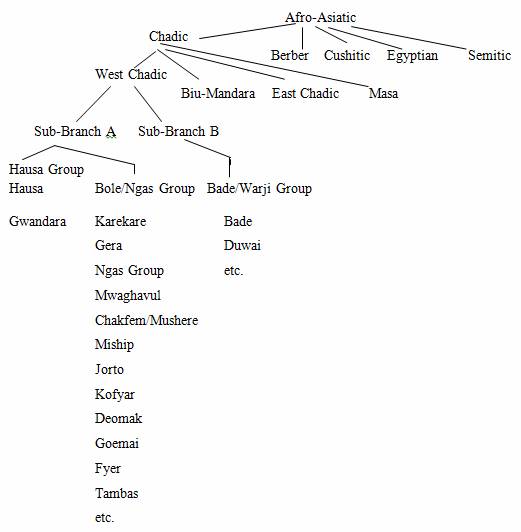
Fig.
1: Blench’s
(2012) classification of Afroasiatic languages
Blench states further that Mupun, often considered a distinct language, is very close
to Mwaghavul and the division may be more ethnic than
linguistic. The closest relatives of Mwaghavul are Jipal-Cakfem, Mushere and Miship while the language falls within the same group as Ngas and Goemai. The Mwaghavul are known as ‘Sura’ in
much of the older literature. Mwaghavul is bordered
by Plateau (i.e. Benue-Congo) languages to the north and west, notably Berom and Izere.
Mwaghavul (under the name Sura) was first described in
modern linguistic terms by Junggraithmayr
(1963/4). Frayzyngier
(1991, 1993 cited in Blench (2011)) has published a dictionary and grammar of
the neighbouring Mupun
language. Scripture portions were first published in the 1920s and there is an
active literacy programme championed majorly by the Mwaghavul Bible Translation Committee who has authored the Mwaghavul Orthography. Roger Blench has also written
seminal papers on the language and co-authored (alongside Dapiya,
N.F. and Bess, J) the soon to be released Mwaghavul Dictionary.
Mwaghavul
Orthography
The orthography used in this study is
the Current Official Orthography adopted for translation purposes by the Mwaghavul Bible Translation Committee. This is both graphemic and phonemic and I will deviate from it only when
its symbols – monographemic or digraphemic
– are at variance (phonemically) from those of the IPA Chart (2005).
Consonants Orthography
Note that the orthography used for
consonants in this study is that of the IPA Chart 2005.
The
following consonants in Mwaghavul need special
symbols:
/ɓ/ - a voiced bilabial plosive
/ɗ/ - a voiced alveolar plosive
/ɣ/ - a voiced velar fricative
/ɲ/ - a voiced palatal nasal
/ŋ/ - a voiced velar nasal
Though Mwaghavul
has no phonemic consonant clusters, the Mwaghavul
Bible Translation Committee (MBTC) (2013) observes that when [ng] sound occurs in word-initial position, it forms the
only noticeable consonant cluster as shown in the examples below:
(1) ngarvip /ngàrvip/ ‘book’
ngul /ngúl/ ‘maybe’
ngaa /nga:/ ‘adultery’
Dapiya et al (2010), posits that Mwaghavul has palatalized and labialized consonants in
contrast with their normal forms, while adding that the language admits
homorganic nasals
for some consonants. Mwaghavul also permits
word-final approximants in a few words such as:
(2) tidiw /tidyu/ ‘hunting expedition of Kombun
Community in Mangu Local
Government
Area.
liliw /lilyu/ ‘lightning’
Mwaghavul Orthography (2013) realized the velar
fricative /ɣ/ as [gh]
wherever it occurs in writing. Similarly, the following consonants will be
represented by their respective graphemes as shown in the table below:
Table 1: Mwaghavul Special Consonants Orthography:
|
IPA
Phoneme
|
Mwaghavul Orthography
|
|
/ʧ/
|
C
|
|
/ɣ/
|
Gh
|
|
/ʤ/
|
J
|
|
/ŋ/
|
***ng
|
|
/ʃ/
|
sh
|
|
/ʒ/
|
zh
|
Consonant Clusters
Orthography
The only consonant clusters in Mwaghavul result from the phonological processes of Pre-Nasalization,
Labialization and Palatalization. In this study, we shall represent pre-nasalition as [m] or [n];
labialization with [w] and palatalization as [y], as in
the following examples:
(3) mbìì /mbì:/ ‘a thing’
bwan /bwán/ ‘to beat thoroughly’
kyák /kyák/ ‘to pick or gather’
However, as observed by the Mwaghavul Bible Translation Committee (MBTC) (2013), when [ng] occurs word-initially, it is realized as a consonant
cluster, as in the following examples:
(4) ngarvip /ngàrvíp/ ‘a
book’
ngumaar
/ngùmá:r/ ‘a farmer’
ngul /ngúl/ ‘maybe’
Vowels Orthography
Both Dapiya,
et al (2003) and MBTC (2013) agree that there are six (6) vowels in Mwaghavul; that is, the cardinal vowels and a central vowel
/ɨ/. Phonetically, the mid-vowels are /ɛ/ and /ɔ/ which do not
in any way contrast /e/ and /o/, and are therefore, realized as [e] and [o] in
orthographic practice.
There are no nasalized vowels or
diphthongs in the language, while the long vowels are the product of
phonological rules in the language. We shall concern ourselves here with just
the long vowels and the high central vowel /ɨ/.
As observed in Dapiya
et al (2010), words with high central vowel /ɨ/ often have variants with
the back vowel /u/; for example:
(5) ngɨrɨs
~ ngúrús ‘cartilage’
/ngrís/ /ngúrús/
This
may be evidence that the /ɨ/ is gradually assimilating to a back vowel.
Vowel Length: We will represent length as sequences
of two identical short vowels. This decision is predicated upon the observed
tonal system of the language. More so that the language permits no more than
two successive vowels; vowel length in Mwaaghavul is
phonemic as shown in the contrasts below:
Table 2: Illustrating Mwaghavul Vowel Length
|
Short Vowels
|
Long Vowels
|
|
sám
|
‘sharpen’
|
sáám
|
‘to sleep/lie down’
|
|
kɨn
|
‘uncle’
|
kɨɨn
|
‘salt’
|
|
tɔk
|
‘to greet’
|
tɔɔk
|
‘neck’
|
Tonal Orthography
High tone in this study is indicated
by acute accent [´] over the vowel, and a low tone by a grave accent [`]. Mid
tone is left unmarked. The tone marking appears on the distinctive contrast,
rather than on absolute values of high or low.
In
this study, we shall adopt [H] for high tone, [L] for low tone and [M] for mid
tone while glide tones will be marked according to their respective tones
following the convention given above.
Sound Pattern of Mwaghavul
There are discrepancies in the number
of consonants in Mwaghavul as observed in the works
of Dapiya et al (2010) and Mwaghavul
Bible Translation Committee (2013) who gave the number of consonants as
twenty-seven (27) and twenty-five (25) respectively. Whereas, both inventories
agree on the twenty-five (25) consonants identified by the MBTC (2013), Dapiya et al (2010) added two more consonants to their
inventory thus: /Ɂ/ and /ɲ/. Furthermore, we observe that the palatal
appoximant /j/ wasn’t realized in either inventories even though the sound actually exists in the
language; rather, Dapiya et al (2010) realized the
sound as a palatal lateral approximant /ʎ/.
Following Dapiya
et al (2010), we shall adopt twenty-seven (27) as representing the consonants
phonetically in the language.
Table 3: Mwaghavul Consonants Chart
|
|
Bilabial
|
Labio-Dental
|
Alveolar
|
Post-Alveolar
|
Paalatal
|
Velar
|
Labio-Velar
|
Glottal
|
|
Plosive
Implosive
Nasal
Fricative
Affricate
Approximant
Trill
Lateral/Approx.
|
p b
ɓ
m
|
f v
|
t d
ɗ
r
l
|
n
s z
|
[ɲ]
ʃ ʒ
j
|
k g
ŋ
ɣ
ʧ ʤ
|
w
|
[Ɂ]
h
|
Each
individual consonant is further substantiated with various examples below that
illustrate its presence in three separate environments: word-initial, intervocalic and word-final.
Table 4: Environments of
Occurrence of Mwaghavul Consonants
|
Grapheme
|
Phoneme
|
Word-Initial
|
Word-Medial
|
Word-Final
|
|
[a]
|
/a/
|
àm /àm/ ‘water’
ár
/ár/ ‘road,
way’
|
kás
/kás/ ‘to abuse’
ran
/ran/ ‘to write’
|
lá
/lá/ ‘to take’
saa /sa:/ ‘to cut’
|
|
[b]
|
/b/
|
bóng /bɔŋ/
‘farmland’
|
ribet
/ribɛt/ ‘to wish, desire’
|
----
|
|
[ɓ]
|
/ɓ/
|
ɓook
/ɓɔ:k/ ‘mud’
|
tɨɓen
/tiɓɛn/ ‘wooden handle of a hoe’
|
----
|
|
[c]
|
/ʧ/
|
ceen
/ʧɛ:n/ ‘to drive, pursue’
|
kucet
/kùʧɛt/ ‘kitchen’
|
----
|
|
[d]
|
/d/
|
dang /daŋ/
‘tail’
|
tiding /tídìŋ/
‘deaf and dumb’
|
----
|
|
[ɗ]
|
/ɗ/
|
ɗel
/ɗɛl/ ‘to enter, pass’
|
ɗiiɗes
/ɗí:ɗɛs/ ‘big one’
|
----
|
|
[e]
|
/ɛ/
|
----
|
fet /fɛt/
‘to sweep’
|
se /sɛ/
‘to eat’
|
|
[f]
|
/f/
|
fee
/fɛ:/ ‘to clean, drag’
|
kufurum
/kufùrùm/ ‘knee’
|
----
|
|
[g]
|
/g/
|
guk
/gùk/ ‘to get worse’
|
kɨgong
/kɨgɔŋ/ ‘shoulder’
|
----
|
|
[gh]
|
/ɣ/
|
ghɨɨ
/ɣɨ:/ ‘goat’
|
koghorong
/kɔɣɔrɔŋ/ ‘hero’
|
----
|
|
[h]
|
/h/
|
hop /hɔp/
‘to borrow’
|
ɗiihai
/ɗí:hái/ ‘glory’
|
----
|
|
[i]
|
/i/
|
ii /ì:/ ‘yes’
|
pit /pìt/ ‘to
put out, to switch off’
|
ɗiici
/ɗí:ʧì/ ‘different’
|
|
[ɨ]
|
/ɨ/
|
ɨrap
/ɨrap/ ‘dust’
|
kɨn
/kɨn/ ‘maternal uncle’
|
ghɨɨ
/ɣɨ:/ ‘goat’
|
|
[j]
|
/ʤ/
|
jaal
/ʤa:l/ ‘to belch’
|
cijeng
/ʧíʤɛŋ/ ‘heel of the foot’
|
----
|
|
[k]
|
/k/
|
kaa /ká:/
‘head’
|
yaksi
/jàksi/ ‘now’
|
bak
/bak/ ‘to throw’
|
|
[l]
|
/l/
|
la /lá/ ‘to
take, have’
|
kɨling
/kɨliŋ/ ‘to hear, listen, heed’
|
gul
/gúl/ ‘maybe’
|
|
[m]
|
/m/
|
maa /mà:/ ‘to
be fed up, exhausted’
|
kimuur
/kɨmù:r/ ‘wooden ladle’
|
ɓam
/ɓam/ ‘to help’
|
|
[n]
|
/n/
|
na
/ná/ ‘to see, look’
|
randong
/randɔŋ/ ‘cow’
|
kyeen
/kyɛn/ ‘future, ahead’
|
|
[ng]
|
/ŋ/
|
ngàn
/ŋàn/ ‘snake’
|
ɗengnaan
/ɗɛŋna:n/ ‘heaven, the skies’
|
song /sɔŋ/
‘branches’
|
|
[o]
|
/ɔ/
|
or /ɔr/
‘shout’
|
pikom
/pɨkɔm/ ‘edge’
|
po
/pɔ/ ‘mouth’
|
|
[p]
|
/p/
|
paa /pá:/ ‘to
cover, close’
|
lupar
/lùpàr/ ‘nursing mother’
|
fulup
/fulup/ ‘to abuse, insult, rebuke’
|
|
[r]
|
/r/
|
raa /ra:/ ‘to
weave, knit’
|
karshak
/kárʃàk/ ‘admonishment’
|
maar /má:r/
‘farm’
|
|
[s]
|
/s/
|
saam
/sa:m/ ‘to sleep’
|
tisek
/tɨsɛk/ ‘chain’
|
pas /pas/ ‘arrow’
|
|
[sh]
|
/ʃ/
|
sham /ʃam/
‘to go down, get off’
|
sushii /sùʃí:/
‘to run’
|
mish /mìʃ/
‘husband’
|
|
[t]
|
/t/
|
taa /tá:/ ‘to
fall, drop’
|
lutuk
/lùtúk/ ‘market’
|
fwat
/fwat/ ‘ash’
|
|
[u]
|
/u/
|
ushira /úʃírá/
‘to lease part of one’s farmland to another person’
|
lung /lúŋ/
‘to swim’
|
muluu /mùlú:/
‘pumpkin’
|
|
[v]
|
/v/
|
vɨlak
/vɨlak/ ‘to work lazily’
|
laarvul
/la:rvul/ ‘twenty’
|
----
|
|
[w]
|
/w/
|
waa /wà:/ ‘to
go home’
|
tuwoor
/tuwɔ:r/ ‘to intimate’
|
----
|
|
[y]
|
/j/
|
yen /jɛn/
‘drug, medicine’
|
ziyaal
/zijá:l/ ‘woven cloth’
|
----
|
|
[z]
|
/z/
|
zok
/zɔk/ ‘to hide something’
|
zonzon
/zɔnzɔn/ ‘to walk aimlessly’
|
----
|
|
[zh]
|
/ʒ/
|
zhak
/ʒàk/ ‘contemptuous remark’
|
wuzhii /wúʒì:/
‘a shrub’
|
----
|
Consonant Clusters
Mwaghavul does not admit consonant clusters,
except for the [ng] sound in initial position. For
example;
(6) ngarvip /ngàrvìp/ ‘a book’
ngumaar /ngùmá:r/ ‘farmer’
ngul /ngúl/ ‘maybe’
ngaa /ngá:/ ‘adultery’
However,
the MBTC (2013) observes that in rare cases, [ng] in
initial position is realized as /ŋ/ as in the examples below:
(7) ngaa /ŋa:/ ‘everlasting’
ngaa-ngaa /ŋa:ŋa:/ ‘everlastingly’ (ideophone)
ngɨngaa
/ŋɨŋà:/ ‘a specie of birds’
Generally,
elsewhere in the language, some consonants can increase their phonetic
inventory through the process of palatalisation, labialisation or pre-nasalisation.
In this section, we shall examine and illustrate with examples, how these
phonemic contrasts affect the consonants in the language.
Palatalised
Consonants or Cy Clusters
Contrary
to the position of Dapiya et al (2010), Palatalisation is a common feature in Mwaghavul
and is used by the language to form phonemic contrasts as shown in the table
below:
Table 6: Mwaghavul Palatalised Consonants
|
[by]
Consonant Clusters
|
Transcription
|
Gloss
|
|
byagas
|
/byagas/
|
‘to
mangle, destroy’
|
|
byan
|
/byán/
|
‘to
beat thoroughly with bare hands’
|
|
[dy] Consonant Clusters
|
|
dyagap
|
/dyagap/
|
‘excessive
application of ointment’
|
|
ɗyágáp
|
/ɗyágáp/
|
‘to
blink’
|
|
[ty] Consonant Clusters
|
|
tyoop
|
/tyɔp/
|
‘to
mix up’
|
|
[fy] Consonant Clusters
|
|
fyaat
|
/fya:t/
|
‘to
rekindle light’
|
|
fyeel
|
/fyέ:l/
|
‘light,
not heavy’
|
|
[vy] Consonant Clusters
|
|
vyang
|
/vyaŋ/
|
‘onee-eyed person’
|
|
[ky] Consonant Clusters
|
|
kyak
|
/kyák/
|
‘to
pick’
|
|
kyeen
|
/kyέ:n/
|
‘’usefulness’
|
|
[gy] Consonant Clusters
|
|
gyar
|
/gyar/
|
‘very,
extremely’
|
|
gyet
|
/gyɛt/
|
‘last
year’
|
|
[my]Consonant
Clusters
|
|
myaal
|
/mya:l/
|
‘dry
tears’
|
|
myas
|
/myas/
|
‘to
drink plenty water’
|
|
[ny]
Consonant Clusters
|
|
nyagas
|
/nyagas/
|
‘to
refuse absloutely’
|
|
nyang
|
/nyaŋ/
|
‘to
disagree, object’
|
|
[ly] Consonant Clusters
|
|
lilyu
|
/lílyú/
|
‘rainbow’
|
|
Lyap
|
/lyap/
|
‘to
look, see’
|
|
[ry] Consonant Clusters
|
|
ryang
|
/ryáŋ/
|
‘welfare,
health and peace’
|
|
ryee
|
/ryέ:/
|
‘to
consider carefully’
|
Labialised
Consonants
Dapiya et al (2010) posits that labialized
consonants in Mwaghavul only occur before low central
and front vowels and never before /ɨ/, /i/, /o/ and /u/. However, older
orthographic practice tended to insert a medial /-u-/ between the initial
consonant and the semi-vowel /w/, thus luwaa ‘meat’
instead of lwaa
‘meat’.
Table 7: Mwaghavul Labialised Consonants
|
[bw]
Consonant Clusters
|
|
bwaan
|
/bwá:n/
|
‘to beat thoroughly with a stick’
|
|
bwen
|
/bwɛn/
|
‘to expose’
|
|
|
|
[ɓw]
Consonant Clusters
|
|
ɓwagal
|
/ɓwàgàl/
|
‘lukewarm (water)’
|
|
ɓweng
|
/ɓwɛŋ/
|
‘to support’
|
|
|
|
[dw]
Consonant Clusters
|
|
dwang
|
/dwáŋ/
|
‘self-centred
person’
|
|
dwat
|
/dwat/
|
‘dimunitive,
dwarf’
|
|
|
|
|
|
[ɗw]
Consonant Clusters
|
|
ɗwang
|
/ɗwáŋ/
|
‘to be sour’
|
|
ɗwat
|
/ɗwat/
|
‘narrow entrance or place’
|
|
|
|
[tw]
Consonant Clusters
|
|
twaar
|
/twà:r/
|
‘side buds’
|
|
twagam
|
/twagam/
|
‘to disappear’
|
|
|
|
[kw] Consonant Clusters
|
|
kwaar
|
/kwa:r/
|
‘to scrape, clean up’
|
|
kwee
|
/kwɛ:/
|
‘chicken’
|
|
|
|
[gw]
Consonant Clusters
|
|
gwat
|
/gwát/
|
‘winner, victor’
|
|
gwom
|
/gwɔm/
|
‘food, porridge’
|
|
|
|
[fw]
Consonant Clusters
|
|
fwaat
|
/fwa:t/
|
‘piece of cloth’
|
|
fwor
|
/fwɔr/
|
‘to follow after’
|
|
|
|
[vw]
Consonant Clusters
|
|
vwagap
|
/vwàgàp/
|
‘to mess things up’
|
|
vwen
|
/vwɛn/
|
‘to choke, strangle’
|
|
|
|
|
|
[sw]
Consonant Clusters
|
|
Swa
|
/swa/
|
‘to run’
|
|
swap
|
/swap/
|
‘to share, give freely’
|
|
|
|
[mw] Consonant Clusters
|
|
mwaan
|
/mwa:n/
|
‘to walk, travel’
|
|
mwol
|
/mwɔl/
|
‘half-brother, cousin’
|
|
|
|
[nw]
Consonant Clusters
|
|
nwagap
|
/nwagap/
|
‘to squeeze’
|
|
nwee
|
/nwɛ/
|
‘no’
|
|
|
|
[pw] Consonant Clusters
|
|
pwan
|
/pwan/
|
‘to eject’
|
|
pweer
|
/pwɛ:r/
|
‘to expose, to dry’
|
|
|
|
[lw]
Consonant Clusters
|
|
lwaa
|
/lwa:/
|
‘meat’
|
|
lwaghas
|
/lwaɣas/
|
‘to rub’
|
|
|
|
[rw]
Consonant Clusters
|
|
Rwa
|
/rwa/
|
‘to embed’
|
|
rwang
|
/rwàŋ/
|
‘a trouble-maker’
|
|
|
|
|
|
[cw]
Consonant Clusters
|
|
cwat
|
/ʧwat/
|
‘to hit’
|
|
cwel
|
/ʧwέl/
|
‘to miss a target narrowly’
|
|
|
|
[jw]
Consonant Clusters
|
|
jwaan
|
/ʤwa:n/
|
‘to tempt someone’
|
|
jweet
|
/ʤwɛ:t/
|
‘to catch someone red handed’
|
3.3.3 Prenasalised
Consonants
Prenasalisation occurs when a consonant sound is
briefly preceded by a corresponding nasal called a prenasal.
MBTC (2013) observes that in Mwaghavul, words
beginning with vowel sounds are often preceded by a glottal stop instead of prenasals. The Mwaghavul prenasals are homorganic and are identified are /m/ -
before bilabials, /ŋ/ - before velars, and /n/ - before all other sounds. Dapiya et al (2010) adds that initial nasals in Mwaghavul have a wide variety of meanings,
hence, it becomes necessary to distinguish specific usages.
Table 8: Mwaghavul Prenasalised Consonants
|
Prenasal
|
Prenasalised Consonants
|
Examples
|
|
[m]
|
/b/
|
mbii
/mbì:/ ‘thing’
|
|
|
/ɓ/
|
mɓam / mɓam/ ‘to help’
|
|
|
/m/
|
mmak
/mmak/ ‘able, ability’
|
|
|
/p/
|
mpet
/mpέt/ ‘broom’
|
|
/[n]
|
[c] /ʧ/
|
nciwe
/ʧíwɛ/ ‘wild beast’
|
|
|
/d/
|
nding
/ndiŋ/ ‘stone’
|
|
|
/ɗ/
|
nɗogom /nɗɔgɔm/
‘to bow’
|
|
|
/f/
|
nfut
/nfùt/ ‘mosquito’
|
|
|
/g/
|
ngak
/ŋgàk/ ‘big’
|
|
|
[gh] /ɣ/
|
ngɨr /nɣɨr/
‘thorn’
|
|
|
/h/
|
nhap
/nhàp/ ‘coin’
|
|
|
[j] /ʤ/
|
njeer /njɛ:r/
‘sugar-cane’
|
|
|
/k/
|
nkaa /ŋka:/
‘about, at’
|
|
|
/l/
|
nlang /nlaŋ/
‘ant’
|
|
|
/n/
|
nnos /nnɔs/
‘fool, foolish’
|
|
|
/r/
|
nryeem /nryɛ:m/
‘vicious animal’
|
|
|
/s/
|
nseet /nsέ:t/
‘to sell or buy’
|
|
|
[sh] /ʃ/
|
nshii /nʃì:/
‘honey, bee’
|
|
|
/t/
|
nttit /ntí:t/
‘to be similar or equal’
|
|
|
//v/
|
nvwet /nvwɛt/
‘to throw away’
|
|
|
/w/
|
nwum /nwum/
‘burial’
|
|
|
[y] /j/
|
nyagal /njágál/
‘to get up, stand’
|
|
|
/z/
|
nzeltet /nzɛltɛt/ ‘scorn’
|
|
|
[zh] /ʒ/
|
nzhitaa /nʒìtá:/
‘pepper’
|
Both Dapiya et al (2010) and MBTC (2013) agree that there are
six vowels in Mwaghavul.
Table 9: Mwaghavul Vowels Chart
Degree Front Central Back
Close i ɨ u
Half-Open ɛ ɔ
Open a
All vowels in
the language have long and short counterparts in most positions, but there are
no nasalized vowels. For example;
(8) /a/ /aa/
lá
/lá/ ‘obtain’ làà /lá:/ ‘child’
sám /sám/ ‘sharpen’ saam /sa:m/ ‘to asleep’
mar /mar/ ‘swelling’ máár /má:r/ ‘farm’
/i/ /ii/
shit /ʃit/ ‘grass
or fodder’ shíít /ʃí:t/ ‘pounding’
ɗi /ɗi/ ‘to be there’ ɗii /ɗi:/ ‘the one
that is’
cin /ʧìn/ ‘to
do’ ciin /ʧi:n/ ‘to lack’
/u/ /uu/
ɗu /ɗu/ ‘to smell’ ɗuu /ɗuu/ ‘a crowd, many’
fur
/fur/ ‘outside’ fúúr /fú:r/ ‘grass with white flower’
pus
/pùs/
‘to kick or hit’ púús /pú:s/ ‘sun,
day’
[o] /ɔ/ [oo] /ɔɔ/
tok /tɔk/ ‘to
greet’ took /tɔ:k/ ‘neck’
kok /kk/ ‘wall’ kook /kɔ:k/ ‘song, dance’
lok /lɔk/ ‘to
soak’ look /lɔ:k/ ‘to make bald’
/ɨ/ /ɨɨ/
kɨn /kɨn/ ‘uncle’ kɨɨn /kɨ:n/ ‘salt’
gɨt /gɨt/ ‘small piece of meat’ gɨɨt /gɨ:t/ ‘hill, mountain’
/ɛ/ /ɛɛ/
wet
/wέt/
‘to do something continuously’ weet /wέ:t/ ‘both
dyes
/dyέs/ ‘bone’ dyees /dyɛ:s/ ‘sand’
ben
/bɛn/ ‘to assume’ been
/bɛ:n/ ‘gourd
or calabash’
Vowel Insertion
In Mwaghavul phonology, there is always the vowel /ɨ/
inserted between any two consonant sequences (the second consonant being mostly
/l/ or /r/) within the same syllable. For example:
(9) fɨlap ‘to
wrest, detach’
kɨling ‘to
hear’
pɨrep ‘to
call (plural)’
tɨreng ‘trample (plural)’
Bibliography
Blench, R. (2012).An atlas of Nigerian Languages.
Cambridge: United Kingdom
Daapiya, N.F., Blench, R.N., and Bess, J.
2010. Mwaghavul-English Dictionary. Unpublished.
Hirse, S. M. (2019). An Introduction to the Phonological Analysis
of Ideophones in Mwaghavul. Unpublished M.A
Thesis.
Heine, B. &
Nurse, D. (2000). African languages: An introduction. Cambridge: Cambridge University Press.
Mphande, L. 1989. A Phonological Analysis of
the ideophone in Chi Tumbuka.
PhD Dissertation, University of Texas.
Mwaghavul Bible Translation
Committee. 2013. Mwaghavul Orthography. Mangu: Binachik Press.
Olagbenro, R.A. 2011. Phonology
of Mernyang Language. B.A.
Linguistics dissertation, University of Ilorin.
Poret, G. S. (2015). A Study of Language Contact between Mupun and Miship in Randa, Pankshin LGA of Plateau
State. Unpublished M.A Thesis.
SIL
International.
2013. Retrieved on January 1, 2023, from www.sil.org.
|
Cite this Article: Poret, GS; Punshak, NL
(2023). Phonetics and Phonology of Mwaghavul
Language: A Brief Survey. Greener Journal of Language and Literature
Research, 8(1): 1-11.
|