The relevance of X-bar theory seems overlooked by many linguists. The
question of whether or not the X-bar theory can be applied to various areas
of human communication or it is just an abstract theory that is irrelevant or
only relevant in the field of linguistics is no too clear.
Twenty sentences drawn from different areas including literary texts,
journal articles, editorials and print media were subjected to X-bar analysis
in order to assess how the theory is applicable in these areas.
This research has proved the fact that the
X-bar theory can be applied to sentences in any context of language use and
that it not just an abstract theory that is irrelevant or only relevant in
the field of linguistics. The study buttresses the fact that meaning is based
on the grammaticality of structures and uses rules in analysis and not on the
abstract areas of language (like context) which functionalists claim meaning
encompasses.
Accepted:16/12/2023
Published: 27/12/2023
*Corresponding
Author
Mary Daniel Nimram
E-mail: marynimram@gmail.com
Keywords: Complimenter, X-bar Projection,
Maximal Projection, Inflection, Movement Operation
INTRODUCTION
X-bar
syntax as a system of grammatical analysis is an interesting field in
generative linguistics. Linguists like Chomsky according to Crystal 2008 have argued
that ‘the rules of Phrase Structure Grammar need to be more constrained’, but
that there may be a need to recognize more types of categories, Crystal
(525).Crystal also stresses that
‘within the noun phrase (NP) for instance, there is need to recognise
an intermediate category which is larger than the noun (N) but smaller than the
phrase’ (525).Very pretty lady in the phrase the very pretty lady is smaller than a phrase (NP) but larger
than a noun (N). This phrase is therefore ‘tagged’ N-bar. It is quite interesting to note that
‘these intermediate categories, which have no status in early phrase-structure
models, are formally recognised in X-bar syntax by a
system of X-bars’ according to Crystal (525).Each of these categories according to Crystal (525): “identifies a level
of phrasal expansion: X, X0 = “X with no bars” (i.e., “zero-bar”,
the category itself); X' = “X-bar” =
“X-single-bar”; X'' = “X-double-bar”;
X''' = “X-treble-bar”; and so on”.
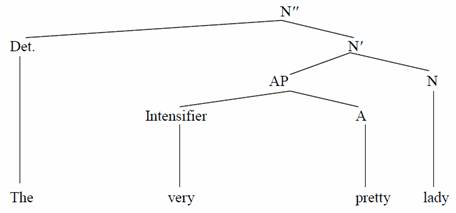
For example, the following tree illustrates two levels of expansion for N
(“N-bar” and “N-double-bar”) for the phrase the very pretty lady:
In X-bar theory, a
head is recognised in every phrase. In every phrase,
X (N, V, A, PP) is the head of XP (NP, VP, AP, PP). All XPs contain a head
element. The head is a lexical category and the phrasal component is called a
“projection”. Since these projections may occur in layers, the topmost layers
are known as maximal projections of a phrase. NP is the maximal projection of
N, while VP is the maximal projection of V. There are also intermediate
projections that must be accounted for in the structure of phrases. These
intermediate projections are called X-bar projections. This theory basically
establishes a more elaborate system of functional relationships among various
structural categories in a phrase.
Head
X-bar Projection
Maximal Projection
V
V-bar (V')
VP
N
N-bar (N')
NP
A
A-bar (A')
AP
P
P-bar (P')
PP
In X-bar theory, the
head of a phrase is projected in two ways – the maximal projection (XP), and
the intermediate projection. In addition to a head and its projections, X-bar
theory recognises another element within a phrase
known as “Specifier” (Spec) in terms of its function.
A similar element is known as the Complement (C). Both the specifier
and the complement occur at the second level along with X-bar categories (they
occur as ‘sisters’ of X; sisters in the sense that they occur side by side and
are of the same syntactic status).
X-bar syntax is an expansion of
the phrase structure component of the grammar and it underlines the fact that
phrases are endocentric, that is, an NP for example must have an N as its head
and so on. The X-bar theory of phrase structure grammar, according to Radford (1988) and Haegeman
(1994), ‘contributes significantly to both the descriptive and
explanatory adequacy of Linguistic Theory’ in English and other languages.
Early traditional grammar introduces a theory of phrase structure grammar (PSG)
which includes two levels of categories: word-level (N, V, A, P, etc.) and
phrase-level (NP, AP, VP, PP, etc.).
The creation of X-bar Syntax or
X-bar theory seems to address the insufficiency in the earlier model of
transformational grammar. X- bar theory takes into
consideration the fact that many other kinds of lexical and phrasal units in
language need to have an X-bar category added to their phrase markers.
Linguists note that in order to describe the process more adequately, each kind
of phrase must have a head constituent upon which a phrase is constructed.
DATA PRESENTATION
AND ANALYSIS
Sentences
from the editorials
1. “Boko Haram forces two million people to flee to Bauchi” Daily Trust, July
23rd, 2014, P.11.
“Full-time job may
disrupt breast- feeding plans”.Daily Trust, July 23rd, 2014,
P.36
The first sentence is
a complex sentence with an object (noun clause object) after the verb ‘forces’.
The second sentence is also a complex sentence.
2. “We won’t allow
lawlessness” (7). This is a statement made by AmosunIbikunle, Ogun state governor.
The sentence is a simple sentence
3. “Babalakin assured the governor that work will begin on the
road” (7)
(From The Nation of Friday, 27th
January, 2012).
This sentence is a complex sentence, with a noun clause object after ‘assured’.
4. The
Nation
of Wednesday, February 22nd, 2012, P.23.
“Kanu
motivates eagles against Rwanda”
Sentences
from literary texts
From Habila’sMeasuring
Time
5. “Are you his son?”
(38)
6. “The next day he
went to her” (101)
From Okoye’sThe Fourth
World.
7. “Chira closed her eyes” (66)
8. “Your father must
have had a good and trustworthy friend here in Enugu” (67)
9. “Immediately,
Isobel remembered her old school” (79).
This sentence is
taken from Swift’s The last Good Man.
Sentences
from journal articles
10. “The first major
bloody attack on residents of Jos was on September 7, 2001” (178).
11. “They have
started” (179).
These two sentences
are from an article written by Ella, D.N. and Dugga,
A. E. in an article entitled “Assessing
the Language of Jos Crises: Syntactico-Semantic
Implications of Pronouns”. This article is published in Affrevlaligens- An International Journal of
Language, Literature and Gender Studies, Ethiopia.
12. “Orwell uses
quite a number of slogans in his text” (220)
A sentence from an
article by Nimram, M.D. titled “A
Linguistic-Stylistic Analysis of George Orwell’s Animal Farm”, published in an International Journal of Continuing
Education, University of Jos.
13. “That Prospero
and his daughter landed safely on an island is divine providence” (13).
“The woman
constitutes the fourth social cluster” (127).
The sentences are
adapted from articles by Doki, G.J. (“ Literature and
Peace on the Plateau”) and Lar, I. B. (“A critique of
the Trial of DedanKimathi
and its Application to Peace- Building in Plateau State, Nigeria”) respectively
. The two articles are published in a journal entitled, Creative and Critical Writing for Peace Building in Nigeria: The Jos
Paradigm.
Sentences
from speeches
14. “This is how
America works” (114)
(From Obama’s speech
entitled: “A Hope to Fulfil” on April 26th,
2005, at Washington D.C.)
15. “Where do you
find that courage?” (121).
From Obama’s speech
entitled: “Remarks at NAACP fight for Freedom Fund Dinner” on May 2nd,
2005 at Detroct, MI.
16. “Libraries have a
special role to play in knowledge economy” (135)
This sentence is
taken from Obama’s speech titled: “Address to the American Library Association”
on June 27th, 2005 at Boston, MA.
17. “But God had a
plan for his people” (238)
18. “We have scorned
our gay brothers and sisters instead of embracing them” (241).
(Obama’s speeche titled: “The Great Need of the Hour” on January 20th,
2008 at Atlanta, GA.)
ANALYSIS
USING X-BAR THEORY
The concept of X-bar
is central to modern generativist theory. One of the primary tasks of syntactic
theory is to explain how sentences are built from words. This explanation is
generally conceived of in terms of assigning syntactic structures to sentences.
Generative grammar is concerned with hierarchical structuring of phrases and
sentences. A hierarchical analysis looks at phrases and sentences in terms of
constituents. These constituents usually correspond to syntactic structures and
are reflected in tree diagrams.
The methods of
analysis used by Radford and Aarts are basically
adopted in this study for analysis. Both linguists use the Transformational
Generative grammar approach. Some differences are: Radford uses the concept of
IP (Inflectional Phrase) at the sentence level while Aarts
uses ‘S’ (Sentence). While Radford uses ‘I'’ (Inflectional-bar), Aarts uses S'(sentence-bar) in his analysis. It
is important to point out that the handling of the ‘S node’ has evolved in
Generative Grammar. The term ‘S node’ was uses then ‘IP node’ and more
recently, ‘TP’. Both linguists use the same major phrase types (NP, VP, AdvP, AP, PP...). Both linguists use ‘I’ (inflection) to
account for tense and agreement features. Radford adheres more strictly to the
rule of ‘binary branching’ which says that all nodes must branch only into two.
This is because he places the VP under theI'(daughter of I') and not under the IP node while Aarts places the I node directly under the ‘S’, between NP
and VP. Aarts sometimes violates the binary rule in
order to have a more ‘convenient’ analysis or tree.Both linguists believe in and use the
concepts of ‘affix hopping’ (usually a movement to the right) and ‘movements’
(usually to the left) in their analysis. Below are analyses of twenty sentences
using the X-bar syntax:
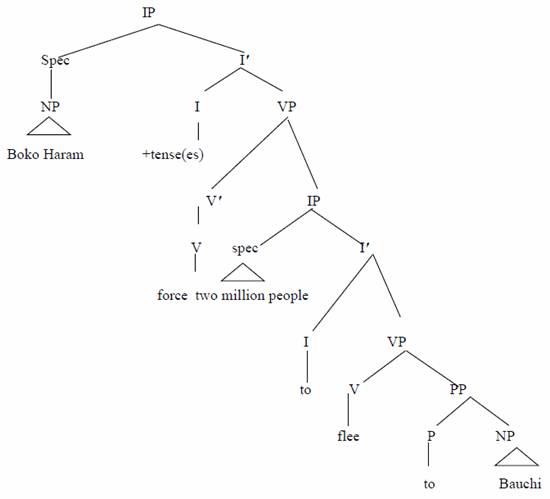
1. Boko Haram forces two million people to flee to Bauchi.
This sentence is analysed using Radford’s method.Here, the ‘IP’ which is the sentence branches
into two; the Specifier node and the I' node . The Specifier in this
sentence is an NP which accounts for ‘Boko Haram’. The I' branches into an I node and a VP
node. The I node accounts for a tense element which is
+present and also an agreement feature which is singular. The VP branches into
V'
which accounts for the verb, ‘force’ and an IP which also branches into a Specifier and an I'. The
Specifier accounts for the unanalysed
phrase, ‘two million people’ while the I'
branches further into the I node and VP node. The I node accounts for the
‘inflectional to’ and the second VP branches into a V which accounts for the
verb ‘flee’ and the PP which branches into a P and an NP. The P accounts for
the preposition, ‘to’ while the NP accounts for the noun ‘Bauchi’.
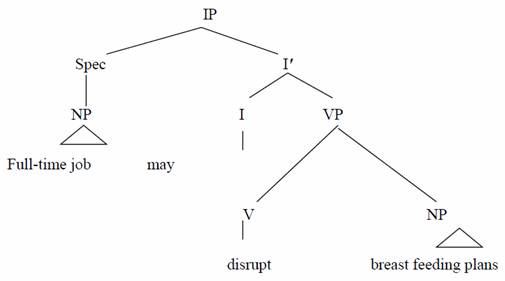
2. Full-time
job may disrupt breast feeding plans
This analysis is also
according to Radford’s. The IP branches into Specifier and I' nodes. The Specifier accounts for the unanalysed
NP, ‘Full-time job’ and I' further branches into an I node
(which accounts for the auxiliary verb, ‘may’) and a
VP node which branches into the V node and the NP node. The V node accounts for
the verb, ‘disrupt’ while the NP node accounts for the NP, ‘breast feeding
plans’.
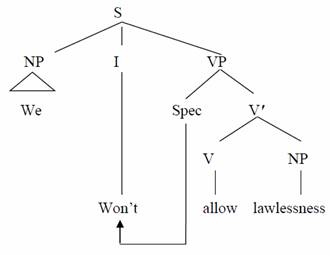
3. We
won’t allow lawlessness.
Aart’s method of analysis
is also used here. The S node branches into NP, I and VP nodes respectively, violating the rule of binary branching. The NP node
accounts for the noun ‘we’ and the I node accounts for
the negative element ‘won’t’ which is a contracted form of two negative
elements, will + not. The VP node branches into a Spec node and a V' node.
The Spec node is empty because there is a movement of the negative element
‘not’ to the I node. The V' node branches into a V
node which accounts for the verb ‘allow’ and NP node which accounts for the
noun ‘lawlessness’.
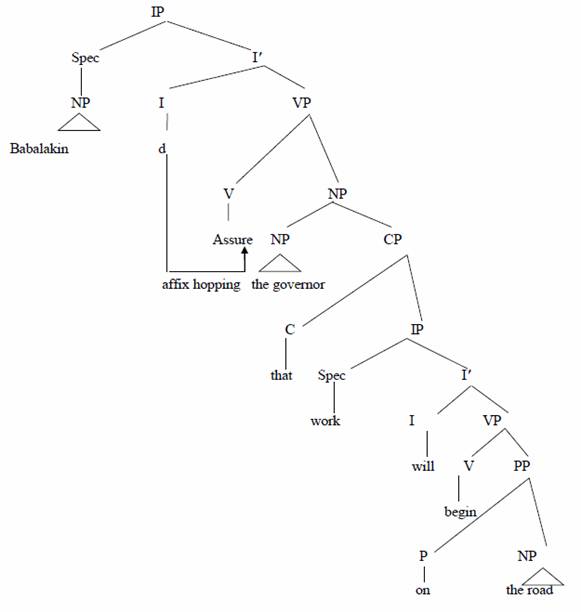
4. Babalakin
assured the governor that work will begin on the road.
According to
Radford’s type of analysis, this IP branches into a Specifier
node and an I' node. The Specifier
accounts for the NP ‘Babalakin’ while the I' branches into I and VP nodes. The
I node accounts for the past tense morpheme, ‘d’ and the VP branches into a V
(which accounts for the base form of the verb ‘assure’) and an NP which further
branches into an NP and a CP. The past tense morpheme, ‘d’hopps or jumps to the right (to the base form of the
Verb), under the VP to make it past tense. The second NP accounts for the
phrase ‘the governor’ while the CP further branches into a C (complementizer-‘that’) and an IP. This second IP branches
into a Specifier which accounts for the noun work and
an I' which branches into an I and a VP.
The I node accounts for the auxiliary ‘will’ while the
VP node branches into a V node (begin) and a PP node. The PP node branches into
a P node (on) and a NP node. This third NP accounts for the unanalysed
noun phrase, ‘the road’.
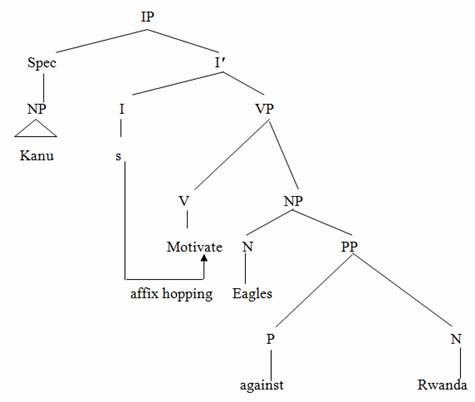
5. Kanu motivates Eagles against Rwanda.
According to
Radford’s type of analysis, this IP branches into a Specifier
node which accounts for the NP ‘Kanu’ and an I' node which branches into an I node
and a VP node. The I node accounts for the inflection feature
‘s’ which indicates present tense and agreement with the NP which is
singular. The VP branches into a V node which accounts for the verb ‘motivate’
and an NP which branches into an N node and a PP node. The
‘s’ under the inflection node jumps to the base form of the verb
‘motivate’ under the V node. The N node accounts for the noun ‘eagles’ while
the PP branches into a P node (against) and another N node (Rwanda).
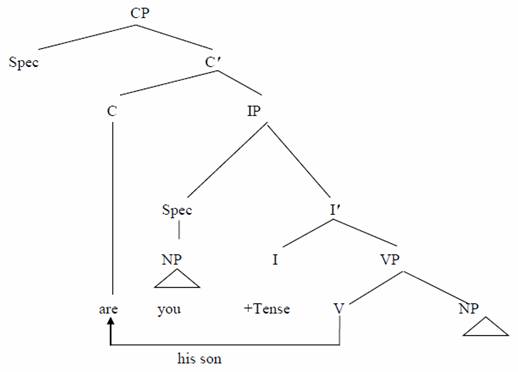
6. Are
you his son?
This is an
interrogative sentence. The CP (complementizer
Phrase) branches into a Spec node and C' node. The Spec node is
empty while the C' branches into a C node and an IP node. The C node accounts
for the verb ‘are’ which is as a result of a movement operation from the V node
under the VP to the C node. This makes the V node empty.This type of movement is a form of
‘inversion’ according to Radford (513). This type of movement is under the
concept of I-movement. Radford refers to this type of movement as a movement
whereby an auxiliary or main verb comes to be positioned before its subject.
The IP node branches into a Spec node which accounts for the NP ‘you’ and an I' node which branches into I and VP
nodes. The I node indicates a tense feature which is +tense and the VP node
branches into a V node (which is empty as a result of the movement operation
that has taken place) and the NP node accounts for the phrase his son.
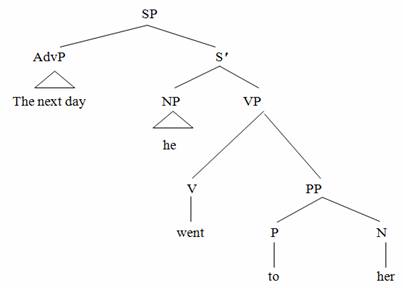
7. The
next day, he went to her.
This analysis is
according to Aarts’ method of analysis. The ‘SP’
branches into an AdvP node and a
S'
node. The AdvP accounts for the phrase
‘the next day’ while the S' branches into NP and VP nodes
respectively. The NP accounts for the noun ‘he’ and the VP branches into a V
node and a PP node. The V node accounts for the verb ‘went’ and the PP branches
further into P node and N node. The P node accounts for the preposition ‘to’
while the N node accounts for the noun ‘her’.
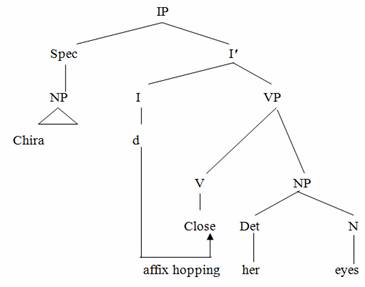
8. Chira closed her eyes.
This analysis is
according to Radford’s. The IP branches into a Specifier
node which accounts for the NP ‘Chira’ and anI' node which
branches into an I node and a VP node.
The I node accounts
for the past tense morpheme, ‘d’ and the VP branches into a V (which accounts
for the base form of the verb ‘close’) and an NP which further branches into a Det node and N node. The past tense morpheme, ‘d’hopps to the right (to the
base form of the Verb), under the VP to make it past tense. The second NP
accounts for the pronoun, ‘her’ and the noun ‘eyes’.
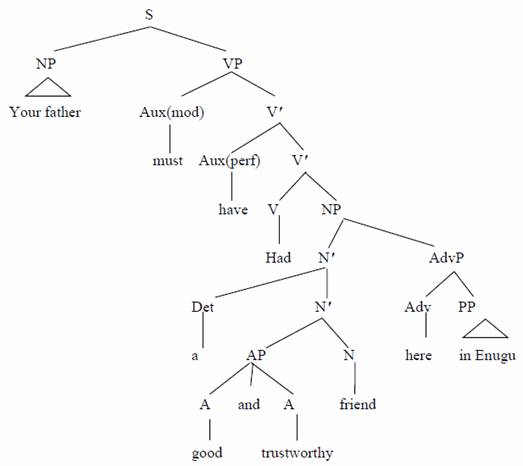
9. Your
father must have had a good and trust worthy friend here in Enugu.
This analysis is
according to Aart’s type of analysis. The ‘S’ node
branches into NP and VP nodes respectively. The NP node accounts for the phrase
‘your father’ while the VP node branches further into a Modal Aux node (which
accounts for the auxiliary ‘must’)and a
V'
node. The V' node branches into a Perfect Aux
node, (which accounts for the auxiliary ‘have’) and a V' node which branches
into a V node and NP node. It will be observed from the three diagram
that we have a ‘stacking’ of V' so as to account for several
auxiliaries (must, have and had respectively). The V node accounts for the main
verb ‘had’ and the NP node branches into an N' node and an AdvP node. The N' node branches into Det. node which
accounts for the determiner ‘a’ and another N'node which further branches
into AP and N nodes. The AP node branches into three nodes: A node, C node and
another A node. Here, the rule of binary branching is violated. This is in
order to account for the Complementizer ‘and’
properly, since it is neither a noun nor a verb. The A node accounts for the
word ‘good’, the C node accounts for the complementizer
‘and’ while the other A node accounts for the word ‘trustworthy’. The N node
accounts for the noun ‘friend’.Lastly,
the AdvP node branches into an Adv
node which accounts for the adverb ‘here’ and a PP node which accountsfor the
phrase ‘in Enugu’.
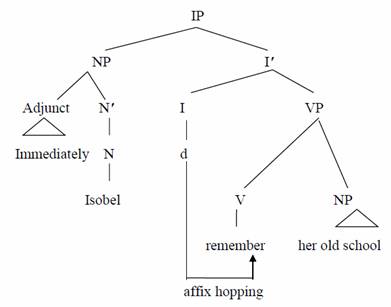
10.
Immediately, Isobel remembered her old school.
This analysis is also
according to Radford’s method of analysis. The IP node branches into NP and I'
nodes. The NP node branches into an adjunct node and a
N'
node. The adjunct node accounts for the adverb, ‘immediately’ while the
N'
accounts for the noun, ‘Isobel’.
It is important to
note that the adjunct, ‘immediately’ is mobile. This implies that it can fit
into different positions in the sentence. It can come after the noun ‘Isobel’,
after the verb ‘remembered’ or after the noun phrase ‘her old school’. This
mobility of adverb is a type of movement operation in Generative Grammar. The I' node branches into an I node and a
VP node. The I node accounts for ‘d’ which is the
inflected morpheme of the verb ‘remember’ to make it a past tense. This results
to an affix hopping (a jump to the right) because the past tense morpheme, ‘d’ hopps to the end of the verb ‘remember’ to make it
‘remembered’, making it the past tense form of the word. The VP node branches
into a V node which accounts for the verb ‘remember’ and a NP node which
accounts for the phrase, ‘her old school’.
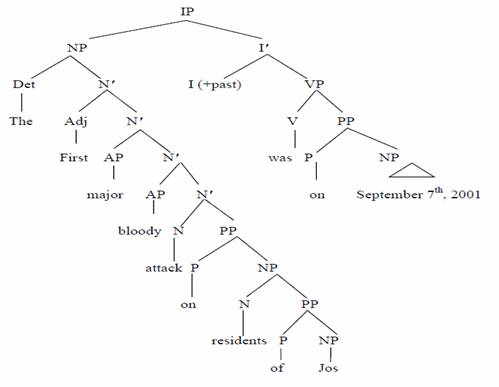
11. The
first major bloody attack on residents of Jos was on September 7th,
2001.
According to
Radford’s type of analysis, this IP node branches into NP and I'
nodes. The NP node branches again into a determiner node which accounts for the
determiner ‘the’ and a N' node which further
branches into Adj and N' nodes. The Adj node accounts for the adjective ‘first’ and the N' branches
into AP and N' nodes. The AP node accounts for the word, ‘major’ and the N'
branches into another AP and N' nodes. This second AP node
accounts for the adjective ‘bloody’ while the N' node further branches
into a N node and a PP node. The N node accounts for
the noun ‘attack’ while the PP node branches into a P node which accounts for
the word ‘on’ and a NP node which branches into N and PP nodes. The N node
accounts for the word ‘residents’ and the PP node branches into P and NP nodes.
The P node accounts for the word ‘of’ while the NP node accounts for the word
‘Jos’.
12.
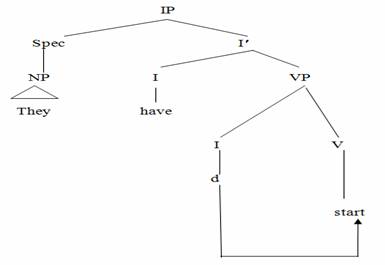
They have started.
The IP node according
to Radford’s analysis branches into a Specifier node
and an I' node. The Specifier
node accounts for the noun ‘they’ while theI'branches into an I node
and a VP node. The I node accounts for the auxiliary verb, ‘have’ and the VP
node branches into another I node and a V node. The I node accounts for ‘d’ which is the inflected morpheme of the verb ‘start’
to make it a past tense. This results to an affix hopping (a jump to the right)
because the past tense morpheme, ‘d’ hopps to the end
of the verb ‘start’ to make it ‘started’, making it the past tense form of the
word.
13.
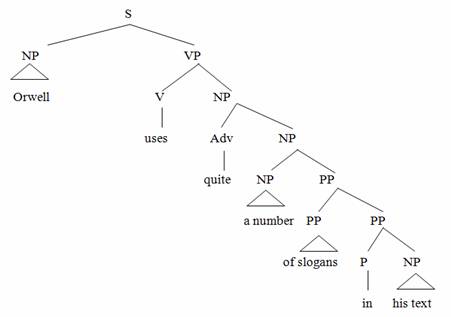
Orwell uses quite a number of slogans in his text.
This analysis is
according to Aarts’ method of analysis. The S node
branches into NP node which accounts for the noun ‘Orwell’ and VP node which
branches into a V node and a NP node. The V node accounts for the verb ‘uses’
and the NP node branches into Adv and NP nodes. The Adv node accounts for the adverb ‘quite’ which is a
pre-head modifier. The NP node further branches into NP node which accounts for
the phrase ‘a number’ andPP node which branches into PP and another PP node . The first PP
node accounts for the phrase ‘of slogans’ and the second PP node branches again
into P and NP node. The P node accounts for the preposition ‘in’ while the NP
node accounts for the phrase ‘his text’.In this example, the pre-head element ‘quite’ in the phrase ‘quite a
number of slogans’ is a bit difficult to decipher if it isperforming a specifying or modifying
function. This is one of the anomalies of the X-bar theory.
14.
That Prospero and his daughter landed safely on the Island is divine
providence.
The sentence branches
into CP node and VP node. The CP node branches into C node which accounts for
the complimentizer ‘that’ and NP node which branches
into another NP node and a VP node. The NP node accounts for the phrase
‘Prospero and his daughter’ while the VP branches into a V node hat accounts
for the verb ‘landed’ and an AdvP node which branches
into Adv node and PP node. The Adv
node accounts for the word ‘safely’ while the PP node accounts for the phrase
‘on the Island’. The VP node that is
the direct daughter of the S node branches into V node which accounts for the
verb ‘is’ and an NP node which accounts for the phrase ‘divine providence’. It
is important to note that ‘that Prospero and his daughter landed safely on the
Island’ is the subject of the entire sentence.
15. The
woman constitutes the fourth social cluster.
This analysis is
according to Radford’s method of analysis. The IP node branches into NP and I'
nodes. The NP node accounts for the phrase ‘the woman’ while the
I' node branches into an I node and a VP node. The I node accounts for the inflected morpheme’s’ which hopps to the right to meet the root word, ‘constitute’ to
make it present and singular. The VP node branches into a V node which accounts
for the verb ‘constitute’ and a NP node which branches into determiner and N'
nodes. The determiner node accounts for the word ‘the’ while the N' node
branches into AP node which accounts for the adjective ‘fourth’ and another N' node.
This N' node branches to an AP node which
accounts for another adjective, ‘social’ and N' node which accounts for
the noun, ‘cluster’.
16.
This is how America works.
According to
Radford’s method of analysis, the IP node branches into a Specifier
node which accounts for the word ‘this’ and an I'
node. The I' node branches into an I node which
indicates tense as present (+ Present) and a VP node. The VP node branches into
a V node which accounts for the auxiliary ‘is’ and S node. The S node further
branches into an Adv node which accounts for ‘how’
and an IP node. This IP node branches into an NP node which accounts for the
noun ‘America’ and an I' node which branches
again into an I node and a VP node. The I node accounts for the inflection ‘s’
which hopps to the root form of the verb, ‘work’ to make
it present and singular. The VP node accounts for the verb, ‘work’.
17.
Where do you find that courage?
This is an inverted
statement, analysed using Aarts’
method of analysis. The sentence ( S'') branches into
a complimentizer node which accounts for the word
‘where’ and S' node which branches further into another complementizer
node and S node. This second complementizer node
accounts for the dummy ‘do’ and the S node branches into NP which accounts for
the noun ‘you’ and a VP node which branches into an I node and another VP node.
The I node indicates that the tense is present and the VP node branches into a
V node which accounts for the verb ‘find’ and a NP node which accounts for the
phrase ‘that courage’.
18.
Libraries have a special role to play in knowledge economy.
The IP node branches
into NP node which accounts for the noun ‘libraries’ and an I'
node which branches into an I node and a VP node. The I node indicates the
tense as present (+present) and the VP node branches into a V node which
accounts for the verb ‘have’ and an IP node. The I
node branches into NP node which further branches into a determiner node and an
I'
node which also branches into an I node and a VP node. The Determiner node
accounts for the word ‘a’ while the I'
node branches into an AP node which accounts for ‘special’ and an N'
node which accounts for the noun ‘role’. The VP node branches into a V node
which accounts for ‘play’ and a PP node which branches again into a P node
which accounts for the preposition, ‘in’ andNP node which accounts for the phrase ‘knowledge economy’ .
19. But
God had a plan for His people.
According to Aart’s method of analysis, the sentence (S')
branches into a CP node which accounts for the conjunction ‘but’ and a S node. The S node branches into NP node which accounts
for the noun ‘God’ and a VP node which branches into a V node and another NP
node. The V node accounts for the verb ‘had’ and the NP node branches into NP
node which accounts for the phrase ‘a plan’ and a PP node which branches into a
P node and a NP node. The P node accounts for the preposition ‘for’ and the NP
node accounts for the phrase ‘his people’.
20. We
had scorned our gay brothers and sisters instead of embracing them.
The IP node branches
into a Specifier node which accounts for the word
‘we’ and an I' node which branches into Aux and I'
nodes respectively. The Aux node accounts for the auxiliary ‘have’ and I'
node branches further into I and VP nodes. The I node accounts for the morpheme
‘d’(a past tense marker) which jumps to the verb ‘scorn’ to make it past tense
while the VP node branches into V' and PP nodes. The
V'
node branches into V node which accounts for the verb ‘scorn’ and NP node which
accounts for the phrase ‘our gay brothers and sisters’. The PP node
branches into P node and S node. The P node accounts for the phrase ‘instead
of’ and the S node branches into NP and VP nodes. The NP node is empty while
the VP node accounts for the phrase ‘embracing them’.
CONCLUSION
AND CONTRIBUTIONS TO KNOWLEDGE
This study has proved
the fact that the X-bar syntax as a theory is applicable in analysing
sentences used in different fields of human endeavours.
This has been proved by the carefully selected sentences that were subjected to
the X-bar analysis. The study has also revealed that the theory of X-bar syntax
as an aspect of Generative Grammar despite its complexities and limitations is
of great significance in the field of syntax generally and is worthy of
attention.This study also ‘disabuses’
the minds of linguists who feel that Generative Grammar is obsolete. X-bar
theory enables us to have a deeper understanding of English Language generally,
particularly in understanding the relationship between highly complex noun
phrases as seen in the analysis of some of the analysed
data.
RECOMMENDATION
FOR FURTHER STUDY
This study is not
intended to be an exhaustive study on the X-bar theory since it is focused
principally on merits and demerits of the X-bar Theory, and its application in
other fields of endeavours. A broader or further
investigation and critique into this field especially using sentences of a
language other than the English language is therefore recommended. Also, since
the X-bar general schema is intended to be applicable to any language using the
SVO structure, (including those languages where the ordering relations might be
different), a holistic and comparative analysis or study is recommended between
English and any other natural language, using the X-bar framework.
It is important to
also note that Generative Grammar including X-bar theory has not been much
studied in English Departments in Nigerian Universities but has been studied in
Departments of Linguistics within and outside Nigeria. However, in my view,
Generative Grammar including X-bar theory ought to be studied in English
Departments because Syntax is one of the core courses in English Departments
and Generative Grammar is a vital approach to the study of syntax.
WORKS
CITED
Aarts, Bars. English Syntax and
Argumentation. 2nded. New York: Palgrave, 2001. Print.
Akmajian, Adrain, Demers, Richard, Farmer, AnnandHarnish, Robert. Linguistics:
An Introduction to Language and Communication. Cambridge: M I T Press,
2001. Print.
Al Aqad, Mohammed.
“Syntactic Analysis of Arabic Adverb’s between Arabic and English: X-bar
Theory” in International Journal of
Language and Linguistics. Vol. 1. Malaya: Science Publishing
Group. August, 2013.Web.
Anyanwu, Chinedu.
“The Hausa Noun Phrase within the X-bar Theory”. An
Unpublished B.A. Project, University of Jos, 2008. Print.
Awoniyi, Olorunson.
“The X-bar Syntax of Emai Noun Phrase”. An Unpublished Ph.D Thesis, University of
Ilorin, 2012.Web.
Brown, Keith and Jim, Miller.Syntax: A
Linguistic Introduction to Sentence Structure,2ndEdition. London: Routledge, 1992. Print.
Burton-
Roberts, Noel. Analysing Sentences: An Introduction to English Syntax, 3rd Edition.
London: Pearson Education Limited, 2011. Print.
Denham, Kristin. & Lobeck, Ann. Linguistics
for Everyone: An Introduction. Boston, MA.:Cengage Learning, 2009. Print.
Doki, Godwin Jeff. “ Literature and Peace on the Plateau” in Creative and Critical Writing for Peace Building in
Nigeria: The Jos Paradigm. Ibadan: Akin Press and Services,2012:13.Print.
Ella, Daniel Nkechi
and Dugga, AnthoniaEleojo. “Assessing
the Language of Jos Crises: Syntactico- Semantic Implications of Pronouns” in Language, Literature
and Gender Studies Vol.1(2).Ethiopia: Bahir Dar. April-
July, 2012:178-9. Print.
Haegeman, Liliane.Introduction to Government and Binding Theory. 2nd
ed. Oxford: Blackwell Publishing, 1994. Print.
Jackendoff, Ray. X-bar Syntax: A Study of Phrase Structure. Cambridge: MIT Press, 1977.
Print.
Kenstowicz
Michael & Kisseberth Charles.Generative Phonology: Description and Theory. New York: Harcourt
Brace Jovanovich Publisher, 1986. Print.
Lar, Isaac Barko. “A critique of
the Trial of DedanKimathi
and its Application to Peace-Building in Plateau State, Nigeria” in Creative and Critical Writing for Peace Building in Nigeria:
The Jos Paradigm. Ibadan: Akin Press and Services, 2012:17.Print.
Leech, Geoffrey. Meaning and the English Verb.3rd
Edition. New York: Pearson Education Limited, 2004. Print.
Muir, James. A
Modern Approach to English Grammar: An Introduction to Systematic Grammar.
London: Batsford Limited, 1972. Print.
Nimram, Mary Daniel. “A
Lingo-Stylistic Analysis of George Orwell’s Animal
Farm” in International Journal of
Continuing Education. Vol. 6. Abuja: Yabyangs
Publishers. July, 2013:220. Print.
Okoye, Ifeoma.
The Fourth World.Enugu: Snaap
Press Nigeria Limited, 2013.Print.
Olu, Tomori S.H. The
Morphology and Syntax of Present-day English: An Introduction. London:
Heinemann Education Books Limited, 1999.Print.
Ouhalla, Jamal.Introducing
Transformational Grammar: From Principles and Parameters to Minimalism.
London: ArnoldPublishers Limited, 2001. Print.
Pushpinder, Syal & Jindal, D.V.An Introduction to Linguistics: Language,
Grammar and Semantics. New Delhi: Prentice- Hall of India, 2008.Print.
Quirk, Randolph, Sidney Greenbaum, Geoffrey Leech, and Jan Svartvik.A Comprehensive Grammar ofEnglish Language. London: Longman,
1985. Print.
Quirk, Randolph and Sidney, Greenbaum.A University Grammar of English.London: Pearson Education Limited, 2004. Print.
Radford, Andrew.Transformational
Grammar: A First Course. Cambridge: CUP, 1988. Print.
Radford, Andrew. English Syntax: an Introduction. Cambridge:
CUP, 2004. Print.
Radford, Andrew. Syntactic Theory and the
Structure of English.Cambridge:
CUP, 1997. Print.
Radford, Andrew. Analysing English Sentences: a Minimalist Approach.
Cambridge: CUP, 2009. Print.
Scott F.S et al. English Grammar: A Linguistic Study of its Classes and Structures. London: Heinemann
Education Books Limited, Print.
Swift, Patience. The Last Good Man. 2nd
Edition. Ibadan: Extention Publications
Limited, 2008. Print. The
Nation. Friday 27th January, 2012. Print.
Van Riemsdijk, Henk and Williams E. Introduction to the theory of Grammar.
Cambridge: MIT Press, Cambridge Mass, 1986. Print.
Cite this Article: Nimram, MD; Azi,
NJ; Nimram, DN; Lagan, BS; Umeh,
AI; Nuhu, O (2023). Exploring X- Bar Syntax as
Applied to English Syntactic Structures.
Greener Journal of Language and Literature Research, 8(1): 12-28.