By
Ebede,
SO; Emenuga, VN; Nwobodo,
HA; Imanyikwa OEI; Offor,
CC; Usige, E; Oguwike, RC;
Oguwike, FN; Okeke, JC
(2022).
|
Greener
Journal of Medical Sciences
Vol. 12(1),
pp. 1-5, 2022
ISSN:
2276-7797
Copyright
©2022, the copyright of this article is retained by the author(s)
https://gjournals.org/GJMS
|

|
Evaluation
of Bacterial Contaminants of over Riped Pear (Dacryodes edulis) and
Their Effect in the Gastrointestinal System of Children.
Ebede S.O1, Emenuga
V. N2, Nwobodo H.A3, Imanyikwa O.E.I3, Offor
C.C4, Usige E5, Oguwike R.C6, Oguwike
F.N7, Okeke J.C7.
1.
Dept. of Medical Microbiology, University
Teaching Hospital, Ituku Ozalla
Enugu, Enugu State.
2.
Dept. of Medical Laboratory Sciences, Faculty
of Health Science and Technology, College of Medicine University of Nigeria
Enugu Campus, Nigeria.
3.
Dept. of Medical Microbiology, Faculty of
Health Science and Technology, College of Medicine. Enugu State University
Teaching Hospital Enugu, Nigeria.
4.
Dept. of Medical Biochemistry, Faculty of
Basic Medical Science. Chukwuemeka Odumegwu, Ojukwu University Uli Campus, Anambra State.
5.
Dept. of Anatomy, Faculty of Basic Medical
Sciences. Chukwuemeka Odumegwu,
Ojukwu University Uli Campus,
Anambra State.
6.
Dept. of Pharmacology, Faculty of
Pharmaceutical Sciences. Chukwuemeka Odumegwu, Ojukwu University Igbariam Campus, Anambra State.
7.
Dept. of Physiology, Faculty of Basic Medical
Sciences. Chukwuemeka Odumegwu,
Ojukwu University Uli Campus,
Anambra State.
|
ARTICLE INFO
|
ABSTRACT
|
|
Article No.: 011922006
Type: Research
Full Text:
PDF, HTML, EPUB, PHP
|
Dacryodes edulis exists as a fruit tree native to Africa, sometimes called Ube. (Igbo,
Nigeria) or African bush pear.
The occasional outbreak of diarrhea as a result of gastrointestinal infection among
children of age 8 months to 2 years necessitated this study. Evaluation of
bacterial contaminants in over riped pear (Dacryodes edulis) and
their effect in the gastrointestinal system of children was investigated
using thirty (30) children within the age range of 8 months to 2 years. The
investigation was carried out using swab sticks to collect
samples from over riped pears (50 samples) and also
isolation of bacteria and fungi from children who had loose or watery stool
after ingestion of over riped pears.
The samples from over riped Dacryodes edulis and
infected children were cultured in Sabouraud agar,
Nutrient agar and MacConkey agar. They were left to
incubate for 24-48 hours. Many methods were adopted in identification of
various bacteria and micro flora contaminants with their colonies counted.
Results indicated that yeast organisms
predominated, while other organisms such
as Staph. epidermidis, aerobic mesophiles
and Staphylococcus mirabilis were
also present. It could be deduced that these bacterial and fungi contaminants
could be responsible for watery stool and gastrointestinal disorder in some
of the children.
|
|
Accepted: 22/01/2022
Published: 17/02/2022
|
|
*Corresponding Author
Dr.
V. N Emenuga
E-mail: veronica.emenuga@ unn.edu.ng
Phone: 08035506341
|
|
Keywords: Dacryodes edulis,
Fungi, Agar, Bacteria, Children.
|
|
|
|
INTRODUCTION
The occasional outbreak of food poisons after
consuming fruits has necessitated this study. Microorganisms are generally
regarded as living forms that are microscopic in size (Cruishank,
1973) and relatively simple usually unicellular in structure. The diameter of
the smallest body that can be resolved and seen clearly with the naked eye is
about 100nm. Little children are ignorant of the existence of this bacteria
especially those living in underdeveloped world such as ours. Seeing adults
consume fruits empowers their curiosity to eat the fruit regardless. Fruits and
vegetables have been discovered by the early man as an additional source of
vitamins in their body. Man does not only consume fruits but believe that it
contributes to his healing and survival in his environment. Most edible fruits
have sweet taste, attractive aroma and quality nutritional properties (Aguoru et al,
2015).
Bacteria are
microscopic unicellular organisms which can be classified into the following
type of cell; the ovoid or spheroid
called coccus, the rod or cylindrical bacillus, the
curved vibro, the spiral shaped spirillium
and coil shaped spirochetes. The coccus (plural cocci)
size 0.5-1.0µm in diameter. Cocci generally
have one axis approximately equal to any other axis. Sometimes the cell is
thickened (giving rise to a kidney shaped cell) or distorted in some way as to
depart from the spherical shape example in Streptococci.
Catherine and Frédéric(2010),reported that some transmitted disease
might be from the silk worm which are commensals that constitute the normal
flora of the healthy body, however, Oguwike et al (2018) reported that these
organisms live on the skin and on the mucous membrane of the upper respiratory
tract, the intestine, female genitals. They obtain nourishment from the
secretions and food residues. This normal flora is also observed to exist as
contaminants on the surface of over ripe pear.
Since normally they do not invade the tissues,
they are generally harmless, though under certain conditions when the body
defenses are impaired. They may invade the tissues and cause disease, thus
acting as opportunistic pathogens, while the true pathogens are adapted to
overcoming the normal defenses of the body and establish their growth in the
tissues producing poisonous substances or toxins often causing damage to the
tissues and thus the manifestation of disease.
Dacryodes edulis is an
evergreen tree attaining a height of 18-40metres in the forest but not
exceeding 12metres in plantations. The fruit is an elliptical drupe which
varies in length from 4 to 12cm. the skin of the fruit is dark blue or violet,
whereas the flesh is pale to light green.
The tree flowers at
the beginning of the rainy season bears fruit during 2 to 5 months after
flowering. There are two variants of Dacryodes edulis: Dacryodes edulis var. edulis and Dacryodes edulis var. parvicarpa. The fruit of Dacryodes edulis var. edulis
is larger and the tree has stout ascending branches. Dacryodes edulis var. parvicarpa
has smaller fruit and slender dropping branches.
Medicinal
Uses of Dacryodes edulis (ube):
The tree is found useful in the traditional
herbal medicine of some African countries to treat various alignment
such as wounds, skin diseases, dysentery and fever. The extracts and secondary
metabolites have been found to show antimicrobial and antioxidant activities. A
wide range of chemicals constituents such as terpenes,
flavonoids, tannins, alkaloids, and saponins have
been isolated from the plant. Our major aim in this study is to evaluate the
bacterial contaminants on the surface of over riped Dacryodes edulis (pear)
and their effect in the gastrointestinal system of children. Most times,
children pick the over riped pears and clean them
with their bare hand and lick them without proper washing or boiling indirectly
introducing the contaminants into the Gut system resulting to different
manifestation of gastrointestinal ailments.
Materials
and Methods
Experimental
design:
Ripening of Pear (Dacryodes edulis):
Fifty (50) fruits of Dacryodes edulis were bought from Orie market in Enugu state Nigeria. They were washed with
clean water, poured into a basket and covered with sack to keep them warm. They
were allowed to stay for 10 days so as to soften and be contaminated with moulds and bacteria that may grow in over ripe fruits. Swab
sticks were used to pick swab samples for culturing.
The
Subjects:
Thirty children (8 months to 2years) were
allowed to consume the pears as the contaminants may be safe and will not pose
serious danger to their health while ten (10) children were given fresh neatly
washed pears to eat for 3 days.
Bacteriological
Methods:
Swab samples were collected from the over riped pears and from stool samples of infants who
complained of gassy stomach, running stool and other unspecific stomach
disturbances.
The swab samples were cultured in blood agar
and nutrient agar media by method of culturing techniques as described by Baker
and Silverton 1998. The samples were allowed to stay in anaerobic condition for
24-48hrs before reading out and examining the isolated organisms.
·
Catalase and coagulase tests were done using
the procedure described by Baker et al, 1998.
·
Gram staining test was carried out using the
procedure described by Baker et al, 1998.
Detection
of organisms in Dacryodes edulis
·
Yeast cells of fungi origin were identified
by plating the samples in sabouraud agar.
·
Aerobic mesophilic
bacteria: Samples were further diluted in sterile tap water and volume of 0.1ml
of appropriate dilutions were spread- plated in duplicates on pre- dried
surfaces of plate count agar (Pc:Merk).colonies were
counted after incubation at 30 to 320c for 48-72hrs.
·
Staphylococci: To identify Staphylococcus aureus,
appropriate dilutions were spread- plated in duplicate plates of manitol salt agar (Oxford) and incubated at 30-320c
for 48-72hrs. Ten colonies from countable plates were picked and slide and tube
coagulase tests were done (Baker and Silverton 1998).
·
Blood agar and Cystine Lactose Electrolyte Deficient (CLED)
Agar plates were used to culture stool
samples of 16 children out of the 30 children who complained of running stomach
pain after ingestion of the over riped pears.
·
Stool analysis was carried out as described
in Guide to Human parasitology (Crewe, 1977).
RESULTS: The
results obtained from this research work were represented in histogram.

Fig 1: Indicates the histogram of various
bacteria and fungi isolated from over riped Dacryodes edulis.
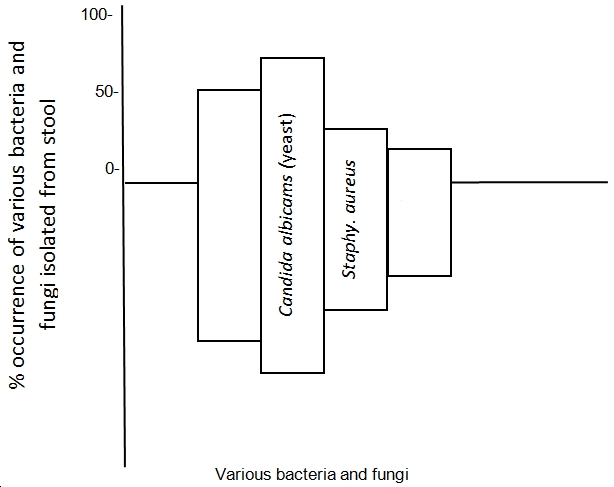
Fig 2:
Shows various bacteria and fungi isolated from stool of children that consumed
over riped Dacryodes edulis.
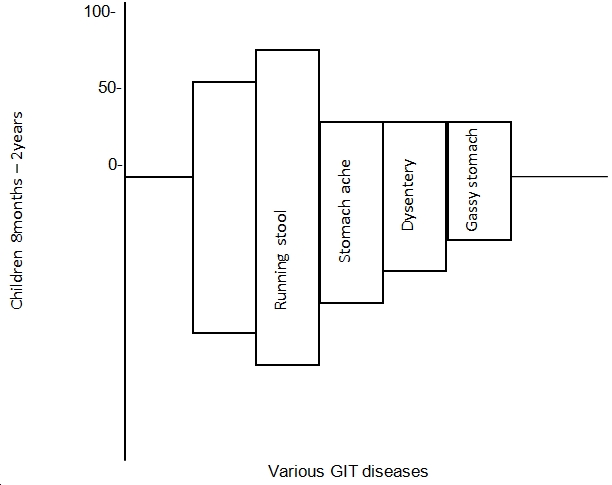
Fig 3: shows various
GIT alignment shown by children that consumed over riped Dacryodes edulis within 24hrs of consumption.
DISCUSSION
Bacterial contaminants in over riped pear (Dacryodes edulis) and its effect in the gastrointestinal system
of children have been evaluated.
The main use of Dacryodes edulis is its
fruit which can be eaten either raw, cooked in salt
water or roasted. Cooked flesh of the fruit has a texture similar to butter.
The pulp contains 48% oil. The fat content of this fruit is much higher
compared to fruits such as apple guava and pawpaw. It is also rich in vitamins.
(NRC, 2008).
The organisms
isolated in over riped pears include yeast cells (Candida albican),
Staphylococcus epidermidis,
Staphylococcus mirabilis, lactobacillus, proteus
specie, pseudomonas, aerobic mesophiles, Zymonass mobilis and Escherichia coli. The highest percentage
organism isolated from Dacryodes edulis is
yeast (Candida species) 80% in fig 1. The next in percentage occurrence is Escherichia coli (70%) followed by staphylococcus epidermidis
(50%) and the least occurrence is aerobic mesophiles
(20%).
On examination of the
faecal samples of the children with prominent
gastrointestinal disorder, yeast cells (Candida
albican) occurred more in percentage, Fig 2. The
next organism diagnosed was Escherichia
coli bacteria (65%) followed by Staphylococcus
aureus and Pseudomonas
specie (30%).
The commonest
gastrointestinal ailment complained by the children was running stool. It could
be noticed that little children eat most of their fruits unwashed,
hence they are exposed to gastrointestinal infection most often times. The
children who ate the neatly washed over ripe pears for 3 days did not complain
of any ailment.
Of the organisms
incriminated in causing running stool in children of 2 years and below is Candida albicans
(yeast) is the main culprit. It is regarded that Candida albicans is one of the microorganisms
that commonly live in and on our bodies. It can be found in the
gastrointestinal tract, the mouth and the vagina. Candida albicans is the most prevalent
cause of fungal infections in people and when they get to the gastrointestinal
tract through eating of unwashed fruits by children, it causes high
multiplication within leading to running stool presenting as slimy greenish
stool in children.
Escherichia
coli
(E. coli) is the next organism (fig2) isolated that
has the next percentage occurrence in the stool of children. It is a bacteria that causes urinary tract infection in adults and
children, but can still harm them when it gets into the bowel of little children,
hence its involvement in watery stool and unspecific stomach disturbances.
Gassy stomach was
seen as another common gastrointestinal disorder complained by children who ate
the unwashed over ripe pear (fig 3).
It could be deduced
from this work, bacteria and fungi present in over ripe Dacryodes edulis fruit, if eaten without proper hygienic
treatment, can introduce germs into the body that will disorient the
gastrointestinal system.
REFERENCES
1.
Aguoru C.E, S. Maaji and J.O Olasan (2015):
Bacteria contaminants on surfaces of some edible fruits sold in Markurdi metropolis, Benue state Nigeria. International
Journal of Current Microbiology and Applied Sciences. ISSN: 2319-7706. Vol. 4
Number 6 pp 334-340.
2.
Baker F.J, Silverton R.E (1998): Method of
anaerobic cultivation of Bacteria. Introduction to Medical Laboratory
Technology 7th Edition. Butter Worth publication. P 290-291.
3.
Catherine Texier, Frédéric Delbac
(2010), Current Opinion in
Microbiology, Elsevier:3(9-12) .
4.
Crewe W (1977). Examination of the faeces for protozoa. A Guide to Human Parasitology for
Medical Practitioners 10th edition. Published in Great Britain for
H. K. Lewis ISBN 0718604326 pg. 177-179.
5.
Cruishank R,
(1973): Microbiology and Medicine. Medical Microbiology. Churchill living stone,
23 Rowelston Edinburgh Terrance. Vol. 1 p4, 10, 110,
134-136.
6.
National Research Council (NRC, 2008).
“Butter fruit”. Lost crops of Africa Volume III. Fruits, lost crops of Africa 3
National academics. Press. doi:
10, 17226/11879, ISBN 978-0-309-10596-5.
7.
Oguwike F.N, Nwobodo H.A, Emenuga V.N, Offor C.C, Ifedi I.C (2018).
Comparative study of the micro flora of the oral cavity in sick and healthy
subjects in Enugu state. Greener Journal of Medical Sciences. Vol. 8 no 4 p057-060.
|
Cite this Article: Ebede,
SO; Emenuga, VN; Nwobodo,
HA; Imanyikwa OEI; Offor,
CC; Usige, E; Oguwike,
RC; Oguwike, FN; Okeke,
JC (2022). Evaluation of Bacterial Contaminants of over Riped Pear (Dacryodes edulis) and Their Effect in the Gastrointestinal System
of Children. Greener Journal of Medical
Sciences, 12(1): 1-5.
|