By Lawson,
SD; Owhonda, GC; Ojum, S;
Davies, S; Adebiyi, O; Nnokam,
BA; Chisor-Wabali, N; Somiari,
A; Ajunwa, CC; Alali, AA (2022).
|
Greener Journal of Medical Sciences
Vol. 12(1), pp. 77-83, 2022
ISSN: 2276-7797
Copyright ©2022, the copyright of this article is retained by the
author(s)
https://gjournals.org/GJMS
|

|
Exploring Admitted Covid-19
Patients Perception and Quality of Care at a Treatment center in Rivers State.
*Lawson SD1;
Owhonda GC2; Ojum
S3; Davies S4; Adebiyi O4;
Nnokam BA5; Chisor-Wabali
N3; Somiari A6; Ajunwa CC7; Alali AA2
1Department of Medical Microbiology and Parasitology,
Rivers State University, Nigeria
2Department of Community Medicine, Rivers
State University, Port Harcourt, Nigeria
3Department of Anaesthesia,
Rivers State University Teaching Hospital, Port Harcourt, Nigeria
4Rivers State Hospitals Management Board, Port
Harcourt, Rivers State, Nigeria
5Department of Family Medicine, Rivers State
University, Rivers State, Nigeria
6Department of Community Medicine, University
of Port Harcourt Teaching Hospital, Rivers State, Nigeria
7Department of Obstetrics and Gynaecology, Rivers State University Teaching Hospital,
Rivers State, Nigeria
|
ARTICLE INFO
|
ABSTRACT
|
|
Article No.: 020222012
Type: Research
Full Text: PDF, HTML, EPUB, PHP
|
Coronavirus
disease (COVID-19), often known as SARS-CoV-2, is a
novel RNA coronavirus that emerged in late 2019 in Wuhan, China. COVID-19
was declared a pandemic by the World Health Organization in early 2020. The
goal of this study was to explore the perception and quality of care offered
to COVID-19 patients at a treatment center in Eleme, Rivers State. A semi-structured questionnaire was
used to interview 117 people who were conveniently chosen for a
cross-sectional descriptive study. Participants' characteristics and
responses were summarized using descriptive statistics. The overall mean age
of the participants was 43.6±14.2 years, with males accounting for 88(75.2%)
of the study participants. A significant number of individuals 56 (50%) said
the attention/care they received was good and should be continued. In
conclusion, COVID-19 patients have a wide range of experience in this facility, however there is room for improvement.
|
|
Accepted: 03/02/2022
Published: 17/02/2022
|
|
*Corresponding Author
Dr Lawson SD. (MBBS,
FWACP)
E-mail: stephensonlawson@ yahoo.com
|
|
Keywords: Perception, Quality of Care, Covid-19, Rivers State
|
|
|
|
INTRODUCTION
SARS-CoV-2 commonly known as Coronavirus
disease (COVID-19), is a new RNA coronavirus that
arose in late 2019 in Wuhan, China (1). On January 30, 2020, the World Health
Organization (WHO) declared the situation a Public Health Emergency of
International Concern (PHEIC). The World Health Organization declared COVID-19
a pandemic on March 11, 2020, putting everyone's health and well-being in
jeopardy, especially those with comorbid diseases (2,3).
The disease has spread to almost every country on the planet, with 167, 011,807
confirmed cases and 3,472,068 deaths as of May 25, 2021 (4). The Americas,
Europe, Southeast Asia, and the Mediterranean are the most impacted regions of
the world, with Africa and Western pacific having a lower frequency (4). As of
May 25, 2021, the WHO estimates that there are over 3.5 million confirmed cases
of COVID-19 across Africa, with over 85,000 deaths (4). Nigeria has had over
166,000 confirmed cases of COVID-19 and over 2,000 deaths nationwide, with
Rivers State, an oil-rich state, ranking fifth in terms of prevalence (5).
COVID-19 patients
have a wide range of clinical symptoms that affect different body systems,
including the respiratory and digestive systems (6). Mild self-limited disease
to severe pneumonia, acute respiratory distress syndrome, septic shock, and
systemic multiple organ failure syndromes are examples of these symptoms. To
improve patients' experiences throughout their COVID-19 hospitalization, a full
therapy package may be required. Many affluent countries, for example, have
used physical activity programs and strengthening aerobic capacity after
COVID-19 to manage these patients (7-9). More so, patients treated for COVID-19
may provide useful data that can be used to improve management and treatment,
particularly in resource-constrained locations where international
recommendations may not be feasible. There
are only few available data that have reported the
attention/care given to COVID-19 patients in Nigeria (10) and England (14). A recent study has shown the experiences of discharged covid-19 patients
in Kano State, Nigeria using a qualitative method of data collection (10). As
a result, the purpose of this study was to explore the quality of care given to
COVID-19 patients at a treatment center in Eleme, Rivers State using a larger
sample and a quantitative approach of data collection (Questionnaire based).
The findings of this study are expected to provide data for informed policy on
how to improve current interventions as well provide valuable information on
COVID-19 patient experiences from an African perspective.
MATERIALS
AND METHODS
At the General Hospital in Nchia,
Eleme, Rivers state, a cross-sectional descriptive study with 117 participants
was conducted. Before interviewing patients who were admitted and discharged
from this center due to COVID-19, we received consent from both the
participants and the appropriate authority. The participants in the study were
chosen through convenience sampling. As a result, all adult patients who had
been at the point discharged from the treatment center were eligible to
participate in the study. All authors created a semi-structured interview
questionnaire, which was face validated by research supervisors before the
start of the main investigation. The survey gathered data on demographics,
clinical features, and experience. The interviews were conducted in English,
and those who did not speak English fluently were assisted by an interpreter
for about twenty minutes. The research took place over five months (November
2020 to March 2021). The Statistical Package for Social Sciences (SPSS) version
23 and Microsoft Excel 2016 were used to analyze the data. To summarize the
characteristics and responses of the participants, descriptive statistics were
employed.
RESULTS
A total of
117 participants were included in the study. Tables 1 shows the distribution of
the socio-demographic characteristics of the participants including age, sex, education,
occupation, marital status, religion, contact history, travel history, and
places traveled to. A major proportion of 88(75.2%) of the participants were
males. The overall mean age of study participants was 43.6 ± 14.2 years with
male mean age being 43.5 ± 12.6 years and female mean age being 43.9 ± 18.5
years. A majority of the study participants 45(38.5%) were between 35-49 years
and was closely followed by those between 18-34 years 36(30.8%). A majority of
the study participants 113(96.6%) were non-health workers. A majority of the
study participants 111(94.9%) have had tertiary education. Some 91(78.4%) of
the study participants were married. A majority of the study participants 110(94.0%) were Christians. A majority
of the study participants 107(98.2%) had no contact history with a case. A few
participants 10(9%) have had a travel history and of the participants who had
travel history, some 2(20%) had traveled outside the country.
Table
1: Frequency Distribution of Socio-Demographic
Characteristics of Participants (N=117)
|
Variables
|
n (%)
|
|
Age
(years)
<17
18-34
35-49
≥50
Total
Sex
Male
Female
Total
Education
Primary
Tertiary
Total
Occupation
Health Workers
+Non-workers
Total
Marital
Status
Single
Married
Total
Religion
Christian
Muslim
Total
Contact
History
Yes
No
Total
Travel
History
Yes
No
Total
Places
Traveled To
In-Nigeria
*Out-of-Nigeria
Total
|
1(0.9)
36(30.8)
45(38.5)
35(29.9)
117(100)
88(75.2)
29(24.8)
117(100)
6(5.1)
111(94.9)
117(100)
4(3.4)
113(96.6)
117(100)
25(21.6)
91(78.4)
116(100)
110(94)
7(6)
117(100)
2(1.8)
107(98.2)
109(100)
10(9)
101(91ss)
111(100)
8(80.0)
2(20.0)
10(100)
|
+Drillers, Seafarers, Lawyers, Public/Civil Servants *Germany,
Britain, Croatia
Figure 1
shows the distribution of the clinical characteristics and drug use a prior
diagnosis of the participants including diabetes mellitus (DM), allergy,
asthma, vomiting, diarrhea, dysphagia, sore throat, myalgia, headache, fatigue,
cough, fever, anosmia, ageusia, HIV (Human Immunodeficiency Syndrome), swelling
and antimalarial use. Mostly, the participants presented with headache
36(30.8%), fatigue 40(34.2%), cough 45(38.5%), and fever 45(38.5%). A
proportion of 14(12.4%) of the participant had taken treatment before diagnosis
and of this proportion 5(41.7%) used the antimalaria drug only, 4(33.3%) used a
combination of antimalaria and other drugs and 3(25%) used other drugs without
antimalaria.
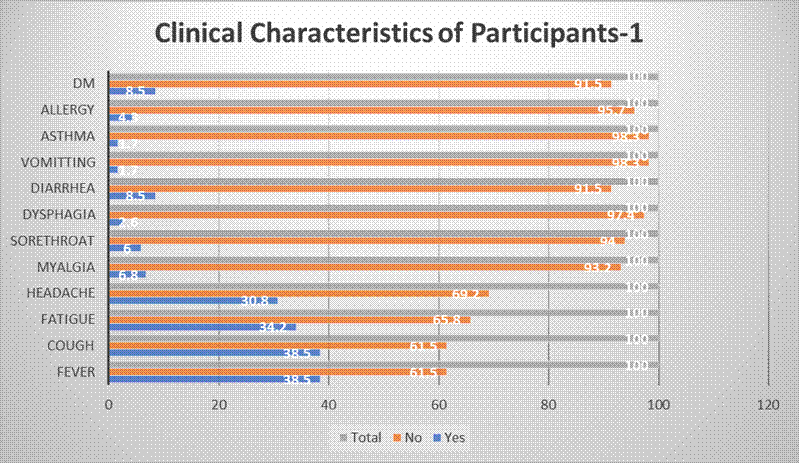
Figure 1a: Frequency
(Percentage) Distribution of Clinical Characteristics of Participants (N=117)
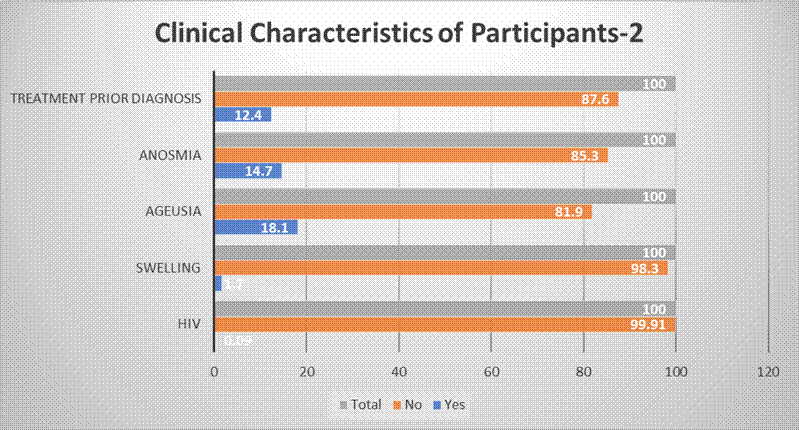
Figure
1b: Frequency (Percentage) Distribution of Clinical Characteristics of
Participants (N=117)
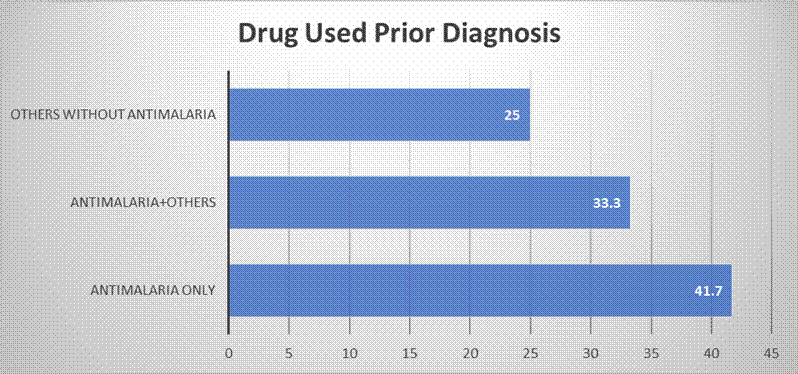
Figure
1c: Frequency (Percentage) Distribution of Drug Use Prior Diagnosis of
Participants (N=117)
Others- Vitamin C,
Anti-hypertensives, Anti-inflammatory and
Anti-pyretic
Tables 2 shows the
distribution of perception of attention/care received by participants at the
treatment center. A majority of the study participants 93(80.9%) felt they were treated excellently. All
participants reported they were given their drugs regularly. A large proportion
of participants 96(83.5%) reported they were satisfied with their feeding with
some 10(8.9%) suggesting improvement in diet and nutrition especially adding
fruits to a meal. Some 56(48.3%) felt the attitude of the health workers was
very good though 6(5.4%) advised there should be an improvement on healt personnel
pieces of training and incentives. A few proportions 3(2.6%) of participants
reported they enjoyed the exercises and games provided with 5(4.5%) of
participants suggesting improvements in exercises/rehabilitation therapy. A
good proportion 56(50%) of participants felt the attention/care received at the
center was good and should be kept up.
Table
2a: Perception of Attention/Care Received by Participants at Treatment Center
(N=117)
|
Variables
|
n (%)
|
|
I felt I
was treated
Good
Very Well
Excellent
Total
Drugs
were given regularly
Yes
Total
My feeding
was
Non-satisfactory
Fair
Satisfactory
Total
The
attitude of Health Personnel
Fair
Good
Very Good
Excellent
Total
I
enjoyed the Internet Services
Yes
No
Total
I
enjoyed the TV provided
Yes
No
Total
I
enjoyed the indoor games provided
Yes
No
Total
I
enjoyed the indoor games provided
Yes
No
Total
|
9(7.8)
13(11.3)
93(80.9)
115(100)
117(100)
117(100)
3(2.6)
16(13.9)
96(83.5)
115(100)
1(0.9)
14(12.1)
56(48.3)
45(38.8)
116(100)
2(1.7)
114(98.3)
116(100)
112(96.6)
4(3.4)
116(100)
3(2.6)
113(97.4)
116(100)
3(2.6)
113(97.4)
116(100)
|
Table
2b: Perception of Attention/Care Received by Participants at Treatment Center
(N=117)
|
Variables
|
n (%)
|
|
Advice
to the facility
Improved diet with fruits/nutrition/feeding
Health Personnel Training and Improved Incentive, Improved
facility waiting time/Ward arrangement for newly diagnosed
Improvement on Environmental Hygiene
Improved Exercise/Rehabilitation/Games
Good, keep it up
Good, but there is room for improvement
Total
|
10(8.9)
6(5.4)
14(12.5)
5(4.5)
56(50.0)
21(18.8)
112(100)
|
DISCUSSION
The purpose of this
study was to explore the perception and quality of care offered to COVID-19
patients at a treatment center in Eleme, Rivers State. The major outcomes of
this study indicated that participants presented with headaches, fatigue,
fever, and cough more. The quality of care, on the other hand, was rated as
good by some participants. This report is similar to finding from a previous
study reporting quality of care to be excellent (10). Study participants stated
that there was room for improvement in the areas of caregiver/patient
interaction and healthcare provider welfare and ward arrangement for newly
diagnosed cases in the isolation center. This report is similar to finding from
a previous study suggesting improvement in the welfare of health care providers
(10). This finding is significant because healthcare providers have long
advocated for a better welfare package (11). Bringing this information to light
may thus be beneficial to relevant authorities seeking to improve the quality
of healthcare delivery in similar low-resource settings, particularly during
this pandemic, when healthcare workers are afraid of jeopardizing their livelihoods.
It's worth noting
that many of the isolation centers are equipped with brand new, cutting-edge
medical technology (12). However, the participants mentioned a low use of other
complementary treatments such as rehabilitation, which could help patients increase
their physical activity and raise their immunity to COVID-19 patients (13).
There are areas in which the study excels. These include looking into the
perspectives of patients at the point of being discharged from the hospital to
avoid recall bias. This is critical for gathering accurate and trustworthy
data. In addition, all interviews were done by the same researchers to ensure
that the data was collected consistentl7y. However, a larger-sized/random study
is needed in further studies for generalization.
CONCLUSION
In conclusion, COVID-19 patients have
a wide range of experience in this facility. However, they tend to agree that
the level of service and health infrastructure was very commendable. Nevertheless,
a few areas involving caregiver/patient contact and health worker wellbeing and
environmental hygiene may require further improvement.
REFERENCES
1. Liu Q,
Luo D, Haase JE, Guo Q, Wang XQ, Liu S, et al. The experiences of
health-care providers during the COVID-19 crisis in China: a qualitative study.
Lancet Glob Health. 2020 Jun;8(6):
e790-e798.
2. Vannabouathong
C, Devji T, Ekhtiari S, Chang Y, Phillips SA, Zhu M et al. Novel coronavirus
COVID-19: current evidence and evolving strategies. J Bone Joint Surg Am. 2020
May 6;102(9):734-744.
3. World Health Organization (2020). WHO Director-General’s Opening
Remarks at Media Briefing on COVID-19.
4. World Health Organization (2021). WHO Coronavirus
(COVID-19) Dashboard.
5. Nigeria Centre for Diseases Control (2021). NCDC
Coronavirus COVID 19 microsite.
6. Parasher A. COVID-19: Current understanding of its
pathophysiology, clinical presentation, and treatment. Postgrad Med J
2020:postgradmedj-2020-138577.
7. Lazzeri
M, Lanza A, Bellini R, Bellofiore A, Cecchetto S, Colombo A et al.
Respiratory physiotherapy in patients with COVID-19 infection in the acute
setting: a position paper of the Italian Association of Respiratory
Physiotherapists (ARIR). Monaldi Arch Chest Dis. 2020 Mar 26;90(1).
8. Thomas
P, Baldwin C, Bissett B, Boden I, Gosselink R, Granger CL et al.
Physiotherapy management for COVID-19 in the acute hospital setting: clinical
practice recommendations. J Physiother. 2020 Apr;66(2):73-82.
9. Hopman
J, Allegranzi B, Mehtar S. Managing COVID-19 in low-and middle-income
countries. JAMA. 2020;323(16):1549-50.
10. Naziru BM, Auwal A, Muhammad, Aliyu A, Jibril M (2020). Views
and experiences of discharged COVID-19 patients in Kano, Nigeria: a qualitative
study. PAMJ
- 37(Supp 1):38. 17 Nov 2020
11. A Madhi
S, E Gray G, Ismail N, Izu A, Mendelson M, Cassim N et al. COVID-19
lockdowns in low-and middle-income countries: success against COVID-19 at the
price of greater costs. S Afr Med J. 2020;110(8):724-6.
12. Okunola
A. Everything you need to know about the COVID-19 Nigeria solidarity support
fund. Sept 3, 2020.
13. Maugeri
G, Castrogiovanni P, Battaglia G, Pippi R, D'Agata V, Palma A, et al. The impact of physical activity on psychological health during
COVID-19 pandemic in Italy. Heliyon. 2020;6(6): e04315.
14. Key, T, Kulkarni, A, Kandhari, V, Jawad, Z,
Hughes Angela & Mohanty, K (2021). The Patient Experience of Inpatient Care
During the COVID-19 Pandemic: Exploring Patient
Perceptions, Communication, and Quality of Care at a University Teaching
Hospital in the United Kingdom. Journal of Patient Experience. 8:1-6
|
Cite this Article: Lawson,
SD; Owhonda, GC; Ojum, S;
Davies, S; Adebiyi, O; Nnokam,
BA; Chisor-Wabali, N; Somiari,
A; Ajunwa, CC; Alali, AA (2022). Exploring Admitted
Covid-19 Patients Perception and Quality of Care at a Treatment center in
Rivers State. Greener Journal of
Medical Sciences, 12(1): 77-83.
|