INTRODUCTION:
Nasal polyps are benign growth arising from
the mucosa of the nose or sinuses protruding into the nasal cavity. 1,2They
are translucent to pale gray, pear shaped, smooth, soft, and freely mobile. 2,3They
initially begin as small growth that slowly increases in size to occupying the
nasal cavity.1,4The prevalence of nasal polyp worldwide is 1-4%.2,5Nasal
polyps are not common in children however when they occur it’s usually
associated with cystic fibrosis.2Nasal polyps aetiology
is very complex and not well-understood.1 Some causes of nasal polyp
are inflammatory (recurrent nasal infections, sinusitis), disorders of ciliary motility (cystic fibrosis), allergy, fungi and
deviation of the nasal septum.2,3 Polyps which are sessile in the
beginning become pedunculated due to gravity and the
excessive sneezing5.The commonest sites of involvement are the anteriorethmoid and maxillary sinuses.2, 6
Clinical features of nasal polyps include nasal congestion or blockage,
post-nasal discharge,rhinorrhea, headache, pain, or
facial pressure and anosmia.2The treatment of nasal polyps consists
of two categories of medical and surgical treatments.6Medical
treatment involves the use of topical or systemic corticosteroids with systemic
antihistamines.7Surgical treatment is indicated in case of nasal
obstruction and lack of response to medical treatment.7 The surgical
treatment of choice is endoscopic sinus surgery7. However, there are
other surgical options of simple polypectomy,
intranasal ethmidectectomy, external ethmoidectomy and Caldwell-Lucs
procedure.7 Diagnosis of nasal polyps is confirmed by histopathology
report from tissue specimen. The aim of this study is determine the clinical
and histolgical pattern of nasal polyps in UPTH.
PATIENTS
AND METHODS
This is a retrospective study that involves
all patients that were managed for nasal polyp at the ENT surgery department of
UPTH. This is a retrospective study that involves all patients that were
managed for nasal polyp at the ENT surgery department of UPTH. Data were
collected from the clinic registers, clinical records of the patients from June
2010 to June 2020. The clinic registers and patient’s folders were the source
data from which the biodata, clinical presentations,
treatment, complications and histology were extracted. These were analyzed
using simple statistical stools
SPSS 20.0
RESULTS
A total of 46 patients were treated for nasal
polyp, 24 male (52%) and 22 female (48%) with a ratio of 1.1:1. The age range
was 14-65 years with the mean age of 32 years. The commonest symptom was nasal
blockage 100%, this was closely followed by nasal discharge 84.7%, reduced
smell was 68.5%, nasal growth 68.5%, post nasal drips
66.2%, allergic symptoms 50.0%. The duration of symptom ranged from 3mths – 10
years. Duration from 1st visit to surgery ranged from 1month to
2years 6months. The modal period of stay, post-surgery was 4 days while the
range was 3-10 days. Nasal polyp found on the left 45.7%, right 36.9%,
bilateral 17.4%, antrochoanal 13.0%. The surgery done was nasal polypectomy 73.9%, calwell- luc 26.1%, intranasalethmoidectomy
15.2%. Histological report showed inflammatory polyp in 66.9%, allergic polyp
predominately oesophilia 13.0%, fibrous polyp 6.5%,
chronic non-specific inflammatory polyp 6.5%, inverted papilloma 4.3%. The mean
duration of post op stay was 5days. Complications seen were recurrence 20.5%,
adhesions 9.1%, and facial swelling.
Figure 1:
AGE DISTRIBUTION OF PATIENTS
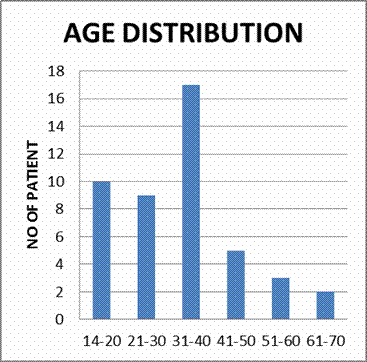
Table 1:
SITE OF POLYP SEEN IN PATIENTS
|
LATERALLY
|
NUMBER
|
%
|
|
RIGHT
|
17
|
36.9%
|
|
LEFT
|
21
|
45.7%
|
|
BILATERAL
|
8
|
17.4%
|
|
ANTROCHOANAL
|
6
|
13.0%.
|
Table 2: PATIENT
SYMPTOMATOLOGY
|
SYMPTOMS
|
NUMBER
|
%
|
|
Nasal blockage
|
46
|
100%
|
|
Nasal discharge
|
39
|
84.7%
|
|
Reduced smell
|
32
|
68.5%
|
|
Nasal growth
|
32
|
68.5%
|
|
Post nasal
drips
|
30
|
66.2%,
|
|
Allergic
symptoms
|
23
|
50.0%
|
|
Mouth breathing
|
17
|
36.9%
|
|
Frontal
headache
|
9
|
19.6%
|
|
Halitosis
|
4
|
8.7%
|
|
Epitaxis
|
3
|
6.5%
|
Table 3: SURGERY
PERFORMED FOR POLYPECTOMY
|
SURGERY
|
NUMBER
|
%
|
|
Intra Nasal polypectomy
|
34
|
73.9%
|
|
Calwell- luc
|
12
|
26.1%
|
|
Intranasal ethmoidectomy
|
7
|
15.2%
|
Table 4:
HISTOLOGICAL PATTERN OF TISSUE SPECIMEN
|
HISTOLOGIC PATTERN
|
N0
|
%
|
|
INLAMMATORY
POLYP
|
32
|
66.9%
|
|
FIBROUS POLPY
|
6
|
13.0%
|
|
CHRONIC NON-SPECIFIC INFLAMMATION
|
3
|
6..5%
|
|
ALLERGIC POLYP PREDOMINANLY EOSINOPHILIA
|
3
|
6.5%
|
|
INVERTED
PAPILLOMA
|
2
|
4.3%
|
DISCUSSION
Nasal polyp is marked by the formation of
benign, stem-like growths on the mucous membrane,
severely affecting daily life.Nasal polyp is a common
disease affecting the nose and Paranasal sinus with a
prevalence of 1-4% globally. 2,3In this study nasal polyp was found
to be commoner in the age group 30 – 40 years,this is similar to the review by Mohammad S.S that
report nasal polyp to be common in adult older than 20 yrs6. Nasal
polyps are uncommon in children less than 10 years,however when they do occur it could be a sign of
cystic fibrosis6. Qaisar K. et al also
noted that majority of the patients (33.33%) were in age group 11-20 years
followed by (21.21%) in age group 21-30 year7.The mean age in this
study is similar to that by Ogunleye A.O and Fasunla A. J. Who reported 33.5 years3.Tezer I.
et al reported a mean age of 34 years, range: 15–53 years in their study8.This
study showed nasal polyp to be slightly commoner in male. Other studies also
reported higher male preponderance. Ogunleye and Fasunla, Qaisar K et al., Fahy C. et al., Payman D. et al.,
Andrijana V. et al.3, 7 9,10,11,However Tezer I. et al., report female preponderance in his work in
Iran8.Left nasal polyp was commoner, however Ogunleye
and Fasunla reported bilateral to be more, followed
by left nasal polyp3.
The commonest symptom
was nasal blockage seen in all patients, this is similar to report by other
authors Ogunleye and Fasunla,
Parvin B. et al.,3,10,12Payman D et al,
reported was alsoSimilar to this work in which the commonest
symptoms was nasal obstruction or congestion, smelling disturbance, headache
and facial pain, nasal discharge, post nasal discharge (PND)10.Lathi
also found that nasal obstruction was the most common (97.3%) presenting
complaint, followed by rhinorrhoea (49.1%), hyposmia (31.25%), intermittent epistaxis (17.9%), headache
(16.9%), facial swelling (11.6%) and eye-related symptoms (10.7%).13 Epistaxis
was seen in 3 patients, with two of the patients having infected nasal polyp
and one having inverted papilloma. However,Ogunleyeand
Fasunla did not report epistaxis, as it is not
frequent in nasal polyp.If it does occur, it may
indicate a more sinister underlying pathology than nasal polyps3.Qaisar
K. et al reported epistaxis as a symptom in 15.15% in their study but no
sinister underlying pathology was found in these patients7.The
duration of symptom ranged from 3 months to 10 years.Duration
from first visit to surgery ranged from 1month to 2years 6months. Patients
living with these discomforting symptom for such a
long time would affect their quality of life.These
delays may be due to the poor health seeking behaviour
people and low socio economy status of our country.
This treatment
options for nasal polyps are medical and surgical.3,12Medical
treatment involves the use of topical or systemic corticosteroids with systemic
antihistamines.12Mohammad S.S et al in their work showed the
effectiveness of antileukotrienes (montelukast, zafirlukast)
in the treatment of nasal polyp6.Nasal polyps are shown to have more
leukotriene C4 and leukotriene B4 than the normal nasal tissue6.The
presence of leukotriene C4 in nasal polyps is likely the cause of early polyp
recurrence 6.Cysteinyl-leukotrienes have been noted to be the cause
of mucus production, mucosal edema and inflammation 6.Surgical
treatment is indicated in case of nasal obstruction and lack of response to
medical treatment.In the study most of our patient
had intra-nasal polypectomy, others had caldwell-Lucs and few had intranasal ethmoidectomy
this similar to the study by Ogunleye and Fasunla3.
None of our patient had endoscopic sinus surgery, which is the treatment choice
due to no availability of facilities for it7.
This study had
recurrence rate as high as 20.5%.Drake lee reported 5% while Ogunleye and Fasunla reported 13%14.
Our study was about four times that recorded by Drake-Lee14. The
exact cause of recurrence is not known but all the patients had topical steroid
to prevent recurrence. Adhesion was observed in 9.1% of our patients for which the
patients had adhesiolysis and stenting done.This study, histopathologic
report showed more of inflammatory polyp 66.9%, allergic polyp predominately eosinophilia
13.0%, fibrous polyp 6.5%. whileQaisar K, et al
reported that all their sample had histopathology report as simple inflammatory
polyps7.Our study differs with; Anjali D. et al report allergic
polyps (67.3%) and inflammatory (32.7%)15. Luciano G.F. et al.,
reported eosinophilic polyp (73%); fibro-inflammatory
polyp: (18%); and polyp with stromaatypia: (2.3%). 16
CONCLUSION:
Nasal polyp is a common nasal condition that
often requires surgical intervention to reduce the attendant morbidity. Nasal blockage being the commonest presenting complaint and
recurrence the commonest complication.
Conflict
of interest
There was no conflict of interest.
Funding
There was no grant for the research work.
REFERENCES
1.
Drake-Lee AB. Nasal Polyps. In: Mackary IS; Bull TR; Eds. Scott-Brown’s Otolaryngology
(Rhinology), 6th Edn. Oxford: Butterworth –
Heinemann, 1997; 4/10/1 – 4/10/16.
2.
Pawankar R. Nasal
Polyposis: an update: editorial review. Curr. Opin Allergy Clin. Immunol; 2003; 3: 1-6.
3.
Ogunleye AO, Fasunla AJ. Nasal polyps-clinical profile and management in
Ibadan, Nigeria. Nigerian journal of surgical research. 2005;7(1):164-7.
4.
Cimmino M, Carvaliere M, Mardone M, Plantulli A, Orefice A, Esposito
V, Ravia V. Clinical characteristics and genotype
analysis of patients with cystic fibrosis and nasal polyposis. ClinOtolaryngol;
2003; 28: 125 – 132.
5.
Lanrent C, Yvon YJ, Hvidsten I, Hellstrom S, Hyaluronan and
alpha-atrial natriurectic polypeptide in human nasal
polyps: contributing factors to oedema formation and
polyp growth? ActaOtolaryngol, 2003;123:
406 – 412.
6.
Soltankhah MS, Majidi MR, Shabani S. Medical
treatment of nasal polyps: a review. Reviews in Clinical Medicine. 2015;2(1):24-7.
7.
Qaisar K, Fazal-I, Asghar U, Naseemul H, Javaid M. Antrochoanal Polyps: Presentation And
Management. Kjms. 2013 Jul;6(2):257.
8.
Tezer I, Erdivanli OC, Sanli A, Aydin S. Could cellular proliferation be a predictive index
for the relapse of nasal polyposis and down-regulated by nasal steroid
treatment?. Indian Journal of Otolaryngology and Head & Neck Surgery. 2013
Aug 1;65(2):329-32.
9.
Fahy C, Jones
NS. Nasal polyposis and facial pain. Clinical Otolaryngology & Allied
Sciences. 2001 Dec;26(6):510-3.
10.
Payman D, Seraj JM, Bastaninejad S, Meighani A, Mokhtari Z. The
efficacy of clarithromycin in patients with severe nasal polyposis. ActaMedicaIranica. 2013;51(6):359-64.
11.
Andrijana V, Đanić D, Včev A, Birtić D, Mihalj H, Zubčić Ž, Kotromanović
Ž, Hadžibegović AĐ. The significance of
Helicobacter pylori in patients with nasal polyposis. MedicinskiGlasnik.
2012 Aug 1;9(2).
12.
Parvin B, Madani SA, Aliabadi BM, Kamalinejad M, Yousofpoor M.
Comparative study of nasal polyp with Bawseer–e-Anff in Persian medicine sources. Journal of Fundamental
and Applied Sciences. 2018;10(6S):1861-72.
13.
Lathi A, Syed
MMA, Kalakoti P, Qutub D
and Kishve SP. Clinico-pathological
profile of sinonasal masses: a study from a tertiary
care hospital of India. ActaOtorhinolaryngol Ital.
2011; 31(6): 372–377
14.
Drake-Lee AB, Lowe D, Swamston
A, Grace A. Clinical profile and
recurrence of nasal polyps. J. Laryngol Otol. 1984; 98: 783-793
15.
Dasgupta A, Ghosh RN, Mukherjee C. Nasal polyps—histopathologic
spectrum. Indian Journal of Otolaryngology and Head and Neck Surgery. 1997 Jan
1;49(1):32-7.
16.
Couto LG, Fernades AM, Brandão DF, Neto S, Valera FC, Anselmo-Lima
WT. Histological aspects of rhinosinusal polyps. RevistaBrasileira de Otorrinolaringologia.
2008 Apr;74(2):207-12.