1.
INTRODUCTION
Welding is a process of joining two metal parts together by
applying intense heat between them which causes the parts to intermix after
melting [1]. A welder is a tradesman who specializes in welding materials
together [2] or a trades person who specializes in fusing materials together[3](en.m.wikipedia.org Wikipedia Welder). Welding,
according to Davies et al[4], emits a wide spectrum of
radiations ranging between 200nm–1400nm which includes ultraviolet (UV) rays
(200-400nm), visible light (400-700nm) and infrared rays (700-1400nm). And all
these rays and radiations are being produced at damaging levels [4,5]. “These radiations and their secondary effects are
responsible for the ocular hazards that are seen clinically”[5]
and these are those factors and conditions which pose a threat to promotion of
healthy, wholesome and comfortable vision[6].In the developed world, the
protective act is not just wearing of welding goggle but use of other personal
protective equipment [7] because they observed the implications and dangers of
welding without proper precautions appropriate. Unprotected exposure of the
eyes to these rays is known to cause both acute and chronic ocular disorders
[4]. Artificial ultraviolet radiation from welding increases the risk of
cortical cataract, conjunctival neoplasm, and ocular
melanoma [8] and this is why the use of proper protective eyewear is called
for in other to minimized the risks of
ocular injury associated with welding. Full face welding helmets with dark face
plates are worn to prevent this exposure is well advocated for as a better
option [9] since some researchers) have
discovered that ultraviolet radiation and far infra-red (IR) are absorbed by
the cornea and lens whereas visible light and near infra-red penetrate to the
retina [10,11].The hazards associated with the
welding process depend on the type of welding, the materials (base metals,
surface coatings, electrodes) to be welded, and the environmental conditions
also play their own role [12],though it is clear
that long term chronic exposure to ultraviolet radiations has been assumed to
be associated with conditions like pterygium, pingueculae, malignant melanoma, cataract and age related
macular degeneration[13,14,15,16]. When the eyes of a welder are unprotected,
the welder may be exposed to his welding arc [17] or the arc of nearby welders
[18,17}] which may seriously lead to impaired eye either from injury or disease
may not function well in terms of seeing [19],If the welders on their parts
really appreciate their eyes as the
engine of the body, they should have
been jealously guarding their eyes and taking
good care of it judiciously while at work by using protective eyewear.
Based on this we now tend analyzed whether their negligence on the use of the
eyes protective device is due to on the
experience on the job, age group, educational background or whether it is based
on unawareness of the adverse effect and long term implications of continuous
exposure of the necked eye to the radiation from the welding arc over a long
period.
2. MATERIAL
AND METHOD
The major occupations engaged the populace in this area which is
the main city of Abakaliki are small/medium scale
businesses, petty trading, self-employed artisans (welding and fabrication,
auto mechanics, hair stylist, barbers, etc.) and based on this we randomly
sampled just few population of welders
within the town, and prepared a well-structured questionnaire which was
administered to the sampled population for the purpose of this study .However, the aim of this study was
clearly explained to the participants as well as the need to give honest
response to the questions contained in the questionnaire. The structured data
for this study was randomly obtained from selected participants through
interviewing and administration of questionnaire which was structured to suit
the objectives of the study centered on the welders with population of 101 in
the Abakaliki metropolis with 67 workshops.
A consent form was filled by the participants
who consented to the study and confidentially was assured. The demographic data
of the participants was obtained and the questionnaires were administered in an
interview manner.
The data collected for this study which was carried using a well-structured
questionnaire was tabulated in the frequency distribution form and were all
expressed as the percentage of the distribution .Chi square was used to test
for the relation of the demographic characteristics, while the analysis was
carried out using the scientific package for social sciences (SPSS) version 22
statistical software package. Descriptive statistics was used to analyze the
data obtained that were arranged into frequency tables, bar charts and pie
charts.
3.
RESULTS
Table 1 Frequency distribution of age of
participants
|
Age
|
Frequency
|
Percentage (%)
|
|
16 – 25
26 – 35
|
18
|
17.82
|
|
40
|
39.60
|
|
36 – 45
|
24
|
23.76
|
|
46 – 55
|
9
|
8.91
|
|
56 – 65
|
6
|
5.94
|
|
66 – 75
|
4
|
3.97
|
|
Total
|
101
|
100
|
The table above shows the frequency distribution all age groups
considered in our study in which it is observed that those within 26-35 has the
highest frequency and 66-75 has the least.
4. DISCUSSIONS
From
our study, it was clear that up to 95.05% of the population of the welders in
our study sample were aware of the ocular hazard of non-compliance
concerning the use of the eye protective wear while at work, Though 5.95%
of them claimed ignorant, but all were pre-informed before the administration
of the questionnaire and by this it was seen that the percentage agreed with
the work of Ajayi
(21) bordering the awareness on the use of protective eyewear by welder in the
South-Western Nigeria.
Based on the
population, it was observed from our study in Abakaliki
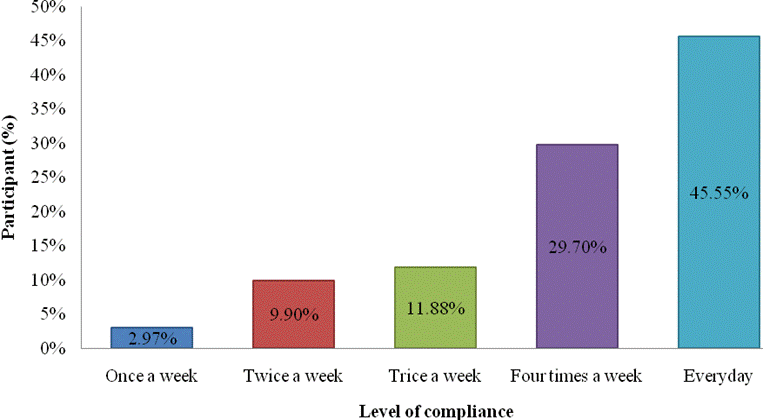
metropolis that the compliance level among the welders in the study area is not
high as also found in the study done by Ogunleye (22)
at North- Western Nigeria where up to 71.6% appeared to comply with the use of
their protective eye-wear regularly while at work.
It was also noticed
from the work that even up to 72.2% who seem to comply with the use of eye
protective wear predominantly use the inappropriate type. This disagree with
the claim that they use regular protective eyewear, and it is found that only 26.73% use goggle eye glass which is better than what most of them make use of.
Imperatively, it implies that in accordance with the work of Ganesh (23) in the
Coastal South of India where up to 67.5% wear inappropriate protective eyewear
and still claim to comply.
In terms of age
group, it was it is clear from our work that up to 38.8% of those between the
26-35 years age group comply, though they form the majority of age group among
the population sample among the welders in the area. However, this contradicts
the report from the work of Boissin (24) as he
presented in his article titled the impact of welding on vision of welders in
France in which the largest age group that complied was those between 36-45
years where we had up to 40.2% compliance.
On the issue of
compliance based on the experience on the job, it was seen that 43.36 %
complied and when compared to other group it appears as if there is a decrease
on compliance with increase on the years of experience on the job. Similarly,
it was clearly indicated that the compliance level in terms of educational
level also decreased with increase on educational level contrary to the
expectation that those who are more educated should have been more apprehensive
of the implication of
the effect on the eye for
failure in compliance
4. CONCLUSION
The study here reveals that the
compliance level is independent of any of the parameters outlined in the
study; age, experience in the work and educational level. This was shown from
the data analysis which indicated statistically that there is no effect of age,
experience on the field of work and educational level on their compliance to
the use of protective eyewear.
Therefore in the final analysis, results from
this study showed that there was a high awareness to protective eye wear usage
and ocular risk associated with the failure in compliance to the use of the protective
eyewear at while at work among the welders, but they still go ahead to adopt
lesser faire attitude towards the compliance to the use of protective eyewear
at work. In fact it is seen from this work that on the average less than 54.55%
comply to the use of protective eye wear among the
welders as compared to the developed countries. It was clear that irrespective
of age or experience on the job by the welders there was no significant
difference. Imperatively, it was observed that up to 72.28% that were inclined
to make use of the protective eye wear unfortunately do not make use of the
correct type of protective eyewear. Secondly it was also observed that the
welders that have worked for more than 5 years comply less than those who are
just new on the job to the use of protective eye wear.
Those who have worked for less years probably feel that it does not matter as
they might have regarded the effect as no meaningful since it has no immediate
resulting effect and thus, the work reveals that there is no reasonable
significant effect of age, educational level and experience on the job in
relation to the level of compliance since statistically the analysis did not
exhibit a reasonable significant result on any of the parameters tested as
observed from the Chi Square analysis.
5. REFERENCES
1.
Mgonja
CT. The effects of arc welding hazards to welders and people surrounding the
welding area. International Journal of
Mechanical Engineering and Technology 2017; 8(3):433–441. Available from http://iaeme.com/Home/issue/IJMET?Volume=8&Issue=3.
2.
Cary
HB, Scott CH. Modern welding technology;
2005; 246-249 as cited by Ihekaire DE, Oji CS.
Corneal Injuries Associated with Ocular Hazards in the Welding Industry: A Case
Study of Nekede Mechanic Village Nekede,
Imo State, Nigeria. International Journal
of Ophthalmology & Visual Science. 2017; 2(2):37-54.
doi:10.11648/j.ijovs.20170202.12
3.
Welder. Wikipedia,
Wikimedia. 2003. Available from https://en.m.wikipedia.org/wiki/Welder.
4.
Davies KG, Asana U, Nku CO, Osim EE. Ocular effects of chronic exposure to welding
light on Calabar welders. Nigeria journal of physiological science 2007; 22(1-2);55-58. Available online/abstracted at https://www.bioliternational.org.r/njps; www.ajol.info/journals.njps; www.cas.org.
5.
Pabley SA,
Keeney HA. Welding Process and Ocular Hazards and New Protective Devices.
Indian Journal of Ophthalmology 1984; 32(5):347–349. [Pub Med].
6.
Ihekaire
DE, Oji CS. Corneal injuries associated with ocular hazards in the welding
industry: A case study of Nekede mechanic village Nekede, Imo State, Nigeria. International Journal of Ophthalmology & Visual Science 2017;
2(2):37-54. doi:10.11648/j.ijovs.20170202.12
7.
Shyam
SB, Singh SB, Sagtani RA, Niraula
SR, Pokharel PK Awareness of occupational hazards and
use of safety measures among welders: a cross-sectional study from eastern
Nepal, BMJ Open 2014; 4(6);e004646
doi:10.1136/bmjopen-2013-004646. PMC4054643.
8.
Gallagher RP, Lee TK. Adverse effects of ultraviolet radiation:
A brief review. Prog
Biophys Mol Biol 2006; 92:119-131. Available at www.sciencedirect.com.
9.
Shaikh
MA. Hazard perception and occupational injuries in the Welders and lathe
machine operators of Rawalpindi and Islambad. Journal of Pakistan Medical Association 2001;
51(2):71-74. PMID:11321875.
10.
Fich M,
Dahl H, Fledelius H, Tinning S. Maculopathy
caused by welding arcs: A report of 3 cases.
Acta Ophthalmol Copenh 1993; 71(3):402–404. Cited by Davies KG, Asana U, Nku CO, Osim EE. Ocular effects of chronic exposure to welding
light on Calabar welders. Nigeria journal of physiological science 2007; 22(1-2);55-58. Available online/abstracted at https://www.bioliternational.org.r/njps; www.ajol.info/journals.njps; www.cas.org.
11.
Voke J.
Radiation effect on the eye–ocular effect of ultraviolet radiation. Optometry Today. 1999; 8:30-35. Cited by Davies KG, Asana U, Nku CO, Osim EE. Ocular effects of chronic exposure to welding
light on Calabar welders. Nigeria journal of physiological science 2007; 22(1-2);55-58. Available online/abstracted at https://www.bioliternational.org.r/njps; www.ajol.info/journals.njps; www.cas.org.
12.
Sithole HL, Oduntan OA, Oriowo MO. Oculo-Visual Status of
the welders in the capricorn
district of the Limpopo province of South Africa. A research paper for the degree Masters in Optometry at the
University of Limpopo. S Afr Optom 2009; 68(1):32-37.
13.
Sliny DH. Risks of occupational exposure to optical
radiation. Med Lav
2006; 97:215-220. As cited by Sithole HL , Oduntan
OA and Oriowo MO. Eye protection practices and
symptoms among welders in the Limpopo Province of South Africa. S Afr Optom 2009; 68(3):130-136
14.
Oduntan AO, Nthangeni ME, Ramudzuli MR, Madu SN. Causes and
prevalence of low vision and blindness in black South African adults in the
Limpopo Province. S Afr
Optom 2003; 62:8-15. As cited by Sithole HL , Oduntan OA and Oriowo MO. Eye
protection practices and symptoms among welders in the Limpopo Province of South
Africa. S Afr Optom 2009; 68(3):130-136
15.
Bergmanson JPG, Söderberg PG.
The significance of ultraviolet radiation for eye diseases. Ophthal Physiol Opt 1995; 15:83-91. As cited by Sithole HL , Oduntan OA and Oriowo MO. Eye
protection practices and symptoms among welders in the Limpopo Province of
South Africa. S Afr
Optom 2009; 68(3):130-136
16.
Tomany SC, Cruickshanks KJ,
Klein R, Klein BE, Knudtson MD. Sunlight and the
10-year incidence of age-related maculopathy: the
Beaver Dam Eye Study. Arch Ophthalmol 2004; 122:750-757. As cited by Sithole HL , Oduntan OA and Oriowo MO. Eye
protection practices and symptoms among welders in the Limpopo Province of
South Africa. S Afr
Optom 2009; 68(3):130-136.
17.
Sithole HL , Oduntan OA and Oriowo MO. Eye
protection practices and symptoms among welders in the Limpopo Province of
South Africa. S Afr
Optom 2009; 68(3):130-136
18.
Sheedy JE, Edlich RF.
Ultraviolet eye radiation: the problem and solutions. J Long Term Eff Med Implants 2004; 14: 67-71. As cited by Sithole HL , Oduntan OA and Oriowo MO. Eye
protection practices and symptoms among welders in the Limpopo Province of
South Africa. S Afr
Optom 2009; 68(3):130-136.
19.
Franck C. Eye symptoms and signs in buildings with indoor
climate problems of office eye syndrome. Acta ophthalmol(Copenh). 1986; 64(3):306-311.
Doi:10.1111/j. 1755-3768. 1986.tb06925.x.
PMID:3751520
20.
Abakaliki. Wkikpedia, Wikimedia 2014. https://en.m.wikipedia.org/wiki/Abakaliki.
21.
Ajayi IA, Adenike OA,
Charles OB, Oluwatoyin HO, Omotoye,
OJ. Awareness and utilization of protective eye device among welders in
southern Nigeria community. Ananas of African
medicine 2011; 10(4):294-299. Available from https://www.annalsafrmed.org/text.asp?2011/10/4/294/87047
22.
Sufiyan MB, Ogunleye OO.
Awareness and compliance with use of safety protective devices and pattern of
injury among quarry workers in Sabon-Gari Local
Government Area, Kaduna state North-Western Nigeria. Annals of Nigeria Medicine, 2012; 6(2):65-70.
23.
Ganesh
KS, Dharanipriya A, Kar SS.
Awareness of Occupational Injuries and Utilization of Safety Measures among
Welders in Coastal South India. Int Journal of Occupational and Environmental Medicine
2013; 4:172-177.
24.
Boissin JP, Peyresblanques
J, Rollins JP, Marini F, Beaufils D. The vision of
welders in France. J Fr
Ophtalmol 2002;
25(8):807-812.