By Al-Zuabi, H; Al-Kandari, W; El-Shazly, M; Nasser,
AH; Hajeri, DA (2022).
|
Greener Journal of Medical Sciences
Vol. 12(2), pp. 192-197, 2022
ISSN: 2276-7797
Copyright ©2022, the copyright of this article is retained by the
author(s)
https://gjournals.org/GJMS
|

|
Impact of
COVID-19 disease on the attendance of diabetic patients to diabetes clinics in
primary health care, State of Kuwait.
Homoud Al-Zuabi1, Wafaa
Al-Kandari2, Medhat El-Shazly3, Ahmed H Nasser4,
Dalal Al Hajeri5
1 Consultant
Family medicine, Head of Chronic Diseases Clinic Team, Head of General Medical
Council, MOH, Kuwait.
2
MRCGP, Consultant Family Medicine, Member of Chronic Diseases Clinic Team, Head
of Jaber Hospital Quarantine Center, MOH, Kuwait.
3 MD,
Consultant of Public Health, Department of Planning, MOH, Kuwait and Professor
of Health Statistics, Medical Research Institute, Alexandria University, Egypt.
4
Nursing Diploma, Farwaniya Hospital, MOH, Kuwait.
5 MRCGP-Int,
Diabetes Diploma St George University of London, Consultant Family Physician, Kifan Primary Health Center, MOH, Kuwait.
|
ARTICLE INFO
|
ABSTRACT
|
|
Article No.: 112922100
Type: Research
Full Text: PDF, HTML, PHP, EPUB
|
Background:
There
is a global impact of coronavirus disease COVID-19 on routine care for
chronic diseases. Diabetes was one of the most impacted conditions due to
reduction in access to care.
Objectives:
This study aimed to detect the impact
of COVID-19 on the attendance of diabetic patients to primary health care
diabetic centers.
Methods:
Electronic records study were used to
extract the number of diabetic patients visited the diabetes clinics in all
primary health care centers in Kuwait during the
period March-June in 2019 and 2020.
Results:
There 27.6% decline in the number of
attendants to diabetic centers in primary health
care during March to June in 2020 as compared with same period in 2019. The
drop reached its lowest peak in May and it was more prominent in the Capital
and Ahmadi health regions. In June 2020, the number of attendants began to
increase.
Conclusions: COVID-19 had a negative impact on the health
care for diabetic patients during March to June 2020.
|
|
Received: 29/11/2022
Accepted: 05/12/2022
Published: 09/12/2022
|
|
*Corresponding
Author
Medhat El-Shazly
E-mail: medshaz@ yahoo.com
Phone: +965 66612524
|
|
Keywords: diabetes,
attendance, PHC, COVID-19
|
|
|
|
Introduction:
The world is facing unprecedented challenges
in the face of a global pandemic. The fast propagation of the COVID-19 led to
its definition as a pandemic on 13 March 2020 by the WHO, [1,2] as
it met the epidemiological criteria and had infected many persons in most
countries over the world. [3,4] The world, in a globalized manner,
is facing an extraordinary public health emergency. The main public health
recommendation was to remain at home and stay safe within it. [5] Serious symptoms that can possibly result in death are
observed in older people and those with underlying medical conditions such as
cardiovascular, pulmonary disease and diabetes. [6]
Recent studies showed that there is a global impact of
coronavirus disease on routine care for chronic diseases. Diabetes was one of
the most impacted conditions due to reduction in access to care. It is
important that routine care continues in spite of the pandemic, to avoid a rise
in non-COVID-19-related morbidity and mortality. [7] Global guidance on confinement measures for the
prevention of COVID-19 have a particular emphasis on vulnerable populations
which include people with diabetes. These recommendations are coherent to avoid
the spread of COVID-19 infection, but are in contradiction with comprehensive
diabetes care, which requires regular patient–provider interactions for patient
education, prescriptions and possible management of complications. [8,9]
In Kuwait, the first 3 cases of COVID-19 was
diagnosed on 24/02/2020. Consequently,
the government took subsequent measures to face the disease as closure of the
airports, schools, gyms, restaurants, cinemas and cafes as well as partial,
regional and total curfews. The Ministry of Health decided to reduce the staff
in the medical centers, close some centers, transform some center for receiving
and treatment of patients with COVID-19. On 4/7/2020 the
Ministry of Health in Kuwait formulated a committee for “Restarting non-communicable
disease clinics”. It was responsible for developing
an action plan and establishing timetable for the gradual return of
non-communicable chronic disease clinics in primary health care (PHC) centers
in coordination with the concerned authorities as well as follow up the
implementation of the agreed plan. This study aims to compare the number of diabetic patients visited
diabetes clinics in PHC during the period from March to June in 2019 and 2020
to determine the impact of COVID-19 on routine care for diabetic
patients in PHC centers in State of Kuwait.
Subjects and Methods:
PHC in Kuwait is provided through 104 centers
distributed within 5 administrative health regions corresponding to the number
of populations in each region (2019). All health centers in the five health
regions participated in the study. A cross-sectional approach was
used in this survey which depends on electronic record study to extract the
number of diabetic patients visited the diabetes clinics in all PHC centers in
Kuwait during March, April, May, and June 2019 and 2020 by age, gender and
nationality.. Official letters were sent to heads of all PHC centers to provide
the required data. Comparison of these numbers during the period from March to
June in 2019 and 2020 will be estimated using Microsoft Excel to calculate the
percentage change which assumed to be due to the pandemic of COVID-19.
All the necessary approvals for carrying out
the research were obtained. The Ethical Committee of the Kuwaiti Ministry of
Health approved the research.
RESULTS:
Reviewing PHC statistics in Kuwait revealed
that during the period March – June 2019 the number of diabetic patients who
attended diabetic clinics in PHC centers was 321,218. This number decreased
during the same period in 2020 to reach 23,2713 with a percentage decrease of
27.6%. This drop of the number of attendants to diabetic clinics was more
prominent among male (31.6%) than female (21.5%) patients
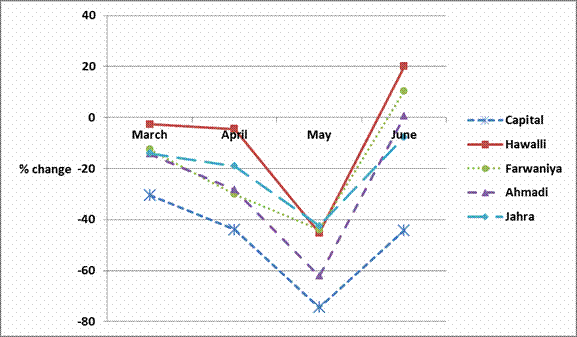
In all administrative health regions, there is a decrease
in the number of attendants to the diabetes clinics in PHC center during 2020
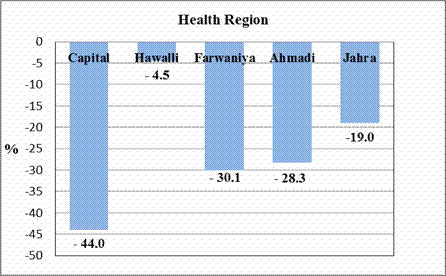
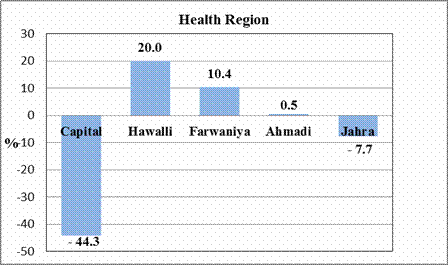
particularly in May. In the Capital Health Region, the percentage change in the
number of attendance to diabetes clinics during 2019 and 2020 was -30.5% in
March, -44.0% in April, -74.5% in May and -44.3% in June. The corresponding
figures for Jahra Health Region were -14.1%, -19.0%,
-42.5% and -7.7%.
The same pattern was seen in the other three
health regions except that during June 2020 the number of attendance overcome
that in 2019.
In Hawalli, the
percentage changes in March, April, May and March were -2.7%, -4.5%, -45.3% and
20.0%; whereas the corresponding figures in Farwaniya
were -12.5%, -30.1%, -0.44% and 10.4%.
In Ahmadi Region, there was a percentage
decrease of attendance during March, April and May (-14.3%, -28.3%, -62.2%). In
June the number of attendance was nearly the same in 2019 and 2020 with
percentage increase equal 0.5%.
It was notable that
reducing the number of staffs in diabetes clinics in PHC centers in different
health regions led to far patients' appointments at these clinics, which
ultimately led to a decrease in the number of patients visiting these clinics. Another
reason for having few numbers of patients at the diabetes clinic was reducing
the number of clinics due to closing some health centers of PHC under the laws
issued by the Ministry to reduce the number of employees or reduce the number
of the workforce in those centers. In addition, changing the function of some
health centers and transforming them to centers for receiving and treating
patients with Covid-19 had an impact on the number of patients at these regions.
Also, it was worth noting that one of the reasons for the decline in the number
of patients at the clinic was the patients' fear of close interpersonal contact
in clinics due to the Covid-19, and their adherence to social distancing by
staying at home and avoid interpersonal contact except in emergency cases that
require leaving their houses for fear of being infected with the Coronavirus,
which may negatively affects their health due to their lack of immunity as a
result of their chronic diseases. Furthermore, the state’s general laws had an
impact on the number of patients that visit the clinic, such as the laws of
total, partial and regional curfews that began on March 22, 2020
Our results went with that of other studies. The comprehensive effort to contain the pandemic and
minimize the subsequent morbidity and mortality has affected both the
continuity and quality of care for patients with chronic diseases. [11]
Resources at all levels have shifted away from chronic disease management and
prevention during the outbreak, and the lock-down of many services has
translated into reduced access, a decrease in referrals and reduced
hospitalizations of patients with non-COVID19 pathology. [12]
Scattered reports suggest chronic patients have postponed health care seeking,
some of them because of the fear of getting infected with the coronavirus. [13]
Among the services
that have been provided and worth mentioning was the service of medicine
delivery by firefighting and civil defense teams to the patients during periods
of total and partial curfew. It was one of the factors affecting in general to
reduce the number of patients in diabetes clinics in PHC centers, and upon the
end of the curfew imposed by the state, this service was stopped.
In June 2020, the
number of visits to diabetic clinics began to increase gradually. This was
because the end of curfew and holding the service of delivering the medicine to
patients at homes. Further, the decision to reopen outpatient clinics in
hospitals and primary health care centers, and the electronic appointment
reservations also contributed to the increase or return of patients to the
clinic and the increase in attendance rates.
-
Variation
in the percentage drop of the number of attendance to diabetic centers among
the different health regions:
The variations in the
numbers of patients who visit the diabetes clinic in the different health
regions in the State of Kuwait could be mainly due to the regional curfew that included
many regions in three governorates. In Farwaniya
governorate the rate of appointments after the total curfew has fallen to 44%
compared to the same month in the previous year. In Ahmadi governorate, 62%
decline in the number of visits was recorded in the same period. Also, in Hhawalli, a sharp decline in the number of appointments by
45.3% was recorded. The law of total lockdown of the aforementioned regions
continued until the end of May 2020, which led to the continued reduction in
the number of visitors till May.
After the cancellation of the total regional lockdown in general and the
partial lockdown timings were modified to be from 7 pm until 5 am, the number
of visitors to clinics increased, as shown in figure 2. It is noticeable that
in Farawaniya and Hawalli
health regions, the number of patients increased significantly in the month of
June, due to the suspension of the regional curfew in these two regions and the
attendance of the delayed patients for their monthly medicines.
In parallel
to the epidemic response, efforts to ensure existing healthcare services for
diabetic patients, especially primary care, should be supported to avoid health
consequences that might be worse than the epidemic itself. [14] Therefore
the committee for “Restarting non-communicable disease
clinics in Kuwait” developed an action plan and timetable for
the gradual return of non-communicable chronic disease clinics in PHC centers
in coordination with the concerned authorities as well as follow up the
implementation for this plan through establishment of three protocols of
action: NCD home visit protocol, NCD telehealth protocol and OPD protocol.
These protocols will be explained in details in further manuscripts.
Conflict of interest: None
References:
1.
WHO. Coronavirus disease 2019 (COVID-19). March 26,
situation report–66. (2020). https://www.who.int/docs/default-source/coronaviruse/situation-reports/20200326-sitrep-66-covid-19.pdf?sfvrsn=81b94e61_2
2.
WHO. WHO Director-General’s Opening Remarks at the Media
Briefing on COVID-19-11 March 2020. Available online: https://www.who.int/dg/speeches/detail/who-director-generals-opening-remarks-at-the-media-briefing-on-covid-19 11-march-2020 (accessed
on 15 May 2020)
3.
Remuzzi A, Remuzzi
G. COVID-19 and Italy: What next? Lancet. 2020;395:1225–1228.
4.
Torri E, Sbrogiò
LG, Di Rosa E, Cinquetti S, Francia
F, Ferro A. Italian public health response to the COVID-19 Pandemic: Case
report from the field, insights and challenges for the Department of
Prevention. Int J Environ Res Public Health. 2020;17(10):3666. doi: 10.3390/ijerph17103666
5.
Jackson, D; Bradbury-Jones C, Baptiste D, Gelling L,
Morin K, Neville Set al. Life in the pandemic: Some reflections on nursing in
the context of COVID-19. J. Clin. Nurs. 2020;29:13-14.
6.
Petrakis D, Margină
D, Tsarouhas K, Tekos F,
Stan M, Nikitovic D, et al. Obesity: a risk factor
for increased COVID‑19
prevalence, severity and lethality (Review). Mol Med Rep. 2020;22(1):9-19.
7.
Chudasama YV, Gillies CL, Zaccardi F, Coles B, Davies MJ, Seidu
S, et al. Impact of COVID-19 on routine care for chronic diseases: A global
survey of views from healthcare professionals. Diabetes Metab
Syndr. 2020;14(5):965-967.
8.
Wake D, Gibb F, Kar P, Kennon B, Klonoff D, Rayman G, et al. Endocrinology in the time of COVID-19. Remodelling diabetes services and emerging innovation. Eur
J Endocrinol. 2020;183:G67–G77.
9.
Beran D, Perone SA, Perolini MC, Chappuis F, Chopard P, Haller DM, et al. Beyond the virus: Ensuring continuity
of care for people with diabetes during COVID-19. Prim Care Diabetes. 2021;15(1):16-17.
10. Danhieux K, Buffel
V, Pairon A, Benkheil A, Remmen R, Wouters E, et al. The
impact of COVID-19 on chronic care according to providers: a qualitative study
among primary care practices in Belgium. BMC Fam Pract. 2020;21:255. https://doi.org/10.1186/s12875-020-01326-3.
11. WHO. Information note on COVID-19 and non-communicable
diseases. 2020. https://www.who.int/publications/m/item/ covid-19-and-ncds.
Updated March 23, 2020. Accessed June 21, 2020
12. Fagan M. Huge fall in non-Covid
hospital admissions and attendances. 2020. https://www.irishexaminer.com/news/arid-30997182.html
13. Verhoeven V, Tsakitzidis
G, Philips H, Van Royen P. Impact of the COVID-19
pandemic on the core functions of primary care: will the cure be worse than the
disease? A qualitative interview study in Flemish GPs. BMJ Open. 2020;10(6):e039674
14. Hartmann-Boyce J, Morris E,
Goyder C, Kinton J, Perring J, Nunan D, et al. Managing
diabetes during the COVID-19 pandemic. The Centre for Evidence-Based Medicine. 2020.
https://www.cebm.net/covid-19/managing-diabetes-during-the-covid-19-pandemic/