Background: Kwashi shakes is a rare
neurological complication of unknown aetiology in
children with severe acute malnutrition. Previous reports show that it
usually presents as coarse tremors one to eight weeks after commencement of
nutritional rehabilitation in children with kwashiokor.
We present a case of kwashi shakes with no prior
nutritional rehabilitation.This is the first case of kwashi shakes managed in our facility.
Methodology: A two year old male presented with a three day history of progressive
body swelling and jerky body movements. He stopped breastfeeding at one year
and was fed 2-3 times daily on mainly carbohydrates and beans. On
examination, he was conscious, apathetic, wasted, moderately
pale with sparse fluffy brown hair and pitting pedal oedema.His weight and length were 7kg and 69cm
respectively (Z-score of<-3SD for age and sex). He had continuous coarse trembling of the upper limbs and head
nodding. The trembling was worse during voluntary movements and reduced and
stopped during rest and sleep. His tone was reduced in all limbs.
Investigations showed a packed cell volume of 26%, elevated white cell counts, positive smear for plasmodium
falciparum and normal findings of serum glucose, calcium, electrolytes,
and cerebrospinal fluid analysis.
He responded to nutritional
rehabilitation, antibiotics, antimalarial and multivitamins. His symptoms
subsided over two weeks.
Conclusion: The case report shows
an unusual presentation of kwashi shakes where the
patient presented without any prior nutritional rehabilitation. Health care providers
should be on the lookout and should not confuse it with meningoencephalitis
or seizure disorder.
Accepted:19/10/2023
Published: 02/11/2023
*Corresponding Author
WoromaWonodi
E-mail: woroma.wonodi@ ust.edu.ng
Keywords: Jerking,
Kwashi Shakes, Nutritional Rehabilitation, Severe
Acute Malnutrition, Trembling.
INTRODUCTION
Malnutrition still remains a problem globally but especially in
developing countries like Nigeria1,2.
Globally, nearly 20 million children suffer severe acute malnutrition with majority of them in Asia and Sub- Saharan Africa according to
UNICEF1,2. Nearly half of all deaths in children under five years, are attributable to
undernutrition. Undernutrition puts children at greater risk of dying from
common infections, increases the frequency and severity of such infections, and
delays recovery.1 In Nigeria, 37 percent of
children, or 6 million children, are stunted (chronically malnourished or low height-for-age); more than half of these
severely.3
Severe acute malnutrition (SAM) is defined by a very low weight-for-height below -3
Z scores of the median World Health Organization (WHO) growth standards, manifest by visible severe wasting, or by the presence of nutritional oedema.2In children aged 6–59 months, an arm circumference
less than 110 mm is also indicative of severe acute malnutrition.
The management of SAM
involves initial treatment /stabilization, rehabilitation and follow-up onnutritional rehabilitation. The initial treatment/stabilization phase is to manage the immediate health problems like dehydration (fluid
resuscitation using rehydration
solution for malnutrition - RESOMAL),
infections (antibiotics, antimalarials), hypoglycaemia and initiate feeding (glucose and food such
as ready-to-use-therapeutic-feeds - RUTF), temperature regulation (kangaroo mother care - KMC , extra clothing for warmth), electrolyte imbalance ( multivitamins). It is in the rehabilitation phase that iron therapy is added, and finally follow-up is continued with emotional stimulation,
follow up visits, ensuring adequate weight gain. While refeeding the child,
protein is added using milk, animal protein etc.Sometimes, there is aggressive protein ingestion either at the hospital or at home
and these children may then rarely present with coarse jerking which imitates
Parkinson’s disease, in that it is worse during activity but
reduces and even stops during rest and sleep.This coarse shaking was called Kwashi shakes
in 1954 by Kahn in South Africa.4
Kwashi shakes is a rare neurological complication of oedematous SAM that occurs during nutritional
rehabilitation especially following aggressive feeding with protein especially
milk4. It usually manifests as coarse jerking of the limbs, head and
sometimes the abdomen and has a good prognosis resolving within a few days to
weeks.4,5 Kwashi shakes is also known as Parkinsonian tremors as it worsens with activities and
subsides with rest. It is not known why kwashi
shakes occurs in some children and not in otheres.4Kwashi shakes is usually self limiting.
It has been reported in
some countries like Jamaica,6South Africa4 andNigeria (during the Nigerian-Biafran Civil war and Sokoto).5,7During the Nigerian-Biafran civil war, malnourished children with kwashiorkor were noticed to have rhythmic twitching
shaking tremors, jerky movement of limbs, tongue and head 1-2 weeks following
introduction of better diet.5There was no loss of consciousness
and children could use thelimb to play.5 These children
recovered within a few weeks of onset, with no neurologic sequelae5.
The jerking was
different from meningitis, encephalitis and epilepsy, and all investigations
including cerebrospinal fluid (CSF) analysis and electroencephalogram (EEG) were normal.4.5 In Sokoto, four
cases were reported and all recovered fully.5
This is the first
reported case in Rivers State. In addition, this case is different in that it
is occurring without a prior nutritional rehabilitation, hence a call to actively look out for it in children with SAM. We report
this case to draw the attention of physicians and other health care providers to this mode of presentation.
CASE PRESENTATION
A 2 year old male
presented with complains of progressive weight loss of three months duration,
generalized body swelling and tremor on the upper limbs all of three days
duration. Weight loss was progressive as evidenced by looseness of previously
fitted clothes and child appearing smaller than peers. Body swelling was
noticed by father three days prior to presentation when he went to pick up the
child from the relative he had been staying with for about two months. Swelling
started from the face, then the abdomen, scrotum and then legs. No history of
reduction in urinary output.
Tremor
was first noticed on the left hand three days prior to presentation. It was
present only when patient is awake and disappeared with sleep. Tremors
gradually progressed to involve the right upper limb and head. It was
aggravated by voluntary movements (like feeding, lifting the hands) and reduced
or disappeared with rest and sleep. At onset of symptoms, he was given
multivitamins and with persistence, presented to our facility for expert
management. There was no previous history of hospital admission, surgery or
blood transfusion. Pregnancy was supervised in a primary health center,
uneventful and neonatal period essentially normal. He was exclusively breastfed
for 6 months, commenced on complementary feeds and stopped breastfeeding at one
year.He eats family diet that usually
consists of locally made cassava flakes (garri) and
soup, rice or beans and cereals 2- 3 times in a day. He took milk and eggs
sparingly. He fed himself but was sometimes assisted by elder siblings and
father. He was fully immunized in infancy according to National Programme on Immunization schedule and walked at one year.
Patient is the youngest of 4 children whose parents separated two months prior
to presentation. Father is a 30 year old mechanic apprentice with primary level
of education and mother is a housewife with primary level of education. Mother
abandoned the family two months prior to presentation and the children were
sent to live with paternal aunt. The father went to pick them a week prior to
presentation. Siblings are 11yr old female, 9yr and 6yr old males. Patient
lives with the father and siblings in a one bedroom apartment and did not sleep
under insecticide treated net. His source of drinking water was boiled borehole
water and refuse was disposed of a few meters away from the house.
At
presentation, he was moderately pale, had sparse brown fluffy hair, wasted with
loss of subcutaneous fat and had bilateral pitting leg edema up to the knees.
His weight and length were <-3SD on the WHO z- score (7kg and 69cm
respectively). His mid upper arm circumference (MUAC) was also low at 10.5cm.
He was conscious and apathetic and had continuous trembling of both hands (left
more than right) with nodding of the head. Tremors were worse when he attempted
voluntary movements like feeding, raising the hands or reaching out to take an
object and reduced or disappeared during rest or sleep respectively. Sometimes
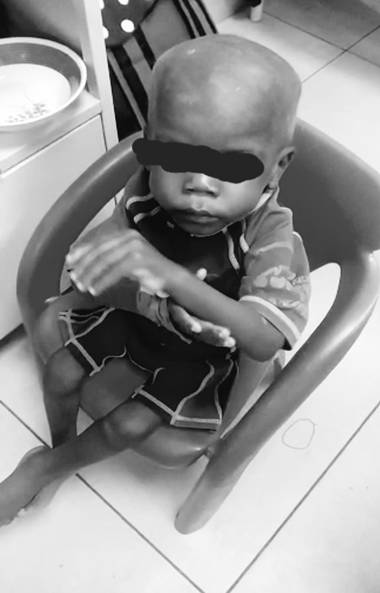
the tremors were so severe that he had to use one limb to support the other in
an attempt to control them. His tone was reduced in all limbs and deep tendon
reflexes were not exaggerated. Respiratory rate was normal at 30cpm and breath
sounds were vesicular. His abdomen was distended but no organs were palpable.
His heart rate was 107bpm and heart sounds 1 and 2 only were heard.
Investigations
done showed a packed cell volume of 26% with elevated white blood cell count,
normal blood sugar, normal serum electrolytes, urea and creatinine levels; normal
calcium, potassium and magnesium levels. The cerebrospinal fluid biochemistry
was normal and culture yielded no growth. Chest radiography was normal. Human
immunodeficiency virus, Hepatitis B and C serology tests were non-reactive. MP
showed 1+ of trophozoites of Plasmodium
falciparum.
He
was commenced on nutritional rehabilitation, antibiotics, anti-malarial
drugs and responded well to treatment with gradual resolution of symptoms
within two weeks.
Fig 1. Supporting the left upper limb
with the right due to the trembling
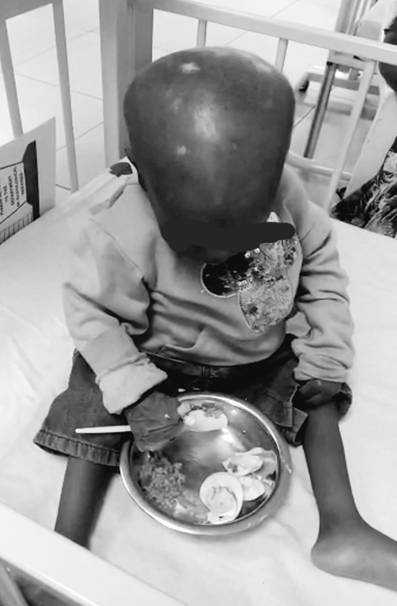
Figure 2: Still able to feed himself despite the
tremors. Note pedal oedema and wasting of the limbs
DISCUSSION
Kwashi shakes is a rare neurological complication that occurs
in children with oedematous forms of severe acute
malnutrition and occurs within days to weeks of refeeding
with protein-rich diet especially aggressive refeeding with
milk. This child presented ab initio with kwashi shakes meaning it occurred before refeeding. His investigation results were essentially
within normal limits. He responded well to treatment as expected, with no obvious neurologic sequelae.
The case presented is a
two year old child. The other children affected fell between 12-24 months.4-7 The reason may be that
these children are now fully introduced to family diet whose taste they are yet
to getting usedto. At this age also,
they are more prone to infections, are unable to feed themselves properly and
where there is food insufficiency they receive the least amount hence their
predisposition to malnutrition. The child in our report is a male similar to
the report inJamaica7as well in Sokoto,
Nigeria ( 3:1) in keeping with a male predilection to malnutrition in children
under the age of five years.8 Males may therefore have a higher
predilection to kwashi shakes based on being
numerically more undernourished.
There is no known cause
for kwashi shakes in this report although previous
studies related it to a complication of nutritional rehabilitation where there
was aggressive protein intake either in the hospital or at home. Although the
exact cause of Kwashi shakes is not known the
increase in food to a child who has been starved for sometime may be comparable
to the gene thrift theory9 where children who had inutero malnutrition now meet abundance postnatally
and this leads to obesity and diabetes mellitus in those who are genetically
predisposed. Is it possible that there may be a genetic predisposition to KS in
children withIn
Sokoto,5 one of the cases was fed 5 eggs a day by the grandmother in
a bid to hasten weight gain while other mothers who had unlimited access to
Ready-to-feed-therapeutic-feeds. In our case report however, this child was yet
to commence nutritional rehabilitation.
Kwashi shakes usually manifests as coarse jerking of
the limbs, head and sometimes the abdomen (resembling Parkinson’s disease)4-7 and this was also observed in the
index patient. The patient usually assumes a characteristic posture with
abduction of the shoulder joint and flexion of the elbow, and metacarpo-phalangeal joints which was seen occasionally in
our patient.4 During the Nigerian-Biafran
civil war, malnourished children with kwashiokor were
noticed to have rhythmic twitching shaking tremors, jerky movement of limbs,
tongue, head one to two weeks following introduction of better diet. It is not
associated with loss of consciousness and children could even use the limb to
play. The shaking is worse during activity but reduces and even stops during
rest and sleep.The index patient had
coarse tremors that were worsened when he tried to grab objects and disappeared
when he slept.
The clinical
presentation is a differential of meningitis/encephalitis hence CSF studies
were done. The absence of fever in this child did not support meningitis
/encephalitis as seen in other studies.4-6 There
were no abnormalities in CSF findings in previous studies.4-7 The
same was observed in our patient. All the patients including ours, were
conscious throughout.4-7
Other investigations to
rule out other diagnosis like epilepsy include EEG which is usually normal.
Brain MRI is usually normal. These investigations were not done for the index
patient.
It has been noted that
when serum calcium is normal there is quick resolution of kwashi
shakes5 just as happened in our patient. Hypocalcemic
patients usually take a longer time to recover. Although the reason for delayed
recovery in hypocalcemickwashi
shakes is not known we know that calcium is required for normal muscle
functioning and activity by stabilizing the resting membrane potential of
neurons thereby preventing spontaneous activation. Hypocalcaemia causes
increased neuromusccular excitability leading to
seizures, tetany, muscle fasciculations,
hyperthermia stiff gait, weakness and generalized
tremors10. It is therefore possible that the presence of hypocalcaemia
delayed the recovery of kwashi shakes in some patients5
while in its absence recovery was faster5 as in our case
report.
Management includes
converting the excessive protein intake4-7 and ensuring the child
receives only the recommended protein intake in nutritional rehabilitation and
this was done for our patient.
Our patient’s symptoms resolved with two weeks
similar to the reports from other studies.4,6These children recovered within a few weeks of onset and no neurologic
sequelae4-7 just like in this patient.
CONCLUSION
The case report shows an unusual presentation
of kwashi shakes where the patient presented without
any prior nutritional rehabilitation. Health care providers should be on the
lookout and should not confuse it with meningitis, encephalitis and seizure
disorder.
What is already known on this topic?
Children with oedematous severe acute malnutrition may have neurological complications such as
coarse tremors (Kwashi
shakes)
during recovery due to high protein diet.
What this study adds
Kwashi shakes may occur even before commencement of
nutritional rehabilitation.
Acknowledgments
We are grateful to all the
nursing staff and doctors that were involved in the care of this patient. Our
gratitude also goes to the social welfare unit of the RSUTH for providing
financial funds and assistance during the management of this patient.
Declaration of patient
consent
The authors certify that they have obtained all appropriate patient consent
forms. In the form the father of the patient has given his consent for his
son’s r images and other clinical information to be reported in the journal.
The patient’s father understands that their names and initials will not be
published and due efforts will be made to conceal their identity, but anonymity
cannot be guaranteed.
4. Kahn E.A Neuropathy of Children
Recovering from Malnutrition (Kwashiokor). the Central African Journal of Medicine. 1957;3(10):398-400
5. Isezuo KO, Amodu-Sanni M, Sani UM, Garba BI, Waziri UM , Ahmad
MM,et al. Coarse tremors(Kwashi shakes) occurring in children recovering from severe
acute malnutrition. Case series from a tertiary hospital in Sokoto.
Sahel Med J. 2022;25: 32
6. Thame M, Gray R, Forrester
T. Parkinsonian-like tremors in the recovery phase of kwashiorkor. West Indian
Med J. 1994 Sep;43(3):102-3. PMID: 7817535.
8. Thurstans S, Opondo C, Seal A, Wells J, Khara
T, Dolan C, Briend A, et al. Boys are
more likely to be undernourished than girls: a systematic review and
meta-analysis of sex differences in undernutrition. BMJ Glob Health.
2020;5(12):e004030. doi:10.1136/bmjgh-2020-004030
9. Myles S, Lea RA, OhashiJ, Chambers GK, Weiss JG, Hardouin
Eet al. Testing
the thrifty gene hypothesis: the Gly482Ser variant in PPARGC1Ais
associated with BMI in Tongans. BMC Med Genet2011. 12, 10. Available at https://doi.org/10.1186/1471-2350-12-10
10. Neurophysiology Module 9. Effects of Ca2+ and
Mg2+ on Neuronal Excitability. Available at https://pittmedneuro.com/ions.html. Accessed on 9/10/2023
Cite this Article: Wonodi,
W;Amaewhule, OU; Korub, SS (2023).
Kwashi Shakes in Port Harcourt, Nigeria - A Case Report. Greener Journal of Medical Sciences, 13(2): 193-198.