This experiment
was carried out using twelve linseed varieties namely;(Bekoji-14, Kassa-2,
Welen, Bekoji, Kuma, Yadano, Furtu, Bakalcha, Dibane, Horesoba, Jitu and
local check) were sown in RCBD with three replications during the 2022 and
2023 main cropping season with the objective, to evaluate the performance of
improved linseed varieties and their genetic variability for seed yield and
related traits in to study areas. All important data were collected and
analyzed by using R-software accordingly. Combined analysis of data from the
three locations revealed that there is significant difference among
varieties for days to flowering, days to maturity and grain yield, but
non-significant for plant height (cm), number of primary branches per plant
and number of capsules per plant. Significant effect of location was
observed in plant height, number of primary branch per plant, number of
capsule per plant and grain yield however non-significant in days to
flowering and days to maturity. The interaction of Variety X location was
significant for days to flowering, days to maturity, plant height and grain
yield, however non-significant for number of primary branch per plant and
number of capsule per plant. The maximum seed yield was recorded in variety
Kuma (1588.9 kgha-1) followed by Beokoji-14 (1476.7 kgha-1) and the lowest
yield (978.9 kgha-1) was obtained from local check. The combined AMMI
analysis for seed yield across environments revealed significantly affected
by environments that hold 26.6% of the total variation. The genotype and
genotype by environmental interaction were significant and accounted for
12.40% and 19.42% respectively. Principal component 1 and 2 accounted for
10.78 % and 6.13% of the GEI respectively with a total of 16.91% variation.
Therefore, Kuma and Bekoji-14 varieties were identified as the best
varieties for yielding ability, stability and recommended in the area and
with similar agro-ecologies.
Among oil crops,
linseed (Linum usitatissimum L.) is
one of the ancient oilseeds cultivated for oil, food and fiber (Nozkova et al., 2016). The haploid chromosome
number of Linseed is 15 (n =15), and the diploid chromosome number is 30 (2n
=30). It is an important oil crop cultivated worldwide for oil and fiber. Ethiopia’s
oilseed crop, which is quickly expanding to fulfill both domestic and
international demand, is critical to the country’s foreign exchange revenues
and income. Oilseed exports account for about 11.5% of Ethiopia’s total export
profits. Oilseeds supplied 5.90% (766,167.66 ha) of grain crop area and 2.27%
(7,774,444.17 quintals) of grain production to Ethiopia’s national grain total
(CSA, 2021). Niger seed, sesame, and linseed accounted for 1.48% (19.766.00
ha), 2.85% (369,897.32 ha), and 0.61% (78,921.37 ha), respectively, of the
grain crop area. These crops account for 0.63%, 0.76%, and 0.24% of grain crop
production, respectively. The European top producer is the Russian Federation
(13.86%) (Jovovic et al.,2019). The
crop is largely grown in temperate climates and cool tropics, including the
highlands (>2500 m above sea level) of Ethiopia. It thrives best at
altitudes of 2200–2800 m above sea level in Ethiopia, but it can also be grown
at 1200 m and 3420 m above sea level (Behailu et al., 2019). Linseed grows in cold weather ranging from 10–30°C,
but it produces the best harvests when temperatures are between 21–22°C during
the growth period. In fact, linseed is the second biggest oil plant in terms of
acreage cultivated and yield in the highland areas of Ethiopia, after Niger
seed (W. Adugna ., 2000). In Ethiopia, linseed supplies 10.3% (78,921.37 ha) of
the oilseed crop area and 10.35% (80,456.64 tons) of the production of the
national oilseed total (CSA, 2021). Despite its diverse uses for the local oil
sector and foreign currency earnings, linseed productivity in Ethiopia is
characterized by low yield, with an average yield of 10.2 qt ha-1 (CSA,
2021) compared to more than 1.5 t/ha in developed countries (FAO, 2008). In
Oromia region linseed covered 27,661.60 hectares of cultivated land and has a
production of about 310,824.57 quintals with average yield of 11.24 qt ha-1
(CSA, 2021). This indicates in the Oromia region linseed production
potential is better. Even though there is no production status of the study
area for this crop appropriate improved variety is crucial in order to increase
the production.
Some attempts have
been done to improve the limitation of ideal linseed varieties for the area of Buno
Bedele zone by Jimma Agricultural Research Center (JARC). However, that is not
enough and satisfying the farmers demand regarding the option and accessibility
of improved varieties. Hence, this study was conceived to evaluate the newly
released linseed varieties to the agro-ecology of the Buno Bedele zones of
south western Oromia region, Ethiopia and identify the most high yielders and
stable varieties for the farmers. One of the major production barriers affecting
linseed productivity is lack of access to improved varieties, which is why the
majority (>90%) of Ethiopian farmers use unimproved seeds (FAO, 2010). On
the contrary, the Ethiopian Institute of Agricultural Research has released
more improved linseed varieties (MoA, 2016) that, if properly assessed and
produced by farmers, have the potential to increase crop output. Every crop
improvement effort begins with a breeder looking into the existence of genetic
variability for the desired traits (Kahsay et al., 2020). Ethiopia is believed
to be the secondary place of variation, and it is the world’s fifth largest
linseed producer (W. Adunya, 2007). Ethiopia’s diverse agro climatic conditions
may have led to the country’s linseed crop diversification. However, having
variance in a population is not enough to improve desired qualities and little
or no research on the genetic variability of released linseed varieties has
been conducted. As a result, breeders must evaluate the degree and distribution
of genetic diversity in the genetic materials that are readily available. The
crop genotypes grown in different environments would frequently encounter
significant fluctuations in yield performance, particularly when the growing
environments are distinctly different, the test genotypes differentially
respond to changes in the growing environments or both. AMMI is a multivariate
tool, which was highly effective for the analysis of multi environment trials
and in the recent years, this method has often been used by international
agricultural development agencies (Grüneberg et al., 2005). The most recent method, the GGE (genotype main
effect (G) plus G x E interaction) biplot model, provides breeders a more
complete and visual evaluation of all aspects of the data by creating a biplot
that simultaneously represents mean performance and stability, as well as identifying
mega-environments (Ding et al., 2007; Yan and Kang, 2003). In this study, we
attempted to apply AMMI and sites regression GGE biplot statistical model for
determination of the magnitude and pattern of G × E interaction effects and
performance stability of seed yield of 12 linseed genotypes.
2.MATERIALS AND METHODS
2.1. Description
of the study Areas
The field experiment
was conducted during the 2022 – 2023 G.C main cropping seasons for two years at
three districts (Bedele, Dabo Hana and Didesa) of Buno Bedele Zone, South
Western Oromia where agro ecology assumed to be conducive for Linseed production
(Table 1).
Table 1 Agro-ecological
features of the experimental Locations
Locations
Altitude(m.a.s.l)
R/fall (mm)
Soil Type
Geographical Coordinates
Ave. Temperature (OC)
Latitude N
Longitude E
Max.
Min.
Bedele
1300-2200
1200-1800
Nitosols
8°28'60.00"
36°20'60.00"
28.5
12.5
Dabo
Hana
1791-1990
1300-1945
Nitosols
8°55ʹ60 20”
36°26ʹ 19.00”
25.8
12.9
Didessa
1945-2340
1250-2000
Nitosols
8°04'60.00"
36°39'59.99"
28
13
Source:
Different literatures
2.2. Experimental
Materials
Eleven improved linseed
varieties from the Holetta, Kulumsa and Sinana Agricultural Research Centers,
as well as one local check from farmers, were collected and evaluated for
performance and variability over seasons (Table 2).
Table 2. Description of the
linseed varieties used for this study
Varieties
Year of release
Releasing
center/Maintainer
Seed Color
Bekoji-14
2014
HARC (EIAR)
Brown
Kassa-2
2012
HARC (EIAR)
Yellow
Welen
2019
KARC (EIAR)
Brown
Bekoji
-
SARC (EIAR)
Brown
Kuma
2016
KARC (EIAR)
Brown
Yadano
2015
KARC (EIAR)
Brown
Furtu
2013
KARC (EIAR)
Brown
Bakalcha
2010
KARC (EIAR)
Brown
Dibanne
2009
SARC (OARI)
Brown
Horesoba
2019
SARC (OARI)
Brown
Jitu
2012
SARC (OARI)
Brown
Local
-
-
Brown
Remark:
HARC=Holetta Agricultural Research Center, KARC=Kulumsa Agricultural Research
Center, SARC=Sinana Agricultural Research Center, EIAR=Ethiopia Institute of
Agricultural Research & OARI=Oromia Agricultural Research Institute
2.3. Experimental
Design and Field Work
The treatments were
laid with a randomized completed block design (RCBD) with three replications
was used in the study. The experimental plots were 1.5 m × 2 m (3m2)
in size, with rows separated by 0.3m. The distance between plots and blocks was
0.5 m and 1m, respectively. Each plot had five rows, with the middle three used
for the collection of the data and the two outermost rows were used as border
rows. The experimental sites were plowed three times with draught animals
called oxen before planting, and 25 kg ha−1 seed rate was used
for planting. After weighing the seeds with a sensitive balance, they were
assigned to each row, and drilling was used for planting. Planting occurred
during 2022 and 2023 main cropping seasons, following the onset of rain and
when the locations received the moisture required for germination. Hand weeding
was used three times during the experiment’s growing seasons, and 30 kg ha−1
of urea and 50 kg ha−1 of NPS fertilizer were used according
to crop recommendations. Harvesting begins in the last week of November of each
cropping year, based on the maturity time of the varieties.
2.4. Data
Collection
Data on flowering
days, maturity days, number of primary branch/plant, capsule number/plant,
plant height, and seed yield per plot were collected from the three middle
rows. Data for days to flowering, days to maturity, and seed yield were
collected on a plot basis on three middle rows.
Days to
flowering -
were calculated from the date of planting when 75% of the crop stand produced
the first flower.
Days to
maturity -
The number of days from planting to physiological maturity of the plants was
used to compute the days to maturity.
Plant
height -
the average height of five randomly selected plants, measured from the base to
the tip of the plant.
The
number of primary branch/plant - was recorded as the average number of
primary branch from five randomly sampled plants taken from the three middle
rows of the plots
The
number of capsules per plant - It was calculated as the mean number of
capsules collected from five randomly selected from the three middle rows of
the plots.
Seed
yield (kg plot−1) - It was calculated as the entire seed yield
produced from the plants harvested and threshed and converted into seed yield
per hectare.
2.5. Analysis
of Variance
The ANOVA was run for
the three locations separately and combined over the three locations for all
characters using R software. Analysis of variance was carried out to partition
the variance due to genotype, environment and genotype by environment
interaction, replication within environment and block within replication. The
combined analysis of variance was carried out to estimate the additive effects
of the environment, genotype and GEI.Mean
separations were estimated using Least Significant Difference (LSD) for the
comparison among the experimental varieties at 0.05 probability level.
ANOVA model for a
single location as: Yijk= µ + Gi +Rj +
Bkj + Eijk
ANOVA model for the
combined over locations as: Yijkr = µ
+Gi + Lj + Rk(Lj) + Br(LjRk) + GiLj + Eijkr., Where Y is the performance of
genotype i in jth location, kth replication and rth
incomplete block, μ is the mean effect, Lj is the effect of jth
location, Rk(Lj) the effect of the kth replication in location J, Br
(LjRk) is the effect of rth incomplete block in jth
location and kth replication, GiLj is the interaction effect of
genotype i and location j and εijkr is the error associated with the ith
genotype, jth location, kth replication, rth
incomplete block
2.6. Stability
Analysis
Yield stability of
the genotypes was evaluated using different models: Yield stability index
(YSI), AMMI Stability Value (ASV), Additive Main Effect and Multiplicative
Interaction (AMMI) model and Genotype Main Effect and Genotype x Environment
Interaction Effect (GGE) biplot analysis were used to determine the effects of
GEI on yields. These analyses also were performed using R software.
2.6.1. Yield
stability index (YSI)
This measurement was
developed by (Farshadfar et al., 2011).
Stability by itself should not be the only measurement for selection, because
the most stable genotypes would not necessarily give the best yield performance. This method is vital to measure and rank genotypes
based on grain yield stability. The summation of rank of ASV and rank of yield
are used to calculate YSI. The genotype with least YSI is considered as the
most stable with high grain yield (Dabesa et al., 2016).
YSI was
calculated as: YSI = RASV + RY, Where: RASV is the rank of AMMI stability
value, RY is the rank of mean yield of genotypes across environments.
2.6.2. AMMI
Stability Value
The ASV is the
distance from the coordinate point to the origin in a two dimensional scatter
length of IPCA1 scores against IPCA2 scores in the AMMI model (Purchase, 1997). AMMI Stability
Value (ASV), length of genotype and environment markers of the origin in a two
dimensional plot of IPCA1 scores against IPCA2 scores was calculated as follow (Purchase, 1997).
Where: IPCA1=
interaction principal component axis 1; IPCA2 = interaction principal
component, axis 2. Genotypes with lower values of the ASV are considered to be
more stable
2.6.3. Additive
main effect and multiplicative interaction (AMMI) model
Additive Main Effect
and Multiplicative Interaction (AMMI) is one of most widely used model to
explain G×E interaction of multi-environment genotype trial and categorizing
the genotypes into narrow or wider adaptation (Crossa et al., 1990). The AMMI analysis uses analysis of variance (ANOVA)
followed by a principal component analysis applied to the sums of squares
allocated by the ANOVA to the GEI (Kempton et
al., 1984).
The AMMI Model
Equation is: Ῡijk =µ+Gi +Ej
+Σmk=1 λkαikγjk +Рij
Where: Ῡijk. =
the yield of the ith genotype in the jth environment, Gi
= the mean of the ith genotype minus the grand mean, Ej = the mean
of the jth environment minus the grand mean, λk = the square root
of the Eigen value of the kth IPCA axis, αik and γjk = the
principal component scores for IPCA axis k of the ith genotypes and
the jth environment, Рij = the deviation from the model
2.6.4.Genotype main effect and genotype by environment
interaction (GGE) biplot
The GGE biplot
(Purchase, 1997) model is: Yij
-μ-βj = λ1Ԑi1ηj1 + λ2Ԑi2ηj2 + Ԑij
where: Yij=
the performance of the ith genotype in the jth environment; μ =
the grand mean; βj = the main effect of the environment j: λl and λ2 = Singular value for IPCA1
and IPCA2 respectively: Ԑi1 and Ԑi2 = Eigen vectors of genotype i
IPCA1 and IPCA2 respectively: ηj1
and ηj2 = Eigen vectors of environment j for IPCA1 and IPCA2 respectively;
Ԑij = Residual associated with genotype i and environment j.
3. RESULTS
AND DISCUSSIONS
3.1. Analysis
of Variance
The ANOVA revealed
highly significant differences (p<0.01) for seed yield at Bedeele-2023 only
and significance differences (p<0.05) at Dabo Hana-2022, Dabo hana-2023,
Bedele-2022 and Didesa-2023.
3.1.1.
Seed Yield
The average
environmental seed yield across varieties ranged from the lowest of 1088.7 kgha-1
at Didesa -2023 to the highest of 1662.9 kgha-1
at Dabo Hana-2023), with a grand mean of 1294.6 kgha-1 (Table 4).
The varieties average seed yield across environments ranged from the lowest of 978.9kgha-1 for local check to the highest of 1588.9a
kgha-1 for Kuma (Table 3). This difference could be due to their
genetic potential of the varieties, and also environment explained large
variation indicated the existence of diverse mega environments.
Table 3 Mean seed yield
(kgha-1) of twelve (12) linseed varieties evaluated at five
environments
Mean of seed yield of 12 linseed varieties across environment
Varieties
D/Hana-2022
D/Hana-2023
Bedele-2022
Bedele-2023
Didesa-2023
Mean
YAd.(%)
Bekoji 14
2288.89a
1400.00bc
1233.33abc
1444.4a
1016.7bc
1476.7ab
50.85
Kassa-2
1633.33bcd
1434.44abc
1177.78bc
1077.8abc
1000.0bc
1260.2bc
28.74
Welen
1511.11bcd
1544.44ab
1144.44bc
1400.0a
1066.7bc
1333.3abc
36.20
Bekoji
1633.33bcd
1355.56bcd
1033.33c
773.3cd
1225.6ab
1204.2cd
23.02
Kuma
1788.89b
1527.78abc
1566.67a
1627.8a
1433.3a
1588.9a
62.31
Yadano
1322.22cd
1722.22a
1077.78c
1244.4abc
1277.8ab
1328.9bc
35.75
Furtu
1755.56bc
1416.67bc
1455.56ab
788.9bcd
1233.3ab
1330.0abc
35.87
Bakalcha
1577.78bcd
1090.00d
1146.67bc
1264.4abc
794.4c
1174.7cd
20.00
Dibanne
1744.44bcd
1473.33abc
1077.78c
1466.7a
983.3bc
1349.1abc
37.82
Horesoba
1725.00bcd
1296.67bcd
1250.00abc
1373.3ab
1058.3bc
1319.3bc
34.77
Jitu
1750.00bcd
1368.33bcd
1000.00c
694.4cd
950.0bc
1191.3cd
21.70
Local
1255.56d
1244.44cd
1066.67c
338.9d
988.9bc
978.9d
-
Mean
1662.96
1404.17
1192.78
1124.5
1088.7
1294.6
LSD (0.05)
440.23
291.80
378.56
590.61
322.2
259.8
CV %
16.08
12.16
17.87
31.02
16.95
27.8
P-value
*
*
*
**
*
**
Remark: LSD=
Least significant different, CV= Coefficient of variation, *=significant at
P<0.05 level, **=highly significant YAd.=Yield Advantage Over local check,
3.1.2. Yield
related traits
The results of the
combined analysis of variance are depicted in Table 4. The combined analysis of
variance over the five sites for two seasons revealed a significant (P <
0.01) difference in flowering days and maturity days however, non-significant
for plant height, number of primary branch and number of capsule per plant
between the studied varieties. Accordingly, the tested linseed varieties shows
statistically significant variation that ranged from 47.1(Kassa-2) and 85.0
(Local check) for days to flowering and 127.8 (Kassa-2) to 153.4(local
check) for days to maturity. From this result kassa-2 was the earliest to
maturity whereas local check was the late maturing variety. A similar result
was reported by (F.Amsalu et al.,
2020).
Table 4 Combined mean yield
and other parameters of linseed variety adaptation trial across the three
locations
Varieties
DTF (days)
DTM (days)
PLH (cm)
NPB/PL(no)
NC/PL(no)
Disease Reaction
Bekoji-14
59.2cd
144.9b
80.4
5.2
27.6
0
Kassa-2
47.1g
127.8f
81.2
5.7
27.9
0
Welen
52.9f
131.5e
74.7
4.4
23.8
0
Bekoji
56.9de
142.9bcd
80.1
4.9
26.9
0
Kuma
62.8bc
142.0d
79.4
5.2
27.3
0
Yadano
56.9de
144.3bc
70.9
4.2
23.3
0
Furtu
63.7b
131.7e
77.9
4.4
22.1
0
Bakalcha
54.0ef
130.0e
73.8
4.4
21.6
0
Dibanne
57.3de
142.8bcd
78.3
4.0
23.8
0
Horesoba
57.2de
142.2cd
76.5
4.6
23.5
0
Jitu
56.6de
142.6cd
79.3
4.4
25.1
0
Local
85.0a
153.4a
78.4
4.5
22.7
0
Grand Mean
59.1
139.68
77.6
4.7
24.6
LSD (0.05)
3.6
2.15
6.9
1.0
6.2
CV %
8.5
2.14
12.3
9.6
14.7
P-value
***
***
NS
NS
NS
Remark: DTF= Days to Flowering, DTM= Days to Maturity, PLH= Plant height (cm),
NPB/PL= Number of primary branch per Plant, NC/PL= Number of capsule per Plant, LSD= Least significant different, CV=
Coefficient of variation, NS= Non-significant, *** significant at 0.001 probability level
3.2.
Combined Analysis of Variance for seed yield and yield-related traits
The combined analysis
of variance showed that significant differences were recorded across location
for most of parameters except number of primary branch per plant and number of
capsule per plant. After testing the homogeneity of error variances of the test
locations, the combined analysis of variance was conducted for each trait with
special focus on grain yield and other agronomic traits in order to examine the
presence of significant effect of locations, varieties and varieties x location
interactions.
The mean square of
analysis of variance (ANOVA) is presented in Table 5. Significant differences
were detected among the main and the interaction effects at (p ≤ 0.05)
and (p<0.001) for most of the parameters.
Table 5: Mean square value of
combined Analysis of Variance (ANOVA) for seed yield and yield related traits
of twelve (12) Linseed varieties tested at three locations for two years
SOV
DF
DTF(days)
DTM(days)
PLH(cm)
NPB/PL(no)
NC/PL(no)
SY (kgha-1)
Loc.
2
11.07ns
9.20ns
1947.41***
15.22***
1222.38**
2064407**
Rep.
2
0.71ns
21.05*
37.44ns
0.3098ns
26.87ns
3895ns
Yr.
1
18.78ns
1.00ns
2557.94***
56.94***
1047.82***
962579***
Var.
11
1278.28***
877.47***
141.46***
2.86*
76.42ns
356370**
Var.*Loc.
22
151.33***
28.26***
69.06**
2.17ns
51.63ns
104936*
Var.*yr.
11
4.54ns
10.44*
90.67*
1.35ns
71.10ns
166036**
Loc.*yr.
2
2.35ns
3.55ns
40.30ns
0.04ns
1205***
163402*
Var.*Loc.*yr.
22
1.17ns
3.37ns
13.10ns
0.89ns
18.51ns
182392**
Pooled error
118
6.19
5.42
38.56
1.52
41.73
60645
CV
8.50
2.14
12.30
9.60
14.70
27.80
Remark:SOV=source of variations, DF=degree of freedom, DTF=days to flowering, DTM=days to maturity, PLH=plant height, NPB/PL=number of primary branch per plant, NC/PL=number of capsule per plant, GY=grain yield,Loc.=Location, Rep=replication, yr.=year, Var.=variety, CV=coefficient of variations,*=significant 0.05 probability level, **=significant at 0.01 probability level, ***=significant at 0.001 probability level
3.3. Stability
Analysis
3.3.1. Yield
Stability Index (YSI)
Yield stability index
incorporates both mean yield and stability in a single criterion. The minimum
values of YSI desirable genotypes with high mean yield and stability.
3.3.2. AMMI
Stability Value (ASV)
The ASV measure was
proposed to cope up the fact that the AMMI model does not make a provision for
a quantitative stability measure (Purchase, 2000). Depending on this method,
genotype with least ASV score is the stable, accordingly, variety Kassa-2
followed by Kuma and Horesoba were the most stable respectively. While local,
Bekoji-4, Furtu, Dibanne and Jitu were unstable varieties (Table 6). The
greater the IPCA scores (Negative or Positive), the more specifically adapted
variety is to certain environment. The closer the IPCA scores to zero, the more
stable the genotype over the tested locations. The further away from zero the
IPCA score for the environments is the more interaction the environment has
with the genotypes, thus making difficult to choose genotypes for that
environment.
Table 6: The first and second
IPCA, Grain Mean yield and different yield stability statistics investigated in
linseed varieties over locations.
Varieties
Yield (kgha-1)
rY
PCA1
PCA2
ASV
rASV
YSI
Bekoji-14
1476.7
2
9.72
-16.40
23.69
11
13
Kassa-2
1260.2
8
-0.29
0.68
0.85
1
9
Welen
1333.3
4
6.44
8.88
14.38
4
8
Bekoji
1204.2
9
-9.45
-1.37
16.67
5
14
Kuma
1588.9
1
5.04
5.01
10.74
2
3
Yadano
1328.9
6
-1.48
17.55
17.74
6
12
Furtu
1330.0
5
-12.22
-5.04
22.06
10
15
Bakalcha
1174.7
11
10.04
-2.98
17.90
7
18
Dibanne
1349.1
3
10.5
1.01
18.47
9
12
Horesoba
1319.3
7
7.85
-0.22
13.80
3
10
Jitu
1191.3
10
-9.02
-9.02
18.25
8
18
Local
978.9
12
-17.49
1.91
30.79
12
24
Remark: rY=rank in yield, IPCA=interaction principal component,
ASV=ammi stability value, rASV = rank in ammi stability value, YSI=yield
stability index
3.3.3. Additive
Main Effects and Multiple Interaction (AMMI) model
The mean squares for
all varieties evaluated under different environmental condition for seed yield
are presented below (Table 7). The result indicated that differences among all
varieties were significant (P ≤ 0.01). Variation due to genotypes by
environments interaction was significant for the studied traits, indicated that
genotypes differ genetically in their response to different environment. The
genotypes by environments interaction was significant effect on the seed yield,
which explained 19.42% of the total variation whiles the genotypes, contributed
12.40% of the variation. However, large portion (26.11%) of the total variation
was attributed to the environmental effect. The environment explains a major
amount of the yield differential, showing that the environments were different,
according to AMMI.
Table 7 Additive main effect
and multiplicative interaction analysis of variances (AMMI) for seed yield of
twelve Linseed varieties
Source
D.F.
S.S.
EX.SS %
M.S.
Environments
4
8257629
26.11
2064407**
Genotypes
11
3920071
12.40
356370*
Interactions (G x E)
44
6141309
19.42
139575**
PCA1
14
3408677
10.78
243477*
PCA2
12
1939471
6.13
161623*
PCA3
10
642666
2.03
64267ns
PCA4
8
150494
0.48
18812ns
Residuals
110
6696354
21.17
60876
Total
223
31624273
100
141813
Remark:
DF=degree of freedom, SS=sum of square, EXSS=explained sum of square, MS=mean
sum of square, PCA= = Interaction
Principal Component Axis
3.3.3.1
AMMI 1 Biplot
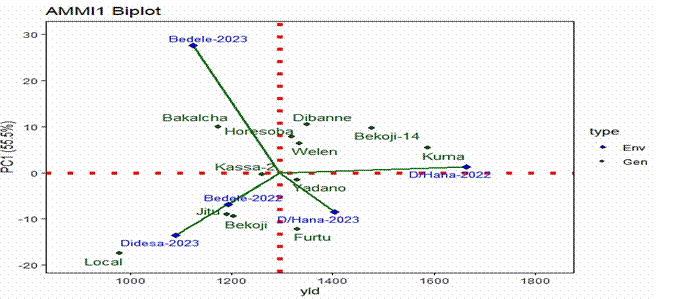
In AMMI biplot 1
showing main effects means on the abscissa and principal component (IPCA)
values as the ordinates, genotypes (environments) that appear almost on a
perpendicular line have similar means and those that fall on the almost
horizontal line have similar interaction patterns. Genotypes that group
together have similar adaptation while environments which group together
influences the genotypes in the same way. Genotypes (environments) with large
IPCA1 scores (either positive or negative) have high interactions whereas
genotypes (environments) with IPCA1 score near zero have small interactions.
AMMI-1 considers
genotype and environment main effects plus the PCA1 to interpret the residual
matrix and represented genotype productivity. It is further stated that any
genotype with PCA1 value close to zero shows general adaptation to the tested
locations whereas a large genotypic PCA1 score reflects more specific
adaptation to location with PCA1 scores of the same size. Genotypes and environments
with IPCA1 scores of the same sign produce positive interaction suggesting
adaptation of genotypes in those locations whereas the reverse sign of PCA
value of genotypes and locations depicts negative interaction i.e., poor
performance of genotypes in such locations. In summary, a stable genotype might
not be the highest yielding. Genotypes having a zero IPCA1 score are less
influenced by the locations and adapted to all locations.
The closer the IPCA
score to zero, the more stable the genotypes over the tested environments. Since
IPCA1 scores of Linseed varieties Welen, Horesoba and Kassa-2, were close to
zero, they were more stable varieties that across these locations. However, the
mean yield of Kassa-2 had a mean yield below average, therefore, they are least
preferable. A variety showing high positive interaction in environments has the
ability to exploit the agro ecological and agro-management conditions of the
specific location and is therefore best suited to that location. In this case,
Kuma and Bekoji-14 linseed varieties are suited for Dabo Hana. Linseed
varieties Furtu is suited for Dabo Hana-2023. Linseed varieties Bakalcha is
suited for Bedele-2023 and Jitu variety is suited for Bedele-2022.
Figure
1: AMMI bi plot of IPCA 1 against grain
yield of 12 linseed varieties across locations
3.3.4. GGE
Bi-plot Analysis for Grain Yield
3.3.4.1
Ranking of Genotypes
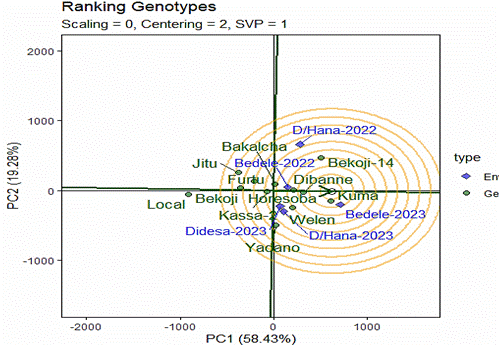
Stability can be
identified using concentric circles and also ideal genotypes are at the center
of the concentric circle. The ideal genotype is the one that with the highest
mean performance and absolutely stable (Purchase, 2000). The genotypes that are
closer to the ideal genotypes are the best performing genotypes. Hence, the GGE
bi plots shows that Kuma is an ideal variety, with other varieties, like
Dibane, Horesoba, Welen and Bekoji-14 are desirable varieties as they are closer
to the ideal variety on the bi plot. The varieties local and Jitu are the most
undesirable varieties as they are too far to the ideal variety on the bi plot.
Figure 2: Ranking of the
genotypes based on the ideal genotype
3.3.4.2.
Ranking of Environments
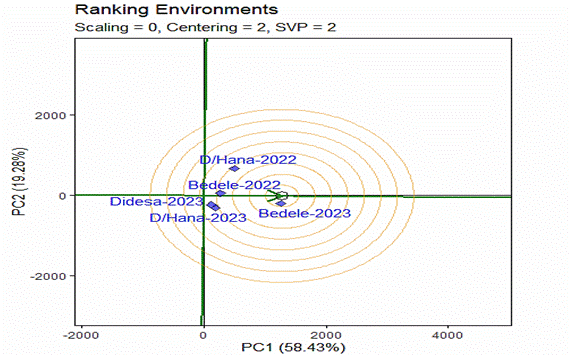
Figure 3:
Ranking of the locations based on the ideal locations
The most representative
of the locations (ability to represent the mega environment) and the most
powerful to discriminate varieties reported that the ideal environment is the
one located at the center of the concentric circles, and it is possible to
identify desirable environments based on their closeness to the ideal
environment (Radet al., 2013) reported that a testing
location has less power to discriminate genotypes when located far away from
the center of the concentric circle or to an ideal location. Therefore, among
the test locations, location Bedele which fell into the center of concentric
circles was an ideal test location in terms of being the most representative of
the overall locations and the most powerful to discriminate the performance of
the tested genotypes. Next to the first concentric circle location, locations
Dabo Hana-2022 is close to the ideal location while, Didesa is detected as the
weakest locations to discriminate varieties.
3.3.4.3.
Which-Won-Where Pattern
The polygon view of
GGE bi plot indicates the best genotypes in each environment and group of
environments (Yan et al., 2002). In this situation, the polygon is formed by
connecting the genotypes that are farthest away from the bi plot origin, such
that all the other genotypes are contained in the polygon. In this case, the
polygon connects all the farthest genotypes and perpendicular lines divide the
polygon into sectors. Sectors help to visualize the mega-environments.
This means that
winning genotypes for each sector are placed at the vertex. Polygon view of the
linseed varieties tested at three locations presented in (figure 4). The
genotypes found at the vertex of the polygon perform best in the environments
within the sector (Tinker et al., 2006). Six rays divide the bi plot in to six sector
and the locations fall in to three different mega-environments (Figure.4).
Figure
4 Which won where pattern
Accordingly, Yadano,
Kuma, Bekoji-14, Jitu and local varieties were the vertex varieties. From this
figure, Yadono variety was best performer at Didesa and Dabo Hana 2023 in mega
environment. The second environment containing the higher yielding environment
Bedele-2023, with winner variety Kuma. The third environment includes Dabo
Hana-2022 with a winner variety Bekoji-14. From the figure, Jitu and local had
no environment on the vertex. This indicates that varieties in the vertex
without environment performed poorly in all the locations.
4. CONCLUSION AND
RECOMMENDATION
Combined analysis of
variance (ANOVA) result revealed significant difference of seed yield and most
of yield contributing traits among evaluated Linseed varieties across
locations, years and the interactions. This indicated that, the location and
fluctuation of weather condition over the cropping season had affected
performance of varieties. Although the GEI of grain yield partitioned in to
different IPCAs using AMMI model analysis, the first principal component axis
for interaction alone explains most of the interaction sum of squares. The sign
and magnitude of IPCA scores showed the relative contribution of each genotype
and environment for the genotype and environment interactions.
This helps to
summarize the pattern and magnitude of GEI and main effects that reveal clear
insight into the adaptation of genotypes to environments. This shows that, Kuma
and Bekoji-14 varieties are fewer contributors to the interaction effect and
have consistent performances across locations. Therefore, Kuma and Bekoji-14
were identified as the best varieties in terms of yielding ability, stability
and better agronomic performance.
Acknowledgments
The authors greatly
acknowledged Oromia Agricultural Research Institute (IQQO) for the financial
support and Sinana, Kulumsa and Holetta Agricultural Research Centers are also highly
acknowledged for providing the linseed improved varieties also all research
staffs for technical support.
5. REFERENCES
Amsalu, F (2020).
“Estimates of heritability, genetic and principal components analysis for yield
and its traits in linseed genotypes (Linum
usitatissimum L.) in central highlands of Ethiopia,” International Journal
of Research in Agriculture and Forestry, vol. 7, no. 9, pp. 1–6, 2020a.
Behailu, S. Yechalew,
H. Mesfn, A. and T. Abush, Linseed (Linum
usitatissimum L.) Variety Adaptation at South Western Ethiopia, vol. 5, no.
4, pp. 41–45, 2019.
Crossa,
J., Gauch Jr, H.G. and Zobel, R.W., 1990. Additive main effects and
multiplicative interaction analysis of two international maize cultivar trials.
Crop Science, 30(3), pp.493-500.
CSA (Central
Statistical Authority), Agricultural Sample Survey Report on Area and
Production for Major Crops (Private Peasant Holdings Meher Season) for
2020/2021.The Federal Democratic Republic of Ethiopia, Statistical Bulletin,
Addis Ababa, Ethiopia, 2021.
Dabessa
A, Alemu B, Abebe Z, Lule D (2016). Genotype by Environment Interaction and
Kernel Yield Stability of Groundnut (Arachis
hypogaea L.) Varieties in Western Oromia, Ethiopia. Journal of Agriculture
and Crops 2(11):113-120.
FAO (Food and
Agricultural Organization), Area Harvested, Total Production and Productivity
of Crops, 2008, https:// www.fao.org/faostat/en/#data/QC.
FAO/Wfp (Food and
Agriculture Organization and World Food Program), Crop and Food Security
Assessment Midsession to Ethiopia, 2010, https://www.faostat.fao.org.
Farshadfar,
E., Zali, H. and Mohammadi, R., 2011. Evaluation of phenotypic stability
chickpea genotypes using GGE-Biplot. Ann. Biol. Res, 2(6), pp.282-292.
Grüneberg, W. J., K.
Manrique, D. Zhang and M. Hermann. 2005. Genotype × Environment Interactions
for a Diverse Set of Sweet potato Clones Evaluated across Varying Ecogeographic
Conditions in Peru. Crop Science, 45: 2160-2171.
Jovovic et al.,
“Linseed (Linum usitatissimum L.),”
Book Title: Serbia: Current Issues and Challenges in the Areas of Natural
Resources, Agriculture and Environment, pp. 123–147, NOVA Science Publishers,
Inc, New York, NY, USA, 2019.
Kahsay, A. G.
Birhanu, K. Kahsay, and N. Kidane, “Yield evaluation and character association
of linseed (Linum usitatissimum L.)
genotypes in moisture stress areas of South Tigray, Ethiopia,” Journal of
Cereals and Oilseeds, vol. 11, no. 1, pp. 16–20, 2020.
Kempton,
R.A., 1984. The use of biplots in interpreting variety by environment
interactions. The Journal of Agricultural Science, 103(1), pp.123-135.
MoA
(Ministry of Agriculture and Natural Resources), Plant Variety Release,
Protection and Seed Quality Control Directorate, Crop Variety Register, no. 19,
Addis Ababa, Ethiopia, 2016.
Nozkova,
J., P. Martin, B. Marie, B. Nina, T. Eva, P. Elezaveta and B. Jan. 2016.Descriptor list of flax (Linum usitatissimum L.). Slovak University of Agriculture.
ISBN978-80-552-1484-9.
Purchase,
J. L., Hatting, H., & Deventer, C. S. van. (2000). Genotype × environment
interaction of winter wheat (Triticum
aestivum L.) in South Africa: II. Stability analysis of yield performance.
South African Journal of Plant and Soil, 17 (3), 101–107. doi:10.1080/02571862.2000.10634878
Purchase, H., 1997, September. Which aesthetic has
the greatest effect on human understanding? In International Symposium on Graph
Drawing (pp.248-261). Springer, Berlin, Heidelberg.
Purchase,
H., 1997, September. Which aesthetic has the greatest effect on human
understanding? In International Symposium on Graph Drawing (pp.248-261).
Springer, Berlin, Heidelberg
Rad, MR Naroui, et al. "Genotype
environment interaction by AMMI and GGE biplot analysis in three consecutive
generations of wheat (Triticum aestivum) under normal and drought stress
conditions." Australian Journal of Crop Science 7.7
(2013): 956.
Tinker,
N. A., and W. Yan. "Information systems for crop performancedata." Canadian journal of
plant science 86.3 (2006): 647-662.
W. Adugna,
“Assessment of tissue culture drived regenerants of linseed (Linum usitatissimum L.) in Ethiopia,”
M.S.C. thesis, Department of Plant Breeding, Faculty of Agriculture, University
of the Free State, Bloemfontein, South Africa, 2000
W. Adugna, “Linseed (Linum usitatissimum L.),” in Vegetable
Oils and Fats, Plant Resources of Tropical Africa (PROTA) No. 14, In:H. A. M.
van der Vossen and G. S. Mkamilo, Eds., pp. 108–115, PROTA Foundation,
Wageningen, Te Netherlands, 2007
Yan, W. and Hunt,
L.A., 2002. Biplot analysis of diallel data. Crop science, 42(1), pp.21-30.
Yan, W. and Kang, M.S., 2002. GGE biplot analysis: A graphical tool for
breeders, geneticists, and agronomists. CRC press.
Cite this Article: Mohammed, T; Garoma, F (2024). Performance Evaluation of Linseed
(Linum usitatissimum L.) Varieties in Buno Bedele Zone, South Western Oromia,
Ethiopia.Greener Journal of Plant breeding and Crop Science, 12(1):
1-12.