1.0 INTRODUCTION
Since the advent of quantum mechanics, the
study of particle behaviour in different media
especially the interaction of particle with electromagnetic has been of great
interest in both non-relativistic and non-relativistic domain. This further led
Gordon and Dirac to go ahead in formulation of their own equation respectively
(1;2) which has revolutionalize the study of particle
in a field that has brought about quantum electrodynamics thereby paving the
ways for the use their equation for analysis of behavior of particle in E.M
field (3;4;5). For instance, a new class of exact solutions of Klein-Gordon
equation for a charge particle in electromagnetic wave medium using laser field
as case study has been examined in which
the analytic solutions of the particle
interacting with field was considered
(6). It was found that the best example within the family of such solutions are
the volkov states of electron or the particle using
exact solution of Dirac, Klein-Gordon or
Schrodinger equation(7;8;9) The solution from their work have been used for
various field analysis ( 10;11;12;13;14)
It was clearly observed that
the results that emerged from their solutions and the analysis revolutionalized the applications of Klein-Gordon and Dirac
equation in relativistic and non-relativistic quantum mechanics which has
invariably increased the understanding of behavior of particles interacting
with electromagnetic field and their solutions could be expressed in a closed
form for a quantized plane wave (15)and be applied in generalization
of a quantized state (15;16). Relativistically both equations has been observed to be a
good tool for the study of charged
particle in external E.M field respectively with a specific interpretation of
the particle in terms of wave equation describing either Bosons or Fermions
having spin zero or spin half and may be showcased from the result of their solution when they
interact with external electromagnetic field(17;18; 19) It was also noted that
each of them in attempting to get
its solution was coupled with one form of electromagnetic wave potential or
the other before any applicable method of solution especially separation of
variable the semi-classical and quantum mechanical frames for any particle in
the electromagnetic field (20;21;22)
In this work however,
we intend to study the behavior trend of charged particle interacting with
electromagnetic field analytically using Klein- Gordon and Dirac equation
coupled with electromagnetic four-vector potential and to ascertain the state
of single particle interaction with electromagnetic field.
2.0 MATHEMATICAL SUPPLEMENT
The mathematical representation of both
Klein-Gordon and Dirac equation and their minimal coupling with electromagnetic
potential are to be presented here as it will enable a good presentation of the
behavior of charged particle in the duo respectively with the picture of
particle’s behavior in each of them.
2.1 Klein-
Gordon Equation
To deduce Klein-Gordon equation in order to
analyze the behavior of charged particle in Klein-Gordon equation, the free
particle Klein-Gordon equation has to be minimally coupled with four- vector
potential to enable deduction of
Klein-Gordon equation involving electromagnetic field in which we obtain
 (1)
(1)
This equation can be subsequently used to
characterize the charge in terms charge and current densities respectively
which will invariably result correspondingly to four-current densities in the
E.M field as given below,
 (2)
(2)
Which otherwise agrees with continuity
equation for four-current density that
depicts conservation law as in relation below
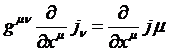 (3)
(3)
With suitable normalization, of the same
equation (1), expression for charge conservation could be obtained explicitly
as
 (4)
(4)
And
 (5)
(5)
It is obvious that in equations (4) and (5),
electromagnetic potential appeared with opposite charge sign in the duo, one
representing electron and the other the opposite particle of electron.
This analytically presents a difficult task
in interpreting the concept of single particle when it come the study of the
interaction of particle with electromagnetic field using Klein- Gordon
equation.
2.2 Dirac
Equation
With Dirac equation, Hamiltonian involving
Dirac particle in relation to its
interaction with electromagnetic field
has to be deduced using
electromagnetic four- potential
just like that of Klein-Gordon
counterpart and minimally couple
it into Dirac equation for free
particle.
The four potential is
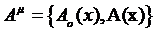 (6)
a
(6)
a
 (6) b
(6) b
Where  are unknown
coefficients
are unknown
coefficients
And then with minimal coupling of
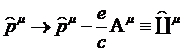 (7)
(7)
Dirac equation is now introduced with
electromagnetic potential that transforms it to
 (8)
(8)
Representing the Dirac equation involving
electromagnetic field and from where the Hamiltonian emerges as
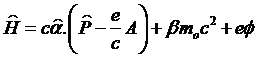 (9)
(9)
Where the equation of motion of an arbitrary
operator  involves
position operator which contains Hamiltonian is given as
involves
position operator which contains Hamiltonian is given as 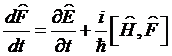 (10)
(10)
With the corresponding position operator
given as
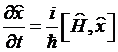 (11)
(11)
Since  is zero, then
 (12)
(12)
Where the coulomb potential and this is
implies that 
And as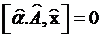 , it connotes that
  commutes with
  as well commute with A
It now leads to
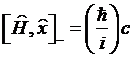 (13)
(13)
Hence, 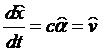 (14)
(14)
Showing that the velocity of a Dirac particle
is as given in equation (14)
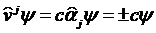
Thus considering the action of the operator
on single component of Dirac particle, we obtain
 (15)
(15)
Since it is seen that the operator, has
eigenvalues  ie
ie  , it agrees with the report that Dirac
particles always move with speed
of light meaning that it is not as same
as that of classical analogy
in which particles are distinguished
in terms of even/ true
particle or odd particle i.e. negative or positive particle.
, it agrees with the report that Dirac
particles always move with speed
of light meaning that it is not as same
as that of classical analogy
in which particles are distinguished
in terms of even/ true
particle or odd particle i.e. negative or positive particle.
3.0 ANALYTICAL
DISCUSSION
It is clear as observed from the analysis
that in using both Klein-Gordon and Dirac equation in study of particle
behavior and interaction with electromagnetic field that primarily, in the
formulation of any of the equation, it
has to be first of all coupled minimally to electromagnetic four-vector
potential (Greiner, 1987) before it is applied in the study as seen in
equations (1) and (6) . Similarly, equations (5) and
(6) had electromagnetic potential that appeared with opposite charge sign in
the duo, one representing electron and the other the opposite particle of
electron as presented from Klein-Gordon equation. While in the case of Dirac
who presented his own case in terms of operator operating on a single particle,
it was also observed that the eigenvalues of the operator was given as. This result invariably indicates that there is
existence of particle and an anti-particle. The analysis also indicated that
the particle exhibited a non –relativistic
limit in their behavior at one time in terms of particle behavioural
trend which calls for a relativistic interpretation for proper
understanding from that analysis, both
agreed that there is a particle and an anti- particle. Though it may be claimed
that in case of Klein-Gordon’s analysis, the idea is based on inference Greiner
1987; Ugwu ,2021), but however there is this
difficult in a single particle interpretation in both as far as relativistic
quantum mechanics is concerned.
4.0 REFERENCES
[1]
A.I. Akhiezer and V.B. Berestetskii
(1965), Quantum Electrodynamics, Dover Science Publisher
[2]
W Greiner,(1987) Relativistic Quantum
Mechanics, wave equations ,Springer, Verlag.
[3]
V.M Simulk and I. Yu Krivs ki (2014) Link between the Relativistic canonical quatum mechanics and the Dirac equation, Uni J. Phys. Appl 2 115
[4] E.S Frandkin, D.M Gitman and M.Sh (1991) Quantum Electrodynamic
with Unstable Vacuum ( Spriger Verlag,
berlin Heidelberg,
[5]
E.I.Ugwu and M.I Echi
(2013) Analytical Study of Band Structure of Material using Relativistic
Concept. Journal of Applied Mathematics, 4
(9) 1287-1289
[6]
M.D Fedorov ( 1997) Atomic
and free Electron in a Srong laser field ( world Scientific, Singapore
[7]
M.Boca and V. Florescu
(2011)On the properties of the Volkov
solutions of the Klein-Gordon equation J.Phys.A;Math.Phys.
14 1481-1484
[8]
L.V. Keldish (1964) Ionization in the field of strong electromagnetic wave Zh. Ekp Teor
Fiz(U.S.S R) 47
1945-1947 [Sov. Phys. JETP 20 1307-1314 (1965)]
[9]
F.E Bunkin and M.V. Fedorov
(1965) Bremsstralung in a stong radiation field .Zh.EKSP. fiz(U.SS.R)
49 1215-1221 [ Sov.Phys.JETP
22844-847 (1966)
[10] L.S Brown and T.W.BKibble
(1964) Interaction of intense laser beams withelectrons. Phys. Rev.
133 A 705-A
719
[11]
J.H.Eberly (1969) Interactionof
very intense light with free electrons. Progree in
Optics VII(Ed.E.Wolf)pp359-415
[12]
A.A Magagzev (2012) Integration of Klein-Gordon
equation-Fock equations in an external electromagnetic
field on Lie group Theor.Math.Phys.33 1654
[13]
V,G.Bagrov and D.M. Gitman (1990) Exact solution of relativistic Wave Equation Dordrecht)
[14]
V. G Bagrov and D.M Gitman
(2014) The Dirac Equation and its solution (Boston; De Gruyter
[15]
I.Y.Berson and J. Valdmanis(1973) Electron in the two field of two
monochromatic electromagnetic waves. J. Math. Phys 14 141481-1484
[16]
M.V. Fedorov and A.E. Kazakov
(1973) An electron in a quantized plane planes wave and in a constant magnetic
field .Zeitschrift fur Physik 261 191-202
[17] I.Y.Berson
and J. Valdmanis(1973) Electron in the two field of two
monochromatic electromagnetic waves. J. Math. Phys 14 141481-1484
[18]
V.M Simulk and I. Yu Krivs ki (2014) Link between the Relativistic canonical quatum mechanics and the Dirac equation, Uni J. Phys. Appl 2 115
[19]
Yu. Sitenko and S.A. Yushchenko (2014) The Casimir
effect with quantized charged scalar matter in background magnetic field. Int
J. Mod Phy A 29
1450052
[20]
W. Becker (1977) Relativistic charged particles in the field of an
electromagnetic plane wave medium. Physica A 87 601-613
[21]
A.I Breev, and A.V Shpapovalov
(2016) The Dirac Equation in an external electromagnetic Field: Symmetry
algebra and exact Integration, Journal of Physics; Conference Series 670 (2016) 012115