The study evaluated the risk of hazards in
shipwreck removal operations in Nigeria waterways. The objective of the
study was among other things, to determine the determinant risk/hazard types
influencing shipwreck removal operations in Nigeria waterways and the
relative influences of the individual risk types. The study used a mixed
method in which both primary and secondary data were used for the study.
Primary data on the risk scores of the identified categories of risks of
hazards affecting shipwreck removal operations was obtained from survey
administered to the staff of Hurmer Marine Werks Ltd, the salvage company used as case study. The
primary data was obtained by the use of a checklist administered to randomly
selected sample of the staff of Hurmer Marine Werks Limited, Port-Harcourt, Nigeria. Secondary data
was obtained from the records maintained by the safety department of the
company, over the years. The statistical methods of major component factor
analysis, and multiple regression analysis were used to analyze
the data obtained. The analysis was implemented by the use of the SPSS
version 20.1 statistical software. The result of the study indicates that
technical risks/hazards, security risks and operational riskeach with Eigen value greater than 1
(Eigen>1), significantly influenceshipwreck removal operations and as a result form the determinant
risk of hazards associated with shipwreck removal operations in Nigeria’s
waterways. The implications on policy development were discussed and recommendations
were preferred on the basis of the research findings.
Accepted:27/10/2023
Published: 09/12/2023
*Corresponding
Author
Ofurumazi Righteousness
E-mail: righteousnessofurumazip@ gmail.com
Keywords: risks, hazards, shipwreck, removal-operations, waterways,
Nigeria.
1.0 INTRODUCTION
Navigation on Nigeria’s waterways
over the years is viewed by many operators as very dangerous now due to the
preponderance of shipwrecks. Nigerian Ports Authority (NPA), National Inland
Waterways Authority (NIWA) and Nigerian Maritime Administration and Safety
Agency (NIMASA) have responsibilities of removing wrecks found within the port
channels, inland waterways and coastal shipping routes respectively. Over the
years however, these authorities are believed to have failed to live up to
their individual responsibilities to ensure wreck free navigable waters in
Nigeria, leading to the preponderance of shipwrecks and derelicts’ in Nigeria’s
waterways. SulaimonSalau
(2021) reports the existence of over 3,000 (three thousand) shipwrecks
littering Nigeria’s coastline alone, without extension to wrecks found in the
inland waterways and within the port channels. This provides evidence the
failure of previously awarded wreck removal contracts in the past years by the
Nigeria Maritime Administration and Safety Agency (NIMASA) responsible for
removal of wrecks in within the coastal shipping/sea routes and the safety of
navigation in Nigeria maritime domain.
The ugly situation presented by the preponderance of
shipwrecks in Nigeria’s waters motivated the Federal Executive Council (FEC) of
Nigeria to approve on 9th April 2021, the removal of shipwrecks and derelicts
from Nigeria's waterways. This was done in a bid to make
Nigeria's navigable waters safer for vessels and is expected to bring some
relief to stakeholders in the shipping industry (Sulaimon,
2021; Nwokedi et al, 2019).Though the (FEC)
approval according to Sulaimon (2021) was approved
for the removal of shipwrecks from Badagry to Tincan Island waterways, it is viewed that wrecks in other
sections ofNigeria’s waters will
subsequently be considered for removal and contracts awarded for such.
Thus,
the current effort of the Federal Government to commence the removal of
shipwrecks in Nigeria waters to promote maritime safety may not be successful
if the risks and the related hazards associated with wreck removal operations
are not identified, assessed and proactively managed to achieve a successful
wreck removal operation.
In
the context of this study, in line with the outcomes of the studies by Ahmad et
al (2021), Pountoni et al (2001), we group and
summarize the primary sources of risks of hazards (risk factors) associated
with wreck removal operations basically considered in the study as shown in
table-1 below:
Table 1: Primary sources of risks of hazards (risk factors)
associated with wreck removal operations
s/n
Risk/hazard
type/grouping
Specific/Individual
risk/causes associated with each risk type/group
Associated
occupational hazards and effects
1
Technical
risks (TR)
i.Hazards
related to poor use, inadequacy/lack of requisite equipment and tools (HTE)
ii.Hazards
related Lack of/poor technical know-how and experience (LTH)
iii.Risks
related to equipment maintainability problems (REM)
iv.Risks
related to poor work procedure (RPWP)
(i)Occupational
Injury to operators
(ii)Death
(iii)Environmental
damage, etc
2
Natural
risks (NR)
(i)Hydrological
conditions related to underwater and surface water operations in removal of
wrecks in the marine environment where wrecks exist (HUSO)
(ii)Geological
conditions and operations ( geological operations associated with the
digging and excavation of sunken and underwater/submerged wrecks conditions
(GESW)
(iii)Atmospheric
weather conditions prevailing in the marine environment to which the operators
are exposed induces risk of occupational injury and deaththat hamper the wreck removal exercise
(AWRW)
(iv)Occupational
Injury to operators
(v)Death
(vi)Environmental
damage, etc
3
Operational
risks (OR)
i.Sudden
failure of equipment/downtime (SFE)
ii.Human error
(HE)
iii.Fleet
traffic within operating location FTOL)
Etc.
(i)Occupational
Injury to operators
(ii)Death
(iii)Environmental
damage, etc
4
Security
risks (SR)
(i)Pirate
attacks and kidnap for ransom (PAKR)
(ii)Attack and
Assault on operators (AAO)
(iii)Deliberate
Shooting at and killing of operators (DSKO)
(iv)Kidnap for
ransom
(v)Missing of
crew
(vi)Trauma and
assault
(vii)Occupational
Injury to operators
(viii)Death, etc.
5
Environmental
pollution Risk (ER)
(i)oil
pollution (OP)
(ii)pollution by
noxious chemical substances (PNCS)
(iii)pollution by
other dangerous materials types other than oil and noxious chemicals (PDMT)
(iv)environmental
damage claims by third parties
(v)damage to
biodiversity
(vi)Occupational
Injury to operators
(vii)Death, etc
Source:
prepared by the author.
To
overcome the disrupting negative influences of the identified risk types
associated with wreck removal and limit the effects of the related hazards in
inducing the abandonment of wreck removal operations following exposure to the
hazards; wreck removal contractors and companies must be able to proactively
manage the risks associated with the operations and mitigate it to their own
advantage. To effectively achieve this, there is serious need that they first
and foremost determine which among the groups of risks constitute the
determinant risk types that significantly influence and is most rampant in wreck
removal operations. This is with a view to prioritizing the wreck removal risk
of hazards reduction, mitigation and elimination to ensure successful wreck
removal operation based on empirical information. The hazard risk assessment
drive of the wreck removal of operators in the context of this study should
thus aim to rank technical risk, natural risks, operational risks, security
risks and environmental damage/pollution risk in order of priority by
determining which among these and other risk types form the determinant risks
types associated with wreck removal operations in Nigerian waters.
Part of the many challenges to the safety of navigation in
Nigerian waterways is the continual failure of Nigeria Ports Authority (NPA),
the Nigeria Maritime Administration and Safety Agency (NIMASA) and the Nigeria
Inland Waterways Authority (NIWA) to ensure wreck free navigable waters in
Nigeria, by successfully removing shipwrecks littered in the navigable
waterways. Sulaimon (2021) notes the existence of
over 3,000 (three thousand) shipwrecks littering Nigeria’s coastline alone. The
implication of this is that it is unsafe to navigate through such waterways
having the preponderance of shipwrecks which could lead to increased frequency
of the occurrence of marine accidents with the associated socio-economic
implications. As a result, sustainable development of the maritime industry to
contribute meaningfully to the economic aspirations and goals of the Country is
hampered. In line with the position of Sulaimon
(2021), closely related to the problem of preponderance of shipwrecks in
Nigeria’s waterwaysis the failure of
indigenous companies previously awarded wreck removal contracts in Nigeria, to
successfully execute such contracts as a result of exposure to marine perils
and risks of hazards associated with wreck removal in the marine environment,
but which they (the contractors) did not envisage prior to the award of the
contract (Sulaimon, 2021;Chima, 2017).
There is therefore a seeming problem of lack of empirical
information on the part of the contractors and the coastal authorities in
Nigeria, of what constitute the significant sources of risks cum categories of
risks of hazards associated with shipwreck removal operations in Nigeria and
which influences the success or otherwise of wreck removal operations in
Nigeria’s waterways. The aim of the study is thus to assess the determinant risk
factors associated with shipwreck removal operations in Nigeria and the
relative influences of the identified risk types.
The
specific objectives of the study are:
i.To identify the
determinant risk factors associated with shipwreck removal operations in
Nigeria waterways.
ii.To assess the influence of the significant risk factors
on the overall success of shipwreck removal operations in Nigeria’s waterways.
2.REVIEW
OF RELATED LITERATURE
The Nairobi Convention of Wreck Removal (2007)
defines a shipwreck as abandoned, wreckage, end-waste of a ship, representing
the entirety of the hull and components of a vessel that has come to the end of
her useful life, but which was abandoned in the waterways, navigation channels
or deep waters, without being properly decomposed and disposed of. In the
waterways, it represents a hazard and a major source of collision and accident
to operational vessels navigating in proximity to the area of the wrecks. The
Nairobi convention on wreck removal therefore provides that to promote maritime
safety, coastal states must make regulatory provisions for the removal of
shipwrecks in their territorial waters and navigation channels, based on the
provisions of the convention.The
majority of coastal states require a wrecked vessel to be removed and for the
ship-owner and his liability insurers to pay for the removal. This is certainly
the case if the vessel poses a threat to the environment or is a hazard to
navigation. Wreck removal operations are therefore activities, actions and
functions carried out and or implemented as part of the process of removing
shipwrecks from the waters to enhance maritime safety and limit environment
pollution from wrecks Nairobi Convention, 2007). It involves and encompasses
all the processes and activities associated with the planning and physical
action of removal wrecks from the waterways. Impact assessment, rigging,
digging, and excavation, lifting exercise, breaking-up components of wrecks,
hazard identification and risk analysis, risk/hazard control among other
activities among the considered parts of the shipwreck removal operations.
Thus, in the context of this study, we define shipwreck removal operations as
activities and functions implemented by the salvor in
the course of a shipwreck removal exercise as defined in the Nairobi
convention, 2007.
Osha (2013) define a hazard as any source of
potential damage, injury, harm, death, adverse health effects devaluation or
devaluation on a person or piece of property. Basically, a hazard is the
condition or system with the potential to harm or cause unpleasant adverse
effect o a person or property exposed to it (Osha, 2013). For example, exposure
to fire can cause injury to persons affected by it and cause economic
devaluation/loss to properties exposed to it. Sometimes the resulting harm may
also is referred to as the hazard instead of the actual source of the harm.
Thus, the occurrence of hazards leads to harm, injury, death, loss, etc. Osha (2013) notes that risks are expressed as a probabilities or
likelihood of occurrences in which it depicts a measure of the likelihood or
probability that harm, injury, death, pollution, damage, etc
will occur following exposure to hazards. Osha
(2013) also notes that several factors influence the degree or likelihood of
risk which are:
the nature of the exposure: how much a person or
property is exposed to a hazardous thing or condition (e.g., several times
a day or once a year),
how the person is exposed (e.g., breathing in a vapour, skin contact), and
the severity of the effect. For example, one substance may
cause severe injury.
Shipwreck removal operations such as lifting,
digging and excavation, breaking-up of components, rigging, etc. are activities
which take place in the marine environment and each is associated with specific
hazard types with occurrence probabilities/likelihoods. The likelihoods of
occurrence of the identified hazard types and the associated injury and harm in
the course of shipwreck removal are referred to as risk of hazards associated
with shipwreck removal operations, in the context of this work.Several other definitions of risk abound.
For example, Iqbal et al (2011) argues that
uncertainty should be included in the definition of risk and Suggests that
probability is only a tool to express or represent uncertainty and that risk is
not limited to an initiating event, its consequences and the associated
probabilities. Iqbal et al (2011) further
discusses that probabilities assigned are based on background information and
assumptions that could hide uncertainties and prevent them from receiving
proper attention. Iqbal et al (2011) define risk as
the “uncertainty about and severity of the consequences (or outcomes) of an
activity with respect to something that humans value”. ISO (2009) also includes
uncertainty and defines risk as the “effect of uncertainty on objectives”.
Cherniack et al (2004) stated three stages of risk
assessment including risk identification, risk estimation, and risk evaluation.
Malherbe, & Mandin
(2007) claimed that the most important step in the process of risk assessment
is the selection and definition of the risk categories, which can be weighted,
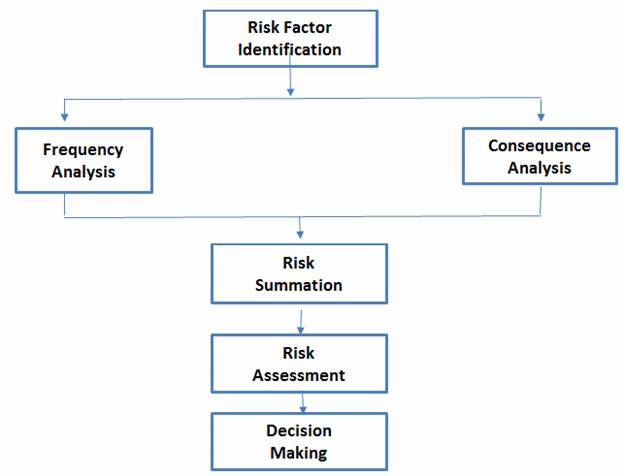
compared and quantified. Cherniack et al (2004) identified
the following five steps for risk evaluation:
(a). Hazard Identification: To determine the
incident scenarios, hazards and hazardous events, their causes and
mechanisms.
(b). Consequence
Analysis: To determine the extent of the consequences of identified
hazardous events.
(c).
Frequency Estimation: To determine the frequency of occurrence of
identified hazardous events and the various consequences.
(d). Risk
Summation: To determine the risk levels.
(e). Risk
Assessment: To identify if the risk is tolerable/intolerable and to
identify risk reduction or mitigation measures and prioritize these using
techniques such as risk ranking and cost-benefit analysis. These elements are
shown in the flow in Figure-1 below. The elements of the procedure are used
both to generate information and as an aid to decision making in managing the
risk.
Figure 1: Risk Evaluation Process
In the implementing the first step of the risk
evaluation methods, studies by Kern (2016), Ventikos
et al (2014), Lee (2020) and Tsavliris (2020) have
common agreement on the likelihood sources of risk of hazards in shipwreck
removal operations as shown in table-3 below. Risk factor identification is the
first step in the process of risk evaluation and it produces a list of risks
that impacts on shipwreck removal operations (Ahmad et al, 2021, Ventikos et al, 2014), and it is an important stage in the
risk evaluation process because decision-makers can become aware of the
unfavorable factors in the projects by risk identification.
Ventikos, Koimtzoglou and Louzi (2014) carried out a study on ‘Shipwreck: A Crisis
with Challenging Solutions’. The objectives of the study among other things was
to assess the methods of shipwreck removal and the risk prevalent with the use
of each identified method with a view to guide workers against injury and other
risks of hazards associated with shipwreck removal operations. The study
employed the case study approach and survey method to illustrate the stages of
involved in shipwreck removal operations as well as the parameters that affect
the success of the process.Ventikos, Koimtzoglou
and Louzi (2014) outlined a number of different
scenarios of the most common techniques in order to demonstrate which one is
the better fit for the particular case while identifying how to overcome injury
risks and hazards associated with the individual methods. The generally highlighted
the difficulties that arise in shipwreck removal operations and offer a
structured methodology for the planning stage of such a process.
The
result identified environmental hazards and weather conditions as major factors
influencing the choice of shipwreck removal method as well as the success of a
shipwreck removal operation.It further
explained that wave action, wide force, water currents, water resistance, and
buoyance levels prevailing in the marine environment greatly retard the the progress of shipwreck removal operations and could form
major environmental hazards and risk factors (Ventikos,
et al 2014). The result of the study also shows that mechanical lifting method
of shipwreck removal is associated with the most hazards and risk of accidents
as it is associated with both fall, vibration, noise, and other forms of
hazards.
Kern
(2016) carried out a study in title ‘Wreck Removal and the Nairobi Convention—a
Movement toward a Unified Framework’. The study was aimed at investigating from
a legal perspective, the responsibilities of the stakeholders a shipwreck
removal operation in line with the 2007 Naira Convention on Shipwreck removal.
The study used the exploratory survey methods to examine from legal
perspectives the responsibilities of owners and coastal authorities in a
shipwreck removal operation as enshrined in the Nairobi Convention on shipwreck
removal. The findings of the study shows that while the 2007 Nairobi convention
on wreck removal provided the much needed framework for removal of shipwreck
from navigable waters, it gives the coastal state the authority to institute
regulatory measures to ensure immediate and or speedy removal of shipwrecks
from the water channels while also emphasizing the it is the liability of the
registered owner(s) of the ship bear the cost associated with shipwreck removal
operations. Thus, the study notes that it is the responsibility of the
registered owners to remove the wreck or fund the wreck removal operation while
noting that the responsibility of the coastal state should be to identify the
registered owner and the flag state of the ship, so that communication to
remove the wreck can be communicated to the owner via the flag state. However,
given the risky nature of shipwreck removal operations, the registered owners
in a bid to limit the cost of wreck removal operations over the years have
continued to avoid a holistic conduct of impact assessment as well as the
determination of major risks of hazards associated with wreck removal
operations. This has led to occurrences of severe occupational injuries to
wreck removal workers and environment damages to third parties with little or
no care rendered by both the registered owners and the coastal state (Kern, 2016).
Lee
(2020) in another study on the ‘ Design of a wreck removal method considering
safety and economy’ assessed the ways of selected shipwreck lifting methods
that will guarantee the safety of the workers and the marine environment while
also offering advantages of economy and cost to the registered owner whose
liability it is to remove shipwrecks. The study notes that selecting a proper
lifting method for wreck removal is one of the most important procedures when
planning a salvage operation. For this, both the safety and economy should be considered
to prevent accidents and reduce time and cost. The study proposed that the
evaluation and verification of safety and economy should be a major
consideration in the choice of methods for shipwreck removal operations.It used a simulation based on multi-body
dynamics is used to assess the safety of the lifting method. In particular, it
used the experimental design approach and primary data to implement a model to
calculate the contact and friction of the wire when lifting the ship to
simulate the wire-wrapping method. In conclusion, it proposed a method of
estimating the total salvage cost and an economic evaluation by comparing the
results of various lifting methods.
Muhammad (2013)
carried out a study on the Health hazards and risks vulnerability of ship
breaking workers: A case study on Sitakunda ship
breaking industrial area of Bangladesh.
The study notes that
Ship breaking activities are facing both challenges and opportunities for
coastal zone management in a holistic manner with increase of its demand of raw
materials for re-rolling mills and other house hold purposes inspite of various negative impacts on coastal environments
in Chittagong region of Bangladesh. The aim of the study was to find out the
socioeconomic condition and health hazard risks of workers due to ship breaking
activities at the Sitakunda ship breaking industrial
area in Chittagong region of Bangladesh. The study used a mixed method,
employing both primary and secondary sources of data during the period of
September 2012 to August 2013. It found that the socio economic condition of
the ship breaking workers indicated that most of the workers are working at the
ship yards with low facilities, risky and vulnerable by health and diseases. It
was observed from the survey that most of the workers came from poverty
stricken regions of Bangladesh, where opportunity of employment is very poor or
less. The survey revealed that 59.59% of workers are migrated from different
districts and 40.40% workers are permanently living in the study area or the
Chittagong. It found that the most prevalent common hazards and risks of ship
breaking activities are in five categories namely; Serious
accident related hazard, Physical hazards, Mechanical hazard, Biological hazard
and Ergonomic and Psychological hazard on workers as well as residences nearest
the breaking yards in the study area (Muhammad, 2013).
Kutub, Nishat, Shahreen
and Yasin (2017) did a research on ‘Ship Breaking Industries and their Impacts on
the Local People and Environment of Coastal Areas of Bangladesh’. The
study notes that the coastal area of Bangladesh is one of the most ecologically
productive and it contains a rich biodiversity which includes several species
that are endemic to this region. It observed that much attention has been
focused on ship breaking industries in the coastal areas because of the threat
they pose to this thriving biological communities along with their other
environmental impacts and the perilous working environment of the workers. The
study adopted an exploratory survey design method. It found that the coastal
environment of Sitakunda is severely contaminated by
various processes related to ship breaking i.e. the disposal of different toxic
wastes into the sea water, deforestation by expanding ship breaking yard,
changing land-use pattern and release of toxic substance into the soil.
Moreover, the workers of this industry are exposed to an extremely risky and
toxic working environment which makes them vulnerable to both physical and
psychological disorder as well as to accidental deaths and injury. Still,
workers embrace these risks for very poor wages and most of the profits go to
the already rich businessmen. Despite various negativities, this industry has
gained importance due to the increasing demand of raw material for re-rolling
industries and employment opportunities for the people of the coastal areas (Kutub, Nishat, Shahreen and Yasin, 2017).
Though, several
empirical studies such as the works of Ventikos, Koimtzoglou and Louzi (2014),
Kern (2016), Lee (2020) and Kutub, Nishat, Shahreen and Yasin (2017) have
investigated shipwreck removal operations in from various perspectives.
However, none of the studies has been able to provide evidence on which among
the identified hazard categories and individual hazards types constitute the
determinant/major hazard types that hamper the most, shipwreck removal
operations, particularly in Nigeria marine environment and waterways and the
relative influences of the identified risk/hazard types. There is therefore a
seeming information gap on what constitute the significant sources of risk of
hazards associated with shipwreck removal operations in Nigeria and ranking of
the influences of each identified hazard category on the success or otherwise
of wreck removal operations in Nigeria’s waterways.
3.0 DATA AND METHODS
The study used a survey research
design method, employing primary data sourced from Humer
Marine Wreck Limited. The primary data was sourced using questionnaire as
survey instrument to obtain data from the staff of the organization especially
staff in the safety and operations department on their ratings and perceptions
of the influences of technical risk factors, natural risk factors, operational
risk factors, security risks and environmental pollution risks factors on the
success ofwreck removal
operations.Also, their rating of the
influences of individual risk of hazards in each group of risk factors was
obtained through survey. The groups of risk factors and the individual risk of
hazards considered in the survey instrument are as shown below:
Table 2: Wreck Removal Risk Types and the associated Hazards
s/n
Risk type/grouping
Specific/Individual risk/causes
associated with each risk type/group
Associated occupational hazards
and effects
1
Technical risks (TR)
i.Hazards
related to poor use, inadequacy/lack of requisite equipment and tools (HTE)
ii.Hazards
related Lack of/poor technical know-how and experience (LTH)
iii.Risks related
to equipment maintainability problems (REM)
iv.Risks related
to poor work procedure (RPWP)
i.Occupational
Injury to operators
ii.Death
iii.Environmental
damage, etc
2
Natural risks (NR)
i.Hydrological
conditions related to underwater and surface water operations in removal of
wrecks in the marine environment where wrecks exist (HUSO)
ii.Geological
conditions and operations ( geological operations associated with the digging
and excavation of sunken and underwater/submerged wrecks conditions (GESW)
iii.Atmospheric
weather conditions prevailing in the marine environment to which the
operators are exposed induces risk of occupational injury and death that
hamper the wreck removal exercise (AWRW).
i.Occupational
Injury to operators
ii.Death
iii.Environmental
damage, etc
3
Operational risks (OR)
i.Sudden
failure of equipment/downtime (SFE)
ii.Human error
(HE)
iii.Fleet traffic
within operating location FTOL)
Etc.
i.Occupational
Injury to operators
ii.Death
iii.Environmental
damage, etc
4
Security risks (SR)
i.Pirate
attacks and kidnap for ransom (PAKR)
ii.Attack and
Assault on operators (AAO)
iii.Deliberate
Shooting at and killing of operators (DSKO)
i.Kidnap for
ransom
ii.Missing of
crew
iii.Trauma and
assault
iv.Occupational
Injury to operators
v.Death, etc.
5
Environmentalpollution risk (ER)
i.oil pollution
(OP)
ii.pollution by
noxious chemical substances (PNCS)
iii.pollution by
other dangerous materials types other than oil and noxious chemicals (PDMT)
i.environmental
damage claims by third parties
ii.damage to
biodiversity
iii.Occupational
Injury to operators
iv.Death, etc
Source:
prepared by the author.
Respondents were also allowed to
identified and include any other risk factors or group as well as individual
hazards not included above from available literature, but which they feel also
affect the success of wreck removal operations in Nigeria.
3.1 Population of the Study and Sampling Technique
The
population of the study consists of the about 30 workers in the company with
specific attention on operational staff and staff who work in the Health safety
and Environment (HSE) department of the company. From this population, samples
were randomly selected and the survey instrument (questionnaire and checklist) delivered
to each respondent. For the purpose of conducting the survey, the study adopted
a purposive random sampling technique in which the responses of workers in the
company were purposively sampled randomly. The reason for the purposive random
sampling was because these employees in operational and HSE department were the
ones that are most often directly exposed to the occupational risk of hazards
in shipwreck removal operations more than other categories of workers who work
in the offices.
The sample size was determined by the use of Taro Yammane formula for determination of sample for known
population that:
Where :
n= sample size required
N = number of people in the population
e = allowable error (%) = 0.05
n = 27.9 = 28 employees.
The sample size consists of 28 employees mostly
in operational and HSE section of the company randomly sampled.
3.2 Method of Data Analysis
3.2.1 Principal Component Factor
Analysis (PCA)
The
study was designed to assess the risk factors cum hazards associated with
shipwreck removal operations in Nigeria. The study used a mixed design method
comprised of the use of primary data from survey and secondary data obtained
from company’s historical records. A questionnaire was used as survey
instruments to gather primary data from mostly operational and HSE staff of the
organization on their perceptions of the level of influences of groups of risks
of hazards associated with shipwreck removal operations in Nigeria’s waterways
with a view to determining the determinant risk groups/types that influence
most, the successfulness of shipwreck removal operations in Nigeria. The
principal component factor analysis (PCA) statistical method was used to analyze
the data obtained from field survey in order to determine the determinant risk
types that influence the success of shipwreck removal operations. The
hazard/risk categories considered as earlier mentioned are:
(i)Technical
risks (TR)
(ii)Natural risk(NR)
(iii)Operational risk (OR)
(iv)Security risk (SR)
(v)Environmental pollution risk (ER)
The
individual risks/hazards that form the components of each of the above
categories of risk of hazards associated with shipwreck removal operations were
discussed in previous sections under table-1. The
analysis was implemented using SPSS version21 analytical software.
3.2.2 Multiple Regressions
Using the multiple regression model
approach, the relative influences of each group of risk factors (categories of
hazard) on the overall rating of on the success of shipwreck removal operations
was determined. If represent the respondents rating of the overall level of
influence of the risks/hazards on the success of a shipwreck removal operation
as ‘OVR’. The various categories/groups of risks of hazards associated with
wreck removal operation are denoted as follows:
(i)Technical
risks =TR
(ii)Natural risk= NR
(iii)Operational risk = OR
(iv)Security risk =SR
(v)Environmental pollution risk = ER
Since the over influence of the
hazards (OVR) is dependent on the individual influences/weights of the
individual categories/groups of risk factors, we specify the multiple
regression model as follows:
Where OVRwrecks=
the overall influence of risk factors associated with shipwreck removal
operations on the successful completion of wreck removal operations. Other
variables are as earlier defined.
Normal OLS estimation may be carried
out in determining the relationship between dependent variables and the
independent variables and normal hypotheses testing method for OLS estimation
using t-test is used to determine the significances of the impacts/relationships.
4.0
RESULTS AND DISCUSSION OF FINDINGS
Table
3: Determining the determinant categories of factors affecting shipwreck
removal operations in Nigeria.
Descriptive
Statistics
Mean
Std. Deviation
Analysis N
TR
4.1071
.95604
28
NR
2.0714
.94000
28
OR
3.9286
.89974
28
SR
3.0357
1.42678
28
ER
2.3214
1.33482
28
Communalities
Initial
Extraction
TR
1.000
.870
NR
1.000
.791
OR
1.000
.875
SR
1.000
.935
ER
1.000
.754
Total Variance Explained
Component
Initial Eigenvalues
Extraction Sums of Squared
Loadings
Total
% of Variance
Cumulative %
Total
% of Variance
Cumulative %
1
1.628
32.558
32.558
1.628
32.558
32.558
2
1.355
27.096
59.653
1.355
27.096
59.653
3
1.243
24.856
84.509
1.243
24.856
84.509
4
.616
12.327
96.836
5
.158
3.164
100.000
Component Matrixa
Component
1
2
3
TR
.886
-.290
.027
NR
-.046
-.397
.794
OR
-.520
.639
.444
SR
-.641
-.449
-.567
ER
.399
.709
-.303
Extraction Method: Principal
Component Analysis.a
a. 3 components extracted.
Table-3 above shows the
result of the Principal Component factor Analysis (PCA) implemented using SPSS
statistical software. The result indicates the significant risk factors which
form the determinant risk of hazard categories associated with shipwreck
removal operations in Nigeria. The result shows that the mean weights of
technical risk (TR), natural risk (SR) and operational risk (OR) that affect
the successful completion of shipwreck removal operations in Nigeria is 4.1071,
2.0714 and 3.9286 respectively with respective standard deviations of 0.95604, 0.9400 and 0.89974. The respective average scores of
security risks and environmental pollution risk affecting the successfulness of
shipwreck removal operation is 3.0357 and 2.3214 with respective standard
deviations of 1.3382 and 1.42678.
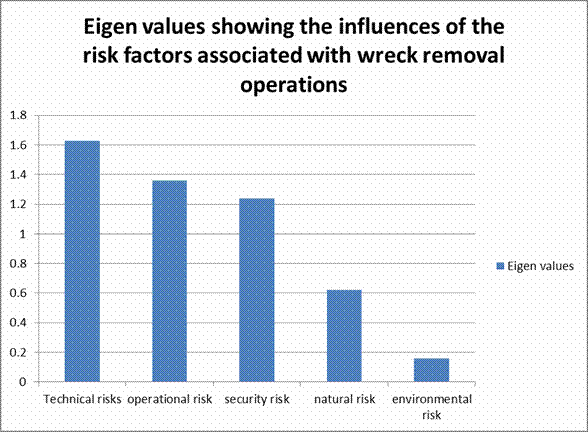
The
Eigen values which indicates the significance of the effects and influences of
each category of risk factors on the completion of shipwreck removal operation
shows that technical risk (TR), security risk (SR) and operational risks (OR)
have respective Eigen values of 1.628, 1.355 and 1.243. The Eigen values
(scores) of natural risk (SR) and environmental risk (ER) is0.616 and 0.158 respectively. Thus, natural and environmental
pollution risk factors having Eigen values/scores less than 1 (i.e: 0.616<1, for natural risks; and; 0.158<1, for
environmental pollution risk) are not significant. As a result, they are not
determinant risk factors that affect successfulness of shipwreck removal
operations in Nigeria’s waters.
Similarly, technical risks, security risks and operational
riskeach with Eigen value greater than
1 (Eigen>1), significantly influence the success ofshipwreck removal operation and as a result
form the determinant risks/hazards associated with shipwreck removal operations
in Nigeria’s waterways.
The policy implication is that for any shipwreck removal operation
in Nigeria’s waters to be successfully implemented, the operators must
prioritize the implementation of risk control, reduction and elimination
measures on the determinant risk factors which include technical risks,
security risks and operational risks factors. This will ensure that the impacts
and effects of the occurrence of risk of hazards under the categories of the
determinant risk factors identified above cannot cause or lead to the
abandonment of the wreck removal operation as it happened in the past years.
While it is important to also implement risk control, reduction and elimination
measures on the non-determinant risk factors such as security and environmental
risks, the most attention should be concentrated on the significant/determinant
risk factors.
The
figure-4.1 below shows the presentation of the Eigen scores showing the
influences of the various groups of risk factors associated with shipwreck
removal operations in Nigeria waters.
Figure 2.
Source: Prepared by author.
Table
4.: Effects of the Determinant Risk of Hazards
associated with shipwreck removal on the overall rating of hazards impeding the
success of wreck removal operation in Nigeria
Descriptive Statistics
Mean
Std. Deviation
N
OVR
4.4643
.69293
28
TR
4.1071
.95604
28
OPR
3.9286
.89974
28
SR
3.0357
1.42678
28
Model Summaryb
Model
R
R Square
Adjusted R Square
Std. Error of the Estimate
Durbin-Watson
1
.810a
.656
-.031
.70356
1.949
ANOVAa
Model
Sum of Squares
df
Mean Square
F
Sig.
1
Regression
1.084
3
.361
7.301
.544b
Residual
11.880
24
.495
Total
12.964
27
Coefficients
Model
Unstandardized Coefficients
Standardized Coefficients
t
Sig.
B
Std. Error
Beta
1
(Constant)
3.583
1.827
1.962
.062
TR
.036
.213
.050
.170
.867
OPR
.066
.208
.085
.316
.755
SR
.156
.126
.321
1.240
.227
Source:
authors calculation
As seen in table-4., the result of the factor
analysis carried out indicate that technical risks/hazards (TR), operational
risks/hazards (ORP) and security risks/hazards (SR) constitute the determinant
categories of hazards in shipwreck removal in Nigeria waters. Table-4.6 above
shows the result of the multiple regression analysis implemented to assess the
significance of the influence of each of the categories of the determinant
risks of hazards on the success of shipwreck removal operations in Nigeria. The
result of the regression analysis indicates that technical hazards/risks (TR),
operational risks/hazards (ORP) and security risks (SR) have mean values of
4.4.11, 3.92 and 3.04 respectively with respective standard deviations of
0.956, 0.8997 and 1.426. The result also indicates that the coefficient of
correlation R between the dependent variable and independent variables is
0.810. This indicates that there exist about 81% correlation
between the technical, operational and security risks of hazards (explanatory
variables) associated with shipwreck removal operation and the overall
likelihood of success of the wreck removal exercise (explained variable). The
R-square value of 0.656 indicates that technical, operational and security
risks faced by salvors in shipwreck removal exercise
explain about 66% of the total variations in the overall success rating of a
shipwreck removal exercise, leaving about 34% unexplained variations. The
regression model showing the relationship between the overall success rating of
a shipwreck removal exercise and the determinant risk of hazards associated
with shipwreck removal exercise is as shown below:
OVR = 0.036TR + 0.066OPR + 0.156SR + e --------(2)
The implication is that for every unit increase
in the exposure of wrecks and salvors to
hazards/risks of technical nature, the overall risks faced by salvor in delivering the project increases by 0.036 while
it increases also by 0.0660 for each unit increase in exposure of shipwrecks
and salvors to operational risk types. Similarly, a
unit increase in the rate of exposure of salvors to
security hazards/risks will increase the overall risk of hazards faced by salvor in shipwreck removal operations by 0.15. The policy
implications is that in order to decrease the overall risks of hazard to which salvors are exposed in shipwreck removal operations and
ensure the success of the operations, the technical risks, operational risks,
and security risks which formed the determinant risk types must be continually
reduced and mitigated.
Table-5:
Estimating the significance of the joint effects of the determinant risk
factors in shipwreck removal operations
Variables
df
F-score
F-critical
Sig.
TR,
OR, and SR
3
7.301
2.93
.0544b
Source: Authors calculation
The test of the significance of the independent
variables shows f-score of 7.301, f-critical of 2.93, p-value of 0.054 at 3
degree of freedom (df).
Since 7.301>2.93 (f-score>f-critical), we conclude that there is a
significant effect of technical risks, operational risks and security risks on
the overall rating of the influence of risks of hazards on the success or
otherwise of shipwreck removal operations in Nigeria. See table-4.8 below for
the test of significance of the individual risk/hazard types.
Table-6:
Estimating the significance of the individual effects of the determinant risk
factors in shipwreck removal operations
Variable
t-cal.
t-critical
p-value/sig.
Decision
TR
0.170
2.10
0.867
Non-significant
OR
0.316
2.10
0.755
Non-significant
SR
1.240
2.10
0.227
Non-significant
Source: Authors calculation. Non-significant if P-value>0.05; significant if p-value<0.05
The result on table-6 indicates that technical
risks, operational risks and security risks have respective t-values (t-cal.)
of 0.17, 0.316 and 1.240. Since for technical hazards/risks, 0.170<2.10;
(t-cal.<t-critical); we conclude that there is no significant effect of
technical hazards on the overall rating of risks of hazards associated with and
affecting shipwreck removal operations in Nigeria. Similarly, for operational
hazards, 0.316<2.10 (t-cal.<t-critical).
Therefore, there is no significant impact of operational hazards on the overall
rating of the risk of hazards influencing the success of shipwreck removal
operations in Nigeria. Furthermore, the test of significance of security
hazards showsthat 1.24<2.10;
indicating also that there is no significant effect of security hazards on the
overall rating of of the influence of risk of hazards
on the success of shipwreck removal operations in Nigeria. Though individually
these determinant hazards shows no significant effects, the F-test shows that
their joint impact significantly influence the overall rating of the influence
of risk of hazards on the success of shipwreck removal operations in
Nigeria.
5.0 CONCLUSION
Welding
& cutting hazards, chemical fumes and dust inhalation hazards, and noise
hazards with Eigen value for each exceeding 1 (Eigen value>1), constitute
the determinant hazards of the shipbuilding and repair industry in Nigeria.
However, exposure to welding & cutting hazards achieves the highest Eigen
value of 2.813and as such, remains the most source of risks of injuries and
illnesses to dockworkers in the shipbuilding sector.Also, electrical hazard, vibration hazard,
fire & explosion hazard, fall hazards (slips & trips), and biological
hazards, each of them achieving Eigen value lower than 1 (e.g:
-9.067E-007<1); does not significantly influence the level of risks of
injury and illness faced by dockworkers in the shipbuilding and repair sector
in Nigeria.
6.0 RECOMMENDATIONS
From
the foregoing, it is recommended that:
(i)The shipbuilding and repair industry in
Nigeria in order limit the occurrence of physical injuries, work related
illness and death of dockworkers as a result of exposure to occupational hazard
in the shipyards should strategically focus of the determinant hazards
associated with shipbuilding and repair operations which include: welding &
cutting hazard, chemical fumes & dust inhalation hazards and noise hazards.
(ii)Hazard control methods should
prioritize the control of dockworkers exposure to welding & cutting hazards
since this is the source of most physical injury and illness in the shipyard as
shown by the result of the study.
(iii)The proper use of personal protective
equipment (PPE) is recommended to address frequent burns injury which is the
most injury suffered by dockworkers as a result of exposure to welding &
cutting hazards.
(iv)Similarly, cuts, bruises and
arc eye injury associated with exposure to welding & cutting injury should
be limited by the compulsory and appropriate use of PPE.
REFERENCES
.
Ahamad, A.F.; Schneider, P.; Khanum, R.; Mozumder, M.M.H.; Mitu, S.J.; Shamsuzzaman, M.M. (2021) Livelihood Assessment and
Occupational Health Hazard of the Ship-Breaking Industry Workers at Chattogram, Bangladesh. Journal of
Marine. Science & Engineering, 9 (718) 2-22. https://doi.org/
10.3390/jmse9070718.
Chima J.(2017)
Arbitration as a conflict resolution approach to oil spill compensation payment
in oil producing Communities of rivers state, Nigeria. International Journal of
Advanced Legal Studies and Governance, 2(1)17 – 32
Cherniack,M.,Brammer,A.J.,Lundstrom,R.,Meyer,J.,Morse,T.F.,Nealy,G.,&Fu,R.W.(2004).Segmental
nerve conduction velocity in vibration-exposed shipyard workers. International
archives of occupational and environmental health, 77(3),159-176
International Maritime Organization
(IMO,2007)Nairobi
Convention on Wreck Removal 2007. Available at: http//www.imo.rog. Retrieved on
13/10/2021
Iqbal, K.S., Zakaria, N.G.,&Hossain, K.A.(2011)
Identifying and Analysing Underlying Problems of
shipbuilding Industries in Bangladesh. Journal of Mechanical Engineering,41(2),147-158.
Kern J.M (2016) Wreck
Removal and the Nairobi Convention—a Movement Toward a
Unified Framework? Frontiers in Marine Science 3(11) Pp:1-10.Doi: 10.3389/fmars.2016.00011
Kutub, M., Pinto, C., Magpili,
L.,&Jaradat, R (2015)
Operational Risk Management: Momentum press, USA.
Lee
J .P (2020) Design of a wreck removal method considering safety and economy.Journal of Transport safety
and security 4(3)1037-1056.https://doi.org/10.1080/17445302.2019.
Muhammad M. (2013) Health hazards and risks vulnerability of ship
breaking workers: A case study on Sitakunda ship
breaking industrial area of Bangladesh.Global Advanced Research Journal of
Geography and Regional Planning (ISSN: 2315-5018) Vol. 2(8) pp. 172-184.
Available online http://garj.org/garjgrp/index.htm
Malherbe,
L.,&Mandin, C.(2007)
VOC emissions during outdoor ship painting and health-riskassessment. Atmospheric environment, 41(30),6322-6330.
Nwokedi T. C., Kalu
D. I., Ibe C.C., Igboanusi
C.C., Gbasibo L.A., Odumodu
C.U. (2019) Constraint Theory Approach Analysis of the Nigerian Shipbuilding
Industry. LOGI –
Scientific Journal on Transport and Logistics Vol. 10 No. (1) 50-61. DOI: 10.2478/logi-2019-0006,
OSHA (2013)
Occupational Safety and Health Standards in Shipyard Industry.US Department of Labor. No.: OSHA
2268-11R.
Puntoni, R., Merlo,F.,
Borsa,L., Reggiado, G., Garrone, E., & Ceppi,
M.(2001) A historical cohort mortality study among shipyard workers in Genoa
Italy. American journal of industrial medicine, 40(4),363-370.
SulemanSalau (2021) Government to spend
N10 billion on shipwreck removal.
https://guardian.ng/business-services/maritime/government-to-spend-n10-billion-on-shipwreck-removal/
Tsavliris A., (2020) Wreck
removal issues–the contractors’ perspective. International
Salvage Union.A working document.
Ventikos N.P., Koimtzoglou A., & Louzis K.
(2014)Shipwreck: A Crisis with
Challenging Solutions. Journal of Risk Analysis and
Crisis Response, Vol. 4, No. 3 (September 2014), 160-174.
Cite this Article: Ofurumazi, R; Emeghara,
GC; Nwokedi, TC (2023). Determinant Risk of Hazards
in Shipwreck Removal Operations in Nigeria’s Waterways.Greener Journal of Social
Sciences, 13(1): 87-100.